motor TOYOTA RAV4 2006 Service Workshop Manual
[x] Cancel search | Manufacturer: TOYOTA, Model Year: 2006, Model line: RAV4, Model: TOYOTA RAV4 2006Pages: 2000, PDF Size: 45.84 MB
Page 851 of 2000
2AZ-FE COOLING – RADIATORCO–33
CO
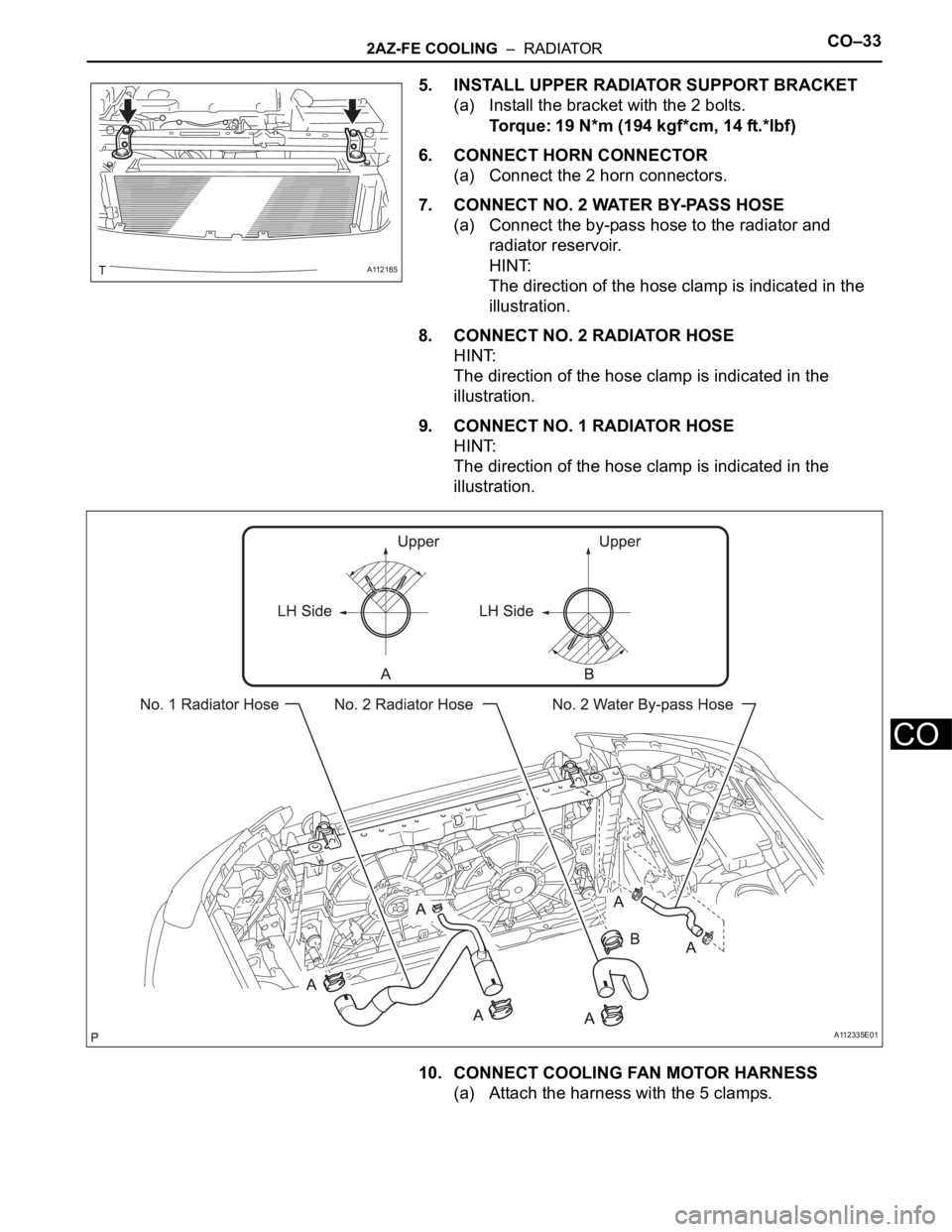
5. INSTALL UPPER RADIATOR SUPPORT BRACKET
(a) Install the bracket with the 2 bolts.
Torque: 19 N*m (194 kgf*cm, 14 ft.*lbf)
6. CONNECT HORN CONNECTOR
(a) Connect the 2 horn connectors.
7. CONNECT NO. 2 WATER BY-PASS HOSE
(a) Connect the by-pass hose to the radiator and
radiator reservoir.
HINT:
The direction of the hose clamp is indicated in the
illustration.
8. CONNECT NO. 2 RADIATOR HOSE
HINT:
The direction of the hose clamp is indicated in the
illustration.
9. CONNECT NO. 1 RADIATOR HOSE
HINT:
The direction of the hose clamp is indicated in the
illustration.
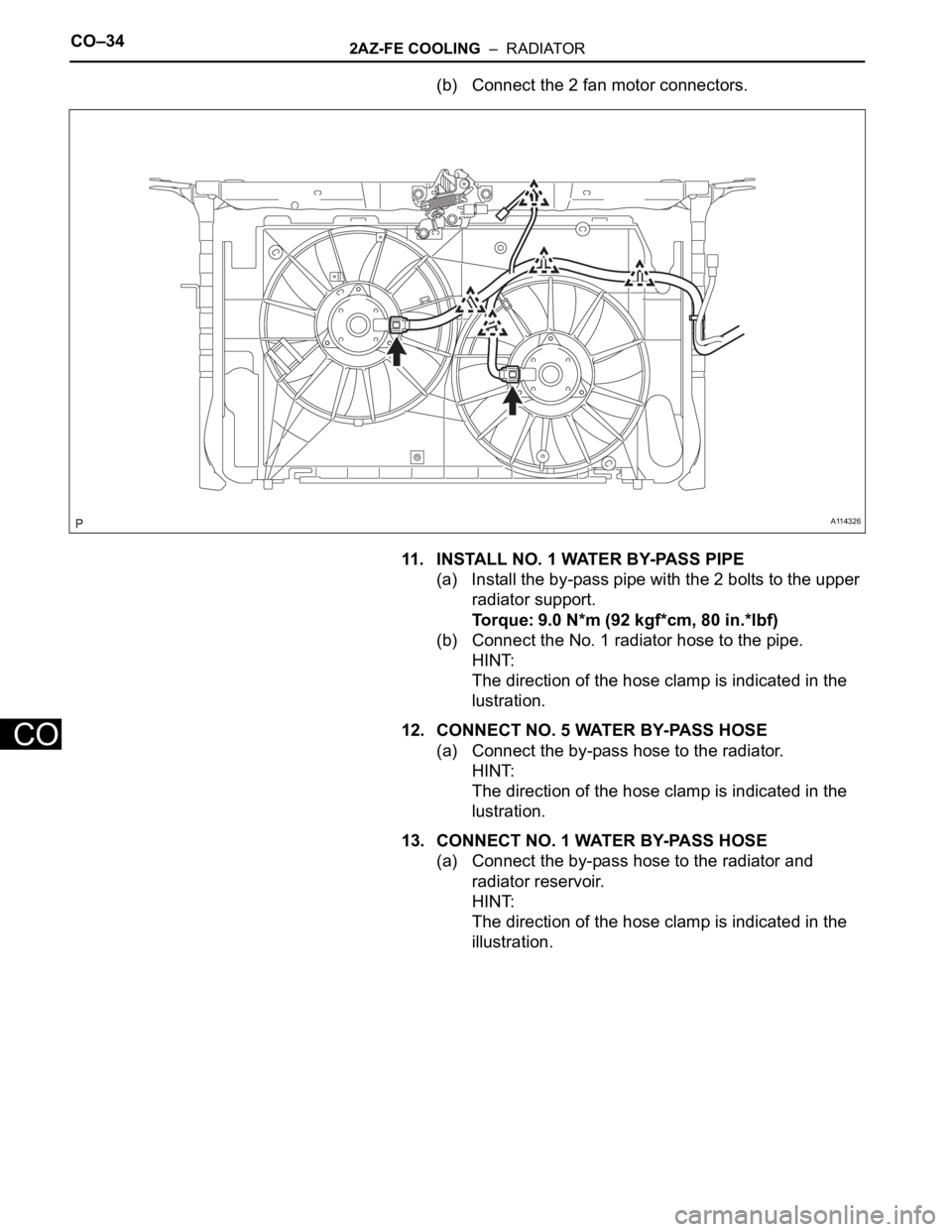
10. CONNECT COOLING FAN MOTOR HARNESS
(a) Attach the harness with the 5 clamps.
A112185
A112335E01
Page 852 of 2000
CO–342AZ-FE COOLING – RADIATOR
CO
(b) Connect the 2 fan motor connectors.
11. INSTALL NO. 1 WATER BY-PASS PIPE
(a) Install the by-pass pipe with the 2 bolts to the upper
radiator support.
Torque: 9.0 N*m (92 kgf*cm, 80 in.*lbf)
(b) Connect the No. 1 radiator hose to the pipe.
HINT:
The direction of the hose clamp is indicated in the
lustration.
12. CONNECT NO. 5 WATER BY-PASS HOSE
(a) Connect the by-pass hose to the radiator.
HINT:
The direction of the hose clamp is indicated in the
lustration.
13. CONNECT NO. 1 WATER BY-PASS HOSE
(a) Connect the by-pass hose to the radiator and
radiator reservoir.
HINT:
The direction of the hose clamp is indicated in the
illustration.
A114326
Page 863 of 2000
2GR-FE COOLING – COOLING FAN MOTORCO–29
CO
REMOVAL
1. REMOVE RADIATOR ASSEMBLY
(a) Remove the radiator (see page CO-36).
DISASSEMBLY
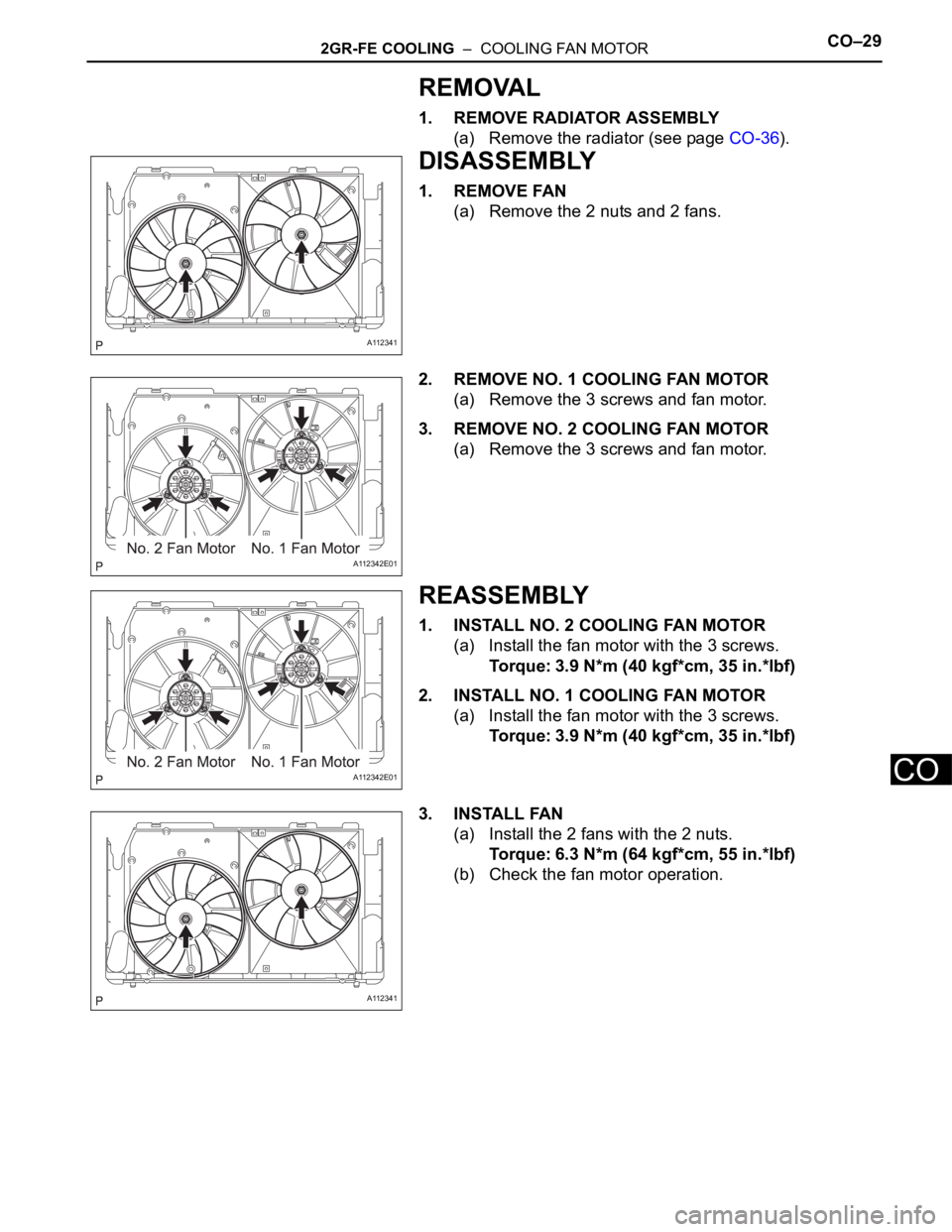
1. REMOVE FAN
(a) Remove the 2 nuts and 2 fans.
2. REMOVE NO. 1 COOLING FAN MOTOR
(a) Remove the 3 screws and fan motor.
3. REMOVE NO. 2 COOLING FAN MOTOR
(a) Remove the 3 screws and fan motor.
REASSEMBLY
1. INSTALL NO. 2 COOLING FAN MOTOR
(a) Install the fan motor with the 3 screws.
Torque: 3.9 N*m (40 kgf*cm, 35 in.*lbf)
2. INSTALL NO. 1 COOLING FAN MOTOR
(a) Install the fan motor with the 3 screws.
Torque: 3.9 N*m (40 kgf*cm, 35 in.*lbf)
3. INSTALL FAN
(a) Install the 2 fans with the 2 nuts.
Torque: 6.3 N*m (64 kgf*cm, 55 in.*lbf)
(b) Check the fan motor operation.
A112341
A112342E01
A112342E01
A112341
Page 864 of 2000
CO–302GR-FE COOLING – COOLING FAN MOTOR
CO
INSTALLATION
1. INSTALL RADIATOR ASSEMBLY
(a) Install the radiator (see page CO-40).
Page 928 of 2000
2GR-FE CHARGING – CHARGING SYSTEMCH–5
CH
ON-VEHICLE INSPECTION
1. CHECK BATTERY CONDITION
NOTICE:
If the battery is weak or if the engine is difficult to
start, perform the following procedures.
(a) Check the battery for damage and deformation. If
severe damage, deformation or leakage is found,
replace the battery.
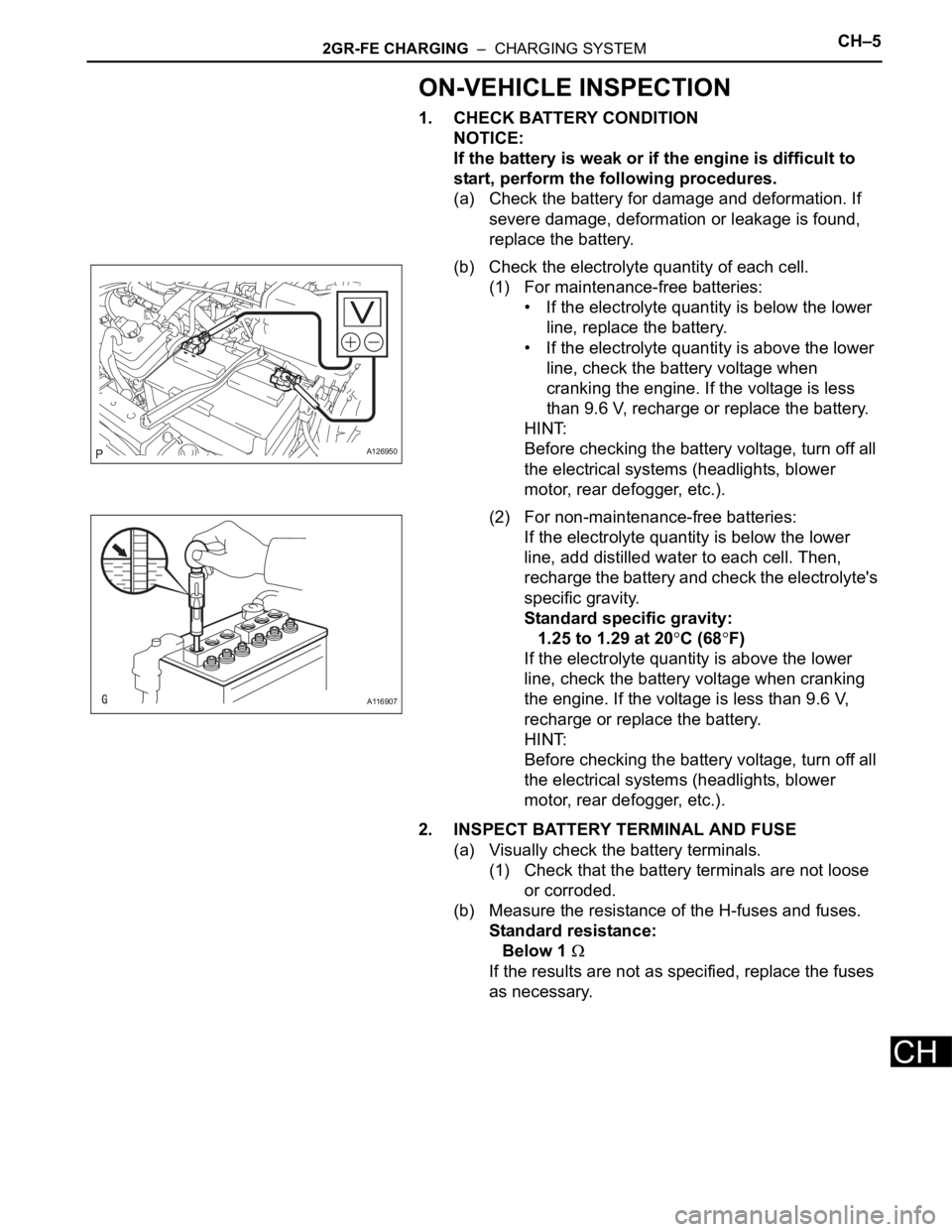
(b) Check the electrolyte quantity of each cell.
(1) For maintenance-free batteries:
• If the electrolyte quantity is below the lower
line, replace the battery.
• If the electrolyte quantity is above the lower
line, check the battery voltage when
cranking the engine. If the voltage is less
than 9.6 V, recharge or replace the battery.
HINT:
Before checking the battery voltage, turn off all
the electrical systems (headlights, blower
motor, rear defogger, etc.).
(2) For non-maintenance-free batteries:
If the electrolyte quantity is below the lower
line, add distilled water to each cell. Then,
recharge the battery and check the electrolyte's
specific gravity.
Standard specific gravity:
1.25 to 1.29 at 20
C (68F)
If the electrolyte quantity is above the lower
line, check the battery voltage when cranking
the engine. If the voltage is less than 9.6 V,
recharge or replace the battery.
HINT:
Before checking the battery voltage, turn off all
the electrical systems (headlights, blower
motor, rear defogger, etc.).
2. INSPECT BATTERY TERMINAL AND FUSE
(a) Visually check the battery terminals.
(1) Check that the battery terminals are not loose
or corroded.
(b) Measure the resistance of the H-fuses and fuses.
Standard resistance:
Below 1
If the results are not as specified, replace the fuses
as necessary.
A126950
A116907
Page 1509 of 2000
BC–6BRAKE CONTROL – VEHICLE STABILITY CONTROL SYSTEM
BC
SYSTEM DESCRIPTION
1. SYSTEM DESCRIPTION
HINT:
The skid control ECU forms a single unit with the ABS
and TRACTION actuator.
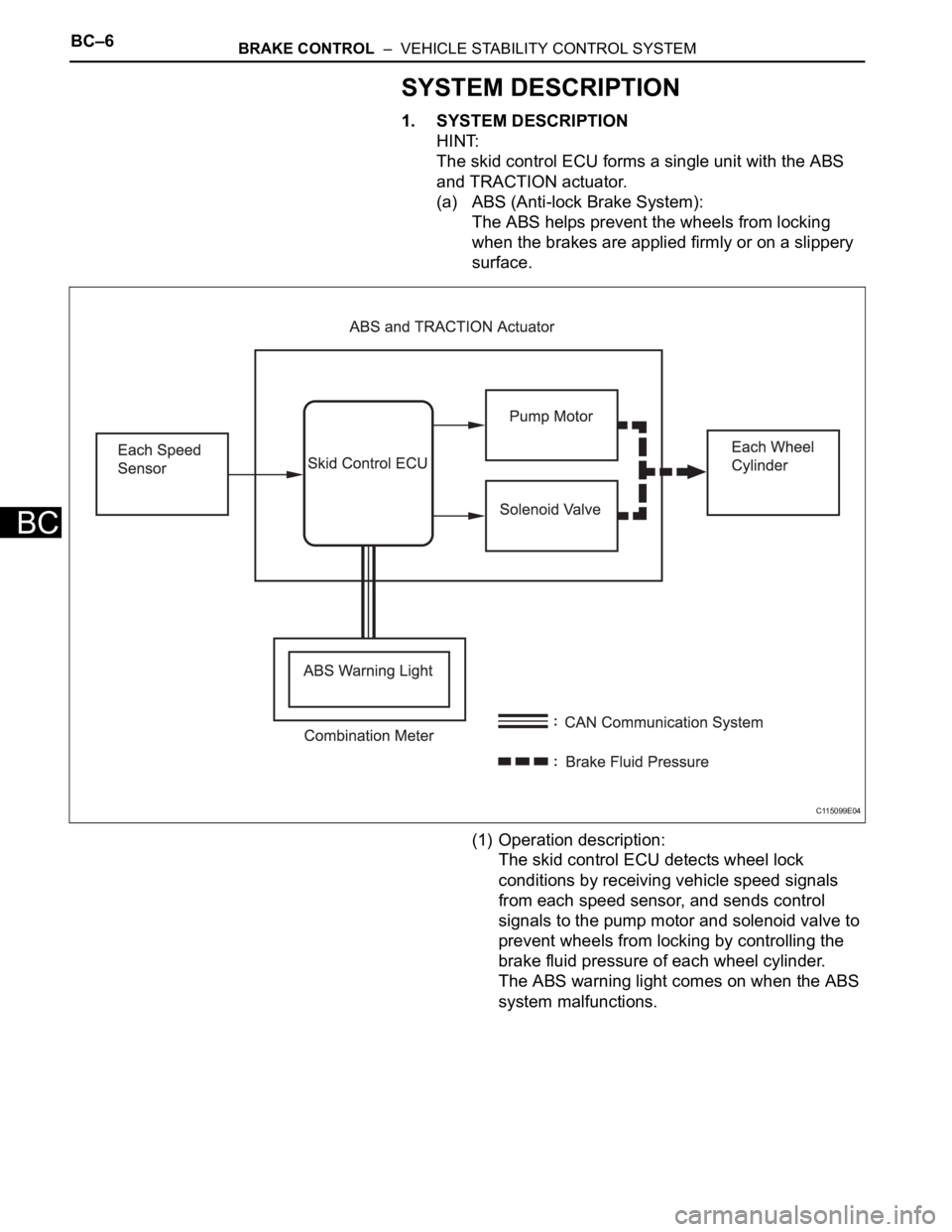
(a) ABS (Anti-lock Brake System):
The ABS helps prevent the wheels from locking
when the brakes are applied firmly or on a slippery
surface.
(1) Operation description:
The skid control ECU detects wheel lock
conditions by receiving vehicle speed signals
from each speed sensor, and sends control
signals to the pump motor and solenoid valve to
prevent wheels from locking by controlling the
brake fluid pressure of each wheel cylinder.
The ABS warning light comes on when the ABS
system malfunctions.
C115099E04
Page 1511 of 2000
BC–8BRAKE CONTROL – VEHICLE STABILITY CONTROL SYSTEM
BC
(c) BA (Brake Assist):
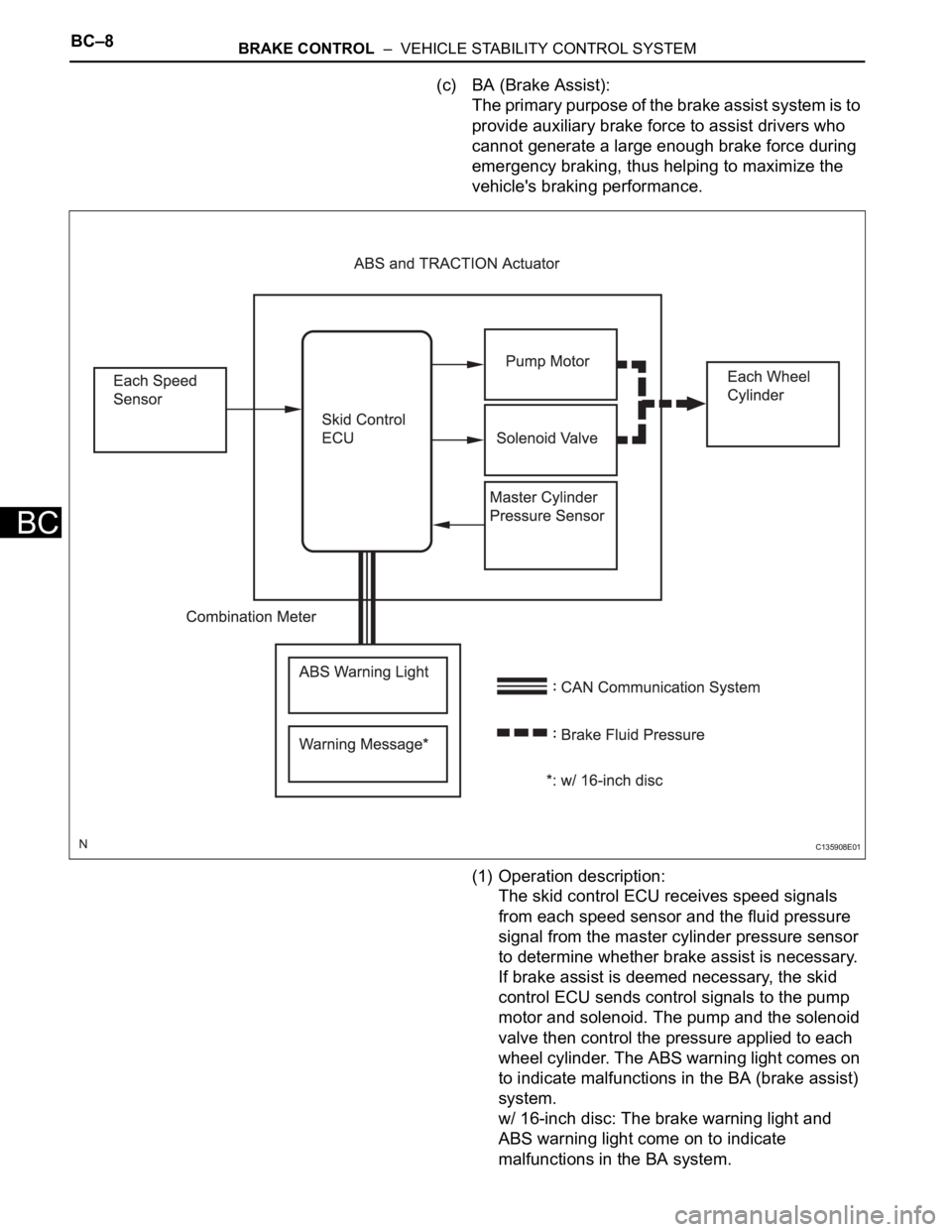
The primary purpose of the brake assist system is to
provide auxiliary brake force to assist drivers who
cannot generate a large enough brake force during
emergency braking, thus helping to maximize the
vehicle's braking performance.
(1) Operation description:
The skid control ECU receives speed signals
from each speed sensor and the fluid pressure
signal from the master cylinder pressure sensor
to determine whether brake assist is necessary.
If brake assist is deemed necessary, the skid
control ECU sends control signals to the pump
motor and solenoid. The pump and the solenoid
valve then control the pressure applied to each
wheel cylinder. The ABS warning light comes on
to indicate malfunctions in the BA (brake assist)
system.
w/ 16-inch disc: The brake warning light and
ABS warning light come on to indicate
malfunctions in the BA system.
C135908E01
Page 1522 of 2000

BRAKE CONTROL – VEHICLE STABILITY CONTROL SYSTEMBC–19
BC
4. FAIL SAFE FUNCTION
(a) When a failure occurs in the ABS with BA, TRC and
VSC systems, the ABS and VSC warning lights
illuminate, the slip indicator light comes on*1 or
remains off*2, and the operations of those systems
are prohibited. In addition to this, when a failure
which disables the EBD operation occurs, the brake
warning light comes on and its operation is
prohibited.
HINT:
*1: for 2WD
*2: for 4WD
(b) If control is prohibited due to a malfunction during
operation, control is disabled gradually to avoid
sudden vehicle instability.
5. INITIAL CHECK
(a) When the vehicle speed first reaches approximately
6 km/h (4 mph) or more after the ignition switch is
turned ON, each solenoid valve and the motor of the
ABS and TRACTION actuator are sequentially
activated to perform electrical checks. During the
initial check, the operating sound of the solenoid
valve and motor can be heard from the engine
compartment, but this does not indicate a
malfunction.
6. SERVICE MODE
(a) VSC operation can be disabled by operating the
intelligent tester.
HINT:
Refer to the intelligent tester operator's manual for
further details.
7. FUNCTION OF COMPONENTS
Components Functions
Speed Sensor
(Semiconductor Type)Detects the wheel speed and sends the signal to skid
control ECU
Skid Control ECU
(Housed in ABS and TRACTION Actuator)• Processes the signals from each sensor to control the
ABS, BA, TRC, and VSC
• Sends and receives control signals to and from the
ECM, yaw rate and deceleration sensor, steering
sensor, etc. via CAN communication.
ABS and TRACTION Actuator • Consists of the master cylinder cut solenoid valve,
holding solenoid valve, pressure reduction solenoid
valve, pump motor, and reservoir, and adjusts the brake
fluid pressure applied to each wheel cylinder
• Houses the skid control ECU
Solenoid Relay • Supplies power to each solenoid
• Housed in the skid control ECU
Motor Relay (VSC MTR Relay) • Supplies power to the pump motor
• Installed in engine room No. 1 relay block
Fail-safe Relay (VSC FAIL Relay) • Cuts off power to the motor when the pump motor circuit
malfunctions
• Installed in engine room No. 1 relay block
Page 1547 of 2000
BC–44BRAKE CONTROL – VEHICLE STABILITY CONTROL SYSTEM
BC
TERMINALS OF ECU
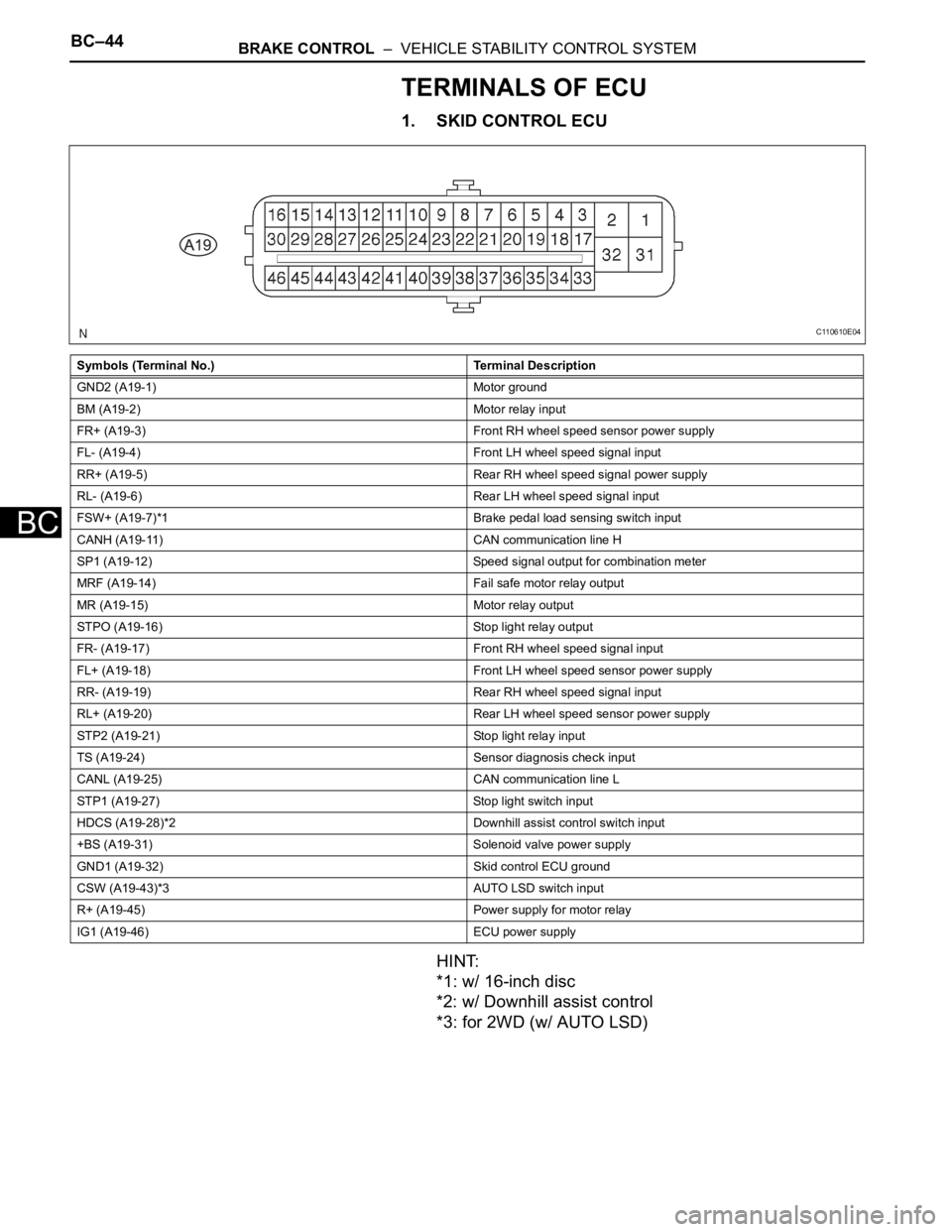
1. SKID CONTROL ECU
HINT:
*1: w/ 16-inch disc
*2: w/ Downhill assist control
*3: for 2WD (w/ AUTO LSD)
Symbols (Terminal No.) Terminal Description
GND2 (A19-1) Motor ground
BM (A19-2) Motor relay input
FR+ (A19-3) Front RH wheel speed sensor power supply
FL- (A19-4) Front LH wheel speed signal input
RR+ (A19-5) Rear RH wheel speed signal power supply
RL- (A19-6) Rear LH wheel speed signal input
FSW+ (A19-7)*1 Brake pedal load sensing switch input
CANH (A19-11) CAN communication line H
SP1 (A19-12) Speed signal output for combination meter
MRF (A19-14) Fail safe motor relay output
MR (A19-15) Motor relay output
STPO (A19-16) Stop light relay output
FR- (A19-17) Front RH wheel speed signal input
FL+ (A19-18) Front LH wheel speed sensor power supply
RR- (A19-19) Rear RH wheel speed signal input
RL+ (A19-20) Rear LH wheel speed sensor power supply
STP2 (A19-21) Stop light relay input
TS (A19-24) Sensor diagnosis check input
CANL (A19-25) CAN communication line L
STP1 (A19-27) Stop light switch input
HDCS (A19-28)*2 Downhill assist control switch input
+BS (A19-31) Solenoid valve power supply
GND1 (A19-32) Skid control ECU ground
CSW (A19-43)*3 AUTO LSD switch input
R+ (A19-45) Power supply for motor relay
IG1 (A19-46) ECU power supply
C110610E04
Page 1561 of 2000
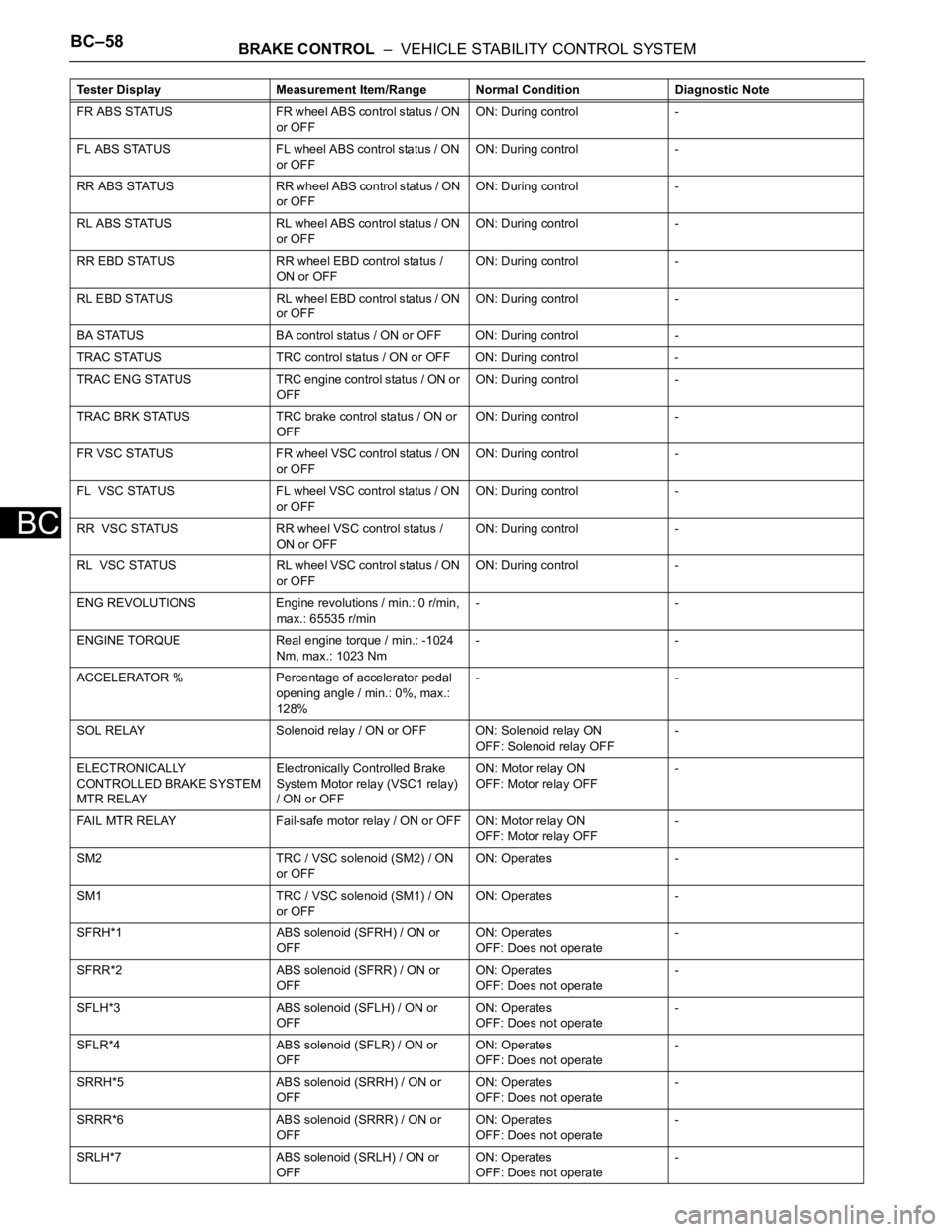
BC–58BRAKE CONTROL – VEHICLE STABILITY CONTROL SYSTEM
BC
FR ABS STATUS FR wheel ABS control status / ON
or OFFON: During control -
FL ABS STATUS FL wheel ABS control status / ON
or OFFON: During control -
RR ABS STATUS RR wheel ABS control status / ON
or OFFON: During control -
RL ABS STATUS RL wheel ABS control status / ON
or OFFON: During control -
RR EBD STATUS RR wheel EBD control status /
ON or OFFON: During control -
RL EBD STATUS RL wheel EBD control status / ON
or OFFON: During control -
BA STATUS BA control status / ON or OFF ON: During control -
TRAC STATUS TRC control status / ON or OFF ON: During control -
TRAC ENG STATUS TRC engine control status / ON or
OFFON: During control -
TRAC BRK STATUS TRC brake control status / ON or
OFFON: During control -
FR VSC STATUS FR wheel VSC control status / ON
or OFFON: During control -
FL VSC STATUS FL wheel VSC control status / ON
or OFFON: During control -
RR VSC STATUS RR wheel VSC control status /
ON or OFFON: During control -
RL VSC STATUS RL wheel VSC control status / ON
or OFFON: During control -
ENG REVOLUTIONS Engine revolutions / min.: 0 r/min,
max.: 65535 r/min--
ENGINE TORQUE Real engine torque / min.: -1024
Nm, max.: 1023 Nm--
ACCELERATOR % Percentage of accelerator pedal
opening angle / min.: 0%, max.:
128%--
SOL RELAY Solenoid relay / ON or OFF ON: Solenoid relay ON
OFF: Solenoid relay OFF-
ELECTRONICALLY
CONTROLLED BRAKE SYSTEM
MTR RELAYElectronically Controlled Brake
System Motor relay (VSC1 relay)
/ ON or OFFON: Motor relay ON
OFF: Motor relay OFF-
FAIL MTR RELAY Fail-safe motor relay / ON or OFF ON: Motor relay ON
OFF: Motor relay OFF-
SM2 TRC / VSC solenoid (SM2) / ON
or OFFON: Operates -
SM1 TRC / VSC solenoid (SM1) / ON
or OFFON: Operates -
SFRH*1 ABS solenoid (SFRH) / ON or
OFFON: Operates
OFF: Does not operate-
SFRR*2 ABS solenoid (SFRR) / ON or
OFFON: Operates
OFF: Does not operate-
SFLH*3 ABS solenoid (SFLH) / ON or
OFFON: Operates
OFF: Does not operate-
SFLR*4 ABS solenoid (SFLR) / ON or
OFFON: Operates
OFF: Does not operate-
SRRH*5 ABS solenoid (SRRH) / ON or
OFFON: Operates
OFF: Does not operate-
SRRR*6 ABS solenoid (SRRR) / ON or
OFFON: Operates
OFF: Does not operate-
SRLH*7 ABS solenoid (SRLH) / ON or
OFFON: Operates
OFF: Does not operate- Tester Display Measurement Item/Range Normal Condition Diagnostic Note