coolant temperature TOYOTA RAV4 2006 Service Manual PDF
[x] Cancel search | Manufacturer: TOYOTA, Model Year: 2006, Model line: RAV4, Model: TOYOTA RAV4 2006Pages: 2000, PDF Size: 45.84 MB
Page 1258 of 2000
AX–34U241E AUTOMATIC TRANSAXLE – AUTOMATIC TRANSAXLE SYSTEM
AX
4. FREEZE FRAME DATA
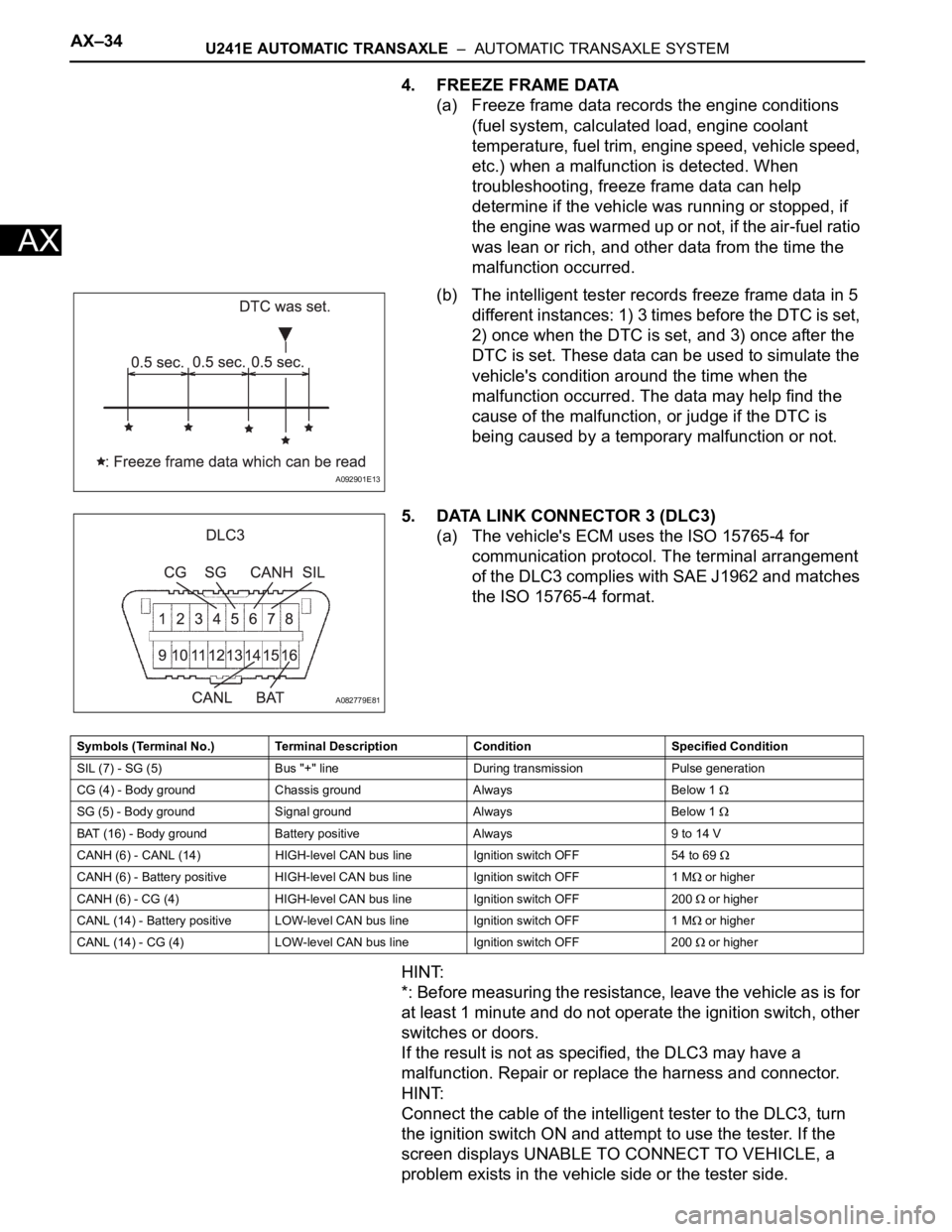
(a) Freeze frame data records the engine conditions
(fuel system, calculated load, engine coolant
temperature, fuel trim, engine speed, vehicle speed,
etc.) when a malfunction is detected. When
troubleshooting, freeze frame data can help
determine if the vehicle was running or stopped, if
the engine was warmed up or not, if the air-fuel ratio
was lean or rich, and other data from the time the
malfunction occurred.
(b) The intelligent tester records freeze frame data in 5
different instances: 1) 3 times before the DTC is set,
2) once when the DTC is set, and 3) once after the
DTC is set. These data can be used to simulate the
vehicle's condition around the time when the
malfunction occurred. The data may help find the
cause of the malfunction, or judge if the DTC is
being caused by a temporary malfunction or not.
5. DATA LINK CONNECTOR 3 (DLC3)
(a) The vehicle's ECM uses the ISO 15765-4 for
communication protocol. The terminal arrangement
of the DLC3 complies with SAE J1962 and matches
the ISO 15765-4 format.
HINT:
*: Before measuring the resistance, leave the vehicle as is for
at least 1 minute and do not operate the ignition switch, other
switches or doors.
If the result is not as specified, the DLC3 may have a
malfunction. Repair or replace the harness and connector.
HINT:
Connect the cable of the intelligent tester to the DLC3, turn
the ignition switch ON and attempt to use the tester. If the
screen displays UNABLE TO CONNECT TO VEHICLE, a
problem exists in the vehicle side or the tester side.
A092901E13
A082779E81
Symbols (Terminal No.) Terminal Description Condition Specified Condition
SIL (7) - SG (5) Bus "+" line During transmission Pulse generation
CG (4) - Body ground Chassis ground Always Below 1
SG (5) - Body ground Signal ground Always Below 1
BAT (16) - Body ground Battery positive Always 9 to 14 V
CANH (6) - CANL (14) HIGH-level CAN bus line Ignition switch OFF 54 to 69
CANH (6) - Battery positive HIGH-level CAN bus line Ignition switch OFF 1 M or higher
CANH (6) - CG (4) HIGH-level CAN bus line Ignition switch OFF 200
or higher
CANL (14) - Battery positive LOW-level CAN bus line Ignition switch OFF 1 M
or higher
CANL (14) - CG (4) LOW-level CAN bus line Ignition switch OFF 200
or higher
Page 1349 of 2000

GF1A TRANSFER – ACTIVE TORQUE CONTROL 4WD SYSTEMTF–21
TF
DATA LIST / ACTIVE TEST
1. READ DATA LIST
HINT:
Using the intelligent tester's (with CAN VIM) DATA LIST
allows switch, sensor and other item values to be read
without removing any parts. Reading the DATA LIST
early in troubleshooting is one way to save time.
(a) Connect the intelligent tester (with CAN VIM) to the
DLC3.
(b) Turn the ignition switch ON.
(c) Read the DATA LIST according to the display on the
tester.
4WD control ECU
Item Measurement Item/Range
(Display)Normal Condition Diagnostic Note
4WD WARN LAMP 4WD indicator light /OFF or ON OFF: 4WD indicator light OFF
ON: 4WD indicator light ON-
SLIP INDI LAMP Slip indicator light /OFF or ON OFF: SLIP indicator light OFF
ON: SLIP indicator light ON-
STOP LAMP SW Stop light switch /OFF or ON OFF: Brake pedal released
ON: Brake pedal depressed-
STEERING ANGLE Steering angle value /
Min.: -3276.8 deg
Max.: 3276.7 degMin.: -3276.8 deg
Max.: 3276.7 deg-
FR WHEEL SPD FR wheel speed /
Min.: 0 km/h (0 mph)
Reading : Max.: 326.4 km/h
(202.8 mph)Actual wheel speed Almost no difference from the
speedometer
FL WHEEL SPD FL wheel speed /
Min.: 0 km/h (0 mph)
Reading : Max.: 326.4 km/h
(202.8 mph)Actual wheel speed Almost no difference from the
speedometer
RR WHEEL SPD RR wheel speed /
Min.: 0 km/h (0 mph)
Reading : Max.: 326.4 km/h
(202.8 mph)Actual wheel speed Almost no difference from the
speedometer
RLWHEEL SPD RL wheel speed /
Min.: 0 km/h (0 mph)
Reading : Max.: 326.4 km/h
(202.8 mph)Actual wheel speed Almost no difference from the
speedometer
AMBI TEMP Ambient temperature /
Min.: -128
C (198.4 F)
Max.: 127 C (260.6 F)Min.: -128 (198.4
F)
Max.: 127 (260.6
F)-
COOLANT TEMP Engine coolant temperature /
Min.: 0
C (32 F)
Max.: 127.5
C (261.5 F)Min.: 0
C (32 F)
Max.: 127.5 C (261.5 F)-
LOCK SW 4WD lock switch / OFF or ON OFF: 4WD lock switch off
ON: 4WD lock switch on-
SLC CUR SLC solenoid (4WD linear
solenoid) current /
Min.: 0 A
Max.: 3 AMin.: 0 A
Max.: 3 A-
Page 1638 of 2000

AC–10AIR CONDITIONING – AIR CONDITIONING SYSTEM (for Automatic Air Conditioning Sys-
tem)
AC
Communication table
Sender Receiver Signal Communication Line
Air conditioning amplifier ECMA/C compressor control signal
CAN Idle up request signal
External variable control solenoid
current signal
Cooling fan motor driving request
signal
Ambient temperature signal
Air conditioning amplifier Air conditioning control assemblyFront panel indication signal
LIN AUTO indication signal
A/C indication signal
MODE indication signal
REC indication signal
FRS indication signal
RDEF indication signal
Blower level indication signal
Set temperature indication signal
Combination meter assembly Air conditioning amplifierVehicle speed signal
CAN
Ambient temperature signal
ECM Air conditioning amplifierEngine revolution speed signal
CAN Engine coolant temperature
signal
A/C control cut signal
Variable control prohibition signal
Air conditioning control assembly Air conditioning amplifierAUTO switch signal
LIN OFF switch signal
A/C switch signal
DEF switch signal
MODE switch signal
RDEF switch signal
Blower switch signal (FAN+, FAN-
)
Set temperature switch signal
(UP, DOWN)
Page 1640 of 2000

AC–12AIR CONDITIONING – AIR CONDITIONING SYSTEM (for Automatic Air Conditioning Sys-
tem)
AC
Communication table
Sender Receiver Signal Communication Line
Air conditioning amplifier ECMA/C compressor control signal
CAN Idle up request signal
External variable control solenoid
current signal
Cooling fan motor driving request
signal
Ambient temperature signal
Air conditioning amplifier Air conditioning control assemblyFront panel indication signal
LIN AUTO indication signal
A/C indication signal
MODE indication signal
REC indication signal
FRS indication signal
RDEF indication signal
Blower level indication signal
Set temperature indication signal
Combination meter assembly Air conditioning amplifierVehicle speed signal
CAN
Ambient temperature signal
ECM Air conditioning amplifierEngine revolution speed signal
CAN Engine coolant temperature
signal
A/C control cut signal
Variable control prohibition signal
Air conditioning control assembly Air conditioning amplifierAUTO switch signal
LIN OFF switch signal
A/C switch signal
DEF switch signal
MODE switch signal
RDEF switch signal
Blower switch signal (FAN+, FAN-
)
Set temperature switch signal
(UP, DOWN)
Page 1934 of 2000

ES–462AZ-FE ENGINE CONTROL SYSTEM – SFI SYSTEM
ES
FAIL-SAFE CHART
If any of the following DTCs are set, the ECM enters fail-safe
mode to allow the vehicle to be driven temporarily.
HINT:
*: The vehicle can be driven slowly when the accelerator
pedal is depressed firmly and slowly. If the accelerator pedal
is depressed quickly, the vehicle may speed up and slow
down erratically.
DTCs Components Fail-Safe OperationsFail-Safe Deactivation
Conditions
P0031 and P0032Air-Fuel Ratio (A/F) Sensor
HeaterECM turns off A/F sensor heater. Ignition switch OFF
P0037 and P0038Heated Oxygen (HO2) Sensor
HeaterECM turns off HO2 sensor heater. Ignition switch OFF
P0100, P0102 and P0103 Mass Air Flow (MAF) MeterECM calculates ignition timing
according to engine speed and
throttle valve position.Pass condition detected
P0110, P0112 and P0113Intake Air Temperature (IAT)
SensorECM estimates IAT to be 20
C
(68
F).Pass condition detected
P0115, P0117 and P0118Engine Coolant Temperature
(ECT) SensorECM estimates ECT to be 80
C
(176
F).Pass condition detected
P0120, P0121, P0122, P0123,
P0220, P0222, P0223, P0604,
P0606, P0607, P0657, P2102,
P2103, P2111, P2112, P2118,
P2119 and P2135Electronic Throttle Control
System (ETCS)ECM cuts off throttle actuator
current and throttle valve returned
to 6
throttle position by return
spring.
ECM then adjusts engine output
by controlling fuel injection
(intermittent fuel-cut) and ignition
timing in accordance with
accelerator pedal opening angle
to allow vehicle to continue at
minimal speed*.Pass condition detected and then
ignition switch turned OFF
P0327 and P0328 Knock SensorECM sets ignition timing to
maximum retard.Ignition switch OFF
P0351 to P0354 Igniter ECM cuts fuel. Pass condition detected
P1550, P1551, P1552 and P1602 Generator Alternator command is fixed. Pass condition detected
P2120, P2121, P2122, P2123,
P2125, P2127, P2128 and P2138Accelerator Pedal Position (APP)
SensorAPP sensor has 2 sensor circuits:
Main and Sub.
If either circuit malfunctions, ECM
controls engine using other
circuit.
If both circuits malfunction, ECM
regards accelerator pedal as
being released. As result, throttle
valve closed and engine idles.Pass condition detected and then
ignition switch turned OFF
Page 1935 of 2000

2AZ-FE ENGINE CONTROL SYSTEM – SFI SYSTEMES–47
ES
DATA LIST / ACTIVE TEST
1. DATA LIST
HINT:
By reading the DATA LIST displayed on an intelligent
tester, values can be checked, including those of the
switches, sensors, and actuators, without removing any
parts. Reading the DATA LIST as the first step of
troubleshooting is one method of shortening diagnostic
time.
NOTICE:
In the table below, the values listed under Normal
Condition are for reference only. Do not depend
solely on these values when determining whether or
not a part is faulty.
(a) Warm up the engine.
(b) Turn the ignition switch OFF.
(c) Connect the intelligent tester to the DLC3.
(d) Turn the ignition switch ON.
(e) Turn the tester ON.
(f) Select the following menu items: DIAGNOSIS /
ENHANCED OBD II / DATA LIST.
(g) Check the values by referring to the table below.
ECM:
Intelligent Tester Display Measurement: Range (Display) Normal Condition*1 Diagnostic Note
INJECTORInjection period of No. 1 cylinder:
Min.: 0 ms, Max.: 32.64 ms1.0 to 3.0 ms: Idling -
IGN ADVANCE Ignition timing advance for No. 1
cylinder:
Min.: -64 deg, Max.: 63.5 degBTDC 0 to 14 deg: Idling -
CALC LOADCalculated load by ECM:
Min.: 0 %, Max.: 100 %• 10 to 30 %: Idling
• 10 to 30 %: Running without
load at 2,500 rpmLoad value
VEHICLE LOADVehicle load:
Min.: 0 %, Max.: 25,700 %Actual vehicle loadLoad percentage in terms of
maximum intake air flow amount
MAFAir flow rate from Mass Air Flow
(MAF) meter:
Min.: 0 g/sec., Max.: 655.35 g/sec.1 to 3 g/sec.: Idling
2 to 6 g/sec.: Running without
load at 2,500 rpmIf value approximately 0.0 g/sec.:
• MAF meter power source
circuit open
• VG circuit open or short
If value 160.0 g/sec. or more:
• E2G circuit open
ENGINE SPDEngine speed:
Min.: 0 rpm, Max.: 16,383.75 rpm650 to 750 rpm: Idling -
VEHICLE SPDVehicle speed:
Min.: 0 km/h, Max.: 255 km/hActual vehicle speed Speed indicated on speedometer
COOLANT TEMPEngine coolant temperature:
Min.: -40
C, Max.: 140C80 to 100C (176 to 212F):
After warming up• If -40
C (-40F): sensor circuit
open
• If 140
C (284F) or more:
sensor circuit shorted
INTAKE AIRIntake air temperature:
Min.: -40
C, Max.: 140CEquivalent to ambient air
temperature• If -40
C (-40F): sensor circuit
open
• If 140
C (284F) or more:
sensor circuit shorted
AIR-FUEL RATIORatio compared to stoichiometric
level:
Min.: 0, Max.: 1.9990.8 to 1.2: Idling• Less than 1 (0 to 0.999) =
Lean
• Stoichiometric air-fuel ratio = 1
• Greater than 1 (1.001 to
1.999) = Rich
Page 1939 of 2000

2AZ-FE ENGINE CONTROL SYSTEM – SFI SYSTEMES–51
ES
CAT TEMP B1S2Estimated catalyst temperature
(sensor 2):
Min.: -40C, Max.: 6,513.5C--
S O2S B1S2Sub heated oxygen sensor
impedance (sensor2):
Min.: 0
, Max.: 21247.68
--
INI COOL TEMPEngine coolant temperature at
engine start:
Min.: -40
C, Max.: 120CClose to ambient air
temperature-
INI INTAKE TEMPIntake air temperature at engine
start:
Min.: -40
C, Max.: 120CClose to ambient air
temperature-
INJ VOLInjection volume (Cylinder 1):
Min.: 0 ml, Max.: 2.048 ml0 to 0.15 ml: IdlingQuantity of fuel injection volume
for 10 times
STARTER SIGStarter switch (STSW) signal:
ON or OFFON: Cranking -
PS SWPower steering signal:
ON or OFFON: Power steering operation -
PS SIGNALPower steering signal (history):
ON or OFFON: When steering wheel first
turned after battery terminals
connectedSignal status usually ON until
battery terminals disconnected
CTP SWClosed throttle position switch:
ON or OFF• ON: Throttle fully closed
• OFF: Throttle open-
A/C SIGNALA/C signal:
ON or OFFON: A/C ON -
PNP SW [NSW]PNP switch status:
ON or OFFON: P or N position -
ELECT LOAD SIGElectrical load signal:
ON or OFFON: Headlights or defogger
turned ON-
STOP LIGHT SWStop light switch:
ON or OFFON: Brake pedal depressed -
+BMWhether or not electric throttle
control system power inputted:
ON or OFFON: Ignition switch ON and
system normal-
+BM VOLTAGE+BM voltage:
Min.: 0, Max.: 19.9229 to 14 (V): Ignition switch ON
and system normalETCS service data
BATTERY VOLTAGEBattery voltage:
Min.: 0 V, Max.: 65.535 V9 to 14 V: Ignition switch ON -
ACTUATOR POWERActuator power supply:
ON or OFFON: Idling ETCS service data
ATM PRESSUREAtmospheric pressure:
Min.: 0 kPa, Max.: 255 kPaApproximately 100 kPa: Ignition
switch ON-
BATTERY CURRENTBattery current:
Min.: -100 A, Max.: 100 A--
BATTERY TEMPBattery temperature:
Min.: -45
C, Max.: 156.4 F--
ALT OUTPUT DUTYGenerator output duty ratio:
Min.: 0 %, Max.: 100 %- During charge control
ALT V NORMALRequest voltage when regulator
not under forced activation:
Min.: 0 V, Max.: 20 VBattery electrolyte temperature
varies (12.5 to 14.8 V) while
driving:
After engine startAlternator regulator output voltage
is out put
When performing Active Test,
value is 0V
ALT V TSTRequest voltage when regulator
under forced activation:
Min.: 0 V, Max.: 20 VRequest instruction voltage
value:
After engine startCharging control service data
When not performing Active Test,
value is 0V
EVAP (Purge) VSVPurge VSV status:
ON or OFF--
FUEL PUMP / SPDFuel pump status:
ON or OFFON: Engine running Active Test support data Intelligent Tester Display Measurement: Range (Display) Normal Condition*1 Diagnostic Note
Page 1947 of 2000
2AZ-FE ENGINE CONTROL SYSTEM – SFI SYSTEMES–59
ES
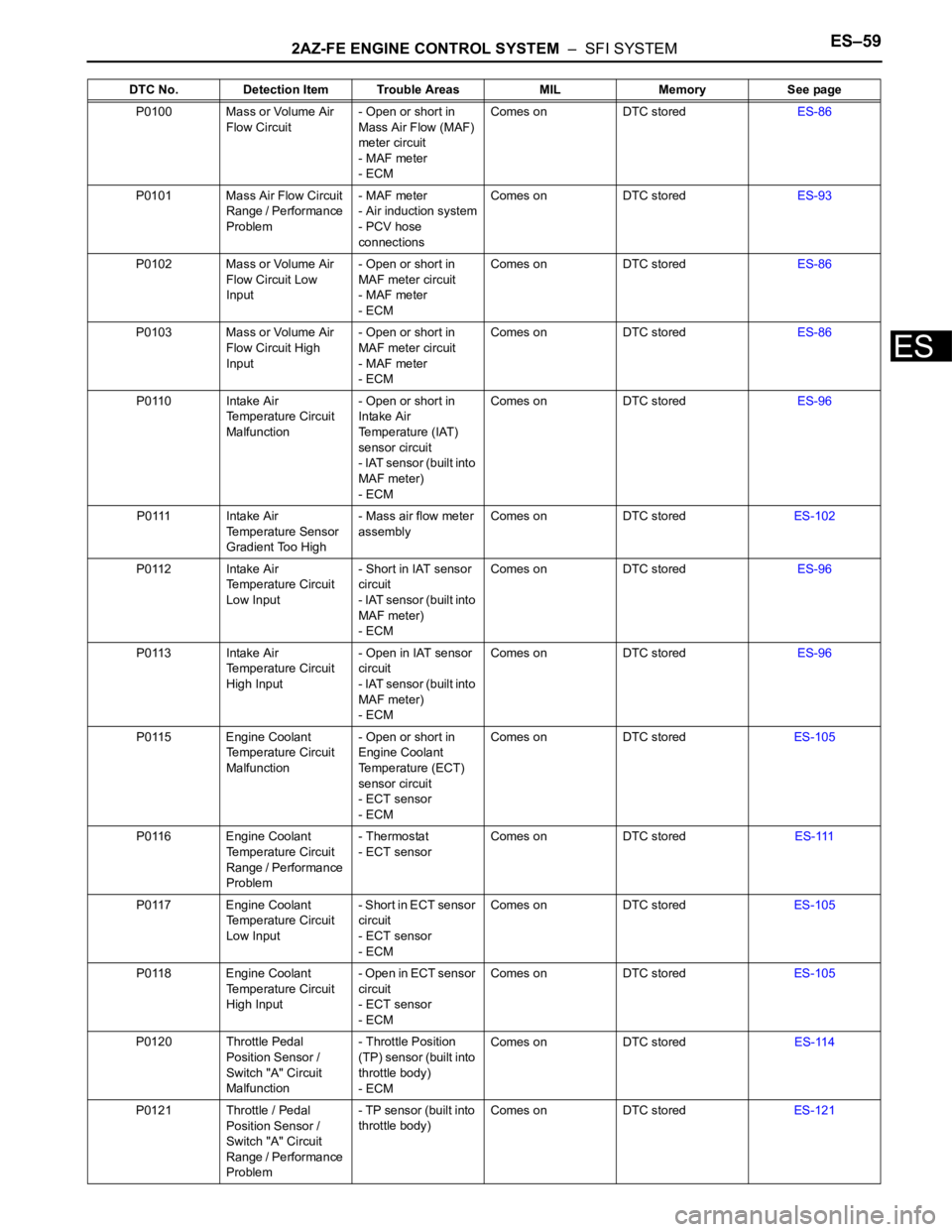
P0100 Mass or Volume Air
Flow Circuit- Open or short in
Mass Air Flow (MAF)
meter circuit
- MAF meter
- ECMComes on DTC storedES-86
P0101 Mass Air Flow Circuit
Range / Performance
Problem- MAF meter
- Air induction system
- PCV hose
connectionsComes on DTC storedES-93
P0102 Mass or Volume Air
Flow Circuit Low
Input- Open or short in
MAF meter circuit
- MAF meter
- ECMComes on DTC storedES-86
P0103 Mass or Volume Air
Flow Circuit High
Input- Open or short in
MAF meter circuit
- MAF meter
- ECMComes on DTC storedES-86
P0110 Intake Air
Temperature Circuit
Malfunction- Open or short in
Intake Air
Temperature (IAT)
sensor circuit
- IAT sensor (built into
MAF meter)
- ECMComes on DTC storedES-96
P0111 Intake Air
Temperature Sensor
Gradient Too High- Mass air flow meter
assemblyComes on DTC storedES-102
P0112 Intake Air
Temperature Circuit
Low Input- Short in IAT sensor
circuit
- IAT sensor (built into
MAF meter)
- ECMComes on DTC storedES-96
P0113 Intake Air
Temperature Circuit
High Input- Open in IAT sensor
circuit
- IAT sensor (built into
MAF meter)
- ECMComes on DTC storedES-96
P0115 Engine Coolant
Temperature Circuit
Malfunction- Open or short in
Engine Coolant
Temperature (ECT)
sensor circuit
- ECT sensor
- ECMComes on DTC storedES-105
P0116 Engine Coolant
Temperature Circuit
Range / Performance
Problem- Thermostat
- ECT sensorComes on DTC storedES-111
P0117 Engine Coolant
Temperature Circuit
Low Input- Short in ECT sensor
circuit
- ECT sensor
- ECMComes on DTC storedES-105
P0118 Engine Coolant
Temperature Circuit
High Input- O p e n i n E C T s e n s o r
circuit
- ECT sensor
- ECMComes on DTC storedES-105
P0120 Throttle Pedal
Position Sensor /
Switch "A" Circuit
Malfunction- Throttle Position
(TP) sensor (built into
throttle body)
- ECMComes on DTC storedES-114
P0121 Throttle / Pedal
Position Sensor /
Switch "A" Circuit
Range / Performance
Problem- TP sensor (built into
throttle body)Comes on DTC storedES-121 DTC No. Detection Item Trouble Areas MIL Memory See page
Page 1948 of 2000
ES–602AZ-FE ENGINE CONTROL SYSTEM – SFI SYSTEM
ES
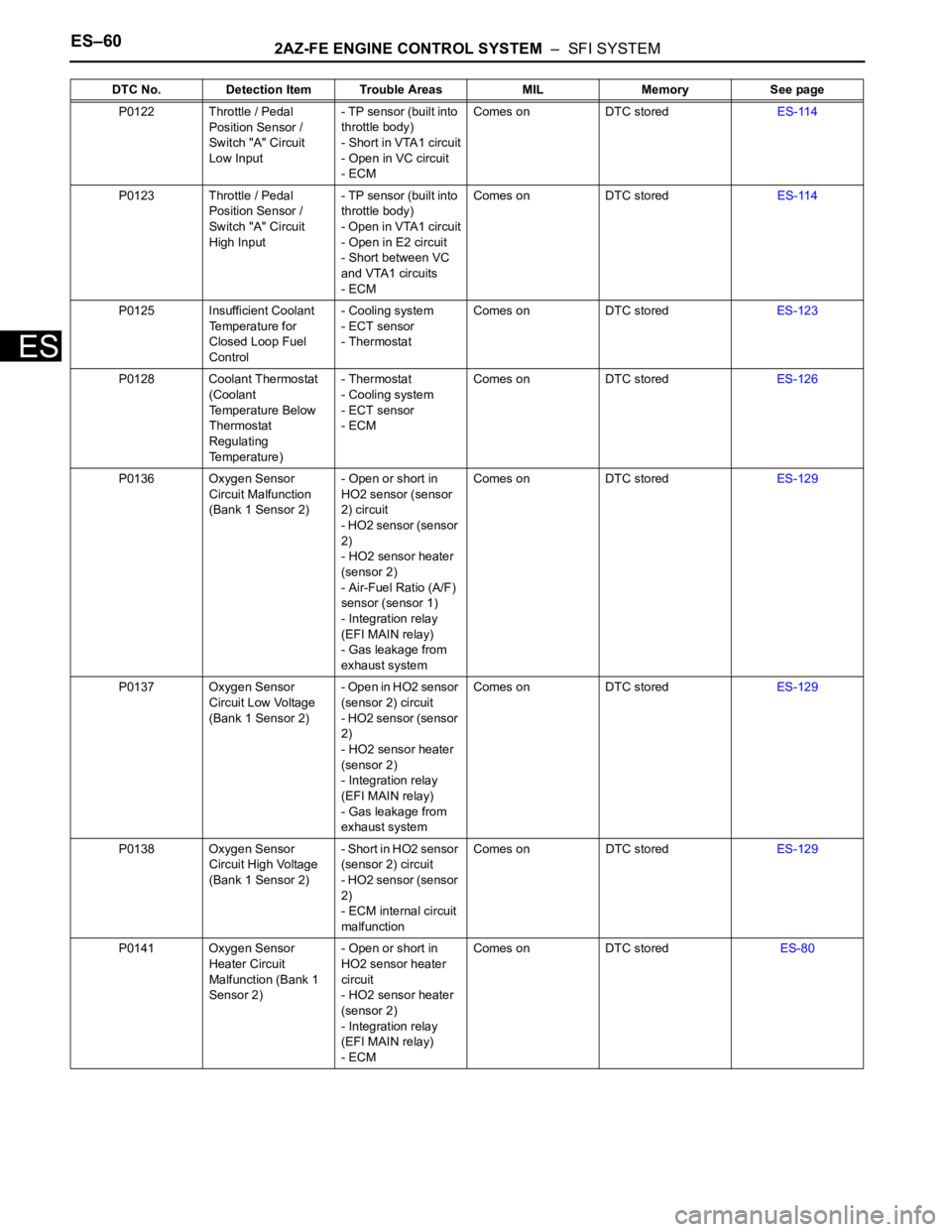
P0122 Throttle / Pedal
Position Sensor /
Switch "A" Circuit
Low Input- TP sensor (built into
throttle body)
- Short in VTA1 circuit
- Open in VC circuit
- ECMComes on DTC storedES-114
P0123 Throttle / Pedal
Position Sensor /
Switch "A" Circuit
High Input- TP sensor (built into
throttle body)
- Open in VTA1 circuit
- Open in E2 circuit
- Short between VC
and VTA1 circuits
- ECMComes on DTC storedES-114
P0125 Insufficient Coolant
Temperature for
Closed Loop Fuel
Control- Cooling system
- ECT sensor
- ThermostatComes on DTC storedES-123
P0128 Coolant Thermostat
(Coolant
Temperature Below
Thermostat
Regulating
Temperature)- Thermostat
- Cooling system
- ECT sensor
- ECMComes on DTC storedES-126
P0136 Oxygen Sensor
Circuit Malfunction
(Bank 1 Sensor 2)- Open or short in
HO2 sensor (sensor
2) circuit
- HO2 sensor (sensor
2)
- HO2 sensor heater
(sensor 2)
- Air-Fuel Ratio (A/F)
sensor (sensor 1)
- Integration relay
(EFI MAIN relay)
- Gas leakage from
exhaust systemComes on DTC storedES-129
P0137 Oxygen Sensor
Circuit Low Voltage
(Bank 1 Sensor 2)- Open in HO2 sensor
(sensor 2) circuit
- HO2 sensor (sensor
2)
- HO2 sensor heater
(sensor 2)
- Integration relay
(EFI MAIN relay)
- Gas leakage from
exhaust systemComes on DTC storedES-129
P0138 Oxygen Sensor
Circuit High Voltage
(Bank 1 Sensor 2)- Short in HO2 sensor
(sensor 2) circuit
- HO2 sensor (sensor
2)
- ECM internal circuit
malfunctionComes on DTC storedES-129
P0141 Oxygen Sensor
Heater Circuit
Malfunction (Bank 1
Sensor 2)- Open or short in
HO2 sensor heater
circuit
- HO2 sensor heater
(sensor 2)
- Integration relay
(EFI MAIN relay)
- ECMComes on DTC storedES-80 DTC No. Detection Item Trouble Areas MIL Memory See page
Page 1957 of 2000
2AZ-FE ENGINE CONTROL SYSTEM – SFI SYSTEMES–69
ES
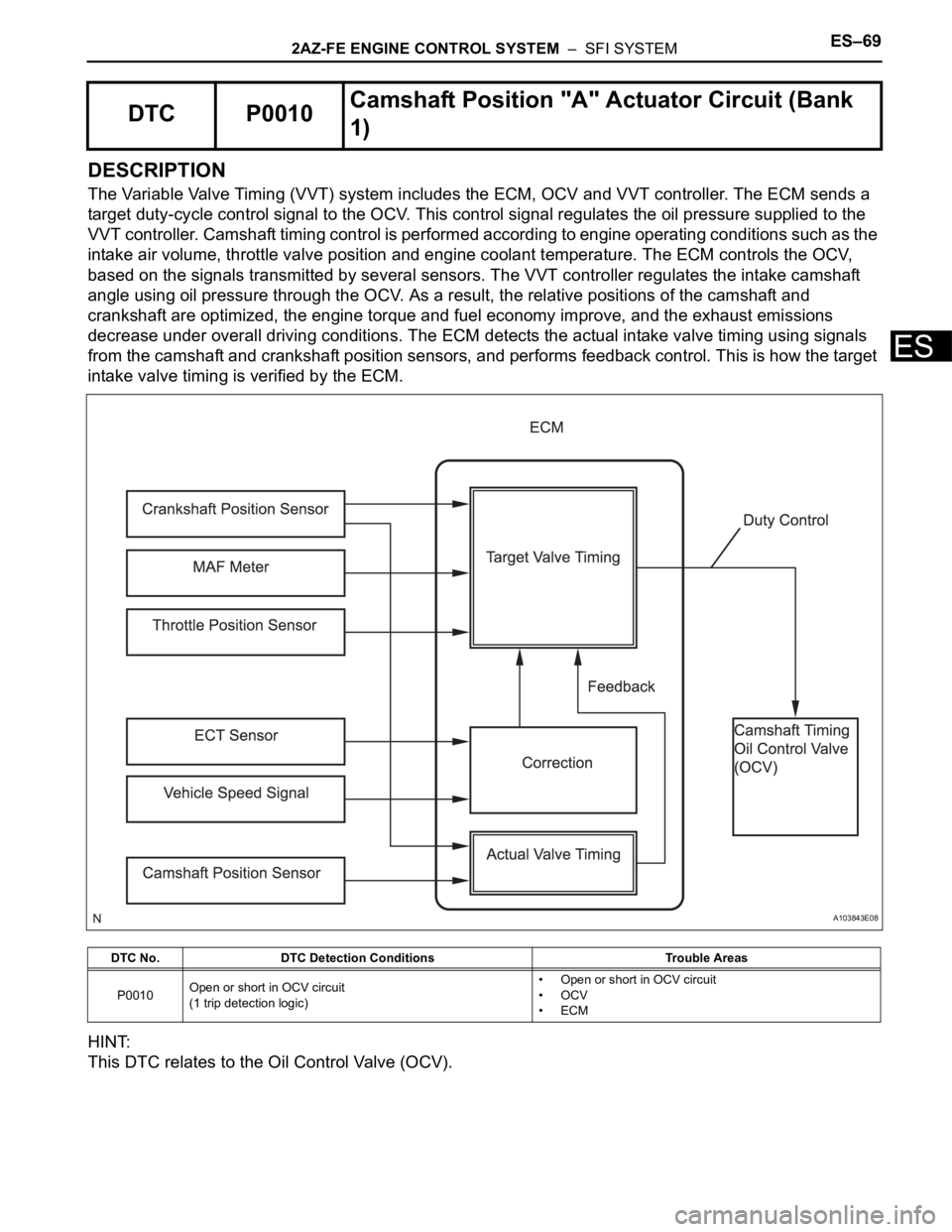
DESCRIPTION
The Variable Valve Timing (VVT) system includes the ECM, OCV and VVT controller. The ECM sends a
target duty-cycle control signal to the OCV. This control signal regulates the oil pressure supplied to the
VVT controller. Camshaft timing control is performed according to engine operating conditions such as the
intake air volume, throttle valve position and engine coolant temperature. The ECM controls the OCV,
based on the signals transmitted by several sensors. The VVT controller regulates the intake camshaft
angle using oil pressure through the OCV. As a result, the relative positions of the camshaft and
crankshaft are optimized, the engine torque and fuel economy improve, and the exhaust emissions
decrease under overall driving conditions. The ECM detects the actual intake valve timing using signals
from the camshaft and crankshaft position sensors, and performs feedback control. This is how the target
intake valve timing is verified by the ECM.
HINT:
This DTC relates to the Oil Control Valve (OCV).
DTC P0010Camshaft Position "A" Actuator Circuit (Bank
1)
DTC No. DTC Detection Conditions Trouble Areas
P0010Open or short in OCV circuit
(1 trip detection logic)• Open or short in OCV circuit
•OCV
•ECM
A103843E08