fuel TOYOTA RAV4 2009 XA30 / 3.G Owner's Manual
[x] Cancel search | Manufacturer: TOYOTA, Model Year: 2009, Model line: RAV4, Model: TOYOTA RAV4 2009 XA30 / 3.GPages: 516, PDF Size: 10.61 MB
Page 343 of 516
343
4-2. Maintenance
4
Maintenance and care
Emission inspection and maintenance (I/M) programs
Some states have vehicle emission inspection programs which
include OBD (On Board Diagnostics) checks. The OBD system moni-
tors the operation of th e emission control system.
■If the malfunction indicator lamp comes on
The OBD system determines that a problem exists somewhere
in the emission control system. Your vehicle may not pass the I/
M test and may need to be repaired. Contact your Toyota dealer
to service the vehicle.
■ Your vehicle may not pass the I/M test:
●When the battery is disconnected or discharged
Readiness codes that are se t during ordinary driving are
erased.
Also, depending on your driving habits, the readiness codes
may not be completely set.
● When the fuel tank cap is loose
The malfunction indicator lamp comes on as a temporary mal-
function and your vehicle may not pass the I/M test.
■ When the malfunction indicator lamp goes off after several
driving trips
The error code in the OBD system will not be cleared unless the
vehicle is driven 40 or more times.
■ If your vehicle does not pass the I/M test
Contact your Toyota dealer to prepare the vehicle for re-testing.
Page 346 of 516
346 4-3. Do-it-yourself maintenance
CAUTION
The engine compartment contains many mechanisms and fluids that may
move suddenly, become hot, or become electrically energized. To avoid death
or serious injury, observe the following precautions.
■When working on the engine compartment
●Keep hands, clothing, and tools away from the moving fans and engine
drive belt.
● Be careful not to touch the engine, radiator, exhaust manifold, etc. right
after driving as they may be hot. Oil and other fluids may also be hot.
● Do not leave anything that may burn easily, such as paper or rags, in the
engine compartment.
● Do not smoke, cause sparks or expose an open flame to fuel or the bat-
tery. Fuel and battery fumes are flammable.
● Be extremely cautious when working on the battery. It contains poisonous
and corrosive sulfuric acid.
● Take care because brake fluid can harm your hands or eyes and damage
painted surfaces.
If fluid gets on your hands or in your eyes, flush the affected area with
clean water immediately.
If you still experience discomfort, see a doctor.
■ When working near the electric c ooling fans or radiator grille
Vehicles without smart key system: Be sure the engine switch is OFF. With
the engine switch in the “ON” position, the electric cooling fans may auto-
matically start to run if the air conditioning is on and/or the coolant tempera-
ture is high. ( P. 361)
Vehicles with smart key system: Be sure the “ENGINE START STOP” switch
is OFF. With the “ENGINE START STOP” switch in IGNITION ON mode, the
electric cooling fans may automatically start to run if the air conditioning is on
and/or the coolant temperature is high. ( P. 361)
■ Safety glasses
Wear safety glasses to prevent flying or falling material, fluid spray, etc. from
getting in the eyes.
Page 357 of 516
357
4-3. Do-it-yourself maintenance
4
Maintenance and care
■
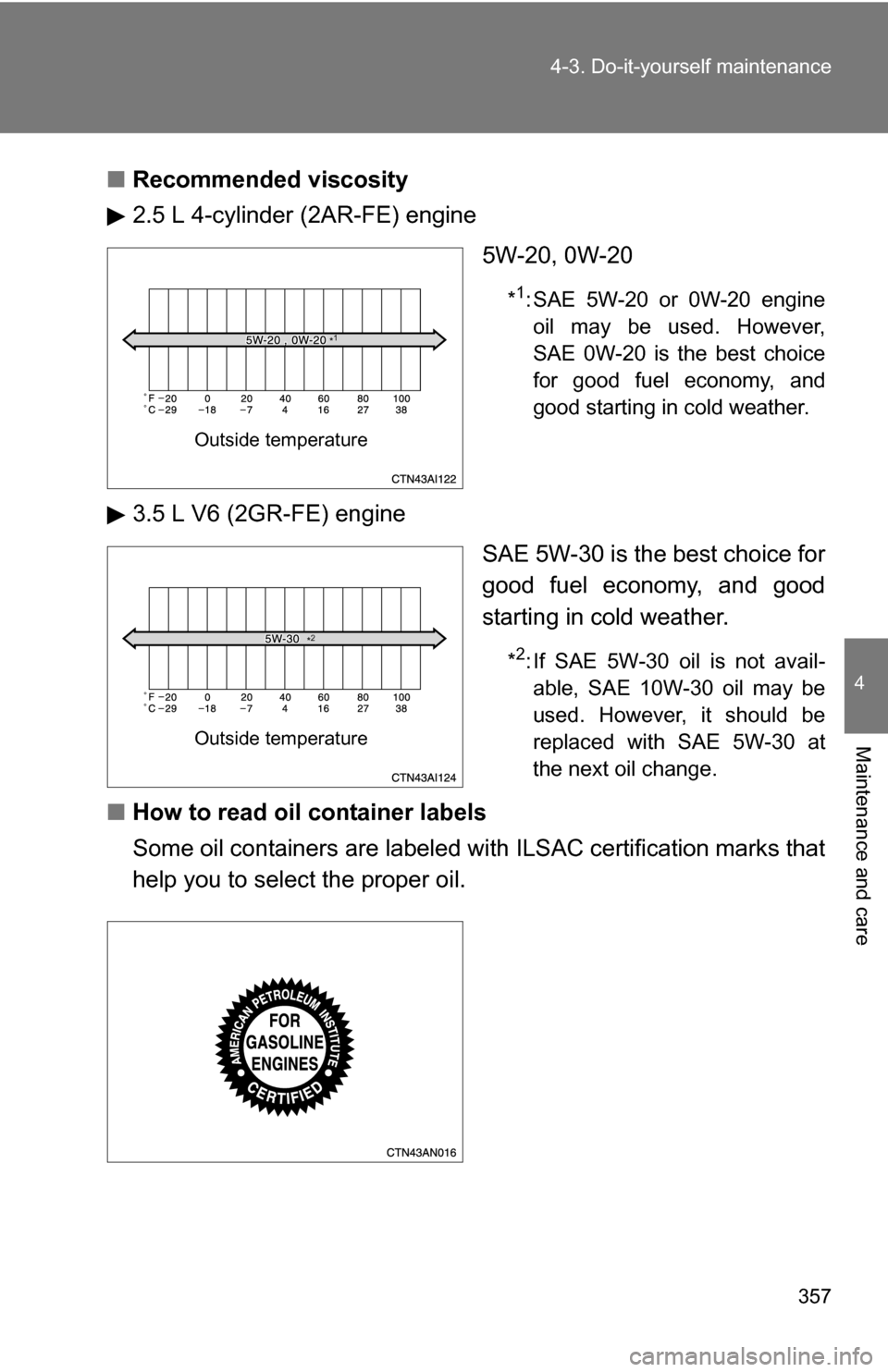
Recommended viscosity
2.5 L 4-cylinder (2AR-FE) engine
5W-20, 0W-20
*1: SAE 5W-20 or 0W-20 engineoil may be used. However,
SAE 0W-20 is the best choice
for good fuel economy, and
good starting in cold weather.
3.5 L V6 (2GR-FE) engine
SAE 5W-30 is the best choice for
good fuel economy, and good
starting in cold weather.
*2: If SAE 5W-30 oil is not avail-able, SAE 10W-30 oil may be
used. However, it should be
replaced with SAE 5W-30 at
the next oil change.
■ How to read oil container labels
Some oil containers are labeled with ILSAC certification marks that
help you to select the proper oil.
Outside temperature
*1
Outside temperature
*2
Page 378 of 516
378 4-3. Do-it-yourself maintenance
■Effects of incorrect tire inflation pressure
Driving with incorrect tire inflation pressure ma y result in the following:
●Reduced fuel efficiency
●Reduced driving comfort and tire life
●Reduced safety
●Damage to the drive train
If a tire needs frequent re filling, have it checked by your Toyota dealer.
■Instructions for checking tire inflation pressure
When checking tire inflation pressure, observe the following:
●Check only when the tires are cold.
If your vehicle has been parked for at least 3 hours and has not been
driven for more than 1 mile or 1.5 km, you will get an accurate cold
tire inflation pressure reading.
●Always use a tire pressure gauge.
The appearance of the tire can be mi sleading. In addition, tire infla-
tion pressures that are even just a few pounds off can degrade ride
and handling.
●Do not bleed or reduce tire inflation pressure after driving. It is normal
for the tire inflation pressure to be higher after driving.
●Never exceed the vehicle capacity weight.
Passengers and luggage weight should be placed so that the vehicle
is balanced.
Page 394 of 516
394 4-3. Do-it-yourself maintenance
*1: Vehicles with towing package
*
2: Vehicles with 2.5 L 4-cylinder (2AR-FE) engine
*
3: Vehicles with 3.5 L V6 (2GR-FE) engine
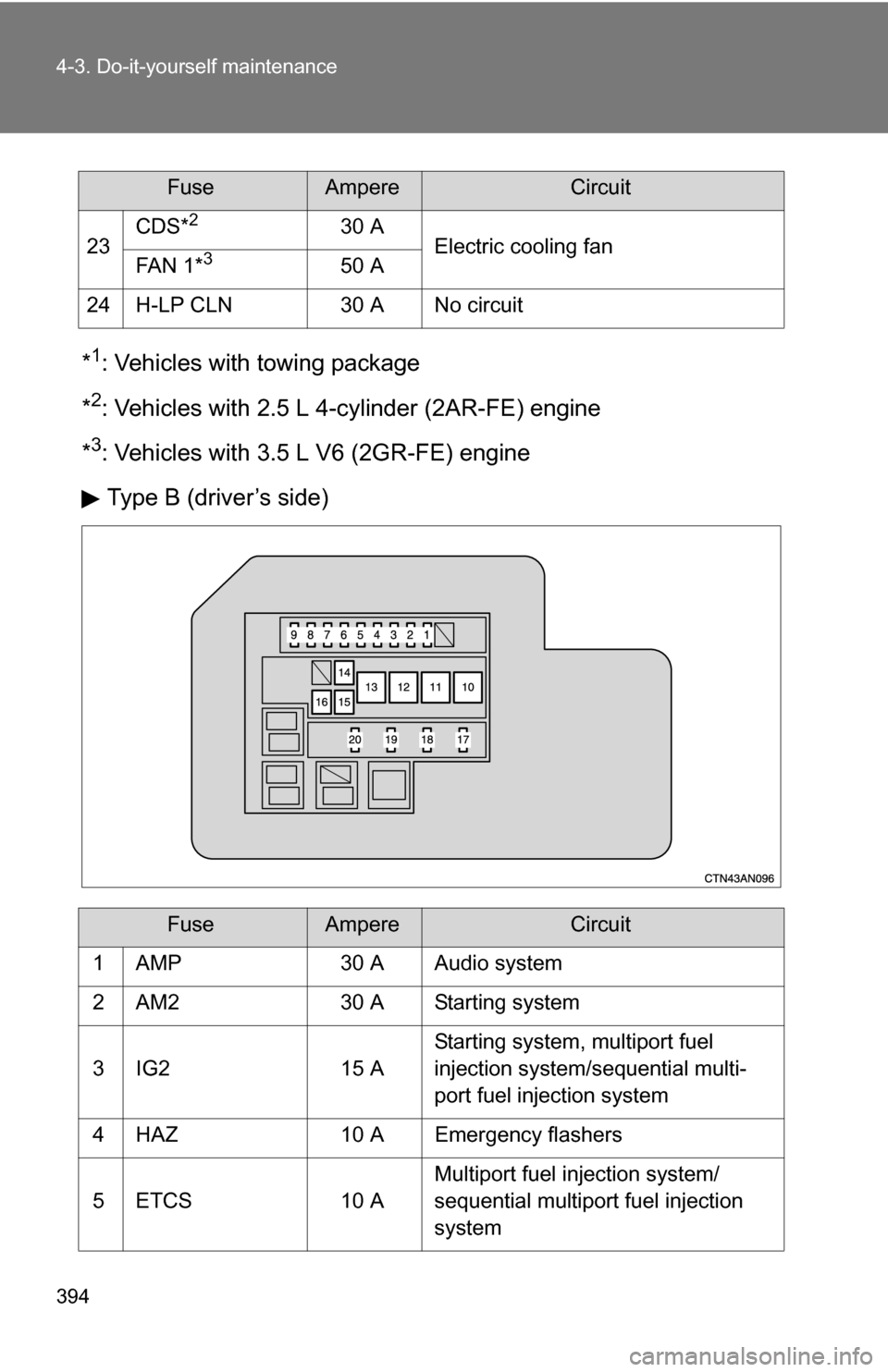
Type B (driver’s side)
23 CDS*
230 A
Electric cooling fan
FA N 1 *
350 A
24 H-LP CLN 30 A No circuit
FuseAmpereCircuit
1 AMP 30 A Audio system
2 AM2 30 A Starting system
3 IG2 15 A Starting system, multiport fuel
injection system/sequential multi-
port fuel injection system
4 HAZ 10 A Emergency flashers
5 ETCS 10 A Multiport fuel injection system/
sequential multiport fuel injection
system
FuseAmpereCircuit
Page 395 of 516
395
4-3. Do-it-yourself maintenance
4
Maintenance and care
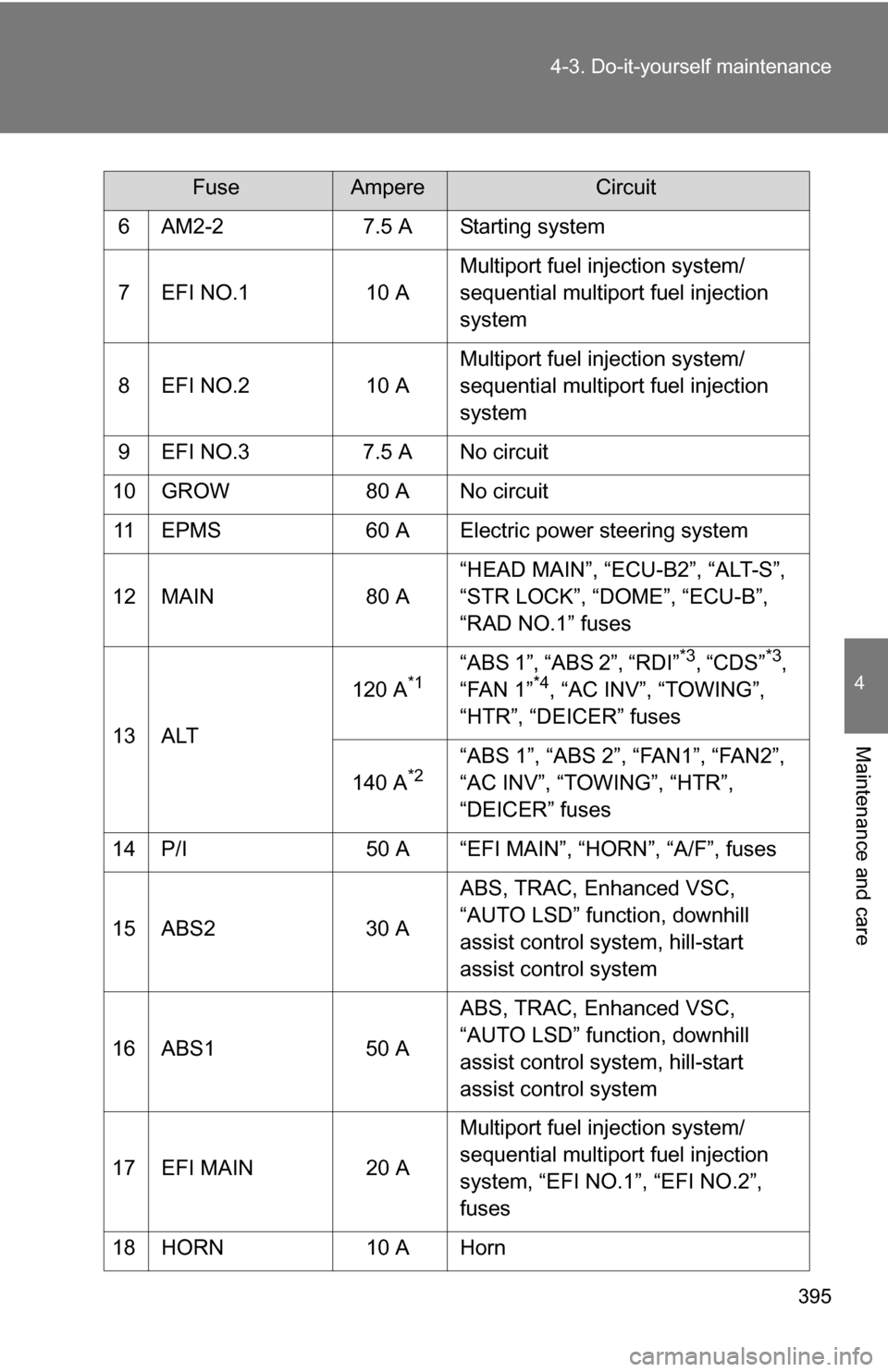
6 AM2-2
7.5 A Starting system
7 EFI NO.1 10 AMultiport fuel injection system/
sequential multiport fuel injection
system
8 EFI NO.2 10 AMultiport fuel injection system/
sequential multiport fuel injection
system
9 EFI NO.3 7.5 A No circuit
10 GROW 80 A No circuit
11 EPMS 60 A Electric power steering system
12 MAIN 80 A“HEAD MAIN”, “ECU-B2”, “ALT-S”,
“STR LOCK”, “DOME”, “ECU-B”,
“RAD NO.1” fuses
13 ALT 120 A
*1“ABS 1”, “ABS 2”, “RDI”*3, “CDS”*3,
“FAN 1”*4, “AC INV”, “TOWING”,
“HTR”, “DEICER” fuses
140 A
*2“ABS 1”, “ABS 2”, “FAN1”, “FAN2”,
“AC INV”, “TOWING”, “HTR”,
“DEICER” fuses
14 P/I 50 A “EFI MAIN”, “HORN”, “A/F”, fuses
15 ABS2 30 A ABS, TRAC, Enhanced VSC,
“AUTO LSD” function, downhill
assist control system, hill-start
assist control system
16 ABS1 50 A ABS, TRAC, Enhanced VSC,
“AUTO LSD” function, downhill
assist control system, hill-start
assist control system
17 EFI MAIN 20 A Multiport fuel injection system/
sequential multiport fuel injection
system, “EFI NO.1”, “EFI NO.2”,
fuses
18 HORN 10 A Horn
FuseAmpereCircuit
Page 396 of 516
396 4-3. Do-it-yourself maintenance
*1: Vehicles without towing package
*
2: Vehicles with towing package
*
3: Vehicles with 2.5 L 4-cylinder (2AR-FE) engine
*
4: Vehicles with 3.5 L V6 (2GR-FE) engine
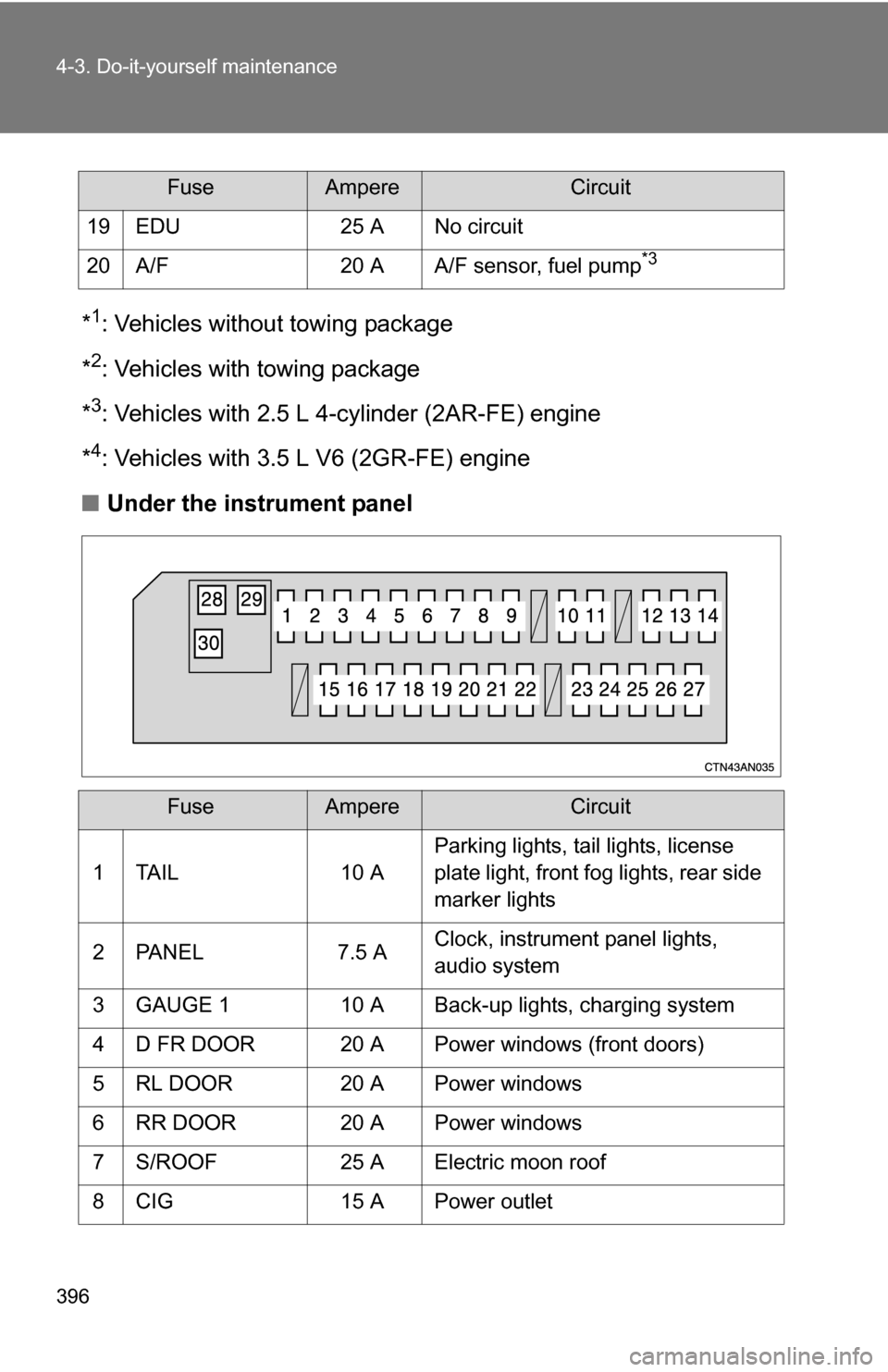
■ Under the instrument panel
19 EDU 25 A No circuit
20 A/F 20 A A/F sensor, fuel pump
*3
FuseAmpereCircuit
1 TAIL 10 A Parking lights, tail lights, license
plate light, front fog lights, rear side
marker lights
2 PANEL 7.5 A Clock, instrument panel lights,
audio system
3 GAUGE 1 10 A Back-up lights, charging system
4 D FR DOOR 20 A Power windows (front doors)
5 RL DOOR 20 A Power windows
6 RR DOOR 20 A Power windows
7 S/ROOF 25 A Electric moon roof
8 CIG 15 A Power outlet
FuseAmpereCircuit
Page 397 of 516
397
4-3. Do-it-yourself maintenance
4
Maintenance and care
9 ACC
7.5 AAudio system, power outlets,
power rear view mirror control,
automatic transmission shift lock
system, main body ECU, clock,
smart key system
10 MIR HTR 10 A Outside rear view mirror defoggers
11 PWR OUTLET 15 A Power outlet
12 RR FOG 10 A No circuit
13 IGN 7.5 AMultiport fuel injection system/
sequential multiport fuel injection
system, steering lock system, front
passenger occupant classification
system, smart key system, SRS
airbag system
14 GAUGE 2 7.5 A Gauges and meters
15 S-HTR 15 A Seat heaters
16 FR WIP 25 A Windshield wipers
17 RR WIP 15 A Rear window wiper
18 WSH 15 AWindshield washer, rear window
washer
19 ECU IG 1 10 AElectric cooling fan, ABS, TRAC,
Enhanced VSC, “AUTO LSD” func-
tion, downhill assist control system,
hill-start assist control system,
active torque control 4WD system,
automatic transmission shift lock
system, air conditioning system,
main body ECU, electric moon
roof, stop/tail lights, electric power
steering system, clock, AC inverter,
auto anti-glare inside rear view mir-
ror
20 ECU IG 2 10 AAir conditioning system, rear win-
dow defogger, emergency flashers
FuseAmpereCircuit
Page 398 of 516
398 4-3. Do-it-yourself maintenance
*: Vehicles without smart key system
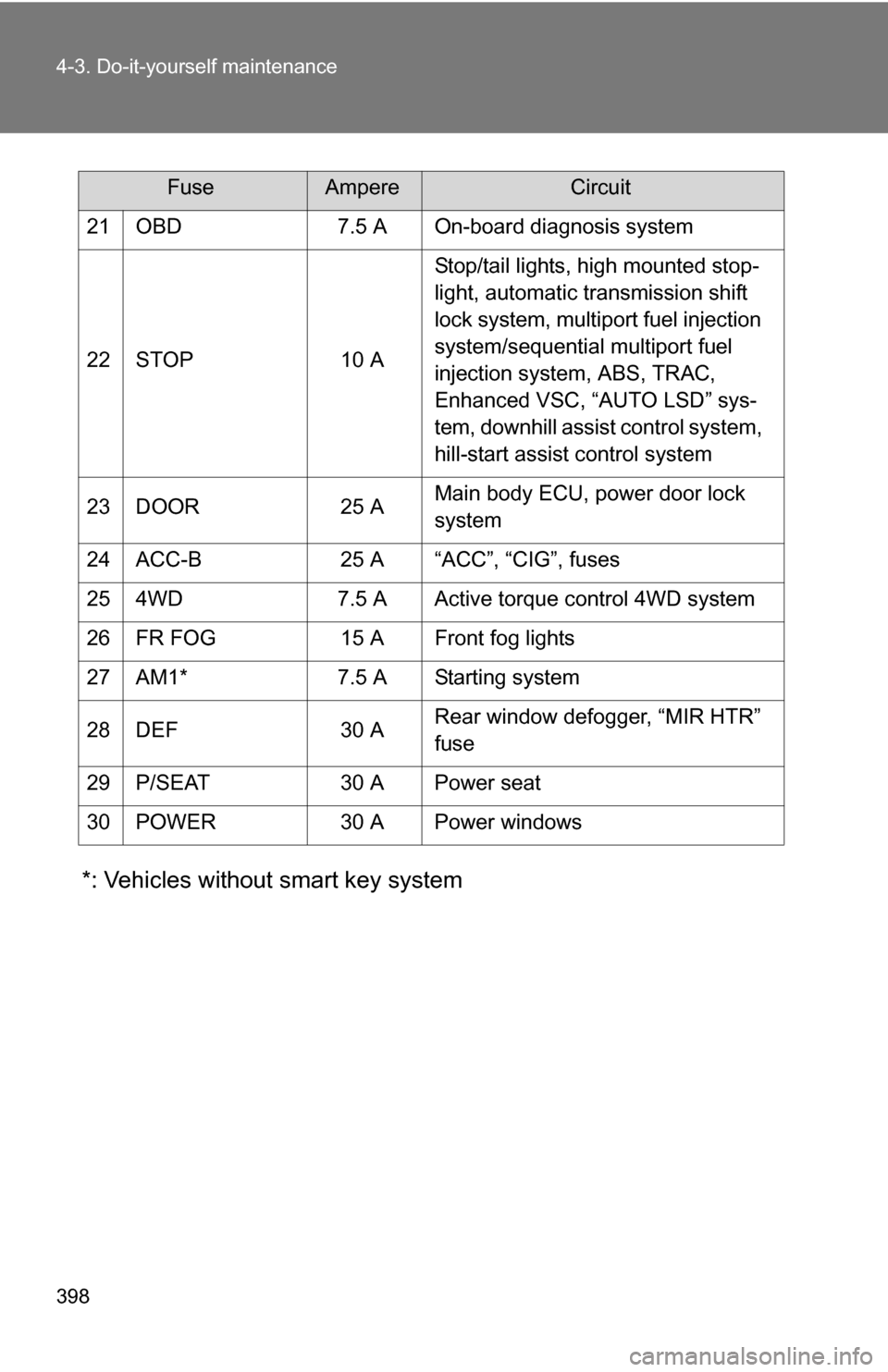
21 OBD7.5 A On-board diagnosis system
22 STOP 10 AStop/tail lights, high mounted stop-
light, automatic transmission shift
lock system, multiport fuel injection
system/sequential multiport fuel
injection system, ABS, TRAC,
Enhanced VSC, “AUTO LSD” sys-
tem, downhill assist control system,
hill-start assist control system
23 DOOR 25 AMain body ECU, power door lock
system
24 ACC-B 25 A “ACC”, “CIG”, fuses
25 4WD 7.5 A Active torque control 4WD system
26 FR FOG 15 A Front fog lights
27 AM1* 7.5 A Starting system
28 DEF 30 ARear window defogger, “MIR HTR”
fuse
29 P/SEAT 30 A Power seat
30 POWER 30 A Power windows
FuseAmpereCircuit
Page 409 of 516
When trouble arises5
409
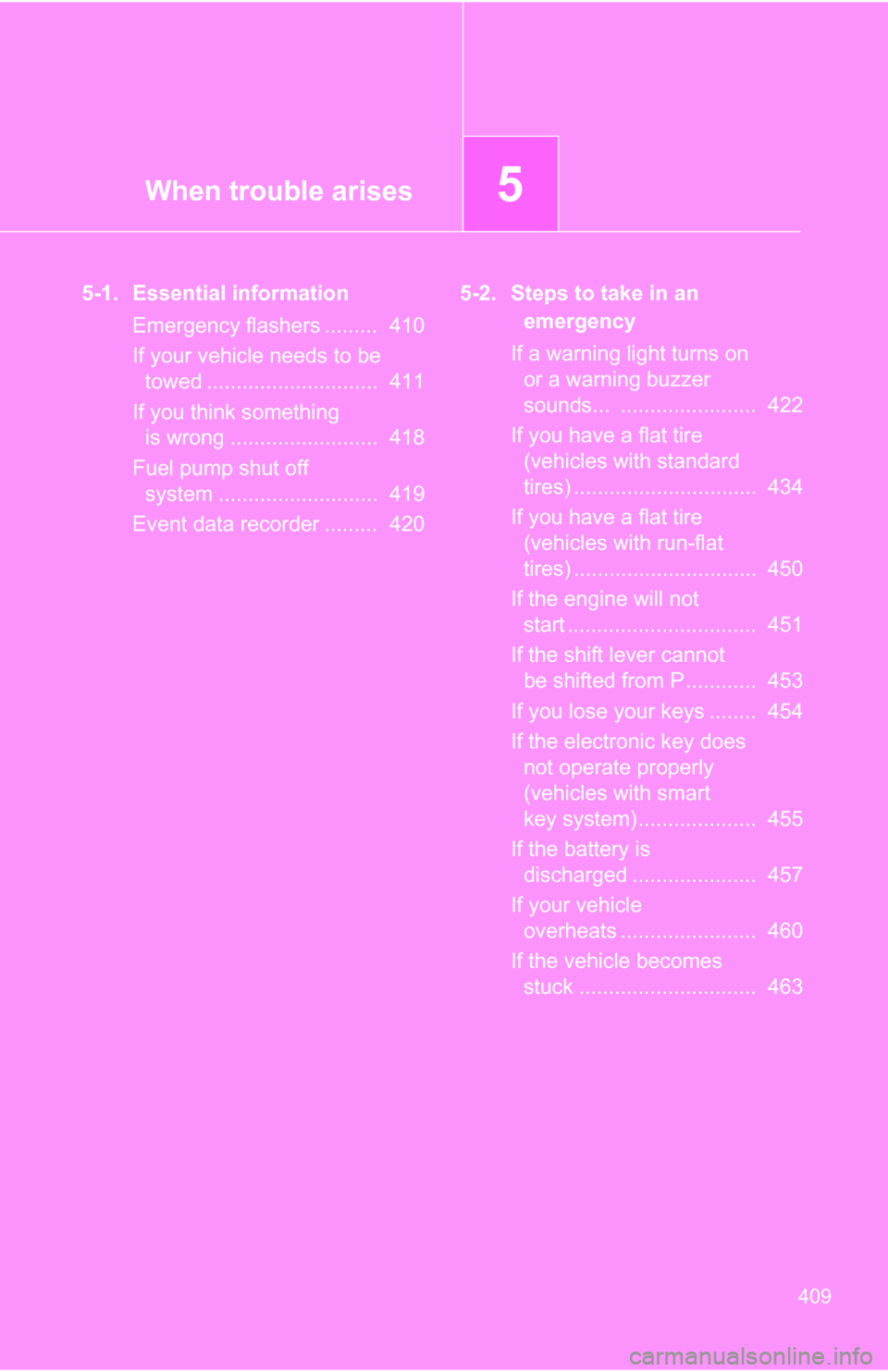
5-1. Essential informationEmergency flashers ......... 410
If your vehicle needs to be towed ............................. 411
If you think something is wrong ......................... 418
Fuel pump shut off system ........................... 419
Event data recorder ......... 420 5-2. Steps to take in an
emergency
If a warning light turns on or a warning buzzer
sounds... ....................... 422
If you have a flat tire (vehicles with standard
tires) ............................... 434
If you have a flat tire (vehicles with run-flat
tires) ............................... 450
If the engine will not start ................................ 451
If the shift lever cannot be shifted from P............ 453
If you lose your keys ........ 454
If the electronic key does not operate properly
(vehicles with smart
key system).................... 455
If the battery is discharged ..................... 457
If your vehicle overheats ....................... 460
If the vehicle becomes stuck .............................. 463