suspension TOYOTA SEQUOIA 2022 User Guide
[x] Cancel search | Manufacturer: TOYOTA, Model Year: 2022, Model line: SEQUOIA, Model: TOYOTA SEQUOIA 2022Pages: 592, PDF Size: 10.82 MB
Page 296 of 592
2964-5. Using the driving support systems
SEQUOIA_OM_USA_OM0C047U
WARNING
■Cautions regarding the use of the system
There is a limit to the degree of recognition accuracy and cont rol perfor-
mance that this system can provide, do not overly rely on this system. The
driver is always responsible for paying attention to the vehicl e’ surroundings
and driving safely.
■ To ensure the system can operate properly
Observe the following precautions.
Failing to do so may result in the vehicle being unable to be driven safely
and possibly cause an accident.
● Do not damage the sensors, and always keep them clean.
● Do not attach a sticker or install an electronic component, such as a backlit
license plate (especially fluorescent type), fog lights, fender pole or wire-
less antenna near a radar sensor.
● Do not subject the surrounding area of the sensor to a strong impact. If
subjected to an impact, have the vehicle inspected by your Toyota dealer.
If the front or rear bumper needs to be removed/installed or replaced, con-
tact your Toyota dealer.
● Do not modify, disassemble or paint the sensors.
● Do not attach a license plate cover.
● Keep your tires properly inflated.
■ When to disable the function
In the following situations, disable the function as it may operate even
though there is no possibility of a collision.
● Failing to observe the warnings above.
● A non-genuine Toyota suspension (lowered suspension, etc.) is installed.
■ Notes when washing the vehicle
Do not apply intensive bursts of water or steam to the sensor a rea.
Doing so may result in the sensor malfunctioning.
● When using a high pressure washer to wash the vehicle, do not spray the
sensors directly, as doing so may cause a sensor to malfunction .
● When using steam to clean the vehicle, do not direct steam too close to
the sensors as doing so may cause a sensor to malfunction.
Page 308 of 592
3084-5. Using the driving support systems
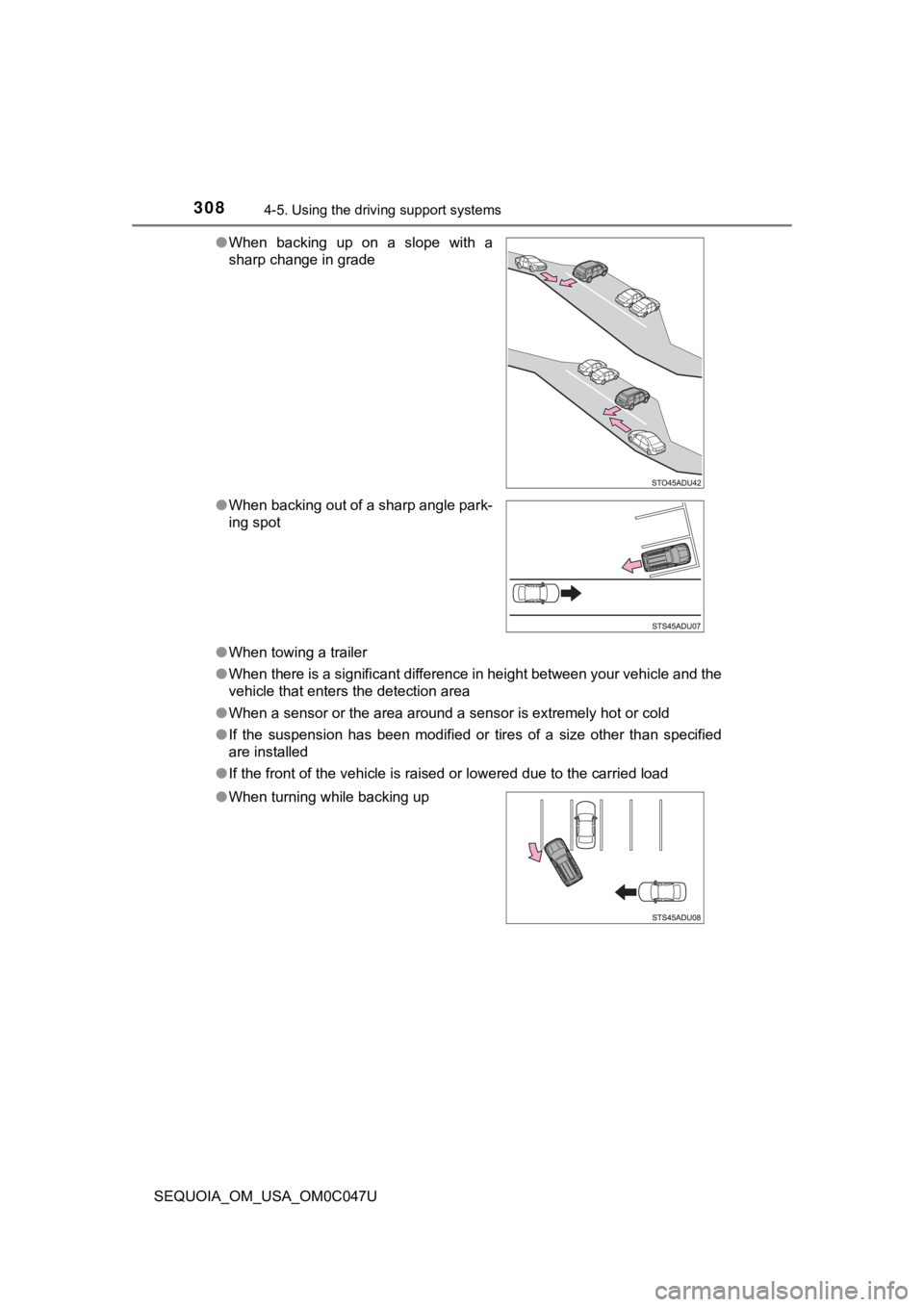
SEQUOIA_OM_USA_OM0C047U●
When towing a trailer
● When there is a significant difference in height between your vehicle and the
vehicle that enters the detection area
● When a sensor or the area around a sensor is extremely hot or c old
● If the suspension has been modified or tires of a size other th an specified
are installed
● If the front of the vehicle is raised or lowered due to the car ried load
●
When backing up on a slope with a
sharp change in grade
● When backing out of a sharp angle park-
ing spot
● When turning while backing up
Page 310 of 592
3104-5. Using the driving support systems
SEQUOIA_OM_USA_OM0C047U●
When there are spinning objects near your vehicle such as the f an of an air
conditioning unit
● When water is splashed or sprayed toward the rear bumper, such as from a
sprinkler
● Moving objects (flags, exhaust fumes, large rain droplets or snowflakes, rain
water on the road surface, etc.)
● When the distance between your vehicle and a guardrail, wall, etc., that
enters the detection area is short
● Gratings and gutters
● When a sensor or the area around a sensor is extremely hot or c old
● If the suspension has been modified or tires of a size other th an specified
are installed
● If the front of the vehicle is raised or lowered due to the car ried load
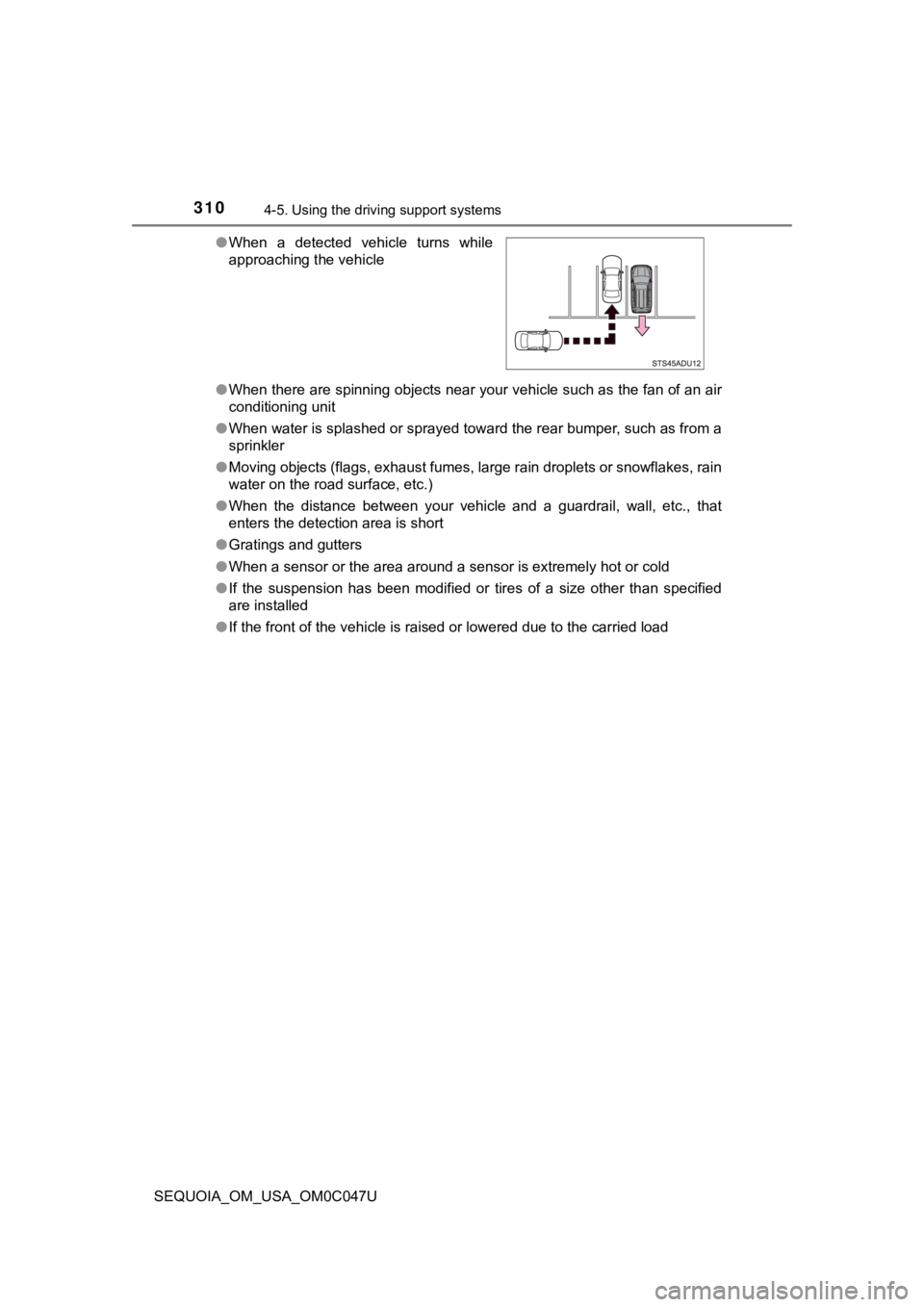
●
When a detected vehicle turns while
approaching the vehicle
Page 311 of 592
3114-5. Using the driving support systems
4
Driving
SEQUOIA_OM_USA_OM0C047U
Electronically modulated air suspension
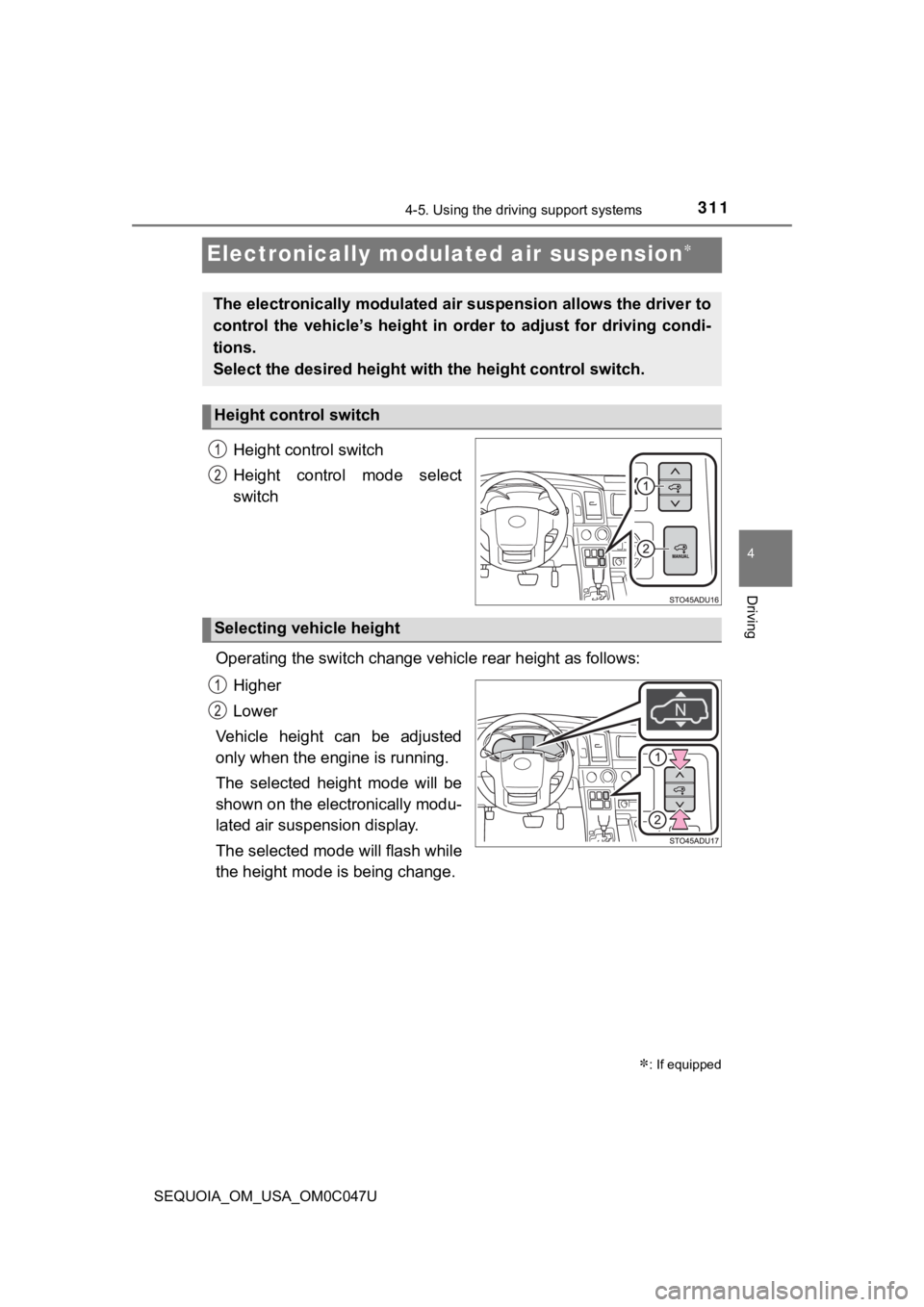
Height control switch
Height control mode select
switch
Operating the switch change vehicle rear height as follows: Higher
Lower
Vehicle height can be adjusted
only when the engine is running.
The selected height mode will be
shown on the electronically modu-
lated air suspension display.
The selected mode will flash while
the height mode is being change.
: If equipped
The electronically modulated air suspension allows the driver t o
control the vehicle’s height in order to adjust for driving condi-
tions.
Select the desired height with the height control switch.
Height control switch
Selecting vehicle height
Page 313 of 592
3134-5. Using the driving support systems
4
Driving
SEQUOIA_OM_USA_OM0C047U
■Automatic leveling function
Regardless of the number of occupants or the luggage load, vehi cle height in
any mode is always adjusted to a fixed height by the automatic leveling func-
tion.
■ When “HI” mode is selected
The vehicle height will change to “N” mode when driving at the speeds of
18 mph (30 km/h).
■ When “LO” mode is selected
●The vehicle height will change to “N” mode when vehicle speed e xceeds
7 mph (12 km/h).
● This mode allows for easy access to the vehicle (getting in and out) and
easy loading and unloading.
■ The electronically modulated air suspension will not operate in the fol-
lowing cases:
● The underbody of the vehicle is touching the surface of the roa d.
● The area around the suspension is covered with ice.
The height control indicators will blink, turn off and then turn on continuously
to indicate that the electronically modulated air suspension is not operational.
To re-enable operation, turn off the engine and then restart it .
■ Even if you hear an operating noise
This does not indicate a problem in the electronically modulate d air suspen-
sion.
■ The electronically modulated air suspension failure warning
The warning message is displayed on the multi-information displ ay, and the
electronically modulated air suspension cannot be activated unt il the malfunc-
tion is corrected.
Stop the engine and start again. If the warning message turns off, the system
operating correctly. If the warning message continues to be displayed, have
your vehicle inspected by your Toyota dealer as soon as possibl e.
Page 314 of 592

3144-5. Using the driving support systems
SEQUOIA_OM_USA_OM0C047U
WARNING
■The electronically modulated air suspension must be turned off in the
following circumstances:
Otherwise, the automatic leveling function may cause the vehicle’s height to
change, and you may catch part of your body in the vehicle, resulting in an
unexpected accident:
● When driving through water such as shallow streams (Put the veh icle
height in “HI” mode and turn off the electronically modulated a ir suspen-
sion. Drive at 18 mph [30 km/h] or slower.)
● When jacking up the vehicle, installing tire chains or tying th e vehicle with
chains/wires for transportation via flat bed truck (Turn the system to the
manual mode and stop the engine.)
● When the vehicle must be towed (Put the vehicle height in “N” mode and
turn the system to the manual mode.)
● When the vehicle gets stuck (Turn the system to the manual mode .)
● When disconnecting a trailer (Put the vehicle height in “N” mod e and turn
the system to the manual mode.)
■ Selecting the correct height mode
Observe the following precautions to prevent accidents.
Failure to do so may cause damage to parts of the vehicle, as w ell as dan-
gerous handling characteristics, which may lead to fatal or inj ury accidents.
● Before you lower the vehicle’s height, check under the vehicle to make
sure that no one is there.
● “HI” mode should only be used when driving on rough roads, for example
when driving off-road.
Because the vehicle’s center of gravity will become higher when in the
mode, the vehicle may become unstable when turning abruptly, resulting
in an accident.
● Do not select “HI” mode when you load cargo on the roof luggage carrier.
Because the vehicle’s center of gravity will become higher when in the
mode, the vehicle may become unstable when turning abruptly, resulting
in an accident.
Page 316 of 592
3164-5. Using the driving support systems
SEQUOIA_OM_USA_OM0C047U
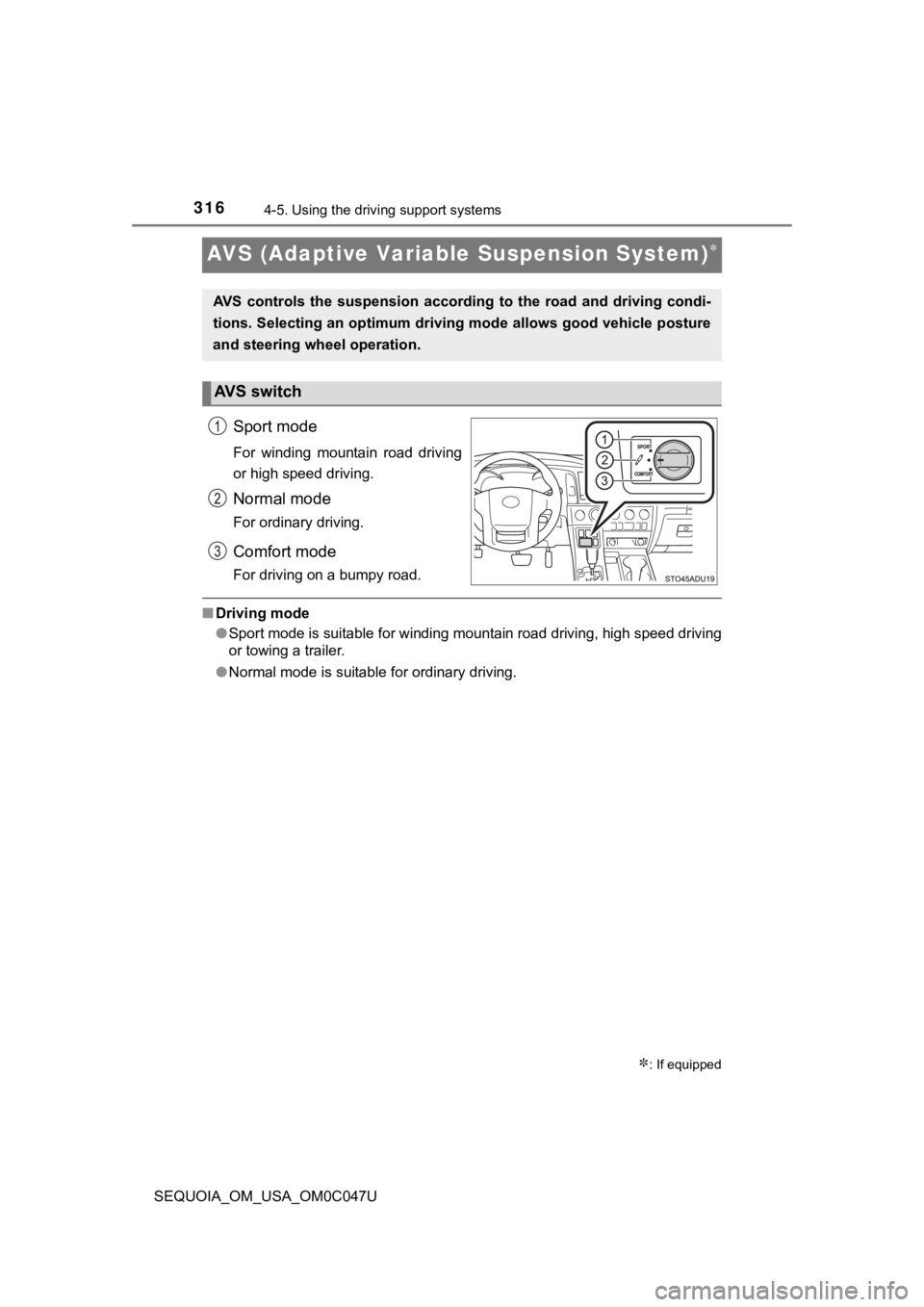
AVS (Adaptive Variable Suspension System)
Sport mode
For winding mountain road driving
or high speed driving.
Normal mode
For ordinary driving.
Comfort mode
For driving on a bumpy road.
■Driving mode
●Sport mode is suitable for winding mountain road driving, high speed driving
or towing a trailer.
● Normal mode is suitable for ordinary driving.
: If equipped
AVS controls the suspension accord ing to the road and driving condi-
tions. Selecting an optimum drivi ng mode allows good vehicle posture
and steering wheel operation.
AVS switch
Page 330 of 592

3304-5. Using the driving support systems
SEQUOIA_OM_USA_OM0C047U
WARNING
■When the TRAC/VSC/Trailer Sway Control systems is turned off
Be especially careful and drive at a speed appropriate to the r oad condi-
tions. As these are the systems to help ensure vehicle stability and driving
force, do not turn the TRAC/VSC/Trailer Sway Control systems off unless
necessary.
■ Replacing tires
Make sure that all tires are of the specified size, brand, trea d pattern and
total load capacity. In addition, make sure that the tires are inflated to the
recommended tire inflation pressure level.
The ABS, TRAC, Trailer Sway Control and VSC systems will not function
correctly if different tires are installed on the vehicle.
Contact your Toyota dealer for further information when replaci ng tires or
wheels.
■ Handling of tires and the suspension
Using tires with any kind of problem or modifying the suspensio n will affect
the driving assist systems, and may cause a system to malfunction.
■ Trailer Sway Control precaution
The Trailer Sway Control system is not able to reduce trailer sway in all situ-
ations. Depending on many factors such as the conditions of the vehicle,
trailer, road surface, and driving environment, the Trailer Swa y Control sys-
tem may not be effective. Refer to your trailer owner’s manual for informa-
tion on how to tow your trailer properly.
■ If trailer sway occurs
Observe the following precautions.
Failing to do so may cause death or serious injury.
● Firmly grip the steering wheel. Steer straight ahead.
Do not try to control trailer swaying by turning the steering w heel.
● Begin releasing the accelerator pedal immediately but very grad ually to
reduce speed.
Do not increase speed. Do not apply vehicle brakes.
If you make no extreme correction with the steering or brakes, your vehicle
and trailer should stabilize. ( P. 209)
Page 332 of 592

3324-6. Driving tips
SEQUOIA_OM_USA_OM0C047U
WARNING
■Off-road vehicle precautions
Always observe the following precautions to minimize the risk of death, seri-
ous injury or damage to your vehicle:
● In a rollover crash, an unbelted person is significantly more likely to die
than a person wearing a seat belt. Therefore, the driver and al l passengers
should always fasten their seat belts.
● Avoid sharp turns or abrupt maneuvers, if at all possible.
Failure to operate this vehicle correctly may result in loss of control or
vehicle rollover causing death or serious injury.
● Loading cargo on the roof luggage carrier will make the center of the vehi-
cle gravity higher. Avoid high speeds, sudden starts, sharp turns, sudden
braking or abrupt maneuvers, otherwise it may result in loss of control or
vehicle rollover due to failure to operate this vehicle correct l y.
● Always slow down in gusty crosswinds. Because of its profile and higher
center of gravity, your vehicle is more sensitive to side winds than an ordi-
nary passenger car. Slowing down will allow you to have better control.
● When driving off-road or in rugged terrain, do not drive at excessive
speeds, jump, make sharp turns, strike objects, etc. This may cause loss
of control or vehicle rollover causing death or serious injury. You are also
risking expensive damage to your vehicle’s suspension and chass is.
● Do not drive horizontally across steep slopes. Driving straight up or
straight down is preferred. Your vehicle (or any similar off-road vehicle)
can tip over sideways much more easily than forward or backward.
Page 334 of 592

3344-6. Driving tips
SEQUOIA_OM_USA_OM0C047U
WARNING
■Off-road driving precautions
Always observe the following precautions to minimize the risk of death, seri-
ous injury or damage to your vehicle:
● Drive carefully when off the road. Do not take unnecessary risks by driving
in dangerous places.
● Do not grip the steering wheel spokes when driving off-road. A bad bump
could jerk the wheel and injure your hands. Keep both hands and espe-
cially your thumbs on the outside of the rim.
● Always check your brakes for effectiveness immediately after dr iving in
sand, mud, water or snow.
● After driving through tall grass, mud, rock, sand, rivers, etc. , check that
there is no grass, bush, paper, rags, stone, sand, etc. adhering or trapped
on the underbody. Clear off any such matter from the underbody. If the
vehicle is used with these materials trapped or adhering to the underbody,
a breakdown or fire could occur.
● In a rollover crash, an unbelted person is significantly more likely to die
than a person wearing a seat belt. Therefore, the driver and al l passengers
should fasten their seat belts whenever the vehicle is moving.
● When driving off-road or in rugged terrain, do not drive at excessive
speeds, jump, make sharp turns, strike objects, etc. This may cause loss
of control or vehicle rollover causing death or serious injury. You are also
risking expensive damage to your vehicle’s suspension and chass is.