battery TOYOTA SIENNA 2007 Service Owner's Manual
[x] Cancel search | Manufacturer: TOYOTA, Model Year: 2007, Model line: SIENNA, Model: TOYOTA SIENNA 2007Pages: 3000, PDF Size: 52.26 MB
Page 321 of 3000

2GR-FE ENGINE CONTROL SYSTEM – SFI SYSTEMES–253
ES
MONITOR STRATEGY
TYPICAL ENABLING CONDITIONS
All:
Exhaust Camshaft Sensor Range Check / Rationality (While starting engine):
Exhaust Camshaft Sensor Range Check / Rationality (After starting engine):
Exhaust Camshaft Sensor Range Check (Chattering, Low voltage, High voltage):
TYPICAL MALFUNCTION THRESHOLDS
Exhaust Camshaft Sensor Range Check / Rationality (While starting engine):
Exhaust Camshaft Sensor Range Check / Rationality (After starting engine):
Exhaust Camshaft Sensor Range Check (Chattering):
Related DTCsP0365: Exhaust camshaft sensor (Bank 1) range check / rationality (while starting
engine)
P0365: Exhaust camshaft sensor (Bank 1) range check / rationality (after starting
engine)
P0365: Exhaust camshaft sensor (Bank 1) range check (chattering)
P0367: Exhaust camshaft sensor (Bank 1) range check (low voltage)
P0368: Exhaust camshaft sensor (Bank 1) range check (high voltage)
P0390: Exhaust camshaft sensor (Bank 2) range check / rationality (while starting
engine)
P0390: Exhaust camshaft sensor (Bank 2) range check / rationality (after starting
engine)
P0390: Exhaust camshaft sensor (Bank 2) range check (chattering)
P0392: Exhaust camshaft sensor (Bank 2) range check (low voltage)
P0393: Exhaust camshaft sensor (Bank 2) range check (high voltage)
Required Sensors / Components (Main) Exhaust camshaft sensor (Bank 1 and 2)
Required Sensors / Components (Related) Exhaust camshaft sensor
Frequency of Operation Continuous
Duration5 seconds: Exhaust camshaft sensor range check / rationality (After starting engine)
4 seconds: Others
MIL Operation2 driving cycles: Exhaust camshaft sensor range check / rationality (After starting
engine)
Immediate: Others
Sequence of Operation None
The monitor will run whenever these DTCs are not
presentNone
Sta r t e r ON
Battery voltage while starter is ON at least once Less than 11 V
Engine RPM 600 rpm or more
Sta r t e r OF F
Battery voltage 8 V or more
Ignition Switch ON
Sta r t e r OF F
Ignition Switch ON and time after ignition switch is OFF
to ON2 seconds or more
Battery voltage 8 V or more
Exhaust camshaft sensor signal No signal
Exhaust camshaft sensor signal No signal
Exhaust camshaft sensor signal Less than 0.3 V, or more than 4.7 V
Page 327 of 3000

2GR-FE ENGINE CONTROL SYSTEM – SFI SYSTEMES–259
ES
TYPICAL ENABLING CONDITIONS
TYPICAL MALFUNCTION THRESHOLDS
MONITOR RESULT
Refer to CHECKING MONITOR STATUS (See page ES-19).
CONDITIONING FOR SENSOR TESTING
HINT:
Perform the operation with the engine speeds and durations described below prior to checking the
waveforms of the A/F and HO2 sensors. This is in order to activate the sensors sufficiently to obtain the
appropriate inspection results.
The monitor will run whenever these DTCs are not
presentP0011, P0012 (VVT System 1-Advance, Retard), P0021, P0022 (VVT System 2-
Adavance, Retard), P0031, P0032, P0051, P0052 (A/F Sensor Heater Sensor 1),
P0037, P0038, P0057, P0058 (O2 Sensor heater Sensor 2), P0100, P0101, P0102,
P0103 (MAF Sensor), P0115, P0116, P0117, P0118 (ECT Sensor), P0120, P0121,
P0122, P0123, P0220, P0222, P0223 , P2135 (TP Sensor), P0125 (Insufficient ECT
for Closed Loop), P0136, P0156 (O2 Sensor 2), P0171,P0172 (Fuel System),
P0300, P0301, P0302, P0303, P0304, P0305, P0306 (Misfire), P0335 (CKP
Sensor), P0340 (CMP Sensor), P0351, P0352, P0353, P0354, P0355, P0356
(Ignitor), P0500 (VSS), P2196, P2198 (A/F Sensor (Rationality)), P2A00, P2A03 (A/
F Sensor (Slow Response))
Battery voltage 11 V or more
IAT -10
C (14F) or more
ECT 75
C (167F) or more
Atmospheric pressure 0.75 or more
Idle OFF
Engine RPM Less than 3200 rpm
A/F sensor Activated
Fuel system status Closed loop
Engine load 10 to 70%
All of the following conditions are met Conditions 1, 2 and 3
1. Mass air flow rate 5 to 60 g/sec.
2. Front catalyst temperature (estimated) 600 to 750
C (1112 to 1382F)
3. Rear catalyst temperature (estimated) 100 to 900
C (212 to 1652F)
Rear HO2S monitor Completed
Shift position 4th or more
Oxygen Storage Capacity (OSC) of catalyst Less than 0.046 g (0.000101 lb)
Page 337 of 3000
2GR-FE ENGINE CONTROL SYSTEM – SFI SYSTEMES–409
ES
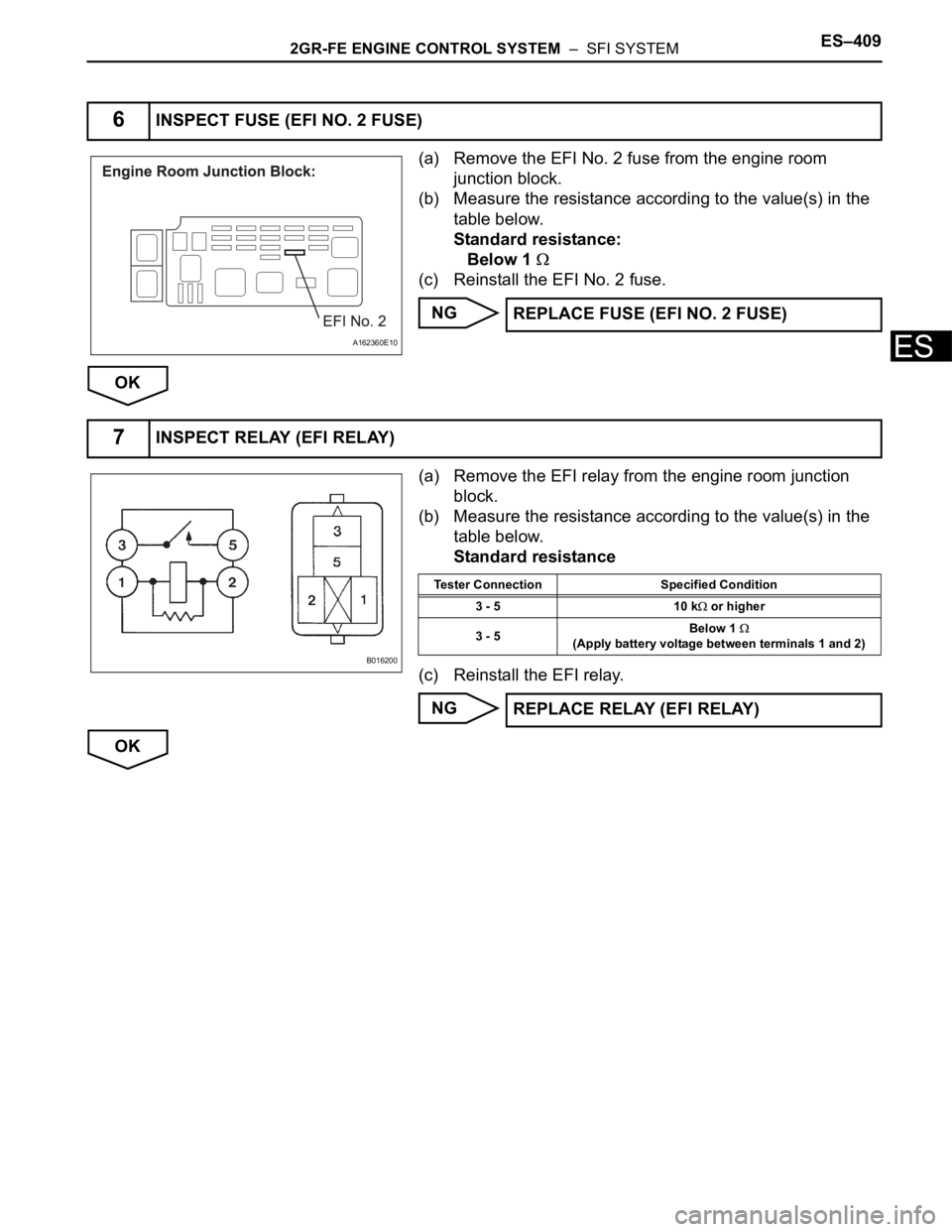
(a) Remove the EFI No. 2 fuse from the engine room
junction block.
(b) Measure the resistance according to the value(s) in the
table below.
Standard resistance:
Below 1
(c) Reinstall the EFI No. 2 fuse.
NG
OK
(a) Remove the EFI relay from the engine room junction
block.
(b) Measure the resistance according to the value(s) in the
table below.
Standard resistance
(c) Reinstall the EFI relay.
NG
OK
6INSPECT FUSE (EFI NO. 2 FUSE)
A162360E10
REPLACE FUSE (EFI NO. 2 FUSE)
7INSPECT RELAY (EFI RELAY)
B016200
Tester Connection Specified Condition
3 - 5 10 k
or higher
3 - 5Below 1
(Apply battery voltage between terminals 1 and 2)
REPLACE RELAY (EFI RELAY)
Page 339 of 3000
2GR-FE ENGINE CONTROL SYSTEM – SFI SYSTEMES–411
ES
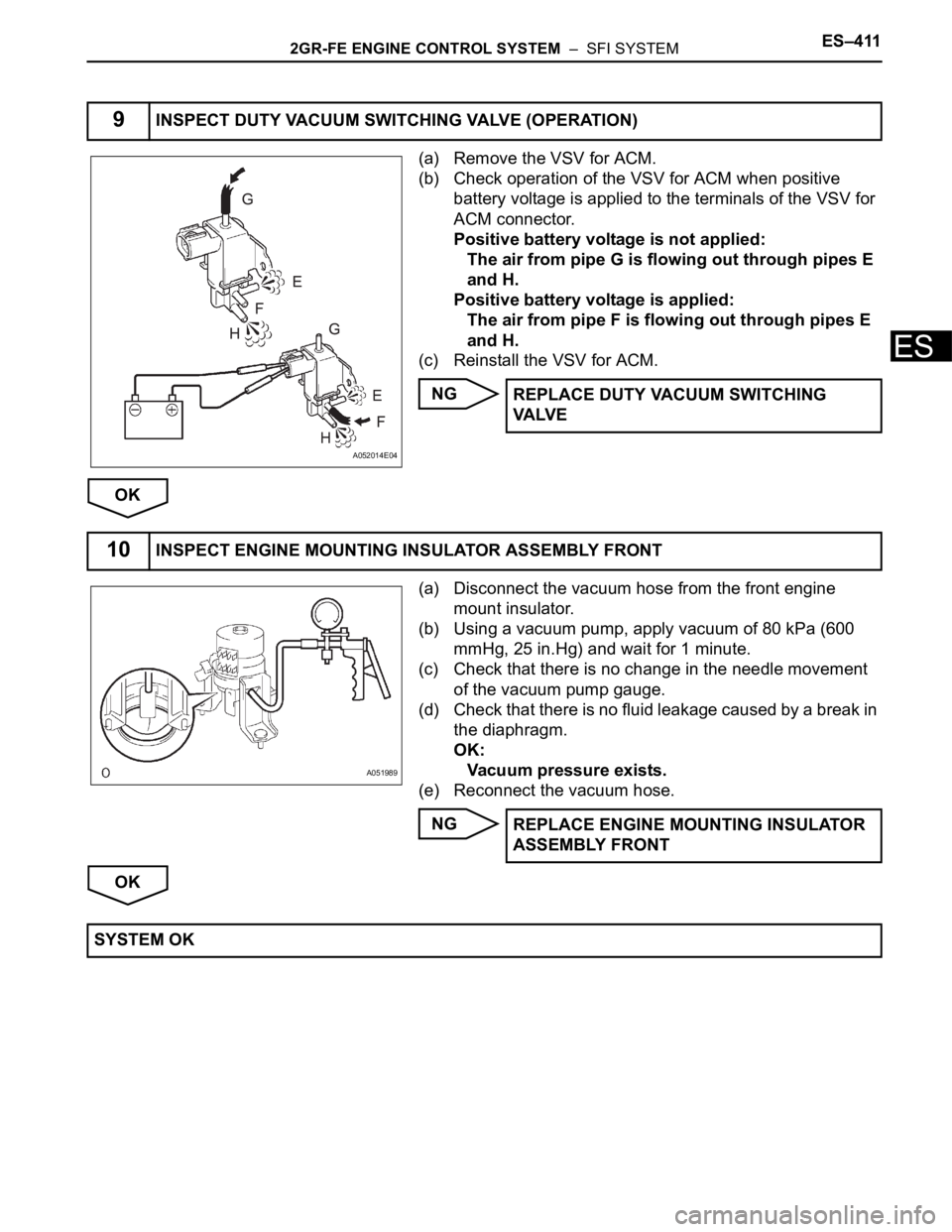
(a) Remove the VSV for ACM.
(b) Check operation of the VSV for ACM when positive
battery voltage is applied to the terminals of the VSV for
ACM connector.
Positive battery voltage is not applied:
The air from pipe G is flowing out through pipes E
and H.
Positive battery voltage is applied:
The air from pipe F is flowing out through pipes E
and H.
(c) Reinstall the VSV for ACM.
NG
OK
(a) Disconnect the vacuum hose from the front engine
mount insulator.
(b) Using a vacuum pump, apply vacuum of 80 kPa (600
mmHg, 25 in.Hg) and wait for 1 minute.
(c) Check that there is no change in the needle movement
of the vacuum pump gauge.
(d) Check that there is no fluid leakage caused by a break in
the diaphragm.
OK:
Vacuum pressure exists.
(e) Reconnect the vacuum hose.
NG
OK
9INSPECT DUTY VACUUM SWITCHING VALVE (OPERATION)
A052014E04
REPLACE DUTY VACUUM SWITCHING
VA LV E
10INSPECT ENGINE MOUNTING INSULATOR ASSEMBLY FRONT
A051989
REPLACE ENGINE MOUNTING INSULATOR
ASSEMBLY FRONT
SYSTEM OK
Page 341 of 3000
2GR-FE ENGINE CONTROL SYSTEM – SFI SYSTEMES–15
ES
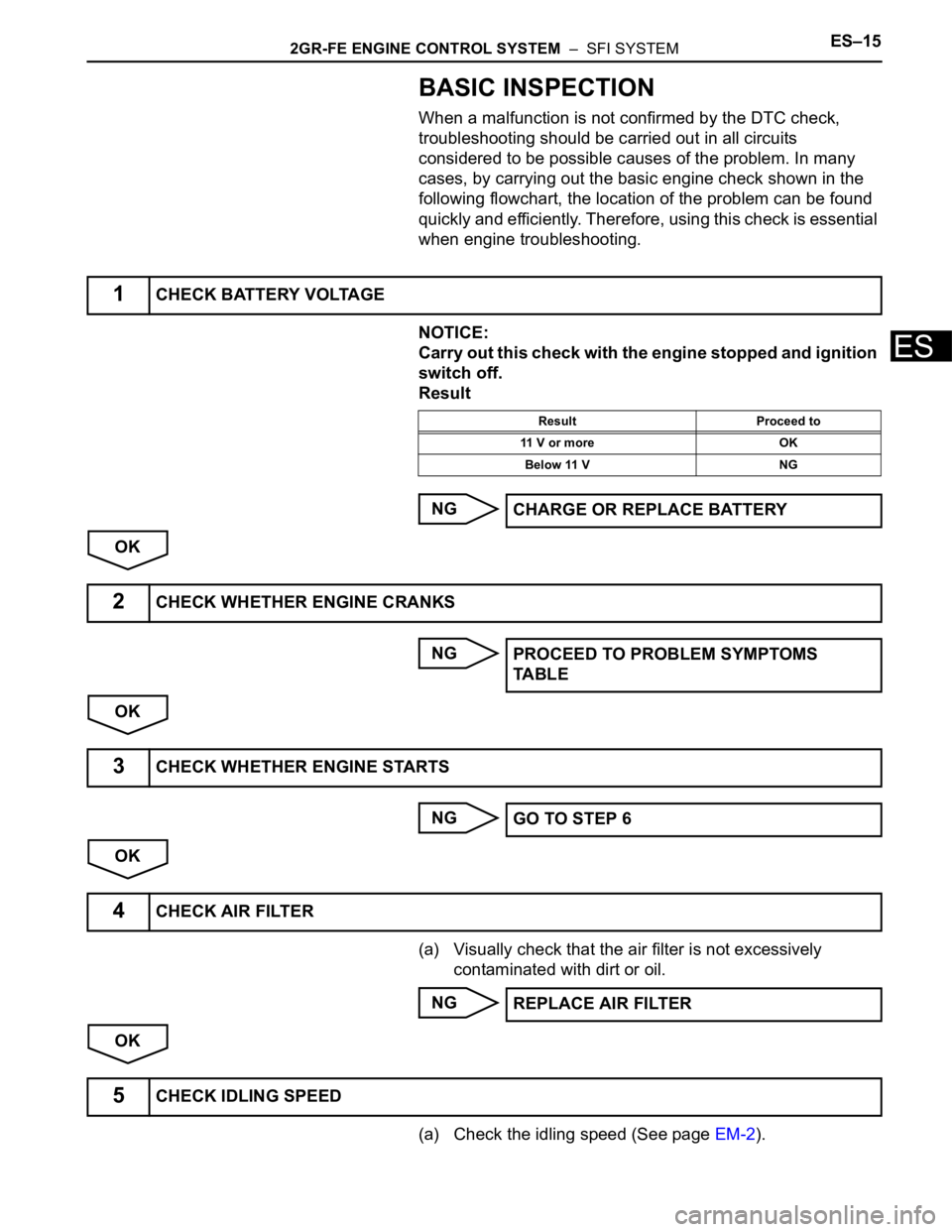
BASIC INSPECTION
When a malfunction is not confirmed by the DTC check,
troubleshooting should be carried out in all circuits
considered to be possible causes of the problem. In many
cases, by carrying out the basic engine check shown in the
following flowchart, the location of the problem can be found
quickly and efficiently. Therefore, using this check is essential
when engine troubleshooting.
NOTICE:
Carry out this check with the engine stopped and ignition
switch off.
Result
NG
OK
NG
OK
NG
OK
(a) Visually check that the air filter is not excessively
contaminated with dirt or oil.
NG
OK
(a) Check the idling speed (See page EM-2).
1CHECK BATTERY VOLTAGE
Result Proceed to
11 V or more OK
Below 11 V NG
CHARGE OR REPLACE BATTERY
2CHECK WHETHER ENGINE CRANKS
PROCEED TO PROBLEM SYMPTOMS
TA B L E
3CHECK WHETHER ENGINE STARTS
GO TO STEP 6
4CHECK AIR FILTER
REPLACE AIR FILTER
5CHECK IDLING SPEED
Page 352 of 3000

ES–262GR-FE ENGINE CONTROL SYSTEM – SFI SYSTEM
ES
READINESS MONITOR DRIVE
PAT T E R N
1. PURPOSE OF READINESS TESTS
• The On-Board Diagnostic (OBD II) system is
designed to monitor the performance of emission-
related components, and indicate any detected
abnormalities with DTCs (Diagnostic Trouble Codes).
Since various components need to be monitored in
different driving conditions, the OBD II system is
designed to run separate monitoring programs called
Readiness Monitors.
• The intelligent tester's software must be version 9.0 or
newer to view the Readiness Monitor status. To view
the status, select the following menu items:
DIAGNOSIS / ENHANCED OBD II / MONITOR INFO
/ MONITOR STATUS.
• When the Readiness Monitor status reads COMPL
(complete), the necessary conditions have been met
for running the performance tests for that Readiness
Monitor.
• A generic OBD II scan tool can also be used to view
the Readiness Monitor status.
HINT:
Many Inspection and Maintenance (I/M) programs
require a vehicle's Readiness Monitor status to show
COMPL before beginning emission tests.
The Readiness Monitor will be reset to INCMPL
(incomplete) if:
• The ECM has lost battery power or broken a fuse.
• DTCs have been cleared.
• The conditions for running the Readiness Monitor
have not been met.
If the Readiness Monitor status shows INCMPL, follow
the appropriate Readiness Monitor Drive Pattern to
change the status to COMPL.
CAUTION:
Strictly observe posted speed limits, traffic laws, and
road conditions when performing these drive
patterns.
NOTICE:
These drive patterns represent the fastest method of
satisfying all conditions necessary to achieve
complete status for each specific Readiness
Monitor.
In the event of a drive pattern being interrupted
(possibly due to factors such as traffic conditions),
the drive pattern can be resumed. In most cases, the
Readiness Monitor will still achieve complete status
upon completion of the drive pattern.
To ensure completion of the Readiness Monitors,
avoid sudden changes in vehicle load and speed
(driving up and down hills and/or sudden
acceleration).
Page 361 of 3000
2GR-FE ENGINE CONTROL SYSTEM – SFI SYSTEMES–43
ES
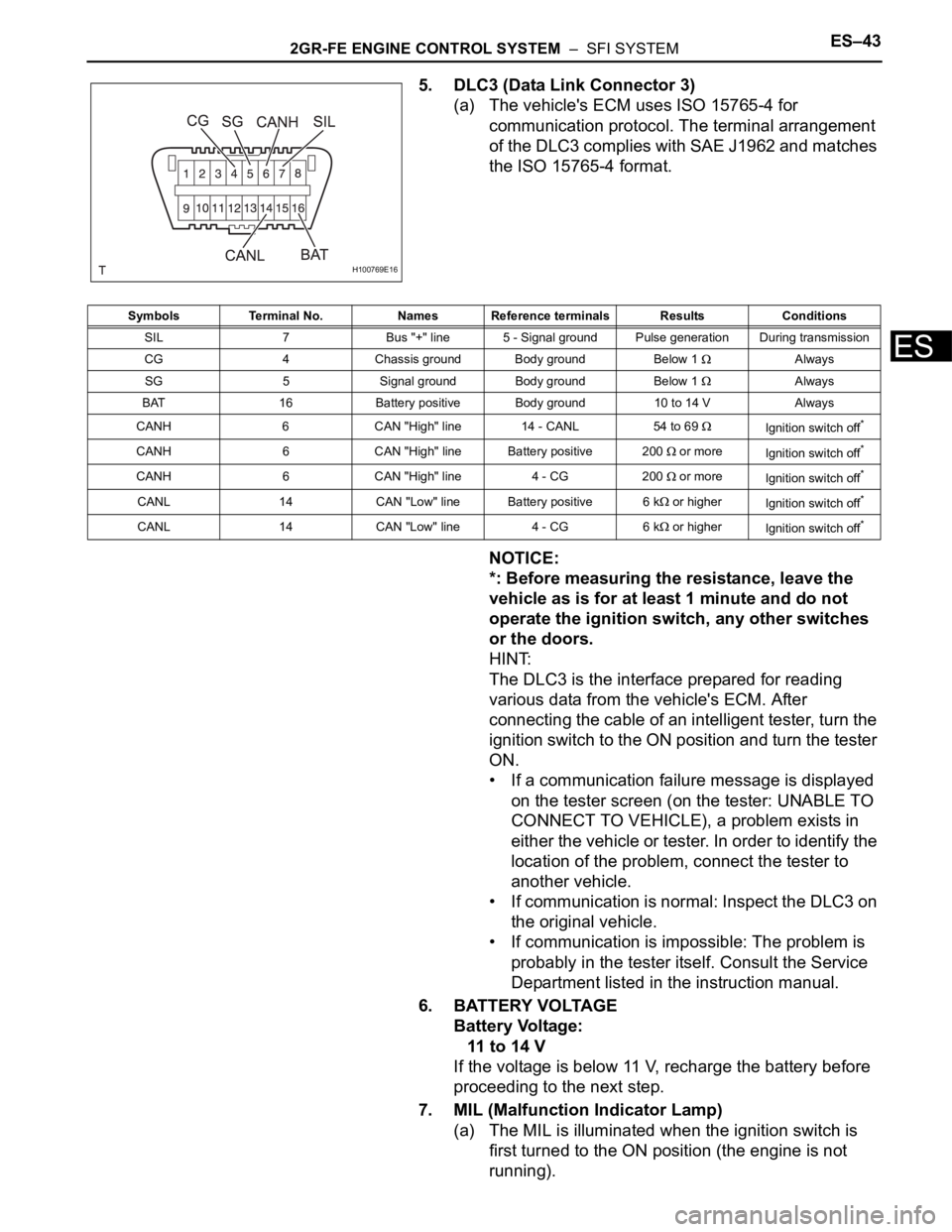
5. DLC3 (Data Link Connector 3)
(a) The vehicle's ECM uses ISO 15765-4 for
communication protocol. The terminal arrangement
of the DLC3 complies with SAE J1962 and matches
the ISO 15765-4 format.
NOTICE:
*: Before measuring the resistance, leave the
vehicle as is for at least 1 minute and do not
operate the ignition switch, any other switches
or the doors.
HINT:
The DLC3 is the interface prepared for reading
various data from the vehicle's ECM. After
connecting the cable of an intelligent tester, turn the
ignition switch to the ON position and turn the tester
ON.
• If a communication failure message is displayed
on the tester screen (on the tester: UNABLE TO
CONNECT TO VEHICLE), a problem exists in
either the vehicle or tester. In order to identify the
location of the problem, connect the tester to
another vehicle.
• If communication is normal: Inspect the DLC3 on
the original vehicle.
• If communication is impossible: The problem is
probably in the tester itself. Consult the Service
Department listed in the instruction manual.
6. BATTERY VOLTAGE
Battery Voltage:
11 to 14 V
If the voltage is below 11 V, recharge the battery before
proceeding to the next step.
7. MIL (Malfunction Indicator Lamp)
(a) The MIL is illuminated when the ignition switch is
first turned to the ON position (the engine is not
running).
H100769E16
Symbols Terminal No. Names Reference terminals Results Conditions
SIL 7 Bus "+" line 5 - Signal ground Pulse generation During transmission
CG 4 Chassis ground Body ground Below 1
Always
SG 5 Signal ground Body ground Below 1
Always
BAT 16 Battery positive Body ground 10 to 14 V Always
CANH 6 CAN "High" line 14 - CANL 54 to 69
Ignition switch off*
CANH 6 CAN "High" line Battery positive 200 or more
Ignition switch off*
CANH 6 CAN "High" line 4 - CG 200 or more
Ignition switch off*
CANL 14 CAN "Low" line Battery positive 6 k or higher
Ignition switch off*
CANL 14 CAN "Low" line 4 - CG 6 k or higher
Ignition switch off*
Page 363 of 3000
2GR-FE ENGINE CONTROL SYSTEM – SFI SYSTEMES–45
ES
DTC CHECK / CLEAR
NOTICE:
All the stored DTCs and freeze frame data are erased if:
1) the ECM is changed from normal mode to check mode
or vice versa; or 2) the ignition switch is turned from ON
to ACC or off while in check mode.
Before changing modes, always check and make a note
of any DTCs and freeze frame data.
HINT:
• DTCs which are stored in the ECM can be displayed on an
intelligent tester. An intelligent tester can display current
and pending DTCs.
• Some DTCs are not set if the ECM does not detect the
same malfunction again during the second consecutive
driving cycle. However, such malfunctions, detected on
only one occasion, are stored as pending DTCs.
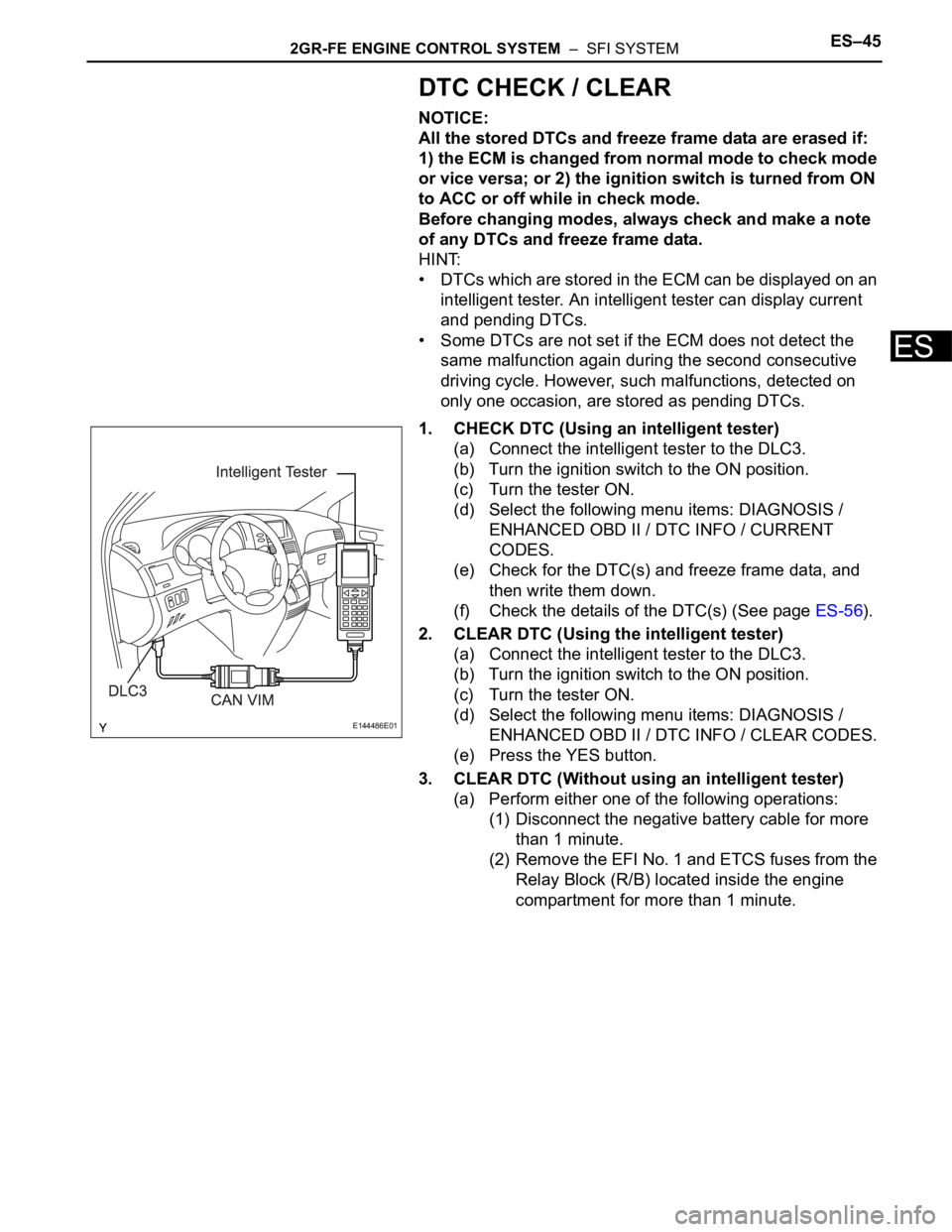
1. CHECK DTC (Using an intelligent tester)
(a) Connect the intelligent tester to the DLC3.
(b) Turn the ignition switch to the ON position.
(c) Turn the tester ON.
(d) Select the following menu items: DIAGNOSIS /
ENHANCED OBD II / DTC INFO / CURRENT
CODES.
(e) Check for the DTC(s) and freeze frame data, and
then write them down.
(f) Check the details of the DTC(s) (See page ES-56).
2. CLEAR DTC (Using the intelligent tester)
(a) Connect the intelligent tester to the DLC3.
(b) Turn the ignition switch to the ON position.
(c) Turn the tester ON.
(d) Select the following menu items: DIAGNOSIS /
ENHANCED OBD II / DTC INFO / CLEAR CODES.
(e) Press the YES button.
3. CLEAR DTC (Without using an intelligent tester)
(a) Perform either one of the following operations:
(1) Disconnect the negative battery cable for more
than 1 minute.
(2) Remove the EFI No. 1 and ETCS fuses from the
Relay Block (R/B) located inside the engine
compartment for more than 1 minute.
E144486E01
Page 366 of 3000

ES–482GR-FE ENGINE CONTROL SYSTEM – SFI SYSTEM
ES
O2FT B2 S2 Fuel trim at heated oxygen sensor Same as SHORT FT #2
AF FT B1 S1 Fuel trim at A/F sensor -
AF FT B2 S1 Fuel trim at A/F sensor -
CAT TEMP B1 S1 Catalyst temperature -
CAT TEMP B2 S1 Catalyst temperature -
CAT TEMP B1 S2 Catalyst temperature -
CAT TEMP B2 S2 Catalyst temperature -
S O2S B1 S2 Heated oxygen sensor impedance (Sensor 2) -
S O2S B2 S2 Heated oxygen sensor impedance (Sensor 2) -
INI COOL TEMP Initial engine coolant temperature -
INI INTAKE TEMP Initial intake air temperature -
INJ VOL Injection volume -
STARTER SIG Starter signal -
PS SW Power steering signal -
PS SIGNAL Power steering signal (history)This signal status usually ON until ignition
switch turned off
CTP SW Closed throttle position switch -
A/C SIGNAL A/C signal -
ELECT LOAD SIG Electrical load signal -
STOP LIGHT SW Stop light switch -
BATTERY VOLTAGE Battery voltage -
ATM PRESSURE Atmospheric pressure -
FUEL PMP SP CTL Fuel pump speed control status -
ACIS VSVVSV for Air Intake Control Induction System
(AICS)-
VVT CTRL B2 VVT control (bank 2 Intake side) status -
EVAP (Purge) VSV EVAP purge VSV -
FUEL PUMP/SPD Fuel pump speed statusVSV for EVAP controlled by ECM (ground
side duty control)
VACUUM PUMP Key-off EVAP system pump status -
EVAP VENT VAL Key-off EVAP system vent valve status -
FAN MOTOR Electric fan motor -
TC/TE1 TC and TE1 terminals of DLC3 -
ACM ACM control status -
VVTL AIM ANGL #1 VVT aim angle -
VVT CHNG ANGL #1 VVT change angle -
VVT OCV DUTY B1 VVT OCV operation duty -
VVT EX HOLD B1VVT exhaust hold duty ratio learning value
(bank 1 Exhaust side)-
VVT EX CHG ANG1 VVT change angle (bank 1 Exhaust side) -
VVT EX OCV D B1VVT OCV (bank 1 Exhaust side) operation
duty-
VVTL AIM ANGL#2 VVT aim angle (bank 2 Intake side) -
VVT CHNG ANGL#2 VVT change angle (bank 2 Intake side) -
VVT OCV DUTY B2 VVT OCV (bank 2 Intake side) operation duty -
VVT EX HOLD B2VVT exhaust hold duty ratio learning value
(bank 2 Exhaust side)-
VVT EX CHG ANG2 VVT change angle (bank 2 Exhaust side) -
VVT EX OCV D B2VVT OCV (bank 2 Exhaust side) operation
duty- LABEL
(Intelligent Tester Display)Measurement Item Diagnostic Note
Page 368 of 3000
ES–502GR-FE ENGINE CONTROL SYSTEM – SFI SYSTEM
ES
CHECK MODE PROCEDURE
HINT:
Intelligent tester only:
Compared to normal mode, check mode is more sensitive to
malfunctions. Therefore, check mode can detect the
malfunctions that cannot be detected by normal mode.
NOTICE:
All the stored DTCs and freeze frame data are erased if:
1) the ECM is changed from normal mode to check mode
or vice versa; or 2) the ignition switch is turned off or
turned to the ACC position from the ON position while in
check mode.
Before changing modes, always check and make a note
of any DTCs and freeze frame data.
1. CHECK MODE PROCEDURE (Using an intelligent
tester)
(a) Check and ensure the following conditions:
(1) Battery voltage 12 V or more
(2) Throttle valve fully closed
(3) The shift lever in the P or N position
(4) A/C switched OFF
(b) Turn the ignition switch off.
(c) Connect an intelligent tester to the DLC3.
(d) Turn the ignition switch to the ON position.
(e) Turn the tester ON.
(f) Select the following menu items: DIAGNOSIS /
ENHANCED OBD II / CHECK MODE.
(g) Switch the ECM from normal mode to check mode.
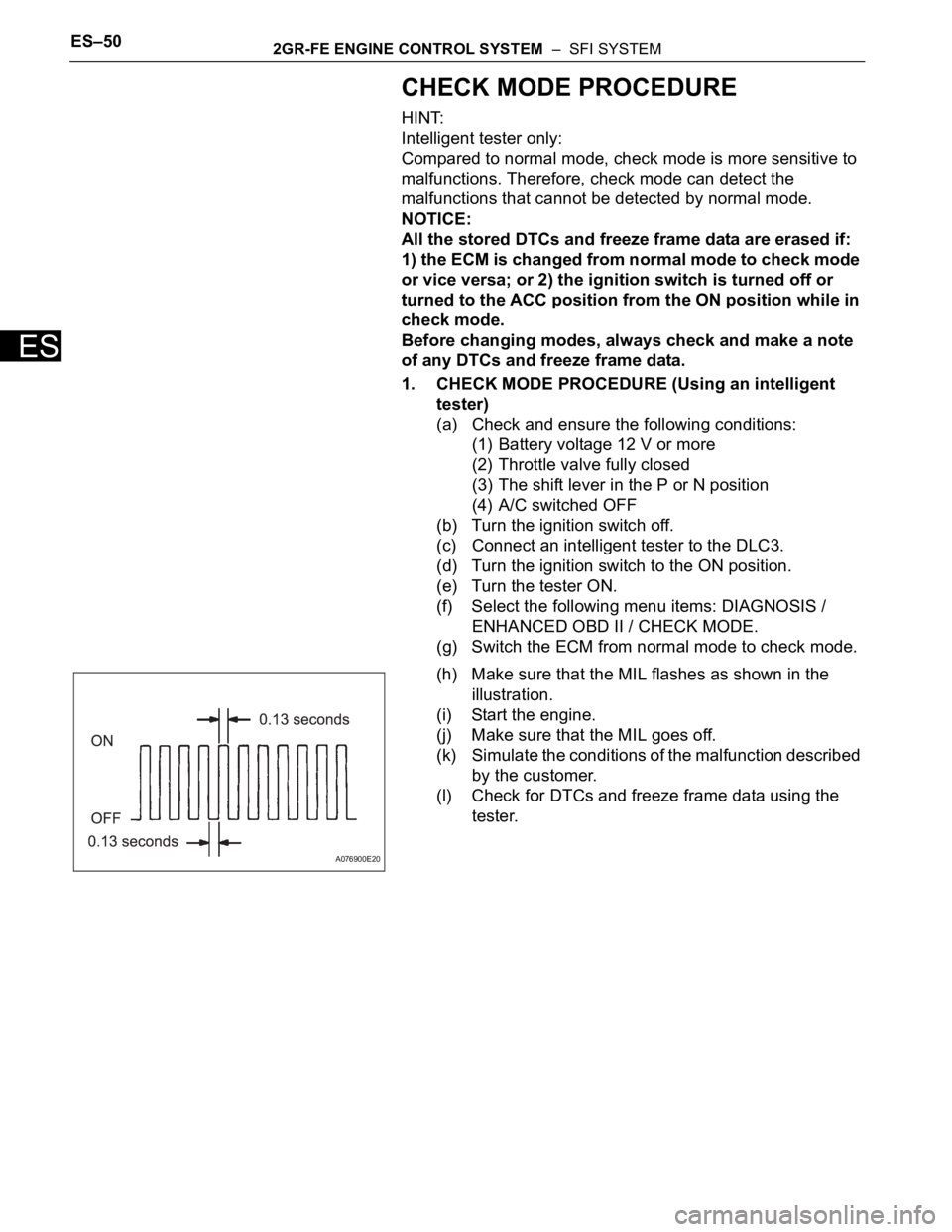
(h) Make sure that the MIL flashes as shown in the
illustration.
(i) Start the engine.
(j) Make sure that the MIL goes off.
(k) Simulate the conditions of the malfunction described
by the customer.
(l) Check for DTCs and freeze frame data using the
tester.
A076900E20