belt TOYOTA SIENNA HYBRID 2023 User Guide
[x] Cancel search | Manufacturer: TOYOTA, Model Year: 2023, Model line: SIENNA HYBRID, Model: TOYOTA SIENNA HYBRID 2023Pages: 602, PDF Size: 14.9 MB
Page 34 of 602
341-1. For safe use
Make sure that all occupants are
wearing their seat belts before
driving the vehicle. (P.36)
Use a child restraint system
appropriate for the child until the
child becomes large enough to properly wear the vehicle’s seat
belt. (
P.58)
Make sure that you can see
backward clearly by adjusting
the inside rear view mirror (if
equipped), Digital Rear-view
Mirror (if equipped) and outside
rear view mirrors properly.
( P.187, 189, 199)
WARNING
Observe the following precau-
tions.
Failure to do so m ay result in
death or serious injury.
●Do not adjust the position of the
driver’s seat while driving.
Doing so could cause the driver
to lose control of the vehicle.
●Do not place a cushion between
the driver or passenger and the
seatback. A cushion may pre-
vent correct pos ture from being
achieved, and reduce the effec-
tiveness of the seat belt and
head restraint.
●Do not place anything under the
front seats.
Objects placed under the front
seats may become jammed in
the seat tracks and stop the
seat from locking in place. This
may lead to an accident and the
adjustment mechanism may
also be damaged.
●Always observe the legal speed
limit when driving on public
roads.
●When driving over long dis-
tances, take regular breaks
before you start to feel tired.
Also, if you feel tired or sleepy
while driving, do not force your-
self to continue driving and take
a break immediately.
Correct use of the seat
belts
Adjusting the mirrors
Page 35 of 602
351-1. For safe use
1
For safety and security
Seat belts
Make sure that all occu-
pants are wearing their seat
belts before driving the
vehicle.
WARNING
Observe the following precautions
to reduce the risk of injury in the
event of sudden braking, sudden
swerving or an accident.
Failure to do so may cause death
or serious injury.
■Wearing a seat belt
●Ensure that all passengers wear
a seat belt.
●Always wear a seat belt prop-
erly.
●Each seat belt should be used
by one person only. Do not use
a seat belt for more than one
person at once, including chil-
dren.
●Toyota recommends that chil-
dren be seated in the rear seat
and always use a seat belt
and/or an appropriate child
restraint system.
●To achieve a proper seating
position, do not recline the seat
more than necessary. The seat
belt is most effective when the
occupants are sitting up straight
and well back in the seats.
●Do not wear the shoulder belt
under your arm.
●Always wear your seat belt low
and snug across your hips.
●Always wear the belt with the
shoulder portion over the out-
side armrest and the lap portion
under the outside armrest.
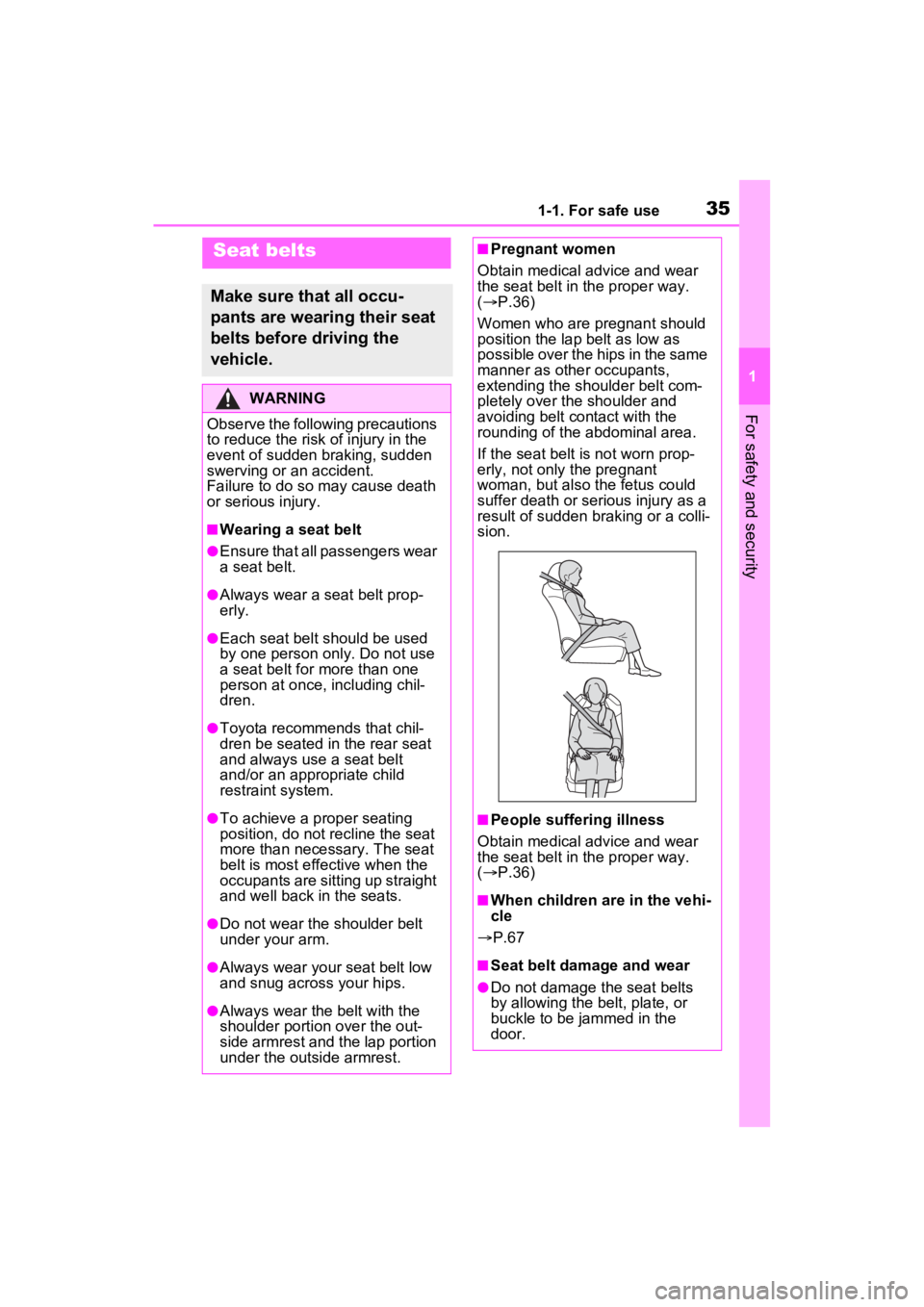
■Pregnant women
Obtain medical advice and wear
the seat belt in the proper way.
( P.36)
Women who are pregnant should
position the lap belt as low as
possible over the hips in the same
manner as other occupants,
extending the shoulder belt com-
pletely over the shoulder and
avoiding belt contact with the
rounding of the abdominal area.
If the seat belt is not worn prop-
erly, not only the pregnant
woman, but also the fetus could
suffer death or serious injury as a
result of sudden braking or a colli-
sion.
■People suffering illness
Obtain medical advice and wear
the seat belt in the proper way.
( P.36)
■When children are in the vehi-
cle
P.67
■Seat belt damage and wear
●Do not damage the seat belts
by allowing the belt, plate, or
buckle to be jammed in the
door.
Page 36 of 602
361-1. For safe use
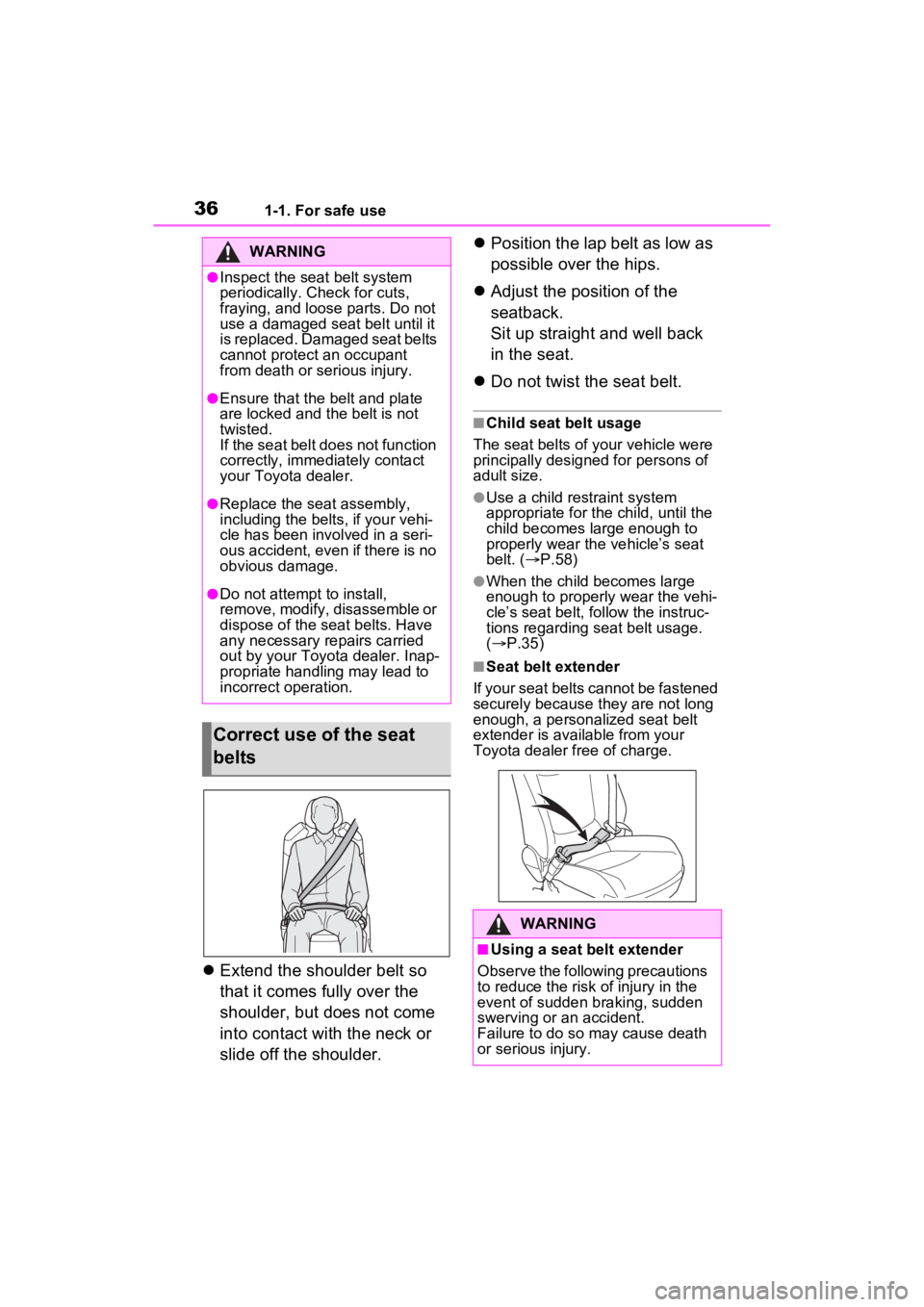
Extend the shoulder belt so
that it comes fully over the
shoulder, but does not come
into contact with the neck or
slide off the shoulder.
Position the lap belt as low as
possible over the hips.
Adjust the position of the
seatback.
Sit up straight and well back
in the seat.
Do not twist the seat belt.
■Child seat belt usage
The seat belts of your vehicle were
principally designed for persons of
adult size.
●Use a child restraint system
appropriate for the child, until the
child becomes large enough to
properly wear the vehicle’s seat
belt. ( P.58)
●When the child becomes large
enough to properl y wear the vehi-
cle’s seat belt, follow the instruc-
tions regarding seat belt usage.
( P.35)
■Seat belt extender
If your seat belts cannot be fastened
securely because they are not long
enough, a personalized seat belt
extender is available from your
Toyota dealer free of charge.
WARNING
●Inspect the seat belt system
periodically. Check for cuts,
fraying, and loose parts. Do not
use a damaged sea t belt until it
is replaced. Damaged seat belts
cannot protect an occupant
from death or serious injury.
●Ensure that the belt and plate
are locked and the belt is not
twisted.
If the seat belt does not function
correctly, immediately contact
your Toyota dealer.
●Replace the seat assembly,
including the belts, if your vehi-
cle has been involved in a seri-
ous accident, even if there is no
obvious damage.
●Do not attempt to install,
remove, modify, disassemble or
dispose of the seat belts. Have
any necessary repairs carried
out by your Toyota dealer. Inap-
propriate handling may lead to
incorrect operation.
Correct use of the seat
belts
WARNING
■Using a seat belt extender
Observe the following precautions
to reduce the risk of injury in the
event of sudden braking, sudden
swerving or an accident.
Failure to do so may cause death
or serious injury.
Page 37 of 602
371-1. For safe use
1
For safety and security
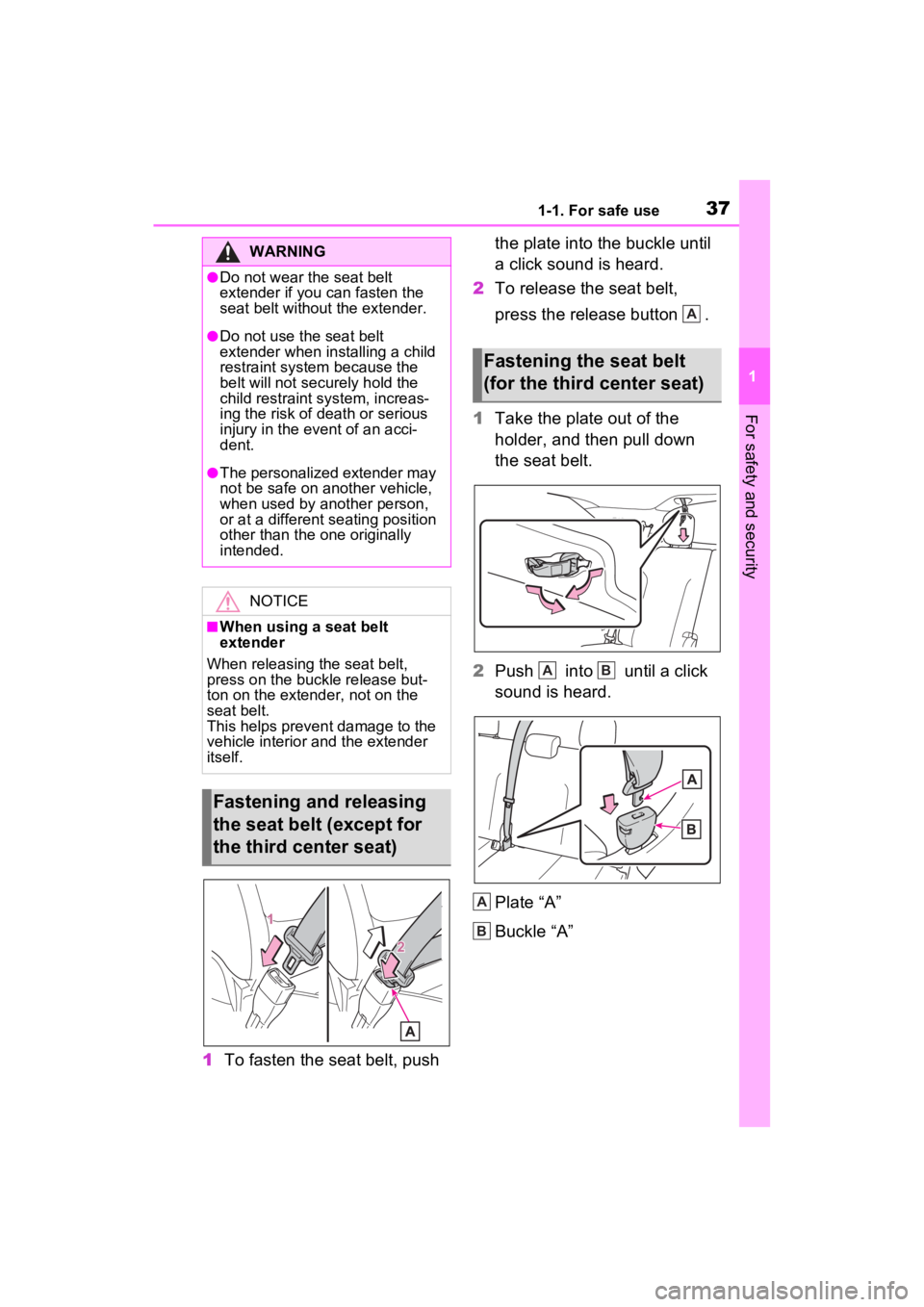
1To fasten the seat belt, push the plate into the buckle until
a click sound is heard.
2 To release the seat belt,
press the release button .
1 Take the plate out of the
holder, and then pull down
the seat belt.
2 Push into until a click
sound is heard.
Plate “A”
Buckle “A”
WARNING
●Do not wear the seat belt
extender if you can fasten the
seat belt without the extender.
●Do not use the seat belt
extender when installing a child
restraint system because the
belt will not securely hold the
child restraint system, increas-
ing the risk of death or serious
injury in the event of an acci-
dent.
●The personalized extender may
not be safe on another vehicle,
when used by another person,
or at a different seating position
other than the one originally
intended.
NOTICE
■When using a seat belt
extender
When releasing the seat belt,
press on the buckle release but-
ton on the extender, not on the
seat belt.
This helps prevent damage to the
vehicle interior and the extender
itself.
Fastening and releasing
the seat belt (except for
the third center seat)
Fastening the seat belt
(for the third center seat)
A
AB
A
B
Page 38 of 602
381-1. For safe use
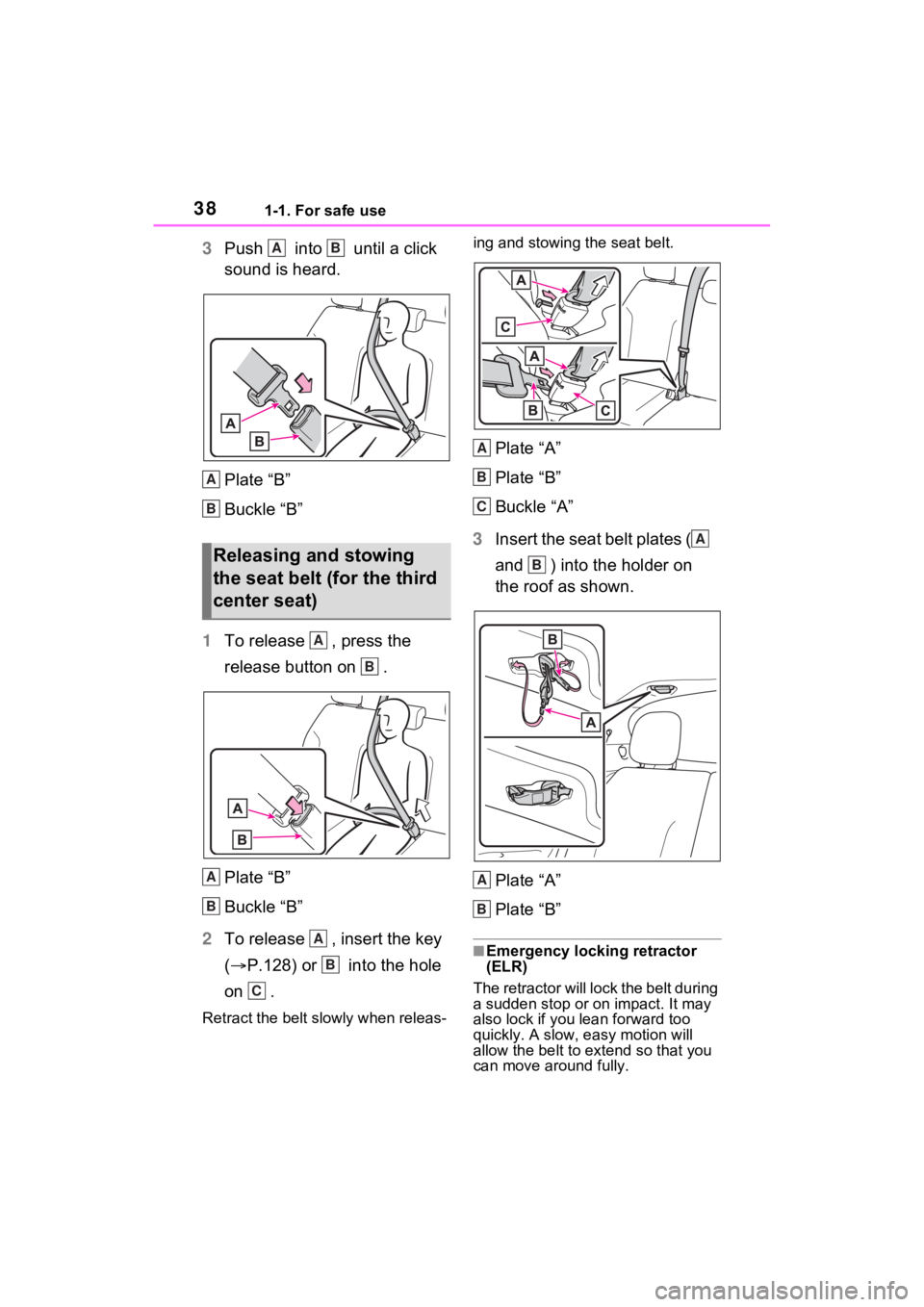
3Push into until a click
sound is heard.
Plate “B”
Buckle “B”
1 To release , press the
release button on .
Plate “B”
Buckle “B”
2 To release , insert the key
( P.128) or into the hole
on .
Retract the belt slowly when releas- ing and stowing the seat belt.
Plate “A”
Plate “B”
Buckle “A”
3 Insert the seat belt plates (
and ) into the holder on
the roof as shown.
Plate “A”
Plate “B”
■Emergency locking retractor
(ELR)
The retractor will lock the belt during
a sudden stop or on impact. It may
also lock if you lean forward too
quickly. A slow, easy motion will
allow the belt to extend so that you
can move around fully.
Releasing and stowing
the seat belt (for the third
center seat)
AB
A
B
A
B
A
B
A
B
C
A
B
C
A
B
A
B
Page 39 of 602
391-1. For safe use
1
For safety and security
■Automatic locking retractor
(ALR)
When a passenger’s shoulder belt is
completely extended and then
retracted even slightly, the belt is
locked in that position and cannot
be extended. This feature is used to
hold a child restraint system (CRS)
firmly. To free the belt again, fully
retract the belt and then pull the belt
out once more.
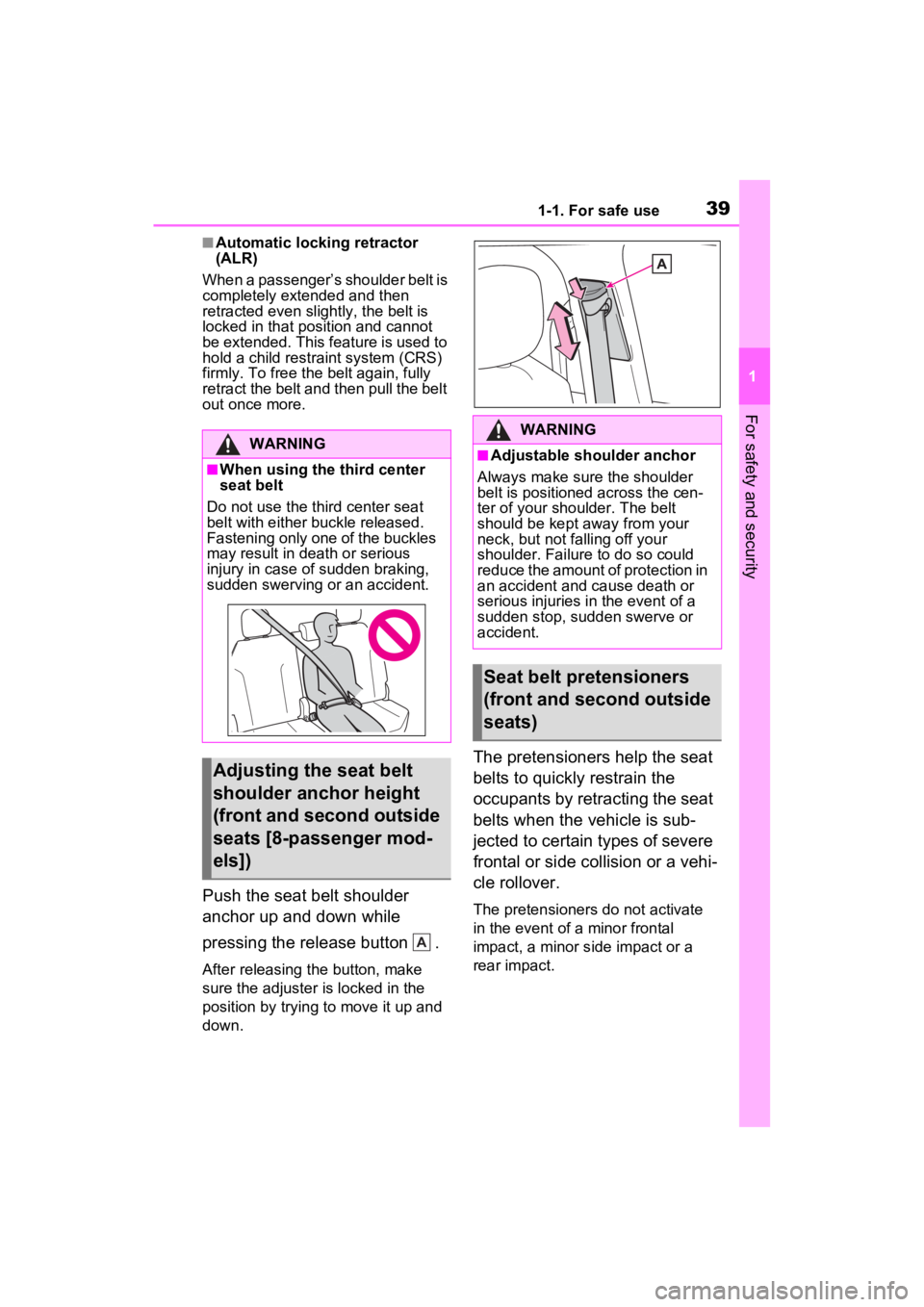
Push the seat belt shoulder
anchor up and down while
pressing the release button .
After releasing the button, make
sure the adjuster is locked in the
position by trying t o move it up and
down.
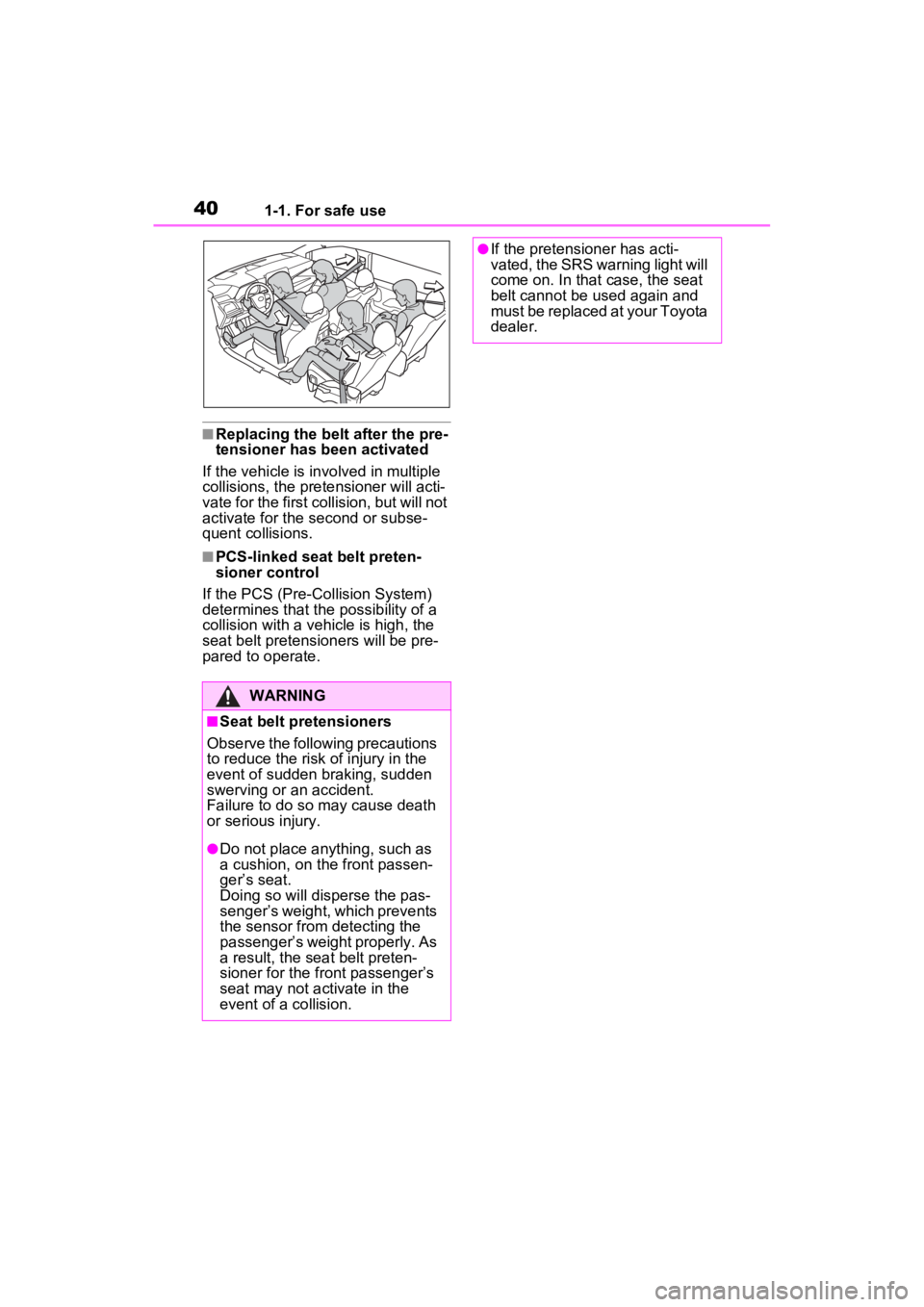
The pretensioners help the seat
belts to quickly restrain the
occupants by retracting the seat
belts when the vehicle is sub-
jected to certain types of severe
frontal or side collision or a vehi-
cle rollover.
The pretensioners do not activate
in the event of a minor frontal
impact, a minor s ide impact or a
rear impact.
WARNING
■When using the third center
seat belt
Do not use the third center seat
belt with either buckle released.
Fastening only one of the buckles
may result in death or serious
injury in case of sudden braking,
sudden swerving or an accident.
Adjusting the seat belt
shoulder anchor height
(front and second outside
seats [8-passenger mod-
els])
A
:$51,1*
■Adjustable shoulder anchor
Always make sure the shoulder
belt is positioned across the cen-
ter of your shoulder. The belt
should be kept away from your
neck, but not falling off your
shoulder. Failure to do so could
reduce the amount of protection in
an accident and cause death or
serious injuries in the event of a
sudden stop, sudden swerve or
accident.
Seat belt pretensioners
(front and second outside
seats)
Page 40 of 602
401-1. For safe use
■Replacing the belt after the pre-
tensioner has been activated
If the vehicle is in volved in multiple
collisions, the pretensioner will acti-
vate for the first collision, but will not
activate for the second or subse-
quent collisions.
■PCS-linked seat belt preten-
sioner control
If the PCS (Pre-Collision System)
determines that the possibility of a
collision with a vehicle is high, the
seat belt pretens ioners will be pre-
pared to operate.
WARNING
■Seat belt pretensioners
Observe the following precautions
to reduce the risk of injury in the
event of sudden braking, sudden
swerving or an accident.
Failure to do so may cause death
or serious injury.
●Do not place anything, such as
a cushion, on the front passen-
ger’s seat.
Doing so will disperse the pas-
senger’s weight, which prevents
the sensor from detecting the
passenger’s weight properly. As
a result, the seat belt preten-
sioner for the front passenger’s
seat may not activate in the
event of a collision.
●If the pretensioner has acti-
vated, the SRS warning light will
come on. In that case, the seat
belt cannot be used again and
must be replaced at your Toyota
dealer.
Page 41 of 602
411-1. For safe use
1
For safety and security
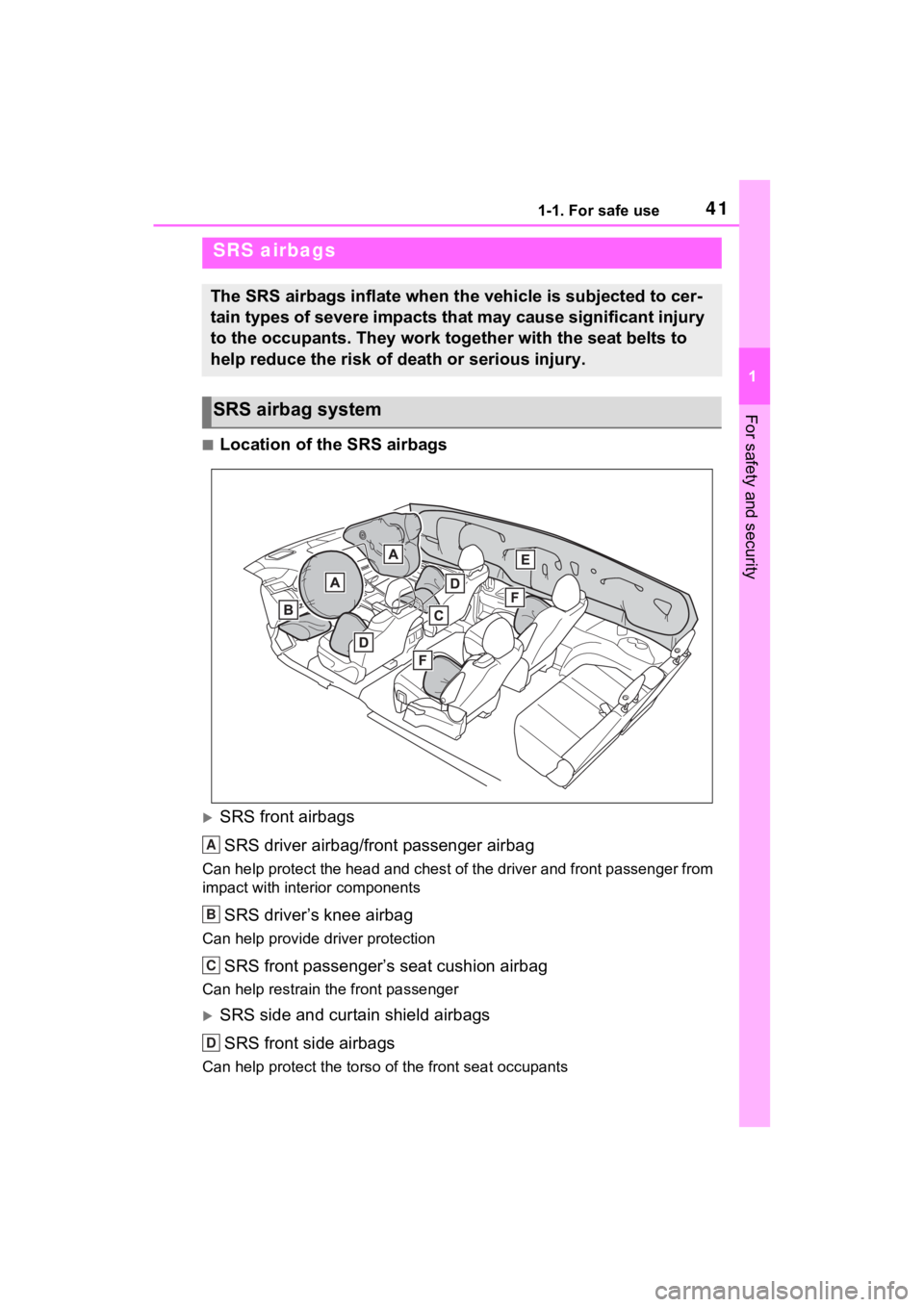
■Location of the SRS airbags
SRS front airbagsSRS driver airbag/front passenger airbag
Can help protect the head and chest of the driver and front passenger from
impact with interior components
SRS driver’s knee airbag
Can help provide dr iver protection
SRS front passenger’s seat cushion airbag
Can help restrain the front passenger
SRS side and curtain shield airbags
SRS front side airbags
Can help protect the torso of the front seat occupants
SRS airbags
The SRS airbags inflate when the vehicle is subjected to cer-
tain types of severe impacts that may cause significant injury
to the occupants. They work together with the seat belts to
help reduce the risk of death or serious injury.
SRS airbag system
A
B
C
D
Page 42 of 602
421-1. For safe use
SRS curtain shield airbags
• Can help protect primarily the head of occupants in the outer seats
• Can help prevent the occupants from being thrown from the vehi cle in the
event of vehicle rollover
SRS second seat side airbags
Can help protect the torso of occ upants in the second outer seats
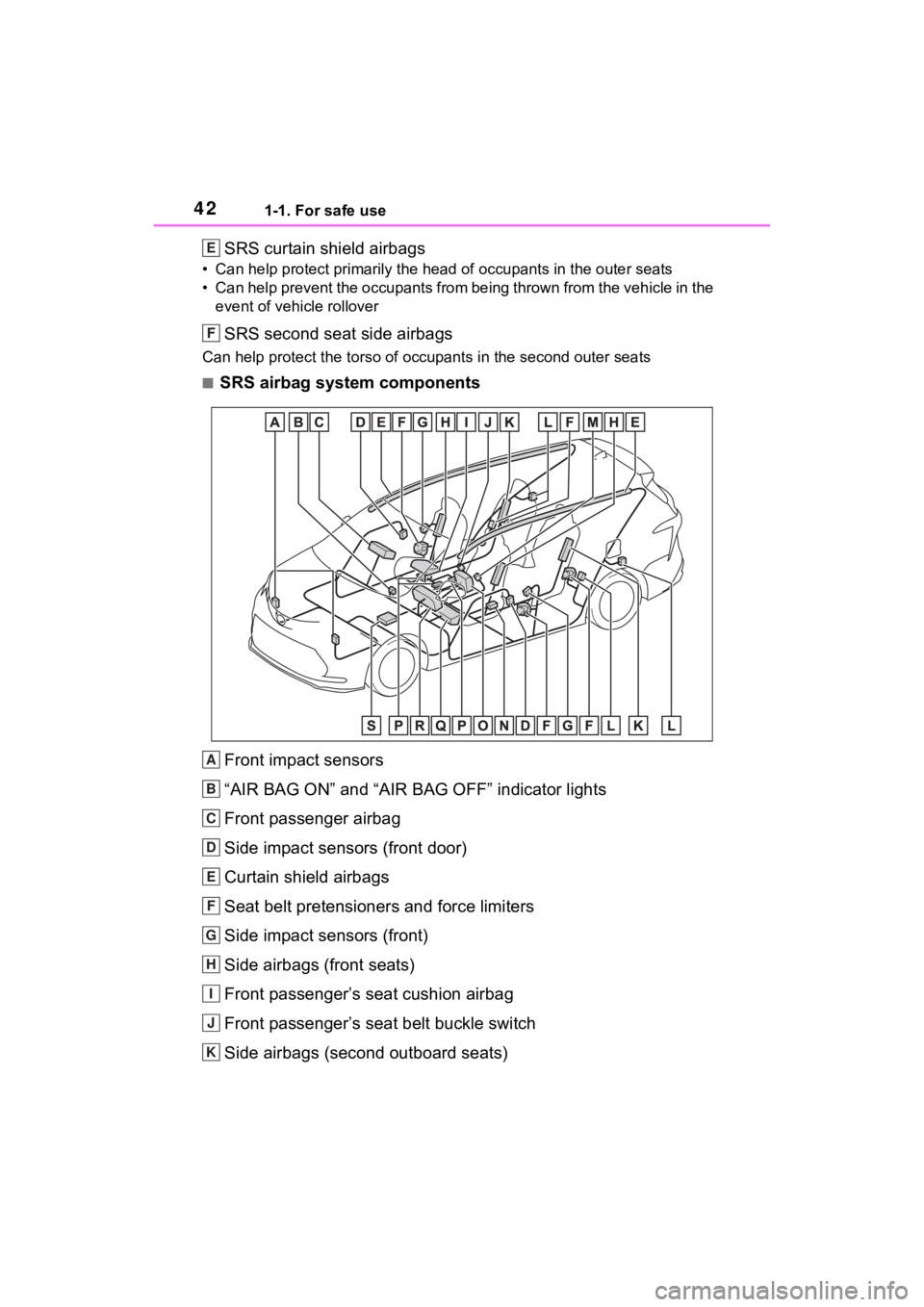
■SRS airbag system components
Front impact sensors
“AIR BAG ON” and “AIR BAG OFF” indicator lights
Front passenger airbag
Side impact sensors (front door)
Curtain shield airbags
Seat belt pretensioners and force limiters
Side impact sensors (front)
Side airbags (front seats)
Front passenger’s seat cushion airbag
Front passenger’s seat belt buckle switch
Side airbags (second outboard seats)
E
F
A
B
C
D
E
F
G
H
I
J
K
Page 43 of 602
431-1. For safe use
1
For safety and security
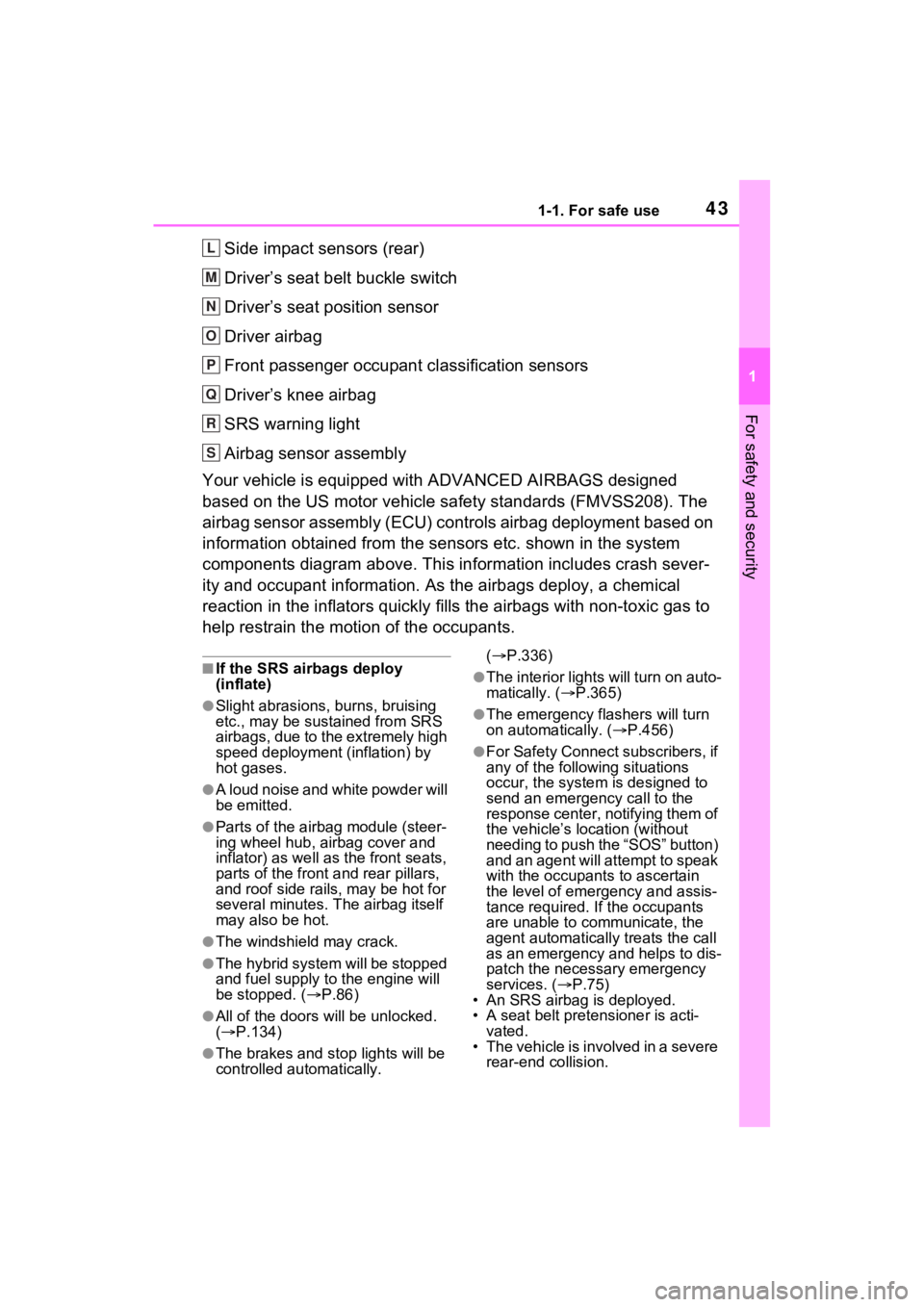
Side impact sensors (rear)
Driver’s seat belt buckle switch
Driver’s seat position sensor
Driver airbag
Front passenger occupant classification sensors
Driver’s knee airbag
SRS warning light
Airbag sensor assembly
Your vehicle is equipped with ADVANCED AIRBAGS designed
based on the US motor vehicle safety standards (FMVSS208). The
airbag sensor assembly (ECU) cont rols airbag deployment based on
information obtained from the sensors etc. shown in the system
components diagram above. This in formation includes crash sever-
ity and occupant information. As the airbags deploy, a chemical
reaction in the inflators quickly fills the airbags with non-toxic gas to
help restrain the motion of the occupants.
■If the SRS airbags deploy
(inflate)
●Slight abrasions, burns, bruising
etc., may be sustained from SRS
airbags, due to the extremely high
speed deployment (inflation) by
hot gases.
●A loud noise and white powder will
be emitted.
●Parts of the airbag module (steer-
ing wheel hub, airbag cover and
inflator) as well as the front seats,
parts of the front and rear pillars,
and roof side rails, may be hot for
several minutes. T he airbag itself
may also be hot.
●The windshield may crack.
●The hybrid system will be stopped
and fuel supply to the engine will
be stopped. ( P.86)
●All of the doors will be unlocked.
( P.134)
●The brakes and st op lights will be
controlled automatically. (
P.336)
●The interior lights will turn on auto-
matically. ( P.365)
●The emergency flashers will turn
on automatically. ( P.456)
●For Safety Connect subscribers, if
any of the following situations
occur, the system is designed to
send an emergency call to the
response center, notifying them of
the vehicle’s location (without
needing to push the “SOS” button)
and an agent will attempt to speak
with the occupants to ascertain
the level of emergency and assis-
tance required. If the occupants
are unable to communicate, the
agent automatically treats the call
as an emergency and helps to dis-
patch the necessary emergency
services. ( P.75)
• An SRS airbag is deployed.
• A seat belt pretensioner is acti- vated.
• The vehicle is involved in a severe rear-end collision.
L
M
N
O
P
Q
R
S