engine overheat TOYOTA SIENNA HYBRID 2023 Owners Manual
[x] Cancel search | Manufacturer: TOYOTA, Model Year: 2023, Model line: SIENNA HYBRID, Model: TOYOTA SIENNA HYBRID 2023Pages: 602, PDF Size: 14.9 MB
Page 15 of 602
15Pictorial index
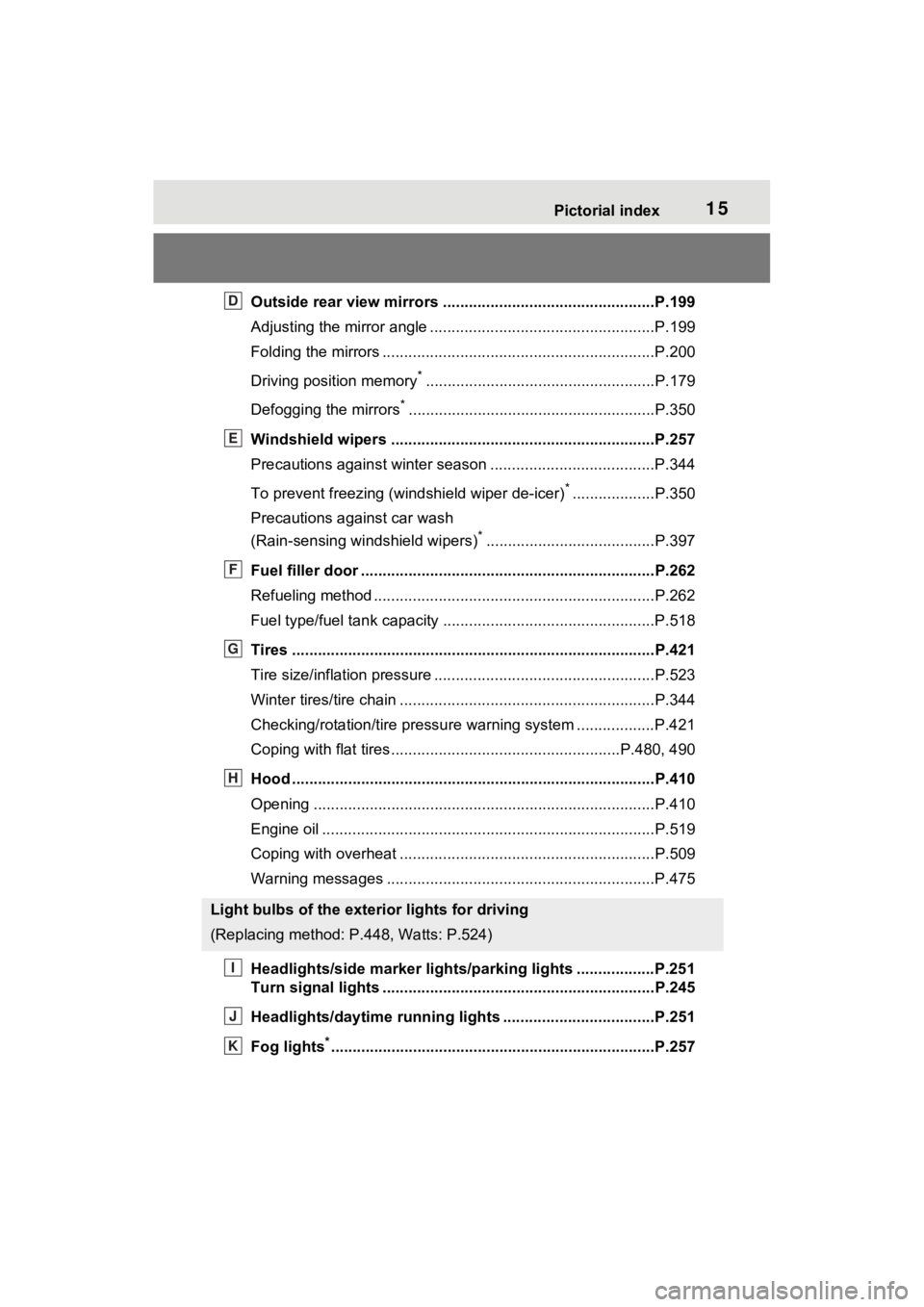
Outside rear view mirrors .................................................P.199
Adjusting the mirror angle ....................................................P.199
Folding the mirrors ...............................................................P.200
Driving position memory
*.....................................................P.179
Defogging the mirrors
*.........................................................P.350
Windshield wipers .............................................. ...............P.257
Precautions against winter season .............................. ........P.344
To prevent freezing (windshield wiper de-icer)
*...................P.350
Precautions against car wash
(Rain-sensing windshield wipers)
*.......................................P.397
Fuel filler door ............................................... .....................P.262
Refueling method ............................................... ..................P.262
Fuel type/fuel tan k capacity .................................................P.518
Tires ....................................................................................P.421
Tire size/inflation pressure ................................... ................P.523
Winter tires/tire chain ........................................ ...................P.344
Checking/rotation/tire pressur e warning system ..................P.421
Coping with flat tires......................................... ............P.480, 490
Hood ....................................................................................P.410
Opening ........................................................ .......................P.410
Engine oil ..................................................... ........................P.519
Coping with overheat ........................................... ................P.509
Warning messages ..............................................................P.475
Headlights/side marke r lights/parking lights ..................P.251
Turn signal lights ...............................................................P.245
Headlights/daytime running lights .............................. .....P.251
Fog lights
*............................................................... ............P.257
Light bulbs of the exterior lights for driving
(Replacing method: P.448, Watts: P.524)
D
E
F
G
H
I
J
K
Page 17 of 602

17Pictorial index
Opening/closing the rear side windows ...............................P.202
Warning messages ..............................................................P.475
Back door ...................................................... .....................P.150
Locking/unlocking ................................................................P.151
Opening from inside the cabin
*............................................P.154
Opening from outside........................................... ........P.152, 153
Warning messages ..............................................................P.475
Outside rear view mirrors .................................................P.199
Adjusting the mirror angle ..................................... ...............P.199
Folding the mirrors ...............................................................P.200
Driving position memory
*.....................................................P.179
Defogging the mirrors
*.........................................................P.350
Windshield wipers .............................................. ...............P.257
Precautions against winter season .............................. ........P.344
To prevent freezing (windshield wiper de-icer)
*...................P.350
Precautions against car wash
(Rain-sensing windshield wipers)
*.......................................P.397
Fuel filler door ............................................... .....................P.262
Refueling method ............................................... ..................P.262
Fuel type/fuel tan k capacity .................................................P.518
Tires ....................................................................................P.421
Tire size/inflation pressure ................................... ................P.523
Winter tires/tire chain ........................................ ...................P.344
Checking/rotation/tire pressur e warning system ..................P.421
Coping with flat tires......................................... ............P.480, 490
Hood ....................................................................................P.410
Opening ........................................................ .......................P.410
Engine oil ..................................................... ........................P.519
Coping with overheat ........................................... ................P.509
Warning messages ..............................................................P.475
C
D
E
F
G
H
Page 20 of 602
20Pictorial index
Coping with flat tires.....................................................P.480, 490
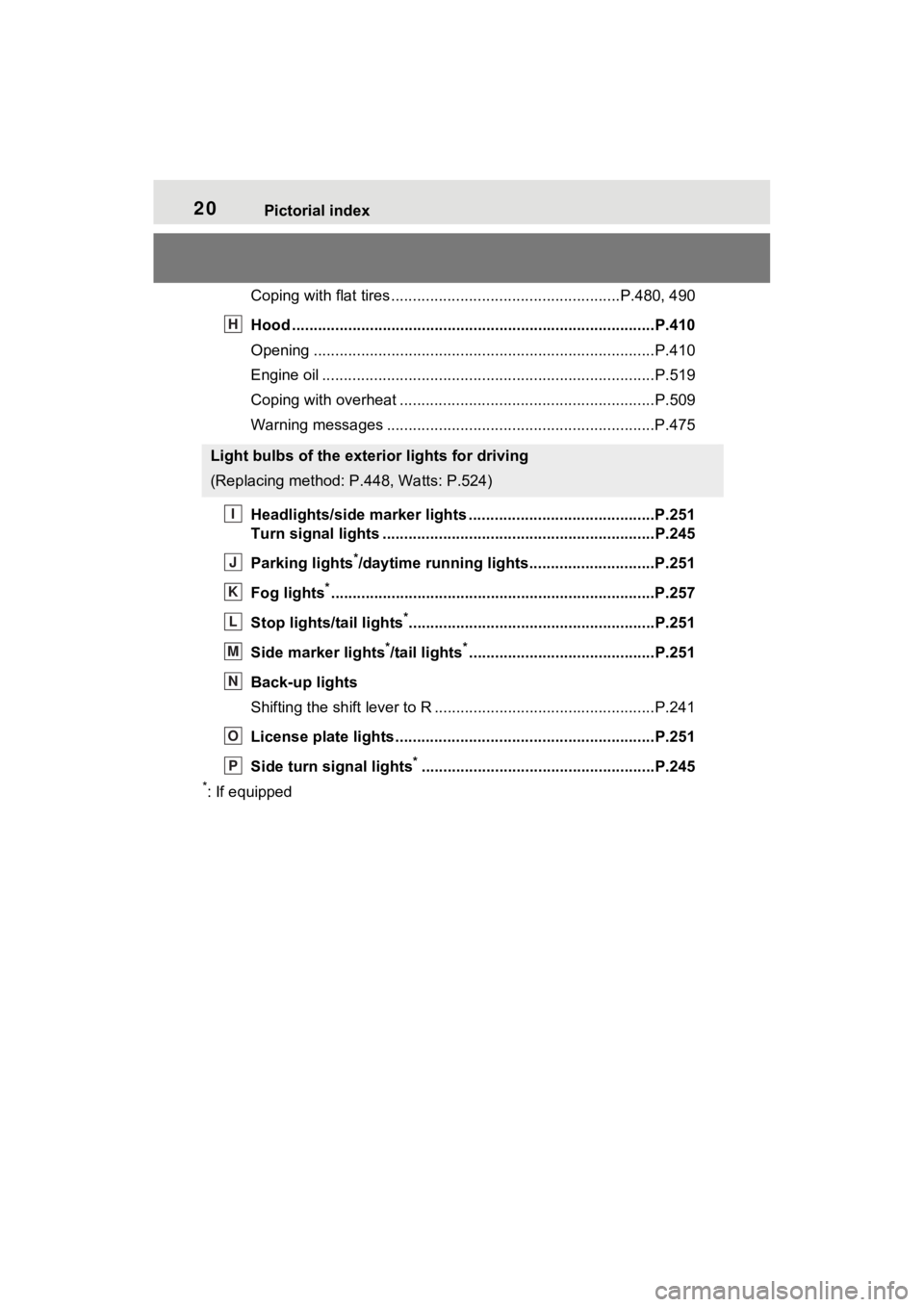
Hood ....................................................................................P.410
Opening ........................................................ .......................P.410
Engine oil ..................................................... ........................P.519
Coping with overheat ........................................... ................P.509
Warning messages ..............................................................P.475
Headlights/side marker lights .................................. .........P.251
Turn signal lights ...............................................................P.245
Parking lights
*/daytime running lights.............................P.251
Fog lights
*............................................................... ............P.257
Stop lights/tail lights
*.........................................................P.251
Side marker lights
*/tail lights*...........................................P.251
Back-up lights
Shifting the shift lever to R ...................................................P.241
License plate lights........................................... .................P.251
Side turn signal lights
*......................................................P.245
*: If equipped
Light bulbs of the exterior lights for driving
(Replacing method: P .448, Watts: P.524)
H
I
J
K
L
M
N
O
P
Page 93 of 602
932-1. Instrument cluster
2
Vehicle status information and indicators
The units used on the meters and some indicators may differ depending on
the target region.
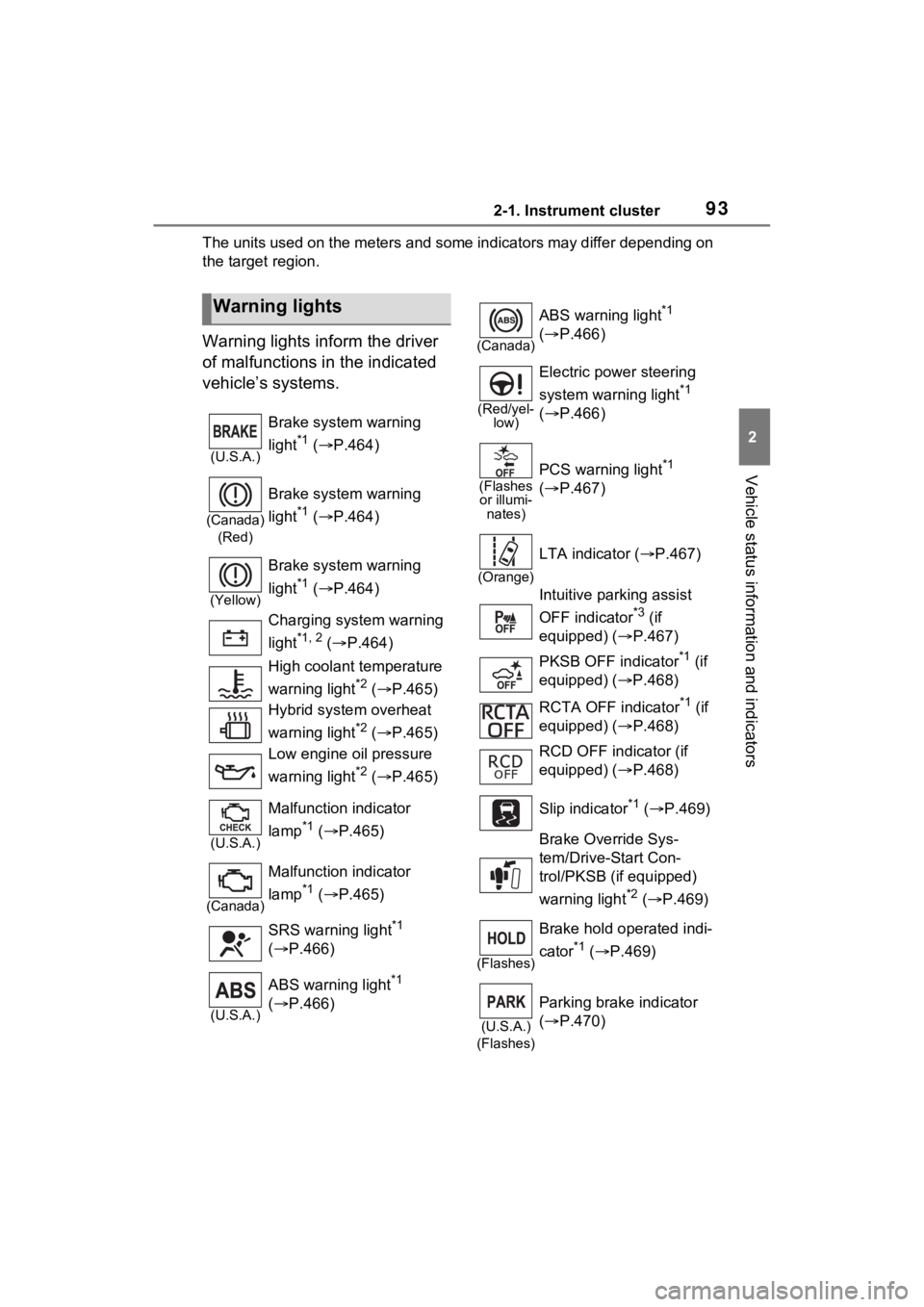
Warning lights inform the driver
of malfunctions in the indicated
vehicle’s systems.
Warning lights
(U.S.A.)
Brake system warning
light
*1 ( P.464)
(Canada)
(Red)
Brake system warning
light
*1 ( P.464)
(Yellow)
Brake system warning
light
*1 ( P.464)
Charging system warning
light
*1, 2 ( P.464)
High coolant temperature
warning light
*2 ( P.465)
Hybrid system overheat
warning light
*2 ( P.465)
Low engine oil pressure
warning light
*2 ( P.465)
(U.S.A.)
Malfunction indicator
lamp
*1 ( P.465)
(Canada)
Malfunction indicator
lamp
*1 ( P.465)
SRS warning light
*1
( P.466)
(U.S.A.)
ABS warning light*1
( P.466)
(Canada)
ABS warning light*1
( P.466)
(Red/yel-
low)
Electric power steering
system warning light
*1
( P.466)
(Flashes
or illumi- nates)
PCS warning light*1
( P.467)
(Orange)
LTA indicator ( P.467)
Intuitive parking assist
OFF indicator
*3 (if
equipped) ( P.467)
PKSB OFF indicator
*1 (if
equipped) ( P.468)
RCTA OFF indicator
*1 (if
equipped) ( P.468)
RCD OFF indicator (if
equipped) ( P.468)
Slip indicator
*1 ( P.469)
Brake Override Sys-
tem/Drive-Start Con-
trol/PKSB (if equipped)
warning light
*2 ( P.469)
(Flashes)
Brake hold operated indi-
cator
*1 ( P.469)
(U.S.A.)
(Flashes)
Parking brake indicator
( P.470)
Page 99 of 602
992-1. Instrument cluster
2
Vehicle status information and indicators
eration” refers to the conversion of
energy created by the movement
of the vehicle into electrical
energy.
In the following situ ation, the Hybrid
System Indicator does not operate.
●“READY” indicator is not illumi-
nated.
●The shift lever is in a range other
than D or S.
■Outside temperature display
●In the following si tuations, the cor-
rect outside tempe rature may not
be displayed, or the display may
take longer than normal to
change.
• When stopped, or driving at low speeds (less than 12 mph [20
km/h])
• When the outside temperature has changed suddenly (at the
entrance/exit of a garage, tunnel,
etc.)
●When “--” or “E” is displayed, the
system may be malfunctioning.
Take your vehicle to your Toyota
dealer.
●Displays the outside temperature
within the range of -40°F (-40°C)
to 122°F (50°C).
●When the outside temperature is
approximately 37°F (3°C) or
lower, the low outside temperature
indicator will flash for approxi-
mately 10 seconds , then stay on.
■Liquid crystal display
P.105Switches the items of the odom-
eter, trip meter A, trip meter B
and oil maintenance by pressing
the “ODO TRIP” switch.
When the trip meter is dis-
played, pressing and holding the
switch will reset the trip meter.
WARNING
■The information display at
low temperatures
Allow the interior of the vehicle to
warm up before using the liquid
crystal information display. At
extremely low temperatures, the
display monitor may respond
slowly, and display changes may
be delayed.
For example, there is a lag
between the driver’s shifting and
the new shift range appearing on
the display. This lag could cause
the driver to downshift again,
causing rapid and excessive
engine braking and possibly an
accident resulting in death or
injury.
NOTICE
■To prevent damage to the
engine and its components
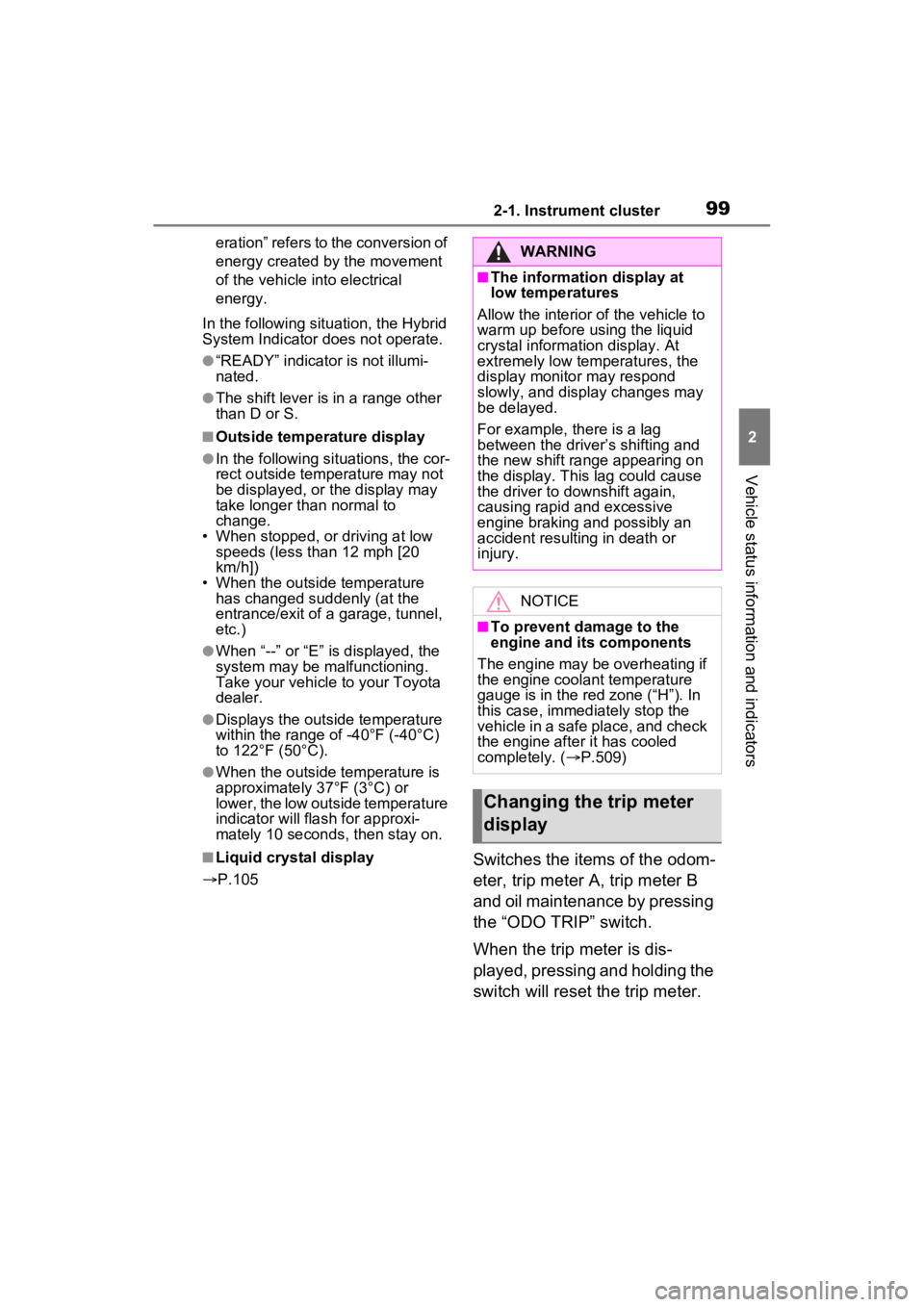
The engine may be overheating if
the engine coolant temperature
gauge is in the red zone (“H”). In
this case, immediately stop the
vehicle in a safe place, and check
the engine after it has cooled
completely. ( P.509)
Changing the trip meter
display
Page 103 of 602
1032-1. Instrument cluster
2
Vehicle status information and indicators
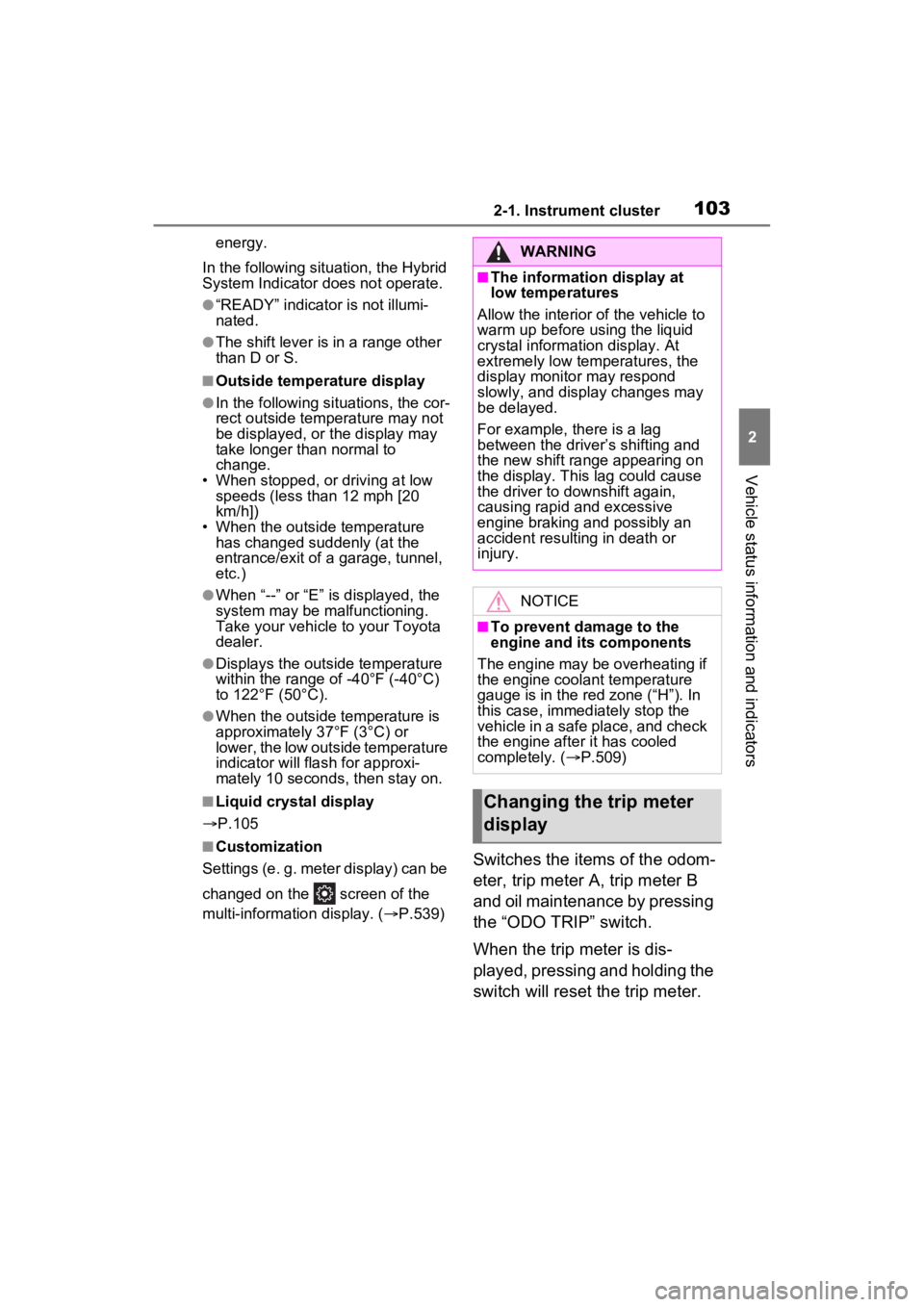
energy.
In the following situ ation, the Hybrid
System Indicator does not operate.
●“READY” indicator is not illumi-
nated.
●The shift lever is in a range other
than D or S.
■Outside temperature display
●In the following si tuations, the cor-
rect outside tempe rature may not
be displayed, or the display may
take longer than normal to
change.
• When stopped, or driving at low speeds (less than 12 mph [20
km/h])
• When the outside temperature has changed suddenly (at the
entrance/exit of a garage, tunnel,
etc.)
●When “--” or “E” is displayed, the
system may be malfunctioning.
Take your vehicle to your Toyota
dealer.
●Displays the outside temperature
within the range of -40°F (-40°C)
to 122°F (50°C).
●When the outside temperature is
approximately 37°F (3°C) or
lower, the low outside temperature
indicator will flash for approxi-
mately 10 seconds , then stay on.
■Liquid crystal display
P.105
■Customization
Settings (e. g. meter display) can be
changed on the screen of the
multi-informat ion display. (P.539)Switches the items of the odom-
eter, trip meter A, trip meter B
and oil maintenance by pressing
the “ODO TRIP” switch.
When the trip meter is dis-
played, pressing and holding the
switch will reset the trip meter.
WARNING
■The information display at
low temperatures
Allow the interior of the vehicle to
warm up before using the liquid
crystal information display. At
extremely low temperatures, the
display monitor may respond
slowly, and display changes may
be delayed.
For example, there is a lag
between the driver’s shifting and
the new shift range appearing on
the display. This lag could cause
the driver to downshift again,
causing rapid and excessive
engine braking and possibly an
accident resulting in death or
injury.
NOTICE
■To prevent damage to the
engine and its components
The engine may be overheating if
the engine coolant temperature
gauge is in the red zone (“H”). In
this case, immediately stop the
vehicle in a safe place, and check
the engine after it has cooled
completely. ( P.509)
Changing the trip meter
display
Page 216 of 602
2144-1. Before driving
WARNING
●Be careful not to shift the shift
lever with the accelerator pedal
depressed.
Shifting the shift lever to a gear
other than P or N may lead to
unexpected rapid acceleration
of the vehicle that may cause an
accident and result in death or
serious injury. Doing so can
damage the transmission and
may result in a loss of vehicle
control.
■If you hear a squealing or
scraping noise (brake pad
wear limit indicators)
Have the brake pads checked and
replaced by your Toyota dealer as
soon as possible.
Rotor damage may result if the
pads are not replaced when
needed.
It is dangerous to drive the vehicle
when the wear limits of the brake
pads and/or those of the brake
discs are exceeded.
■When the vehicle is stopped
●Do not depress t he accelerator
pedal unnecessarily.
If the vehicle is in any gear other
than P or N, the vehicle may
accelerate suddenly and unex-
pectedly, causing an accident.
●In order to prev ent accidents
due to the vehicle rolling away,
always keep depressing the
brake pedal while stopped with
the “READY” indicator is illumi-
nated, and apply the parking
brake as necessary.
●If the vehicle is stopped on an
incline, in order to prevent acci-
dents caused by the vehicle roll-
ing forward or backward, always
depress the brake pedal and
securely apply the parking
brake as needed.
●Avoid revving or racing the
engine.
Running the engine at high
speed while the vehicle is
stopped may cause the exhaust
system to overheat, which could
result in a fire if combustible
material is nearby.
■When the vehicle is parked
●Do not leave glasses, cigarette
lighters, spray cans, or soft
drink cans in the vehicle when it
is in the sun.
Doing so may result in the fol-
lowing:
• Gas may leak from a cigarette lighter or spray can, and may
lead to a fire.
• The temperature inside the vehicle may cause the plastic
lenses and plastic material of
glasses to deform or crack.
• Soft drink cans may fracture, causing the contents to spray
over the interior of the vehicle,
and may also cause a short cir-
cuit in the vehicle’s electrical
components.
●Do not leave cigarette lighters in
the vehicle. If a cigarette lighter
is in a place such as the glove
box or on the floor, it may be lit
accidentally when luggage is
loaded or the se at is adjusted,
causing a fire.
●Do not attach adhesive discs to
the windshield or windows. Do
not place containers such as air
fresheners on the instrument
panel or dashboard. Adhesive
discs or containers may act as
lenses, causing a fire in the
vehicle.
Page 233 of 602

2314-1. Before driving
4
Driving
down too long or applying the
brakes too frequently. This
could cause the brakes to
overheat and result in
reduced braking efficiency.
Due to the added load of the
trailer, your vehicle’s hybrid
system may overheat on hot
days (at temperatures over
85°F [30°C]) when driving up
a long or steep grade. If the
engine coolant temperature
gauge indicates overheating,
immediately turn off the air
conditioning (if in use), pull
your vehicle off the road and
stop in a safe spot. ( P.509)
Always place wheel blocks
under both the vehicle’s and
the trailer’s wheels when
parking. Apply the parking
brake firmly, and put the
transmission in P. Avoid park-
ing on a slope, but if unavoid-
able, do so only after
performing the following:
1 Apply the brakes and keep
them applied.
2 Have someone place wheel
blocks under both the vehi-
cle’s and trailer’s wheels.
3 When the wheel blocks are in
place, release the brakes
slowly until the blocks absorb
the load.
4 Apply the parking brake
firmly. 5
Shift into P and turn off the
hybrid system.
When restarting after parking
on a slope:
1 With the transmission in P,
start the hybrid system. Be
sure to keep the brake pedal
depressed.
2 Shift into a forward gear. If
reversing, shift into R.
3 If the parking brake is in man-
ual mode, release the park-
ing brake. ( P.246)
4 Release the brake pedal, and
slowly pull or back away from
the wheel blocks. Stop and
apply the brakes.
5 Have someone retrieve the
blocks.
■Break-in schedule
If your vehicle is new or equipped
with any new power train compo-
nents (such as an engine, transmis-
sion, differential or wheel bearing),
Toyota recommends that you do not
tow a trailer until the vehicle has
been driven for over 500 miles (800
km).
After the vehicle has been driven for
over 500 miles (800 km), you can
start towing. However, for the next
500 miles (800 km), drive the vehi-
cle at a speed of less than 45 mph
(72 km/h) when towing a trailer, and
avoid full throttle acceleration.
■Maintenance
●If you tow a traile r, your vehicle
will require more fr equent mainte-
nance due to the additional load.
(See “Scheduled Maintenance
Guide” or “Owner ’s Manual Sup-
plement”.)
Page 340 of 602

3384-5. Using the driving support systems
■Sounds and vibrations caused
by the ABS, brake assist, VSC,
TRAC, Trailer Sway Control and
hill-start assist control systems
●A sound may be heard from the
engine compartment when the
brake pedal is dep ressed repeat-
edly, when the hybrid system is
started or just after the vehicle
begins to move. This sound does
not indicate that a malfunction has
occurred in any of these systems.
●Any of the following conditions
may occur when t he above sys-
tems are operating. None of these
indicates that a malfunction has
occurred.
• Vibrations may be felt through the vehicle body and steering.
• A motor sound may be heard also after the vehicle comes to a stop.
■ECB operating sound
ECB operating sound may be heard
in the following cases, but it does
not indicate that a malfunction has
occurred.
●Operating sound heard from the
engine compartment when the
brake pedal is operated.
●Motor sound of the brake system
heard from the front part of the
vehicle when the driver’s door is
opened.
●Operating sound heard from the
engine compartment when one or
two minutes passed after the stop
of the hybrid system.
■Active Cornering Assist opera-
tion sounds and vibrations
When the Active Cornering Assist is
operated, operation sounds and
vibrations may b e generated from
the brake system, but this is not a
malfunction.
■EPS operation sound
When the steering wheel is oper-
ated, a motor sou nd (whirring
sound) may be heard. This does not
indicate a malfunction.
■Automatic reactivation of
TRAC, Trailer Sway Control and
VSC systems
After turning the TRAC, Trailer
Sway Control and VSC systems off,
the systems will be a utomatically re-
enabled in the following situations:
●When the power switch is turned
off
●If only the TRAC sy stem is turned
off, the TRAC will turn on when
vehicle speed increases
If both the TRAC and VSC sys-
tems are turned of f, automatic re-
enabling will not occur when vehi-
cle speed increases.
■Operating conditions of Active
Cornering Assist
The system operates when the fol-
lowing occurs.
●TRAC/VSC can operate
●The driver is attempting to accel-
erate while turning
●The system detects that the vehi-
cle is drifting to the outer side
●The brake pedal is released
■Reduced effectiveness of the
EPS system
The effect iveness of the EPS sys-
tem is reduced to prevent the sys-
tem from overheating when there is
frequent steering input over an
extended period of time. The steer-
ing wheel may feel heavy as a
result. Should this occur, refrain
from excessive steering input or
stop the vehicle a nd turn the hybrid
system off. The EPS system should
return to normal within 10 minutes.
■Secondary Collision Brake
operating conditions
The system operates when the SRS
airbag sensor de tects a collision
while the vehicle is in motion. How-
ever, the system does not operate
when the components are dam-
aged.
Page 467 of 602
4657-2. Steps to take in an emergency
7
When trouble arises
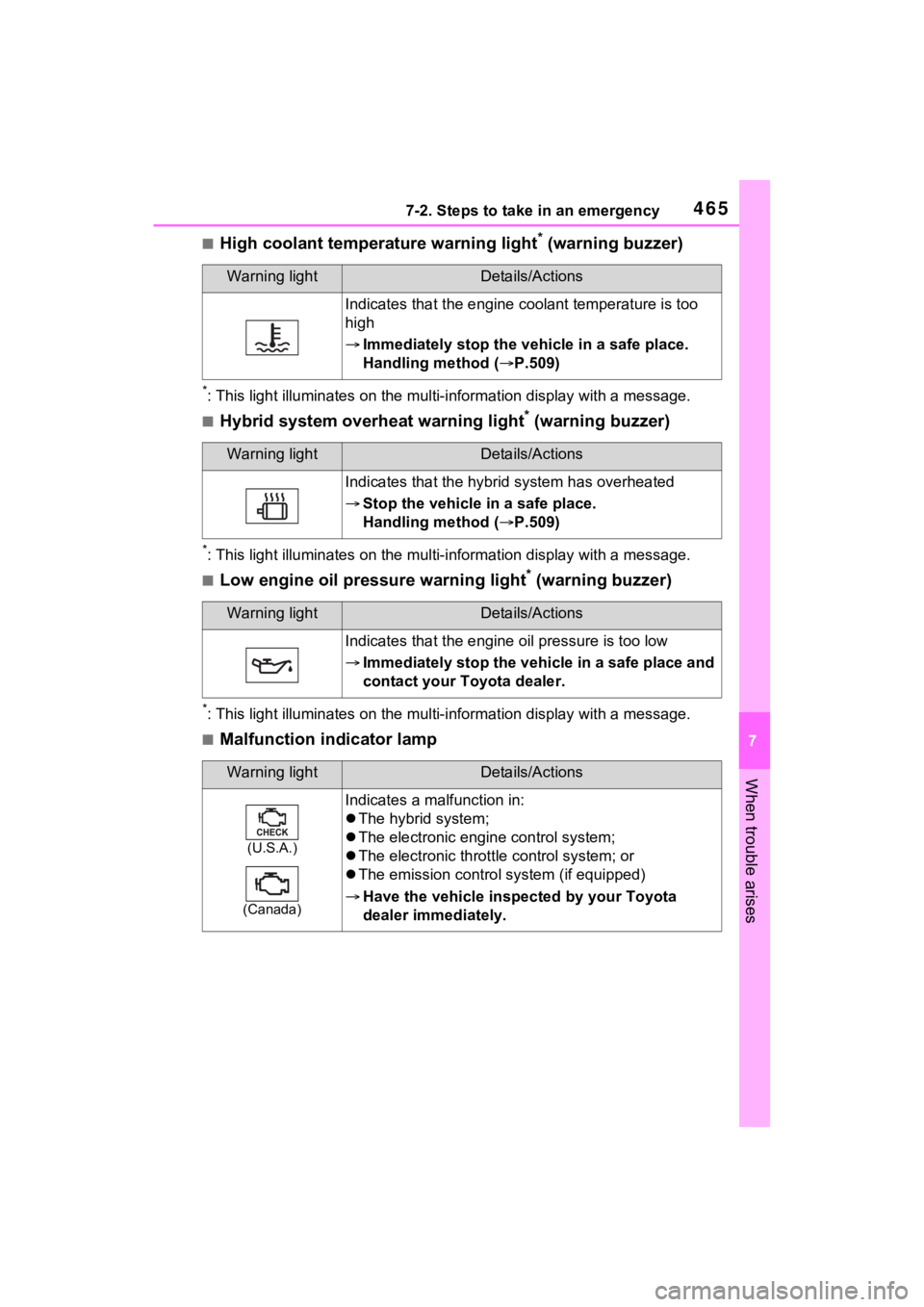
■High coolant temperature warning light* (warning buzzer)
*: This light illuminates on the mu lti-information display with a message.
■Hybrid system overheat warning light* (warning buzzer)
*: This light illuminates on the mu lti-information display with a message.
■Low engine oil pressure warning light* (warning buzzer)
*: This light illuminates on the mu lti-information display with a message.
■Malfunction indicator lamp
Warning lightDetails/Actions
Indicates that the engine coolant temperature is too
high
Immediately stop the v ehicle in a safe place.
Handling method ( P.509)
Warning lightDetails/Actions
Indicates that the hybri d system has overheated
Stop the vehicle in a safe place.
Handling method ( P.509)
Warning lightDetails/Actions
Indicates that the engine oil pressure is too low
Immediately stop the vehicle in a safe place and
contact your Toyota dealer.
Warning lightDetails/Actions
(U.S.A.)
(Canada)
Indicates a malfunction in:
The hybrid system;
The electronic engi ne control system;
The electronic throttle control system; or
The emission control system (if equipped)
Have the vehicle insp ected by your Toyota
dealer immediately.