ESP TOYOTA SUPRA 2022 Workshop Manual
[x] Cancel search | Manufacturer: TOYOTA, Model Year: 2022, Model line: SUPRA, Model: TOYOTA SUPRA 2022Pages: 498, PDF Size: 104.06 MB
Page 221 of 498
219
3
3-1. CONTROLS
CONTROLS
the lane marking is detected, the
steering wheel vibrates in accord-
ance with the steering wheel vibra-
tion setting.
If the turn indicator is switched on in
the corresponding direction before
changing lanes, no warning is
issued.
Depending on the equipment, if a
lane marking is crossed in the
speed range up to 210 km/h,
approx. 130 mph, the system may
intervene not only by vibrating but
also with a brief active steering
intervention. The steering interven-
tion helps to keep the vehicle in
lane. Steering intervention can be
felt at the steering wheel, and can
be overridden manually at any time.
With active steering intervention,
the display flashes in the instru-
ment cluster.
Depending on the equipment, if the
system executes an active steering
intervention multiple times within 3
minutes without the driver touching
the steering wheel, an acoustic
warning is emitted. A short warning
signal sounds on the second steer-
ing intervention. A longer warning
signal sounds from the third steer-
ing intervention onwards.
A vehicle message is also dis-
played.
The warning signal and vehicle
message tell the driver to pay more
attention to the lane.
For example, the warning is can-
celled in the following situations:
Automatically after a few sec-
onds.
On returning to the correct lane.
If the vehicle is braking heavily.
On indicating.
If Vehicle Stability Control VSC
intervenes.
For further information:
• Sensors of the vehicle, see page
50.
The system may have limited func-
Steering intervention
Warning signal
Cancellation of the warning
System limits
Safety note
WA R N I N G
The system may not respond at all, or may respond too late, incorrectly or
without justification due to limits of the
system. There is a danger of acci- dents or damage to property.
Observe the information on the sys-
tem limits and intervene actively if necessary.
System limits of the sensors
Functional limitations
Page 223 of 498
221
3
3-1. CONTROLS
CONTROLS
The system is controlled using the
following sensors:
• Side radar sensors, rear.
For further information:
Sensors of the vehicle, see page
50.
The Blind spot monitor is reacti-
vated automatically at the start of a
journey if the function was switched
on the last time the engine was
stopped.
The menu for the Toyota Supra
Safety Systems is shown.
If all Toyota Supra Safety Systems
were switched off, all systems are
now switched on.
"Customise Settings": depending
on the equipment, the Toyota Supra
Safety Systems can be configured
individually. The custom settings
are activated and saved. As soon
as a setting is changed in the
menu, all settings in the menu are
activated.
Safety notes
WA R N I N G
The system does not relieve you of
your personal responsibility to assess the visibility conditions and traffic situ-
ation correctly. There is a danger of
accidents. Adapt your driving style to the traffic conditions. Observe the
traffic situation and intervene actively
if the situation warrants it.
WA R N I N G
Displays and warnings do not relieve
you of your personal responsibility.
System limitations can mean that warnings or system responses are
not issued or are issued too late,
incorrectly or wit hout justification. There is a danger of accidents. Adapt
your driving style to the traffic condi-
tions. Observe the traffic situation and intervene actively if the situation war-
rants it.
Overview
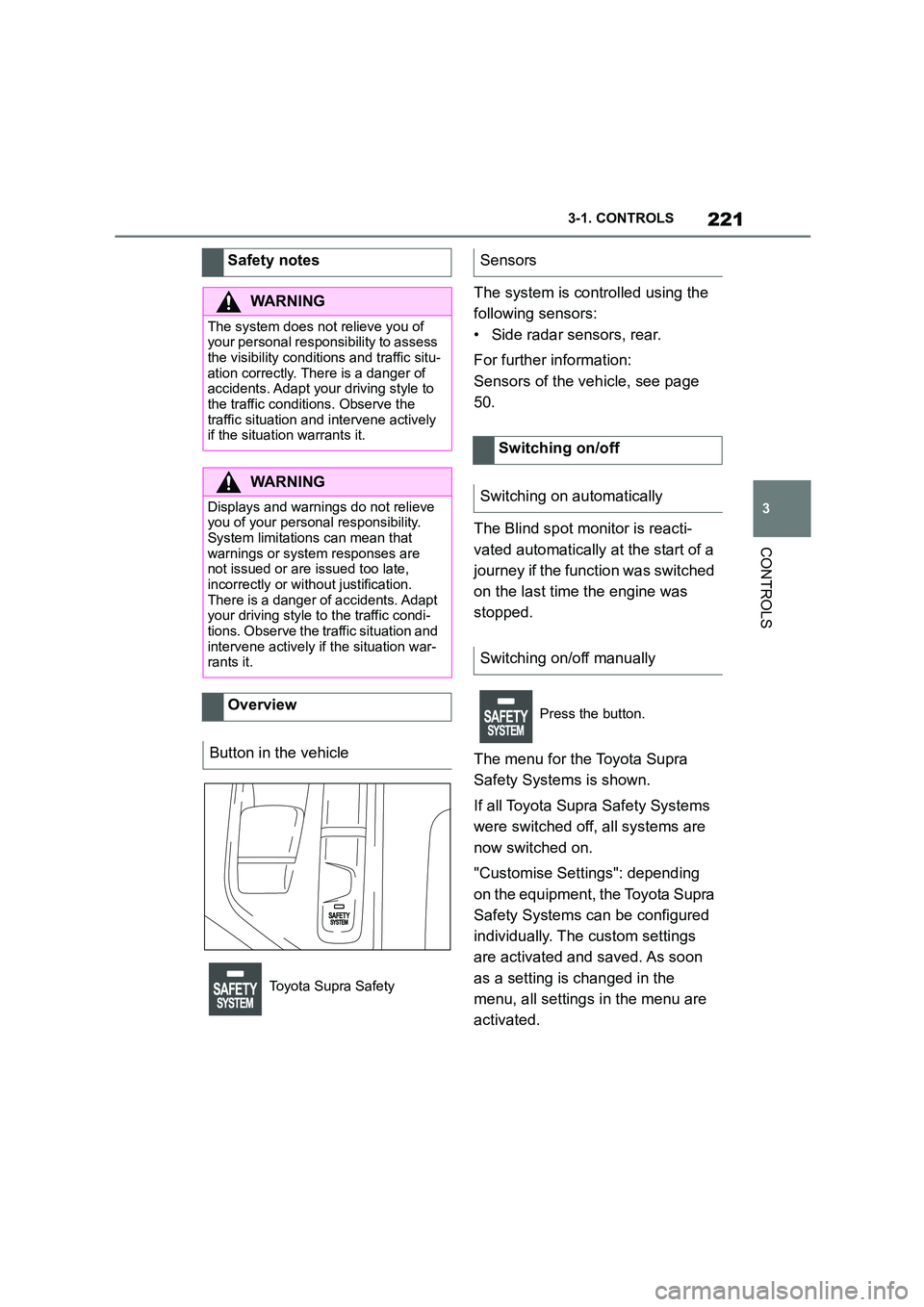
Button in the vehicle
Toyota Supra Safety
Sensors
Switching on/off
Switching on automatically
Switching on/off manually
Press the button.
Page 225 of 498
223
3
3-1. CONTROLS
CONTROLS
If the turn indicator is switched on
while a vehicle is in the critical area,
the steering wheel vibrates briefly
and the light in the exterior mirror
flashes brightly.
The warning is terminated when the
turn signal is cancelled or the other
vehicle has left the critical area.
A flashing light when the vehicle is
unlocked indicates that the system
is performing a self-test.
At speeds over approx. 250 km/h,
155 mph, the system is temporarily
disabled.
At speeds below approx. 250 km/h,
155 mph, the system once again
responds according to the setting.
For further information:
• Radar sensors, see page 50.
The system may have limited func-
tionality in the following situations,
for example:
If the speed of the approaching
vehicle is significantly higher
than the driver's own speed.
In thick fog, wet conditions or
snow.
On sharp bends or narrow roads.
If the bumper is dirty, iced up or
covered, for example by stickers.
After work performed incorrectly
on the vehicle paintwork.
When a projecting load is being
transported.
Attaching any objects – stickers or
film, for example – in the beam
area of the radar sensors will also
restrict the function of the radar
sensors and may even cause them
to fail.
A vehicle message is displayed in
the event of limited functionality.
Depending on the selected setting
for warnings, for example the warn-
ing time, it is po ssible for more
warnings to be displayed. As a
result, there may be an increased
Acute warning
Flashing of light
System limits
Safety note
WA R N I N G
The system may not re spond at all, or
may respond too late, incorrectly or
without justification due to limits of the system. There is a danger of acci-
dents or damage to property.
Observe the information on the sys- tem limits and intervene actively if
necessary.
Upper speed limit
System limits of the sensors
Functional limitations
Warning displays
Page 226 of 498
2243-1. CONTROLS
number of premature warnings
about critical situations.
Depending on the equipment and
the nationalmarket version, the
Rear Collision Prevention can
respond to vehicles approaching
from behind.
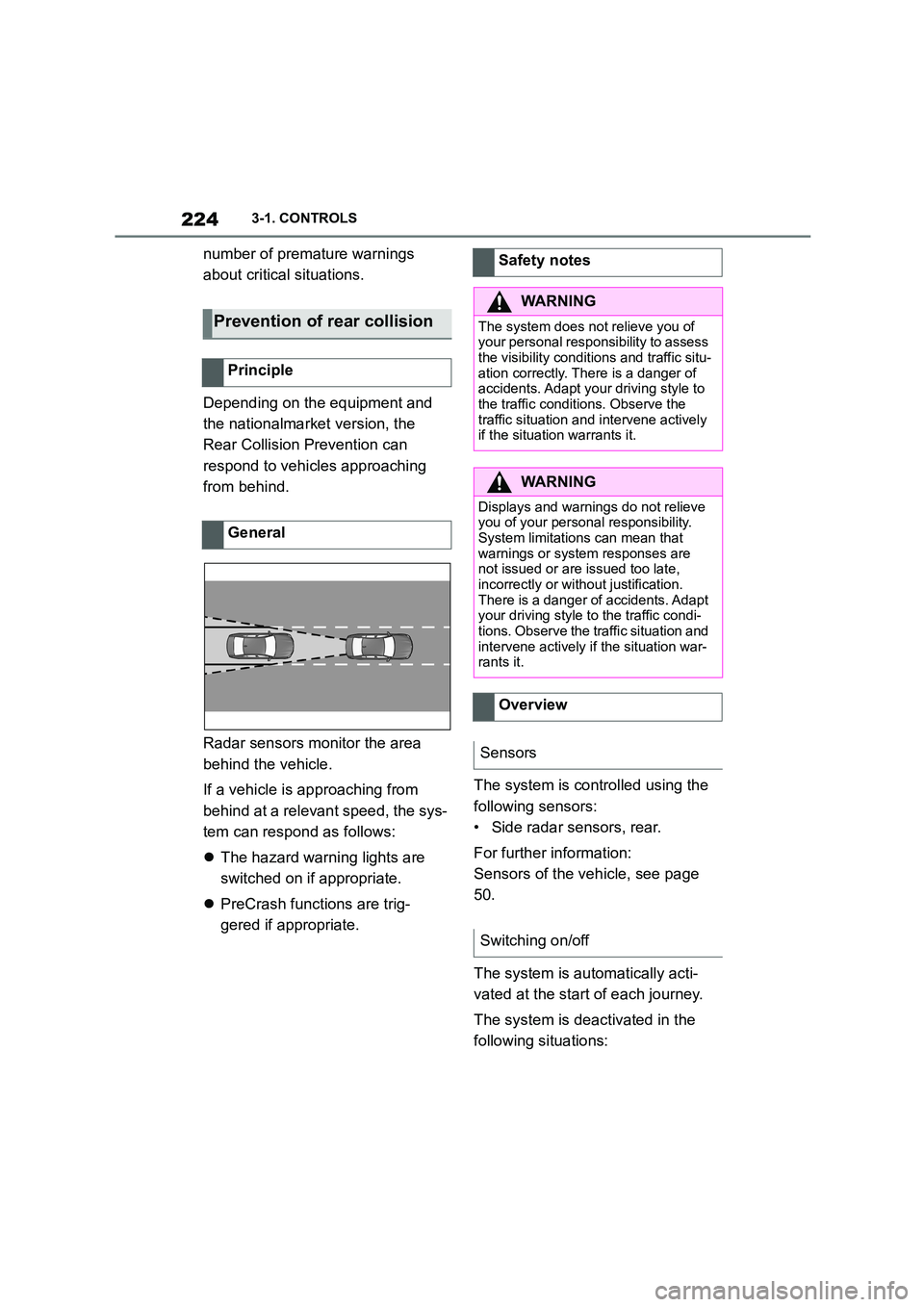
Radar sensors monitor the area
behind the vehicle.
If a vehicle is approaching from
behind at a relevant speed, the sys-
tem can respond as follows:
The hazard warning lights are
switched on if appropriate.
PreCrash functions are trig-
gered if appropriate.
The system is controlled using the
following sensors:
• Side radar sensors, rear.
For further information:
Sensors of the vehicle, see page
50.
The system is automatically acti-
vated at the start of each journey.
The system is deactivated in the
following situations:
Prevention of rear collision
Principle
General
Safety notes
WA R N I N G
The system does not relieve you of
your personal responsibility to assess the visibility conditions and traffic situ-
ation correctly. There is a danger of
accidents. Adapt your driving style to the traffic conditions. Observe the
traffic situation and intervene actively
if the situation warrants it.
WA R N I N G
Displays and warnings do not relieve
you of your personal responsibility.
System limitations can mean that warnings or system responses are
not issued or are issued too late,
incorrectly or without justification. There is a danger of accidents. Adapt
your driving style to the traffic condi-
tions. Observe the traffic situation and intervene actively if the situation war-
rants it.
Overview
Sensors
Switching on/off
Page 228 of 498
2263-1. CONTROLS
achieved with the automatic brak-
ing function. This action interrupts
the automatic braking process.
In certain situations, it may be nec-
essary to cancel automatic braking,
for example for an evasive
manoeuvre.
Cancel automatic braking:
By depressing the brake pedal.
By depressing the accelerator
pedal.
The system can det ect decreasing
attentiveness or the onset of fatigue
in the driver on long monotonous
journeys, for example on motor-
ways. In this situation, it is recom-
mended that you take a break.
The system is switched on every
time drive-ready state is switched
on.
After commencement of the jour-
ney, the system adapts to the driver
so that an decrease in attention or
fatigue can be detected.
This process considers the follow-
ing criteria:
Personal driving style, for exam-
ple, steering.
Driving conditions, for example,
time of day, duration of journey.
The system is active from approx.
70 km/h, 43 mph and can also dis-
play a recommendation to take a
break.
The driver attention control is auto-
matically active every time
drive-ready state is switched on
and can thus display break recom-
mendations.
Break recommendations can also
be switched on or off and adjusted
via Toyota Supra Command.
Via Toyota Supra Command:
1 "My Vehicle"
2 "Vehicle settings"
3 "Driver Attention Control"
Cancelling automatic braking
Driver Attention Control
Principle
Safety note
WA R N I N G
The system does not relieve you of
your personal responsibility to assess your physical condition correctly.
Increasing inattention or fatigue might
not be detected, or may not be detected in good time. There is a dan-
ger of accidents. Make sure that the
driver is rested and alert. Adapt your driving style to the traffic conditions.
Function
Recommendation to take a
break
Adjusting
Page 230 of 498
2283-1. CONTROLS
This chapter describes all standard,
country-specific and special equip-
ment available for the model series.
It may therefore describe equip-
ment and functions which are not
installed in your vehicle, for exam-
ple on account of the special equip-
ment selected or the country
specification. This also applies to
safety-relevant functions and sys-
tems. Please comply with the rele-
vant laws and regulations when
using the corresponding functions
and systems.
ABS prevents the wheels from lock-
ing when the brakes are applied.
Steering control is retained even in
the event of full braking, thereby
enhancing active road safety.
ABS is ready to operate each time
the engine is started.
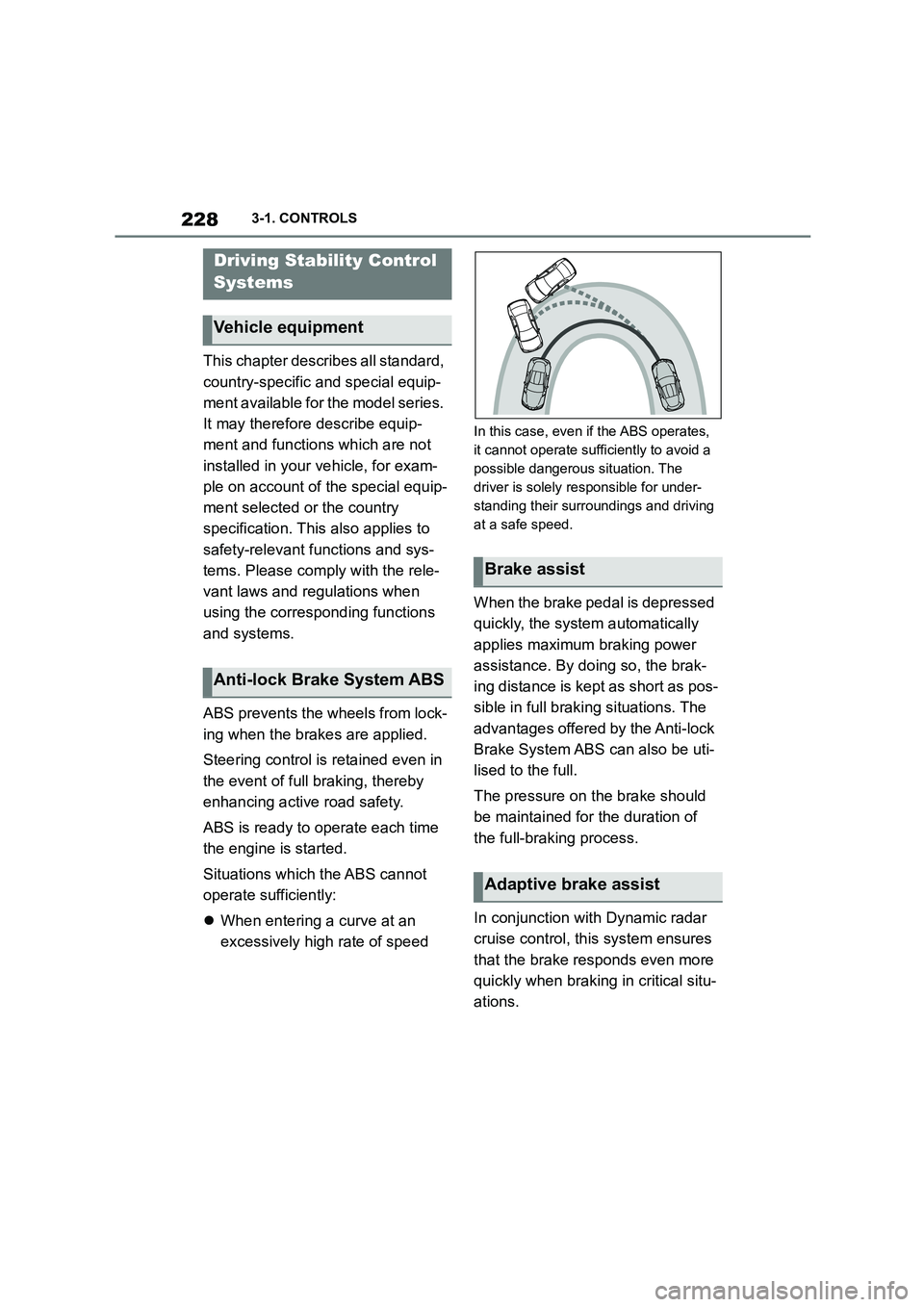
Situations which the ABS cannot
operate sufficiently:
When entering a curve at an
excessively high rate of speed
In this case, even if the ABS operates,
it cannot operate sufficiently to avoid a
possible dangerous situation. The
driver is solely responsible for under-
standing their surroundings and driving
at a safe speed.
When the brake pedal is depressed
quickly, the system automatically
applies maximum braking power
assistance. By doi ng so, the brak-
ing distance is kept as short as pos-
sible in full braking situations. The
advantages offered by the Anti-lock
Brake System ABS can also be uti-
lised to the full.
The pressure on the brake should
be maintained for the duration of
the full-braking process.
In conjunction with Dynamic radar
cruise control, th is system ensures
that the brake responds even more
quickly when braking in critical situ-
ations.
Driving Stability Control
Systems
Vehicle equipment
Anti-lock Brake System ABS
Brake assist
Adaptive brake assist
Page 231 of 498
229
3
3-1. CONTROLS
CONTROLS
The system provides support when
driving off on upward gradients.
1 Hold the vehicle in place by
depressing the foot brake.
2 Release the foot brake and drive
off without delay.
The vehicle is held for approxi-
mately 2 seconds after the foot
brake has been released.
Depending on the vehicle's load,
the vehicle may roll backwards a lit-
tle.
The system reduce s engine power
output and applies the brakes on
individual wheels thereby helping,
within the limits imposed by the
laws of physics, to keep the vehicle
safely on course.
VSC detects the following unstable
driving conditions, for example:
Loss of traction at the rear which
can lead to oversteer.
Loss of grip of the front wheels
which can lead to understeer.Hill-start assist control
Principle
Driving off
Vehicle Stability Control
VSC
Principle
General
Safety notes
WA R N I N G
The system does not relieve you of
your personal responsibility to assess
the traffic situation correctly. Due to system limitations, it cannot respond
independently and appropriately in all
traffic conditions. There is a danger of accidents. Adapt your driving style to
the traffic conditions. Observe the
traffic situation and intervene actively if the situation warrants it.
WA R N I N G
When driving with a roof load, for example with a roof rack, the higher
centre of gravity can mean that driv-
ing safety is no longer guaranteed in critical driving situations. There is a
danger of accidents or damage to
property. Do not deactivate Vehicle
Stability Control VSC when driving with a roof load.
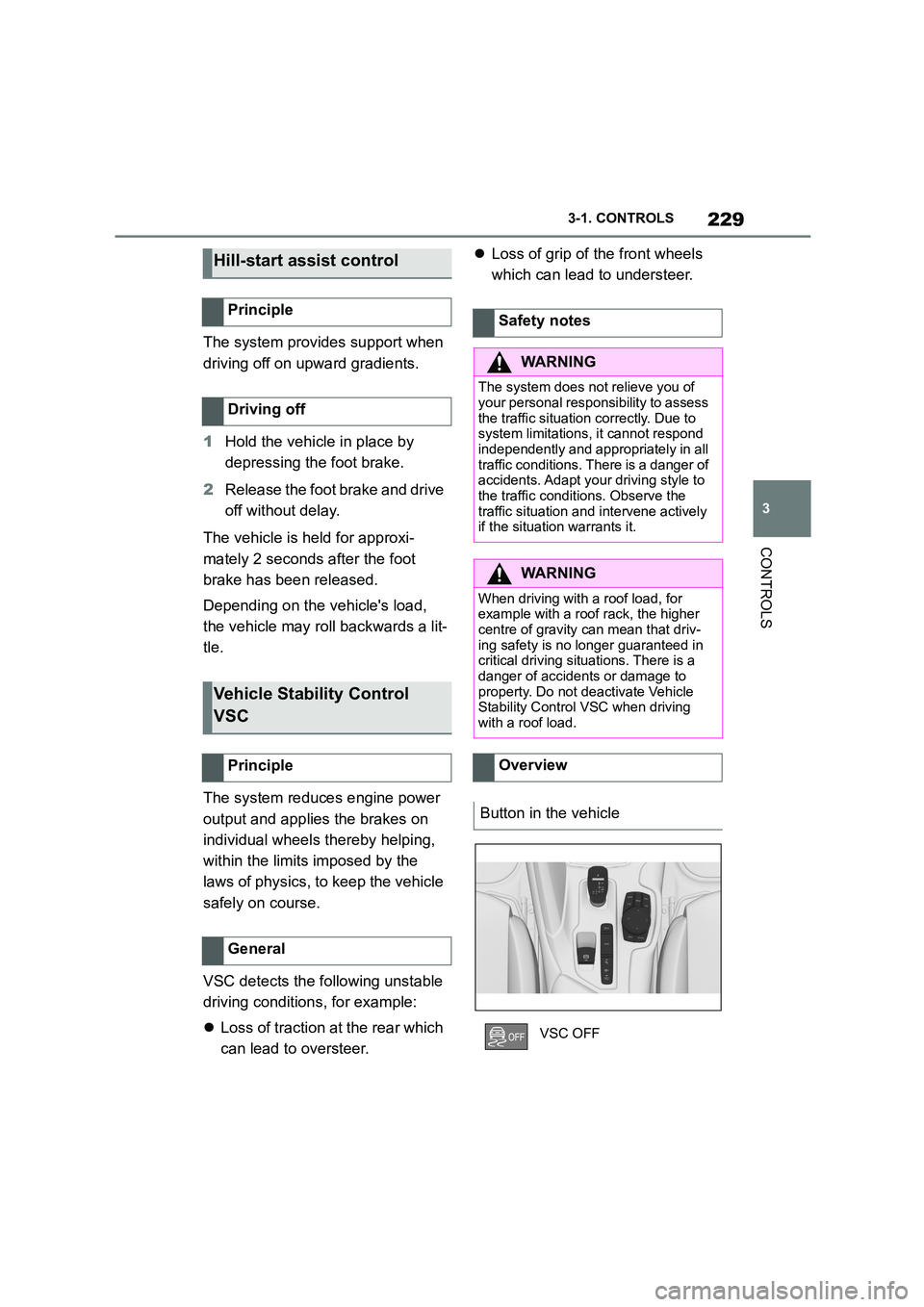
Overview
Button in the vehicle
VSC OFF
Page 232 of 498
2303-1. CONTROLS
Driving stability during acceleration
and cornering is rest ricted if VSC is
deactivated.
To assist driving stability, re-acti-
vate VSC as soon as possible.
VSC OFF is displayed in the instru-
ment cluster when VSC is deacti-
vated.
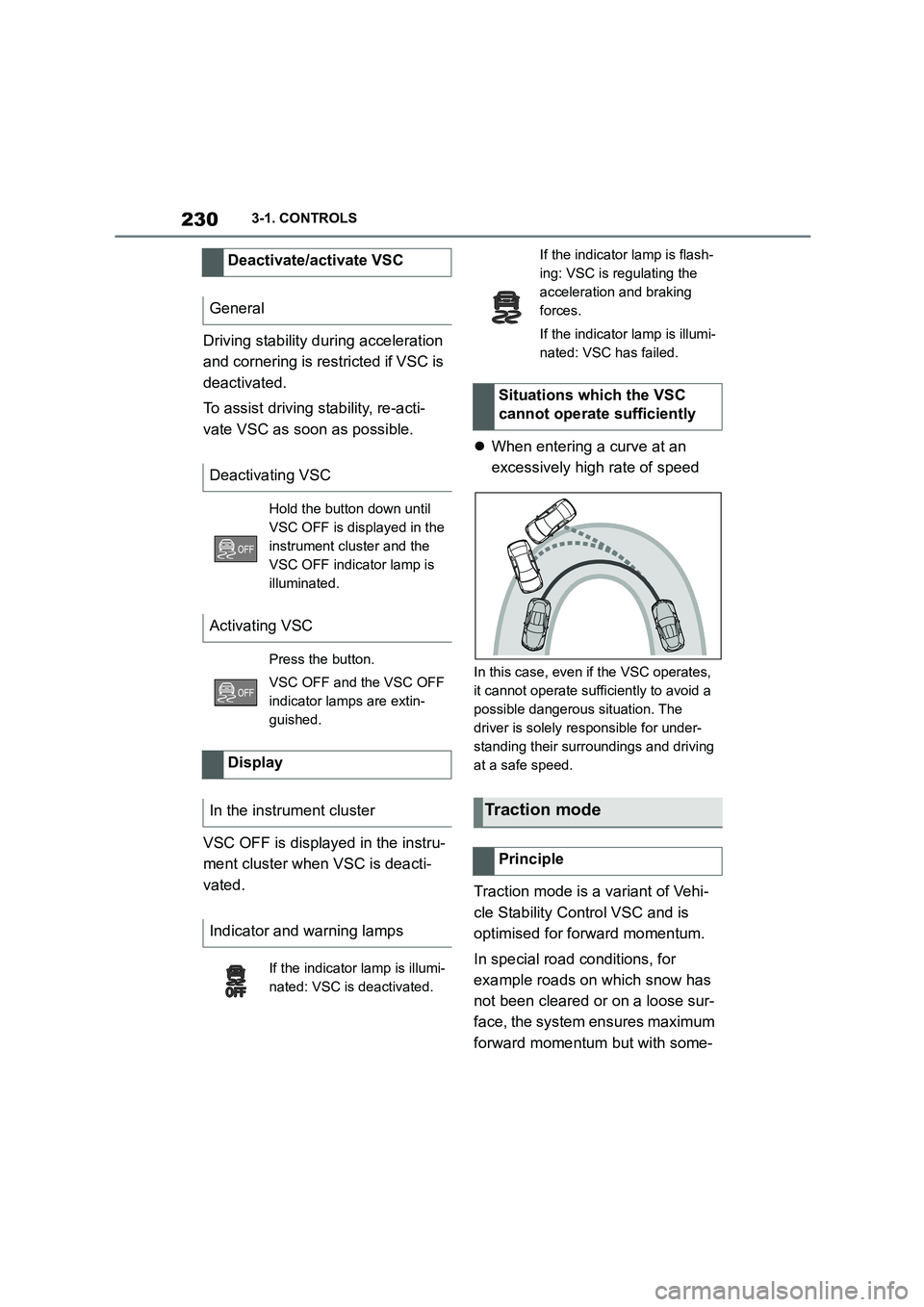
When entering a curve at an
excessively high rate of speed
In this case, even if the VSC operates,
it cannot operate sufficiently to avoid a
possible dangerous situation. The
driver is solely responsible for under-
standing their surroundings and driving
at a safe speed.
Traction mode is a variant of Vehi-
cle Stability Control VSC and is
optimised for forward momentum.
In special road conditions, for
example roads on which snow has
not been cleared or on a loose sur-
face, the system ensures maximum
forward momentum but with some-
Deactivate/activate VSC
General
Deactivating VSC
Hold the button down until
VSC OFF is displayed in the
instrument cluster and the
VSC OFF indicator lamp is
illuminated.
Activating VSC
Press the button.
VSC OFF and the VSC OFF
indicator lamps are extin-
guished.
Display
In the instrument cluster
Indicator and warning lamps
If the indicator lamp is illumi-
nated: VSC is deactivated.
If the indicator lamp is flash-
ing: VSC is regulating the
acceleration and braking
forces.
If the indicator lamp is illumi-
nated: VSC has failed.
Situations which the VSC
cannot operate sufficiently
Traction mode
Principle
Page 234 of 498
2323-1. CONTROLS
In the event of a braking inter-
vention by the Toyota Supra
Safety Systems.
In the event of a flat tyre.
*: if equipped
The active differential steplessly
locks the rear axle depending on
the driving conditions. This pro-
vides optimal power transfer in all
driving conditions by helping pre-
vent wheel spin at either rear
wheel.
The driver is responsible for a driv-
ing style appropriate to the situa-
tion.
This chapter describes all standard,
country-specific and special equip-
ment available for the model series.
It may therefore describe equip-
ment and functions which are not
installed in your vehicle, for exam-
ple on account of the special equip-
ment selected or the country
specification. This also applies to
safety-relevant functions and sys-
tems. Please comply with the rele-
vant laws and regulations when
using the corresponding functions
and systems.
The system can be used to set a
speed limit so that speed restric-
tions are not exceeded.
The system enables speeds from a
value of 30 km/h/20 mph and above
to be set as a speed limit. Below
the set speed limit, the vehicle can
be driven without restriction.
Active differential*
Driver Assistance Sys-
tems
Vehicle equipment
Manual Speed Limiter
Principle
General
Page 237 of 498
235
3
3-1. CONTROLS
CONTROLS
To do so, the system automatically
accelerates and brakes the vehicle
as necessary.
The system can be activated from
30 km/h/20 mph.
Depending on the vehicle settings,
the characteristics of the Cruise
Control may change.
The indicator will come on.
Cruise Control is active. The driven
General
Safety notes
WA R N I N G
The system does not relieve you of
your personal responsibility to assess the traffic situation correctly. Due to
system limitations, it cannot respond
independently and appropriately in all traffic conditions. There is a danger of
accidents. Adapt your driving style to
the traffic conditions. Observe the traffic situation and intervene actively
if the situation warrants it.
WA R N I N G
Using the system in the following situ- ations may increase the risk of an
accident, for example:
●On stretches of road with many cor-
ners and bends.
●In heavy traffic.
●If the road is icy, if there is fog or snow, if conditions are wet or on a
loose road surface.
There is a danger of accidents or
damage to property. Only use the sys-
tem if it is possible to drive at a con- stant speed.
WA R N I N G
The desired speed may be acciden-
tally set incorrectly or called up by
mistake. There is a danger of acci- dents. Adjust the desired speed to the
traffic conditions. Observe the traffic
situation and intervene actively if the situation warrants it.
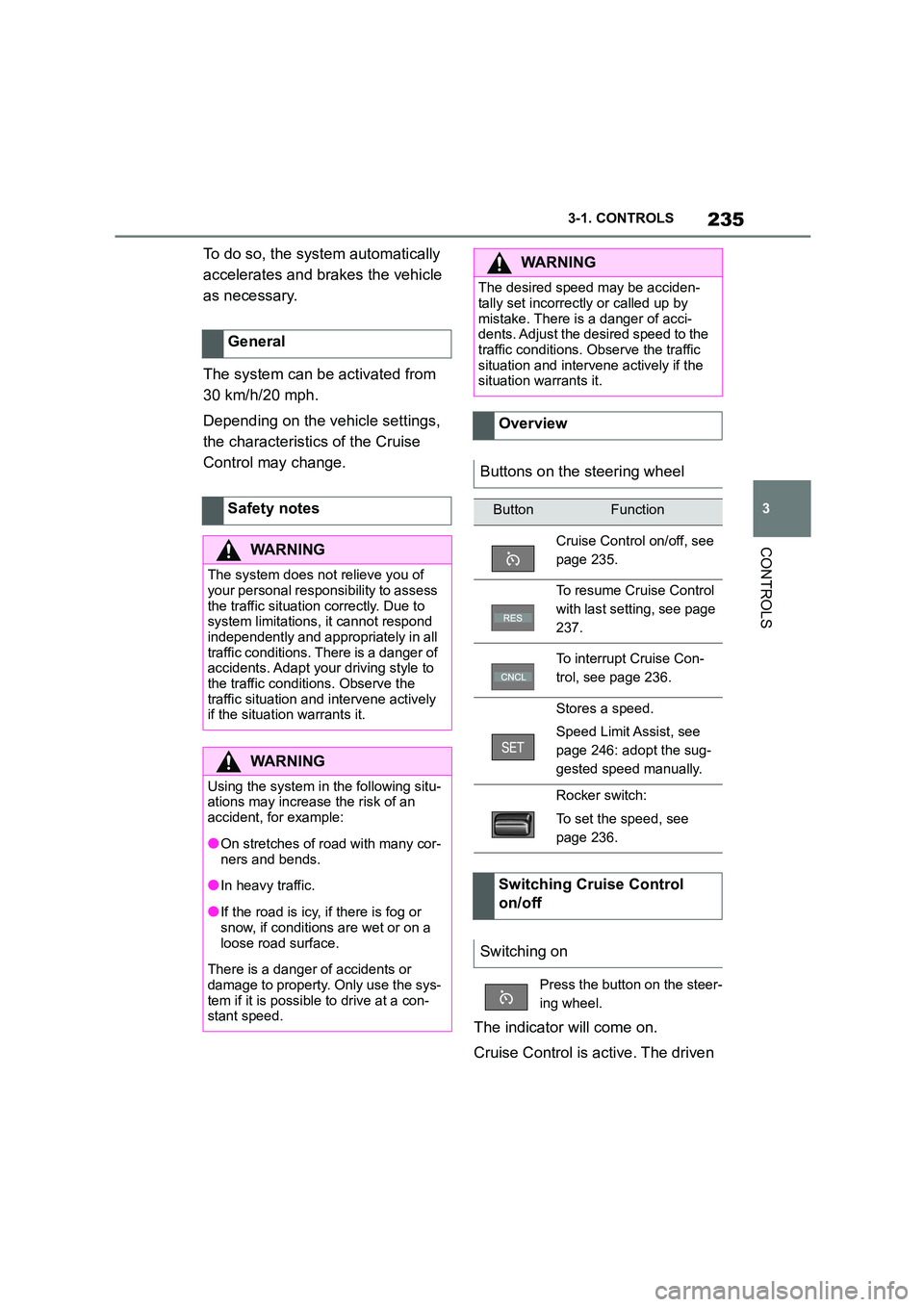
Overview
Buttons on the steering wheel
ButtonFunction
Cruise Control on/off, see
page 235.
To resume Cruise Control
with last setting, see page
237.
To interrupt Cruise Con-
trol, see page 236.
Stores a speed.
Speed Limit Assist, see
page 246: adopt the sug-
gested speed manually.
Rocker switch:
To set the speed, see
page 236.
Switching Cruise Control
on/off
Switching on
Press the button on the steer-
ing wheel.