child seat TOYOTA SUPRA 2022 Owners Manual
[x] Cancel search | Manufacturer: TOYOTA, Model Year: 2022, Model line: SUPRA, Model: TOYOTA SUPRA 2022Pages: 498, PDF Size: 104.06 MB
Page 4 of 498
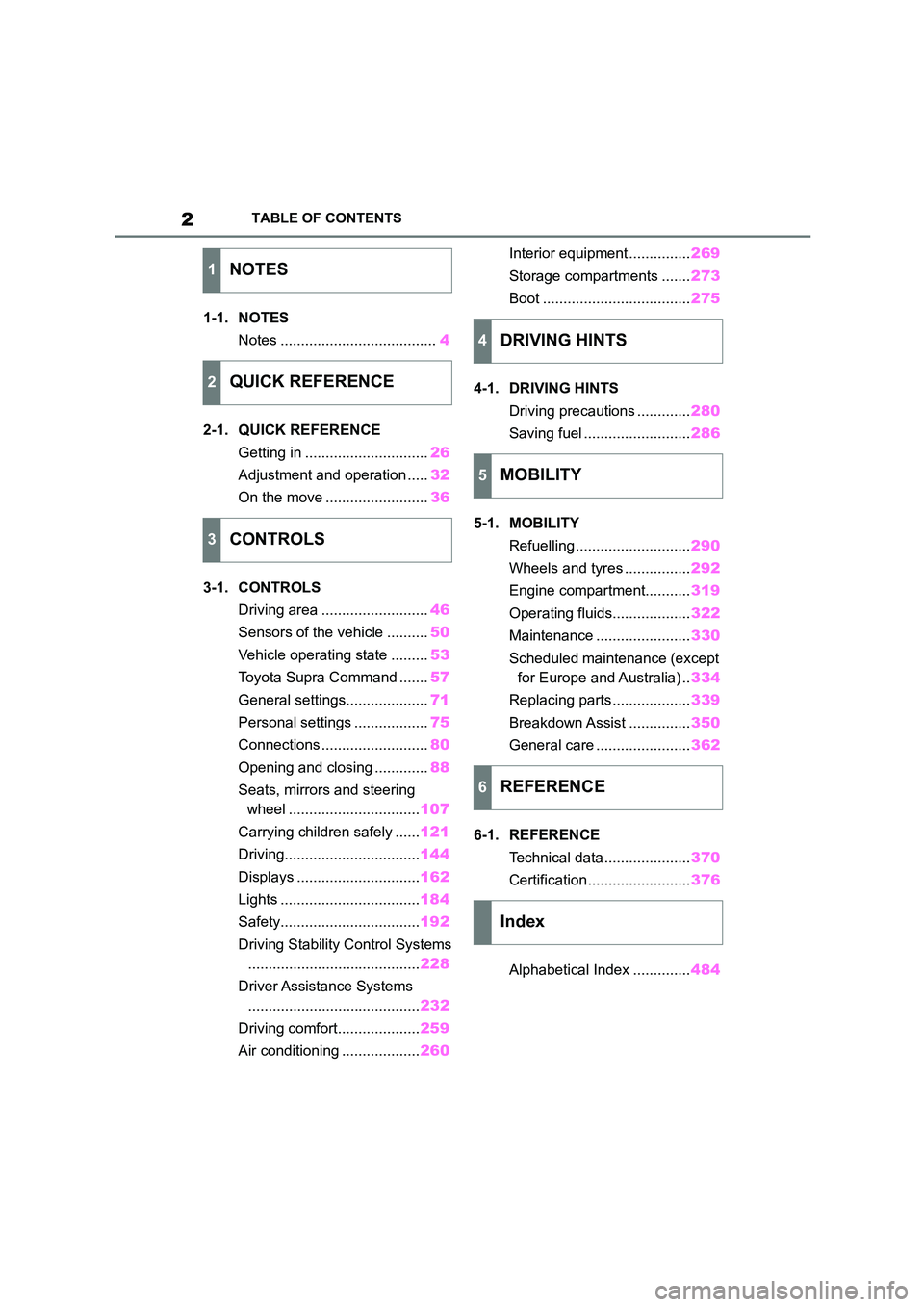
2TABLE OF CONTENTS
1-1. NOTES
Notes ...................................... 4
2-1. QUICK REFERENCE
Getting in .............................. 26
Adjustment and operation ..... 32
On the move ......................... 36
3-1. CONTROLS
Driving area .......................... 46
Sensors of the vehicle .......... 50
Vehicle operating state ......... 53
Toyota Supra Command ....... 57
General settings.................... 71
Personal settings .................. 75
Connections .......................... 80
Opening and closing ............. 88
Seats, mirrors and steering
wheel ................................ 107
Carrying children safely ...... 121
Driving................................. 144
Displays .............................. 162
Lights .................................. 184
Safety.................................. 192
Driving Stability Control Systems
.......................................... 228
Driver Assistance Systems
.......................................... 232
Driving comfort.................... 259
Air conditioning ................... 260
Interior equipment ............... 269
Storage compartments ....... 273
Boot .................................... 275
4-1. DRIVING HINTS
Driving precautions ............. 280
Saving fuel .......................... 286
5-1. MOBILITY
Refuelling ............................ 290
Wheels and tyres ................ 292
Engine compartment........... 319
Operating fluids................... 322
Maintenance ....................... 330
Scheduled maintenance (except
for Europe and Australia) .. 334
Replacing parts ................... 339
Breakdown Assist ............... 350
General care ....................... 362
6-1. REFERENCE
Technical data ..................... 370
Certification ......................... 376
Alphabetical Index .............. 484
1NOTES
2QUICK REFERENCE
3CONTROLS
4DRIVING HINTS
5MOBILITY
6REFERENCE
Index
Page 29 of 498
27
2
2-1. QUICK REFERENCE
QUICK REFERENCE
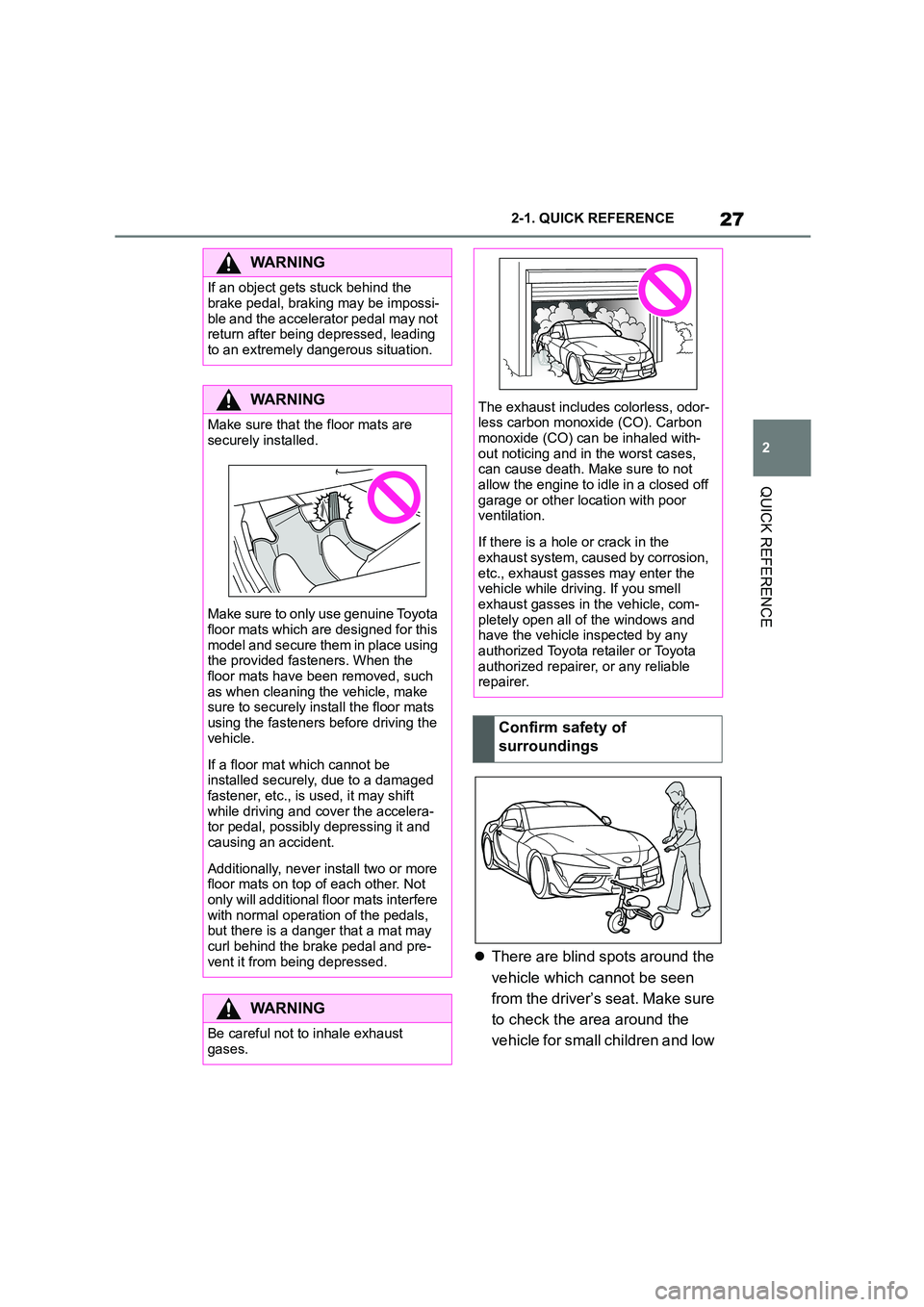
There are blind spots around the
vehicle which cannot be seen
from the driver’s seat. Make sure
to check the area around the
vehicle for small children and low
WA R N I N G
If an object gets stuck behind the
brake pedal, braking may be impossi-
ble and the accelerator pedal may not return after being depressed, leading
to an extremely dangerous situation.
WA R N I N G
Make sure that the floor mats are
securely installed.
Make sure to only use genuine Toyota
floor mats which are designed for this model and secure them in place using
the provided fasteners. When the
floor mats have been removed, such as when cleaning the vehicle, make
sure to securely install the floor mats
using the fasteners before driving the
vehicle.
If a floor mat which cannot be
installed securely, due to a damaged fastener, etc., is used, it may shift
while driving and cover the accelera-
tor pedal, possibly depressing it and causing an accident.
Additionally, never install two or more floor mats on top of each other. Not
only will additional floor mats interfere
with normal operation of the pedals, but there is a danger that a mat may
curl behind the brake pedal and pre-
vent it from being depressed.
WA R N I N G
Be careful not to inhale exhaust
gases.
The exhaust includes colorless, odor- less carbon monoxide (CO). Carbon
monoxide (CO) can be inhaled with-
out noticing and in the worst cases, can cause death. Make sure to not
allow the engine to idle in a closed off
garage or other location with poor ventilation.
If there is a hole or crack in the exhaust system, caused by corrosion,
etc., exhaust gasses may enter the
vehicle while driving. If you smell exhaust gasses in the vehicle, com-
pletely open all of the windows and
have the vehicle inspected by any authorized Toyota retailer or Toyota
authorized repairer, or any reliable
repairer.
Confirm safety of
surroundings
Page 47 of 498
3
45
3
CONTROLS
CONTROLS
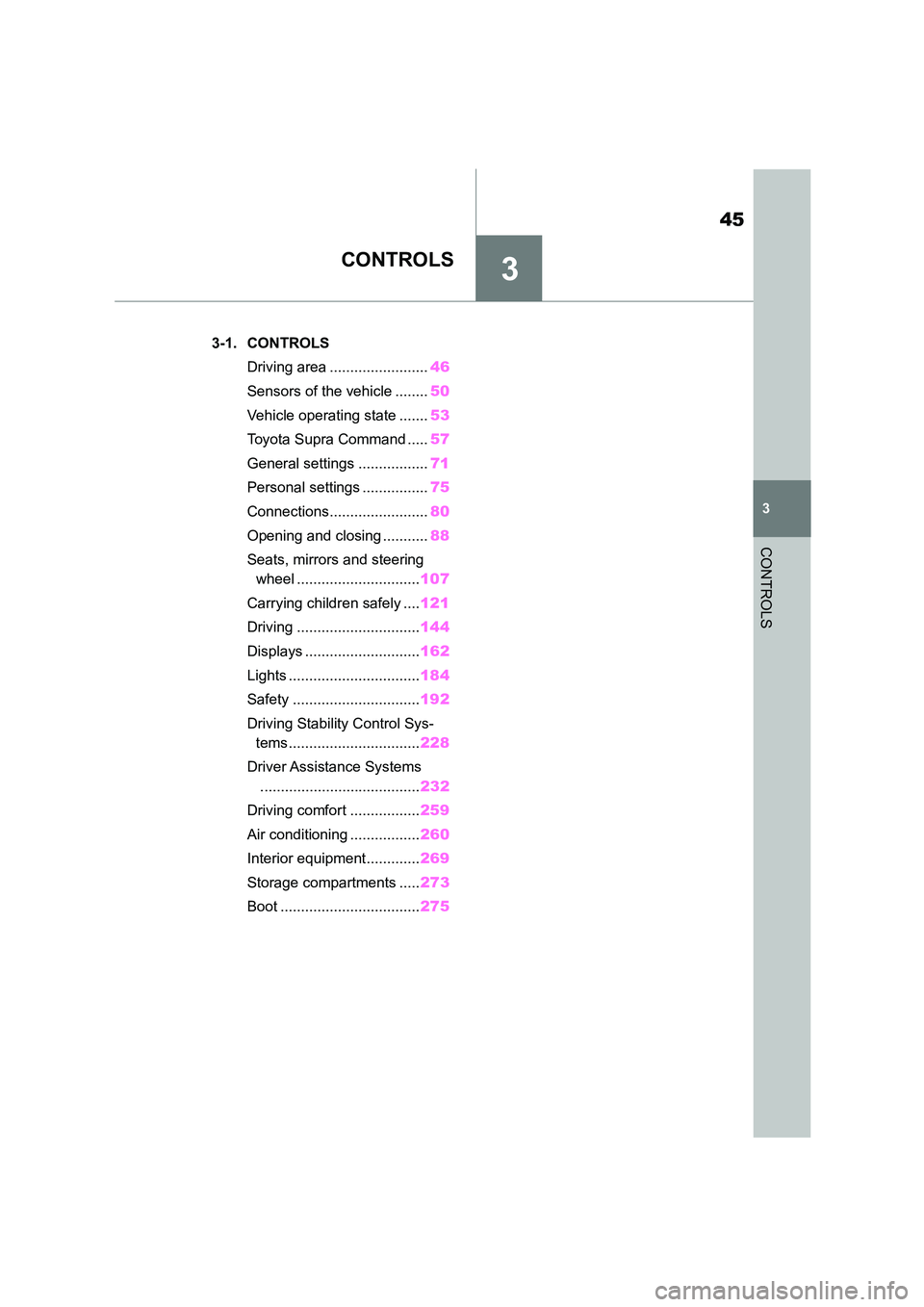
.3-1. CONTROLS
Driving area ........................ 46
Sensors of the vehicle ........ 50
Vehicle operating state ....... 53
Toyota Supra Command ..... 57
General settings ................. 71
Personal settings ................ 75
Connections........................ 80
Opening and closing ........... 88
Seats, mirrors and steering
wheel .............................. 107
Carrying children safely .... 121
Driving .............................. 144
Displays ............................ 162
Lights ................................ 184
Safety ............................... 192
Driving Stability Control Sys-
tems................................ 228
Driver Assistance Systems
....................................... 232
Driving comfort ................. 259
Air conditioning ................. 260
Interior equipment............. 269
Storage compartments ..... 273
Boot .................................. 275
Page 91 of 498
89
3
3-1. CONTROLS
CONTROLS
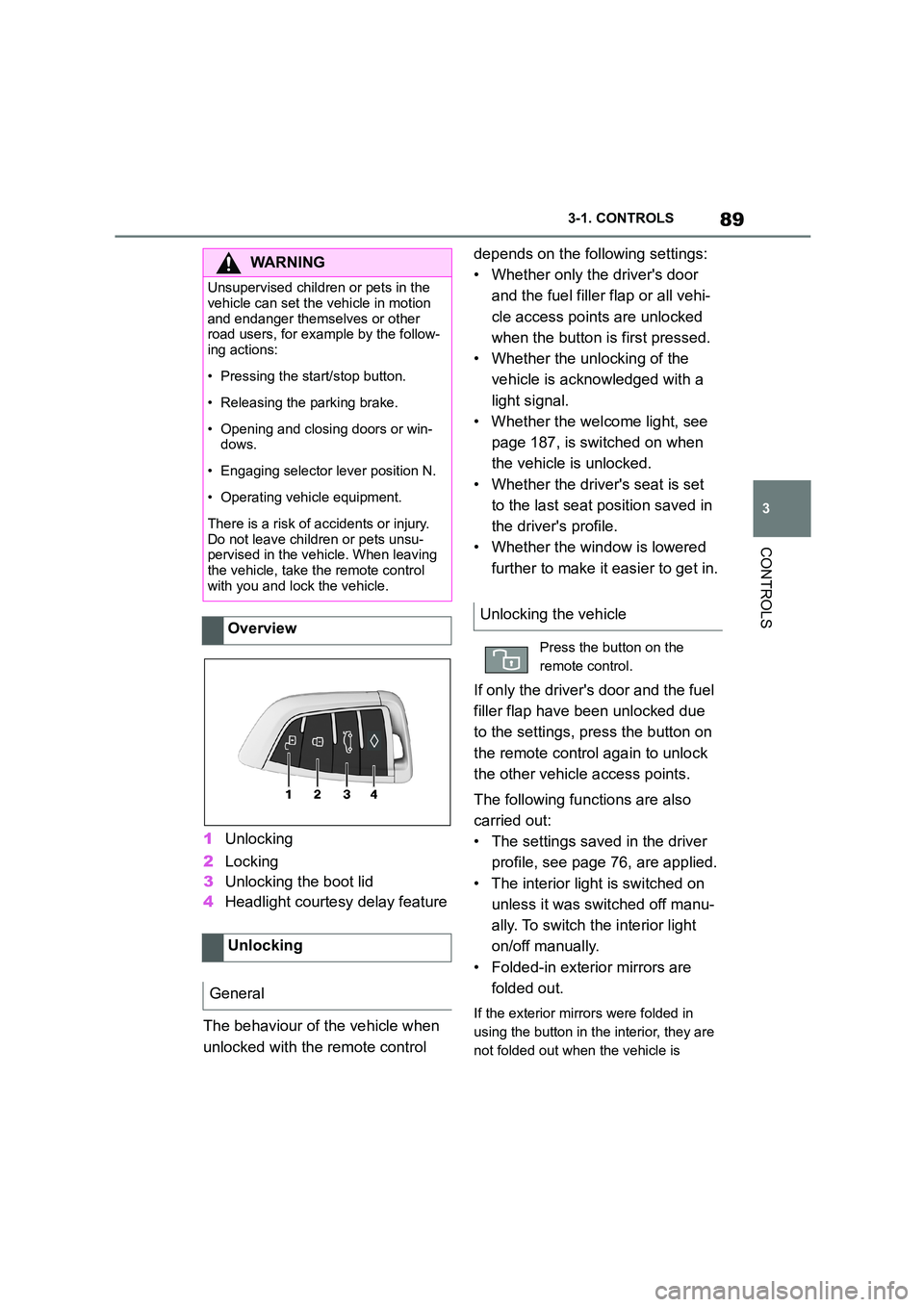
1 Unlocking
2 Locking
3 Unlocking the boot lid
4 Headlight courtesy delay feature
The behaviour of the vehicle when
unlocked with the remote control
depends on the following settings:
• Whether only the driver's door
and the fuel filler flap or all vehi-
cle access poin ts are unlocked
when the button is first pressed.
• Whether the unlocking of the
vehicle is acknowledged with a
light signal.
• Whether the welcome light, see
page 187, is switched on when
the vehicle is unlocked.
• Whether the driver's seat is set
to the last seat position saved in
the driver's profile.
• Whether the window is lowered
further to make it easier to get in.
If only the driver's door and the fuel
filler flap have been unlocked due
to the settings, press the button on
the remote control again to unlock
the other vehicle access points.
The following functions are also
carried out:
• The settings saved in the driver
profile, see page 76, are applied.
• The interior light is switched on
unless it was switched off manu-
ally. To switch the interior light
on/off manually.
• Folded-in exterior mirrors are
folded out.
If the exterior mirrors were folded in
using the button in the interior, they are
not folded out when the vehicle is
WA R N I N G
Unsupervised children or pets in the
vehicle can set the vehicle in motion
and endanger themselves or other road users, for example by the follow-
ing actions:
• Pressing the start/stop button.
• Releasing the parking brake.
• Opening and closing doors or win-
dows.
• Engaging selector lever position N.
• Operating vehicle equipment.
There is a risk of accidents or injury.
Do not leave children or pets unsu- pervised in the vehicle. When leaving
the vehicle, take the remote control
with you and lock the vehicle.
Overview
Unlocking
General
Unlocking the vehicle
Press the button on the
remote control.
Page 113 of 498
111
3
3-1. CONTROLS
CONTROLS
For the safety of the vehicle occu-
pants, the vehicle is equipped with
two seat belts. However, they can
only provide effective protection
when worn correctly.
Before a journey, always make sure
that all occupants have fastened
their seat belts. The airbags sup-
plement the seat belts as an addi-
tional safety device. The airbags
are not a substitute for the seat
belts.
All belt fastening points are
designed to achieve the best possi-
ble protective effe ct of the seat
belts with proper use of the seat
belts and correct seat setting.
Notes on sitting safely, see page
P.107.
Adjusting
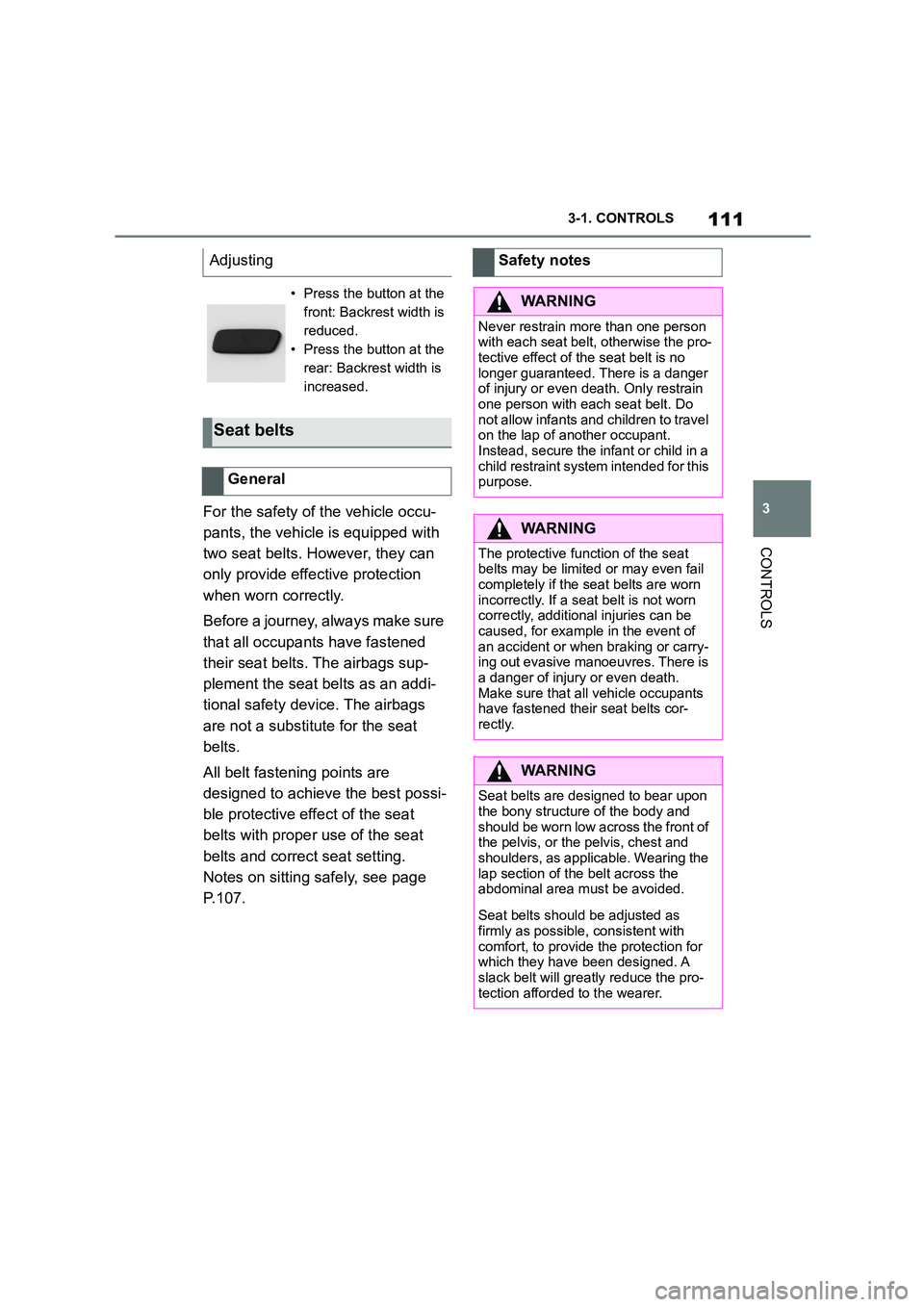
• Press the button at the
front: Backrest width is
reduced.
• Press the button at the
rear: Backrest width is
increased.
Seat belts
General
Safety notes
WA R N I N G
Never restrain more than one person
with each seat belt, otherwise the pro- tective effect of the seat belt is no
longer guaranteed. There is a danger
of injury or even death. Only restrain one person with each seat belt. Do
not allow infants and children to travel
on the lap of another occupant.
Instead, secure the infant or child in a child restraint system intended for this
purpose.
WA R N I N G
The protective function of the seat
belts may be limited or may even fail
completely if the seat belts are worn incorrectly. If a seat belt is not worn
correctly, additional injuries can be
caused, for example in the event of an accident or when braking or carry-
ing out evasive manoeuvres. There is
a danger of injury or even death.
Make sure that al l vehicle occupants have fastened their seat belts cor-
rectly.
WA R N I N G
Seat belts are designed to bear upon
the bony structure of the body and
should be worn low across the front of the pelvis, or the pelvis, chest and
shoulders, as applicable. Wearing the
lap section of the belt across the abdominal area must be avoided.
Seat belts should be adjusted as firmly as possible, consistent with
comfort, to provide the protection for
which they have been designed. A
slack belt will greatly reduce the pro- tection afforded to the wearer.
Page 114 of 498
1123-1. CONTROLS
• Insert the seat belt into the belt
guide.
• Place the seat belt tightly over
the pelvis and shoulder, close to
the body and without twisting.
• Make sure that the seat belt is
positioned low at the hip in the
area of the pelvis. The seat belt
must not press on the abdomen.
• The seat belt must not be rubbed
on sharp edges, be routed over
solid or breakable objects or be
trapped.
• Avoid wearing bulky clothing.
• Keep the seat belt taut by occa-
sionally pulling upwards on the
upper section.
WA R N I N G
Care should be taken to avoid con-
tamination of the webbing by pol-
ishes, oils and chemicals and particularly battery acid. Cleaning
may safely be carried out using a mild
soap and water solution. The belt should be replaced if webbing
becomes frayed, contaminated or
damaged. Seat belts should not be
worn with straps twisted. Each seat belt assembly must only be used by
one occupant; it is forbidden to put a
belt around a child being carried on the occupant’s lap.
It is essential to replace the entire assembly after it has been worn in a
severe impact even if damage to the
assembly is not obvious.
WA R N I N G
No modifications or additions should
be made by the user that will either
prevent the seat belt adjusting
devices from operating to remove slack, or prevent the seat belt assem-
bly from being adjusted to remove
slack.
WA R N I N G
If the rear backrest is not locked, the
protective effect of the middle seat belt is not ensured. There is a danger
of injury or even death. Lock the wider
rear seat backrest when using the middle seat belt.
WA R N I N G
The protective function of the seat
belts may be limited or may even fail completely in the following situations:
• The seat belts or belt buckles are damaged, dirty or have been modi-
fied in another way.
• The seat belt tensioners or belt retractors have been modified.
Seat belts can be damaged in an accident without the damage neces-
sarily being apparent. There is a dan-
ger of injury or danger to life. Do not modify seat belts, seat belt buckles,
seat belt tensioners, belt retractors
and belt anchor points and ensure that they are kept clean. After an acci-
dent, have the seat belts inspected at
any authorized Toyota retailer or Toyota authorized repairer, or any reli-
able repairer.
Correct seat belt use
Page 123 of 498
121
3
3-1. CONTROLS
CONTROLS
Press the button
once for each temperature level.
The highest level is selected if the
three LEDs are illuminated.
Press and hold the
button until the LEDs no longer illu-
minates.
This chapter describes all standard,
country-specific and special equip-
ment available for the model series.
It may therefore describe equip-
ment and functions which are not
installed in your vehicle, for exam-
ple on account of the special equip-
ment selected or the country
specification. This also applies to
safety-relevant functions and sys-
tems. Please comply with the rele-
vant laws and regulations when
using the corresponding functions
and systems.
Switching on
Switching off
Carr ying children safely
Vehicle equipment
When children are in the
vehicle
WA R N I N G
Make sure that any children in the
vehicle wear a seat belt.
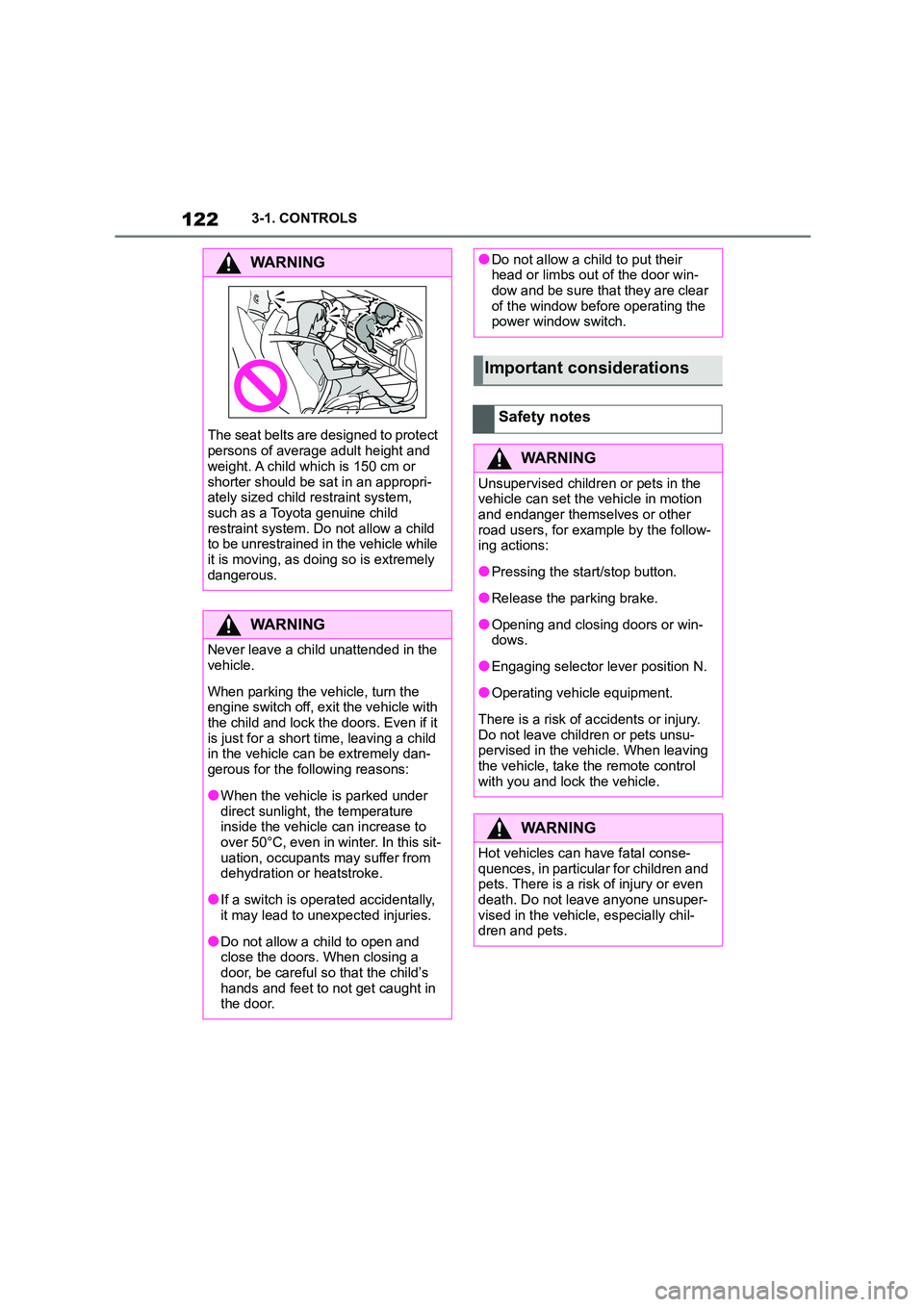
Do not allow occupants to ride with a
child in their arms or on their lap. In
the case of sudden braking or a colli- sion, the child may hit their head on
the instrument panel or windshield, or
may even be thrown from the vehicle.
Page 124 of 498
1223-1. CONTROLS
WA R N I N G
The seat belts are designed to protect
persons of average adult height and
weight. A child which is 150 cm or
shorter should be sat in an appropri- ately sized child restraint system,
such as a Toyota genuine child
restraint system. Do not allow a child to be unrestrained in the vehicle while
it is moving, as doing so is extremely
dangerous.
WA R N I N G
Never leave a child unattended in the
vehicle.
When parking the vehicle, turn the
engine switch off, exit the vehicle with
the child and lock the doors. Even if it
is just for a short time, leaving a child in the vehicle can be extremely dan-
gerous for the following reasons:
●When the vehicle is parked under
direct sunlight, the temperature
inside the vehicle can increase to over 50°C, even in winter. In this sit-
uation, occupants may suffer from
dehydration or heatstroke.
●If a switch is operated accidentally,
it may lead to unexpected injuries.
●Do not allow a child to open and
close the doors. When closing a door, be careful so that the child’s
hands and feet to not get caught in
the door.
●Do not allow a child to put their head or limbs out of the door win-
dow and be sure that they are clear
of the window before operating the power window switch.
Important considerations
Safety notes
WA R N I N G
Unsupervised children or pets in the vehicle can set the vehicle in motion
and endanger themselves or other
road users, for example by the follow- ing actions:
●Pressing the start/stop button.
●Release the parking brake.
●Opening and closing doors or win-
dows.
●Engaging selector lever position N.
●Operating vehicle equipment.
There is a risk of accidents or injury.
Do not leave children or pets unsu- pervised in the vehicle. When leaving
the vehicle, take the remote control
with you and lock the vehicle.
WA R N I N G
Hot vehicles can have fatal conse-
quences, in particular for children and
pets. There is a risk of injury or even death. Do not leave anyone unsuper-
vised in the vehicle, especially chil-
dren and pets.
Page 125 of 498
123
3
3-1. CONTROLS
CONTROLS
When using a child restraint system
on the front passenger seat, make
sure that the front and side airbags
on the passenger side are deacti-
vated. Front passenger airbags can
only be deactivated with the key
switch for front passenger airbags,
see page 202.
Appropriate child restraint systems
for every age and weight class are
available from any authorized
Toyota retailer or Toyota authorized
repairer, or any reliable repairer.
Please comply with the operating
and safety instructions provided by
the child restraint system manufac-
turer when selecting, attaching and
using child restraint systems.
WA R N I N G
Child restraint systems and their parts
can get very hot when exposed to
direct sunlight. Contact with hot parts can cause burns. There is a risk of
injury. Do not expose the child
restraint system to direct sunlight. Cover the child restraint system if
necessary. It may be necessary to
allow the child restraint system to cool
down before strapping a child in. Do not leave children unsupervised in the
vehicle.
WA R N I N G
Children under 150 cm, 5 ft tall cannot
wear the seat belt correctly without
using additional child restraint sys- tems. The protective function of the
seat belts may be limited or may even
fail completely if the seat belts are worn incorrectly. If a seat belt is not
worn correctly, additional injuries can
be caused, for example in the event of an accident or when braking or car-
rying out evasive manoeuvres. There
is a risk of injury or even death. Chil-
dren under 150 cm, 5 ft tall must be secured in suitable child restraint sys-
tems.
Not for Austra lia/New Zea-
land: Children on the front
passenger seat
General
Safety note
WA R N I N G
Active front passenger airbags can
injure a child in a child restraint sys- tem if they are deployed. There is a
risk of injury. Make sure that the front
passenger airbags are deactivated and the PASSENGER AIRBAG OFF
indicator lamp is illuminated.
WA R N I N G
Children less than 150 cm, 5 ft in height cannot wear the seat belt cor-
rectly without using additional child
restraint systems. The protective function of the seat belts may be lim-
ited or may even fail completely if the
seat belts are worn incorrectly. If a seat belt is not worn correctly, addi-
tional injuries can be caused, for
example in the event of an accident or braking and evasive manoeuvres.
There is a danger of injury or even
death. Children smaller than 150 cm,
5 ft in height must be secured in suita- ble child restraint systems.
Fitting child restraints
General
Page 126 of 498
1243-1. CONTROLS
Please note the following warning
because your vehicle has been
equipped with a front airbag for the
front passenger’s seat that cannot
be deactivated:
Before fitting a child restraint on the
front passenger seat, make sure
that the front and side airbags on
the passenger side are disabled. If
the airbag cannot be deactivated,
do not fit child restraint systems.
Deactivating the front passenger
airbags with key switch, see page
202.
Safety notes
WA R N I N G
If child restraint systems and their
attachment system s have been dam- aged or subjected to stresses in an
accident, their protective function may
be limited or may fail completely. A child might not be adequately
restrained, for example in the event of
an accident, braking or evasive
manoeuvres. There is a risk of injury or even death. Child restraint systems
that are damaged or have been sub-
jected to stresses in an accident must not be used further. If attachment sys-
tems have been damaged or sub-
jected to stresses in an accident, have them checked and replaced by
any authorized Toyota retailer or
Toyota authorized repairer, or any reli- able repairer and renewed if neces-
sary.
WA R N I N G
If the seat is not adjusted properly or the child seat has been installed
incorrectly, the chil d restraint system
may have limited stability or may not be stable at all. There is a risk of
injury or even death. Make sure that
the child restraint system rests firmly against the backrest. Wherever possi-
ble, adapt the backrest angle of all the
relevant seat backrests and adjust the seats correctly. Make sure that the
seats and their backrests are correctly
engaged or locked. If possible, adjust the height of the head restraints, or
remove them.
For Australia: In stallation of
child restraints
It is recommended not to
use any kind of child
restraint system on the
front passenger’s seat.
WA R N I N G
Extreme hazard:
Do not use a rearward facing child
restraint on a seat protected by an airbag in front of it.
Not for Australia and Taiwan:
On the front passenger seat
Deactivating airbags
WA R N I N G
Active front passenger airbags can
injure a child in a child restraint sys-
tem if they are deployed. There is a
risk of injury. Make sure that the front passenger airbags are deactivated
and the PASSENGER AIRBAG OFF
indicator lamp is illuminated.