engine overheat TOYOTA SUPRA 2022 Owners Manual
[x] Cancel search | Manufacturer: TOYOTA, Model Year: 2022, Model line: SUPRA, Model: TOYOTA SUPRA 2022Pages: 498, PDF Size: 104.06 MB
Page 57 of 498
55
3
3-1. CONTROLS
CONTROLS
Switching on drive-ready state cor-
responds to starting the engine.
Some functions, for example Vehi-
cle Stability Control VSC, can only
be operated when drive-ready state
is switched on.
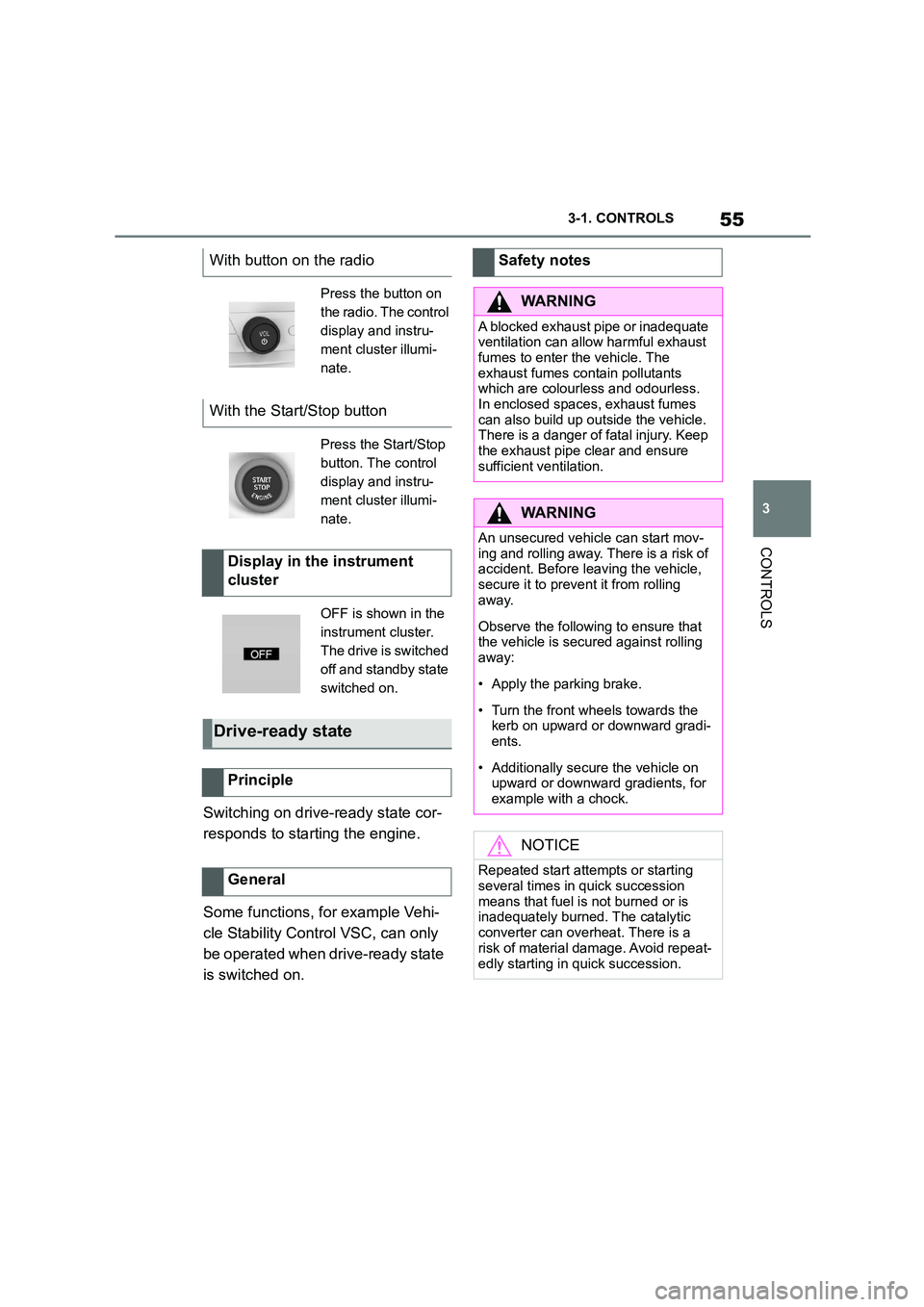
With button on the radio
Press the button on
the radio. The control
display and instru-
ment cluster illumi-
nate.
With the Start/Stop button
Press the Start/Stop
button. The control
display and instru-
ment cluster illumi-
nate.
Display in the instrument
cluster
OFF is shown in the
instrument cluster.
The drive is switched
off and standby state
switched on.
Drive-ready state
Principle
General
Safety notes
WA R N I N G
A blocked exhaust pipe or inadequate
ventilation can allow harmful exhaust fumes to enter the vehicle. The
exhaust fumes contain pollutants
which are colourless and odourless. In enclosed spaces, exhaust fumes
can also build up outside the vehicle.
There is a danger of fatal injury. Keep
the exhaust pipe clear and ensure sufficient ventilation.
WA R N I N G
An unsecured vehicle can start mov-ing and rolling away. There is a risk of
accident. Before leaving the vehicle,
secure it to prevent it from rolling away.
Observe the following to ensure that the vehicle is secured against rolling
away:
• Apply the parking brake.
• Turn the front wheels towards the
kerb on upward or downward gradi- ents.
• Additionally secure the vehicle on upward or downward gradients, for
example with a chock.
NOTICE
Repeated start attempts or starting
several times in quick succession
means that fuel is not burned or is inadequately burned. The catalytic
converter can overheat. There is a
risk of material damage. Avoid repeat-
edly starting in quick succession.
Page 217 of 498
215
3
3-1. CONTROLS
CONTROLS
The system reacts to pedestrians
and cyclists if your own speed is
below approx. 85 km/h, 53 mph.
The detection ability of the system
is limited.
As a result, the system may fail to
give warnings or may give warnings
late.
It is possible that the following are
not detected, for example:
Partially concealed pedestrians.
Pedestrians who are not
detected as such, because of the
viewing angle or outline.
Pedestrians outside the detec-
tion range.
Pedestrians less than approxi-
mately 80 cm, 32 in tall.
The system may have limited func-
tionality in some situations, for
example:
In thick fog, wet conditions or
snow.
On sharp bends.
If vehicle stability control sys-
tems are deactivated, for exam-
ple VSC OFF.
If the field of view of the camera
or the windscreen in front of the
rear-view mirror is soiled or cov-
ered.
If the camera has overheated
due to excessively high tempera-
tures and has been temporarily
deactivated.
Depending on the equipment
version: if the radar sensors are
soiled or covered.
Depending on the vehicle's
equipment: after work performed
incorrectly on the vehicle paint-
work.
Up to 10 seconds after starting
the engine using the start/stop
button.
During the camera calibration
process immediately after vehi-
cle delivery.
If there is sustained glare due to
oncoming light, for example if the
sun is low in the sky.
In the dark.
Attaching any objects – stickers or
System limits
Safety note
WA R N I N G
The system may not re spond at all, or may respond too late, incorrectly or
without justification due to limits of the
system. There is a danger of acci-
dents or damage to property.
Observe the information on the sys-
tem limits and intervene actively if
necessary.
Upper speed limit
Detection range
Functional limitations
Page 287 of 498
285
4
4-1. DRIVING HINTS
DRIVING HINTS
Ensure that you do not obstruct
other road users when doing so.
The heat generated by braking
dries the brake discs and brake
pads and protects them against
corrosion.
This way, brake power is available
immediately, whenever it is needed.
■General
When driving on long or steep
downhill stretches, use the gear in
which the least braking is required.
Otherwise the brake system can
overheat and the braking effect is
reduced.
Engine braking effect can be addi-
tionally increased by manually shift-
ing down, even into first gear, if
applicable.
■Safety notes
Corrosion of the brake discs and
contamination of the brake pads
increase in the following circum-
stances:
Low mileage.
Extended periods when the vehi-
cle is not used.
Infrequent use of the brakes.
Aggressive, acidic or alkaline
cleaning agents.
During braking, corroded brake
discs may cause brake judder
which usually cannot be eliminated.
When the automatic air condition-
ing is in operation, condensation
develops and exits underneath the
vehicle.
The higher mechanical and thermal
loads involved in driving on racing
tracks lead to increased wear. This
wear is not covered by the war-
ranty. The vehicle is not conceived
for use in motor sports competi-
tions.
Before and after driving on a racing
track, have the vehicle checked at
any authorized Toyota retailer or
Toyota authorized repairer, or any
reliable repairer.
Downhill gradients
WA R N I N G
Even slight continuous pressure on the brake pedal can cause overheat-
ing, brake pad wear or even brake
system failure. There is a danger of accidents. Avoid excessive loads on
the brake.
WA R N I N G
When idling or with the engine switched off, safety-relevant func-
tions, for example engine braking
effect or steering and braking force assistance, are either restricted or not
available at all. There is a risk of acci-
dent. Do not drive at idle speed or with the engine switched off.
Corrosion of the brake discs
Condensation when vehicle
is parked
Driving on a racing track
Page 492 of 498
490Alphabetical Index
Luggage compartment lid, see Boot
lid ................................................. 100
Lumbar support ............................ 110
M
Maintenance.................................. 330
Scheduled maintenance ............ 334
Maintenance requirement, see CBS
Condition Based Service ........... 330
Maintenance System .................... 330
Maintenance, see Service require-
ments........................................... 170
Make-up mirror ............................. 269
Malfunction indications, see Vehicle
messages .................................... 163
Malfunction, remote control .......... 93
Manual operation, Automatic trans-
mission........................................ 154
Manual operation, fuel filler flap . 291
Matt paintwork .............................. 364
Maximum cooling effect............... 263
Maximum speed of winter tyres .. 297
Maximum speed, display, see Speed
Limit Info ..................................... 173
Memory function........................... 119
Menu, instrument cluster, see Selec-
tion lists ...................................... 177
Messages ........................................ 74
Messages, see Vehicle messages
..................................................... 163
Microfilter ...................................... 266
Minimum tread depth, tyres......... 295
Mirror, see Memory function ....... 119
Mirror, vanity ................................. 269
Mobile communication in the vehicle
..................................................... 282
Mobile devices, managing ............. 86
Mobile Service, see Breakdown
assistance ................................... 353
Mobility System ............................ 299
Moisture in the headlights, see Head-
light glass ................................... 340
Monitor, see Control Display ......... 59
Mounting child restraints............. 123
Multifunction steering wheel, but-
tons ................................................ 46
N
Net, boot ........................................277
Neutral cleaner, light alloy wheels
..................................................... 366
New wheels and tyres ..................296
No Passing Information ...............173
NORMAL, see Sport mode switch160
Notes ..................................................4
Number plate light, see Bulbs and
lights ............................................340
Nylon rope for tow-starting/towing
..................................................... 360
O
OBD on-board diagnosis .............332
Obstacle marking, rear-view camera
..................................................... 255
Octane number, see Petrol grade 323
Oil ................................................... 323
Oil change .....................................327
Oil change interval, see Service
requirements............................... 170
Oil filler neck ................................. 325
Oil grades for topping up, engine326
On-board diagnosis OBD .............332
On-board monitor, see Control Dis-
play ................................................ 59
On-board tool kit ...........................339
Opening and closing ...................... 88
Operating menus, see Toyota Supra
Command ...................................... 57
Operation by touchscreen ............. 65
Operation via Controller................. 62
Outlets, see Ventilation ................266
Outside temperature.....................169
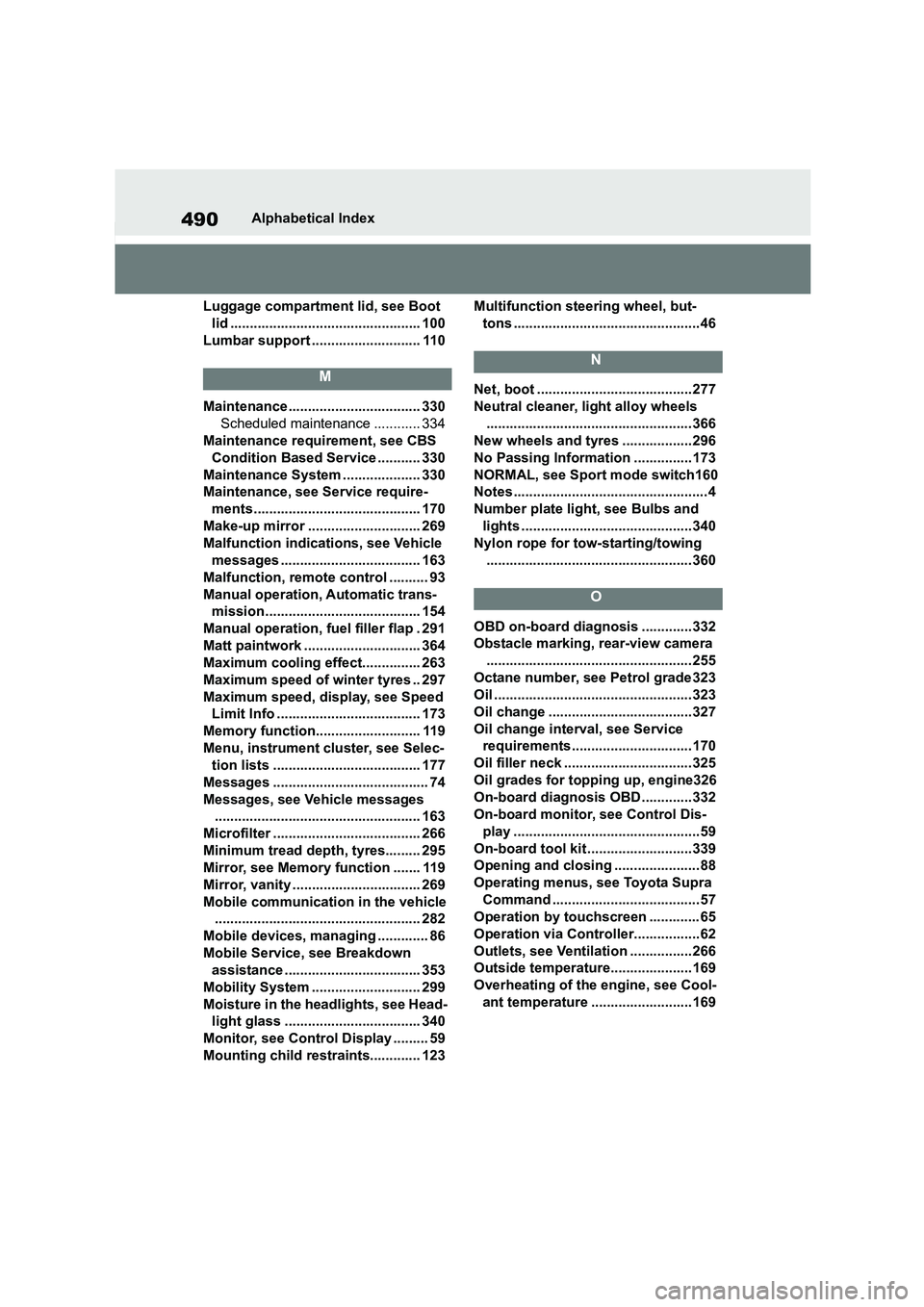
Overheating of the engine, see Cool-
ant temperature ..........................169