check engine light TOYOTA TACOMA 2009 Owners Manual (in English)
[x] Cancel search | Manufacturer: TOYOTA, Model Year: 2009, Model line: TACOMA, Model: TOYOTA TACOMA 2009Pages: 520, PDF Size: 10.75 MB
Page 4 of 520
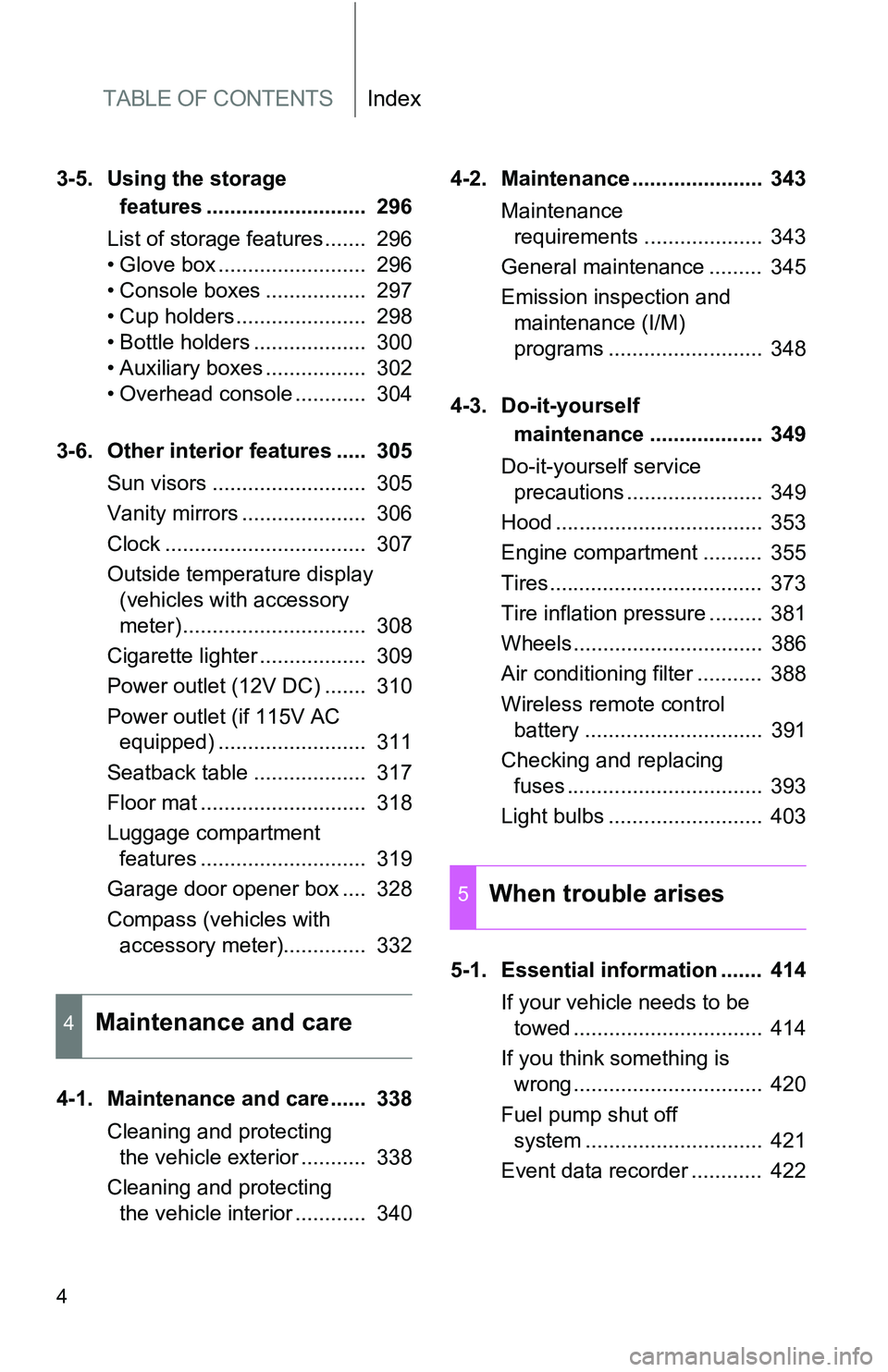
TABLE OF CONTENTSIndex
4
3-5. Using the storage features ........................... 296
List of storage features....... 296
• Glove box ......................... 296
• Console boxes ................. 297
• Cup holders ...................... 298
• Bottle holders ................... 300
• Auxiliary boxes ................. 302
• Overhead console ............ 304
3-6. Other interior features ..... 305 Sun visors .......................... 305
Vanity mirrors ..................... 306
Clock .................................. 307
Outside temperature display (vehicles with accessory
meter) ............................... 308
Cigarette lighter .................. 309
Power outlet (12V DC) ....... 310
Power outlet (if 115V AC equipped) ......................... 311
Seatback table ................... 317
Floor mat ............................ 318
Luggage compartment features ............................ 319
Garage door opener box .... 328
Compass (vehicles with accessory meter).............. 332
4-1. Maintenance and care...... 338 Cleaning and protecting the vehicle exterior ........... 338
Cleaning and protecting the vehicle interior ............ 340 4-2. Maintenance ...................... 343
Maintenance requirements .................... 343
General maintenance ......... 345
Emission inspection and maintenance (I/M)
programs .......................... 348
4-3. Do-it-yourself maintenance ................... 349
Do-it-yourself service precautions ....................... 349
Hood ................................... 353
Engine compartment .......... 355
Tires.................................... 373
Tire inflation pressure ......... 381
Wheels................................ 386
Air conditioning filter ........... 388
Wireless remote control battery .............................. 391
Checking and replacing fuses ................................. 393
Light bulbs .......................... 403
5-1. Essential information ....... 414 If your vehicle needs to be towed ................................ 414
If you think something is wrong ................................ 420
Fuel pump shut off system .............................. 421
Event data recorder ............ 422
4Maintenance and care
5When trouble arises
Page 130 of 520
130 2-1. Driving procedures
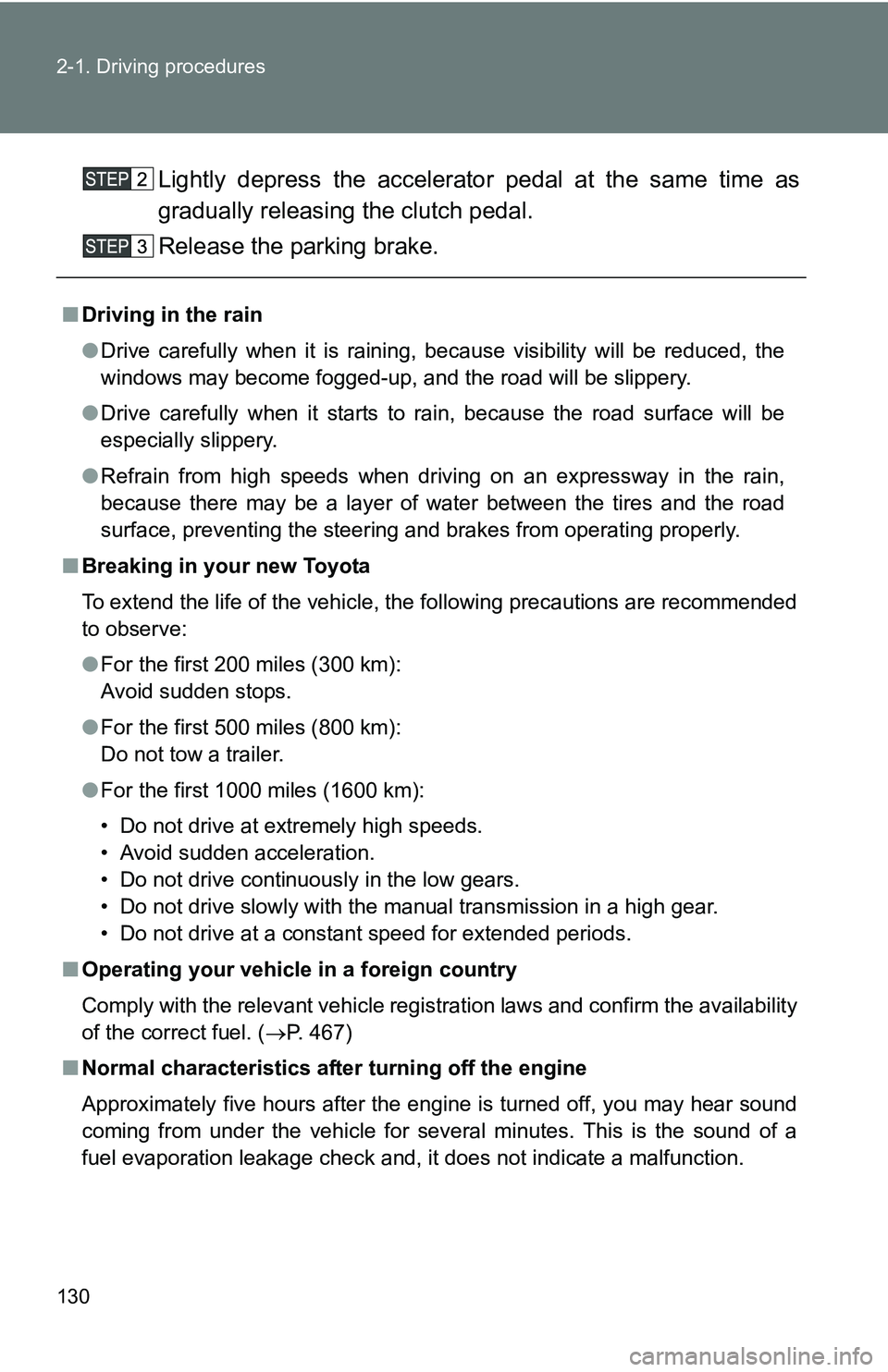
Lightly depress the accelerator pedal at the same time as
gradually releasing the clutch pedal.
Release the parking brake.
■Driving in the rain
●Drive carefully when it is raining, because visibility will be reduced, the
windows may become fogged-up, and the road will be slippery.
● Drive carefully when it starts to rain, because the road surface will be
especially slippery.
● Refrain from high speeds when driving on an expressway in the rain,
because there may be a layer of water between the tires and the road
surface, preventing the steering and brakes from operating properly.
■ Breaking in your new Toyota
To extend the life of the vehicle, the following precautions are recommended
to observe:
●For the first 200 miles (300 km):
Avoid sudden stops.
● For the first 500 miles (800 km):
Do not tow a trailer.
● For the first 1000 miles (1600 km):
• Do not drive at extremely high speeds.
• Avoid sudden acceleration.
• Do not drive continuously in the low gears.
• Do not drive slowly with the manual transmission in a high gear.
• Do not drive at a constant speed for extended periods.
■ Operating your vehicle in a foreign country
Comply with the relevant vehicle registration laws and confirm the availability
of the correct fuel. ( P. 467)
■ Normal characteristics afte r turning off the engine
Approximately five hours after the engine is turned off, you may hear sound
coming from under the vehicle for several minutes. This is the sound of a
fuel evaporation leakage check and, it does not indicate a malfunction.
Page 131 of 520
131
2-1. Driving procedures
2
When driving
CAUTION
■
When starting the vehicle
Vehicles with an automatic transmission, always keep your foot on the brake
pedal while stopped with the engine running. This prevents the vehicle from
creeping.
■ When driving the vehicle
●Do not drive if you are unfamiliar with the location of the brake and accel-
erator pedals to avoid depressing the wrong pedal.
• Accidentally depressing the accelerator pedal instead of the brake
pedal will result in sudden acceleration that may lead to an accident
that could result in death or serious injury.
• When backing up, you may twist your body around, leading to a diffi- culty in operating the pedals. Make sure to operate the pedals properly.
• Make sure to keep a correct driving posture even when moving the vehicle only slightly, allowing you to depress the brake and accelerator
pedals properly.
• Depress the brake pedal using your right foot. Depressing the brake pedal using your left foot may delay response in an emergency, result-
ing in an accident.
● Do not drive the vehicle over or st op the vehicle near flammable materials.
The exhaust system and exhaust gases can be extremely hot. This may
cause a fire if there is any flammable material nearby.
● Vehicles with an automatic transmission, do not let the vehicle roll back-
wards while the shift lever is in a driving position, or roll forward while the
shift lever is in R.
Doing so may cause the engine to stall or lead to poor brake and steering
performance, resulting in an accident or damage to the vehicle.
● If the smell of exhaust is noticed inside the vehicle, open the windows and
check that the back window is closed. Large amounts of exhaust in the
vehicle can cause driver drowsiness and an accident, resulting in death or
a serious health hazard. Have the vehicle inspected by your Toyota dealer
immediately.
● Do not under any circumstances shift the shift lever to P, R or N (automatic
transmission) or R (manual transmission) while the vehicle is moving.
Doing so can cause significant damage to the transmission system and
may result in a loss of vehicle control.
Page 133 of 520
133
2-1. Driving procedures
2
When driving
CAUTION
■
When driving on slippery road surfaces
●After driving through a puddle, lightly depress the brake pedal to make
sure that the brakes are functioning properly. Wet brake pads may prevent
the brakes from functioning properly. If the brakes on only one side are wet
and not functioning properly, steering control may be affected, resulting in
an accident.
■ When shifting the shift lever
●Vehicles with an automatic transmission, be careful not to shift the shift
lever with the accelerator pedal depressed.
This may lead to unexpected rapid acceleration of the vehicle that may
cause an accident and result in death or serious injury.
■ When the vehicle is stopped
●Do not race the engine.
If the vehicle is in any gear other than P (automatic transmission only) or
N, the vehicle may accelerate suddenly and unexpectedly, and may cause
an accident.
● Do not leave the vehicle with the engine running for a long time.
If such a situation cannot be avoided, park the vehicle in an open space
and check that exhaust fumes do not enter the vehicle interior.
● Vehicles with an automatic transmission, always keep a foot on the brake
pedal while the engine is running to prevent an accident caused by the
vehicle moving.
■ When the vehicle is parked
●Do not leave glasses, cigarette lighters, spray cans, or soft drink cans in
the vehicle when it is in the sun.
Doing so may result in the following.
• Gas may leak from a cigarette lighter or spray can, and may lead to a
fire.
• The temperature inside the vehicle may cause the plastic lenses and plastic material of eye glasses to deform or crack.
• Soft drink cans may fracture, causing the contents to spray over the interior of the vehicle, and may also cause a short circuit in the vehi-
cle’s electrical components.
Page 147 of 520
147
2-1. Driving procedures
2
When driving
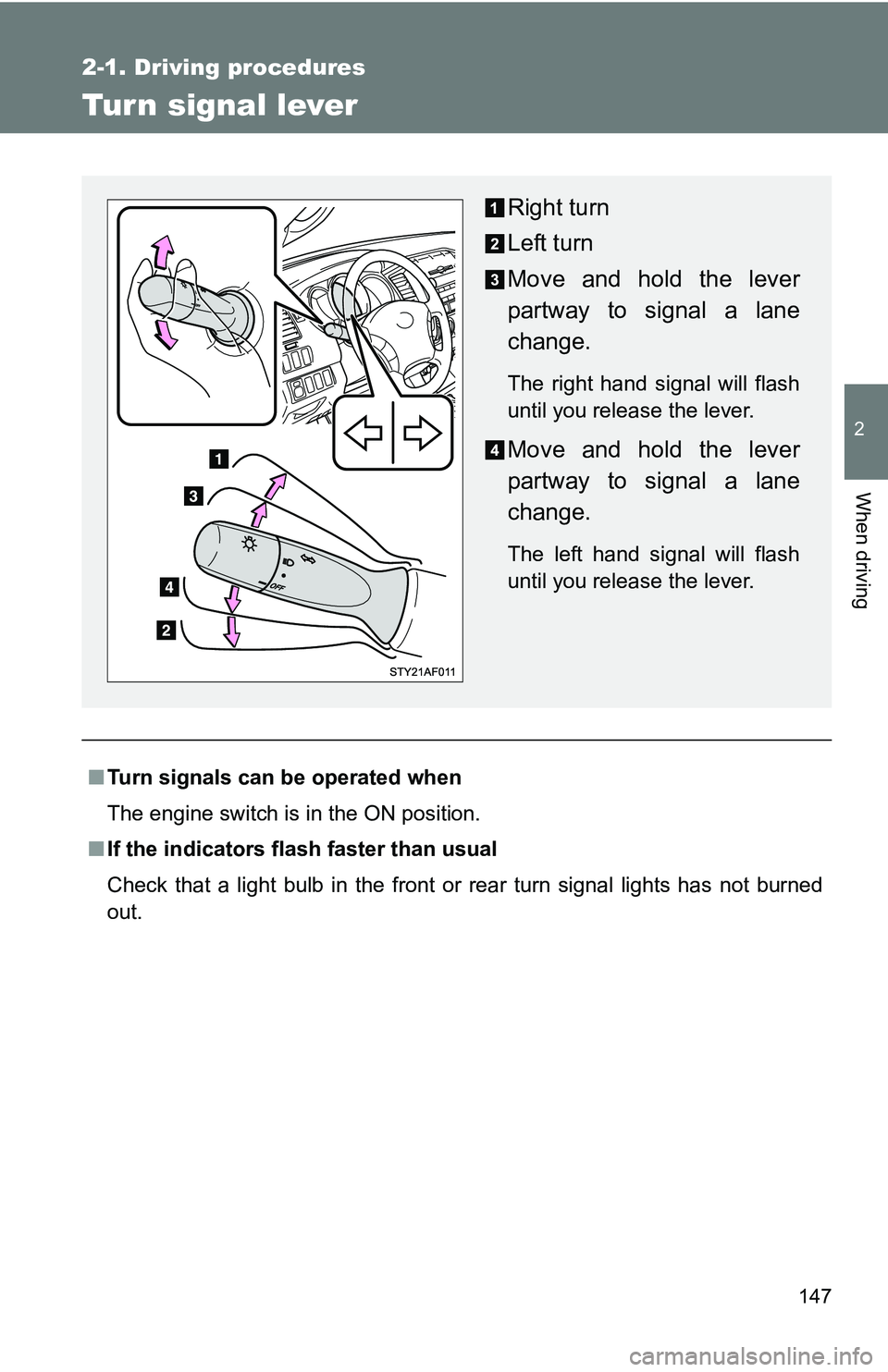
Tur n signal lever
■Turn signals can be operated when
The engine switch is in the ON position.
■ If the indicators flash faster than usual
Check that a light bulb in the front or rear turn signal lights has not burned
out.
Right turn
Left turn
Move and hold the lever
partway to signal a lane
change.
The right hand signal will flash
until you release the lever.
Move and hold the lever
partway to signal a lane
change.
The left hand signal will flash
until you release the lever.
Page 155 of 520
155
2-2. Gauges and meters
2
When driving
CAUTION
■
If a safety system warning light does not come on
Should a safety system light such as ABS and the SRS airbag warning light
not come on when you start the engine, this could mean that these systems
are not available to help protect you in an accident, which could result in
death or serious injury. Have the vehicle inspected by your Toyota dealer
immediately if this occurs.
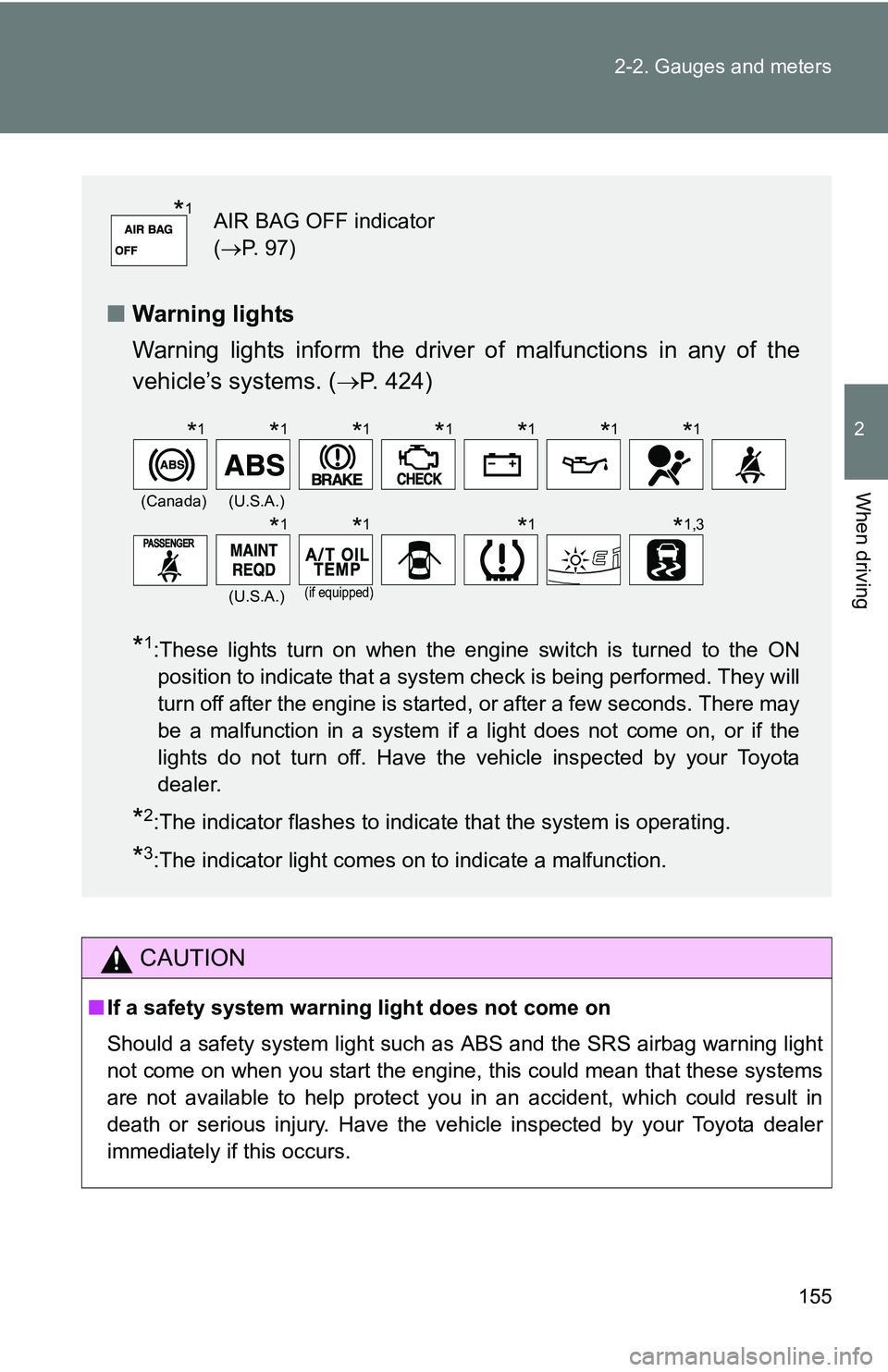
■ Warning lights
Warning lights inform the driver of malfunctions in any of the
vehicle’s systems. ( P. 424)
*1:These lights turn on when the engine switch is turned to the ON
position to indicate that a system check is being performed. They will
turn off after the engine is started, or after a few seconds. There may
be a malfunction in a system if a light does not come on, or if the
lights do not turn off. Have the vehicle inspected by your Toyota
dealer.
*2:The indicator flashes to indicate that the system is operating.
*3:The indicator light comes on to indicate a malfunction.
*1AIR BAG OFF indicator
( P. 97)
(Canada)(U.S.A.)
(U.S.A.)
(if equipped)
*1*1*1*1*1*1*1
*1*1*1*1,3
Page 162 of 520
162 2-3. Operating the lights and wipers
■The windshield wiper and washer can be operated when
The engine switch must be in the ON position.
■ If no windshield washer fluid sprays
Check that the washer nozzles are not blocked and if there is washer fluid in
the windshield washer fluid reservoir.
NOTICE
■When the windshield is dry
Do not use the wipers, as they may damage the windshield.
■ When there is no washer fluid spray from the nozzle
Damage to the washer fluid pump may be caused if the lever is pulled
toward you and held continually.
■ When a nozzle becomes block
Do not try to clear it with a pin or other object. The nozzle will be damaged.
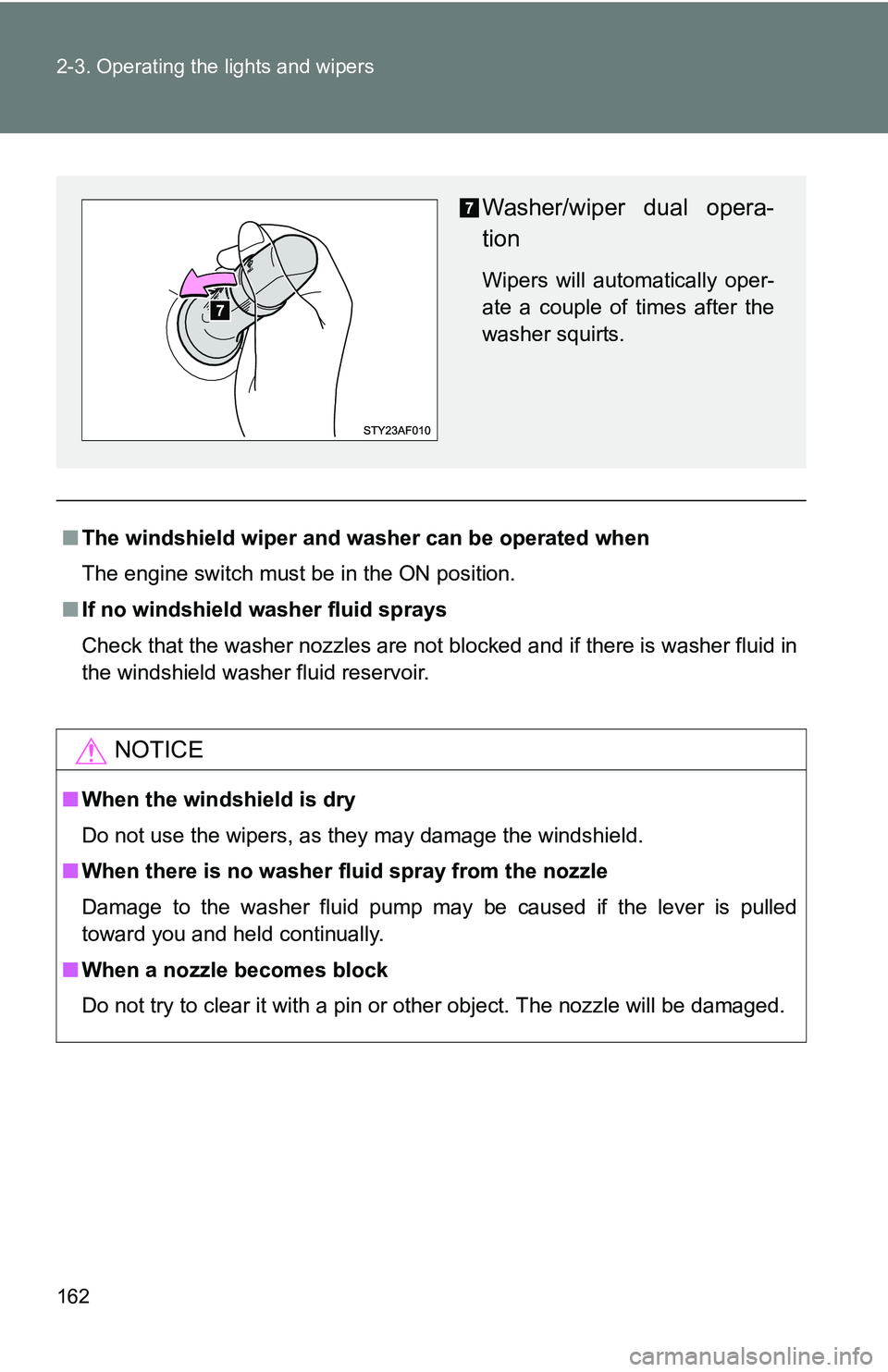
Washer/wiper dual opera-
tion
Wipers will automatically oper-
ate a couple of times after the
washer squirts.
Page 182 of 520
182 2-4. Using other driving systems
■Operating tips
The system will operate when the shift lever is in a position other than P.
However, to make effective use of the system it is recommended that the
shift lever be shifted to 2 or L.
■ The system will not operate when
●The front-wheel drive control switch is in the H2 or H4 position.
● The rear differential is locked.
■ The downhill assist control system indicator light flashes when
● The selector lever is in the N position.
● The front-wheel drive control switch is in the H2 or H4 position.
● The rear differential is locked.
■ If the brake system overheats
The system will cease operation and a buzzer will sound to alert the driver.
Stop the vehicle in a safe place. (There is no problem with continuing normal
driving.)
■ System malfunction
●The downhill assist control system indicator does not come on when the
engine switch is turned to the ON position.
● The downhill assist control system indicator does not come on when the
DAC switch is pressed.
In the above cases have your vehicle checked by your Toyota dealer.
CAUTION
■Do not rely excessively on the downhill assist control system.
It may not be able to maintain a low speed over road surfaces on which slid-
ing can easily occur, such as extremely steep slopes or icy or muddy roads.
Page 211 of 520
211
2-5. Driving information
2
When driving
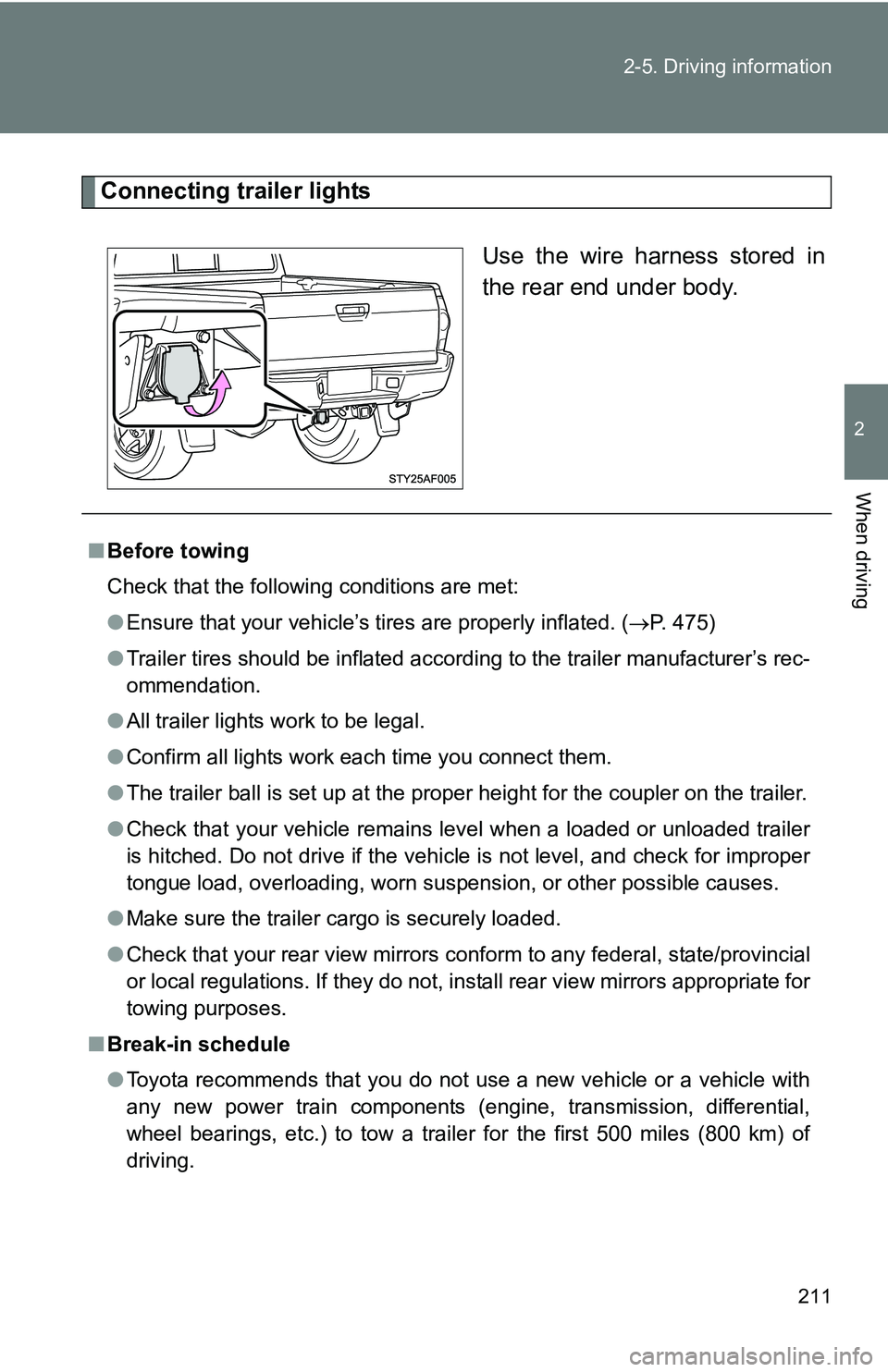
Connecting trailer lights
Use the wire harness stored in
the rear end under body.
■Before towing
Check that the following conditions are met:
●Ensure that your vehicle’s tires are properly inflated. ( P. 475)
● Trailer tires should be inflated according to the trailer manufacturer’s rec-
ommendation.
● All trailer lights work to be legal.
● Confirm all lights work each time you connect them.
● The trailer ball is set up at the proper height for the coupler on the t\
railer.
● Check that your vehicle remains level when a loaded or unloaded trailer
is hitched. Do not drive if the vehicle is not level, and check for improper
tongue load, overloading, worn suspension, or other possible causes.
● Make sure the trailer cargo is securely loaded.
● Check that your rear view mirrors c onform to any federal, state/provincial
or local regulations. If they do not, inst all rear view mirrors appropriate for
towing purposes.
■ Break-in schedule
●Toyota recommends that you do not use a new vehicle or a vehicle with
any new power train components (engine, transmission, differential,
wheel bearings, etc.) to tow a trailer for the first 500 miles (800 km) of
driving.
Page 215 of 520
215
2-5. Driving information
2
When driving
Trailer towing tips
Your vehicle will handle differently when towing a trailer. The three
main causes of vehicle-trailer ac cidents are driver error, excessive
speed and improper trailer loading. Keep these in mind when towing.
● Before starting out, check the trailer’s light and the vehicle-trailer
connections. Recheck after driving a short distance.
● Practice turning, stopping and reve rsing with the trailer attached in
an area away from traffic until you become accustomed to the feel
of the vehicle.
● Reversing with a trailer attached is difficult and requires practice.
Grip the bottom of the steering wheel and move your hand to the
left to move the trailer to the left. Move your hand to the right to
move the trailer to the right. (Thi s is generally opposite to reversing
without a trailer attached.) Avoid sharp or prolonged turning. Have
someone guide you when reversing to reduce the risk of an acci-
dent.
● As stopping distance is increased when towing a trailer, vehicle-to-
vehicle distance should be increased. For each 10 mph (16 km/h)
of speed, allow at least o ne vehicle and trailer length.
● Avoid sudden braking as you may skid, resulting in jackknifing and
loss of control. This is especiall y true on wet or slippery surfaces.
● Avoid jerky starts or sudden acceleration. For vehicles with a man-
ual transmission, prevent excessive clutch slippage by keeping
engine rpm low and not racing the engine. Always start out in first
gear.
● Avoid jerky steering and sharp turns, and slow down before mak-
ing a turn.