trailer TOYOTA TACOMA 2009 Owners Manual (in English)
[x] Cancel search | Manufacturer: TOYOTA, Model Year: 2009, Model line: TACOMA, Model: TOYOTA TACOMA 2009Pages: 520, PDF Size: 10.75 MB
Page 3 of 520
1
2
3
4
5
6
7
3
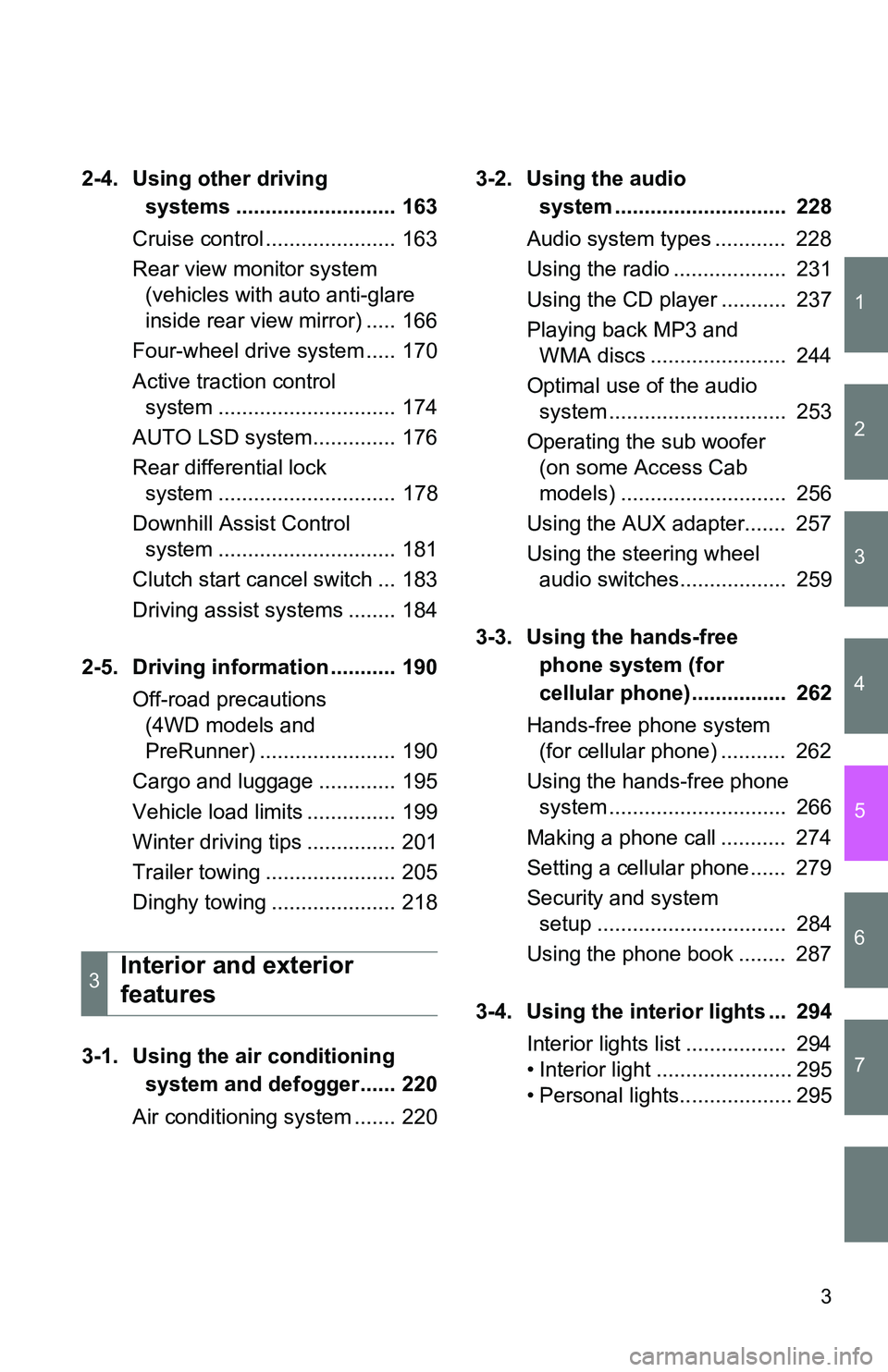
2-4. Using other driving systems ........................... 163
Cruise control ...................... 163
Rear view monitor system (vehicles with auto anti-glare
inside rear view mirror) ..... 166
Four-wheel drive system ..... 170
Active traction control system .............................. 174
AUTO LSD system.............. 176
Rear differential lock system .............................. 178
Downhill Assist Control system .............................. 181
Clutch start cancel switch ... 183
Driving assist systems ........ 184
2-5. Driving information ........... 190 Off-road precautions (4WD models and
PreRunner) ....................... 190
Cargo and luggage ............. 195
Vehicle load limits ............... 199
Winter driving tips ............... 201
Trailer towing ...................... 205
Dinghy towing ..................... 218
3-1. Using the air conditioning system and defogger...... 220
Air conditioning system ....... 220 3-2. Using the audio
system ............................. 228
Audio system types ............ 228
Using the radio ................... 231
Using the CD player ........... 237
Playing back MP3 and WMA discs ....................... 244
Optimal use of the audio system .............................. 253
Operating the sub woofer (on some Access Cab
models) ............................ 256
Using the AUX adapter....... 257
Using the steering wheel audio switches.................. 259
3-3. Using the hands-free phone system (for
cellular phone)................ 262
Hands-free phone system (for cellular phone) ........... 262
Using the hands-free phone system .............................. 266
Making a phone call ........... 274
Setting a cellular phone ...... 279
Security and system setup ................................ 284
Using the phone book ........ 287
3-4. Using the interior lights ... 294 Interior lights list ................. 294
• Interior light ....................... 295
• Personal lights................... 295
3Interior and exterior
features
Page 127 of 520
When driving2
127
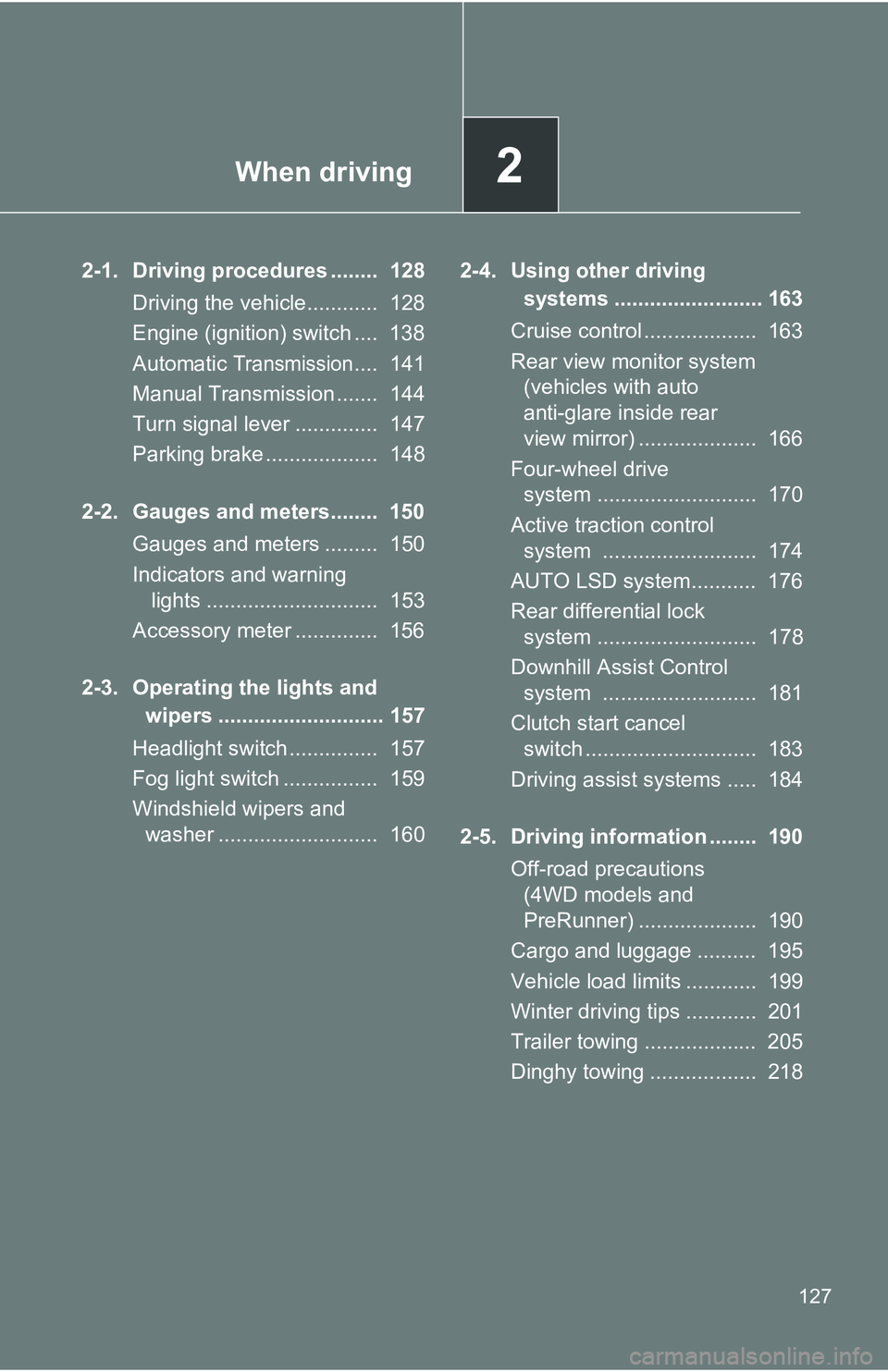
2-1. Driving procedures ........ 128Driving the vehicle............ 128
Engine (ignition) switch .... 138
Automatic
Transmission.... 141
Manual Transmission ....... 144
Turn signal lever .............. 147
Parking brake ................... 148
2-2. Gauges and meters........ 150 Gauges and meters ......... 150
Indicators and warning lights ............................. 153
Accessory meter .............. 156
2-3. Operating the lights and wipers ............................ 157
Headlight switch ............... 157
Fog light switch ................ 159
Windshield wipers and washer ........................... 160 2-4. Using other driving
systems ......................... 163
Cruise control ................... 163
Rear view monitor system (vehicles with auto
anti-glare inside rear
view mirror) .................... 166
Four-wheel drive system ........................... 170
Active traction control system .......................... 174
AUTO LSD system........... 176
Rear differential lock system ........................... 178
Downhill Assist Control system .......................... 181
Clutch start cancel switch ............................. 183
Driving assist systems ..... 184
2-5. Driving information ........ 190 Off-road precautions (4WD models and
PreRunner) .................... 190
Cargo and luggage .......... 195
Vehicle load limits ............ 199
Winter driving tips ............ 201
Trailer towing ................... 205
Dinghy towing .................. 218
Page 130 of 520
130 2-1. Driving procedures
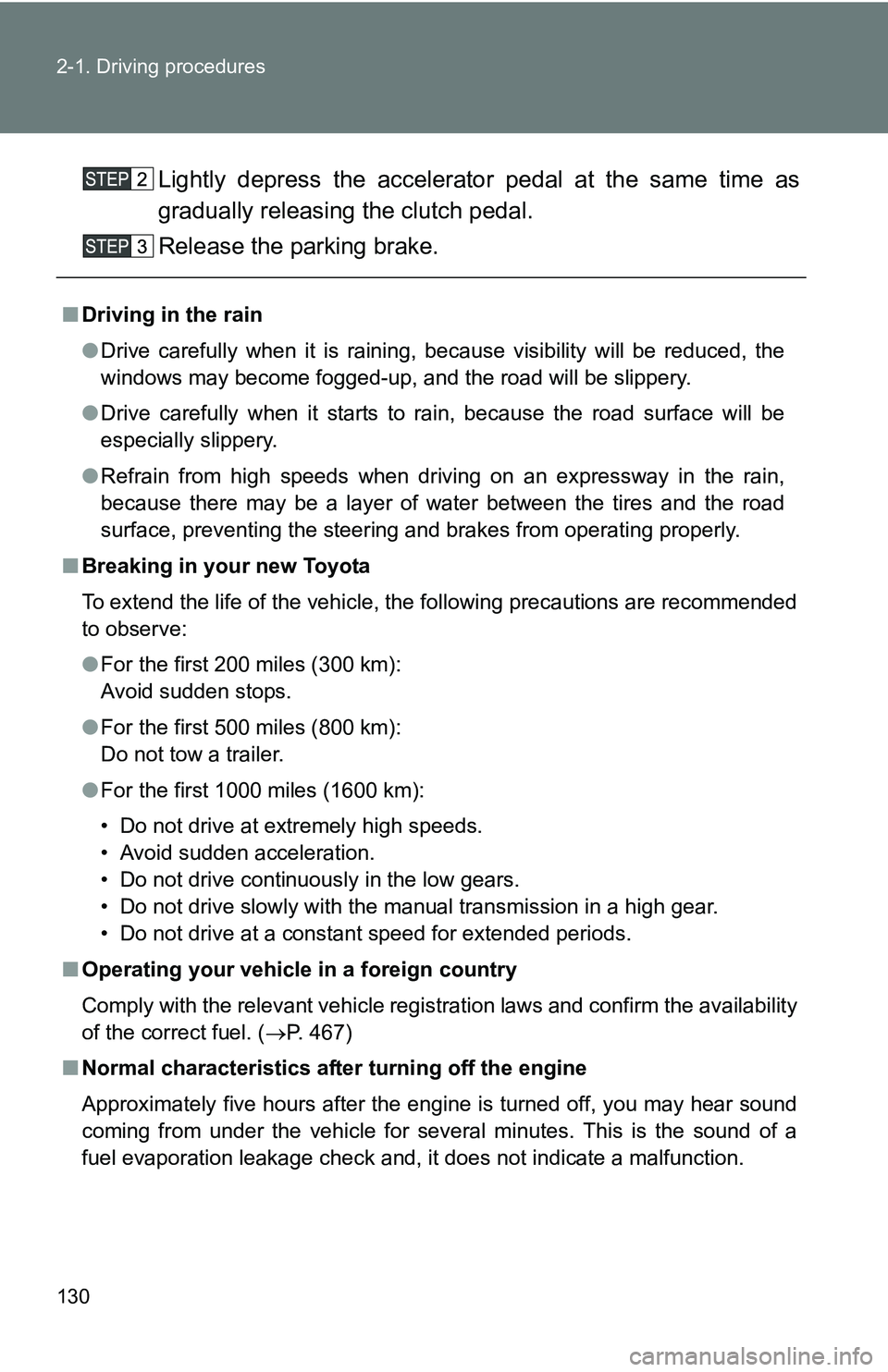
Lightly depress the accelerator pedal at the same time as
gradually releasing the clutch pedal.
Release the parking brake.
■Driving in the rain
●Drive carefully when it is raining, because visibility will be reduced, the
windows may become fogged-up, and the road will be slippery.
● Drive carefully when it starts to rain, because the road surface will be
especially slippery.
● Refrain from high speeds when driving on an expressway in the rain,
because there may be a layer of water between the tires and the road
surface, preventing the steering and brakes from operating properly.
■ Breaking in your new Toyota
To extend the life of the vehicle, the following precautions are recommended
to observe:
●For the first 200 miles (300 km):
Avoid sudden stops.
● For the first 500 miles (800 km):
Do not tow a trailer.
● For the first 1000 miles (1600 km):
• Do not drive at extremely high speeds.
• Avoid sudden acceleration.
• Do not drive continuously in the low gears.
• Do not drive slowly with the manual transmission in a high gear.
• Do not drive at a constant speed for extended periods.
■ Operating your vehicle in a foreign country
Comply with the relevant vehicle registration laws and confirm the availability
of the correct fuel. ( P. 467)
■ Normal characteristics afte r turning off the engine
Approximately five hours after the engine is turned off, you may hear sound
coming from under the vehicle for several minutes. This is the sound of a
fuel evaporation leakage check and, it does not indicate a malfunction.
Page 134 of 520
134 2-1. Driving procedures
CAUTION
■When the vehicle is parked
●Always apply the parking brake, shift the shift lever to P (automatic trans-
mission only), stop the engine and lock the vehicle.
Do not leave the vehicle unattended while the engine is running.
● Do not touch the exhaust pipe while the engine is running or immediately
after turning the engine off.
Doing so may cause burns.
● Do not leave the engine running in an area with snow build-up, or where it
is snowing. If snowbanks build up around the vehicle while the engine is
running, exhaust gases may collect and enter the vehicle. This may lead
to death or a serious health hazard.
■ Exhaust gases
Exhaust gases include harmful carbon monoxide (CO) that is colorless and
odorless. Inhaling exhaust gases may lead to death or a serious health haz-
ard.
●If the vehicle is in a poorly ventilated area, stop the engine. In a closed
area, such as a garage, exhaust gases may collect and enter the vehicle.
This may lead to death or a serious health hazard.
● The exhaust should be checked occasionally. If there is a hole or crack
caused by corrosion, damage to a joint or abnormal exhaust noise, be
sure to have the vehicle inspected and repaired by your Toyota dealer.
Failure to do so may allow exhaust gases to enter the vehicle, resulting in
death or a serious health hazard.
● Toyota does not recommend occupying the rear cargo area when it is fitted
with a slide-in camper, camper shell or other type cover while the engine is
running. This caution applies to bot h driving and stopped or parked situa-
tions with the engine running. Particular care should be taken to prevent
exhaust gases from entering camper bodies, trailers or other enclosures
on or around your vehicle. If exhaust fumes are detected, open all win-
dows and thoroughly ventilate the area.
Page 165 of 520
165
2-4. Using other
driving systems
2
When driving
■Automatic cruise control cancelation
The set speed is automatically cancelled in any of the following situations.
●Actual vehicle speed falls more than 10 mph (16 km/h) below the preset
vehicle speed.
At this time, the memorized set speed is not retained.
● Actual vehicle speed is below 25 mph (40 km/h).
● VSC is activated.
■ If the cruise control indicator light flashes
Press the ON-OFF button to turn the cruise control off, and then reactivate
the system.
If the cruise control speed cannot be set or if the cruise control cancels
immediately after being activated, there may be a malfunction in the cruise
control system. Have the vehicle inspected by your Toyota dealer.
CAUTION
■ To avoid operating the cruise control by mistake
Keep the ON-OFF button off when not in use.
■ Situations unsuitable for cruise control
Do not use cruise control in any of the following situations.
Doing so may result in control of the vehicle being lost and could cause seri-
ous or fatal accident.
●In heavy traffic
● On roads with sharp bends
● On winding roads
● On slippery roads, such as those covered with rain, ice or snow
● On steep hills
● When towing a trailer
Page 197 of 520
197
2-5. Driving information
2
When driving
(6) If your vehicle will be towing a tr
ailer, load from your trailer will be
transferred to your vehicle. Consult this manual to determine how
this reduces the available cargo and luggage load capacity of your
vehicle.
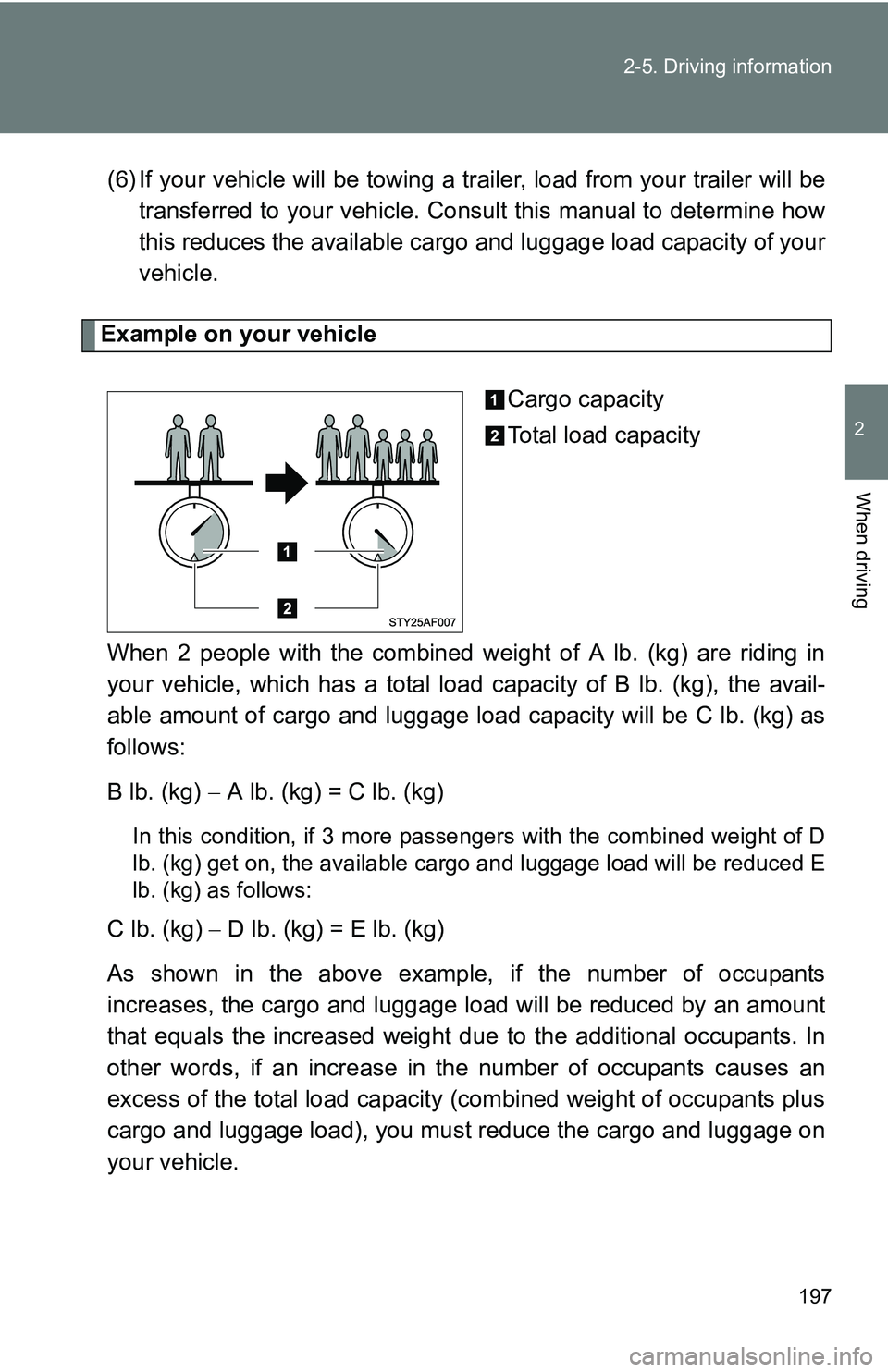
Example on your vehicle
Cargo capacity
Total load capacity
When 2 people with the combined weight of A lb. (kg) are riding in
your vehicle, which has a total load capacity of B lb. (kg), the avail-
able amount of cargo and luggage load capacity will be C lb. (kg) as
follows:
B lb. (kg) A lb. (kg) = C lb. (kg)
In this condition, if 3 more passengers with the combined weight of D
lb. (kg) get on, the available carg o and luggage load will be reduced E
lb. (kg) as follows:
C lb. (kg) D lb. (kg) = E lb. (kg)
As shown in the above example, if the number of occupants
increases, the cargo and luggage load will be reduced by an amount
that equals the increased weight du e to the additional occupants. In
other words, if an increase in th e number of occupants causes an
excess of the total load capacity (combined weight of occupants plus
cargo and luggage load), you must reduce the cargo and luggage on
your vehicle.
Page 199 of 520
199
2-5. Driving information
2
When driving
Vehicle load limits
Vehicle load limits include total load capacity, seating capacity,
towing capacity and cargo capacity.
■Total load capacity: ( P. 463)
Total load capacity means the combined weight of occupants,
cargo and luggage.
■ Seating capacity:
Regular Cab models
3 occupants
Access Cab models 4 occupants (Front 2, Rear 2)
Double Cab models 5 occupants (Front 2, Rear 3)
Seating capacity means the ma ximum number of occupants
whose estimated average weight is 150 lb. (68 kg) per person.
Even if the number of occupants are within the seating capacity,
do not exceed the total load capacity.
■ Towing capacity:
Without towing package
3500 lb. (1587 kg)
With towing package 6500 lb. (2948 kg)
Towing capacity means the maximum gross trailer weight (trailer
weight plus its cargo weight) that your vehicle is able to tow.
■ Cargo capacity
Cargo capacity may increase or decrease depending on the
weight and the number of occupants.
Page 205 of 520
205
2-5. Driving information
2
When driving
Trailer towing
Your vehicle is designed primarily as a passenger-and-load carrying
vehicle, and thus towing a trailer will have an adverse effect on han-
dling, performance, braking, durability, and fuel consumption. For
your safety and the safety of others, do not overload the vehicle or
trailer.
We recommend you use a weight distributing hitch when towing to
keep your vehicle level with the ground.
■ Weight limits
Confirm that the total trailer we ight, gross combination weight,
gross vehicle weight, gross axle weight, and trailer tongue load
are all within the limits.
■ Gross vehicle weight
The gross vehicle weight must not exceed the Gross Vehicle
Weight Rating (GVWR) indicated on the Certification Label. The
gross vehicle weight is the sum of the weights of the unloaded
vehicle, driver, passengers, luggage, hitch, and the trailer
tongue load. It also includes t he weight of any special equipment
installed on your vehicle.
Page 207 of 520
207
2-5. Driving information
2
When driving
■
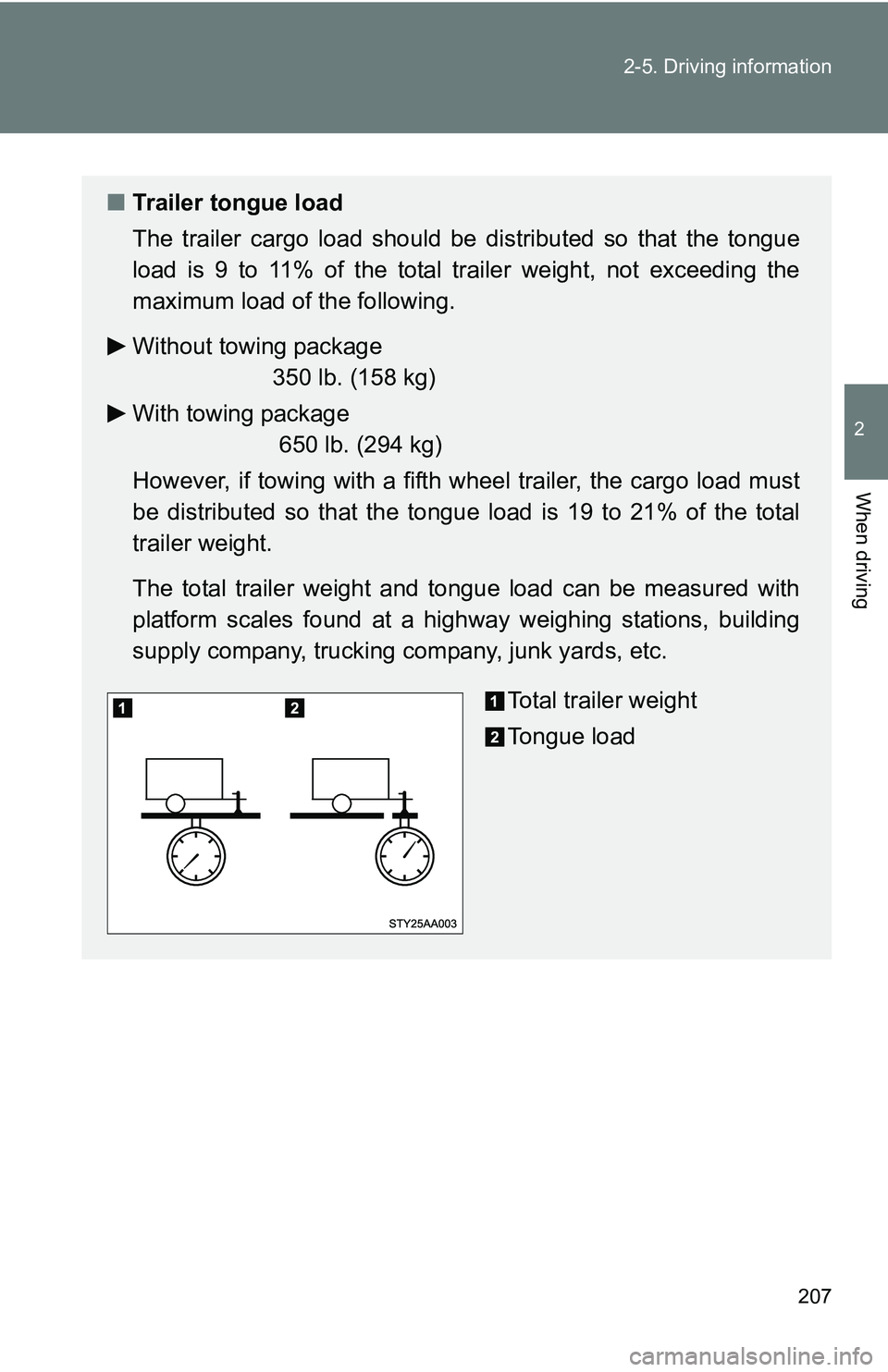
Trailer tongue load
The trailer cargo load should be distributed so that the tongue
load is 9 to 11% of the total trailer weight, not exceeding the
maximum load of the following.
Without towing package 350 lb. (158 kg)
With towing package 650 lb. (294 kg)
However, if towing with a fifth wheel trailer, the cargo load must
be distributed so that the tongue load is 19 to 21% of the total
trailer weight.
The total trailer weight and tongue load can be measured with
platform scales found at a highway weighing stations, building
supply company, trucking company, junk yards, etc.
Total trailer weight
Tongue load
Page 208 of 520
208 2-5. Driving information
Towing a trailerConsult your Toyota dealer for further information about additional
requirements such as a towing kits, etc.
Hitch and tow hitch receiver■ Hitch
Trailer hitch assemblies have different weight capacities estab-
lished by the hitch manufacturer . Even though the vehicle may be
rated for towing a higher weight, the operator must never exceed
the maximum weight rating specified for the trailer hitch.