light TOYOTA TACOMA 2011 (in English) Owner's Guide
[x] Cancel search | Manufacturer: TOYOTA, Model Year: 2011, Model line: TACOMA, Model: TOYOTA TACOMA 2011Pages: 548, PDF Size: 9.84 MB
Page 102 of 548
102 1-7. Safety information
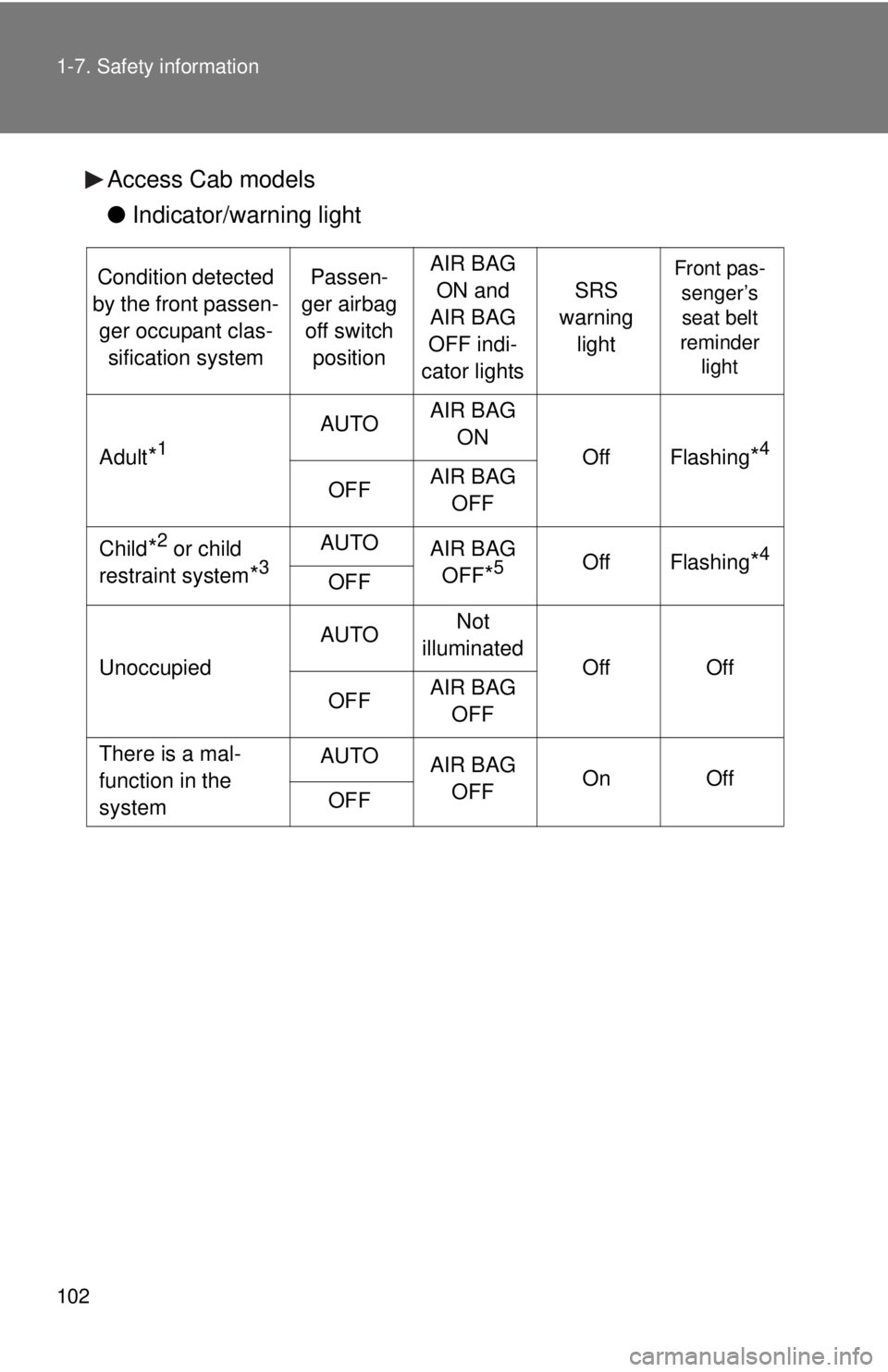
Access Cab models
●Indicator/warning light
Condition detected
by the front passen- ger occupant clas- sification systemPassen-
ger airbag off switch positionAIR BAG ON and
AIR BAG
OFF indi-
cator lights
SRS
warning light
Front pas-senger’s
seat belt
reminder light
Adult*1
AUTOAIR BAG
ON
OffFlashing*4
OFFAIR BAG OFF
Child*2 or child
restraint system
*3
AUTOAIR BAG OFF
*5OffFlashing*4
OFF
Unoccupied
AUTONot
illuminated
OffOff
OFFAIR BAG OFF
There is a mal-
function in the
systemAUTOAIR BAG OFFOnOffOFF
Page 104 of 548
104 1-7. Safety information
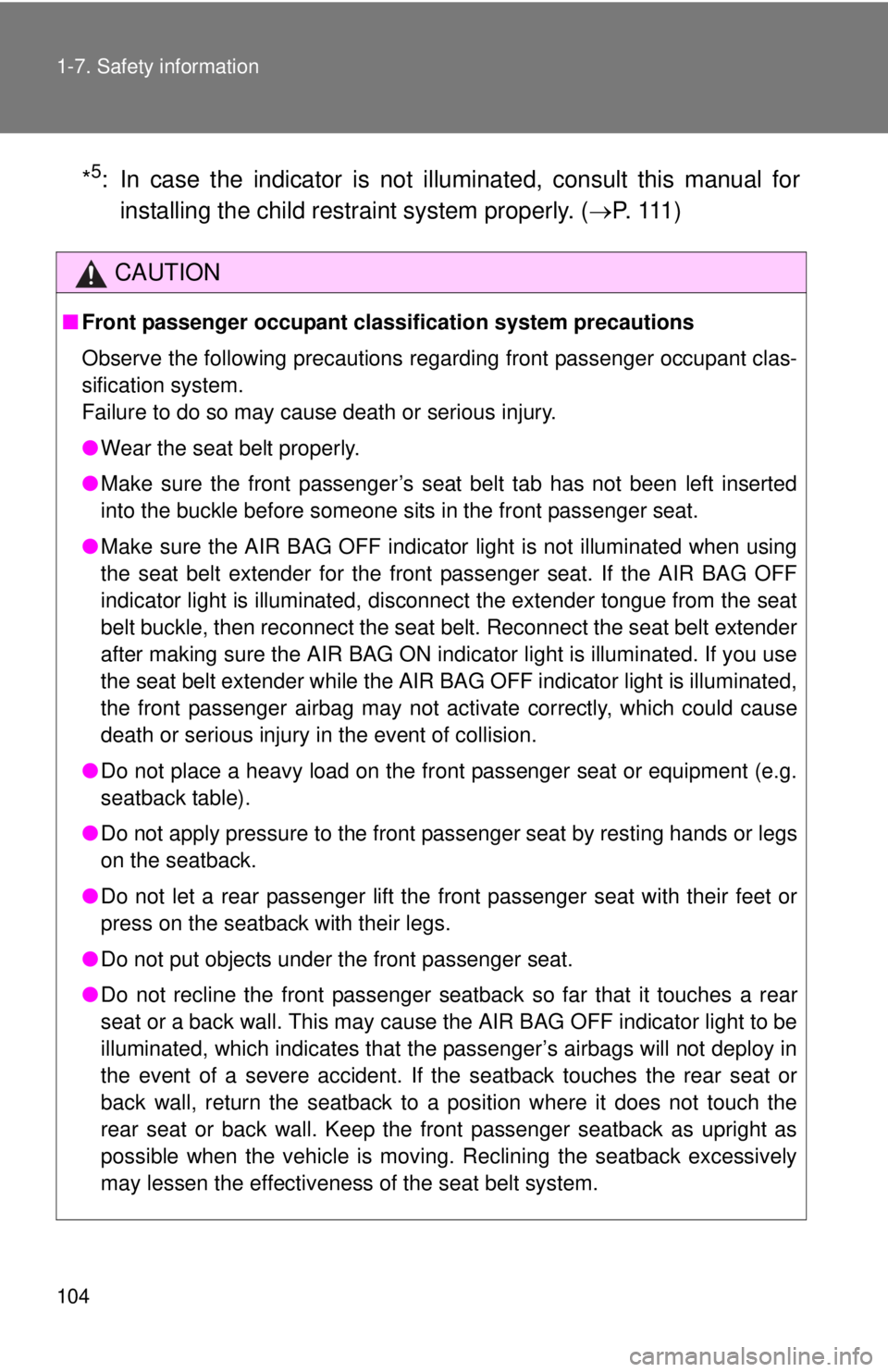
*5: In case the indicator is not illuminated, consult this manual for
installing the child restraint system properly. ( P. 111 )
CAUTION
■Front passenger occupant cl assification system precautions
Observe the following precautions regarding front passenger occupant clas-
sification system.
Failure to do so may cause death or serious injury.
● Wear the seat belt properly.
● Make sure the front passenger’s seat belt tab has not been left inserted
into the buckle before someone sits in the front passenger seat.
● Make sure the AIR BAG OFF indicator light is not illuminated when using
the seat belt extender for the front passenger seat. If the AIR BAG OFF
indicator light is illuminated, disconnect the extender tongue from the seat
belt buckle, then reconnect the seat belt. Reconnect the seat belt extender
after making sure the AIR BAG ON indicator light is illuminated. If you use
the seat belt extender while the AIR BAG OFF indicator light is illuminated,
the front passenger airbag may not activate correctly, which could cause
death or serious injury in the event of collision.
● Do not place a heavy load on the front passenger seat or equipment (e.g.
seatback table).
● Do not apply pressure to the front passenger seat by resting hands or legs
on the seatback.
● Do not let a rear passenger lift the front passenger seat with their feet or
press on the seatback with their legs.
● Do not put objects under the front passenger seat.
● Do not recline the front passenger seatback so far that it touches a rear
seat or a back wall. This may cause the AIR BAG OFF indicator light to be
illuminated, which indicates that the passenger’s airbags will not deploy in
the event of a severe accident. If the seatback touches the rear seat or
back wall, return the seatback to a position where it does not touch the
rear seat or back wall. Keep the front passenger seatback as upright as
possible when the vehicle is moving. Reclining the seatback excessively
may lessen the effectiveness of the seat belt system.
Page 105 of 548
105
1-7. Safety information
1
Before driving
CAUTION
■
Front passenger occupant cl assification system precautions
● If an adult sits in the front passenger seat, the AIR BAG ON indicator light
is illuminated. If the AIR BAG OFF indicator is illuminated, ask the passen-
ger to sit up straight, well back in the seat, feet on the floor, and with the
seat belt worn correctly. If the AIR BAG OFF indicator still remains illumi-
nated, either ask the passenger to move to the rear seat, or if that is not
possible, move the front passenger seat fully rearward.
● When it is unavoidable to install the forward-facing child restraint system
on the front passenger seat, install the child restraint system on the front
passenger seat in the proper order. ( P. 1 1 1 )
● Do not modify or remove the front seats.
● Do not kick the front passenger seat or subject it to severe impact. Other-
wise, the SRS warning light may come on to indicate a malfunction of the
detection system. In this case, contact your Toyota dealer immediately.
● Child restraint systems installed on the rear seat should not contact the
front seatbacks.
● Do not use a seat accessory, such as a cushion or seat cover, that covers
the seat cushion surface.
● Access Cab and Double Cab models: Do not attach a commercial seat-
back table or other heavy item to the back of the front passenger seat.
● Do not modify or replace the upholstery of the front seat.
Page 108 of 548
108 1-7. Safety information
CAUTION
■Child restraint precautions
●Regular Cab models: Toyota strongly urges use of a proper child restraint
system which conforms to the size of the child.
● Access Cab and Double Cab models: Toyota strongly urges the use of a
proper child restraint system that conforms to the size of the child, installed
on the rear seat. According to accident statistics, the child is safer when
properly restrained in the rear seat than in the front seat.
● Access Cab models: Never put infant or child age 1 to 12 in a passenger
risk group on the front passenger seat with the passenger airbag off switch
in the AUTO position. In the event of an accident, the force of the rapid
inflation of the front passenger airbag can cause death or serious injury to
the child. If you must put infant or child age 1 to 12 in a passenger risk
group on the front passenger seat, make sure that the passenger airbag
off switch is in the OFF position with the key removed and that the indica-
tor light is on. ( P. 96)
● Regular Cab and Double Cab models: Never install a rear-facing child
restraint system on the front passenger seat even if the AIR BAG OFF
indicator light is illuminated. In the event of an accident, the force of the
rapid inflation of the front passenger airbag can cause death or serious
injury to the child if the rear-facing child restraint system is installed on the
front passenger seat.
Page 109 of 548
109
1-7. Safety information
1
Before driving
CAUTION
■
Child restraint precautions
●Double Cab models: A forward-facing child restraint system may be
installed on the front passenger seat only when it is unavoidable. A child
restraint system that requires a top tether strap should not be used in the
front passenger seat since there is no top tether strap anchor for the front
passenger seat. Adjust the seatback as upright as possible and always
move the seat as far back as possible even if AIR BAG OFF indicator light
is illuminated, because the front passenger airbag could inflate with con-
siderable speed and force. Otherwise, the child may be killed or seriously
injured.
● Access Cab models: A forward-facing child restraint system which belongs
to a passenger risk group should never be installed on the front passenger
seat with the passenger airbag off switch in the AUTO position, because
the force of the deploying airbag could cause death or serious injury to the
child in forward seating position. (P. 96)
● Bench type front seat: Do not install a child restraint system on the center
seat if it interferes with driving operations such as gear shifting. In this
case, install the child restraint system on the right passenger seat.
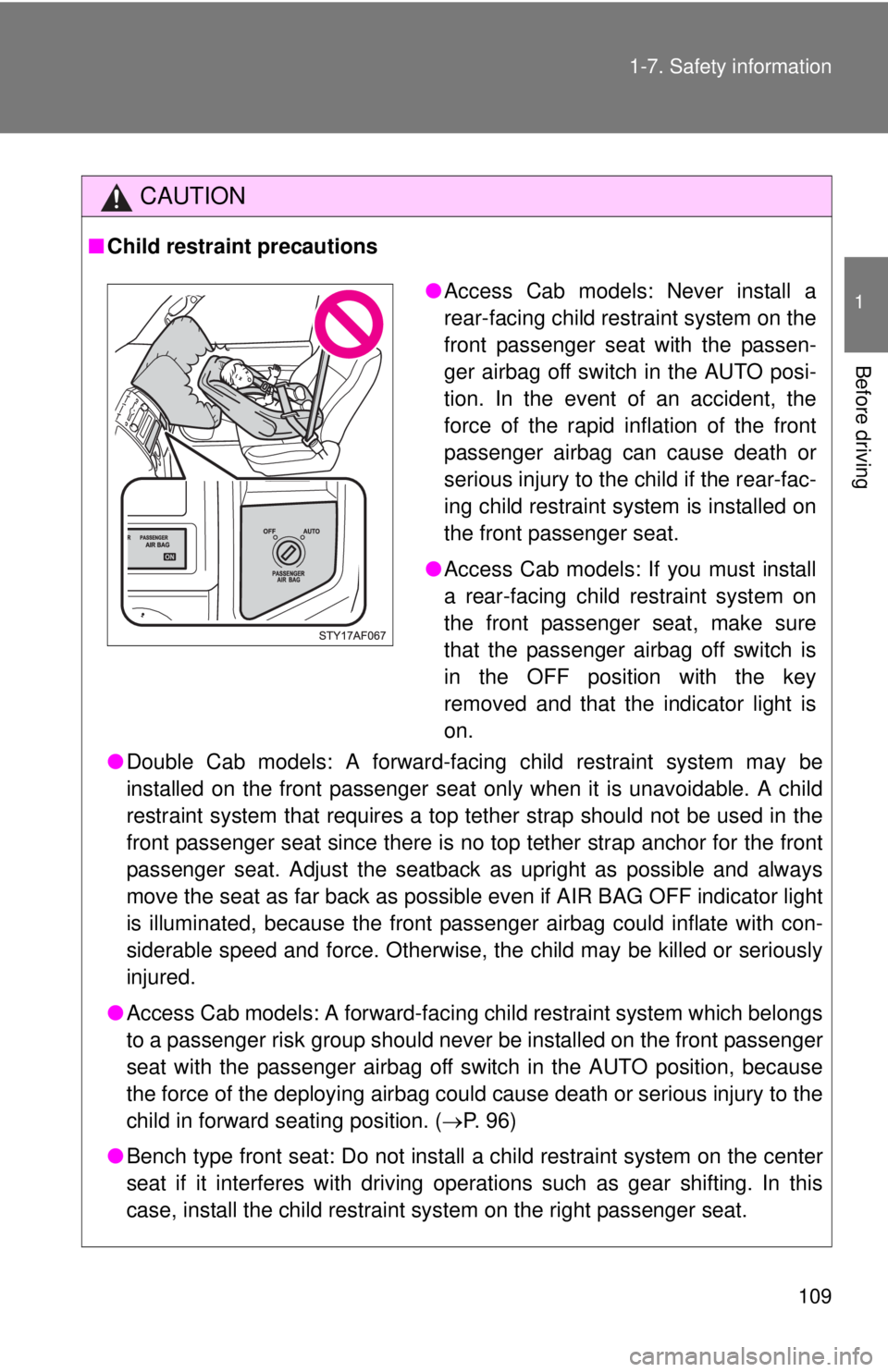
●Access Cab models: Never install a
rear-facing child restraint system on the
front passenger seat with the passen-
ger airbag off switch in the AUTO posi-
tion. In the event of an accident, the
force of the rapid inflation of the front
passenger airbag can cause death or
serious injury to the child if the rear-fac-
ing child restraint system is installed on
the front passenger seat.
● Access Cab models: If you must install
a rear-facing child restraint system on
the front passenger seat, make sure
that the passenger airbag off switch is
in the OFF position with the key
removed and that the indicator light is
on.
Page 114 of 548
114 1-7. Safety information
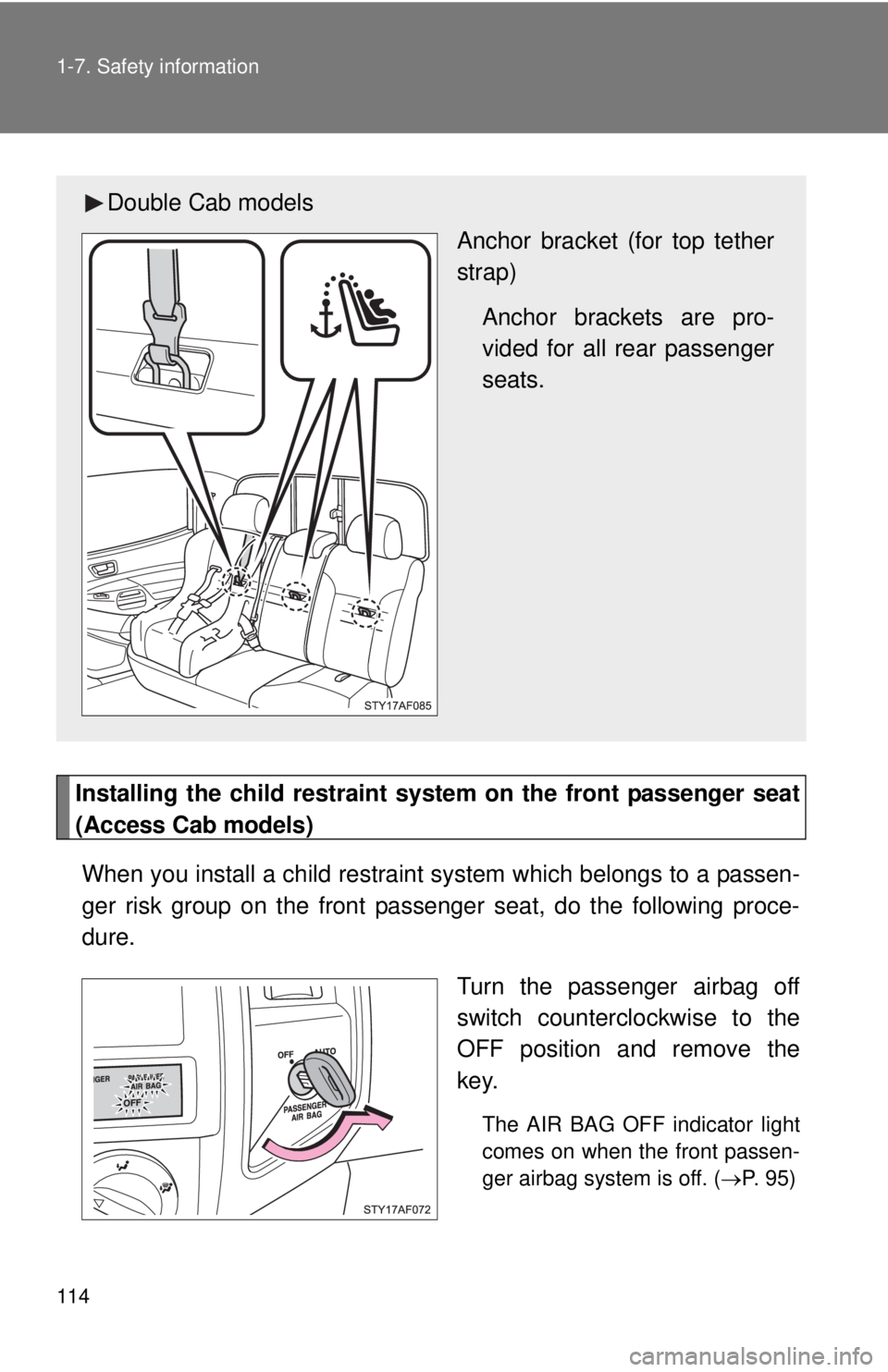
Installing the child restraint system on the front passenger seat
(Access Cab models)When you install a child restraint system which belongs to a passen-
ger risk group on the front passenger seat, do the following proce-
dure.
Turn the passenger airbag off
switch counterclockwise to the
OFF position and remove the
key.
The AIR BAG OFF indicator light
comes on when the front passen-
ger airbag system is off. (P. 95)
Double Cab models
Anchor bracket (for top tether
strap)
Anchor brackets are pro-
vided for all rear passenger
seats.
Page 115 of 548
115
1-7. Safety information
1
Before driving
Installation with LATCH s
ystem (Access Cab models)
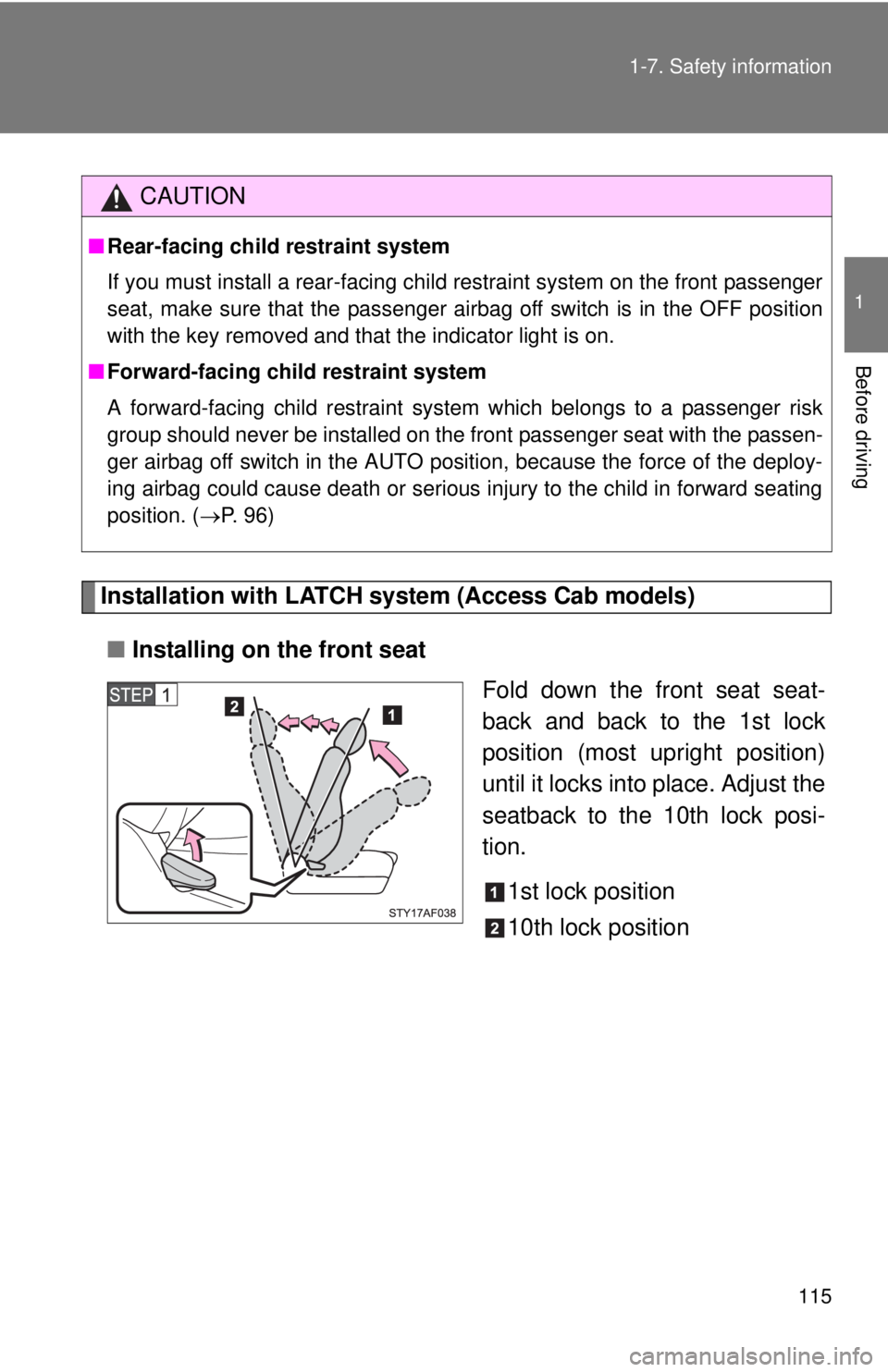
■ Installing on the front seat
Fold down the front seat seat-
back and back to the 1st lock
position (most upright position)
until it locks into place. Adjust the
seatback to the 10th lock posi-
tion.
1st lock position
10th lock position
CAUTION
■Rear-facing child restraint system
If you must install a rear-facing child restraint system on the front passenger
seat, make sure that the passenger airbag off switch is in the OFF position
with the key removed and that the indicator light is on.
■ Forward-facing child restraint system
A forward-facing child restraint system which belongs to a passenger risk
group should never be installed on the front passenger seat with the passen-
ger airbag off switch in the AUTO position, because the force of the deploy-
ing airbag could cause death or serious injury to the child in forward seating
position. ( P. 96)
Page 116 of 548
116 1-7. Safety information
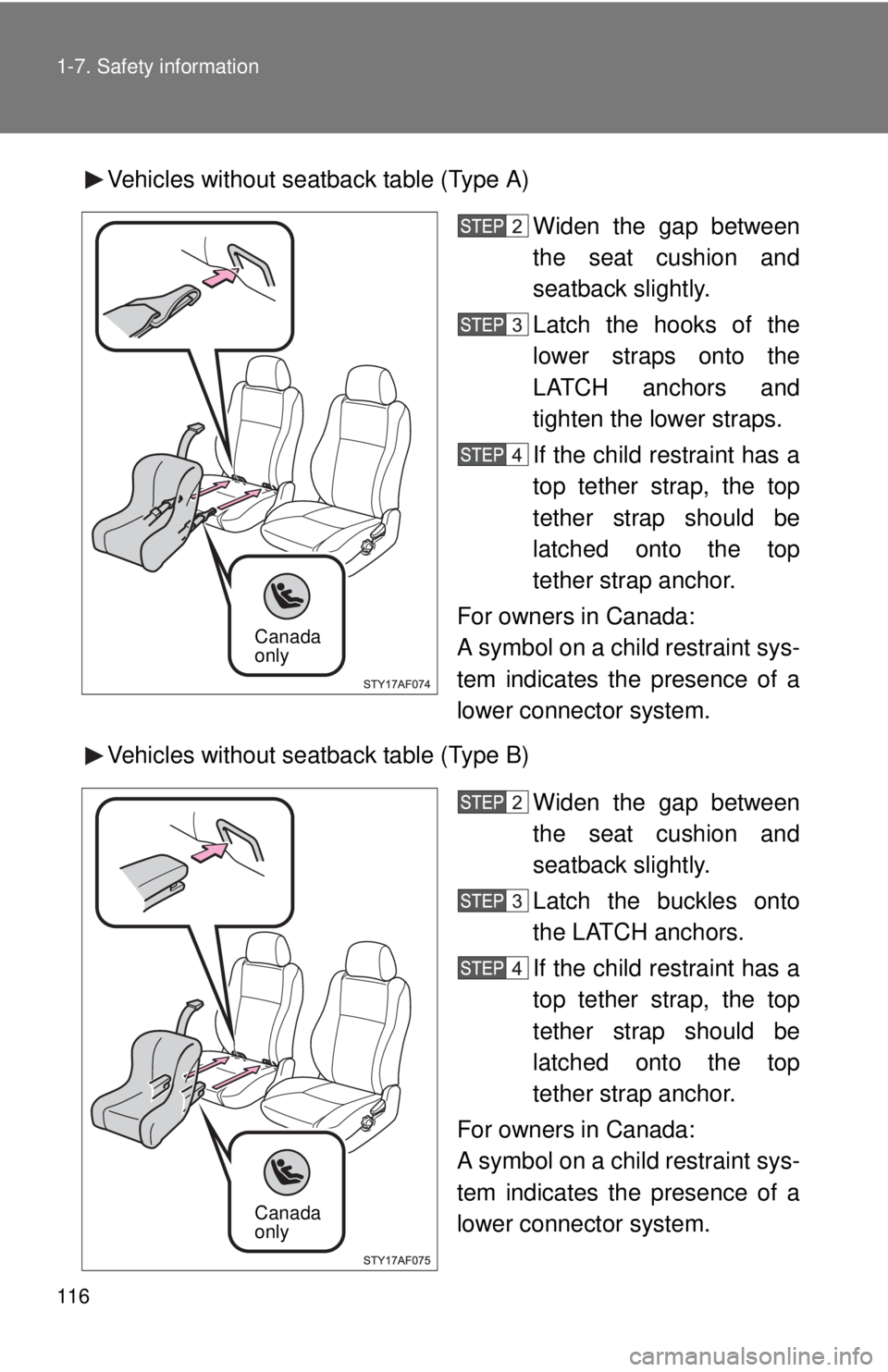
Vehicles without seatback table (Type A)Widen the gap between
the seat cushion and
seatback slightly.
Latch the hooks of the
lower straps onto the
LATCH anchors and
tighten the lower straps.
If the child restraint has a
top tether strap, the top
tether strap should be
latched onto the top
tether strap anchor.
For owners in Canada:
A symbol on a child restraint sys-
tem indicates the presence of a
lower connector system.
Vehicles without seatback table (Type B)
Widen the gap between
the seat cushion and
seatback slightly.
Latch the buckles onto
the LATCH anchors.
If the child restraint has a
top tether strap, the top
tether strap should be
latched onto the top
tether strap anchor.
For owners in Canada:
A symbol on a child restraint sys-
tem indicates the presence of a
lower connector system.
Canada
only
Canada
only
Page 117 of 548
117
1-7. Safety information
1
Before driving
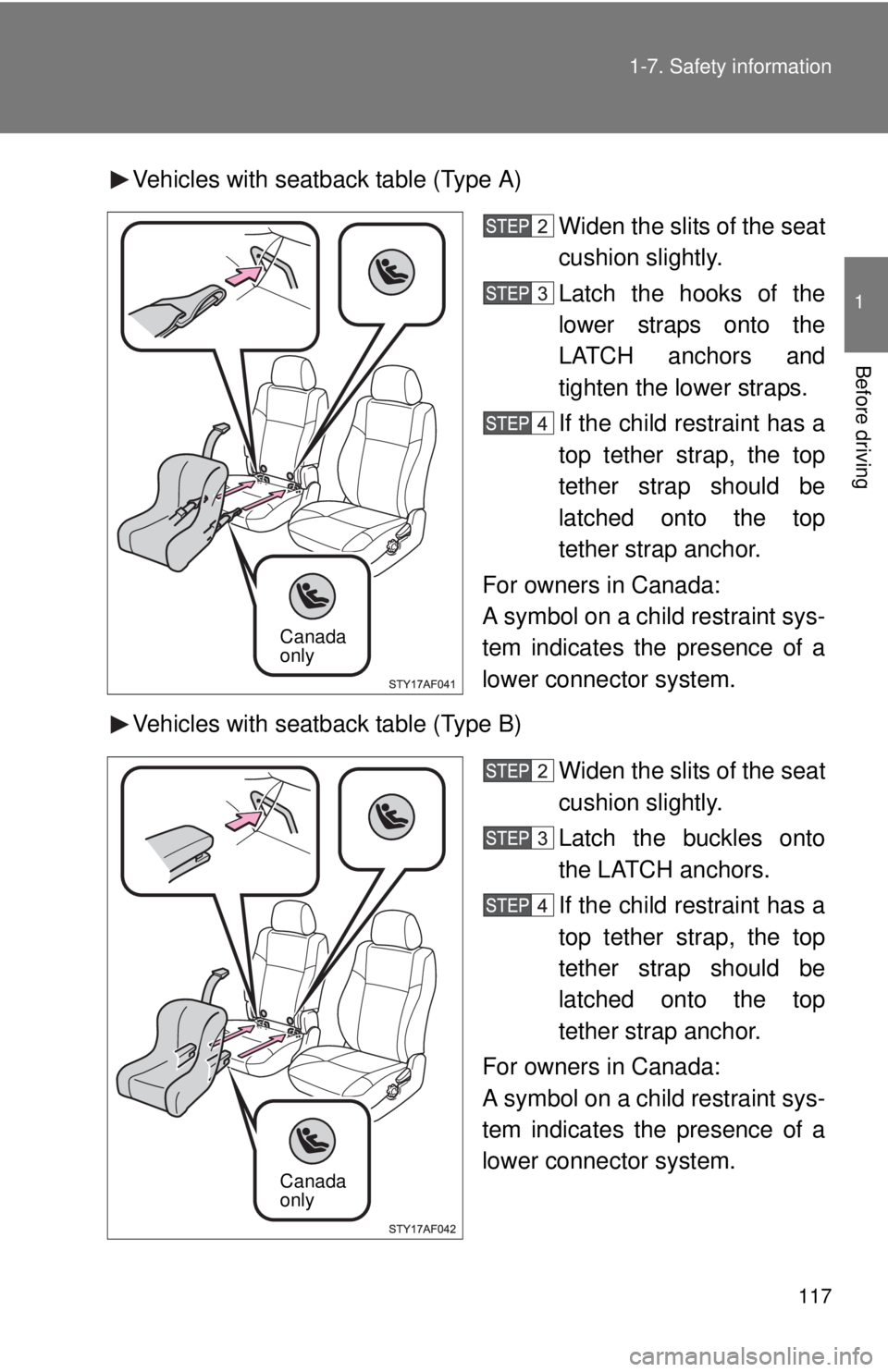
Vehicles with seatback table (Type A)
Widen the slits of the seat
cushion slightly.
Latch the hooks of the
lower straps onto the
LATCH anchors and
tighten the lower straps.
If the child restraint has a
top tether strap, the top
tether strap should be
latched onto the top
tether strap anchor.
For owners in Canada:
A symbol on a child restraint sys-
tem indicates the presence of a
lower connector system.
Vehicles with seatback table (Type B)
Widen the slits of the seat
cushion slightly.
Latch the buckles onto
the LATCH anchors.
If the child restraint has a
top tether strap, the top
tether strap should be
latched onto the top
tether strap anchor.
For owners in Canada:
A symbol on a child restraint sys-
tem indicates the presence of a
lower connector system.
Canada
only
Canada
only
Page 119 of 548
119
1-7. Safety information
1
Before driving
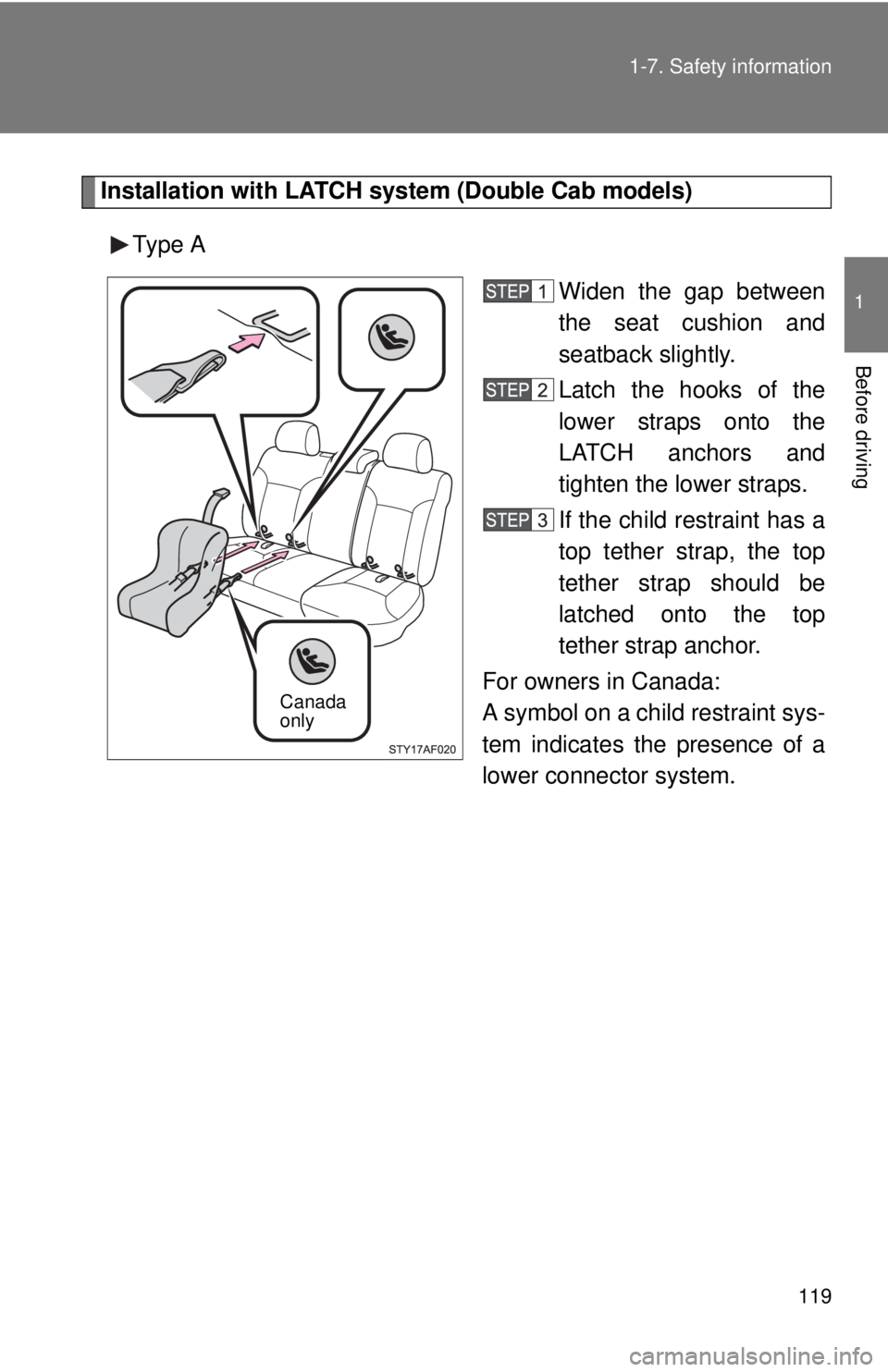
Installation with LATCH system (Double Cab models)
Type A Widen the gap between
the seat cushion and
seatback slightly.
Latch the hooks of the
lower straps onto the
LATCH anchors and
tighten the lower straps.
If the child restraint has a
top tether strap, the top
tether strap should be
latched onto the top
tether strap anchor.
For owners in Canada:
A symbol on a child restraint sys-
tem indicates the presence of a
lower connector system.
Canada
only