light TOYOTA TACOMA 2011 (in English) Service Manual
[x] Cancel search | Manufacturer: TOYOTA, Model Year: 2011, Model line: TACOMA, Model: TOYOTA TACOMA 2011Pages: 548, PDF Size: 9.84 MB
Page 120 of 548
120 1-7. Safety information
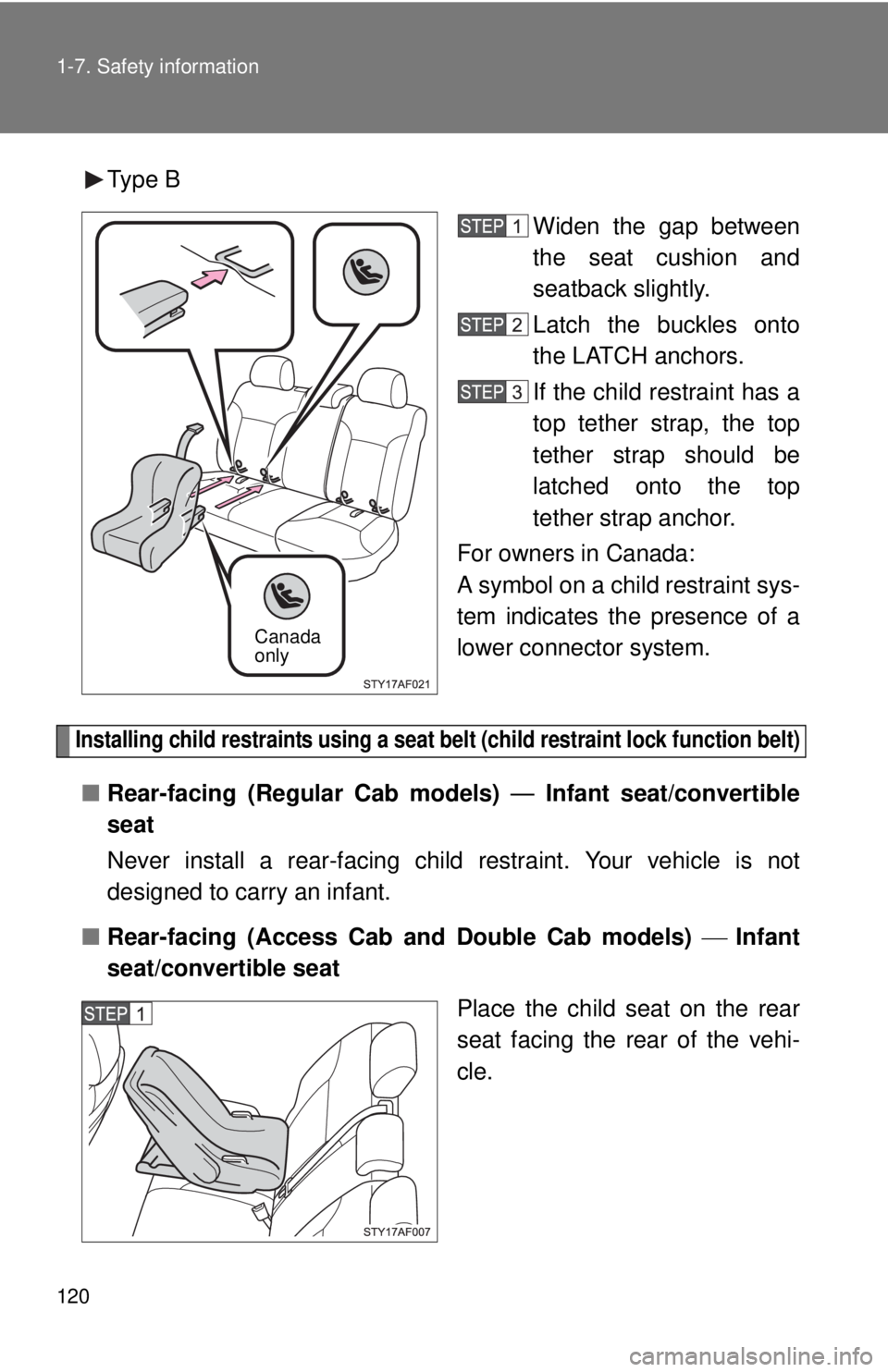
Type BWiden the gap between
the seat cushion and
seatback slightly.
Latch the buckles onto
the LATCH anchors.
If the child restraint has a
top tether strap, the top
tether strap should be
latched onto the top
tether strap anchor.
For owners in Canada:
A symbol on a child restraint sys-
tem indicates the presence of a
lower connector system.
Installing child restraints using a seat belt (child restraint lock function belt)
■ Rear-facing (Regular Cab models) — Infant seat/convertible
seat
Never install a rear-facing child restraint. Your vehicle is not
designed to carry an infant.
■ Rear-facing (Access Cab and Double Cab models) Infant
seat/convertible seat
Place the child seat on the rear
seat facing the rear of the vehi-
cle.
Canada
only
Page 121 of 548
121
1-7. Safety information
1
Before driving
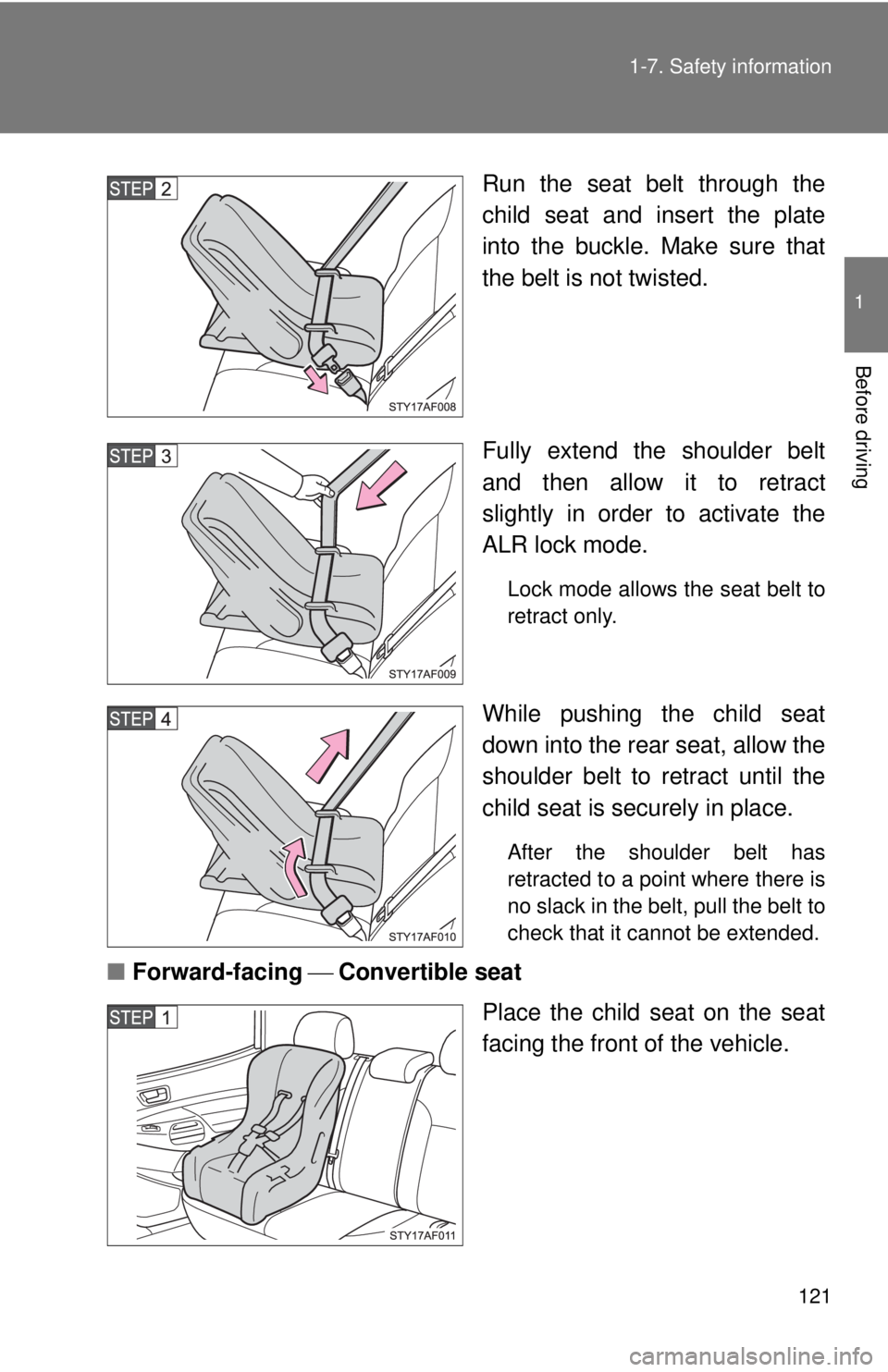
Run the seat belt through the
child seat and insert the plate
into the buckle. Make sure that
the belt is not twisted.
Fully extend the shoulder belt
and then allow it to retract
slightly in order to activate the
ALR lock mode.
Lock mode allows the seat belt to
retract only.
While pushing the child seat
down into the rear seat, allow the
shoulder belt to retract until the
child seat is securely in place.
After the shoulder belt has
retracted to a point where there is
no slack in the belt, pull the belt to
check that it cannot be extended.
■
Forward-facing Convertible seat
Place the child seat on the seat
facing the front of the vehicle.
Page 122 of 548
122 1-7. Safety information
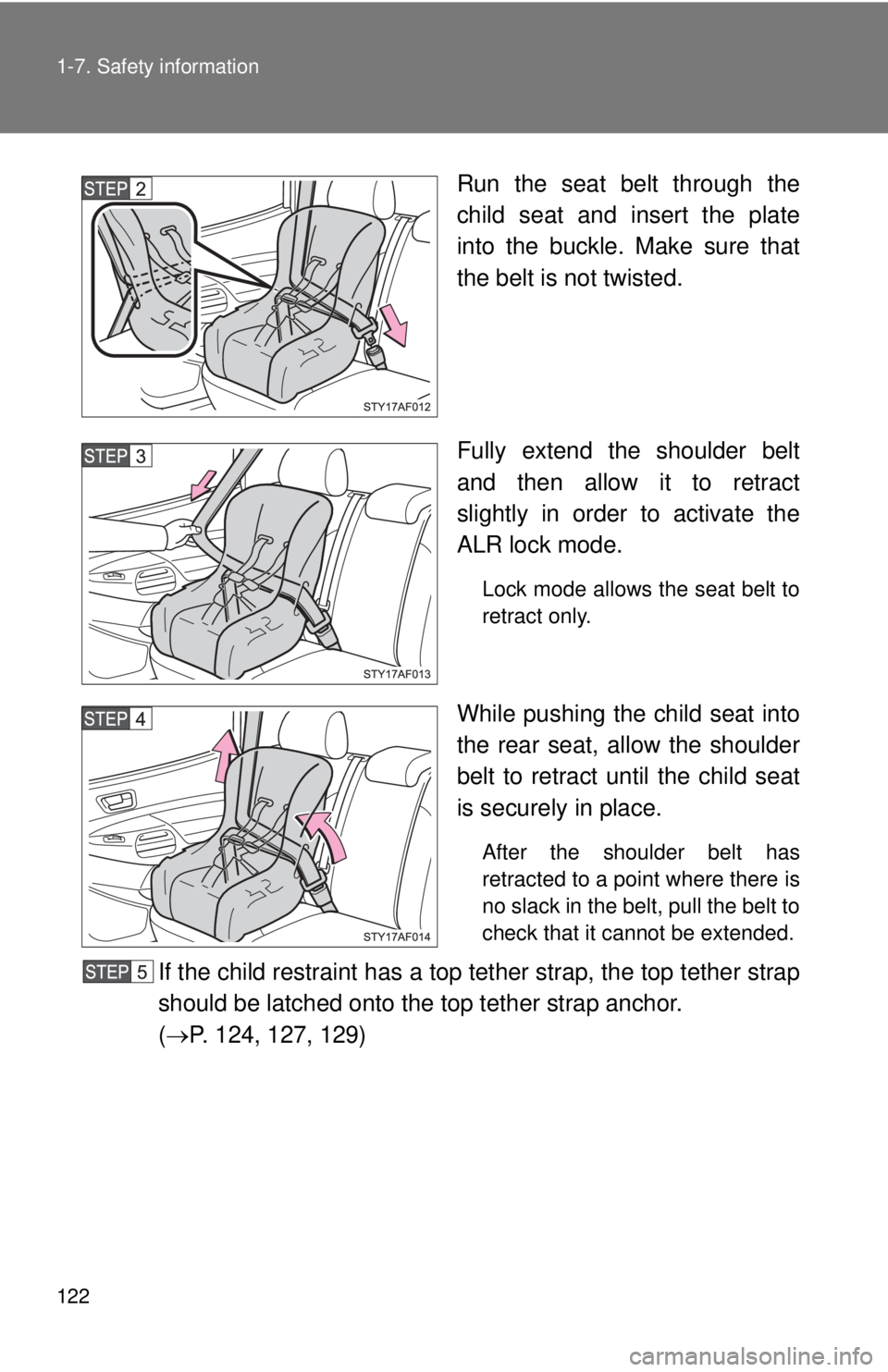
Run the seat belt through the
child seat and insert the plate
into the buckle. Make sure that
the belt is not twisted.
Fully extend the shoulder belt
and then allow it to retract
slightly in order to activate the
ALR lock mode.
Lock mode allows the seat belt to
retract only.
While pushing the child seat into
the rear seat, allow the shoulder
belt to retract until the child seat
is securely in place.
After the shoulder belt has
retracted to a point where there is
no slack in the belt, pull the belt to
check that it cannot be extended.
If the child restraint has a top tether strap, the top tether strap
should be latched onto the top tether strap anchor.
( P. 124, 127, 129)
Page 124 of 548
124 1-7. Safety information
Child restraint systems with a top tether strap (Regular Cab models)
■Bench type seat
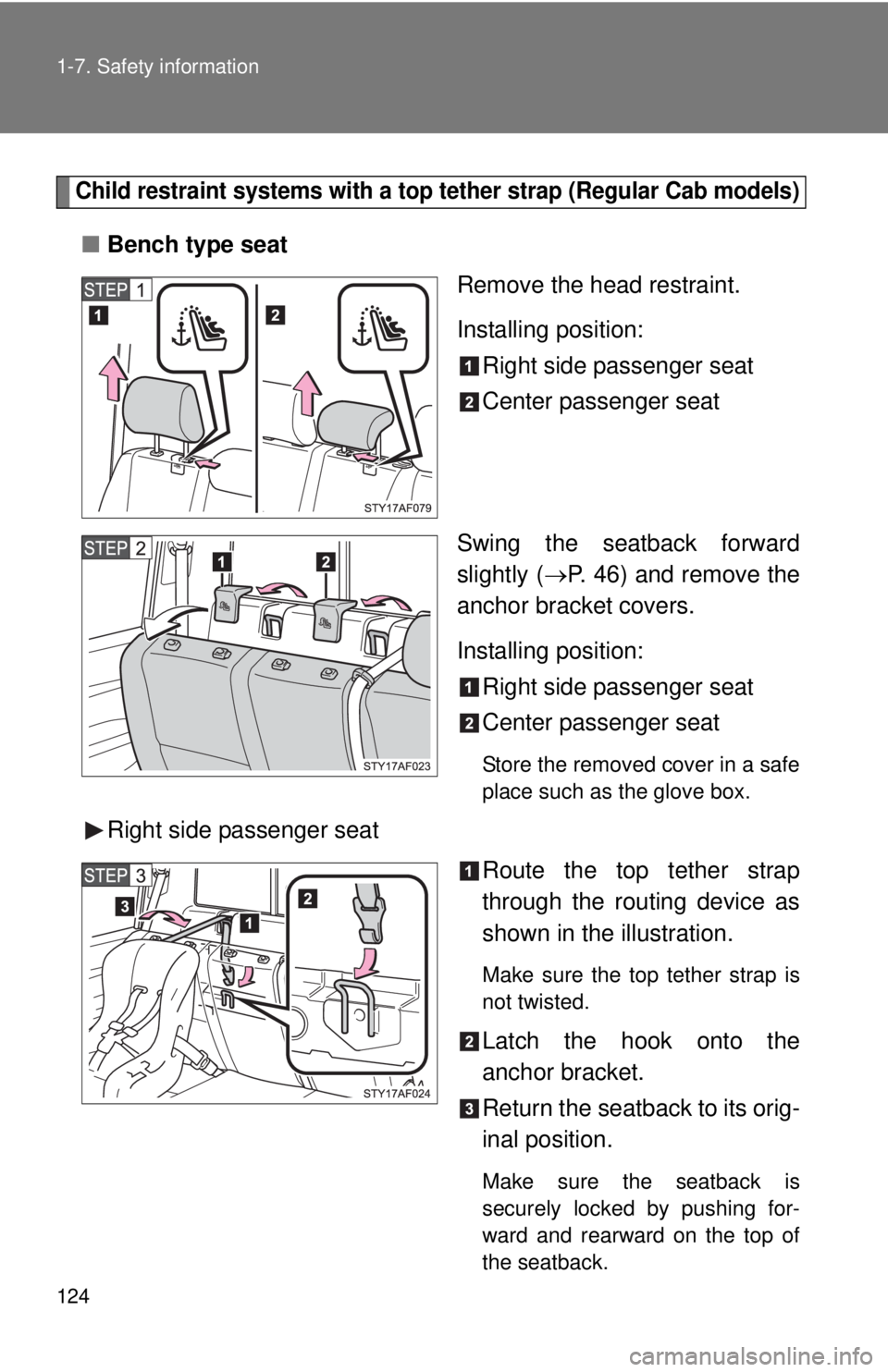
Remove the head restraint.
Installing position:Right side passenger seat
Center passenger seat
Swing the seatback forward
slightly ( P. 46) and remove the
anchor bracket covers.
Installing position:
Right side passenger seat
Center passenger seat
Store the removed cover in a safe
place such as the glove box.
Right side passenger seat
Route the top tether strap
through the routing device as
shown in the illustration.
Make sure the top tether strap is
not twisted.
Latch the hook onto the
anchor bracket.
Return the seatback to its orig-
inal position.
Make sure the seatback is
securely locked by pushing for-
ward and rearward on the top of
the seatback.
Page 126 of 548
126 1-7. Safety information
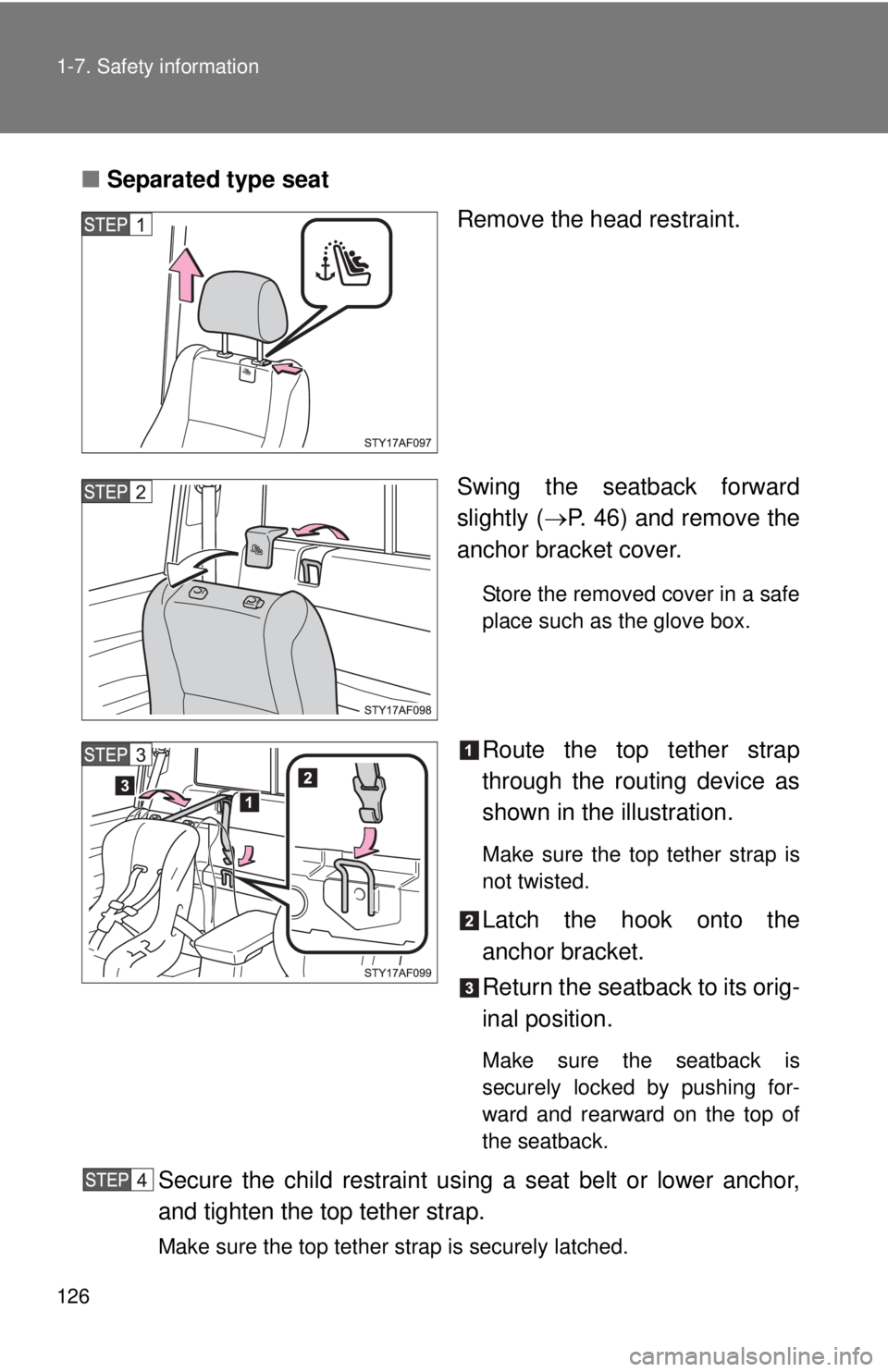
■Separated type seat
Remove the head restraint.
Swing the seatback forward
slightly (P. 46) and remove the
anchor bracket cover.
Store the removed cover in a safe
place such as the glove box.
Route the top tether strap
through the routing device as
shown in the illustration.
Make sure the top tether strap is
not twisted.
Latch the hook onto the
anchor bracket.
Return the seatback to its orig-
inal position.
Make sure the seatback is
securely locked by pushing for-
ward and rearward on the top of
the seatback.
Secure the child restraint usi ng a seat belt or lower anchor,
and tighten the top tether strap.
Make sure the top tether strap is securely latched.
Page 129 of 548
129
1-7. Safety information
1
Before driving
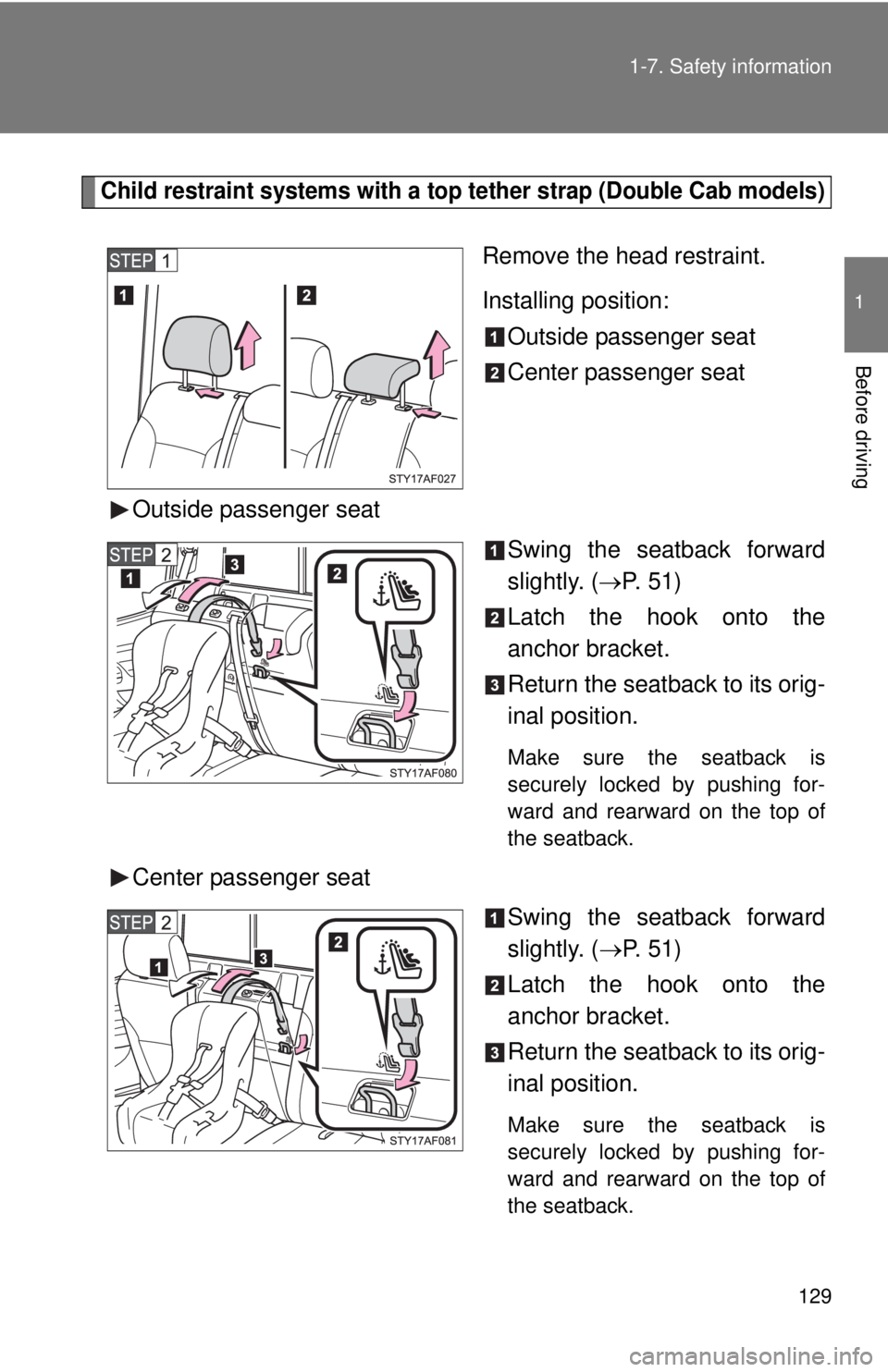
Child restraint systems with a top tether strap (Double Cab models)
Remove the head restraint.
Installing position:
Outside passenger seat
Center passenger seat
Outside passenger seat Swing the seatback forward
slightly. (P. 51)
Latch the hook onto the
anchor bracket.
Return the seatback to its orig-
inal position.
Make sure the seatback is
securely locked by pushing for-
ward and rearward on the top of
the seatback.
Center passenger seat
Swing the seatback forward
slightly. (P. 51)
Latch the hook onto the
anchor bracket.
Return the seatback to its orig-
inal position.
Make sure the seatback is
securely locked by pushing for-
ward and rearward on the top of
the seatback.
Page 131 of 548
131
1-7. Safety information
1
Before driving
CAUTION
■
When installing a booster seat
Do not fully extend the shoulder belt to prevent the belt from going to ALR
lock mode. ( P. 60)
ALR mode causes the belt to tighten only which could cause injury or dis-
comfort to the child.
■ When installing a child restraint system
Follow the directions given in the child restraint system installation manual
and fix the child restraint system securely in place.
If the child restraint system is not correctly fixed in place, the child or other
passengers may be seriously injured or even killed in the event of sudden
braking, sudden swerving or an accident.
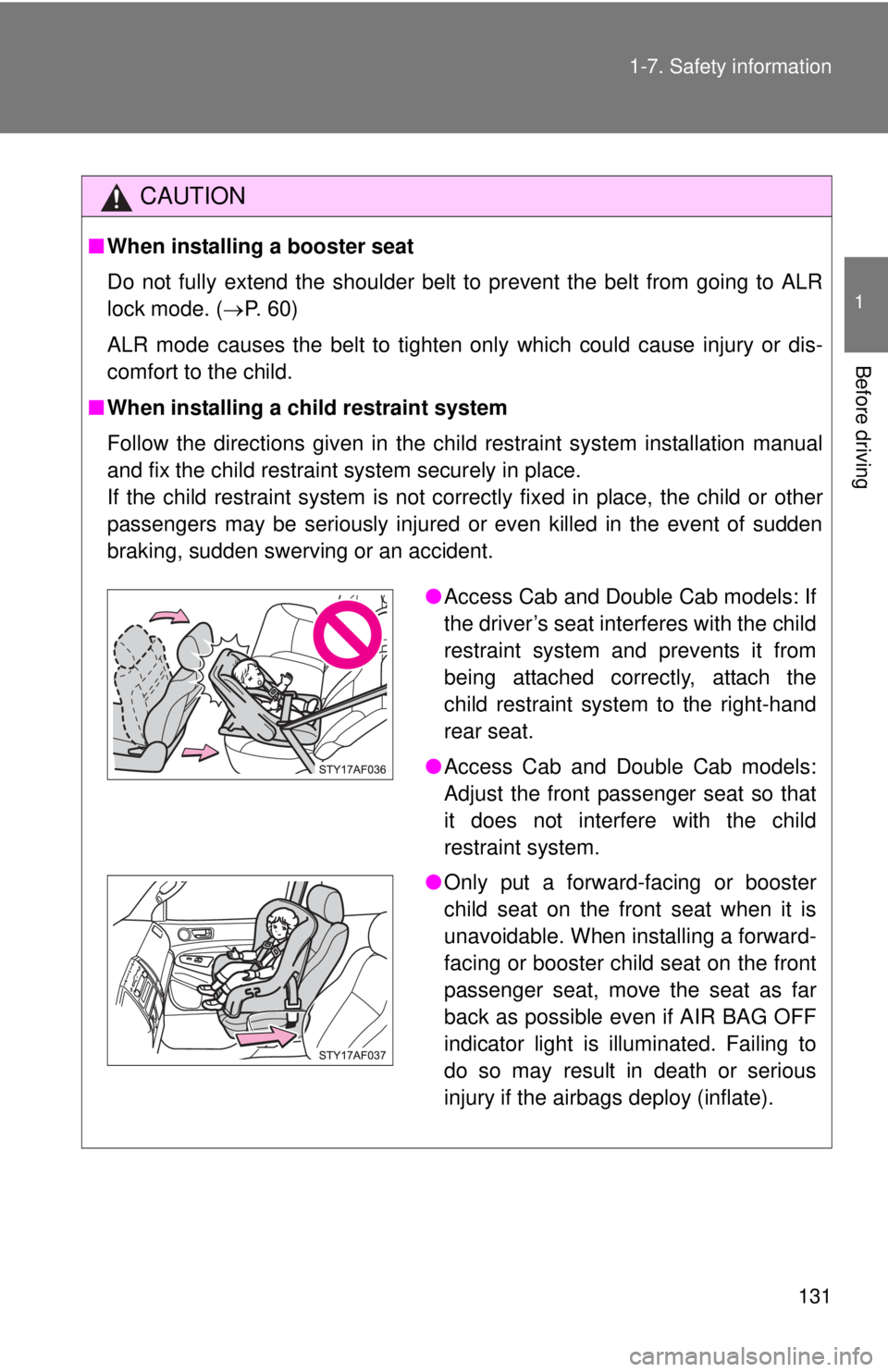
●Access Cab and Double Cab models: If
the driver’s seat interferes with the child
restraint system and prevents it from
being attached correctly, attach the
child restraint system to the right-hand
rear seat.
● Access Cab and Double Cab models:
Adjust the front passenger seat so that
it does not interfere with the child
restraint system.
● Only put a forward-facing or booster
child seat on the front seat when it is
unavoidable. When installing a forward-
facing or booster child seat on the front
passenger seat, move the seat as far
back as possible even if AIR BAG OFF
indicator light is illuminated. Failing to
do so may result in death or serious
injury if the airbags deploy (inflate).
Page 133 of 548
When driving2
133
2-1. Driving proceduresDriving the vehicle............ 134
Engine (ignition) switch .... 144
Automatic
transmission..... 147
Manual transmission ........ 150
Turn signal lever .............. 153
Parking brake ................... 154
Horn ................................. 156
2-2. Gauges and meters Gauges and meters ......... 157
Indicators and warninglights .............................. 160
Accessory meter .............. 163
2-3. Operating the lights and wipers
Headlight switch ............... 164
Fog light switch ................ 166
Windshield wipers and washer ........................... 167 2-4. Using other driving systems
Cruise control ................... 170
Rear view monitor system (vehicles with auto
anti-glare inside rear
view mirror) .................... 173
Four-wheel drive system ........................... 177
Active traction control system ........................... 181
AUTO LSD system........... 183
Rear differential lock system ........................... 185
Downhill Assist Control system ........................... 188
Clutch start cancel switch ............................. 190
Driving assist systems ..... 191
2-5. Driving information Off-road precautions (4WD models and
PreRunner) .................... 197
Cargo and luggage .......... 202
Vehicle load limits ............ 207
Winter driving tips ............ 209
Trailer towing ................... 213
Dinghy towing .................. 233
Page 136 of 548
136 2-1. Driving procedures
Lightly depress the accelerator pedal at the same time as
gradually releasing the clutch pedal.
Release the parking brake.
■Driving in the rain
●Drive carefully when it is raining, because visibility will be reduced, the
windows may become fogged-up, and the road will be slippery.
● Drive carefully when it starts to rain, because the road surface will be
especially slippery.
● Refrain from high speeds when driving on an expressway in the rain,
because there may be a layer of water between the tires and the road
surface, preventing the steering and brakes from operating properly.
■ Breaking in your new Toyota
To extend the life of the vehicle, the following precautions are recommended
to observe:
●For the first 200 miles (300 km):
Avoid sudden stops.
● For the first 500 miles (800 km):
Do not tow a trailer.
● For the first 1000 miles (1600 km):
• Do not drive at extremely high speeds.
• Avoid sudden acceleration.
• Do not drive continuously in the low gears.
• Do not drive slowly with the manual transmission in a high gear.
• Do not drive at a constant speed for extended periods.
■ Operating your vehicle in a foreign country
Comply with the relevant vehicle registration laws and confirm the availability
of the correct fuel. ( P. 491)
Page 137 of 548
137
2-1. Driving procedures
2
When driving
CAUTION
■
When starting the vehicle
Vehicles with an automatic transmission, always keep your foot on the brake
pedal while stopped with the engine running. This prevents the vehicle from
creeping.
■ When driving the vehicle
●Do not drive if you are unfamiliar with the location of the brake and accel-
erator pedals to avoid depressing the wrong pedal.
• Accidentally depressing the accelerator pedal instead of the brake
pedal will result in sudden acceleration that may lead to an accident
that could result in death or serious injury.
• When backing up, you may twist your body around, leading to a diffi- culty in operating the pedals. Make sure to operate the pedals properly.
• Make sure to keep a correct driving posture even when moving the vehicle only slightly, allowing you to depress the brake and accelerator
pedals properly.
• Depress the brake pedal using your right foot. Depressing the brake pedal using your left foot may delay response in an emergency, result-
ing in an accident.
● Do not drive the vehicle over or st op the vehicle near flammable materials.
The exhaust system and exhaust gases can be extremely hot. This may
cause a fire if there is any flammable material nearby.
● Vehicles with an automatic transmission, do not let the vehicle roll back-
wards while the shift lever is in a driving position, or roll forward while the
shift lever is in R.
Doing so may cause the engine to stall or lead to poor brake and steering
performance, resulting in an accident or damage to the vehicle.
● If the smell of exhaust is noticed inside the vehicle, open the windows and
check that the back window is closed. Large amounts of exhaust in the
vehicle can cause driver drowsiness and an accident, resulting in death or
a serious health hazard. Have the vehicle inspected by your Toyota dealer
immediately.
● Do not under any circumstances shift the shift lever to P, R or N (automatic
transmission) or R (manual transmission) while the vehicle is moving.
Doing so can cause significant damage to the transmission system and
may result in a loss of vehicle control.