child lock TOYOTA TACOMA 2011 Owners Manual (in English)
[x] Cancel search | Manufacturer: TOYOTA, Model Year: 2011, Model line: TACOMA, Model: TOYOTA TACOMA 2011Pages: 548, PDF Size: 9.84 MB
Page 2 of 548
TABLE OF CONTENTSIndex
2
1-1. Key informationKeys ..................................... 30
1-2. Opening, closing and locking
the doors
Wireless remote control ....... 32
Side doors ............................ 35
Access doors (Access Cab models only) ....................... 39
Tailgate ................................ 40
1-3. Adjustable components
(seats, mirrors, steering
wheel)
Front seats ........................... 45
Rear seats (Access Cab and Double Cab models) .......... 50
Head restraints ..................... 54
Seat belts ............................. 58
Steering wheel ..................... 64
Anti-glare inside rear view mirror .................................. 65
Outside rear view mirrors ..... 68
1-4. Opening and clos ing
the windows
Pow er windows .................... 71
Back window (vehicles with sliding type) ........................ 73
1-5. Refueling Opening the fuel tank cap .... 74 1-6. Theft deterrent system
Engine immobilizer system ... 78
1-7. Safety information Correct driving posture ......... 80
SRS airbags ......................... 82
Front passenger occupant classification system ........... 99
Child restraint systems ....... 106
Installing child restraints ..... 111
2-1. Driving procedures Driving the vehicle .............. 134
Engine (ignition) switch....... 144
Automatic
transmission........ 147
Manual transmission........... 150
Turn signal lever ................. 153
Parking brake ..................... 154
Horn .................................... 156
2-2. Gauges and meters Gauges and meters ............ 157
Indicators and warning lights ................................. 160
Accessory meter ................. 163
2-3. Operating the li ghts and
wipers
Headlight switch ................. 164
Fog light switch ................... 166
Windshield wipers and washer .............................. 167
1Before driving
2When driving
Page 29 of 548
Before driving1
29
1-1. Key informationKeys ................................... 30
1-2. Opening, closing and locking the doors
Wireless remote control ..... 32
Side doors .......................... 35
Access doors (Access Cab models only) .................... 39
Tailgate .............................. 40
1-3. Adjustable components (seats, mirrors, steering
wheel)
Front seats ......................... 45
Rear seats (Access Cab and Double Cab
models) ............................ 50
Head restraints................... 54
Seat belts ........................... 58
Steering wheel ................... 64
Anti-glare inside rear view mirror ............................... 65
Outside rear view mirrors ... 68
1-4. Opening and closing the windows
Power windows .................. 71
Back window (vehicles with sliding type) .............. 73
1-5. Refueling Opening the fuel tank cap ................................... 74 1-6. Theft deterrent system
Engine immobilizer system ............................. 78
1-7. Safety information Correct driving posture....... 80
SRS airbags ....................... 82
Front passenger occupant classification system ........ 99
Child restraint systems..... 106
Installing child restraints... 111
Page 37 of 548
37
1-2. Opening, closing and locking the doors
1
Before driving
Locking the front doors from the outside without a key
Move the inside door lock button to the lock position.
Close the door.
Vehicles with power door lock system
The door cannot be locked if a front door is open and the key is in
the engine switch.
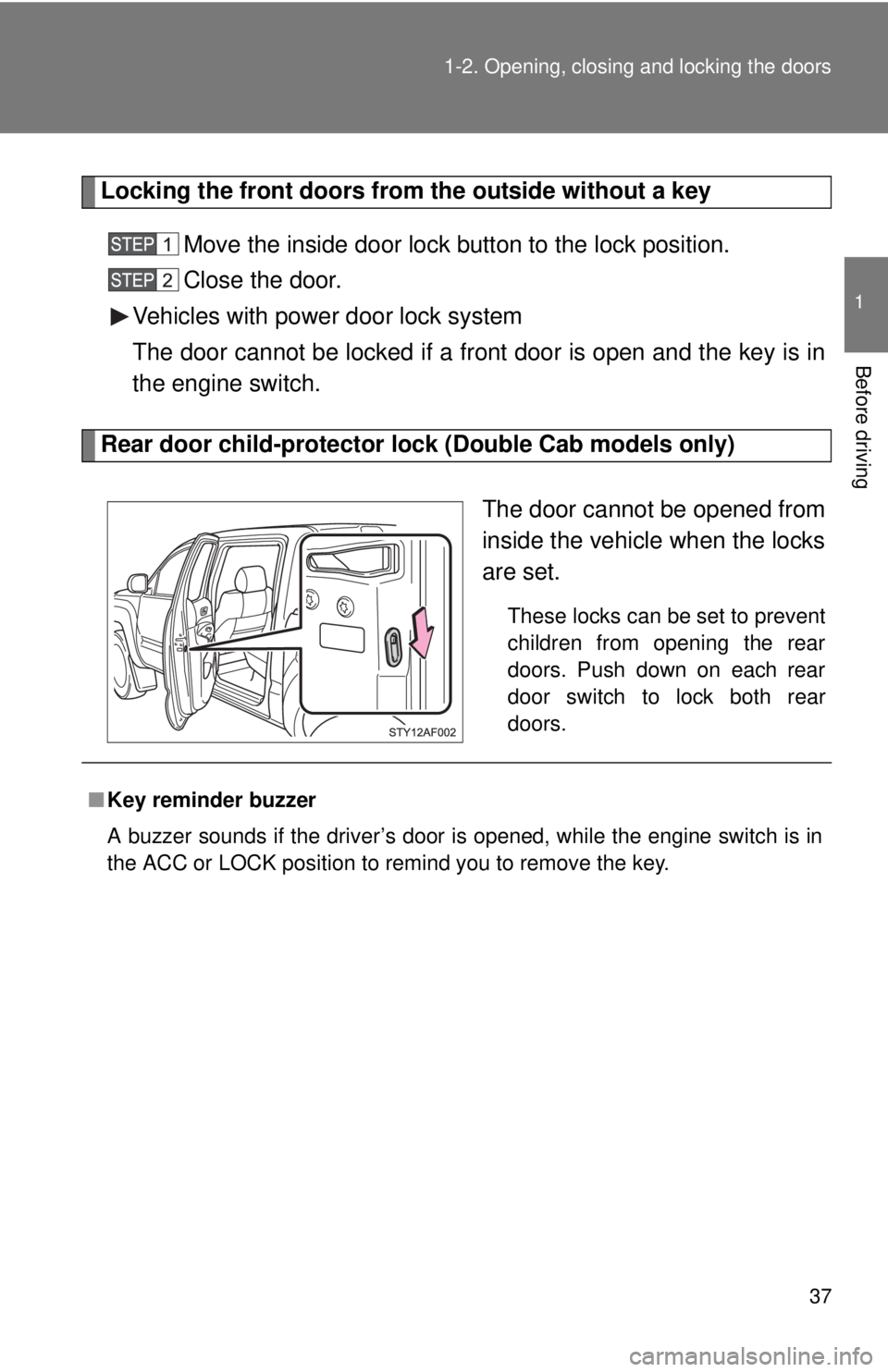
Rear door child-protector lock (Double Cab models only)
The door cannot be opened from
inside the vehicle when the locks
are set.
These locks can be set to prevent
children from opening the rear
doors. Push down on each rear
door switch to lock both rear
doors.
■Key reminder buzzer
A buzzer sounds if the driver’s door is opened, while the engine switch is in
the ACC or LOCK position to remind you to remove the key.
Page 38 of 548
38 1-2. Opening, closing and locking the doors
CAUTION
■To prevent an accident
Observe the following precautions while driving the vehicle.
Failing to do so may result in a door opening and an occupant falling out,
resulting in death or serious injury.
●Always use a seat belt.
● Always lock all doors.
● Ensure that all doors are properly closed.
● Do not pull the inside handle of the doors while driving.
The doors may be opened and the passengers are thrown out of the vehi-
cle and it may result in serious injury or death.
Be especially careful for the front doors, as the doors may be opened even
if the inside lock buttons are in locked position.
● Set the rear door child protector locks when children are seated in the rear
seat.
Page 60 of 548
60 1-3. Adjustable components (seats, mirrors, steering wheel)
■Emergency locking retractor (ELR)
The retractor will lock the belt during a sudden stop or on impact. It may also
lock if you lean forward too quickly. A slow, easy motion will allow the belt to
extend so that you can move around fully.
■ Automatic locking retractor (ALR)
When a passenger’s shoulder belt is completely extended and then
retracted even slightly, the belt is locked in that position and cannot be
extended. This feature is used to hold the child restraint system (CRS) firmly.
To free the belt again, fully retract the belt and then pull the belt out once
more. ( P. 1 1 1 )
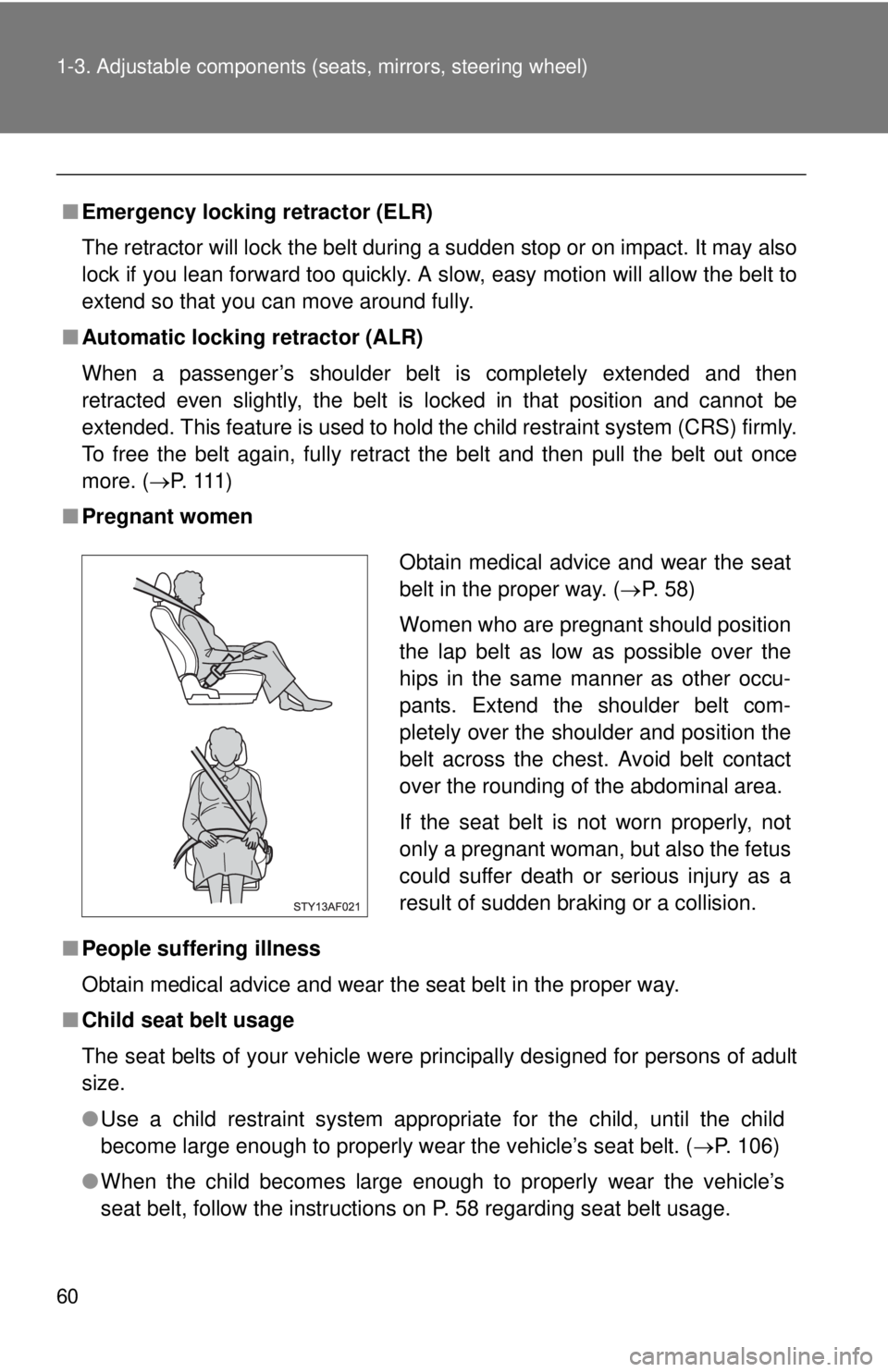
■ Pregnant women
■ People suffering illness
Obtain medical advice and wear the seat belt in the proper way.
■ Child seat belt usage
The seat belts of your vehicle were principally designed for persons of adult
size.
●Use a child restraint system appropriate for the child, until the child
become large enough to properly wear the vehicle’s seat belt. ( P. 106)
● When the child becomes large enough to properly wear the vehicle’s
seat belt, follow the instructions on P. 58 regarding seat belt usage.
Obtain medical advice and wear the seat
belt in the proper way. ( P. 58)
Women who are pregnant should position
the lap belt as low as possible over the
hips in the same manner as other occu-
pants. Extend the shoulder belt com-
pletely over the shoulder and position the
belt across the chest. Avoid belt contact
over the rounding of the abdominal area.
If the seat belt is not worn properly, not
only a pregnant woman, but also the fetus
could suffer death or serious injury as a
result of sudden braking or a collision.
Page 62 of 548
62 1-3. Adjustable components (seats, mirrors, steering wheel)
CAUTION
■Adjustable shoulder anchor
Always make sure the shoulder belt is positioned across the center of your
shoulder. The belt should be kept away from your neck, but not falling off
your shoulder. Failure to do so could reduce the amount of protection in an
accident and cause death or serious injuries in the event of a sudden stop,
sudden swerve or accident. ( P. 59)
■ Seat belt pretensioners
●Do not place anything, such as a cushion, on the front passenger’s seat.
Doing so will disperse the passenger’s weight, which prevents the sensor
from detecting the passenger’s weight properly. As a result, the seat belt
pretensioner for the front passenger’s seat may not activate in the event of
a collision.
● If the pretensioner has activated, the SRS warning light will come on. In
that case, the seat belt cannot be used again and must be replaced at
your Toyota dealer.
■ Child restraint lock function belt precaution
Do not allow children to play with the child restraint lock function belt. If the
belt becomes twisted around a child’s neck, it will not be possible to pull the
belt out leading to chocking or other serious injuries that could result in
death. If this occurs and the buckle cannot be unfastened, scissors should
be used to cut the belt.
■ Seat belt damage and wear
●Do not damage the seat belts by allowing the belt, plate, or buckle to be
jammed in the door.
● Inspect the seat belt system periodically. Check for cuts, fraying, and loose
parts. Do not use a damaged seat belt until it is replaced. Damaged seat
belts cannot protect an occupant from death or serious injury.
● Ensure that the belt and tab are locked and the belt is not twisted.
If the seat belt does not function correctly, immediately contact your Toyota
dealer.
● Replace the seat assembly, including the belts, if your vehicle has been
involved in a serious accident, even if there is no obvious damage.
Page 110 of 548
110 1-7. Safety information
CAUTION
■Child restraint precautions
●Bench type front seat: The driver and passengers sit on a bench seat in
this vehicle. Therefore, when installing a child restraint system, the seat
must be moved back from the SRS airbag as far as possible while also
maintaining the driver’s seating position. Otherwise, the force of the rapid
inflation of the airbag could cause death or serious injury to the child.
● Do not use the seat belt extender when installing a child restraint system
on the front or rear passenger seat. If installing a child restraint system
with the seat belt extender connected to the seat belt, the seat belt will not
securely hold the child restraint system, which could cause death or seri-
ous injury to the child or other passengers in the event of a sudden stop,
sudden swerve or an accident.
● Do not allow the child to lean his/her head or any part of his/her body
against the door or the area of the sea t, front and rear pillars or roof side
rail from which the side airbags or curtain shield airbags deploy even if the
child is seated in the child restraint system. It is dangerous if the side air-
bags and curtain shield airbags inflate, and the force of the rapid inflation
could cause death or serious injury to the child.
● Make sure you have complied with all installation instructions provided by
the child restraint manufacturer and that the system is properly secured. If
it is not secured properly, it may cause death or serious injury to the child
in the event of a sudden stop, sudden swerve or an accident.
■ Child restraint lock function belt precaution
Do not allow children to play with the child restraint lock function belt. If the
belt becomes twisted around a child’s neck, it will not be possible to pull the
belt out leading to choking or other serious injuries that could result in death.
If this occurs and the buckle cannot be unfastened, scissors should be used
to cut the belt.
■ When the child restrain t system is not in use
● Keep the child restraint system properly secured on the seat even if it is
not in use. Do not store the restraint unsecured in the passenger compart-
ment.
● If it is necessary to detach the child restraint system, remove it from the
vehicle. This will prevent it from injuring passengers in the event of a sud-
den stop, sudden swerve or an accident.
Page 112 of 548
112 1-7. Safety information
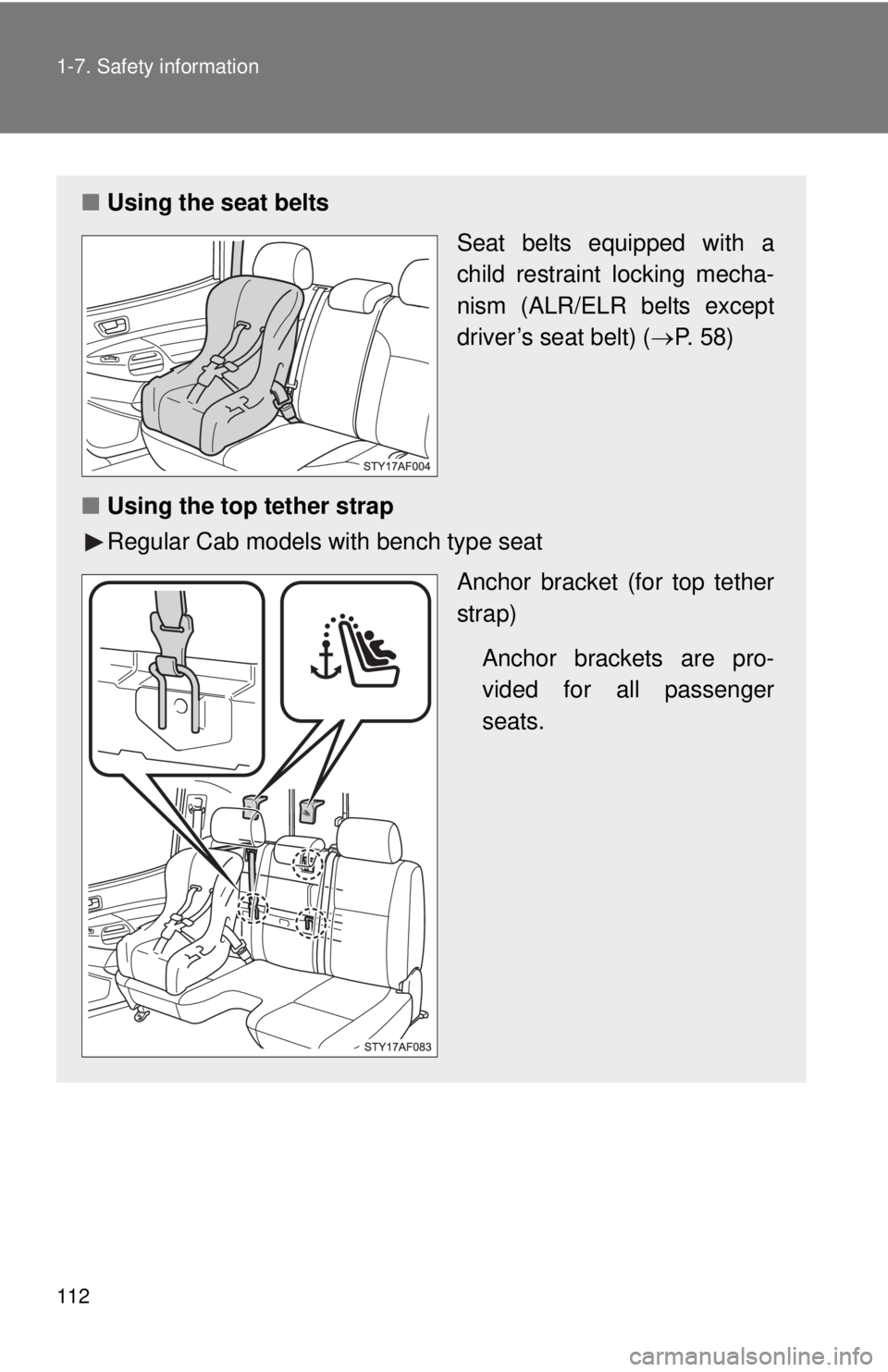
■Using the seat belts
Seat belts equipped with a
child restraint locking mecha-
nism (ALR/ELR belts except
driver’s seat belt) (P. 58)
■ Using the top tether strap
Regular Cab models with bench type seat
Anchor bracket (for top tether
strap)
Anchor brackets are pro-
vided for all passenger
seats.
Page 114 of 548
114 1-7. Safety information
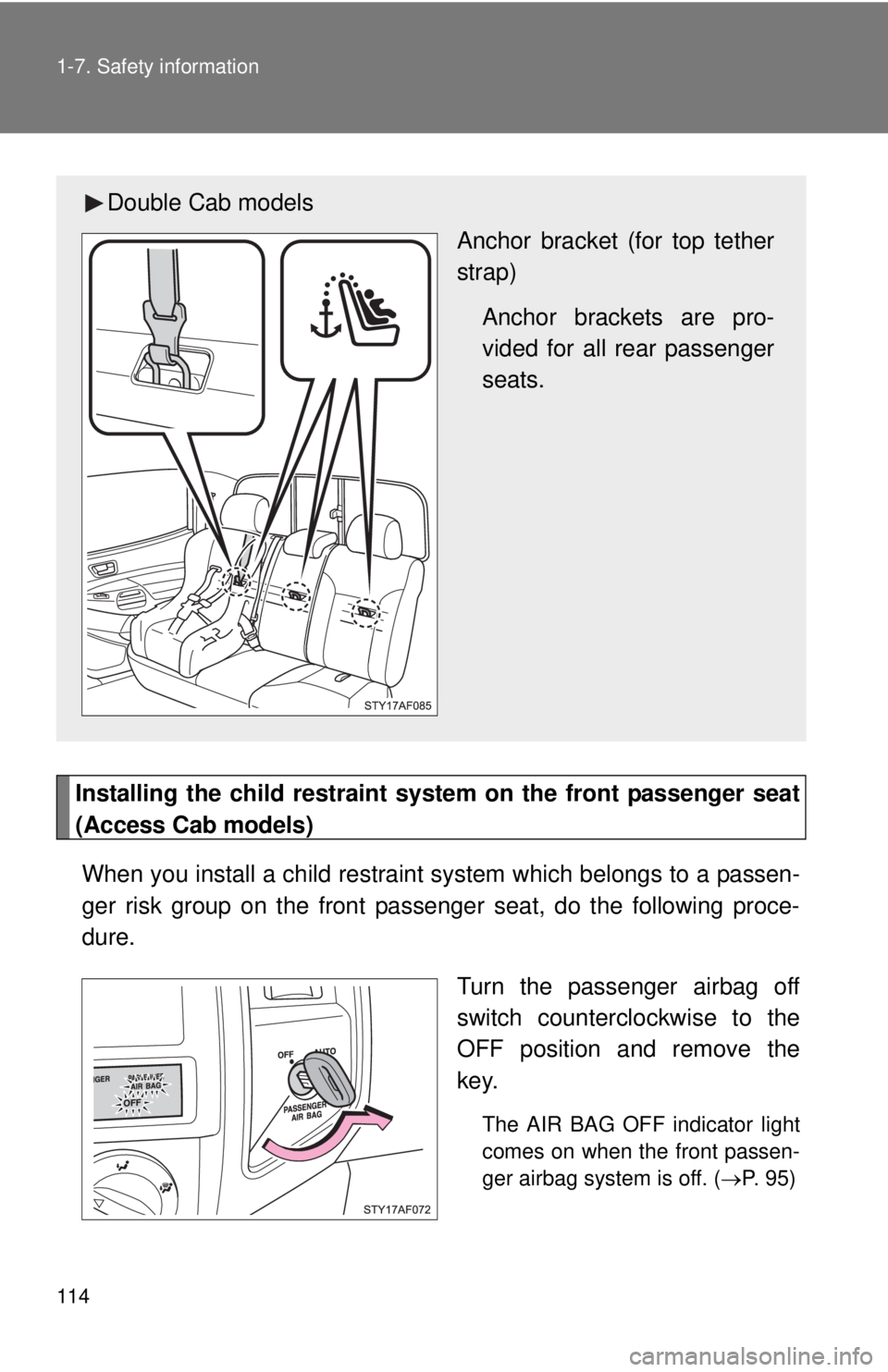
Installing the child restraint system on the front passenger seat
(Access Cab models)When you install a child restraint system which belongs to a passen-
ger risk group on the front passenger seat, do the following proce-
dure.
Turn the passenger airbag off
switch counterclockwise to the
OFF position and remove the
key.
The AIR BAG OFF indicator light
comes on when the front passen-
ger airbag system is off. (P. 95)
Double Cab models
Anchor bracket (for top tether
strap)
Anchor brackets are pro-
vided for all rear passenger
seats.
Page 115 of 548
115
1-7. Safety information
1
Before driving
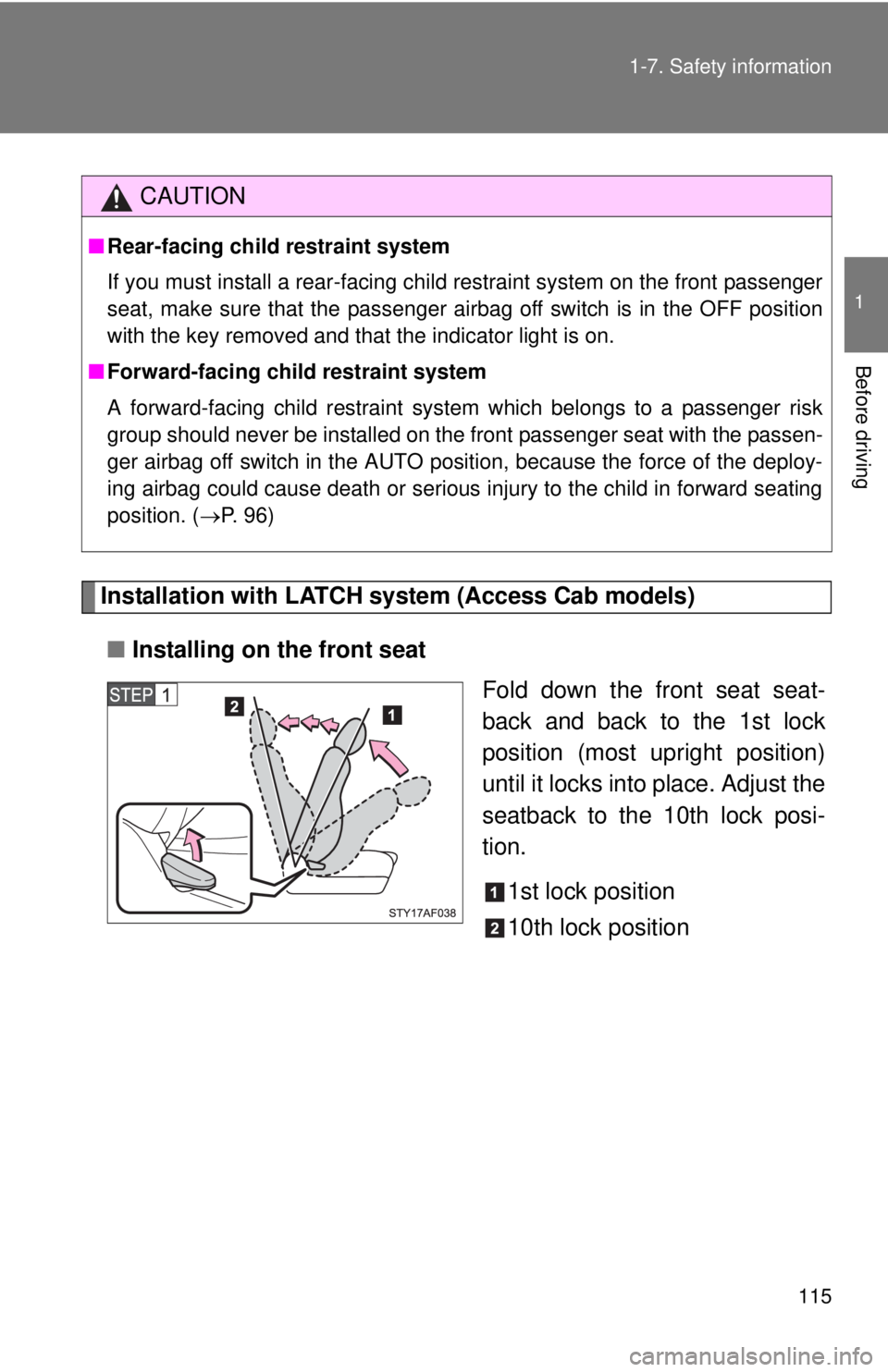
Installation with LATCH s
ystem (Access Cab models)
■ Installing on the front seat
Fold down the front seat seat-
back and back to the 1st lock
position (most upright position)
until it locks into place. Adjust the
seatback to the 10th lock posi-
tion.
1st lock position
10th lock position
CAUTION
■Rear-facing child restraint system
If you must install a rear-facing child restraint system on the front passenger
seat, make sure that the passenger airbag off switch is in the OFF position
with the key removed and that the indicator light is on.
■ Forward-facing child restraint system
A forward-facing child restraint system which belongs to a passenger risk
group should never be installed on the front passenger seat with the passen-
ger airbag off switch in the AUTO position, because the force of the deploy-
ing airbag could cause death or serious injury to the child in forward seating
position. ( P. 96)