tow TOYOTA TACOMA 2011 Owners Manual (in English)
[x] Cancel search | Manufacturer: TOYOTA, Model Year: 2011, Model line: TACOMA, Model: TOYOTA TACOMA 2011Pages: 548, PDF Size: 9.84 MB
Page 1 of 548

TABLE OF CONTENTS
1
1Before drivingAdjusting and operating features such as door locks,
mirrors, and steering column.
2When drivingDriving, stopping and safe-driving information.
3Interior and
exterior featuresAir conditioning and audio systems, as well as other in-
terior features for a comfortable driving experience.
4Maintenance
and careCleaning and protecting your vehicle, performing do-it-
yourself maintenance, and maintenance information.
5When trouble
arisesWhat to do if the vehicle needs to be towed, gets a flat
tire, or is involved in an accident.
6Vehicle
specificationsDetailed vehicle information.
7For owners
Reporting safety defects for U.S. owners, seat belt in-
structions for Canadian owners and camper informa-
tion.
IndexAlphabetical listing of information contained in this
manual.
Page 3 of 548

1
2
3
4
5
6
7
3
2-4. Using other driving systemsCruise control ...................... 170
Rear view monitor system (vehicles with auto
anti-glare inside rear view
mirror) ............................... 173
Four-wheel drive system ..... 177
Active traction control system .............................. 181
AUTO LSD system.............. 183
Rear differential lock system .............................. 185
Downhill Assist Control system .............................. 188
Clutch start cancel switch ... 190
Driving assist systems ........ 191
2-5. Driving information Off-road precautions (4WD models and
PreRunner) ....................... 197
Cargo and luggage ............. 202
Vehicle load limits ............... 207
Winter driving tips ............... 209
Trailer towing ...................... 213
Dinghy towing ..................... 233 3-1. Using the air conditioning
system and defogger
Air conditioning system ...... 236
3-2. Using the audio system Audio system types ............ 244
Using the radio ................... 247
Using the CD player ........... 253
Playing back MP3 and WMA discs ....................... 259
Optimal use of the audio system .............................. 267
Operating the sub woofer (on some Access Cab
models) ............................ 270
Using the AUX port............. 271
Using the steering wheel audio switches.................. 273
3-3. Using the hands-free phone system (for cellular phone)
Hands-free phone system (for cellular phone) ........... 276
Using the hands-free phone system ................... 280
Making a phone call ........... 288
Setting a cellular phone ...... 293
Security and system setup ................................ 298
Using the phone book ........ 301
3Interior and exterior
features
Page 5 of 548

1
2
3
4
5
6
7
5
5-1. Essential informationEmergency flashers ............ 430
If your vehicle needs to be towed ........................... 431
If you think something is wrong ............................ 437
Fuel pump shut off system .............................. 438
Event data recorder ............ 439
5-2. Steps to take in an emergency If a warning light turns on or a warning buzzer
sounds... ........................... 441
If you have a flat tire............ 450
If the engine will not start .... 468
If the shift lever cannot be shifted from P.................... 469
If you lose your keys ........... 470
If the vehicle battery is discharged ........................ 471
If your vehicle overheats ..... 475
If the vehicle becomes stuck ................................. 478
If your vehicle has to be stopped in
an emergency ................... 480 6-1. Specifications
Maintenance data (fuel, oil level, etc.) ........... 484
Fuel information.................. 504
Tire information .................. 507
6-2. Customization Customizable features........ 518
Items to initialize ................. 519
Reporting safety defects for U.S. owners ................ 522
Seat belt instructions for Canadian owners
(in French) ........................ 523
Camper information ............ 525
Abbreviation list ........................ 532
Alphabetical index .................... 534
What to do if... ........................... 544
5When trouble arises6Vehicle specifications
7For owners
Index
Page 33 of 548

33
1-2. Opening, closing and locking the doors
1
Before driving
■
Wireless remote control depletion
The standard battery life is 1 to 2 years. (The battery becomes depleted
even if the key is not used.) If the wireless remote control function does not
operate, the battery may be depleted. Replace the battery when necessary.
(P. 406)
■ If the wireless remote control does not operate
Locking and unlocking the doors: Use the key. ( P. 35)
■ Security feature
If a door is not opened within approximately 30 seconds after the vehicle is
unlocked, the security feature automatically locks the vehicle again.
■ Conditions affecting operation
The wireless remote control function may not operate normally in the follow-
ing situations.
●Near a TV tower, radio station, electr ic power plant, airport or other facil-
ity that generates strong radio waves
● When carrying a portable radio, cell ular phone or other wireless commu-
nication device
● When multiple wireless keys are in the vicinity
● When the wireless key has come into contact with, or is covered by a
metallic object
● When a wireless key (that emits radio waves) is being used nearby
● When the wireless key has been left near an electrical appliance such as
a personal computer
■ When riding in an aircraft
When bringing a wireless remote control onto an aircraft, make sure you do
not press any buttons on the wireless remote control while inside the aircraft
cabin. If you are carrying a wireless remote control in your bag etc, ensure
that the buttons are not likely to be pressed accidentally. Pressing a button
may cause the wireless remote control to emit radio waves that could inter-
fere with the operation of the aircraft.
■ Customization that can be co nfigured at Toyota dealer
Settings (e.g. wireless remote control system) can be changed.
(Customizable features P. 518)
Page 40 of 548
40
1-2. Opening, closing and locking the doors
Tailgate
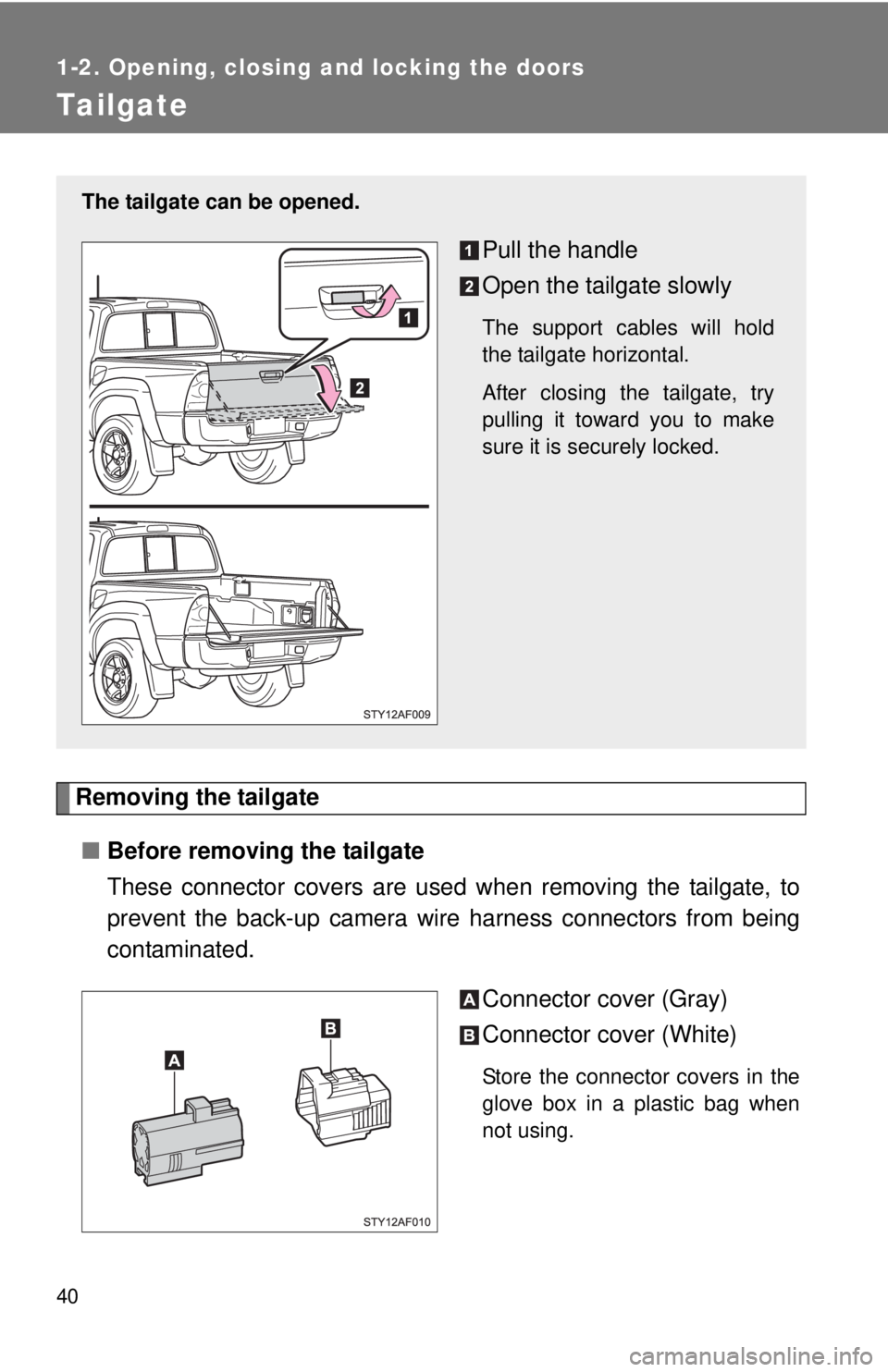
Removing the tailgate■ Before removing the tailgate
These connector covers are used when removing the tailgate, to
prevent the back-up camera wire harness connectors from being
contaminated.
Connector cover (Gray)
Connector cover (White)
Store the connector covers in the
glove box in a plastic bag when
not using.
The tailgate can be opened.
Pull the handle
Open the tailgate slowly
The support cables will hold
the tailgate horizontal.
After closing the tailgate, try
pulling it toward you to make
sure it is securely locked.
Page 44 of 548

44 1-2. Opening, closing and locking the doors
NOTICE
■To prevent damage to the tailgate wire harness
Do not pull out all of the tailgate wire harness before open the tailgate.
■ To prevent damage to the camera lens (vehicles with rear view monitor
system)
Store the removed tailgate with the back-up camera lens facing upward.
■ After closing the tailgate
Try pulling it toward you to make sure it is securely locked.
■ To prevent damage to the rear step bumper
Do not allow more than one person to get on the rear step bumper at a time.
Page 50 of 548
50
1-3. Adjustable components (seats, mirrors, steering wheel)
Rear seats (Access Cab and Double Cab models)
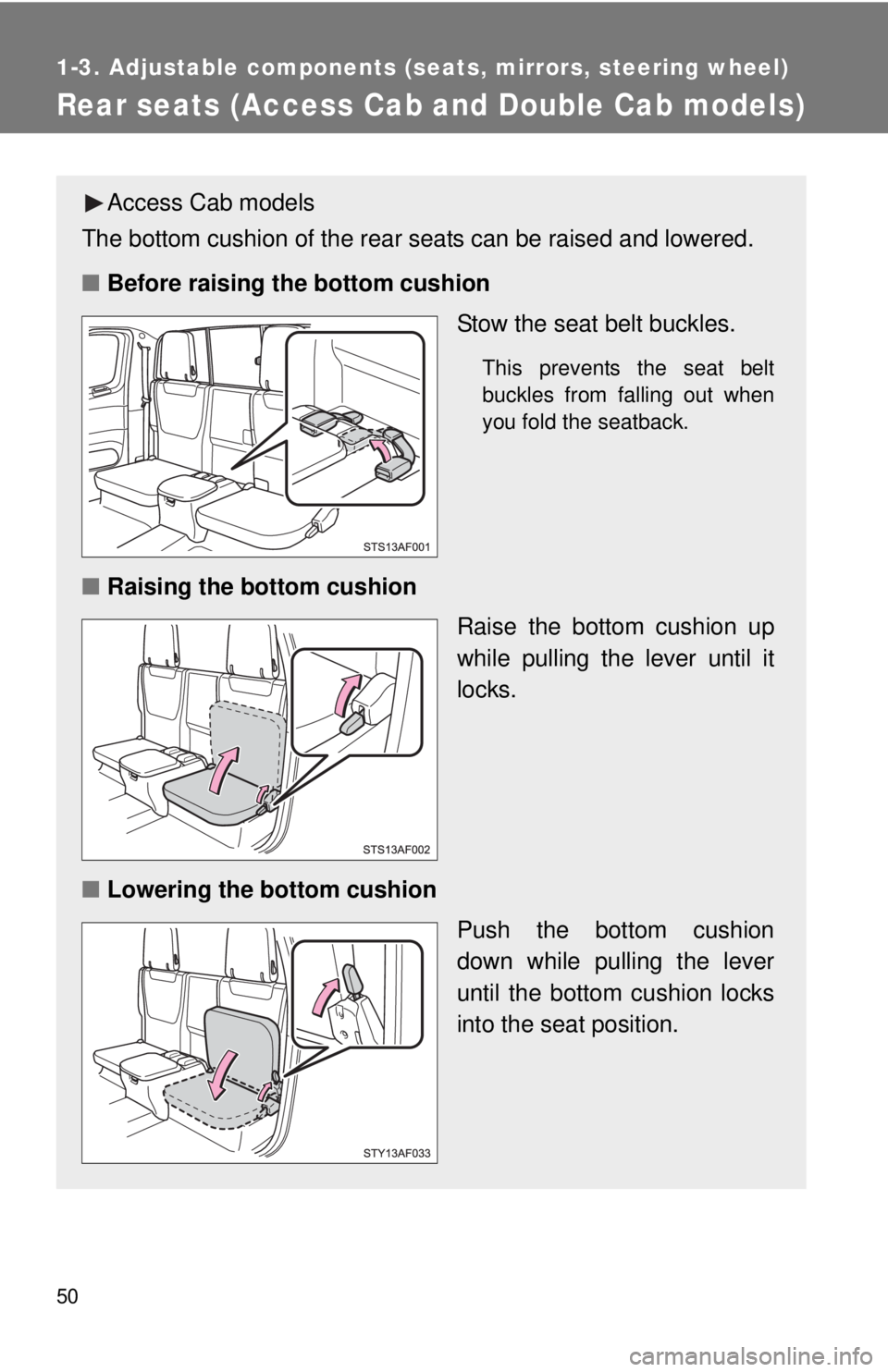
Access Cab models
The bottom cushion of the rear seats can be raised and lowered.
■ Before raising the bottom cushion
Stow the seat belt buckles.
This prevents the seat belt
buckles from falling out when
you fold the seatback.
■Raising the bottom cushion
Raise the bottom cushion up
while pulling the lever until it
locks.
■ Lowering the bottom cushion
Push the bottom cushion
down while pulling the lever
until the bottom cushion locks
into the seat position.
Page 51 of 548
51
1-3. Adjustable components (s
eats, mirrors, steering wheel)
1
Before driving
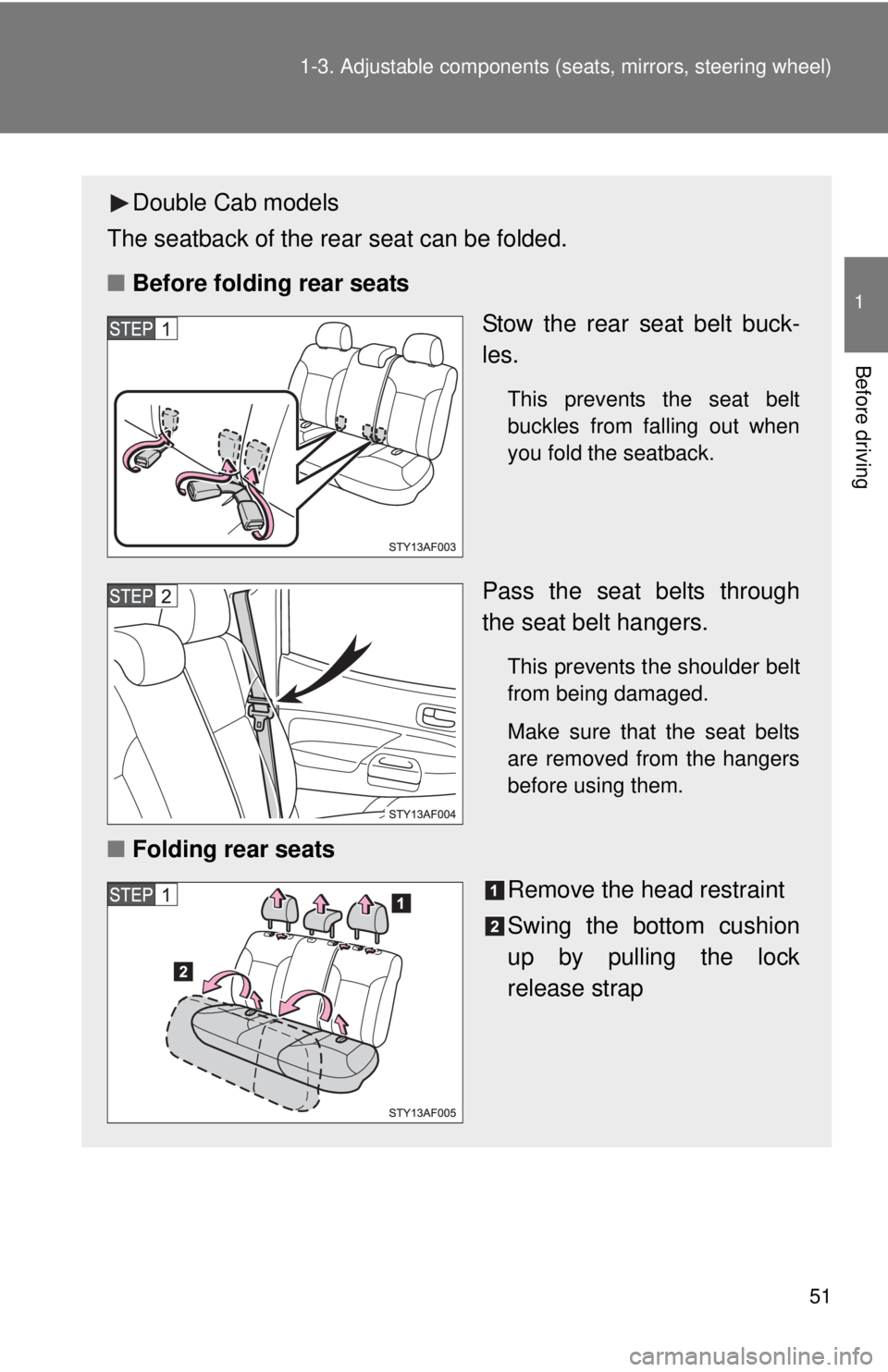
Double Cab models
The seatback of the rear seat can be folded.
■ Before folding rear seats
Stow the rear seat belt buck-
les.
This prevents the seat belt
buckles from falling out when
you fold the seatback.
Pass the seat belts through
the seat belt hangers.
This prevents the shoulder belt
from being damaged.
Make sure that the seat belts
are removed from the hangers
before using them.
■Folding rear seats
Remove the head restraint
Swing the bottom cushion
up by pulling the lock
release strap
Page 53 of 548

53
1-3. Adjustable components (s
eats, mirrors, steering wheel)
1
Before driving
NOTICE
■Before folding the seats
The seat belts buckles must be stowed.
Page 57 of 548
57
1-3. Adjustable components (s
eats, mirrors, steering wheel)
1
Before driving
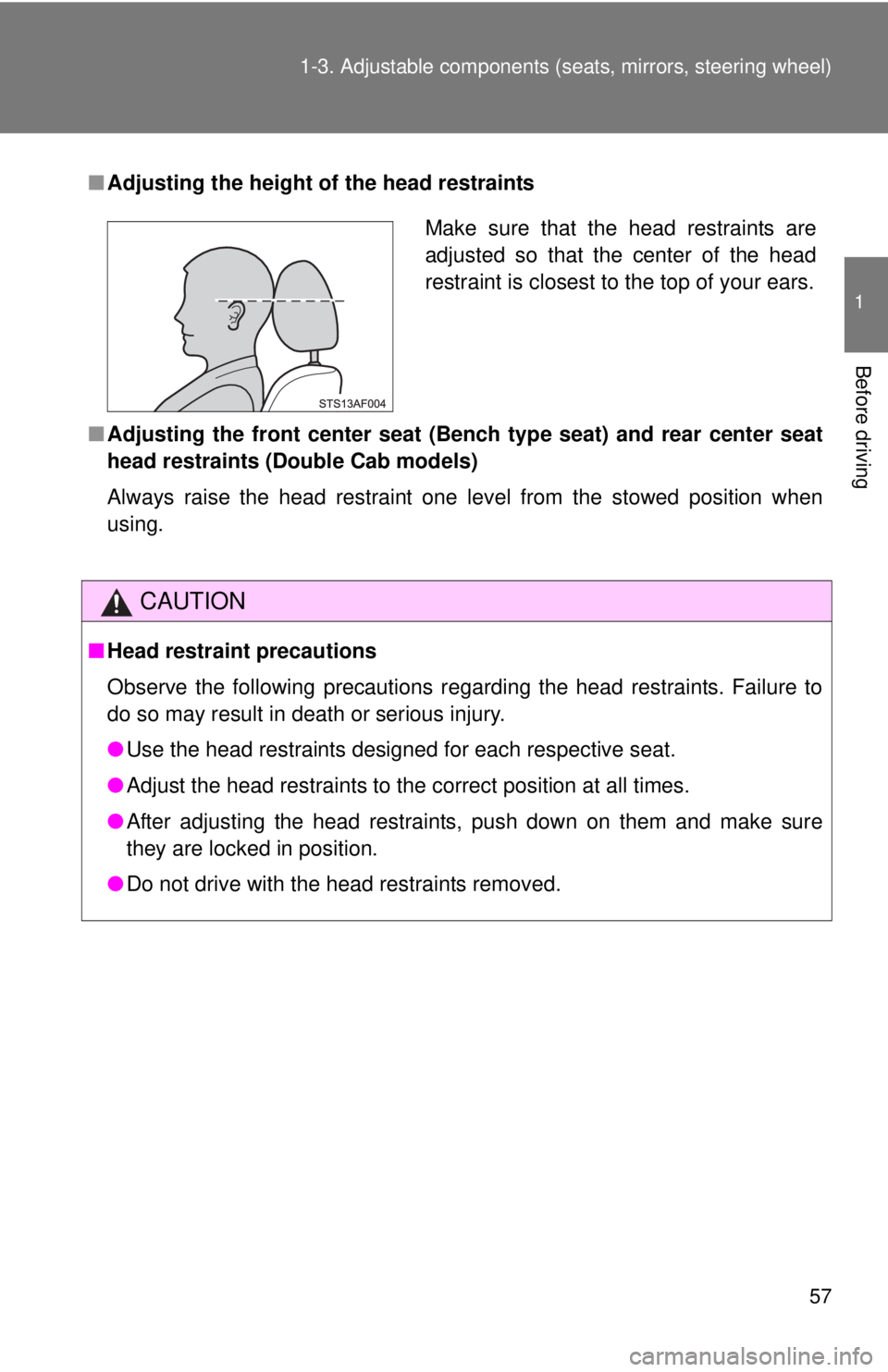
■Adjusting the height of the head restraints
■ Adjusting the front center seat (Ben ch type seat) and rear center seat
head restraints (Double Cab models)
Always raise the head restraint one level from the stowed position when
using.
CAUTION
■ Head restraint precautions
Observe the following precautions regarding the head restraints. Failure to
do so may result in death or serious injury.
●Use the head restraints designed for each respective seat.
● Adjust the head restraints to the correct position at all times.
● After adjusting the head restraints, push down on them and make sure
they are locked in position.
● Do not drive with the head restraints removed.
Make sure that the head restraints are
adjusted so that the center of the head
restraint is closest to the top of your ears.