tire pressure TOYOTA TACOMA 2020 Warranties & Maintenance Guides (in English)
[x] Cancel search | Manufacturer: TOYOTA, Model Year: 2020, Model line: TACOMA, Model: TOYOTA TACOMA 2020Pages: 260, PDF Size: 8.54 MB
Page 136 of 260
 MICHELIN
134
Tires loaded beyond their maximum allowable loads for the particular
application will build up excessive heat that may result in sudden tire \
failure and an accident. Do not exceed the")
MICHELIN
134
Tires loaded beyond their maximum allowable loads for the particular
application will build up excessive heat that may result in sudden tire \
failure and an accident. Do not exceed the gross axle weight rating for \
any axle on your vehicle.
Trailer Towing
If you anticipate towing a trailer, you should visit your Michelin tire
retailer for advice about the correct tire size and pressures. Tire size
and pressures will depend on the type and size of trailer and hitch
utilized, but in no case must the maximum cold inflation pressure
or tire load rating be exceeded. Check the tire information placard
that came on your vehicle, (located in the vehicle’s door jamb, inside
the fuel hatch, or on the glove compartment door) and the owner’s
manual supplied by the manufacturer of your vehicle for further
recommendations on trailer towing.
Self-Supporting Zero Pressure (ZP) Tires and Trailer Towing
Operation of ZP tires at low or zero air pressure with a trailer in tow
is dangerous and should be avoided. If the low pressure warning
indicator is activated when a trailer is in tow, stop, disconnect the
trailer, and do not continue to tow the trailer until the tire has been
properly repaired and re-inflated to the proper inflation. If the tire
cannot be properly repaired, it must be replaced with a new full-size,
matching ZP tire, and inflated to the proper inflation, before the trailer
can be safely towed again.
Wheel Alignment and Balancing Are Important for
Safety and Maximum Mileage from Your Tires.
Page 137 of 260
MICHELIN
135
Check How Your Tires Are Wearing at Least
Once Each Month
If your tires are wearing unevenly, such as the inside shoulder of the
tire wearing faster than the rest of the tread, or if you detect excessi\
ve
vibration, your vehicle may be out of alignment or balance. These
conditions not only shorten the life of your tires but adversely affect the
handling characteristics of your vehicle, which could be dangerous. If
you detect irregular wear or vibration, have your alignment and balance
checked immediately. Tires which have been run underinflated will
show more wear on the shoulders than in the center of the tread. Read
and follow the instructions on tire rotation and replacement below.
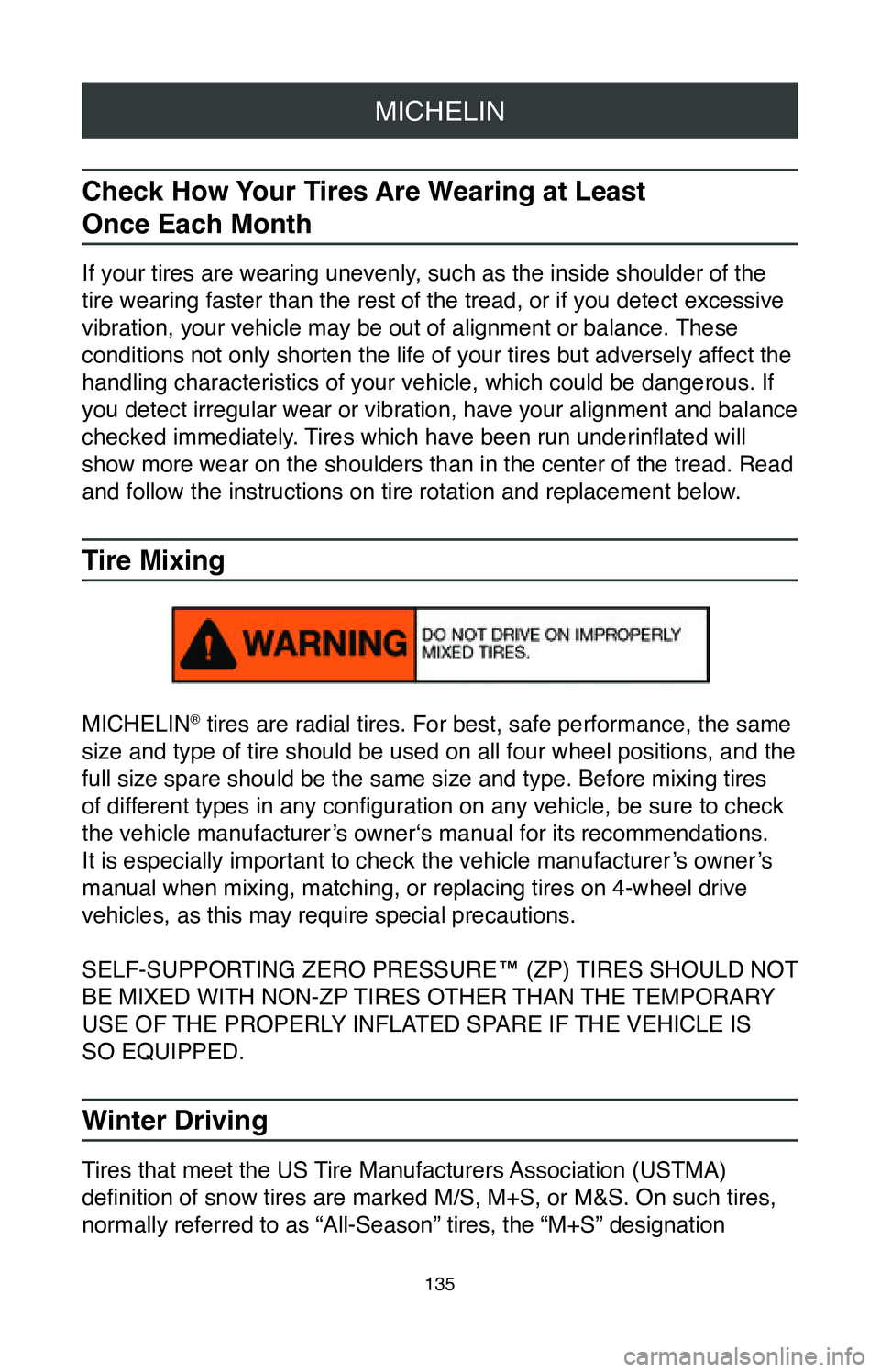
Tire Mixing
MICHELIN® tires are radial tires. For best, safe performance, the same
size and type of tire should be used on all four wheel positions, and th\
e
full size spare should be the same size and type. Before mixing tires
of different types in any configuration on any vehicle, be sure to check
the vehicle manufacturer’s owner‘s manual for its recommendations.
It is especially important to check the vehicle manufacturer’s owner’s
manual when mixing, matching, or replacing tires on 4-wheel drive
vehicles, as this may require special precautions.
SELF-SUPPORTING ZERO PRESSURE™ (ZP) TIRES SHOULD NOT
BE MIXED WITH NON-ZP TIRES OTHER THAN THE TEMPORARY
USE OF THE PROPERLY INFLATED SPARE IF THE VEHICLE IS
SO EQUIPPED.
Winter Driving
Tires that meet the US Tire Manufacturers Association (USTMA)
definition of snow tires are marked M/S, M+S, or M&S. On such tires,
normally referred to as “All-Season” tires, the “M+S” designation
Page 138 of 260
MICHELIN
136
is molded into the sidewall. Tires without this notation are not
recommended for winter driving in regions that experience
winter conditions.
Although All-Season tires are designed to provide reliable performance
in some winter conditions, the use of four winter tires is recommended
for optimal performance. Tires designated for use in severe winter
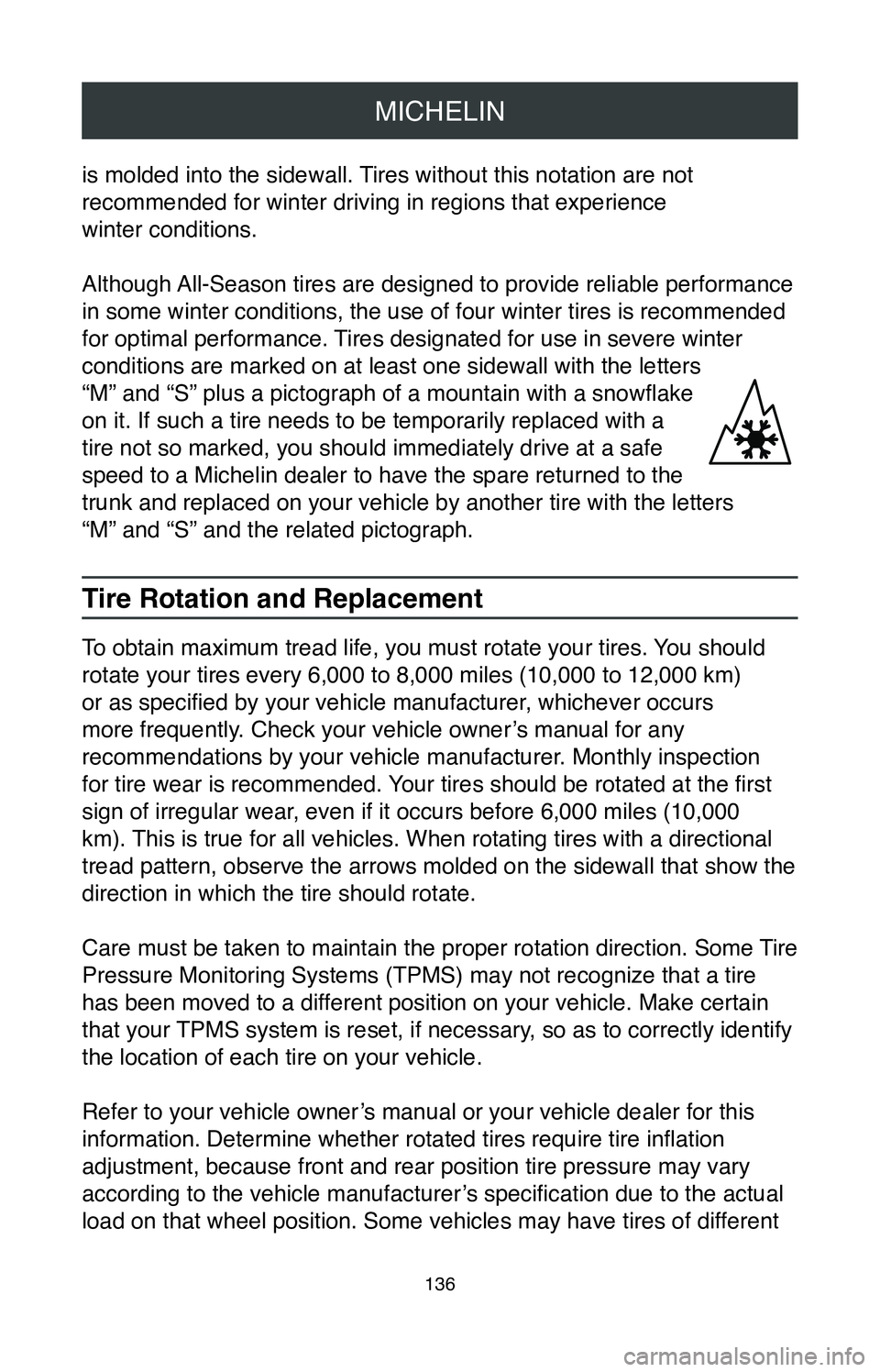
conditions are marked on at least one sidewall with the letters
“M” and “S” plus a pictograph of a mountain with a snowflake
on it. If such a tire needs to be temporarily replaced with a
tire not so marked, you should immediately drive at a safe
speed to a Michelin dealer to have the spare returned to the
trunk and replaced on your vehicle by another tire with the letters
“M” and “S” and the related pictograph.
Tire Rotation and Replacement
To obtain maximum tread life, you must rotate your tires. You should
rotate your tires every 6,000 to 8,000 miles (10,000 to 12,000 km)
or as specified by your vehicle manufacturer, whichever occurs
more frequently. Check your vehicle owner’s manual for any
recommendations by your vehicle manufacturer. Monthly inspection
for tire wear is recommended. Your tires should be rotated at the first
sign of irregular wear, even if it occurs before 6,000 miles (10,000
km). This is true for all vehicles. When rotating tires with a directional
tread pattern, observe the arrows molded on the sidewall that show the
direction in which the tire should rotate.
Care must be taken to maintain the proper rotation direction. Some Tire
Pressure Monitoring Systems (TPMS) may not recognize that a tire
has been moved to a different position on your vehicle. Make certain
that your TPMS system is reset, if necessary, so as to correctly identify
the location of each tire on your vehicle.
Refer to your vehicle owner’s manual or your vehicle dealer for this
information. Determine whether rotated tires require tire inflation
adjustment, because front and rear position tire pressure may vary
according to the vehicle manufacturer’s specification due to the actual
load on that wheel position. Some vehicles may have tires of different
Page 139 of 260
MICHELIN
137
size mounted on the front versus the rear axles, and these different
tires have rotation restrictions. Always check the vehicle owner’s
manual for the proper rotation recommendations.
Full-Size Spare
Full-size spare tires (not temporary spares) of the same size and
construction should be used in a five-tire rotation and should be
inspected by a tire professional during routine tire inspection. Always
have spare tires inspected before installation. Tires are composed
of various types of rubber compounds and other materials having
performance properties essential to the proper functioning of the tire. \
These component properties change over time. Always check the
inflation pressure of the full-size spare and look for any indication of
cracking or other damage immediately before incorporating the spare
into rotation. If you see any damage, or if the tire is underinflated, do
not resume driving with that tire unless you have no other option, in
which case you should drive only as slowly as is safely possible in the \
traffic conditions until you can both get the spare tire properly inflated
and have it checked by a tire professional to ensure that it is safe
to use. Follow the vehicle manufacturer’s recommended pattern for
rotation. If such a recommendation is unavailable, see a qualified
tire professional.
Replacement of Two Tires
All four tires should be replaced at the same time. However, if only
two tires are replaced, the new ones should be put on the rear.
Deeper tread tires on the rear axle provide better handling, wet grip
and evacuate water, thereby helping to avoid oversteer and loss of
vehicle stability on wet surfaces. Deeper tread tires on the front axle \
can improve wet straight line braking and stopping distance. If only
two tires are being replaced, Michelin generally recommends they be
installed on the rear axle in the absence of a tire service professional’ s
recommendation or consumer’s preference to the contrary.
Page 143 of 260
MICHELIN
141
have safety humps or ledges. Always utilize valve caps capable of
containing the tire’s inflation, should the valve core leak. The valve
cap is the primary seal against air loss. Each tire and wheel assembly
should be balanced to ensure proper tire and vehicle performance and
to maintain tire warranty coverage. Tires and wheel assemblies that
are not balanced may cause steering difficulties, a bumpy ride, and
irregular tire wear.
Special Mounting Instructions For Self-Supporting
Zero Pressure™ (ZP) Tires
ZP tires can be more difficult to mount than conventional tires. They
should be mounted and demounted only by a properly trained tire
professional. ZP tires can generate a tremendous amount of heat
when run at low or zero pressure. ALWAYS ALLOW A ZP TIRE TO
COOL BEFORE ATTEMPTING TO HANDLE IT. FAILURE TO DO
SO COULD RESULT IN INJURY OR DEATH. Michelin
® ZP tires are
tubeless tires designed to operate in emergency conditions at low or
zero air inflation.
MICHELIN® Self Supporting Zero Pressure™ (Zp) Tires
and Special Sh-M (Symmetric Hump-Modified) Wheels
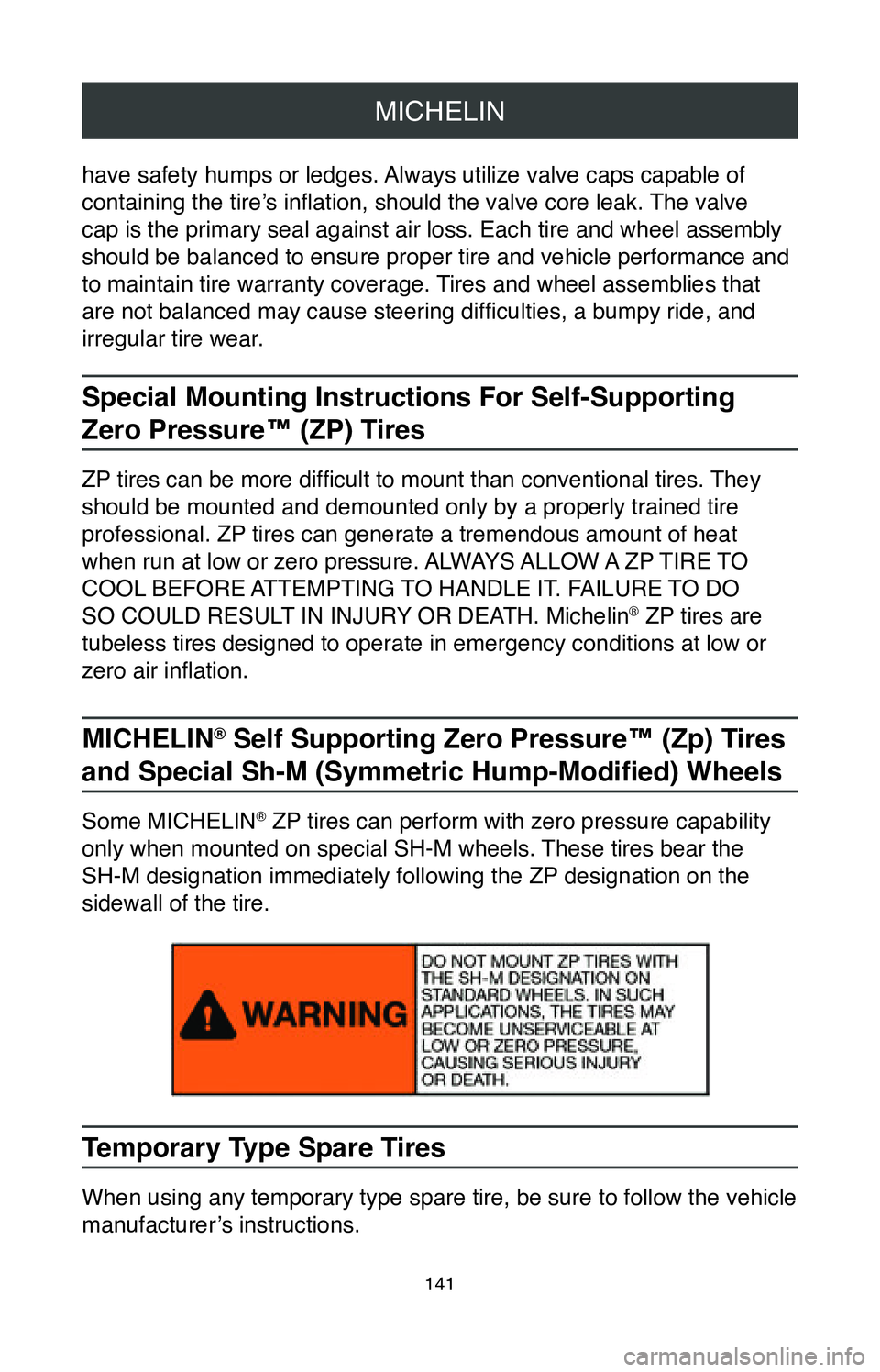
Some MICHELIN® ZP tires can perform with zero pressure capability
only when mounted on special SH-M wheels. These tires bear the
SH-M designation immediately following the ZP designation on the
sidewall of the tire.
Temporary Type Spare Tires
When using any temporary type spare tire, be sure to follow the vehicle \
manufacturer’s instructions.
Page 144 of 260
MICHELIN
142
Reading the Dot
DOT XXXX XXXX XXX (prior to August 2000)
DOT XXXX XXXX XXX
(1990-1999)
DOT XXXX XXXX XXXX (after July 2000)
The Dot
The “DOT” symbol certifies tire manufacturer’s compliance with U.S.
Department of Transportation tire safety standards. Next to the symbol
is the tire identification or “serial number.” The first two characters
identify the plant where the tire was manufactured. The next two
characters reflect the tire size. The following one to four digits may
be used at the tire manufacturer’s option as a descriptive code. The
last three characters are numbers identifying the week and year of
manufacture. (Example: “O25” means second week of the year of
decade, e.g.: 1995, 1985, etc.) For the 1990-1999 decade MICHELIN
®
brand tires are marked with a triangle pointing to the last three numeri\
c
characters. Tires produced after July 2000 have an additional digit
to identify a given decade. For example, 2800 means the tire was
produced during the 28th week of 2000; 0201 during the 2nd week
of 2001. If the last digits of your DOT number contain three numeric
characters and are not marked with a triangle, consult a qualified tire
professional to determine the year of manufacture.
Service Life for Passenger Car and Light Truck Tires
Including Spare Tires
Tires are composed of various types of material and rubber
compounds having performance properties essential to the proper
functioning of the tire itself. These component properties evolve over
time. For each tire, this evolution depends upon many factors such
as weather, storage conditions, and conditions of use (load, speed,
inflation pressure, maintenance etc.) to which the tire is subjected
throughout its life. This service-related evolution varies widely so that
accurately predicting the serviceable life of any specific tire in advance
is not possible. That is why, in addition to regular inspections and
inflation pressure maintenance by consumers, it is recommended
Page 145 of 260
MICHELIN
143
that passenger car and light truck tires, including spare tires be
inspected regularly by a qualified tire specialist, such as a Michelin
tire retailer, who will assess the tire’s suitability for continued service.
Tires which have been in use for 5 years or more should continue to
be inspected by a specialist at least annually. Consumers are strongly
encouraged to be aware not only of their tires’ visual condition and
inflation pressure but also of any change in dynamic performance such
as increased air loss, noise or vibration, which could be an indication \
that the tires need to be removed from service to prevent tire failure. \
It
is impossible to predict when tires should be replaced based on their
calendar age alone. However, the older a tire, the greater the chance
that it will need to be replaced due to the service-related evolution or
other conditions found upon inspection or detected during use. While
most tires will need replacement before they achieve 10 years, it is
recommended that any tires in service 10 years or more from the date
of manufacture, including spare tires, be replaced with new tires as
a precaution even if such tires appear serviceable and even if they
have not reached the legal wear limit. For tires that were on an origina\
l
equipment vehicle (i.e., acquired by the consumer on a new vehicle),
follow the vehicle manufacturer’s tire replacement recommendations,
when specified (but not to exceed 10 years). The date when a tire
was manufactured is located on the sidewall of each tire. Consumers
should locate the Department of Transportation or “DOT” code on the
tire. The code begins with “DOT” and ends with the week and year of
manufacture. For example, a DOT code ending with “2214” indicates a
tire made in the 22nd week of 2014.
Remember . . . to Avoid Damage to Your Tires and a
Possible Accident
• INSPECT TIRES AT LEAST MONTHLY, AND IMMEDIATELY
AFTER STRIKING ANY ROAD HAZARD.
•
CHECK TIRE PRESSURE AT LEAST ONCE EACH MONTH
WHEN TIRES ARE COLD AND BEFORE EVERY LONG TRIP.
•
NEVER UNDERINFLATE OR OVERINFLATE A TIRE.
•
NEVER OVERLOAD YOUR VEHICLE AND TIRES.
•
ALWAYS OBEY LEGAL SPEED LIMITS AND DRIVE AT A
Page 149 of 260
NITTO TIRE
147
WHAT IS NOT COVERED?
This Limited Warranty does not cover the following categories
of claims:
Rapid Treadwear: Original equipment tires are not guaranteed to last a
specified number of miles.
Damage from road hazards (not limited to cuts, snags, bruises, impact
breaks, bulges, punctures, stone drills, chips, and scales), fire, theft,
or collision.
Conditions arising from improper tire/vehicle maintenance or use, not
limited to:
•
Irregular or excessive treadwear due to: Incorrect inflation;
overloading; vehicle misalignment; failure to rotate tires; and poor
or defective mechanical condition of brakes, shocks, and wheels;
or other factors attributable to the vehicle or wheel.
•
Any tire which has been run with low air pressure or while flat.
•
Damage due to abuse; vandalism; tire alteration; tire spinning;
racing; or other competitive activities.
•
Damage, corrosion, or deterioration from using oil-based
chemicals, water-based sealers, balancing substances, or
flammable gases.
•
Damage from improper use of tire chains.
Tires with the DOT identification number removed or rendered illegible.
Improper mounting, balancing or repair, not limited to: •
Improper tire mounting, or tire/wheel assembly imbalance.
•
Damage from incorrect mounting or dismounting of the tire,
incorrect wheel size, water or other material trapped inside the tire
during mounting, or failure to keep the tires balanced.
•
Damage resulting from improper repair materials or procedures.
Page 154 of 260
NITTO TIRE
152
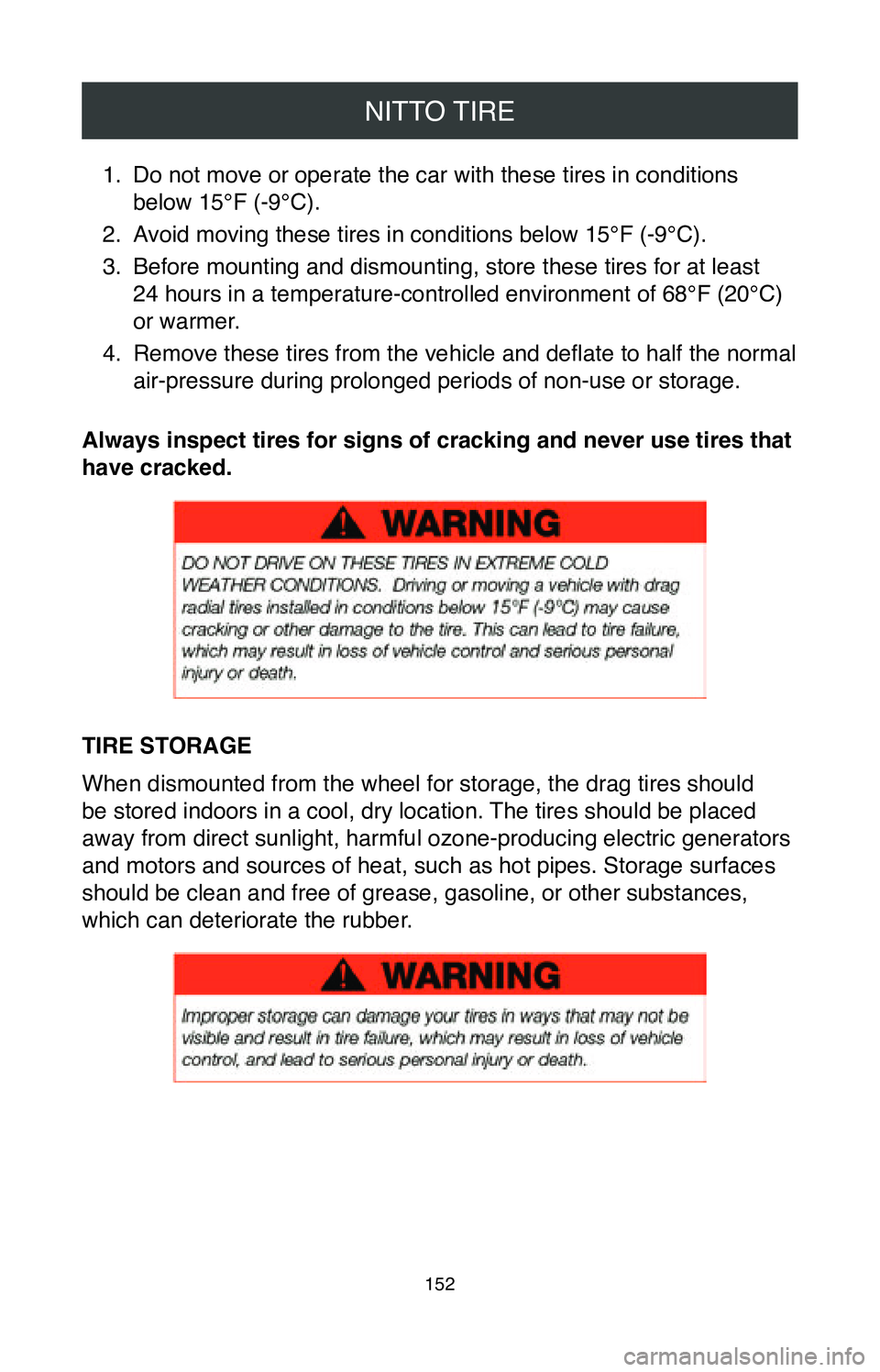
1. Do not move or operate the car with these tires in conditions
below 15°F (-9°C).
2.
Avoid moving these tires in conditions below 15°F (-9°C).
3.
Before mounting and dismounting, store these tires for at least
24 hours in a temperature-controlled environment of 68°F (20°C)
or warmer.
4.
Remove these tires from the vehicle and deflate to half the normal
air-pressure during prolonged periods of non-use or storage.
Always inspect tires for signs of cracking and never use tires that
have cracked.
TIRE STORAGE
When dismounted from the wheel for storage, the drag tires should
be stored indoors in a cool, dry location. The tires should be placed
away from direct sunlight, harmful ozone-producing electric generators
and motors and sources of heat, such as hot pipes. Storage surfaces
should be clean and free of grease, gasoline, or other substances,
which can deteriorate the rubber.
Page 155 of 260
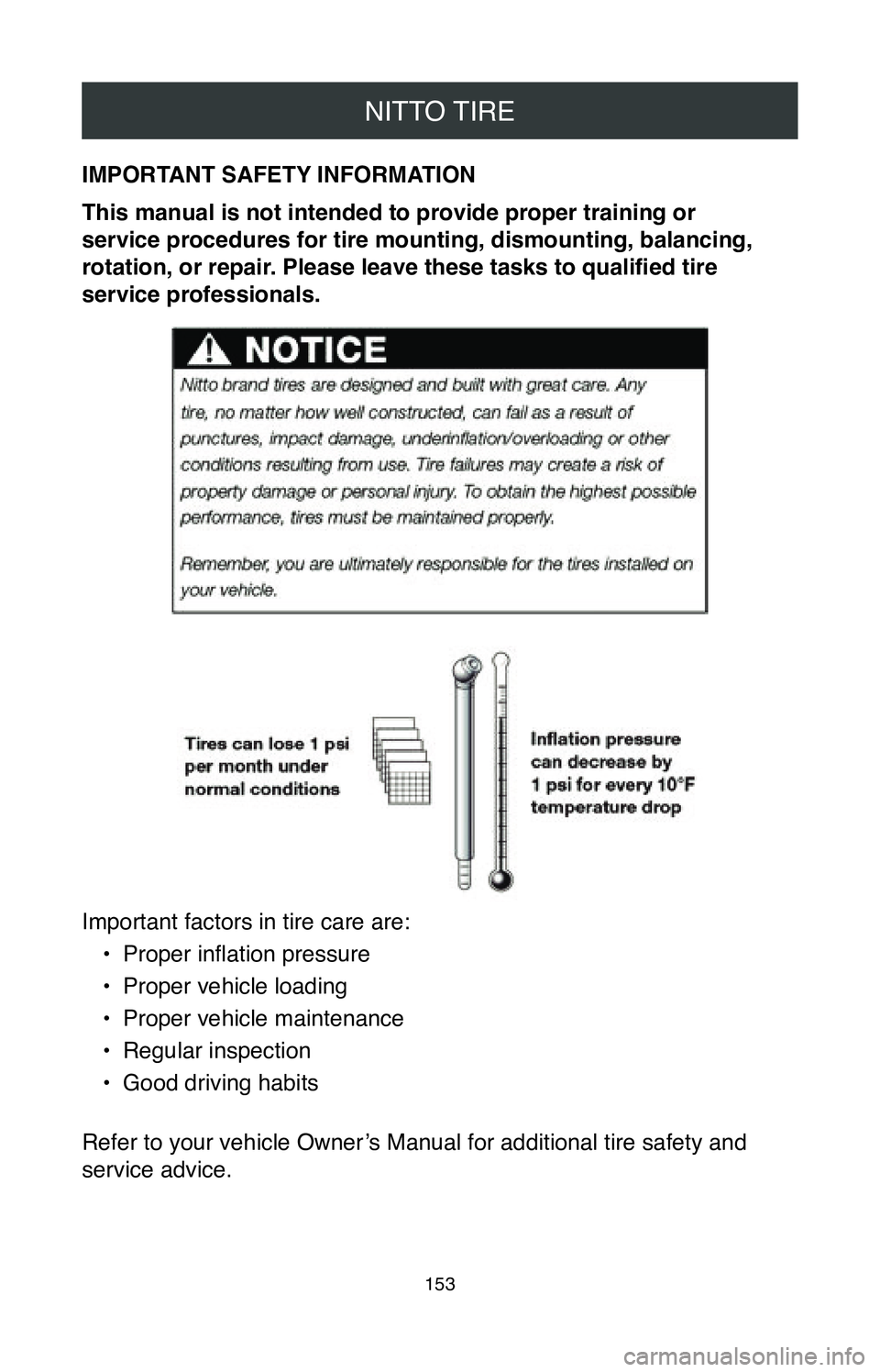
NITTO TIRE
153
IMPORTANT SAFETY INFORMATION
This manual is not intended to provide proper training or
service procedures for tire mounting, dismounting, balancing,
rotation, or repair. Please leave these tasks to qualified tire
service professionals.
Important factors in tire care are:•
Proper inflation pressure
•
Proper vehicle loading
•
Proper vehicle maintenance
•
Regular inspection
•
Good driving habits
Refer to your vehicle Owner’s Manual for additional tire safety and
service advice.