brake light TOYOTA VENZA HYBRID 2022 Owners Manual
[x] Cancel search | Manufacturer: TOYOTA, Model Year: 2022, Model line: VENZA HYBRID, Model: TOYOTA VENZA HYBRID 2022Pages: 548, PDF Size: 17.93 MB
Page 3 of 548
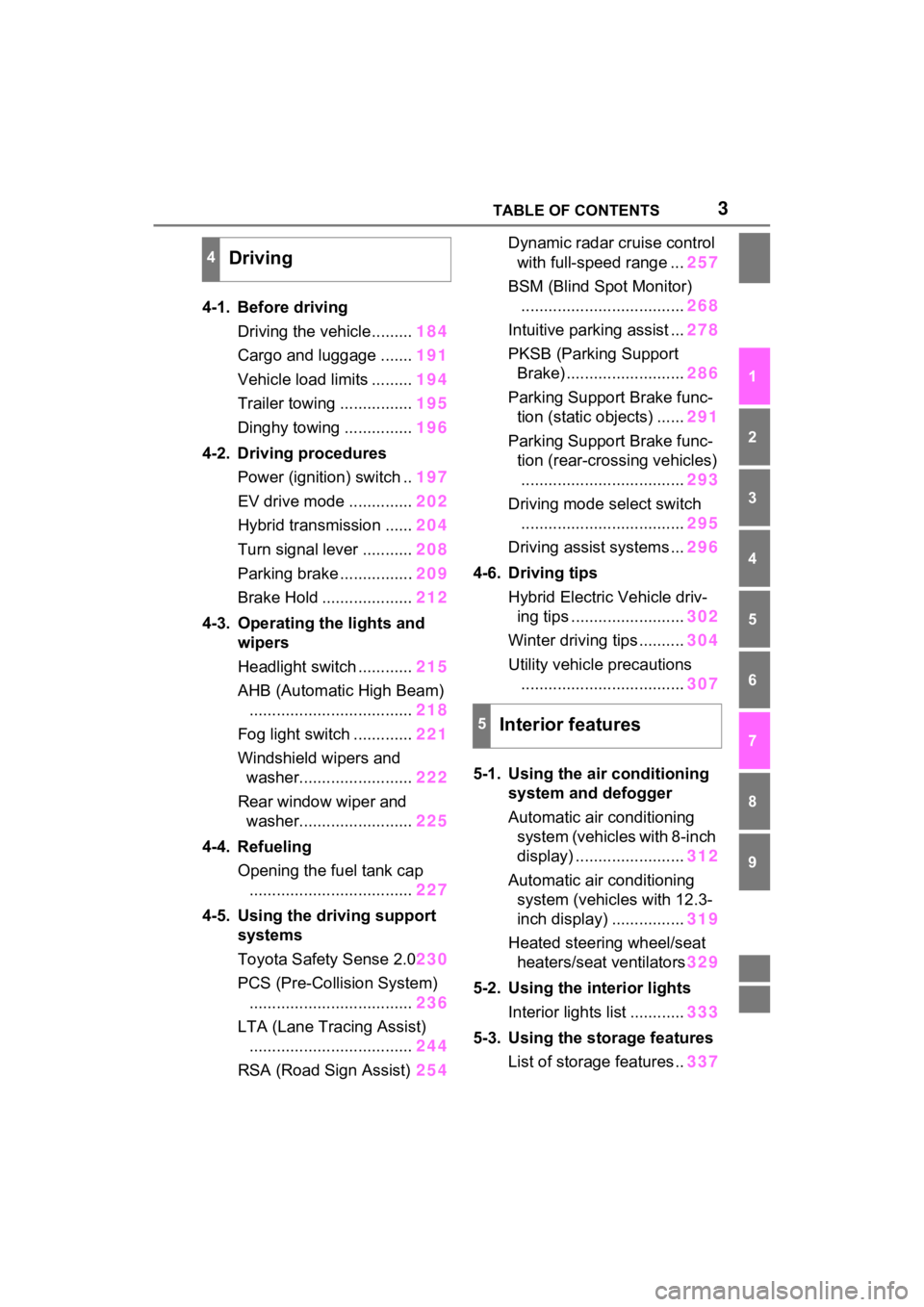
3TABLE OF CONTENTS
1
2
3
4
5
6
7
8
9
4-1. Before drivingDriving the vehicle......... 184
Cargo and luggage ....... 191
Vehicle load limits ......... 194
Trailer towing ................ 195
Dinghy towing ............... 196
4-2. Driving procedures Power (ignition) switch .. 197
EV drive mode .............. 202
Hybrid transmission ...... 204
Turn signal lever ........... 208
Parking brake ................ 209
Brake Hold .................... 212
4-3. Operating the lights and wipers
Headlight switch ............ 215
AHB (Automatic High Beam) .................................... 218
Fog light switch ............. 221
Windshield wipers and washer......................... 222
Rear window wiper and washer......................... 225
4-4. Refueling Opening the fuel tank cap.................................... 227
4-5. Using the driving support
systems
Toyota Safety Sense 2.0 230
PCS (Pre-Collision System) .................................... 236
LTA (Lane Tracing Assist) .................................... 244
RSA (Road Sign Assist) 254Dynamic radar cruise control
with full-speed range ... 257
BSM (Blind Spot Monitor) .................................... 268
Intuitive parking assist ... 278
PKSB (Parking Support Brake) .......................... 286
Parking Support Brake func- tion (static objects) ...... 291
Parking Support Brake func- tion (rear-crossing vehicles).................................... 293
Driving mode s elect switch
.................................... 295
Driving assist systems ... 296
4-6. Driving tips Hybrid Electric Vehicle driv-ing tips ......................... 302
Winter driving tips .......... 304
Utility vehicle precautions .................................... 307
5-1. Using the ai r conditioning
system and defogger
Automatic air conditioning system (vehicles with 8-inch
display) ........................ 312
Automatic air conditioning system (vehicl es with 12.3-
inch display) ................ 31
9
Heated stee
ring wheel/seat
heaters/seat ventilators 329
5-2. Using the interior lights Interior lights list ............ 333
5-3. Using the storage features List of storage features .. 337
4Driving
5Interior features
Page 35 of 548

351-1. For safe use
1
For safety and security
Front passenger occupant classification sensors
Knee airbag
SRS warning light
Airbag sensor assembly
Your vehicle is equipped with ADVANCED AIRBAGS designed
based on the US motor vehicle safety standards (FMVSS208). The
airbag sensor assembly (ECU) cont rols airbag deployment based on
information obtained from the sensors etc. shown in the system
components diagram above. This in formation includes crash sever-
ity and occupant information. As the airbags deploy, a chemical
reaction in the inflators quickly fills the airbags with non-toxic gas to
help restrain the motion of the occupants.
■If the SRS airbags deploy
(inflate)
●Slight abrasions, burns, bruising
etc., may be sustained from SRS
airbags, due to the extremely high
speed deployment (inflation) by
hot gases.
●A loud noise and white powder will
be emitted.
●Parts of the airbag module (steer-
ing wheel hub, airbag cover and
inflator) as well as the front seats,
parts of the front and rear pillars,
and roof side rails, may be hot for
several minutes. T he airbag itself
may also be hot.
●The windshield may crack.
●The hybrid system will be stopped
and fuel supply to the engine will
be stopped. ( P.78)
●All of the doors will be unlocked.
( P.134)
●The brakes and st op lights will be
controlled automatically.
( P.297)
●The interior lights will turn on auto-
matically. ( P.334)
●The emergency flashers will turn
on automatically. ( P.430)
●For Safety Connect subscribers, if any of the following situations
occur, the system is designed to
send an emergency call to the
response center, notifying them of
the vehicle’s location (without
needing to push the “SOS” button)
and an agent will attempt to speak
with the occupants to ascertain
the level of emergency and assis-
tance required. If the occupants
are unable to communicate, the
agent automatically treats the call
as an emergency and helps to dis-
patch the necessary emergency
services. (
P.65)
• An SRS airbag is deployed.
• A seat belt pretensioner is acti- vated.
• The vehicle is involved in a severe rear-end collision.
■SRS airbag deployment condi-
tions (SRS front airbags)
●The SRS front airbags will deploy
in the event of an impact that
exceeds the set threshold level
(the level of forc e corresponding
to an approximately 12 - 18 mph
[20 - 30 km/h] frontal collision with
a fixed wall that does not move or
deform).
However, this threshold velocity will
be considerably higher in the follow-
ing situations:
N
O
P
Q
Page 75 of 548
751-4. Hybrid system
1
For safety and security
■Running out of fuel
When the vehicle has run out of fuel
and the hybrid system cannot be
started, refuel th e vehicle with at
least enough gasoline to make the
low fuel level warning light ( P.444)
go off. If there is only a small
amount of fuel, th e hybrid system
may not be able to start. (The stan-
dard amount of fuel is about 2.3 gal.
[8.8 L, 1.9 Imp.gal.], when the vehi-
cle is on a level su rface. This value
may vary when the vehicle is on a
slope. Add extra fuel when the vehi-
cle is inclined.)
■Electromagnetic waves
●High voltage parts and cables on
Hybrid Electric Vehicles incorpo-
rate electromagnetic shielding,
and therefore emi t approximately
the same amount of electromag-
netic waves as conventional gaso-
line powered vehicles or home
electronic appliances.
●Your vehicle may cause sound
interference in so me third party-
produced radio parts.
■Hybrid battery (tr action battery)
The hybrid battery (traction battery)
has a limited service life. The lifes-
pan of the hybrid battery (traction
battery) can change in accordance
with driving style and driving condi-
tions.
■Starting the hybrid system in an
extremely cold environment
When the hybrid battery (traction
battery) is extremely cold (below
approximately -22°F [-30°C]) under
the influence of t he outside tem-
perature, it may no t be possible to
start the hybrid system. In this case,
try to start the hybrid system again
after the temperature of the hybrid
battery increases due to the outside
temperature increase etc.
WARNING
■High voltage precautions
This vehicle has high voltage DC
and AC systems as well as a 12-
volt system. DC and AC high volt-
age is very dangerous and can
cause severe burns and electric
shock that may result in death or
serious injury.
●Never touch, disassemble,
remove or replace the high volt-
age parts, cables or their con-
nectors.
●The hybrid system will become
hot after starting as the system
uses high voltage. Be careful of
both the high voltage and the
high temperature, and always
obey the warning labels
attached to the vehicle.
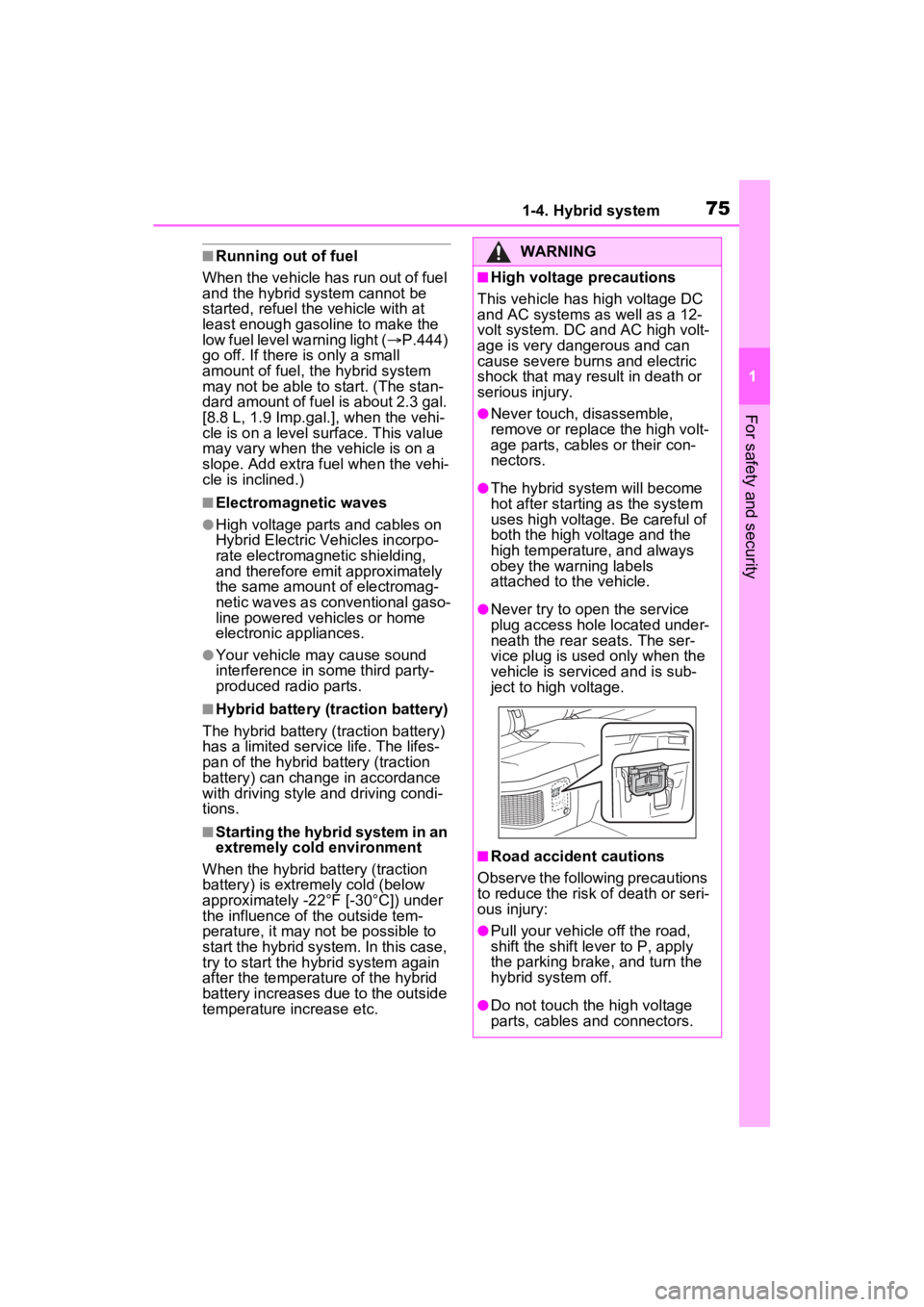
●Never try to open the service
plug access hole located under-
neath the rear seats. The ser-
vice plug is used only when the
vehicle is serviced and is sub-
ject to high voltage.
■Road accident cautions
Observe the following precautions
to reduce the risk of death or seri-
ous injury:
●Pull your vehicle off the road,
shift the shift le ver to P, apply
the parking brake, and turn the
hybrid system off.
●Do not touch the high voltage
parts, cables and connectors.
Page 85 of 548
852-1. Instrument cluster
2
Vehicle status information and indicators
The units used on the meters and some indicators may differ depending on
the target region.
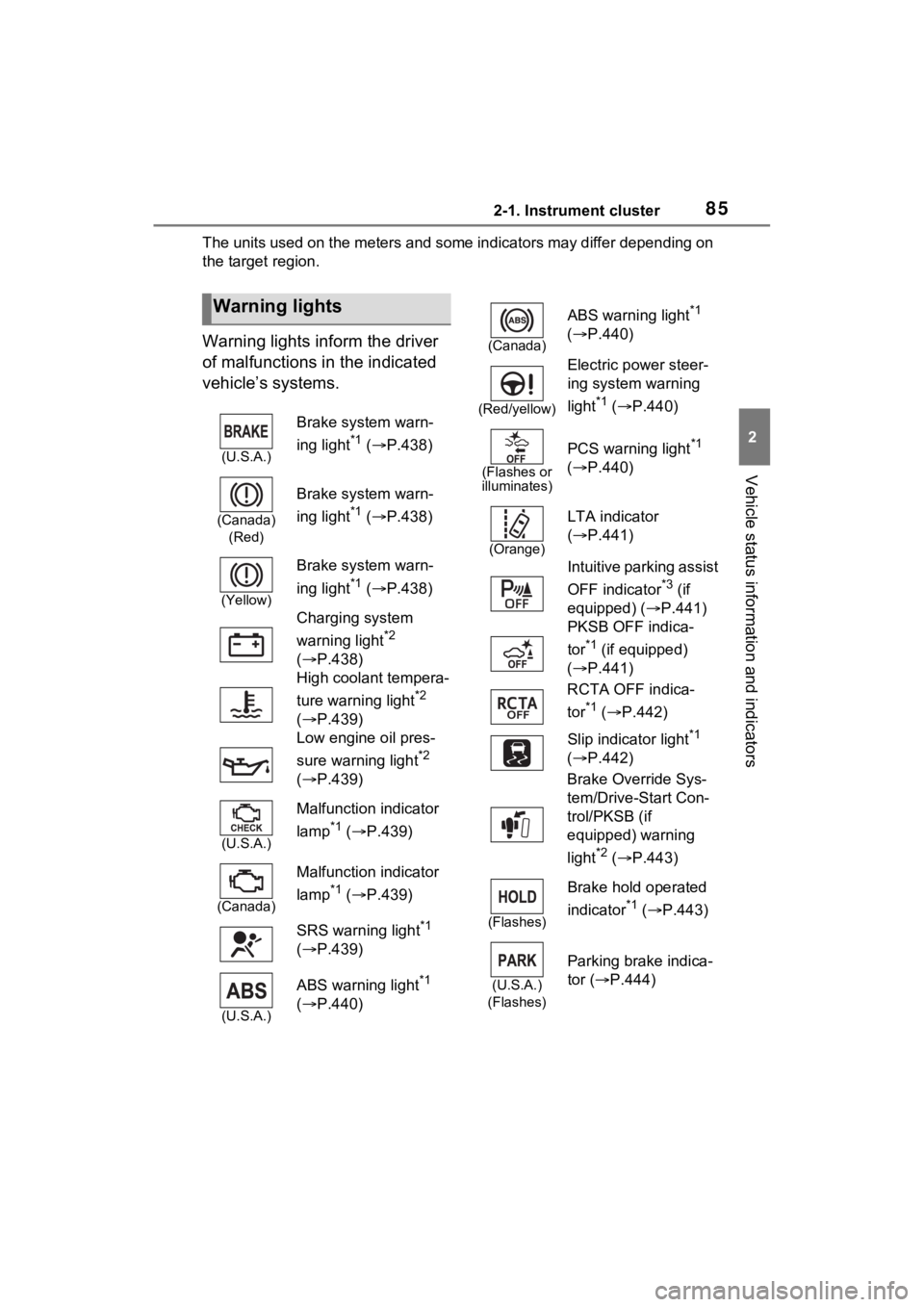
Warning lights inform the driver
of malfunctions in the indicated
vehicle’s systems.
Warning lights
(U.S.A.)
Brake system warn-
ing light
*1 ( P.438)
(Canada)
(Red)
Brake system warn-
ing light
*1 ( P.438)
(Yellow)
Brake system warn-
ing light
*1 ( P.438)
Charging system
warning light
*2
( P.438)
High coolant tempera-
ture warning light
*2
( P.439)
Low engine oil pres-
sure warning light
*2
( P.439)
(U.S.A.)
Malfunction indicator
lamp
*1 ( P.439)
(Canada)
Malfunction indicator
lamp
*1 ( P.439)
SRS warning light
*1
( P.439)
(U.S.A.)
ABS warning light*1
( P.440)
(Canada)
ABS warning light*1
( P.440)
(Red/yellow)
Electric power steer-
ing system warning
light
*1 ( P.440)
(Flashes or
illuminates)
PCS warning light*1
( P.440)
(Orange)
LTA indicator
( P.441)
Intuitive parking assist
OFF indicator
*3 (if
equipped) ( P.441)
PKSB OFF indica-
tor
*1 (if equipped)
( P.441)
RCTA OFF indica-
tor
*1 ( P.442)
Slip indicator light
*1
( P.442)
Brake Override Sys-
tem/Drive-Start Con-
trol/PKSB (if
equipped) warning
light
*2 ( P.443)
(Flashes)
Brake hold operated
indicator
*1 ( P.443)
(U.S.A.)
(Flashes)
Parking brake indica-
tor ( P.444)
Page 86 of 548
862-1. Instrument cluster
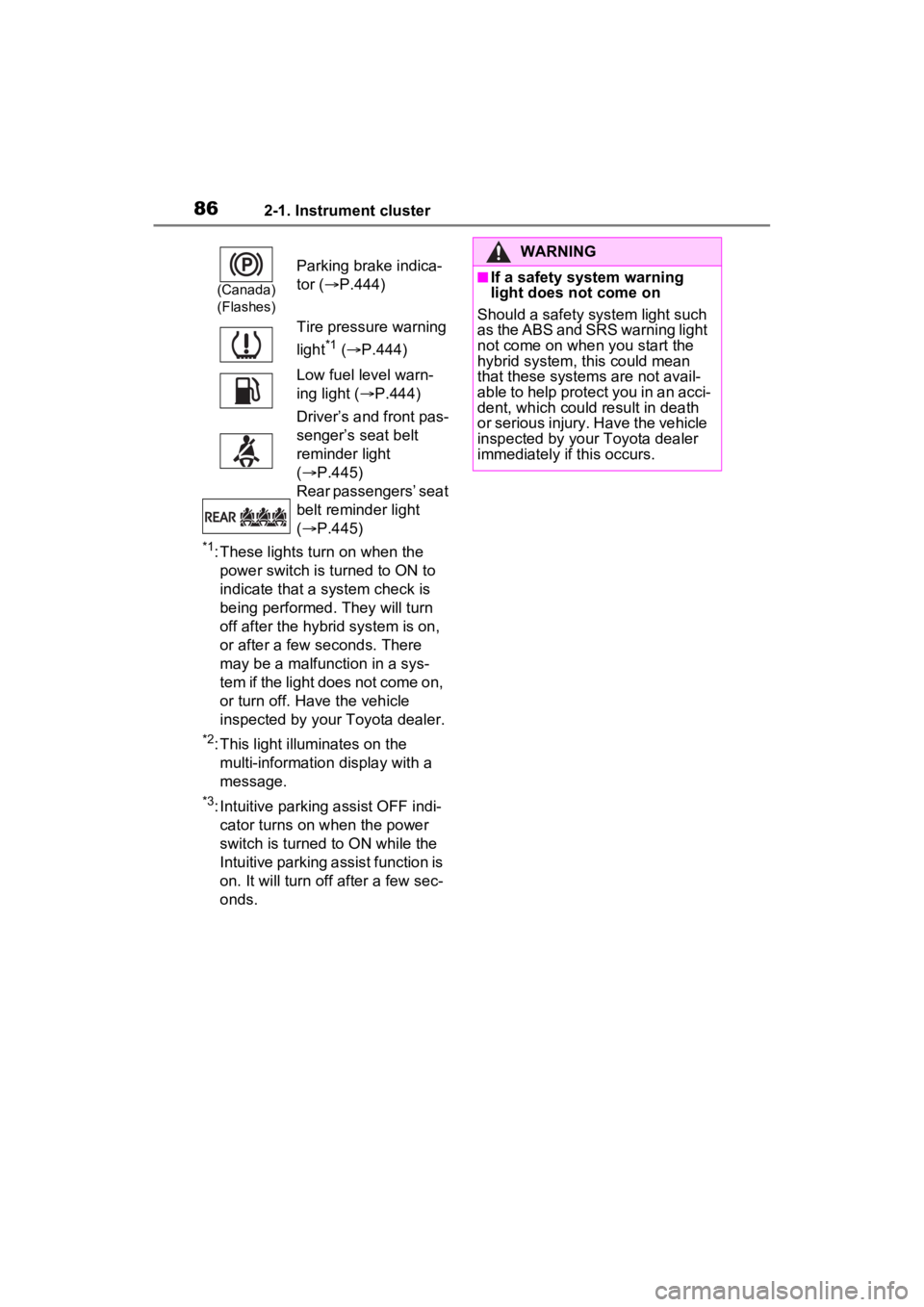
*1: These lights turn on when the power switch is turned to ON to
indicate that a system check is
being performed. They will turn
off after the hybr id system is on,
or after a few seconds. There
may be a malfunction in a sys-
tem if the light does not come on,
or turn off. Have the vehicle
inspected by your Toyota dealer.
*2: This light illuminates on the multi-informatio n display with a
message.
*3: Intuitive parking assist OFF indi- cator turns on when the power
switch is turned to ON while the
Intuitive parking assist function is
on. It will turn off after a few sec-
onds.
(Canada)
(Flashes)
Parking brake indica-
tor ( P.444)
Tire pressure warning
light
*1 ( P.444)
Low fuel level warn-
ing light ( P.444)
Driver’s and front pas-
senger’s seat belt
reminder light
( P.445)
Rear passengers’ seat
belt reminder light
( P.445)
WARNING
■If a safety system warning
light does not come on
Should a safety system light such
as the ABS and SRS warning light
not come on when you start the
hybrid system, this could mean
that these system s are not avail-
able to help protect you in an acci-
dent, which could result in death
or serious injury. Have the vehicle
inspected by your Toyota dealer
immediately if this occurs.
Page 87 of 548
872-1. Instrument cluster
2
Vehicle status information and indicators
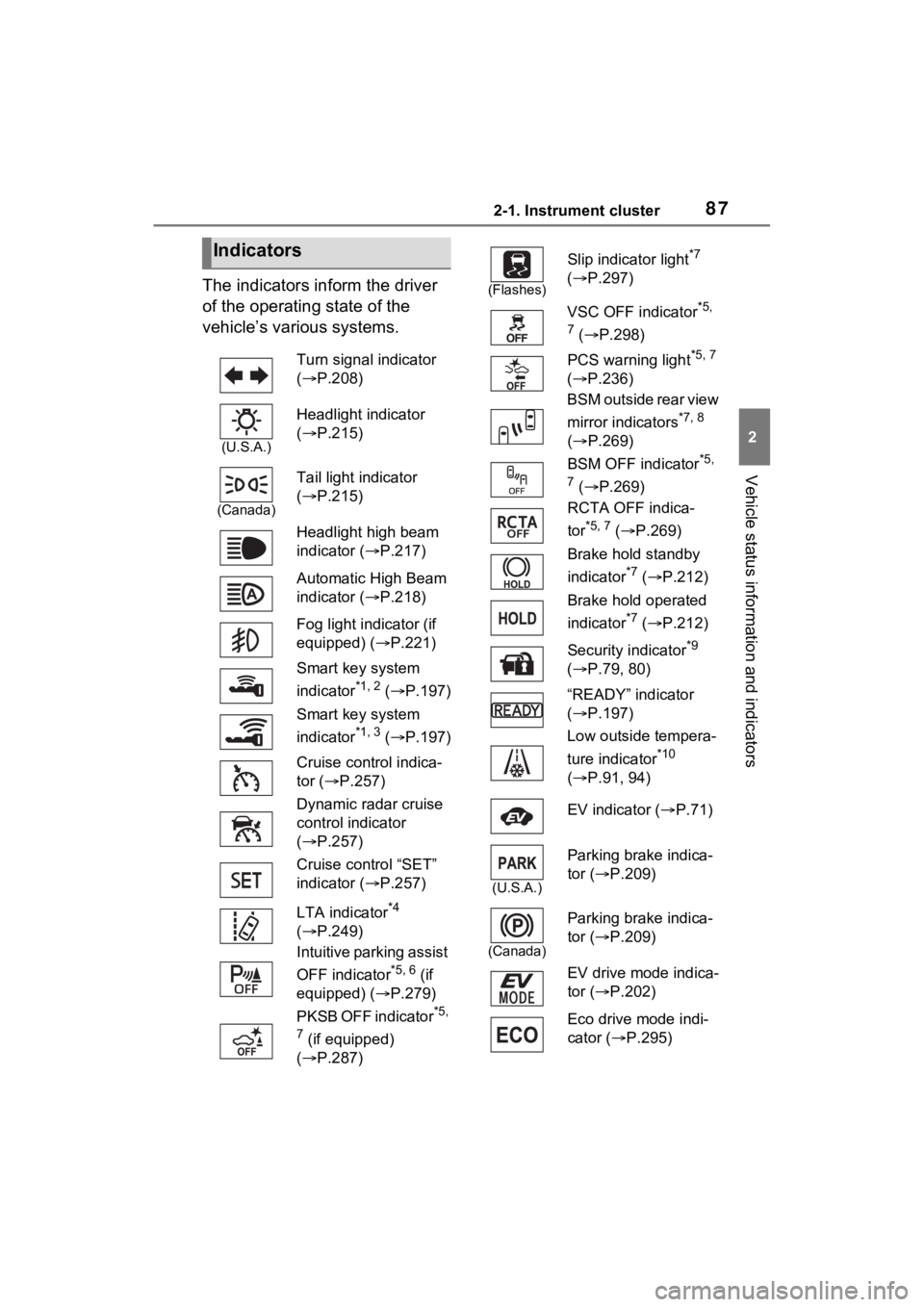
The indicators inform the driver
of the operating state of the
vehicle’s various systems.
Indicators
Turn signal indicator
( P.208)
(U.S.A.)
Headlight indicator
( P.215)
(Canada)
Tail light indicator
( P.215)
Headlight high beam
indicator ( P.217)
Automatic High Beam
indicator ( P.218)
Fog light indicator (if
equipped) (P.221)
Smart key system
indicator
*1, 2 ( P.197)
Smart key system
indicator
*1, 3 ( P.197)
Cruise control indica-
tor ( P.257)
Dynamic radar cruise
control indicator
( P.257)
Cruise control “SET”
indicator ( P.257)
LTA indicator
*4
( P.249)
Intuitive parking assist
OFF indicator
*5, 6 (if
equipped) (P.279)
PKSB OFF indicator
*5,
7
(if equipped)
( P.287)
(Flashes)
Slip indicator light*7
( P.297)
VSC OFF indicator
*5,
7
( P.298)
PCS warning light
*5, 7
( P.236)
BSM outside rear view
mirror indicators
*7, 8
( P.269)
BSM OFF indicator
*5,
7
( P.269)
RCTA OFF indica-
tor
*5, 7 ( P.269)
Brake hold standby
indicator
*7 ( P.212)
Brake hold operated
indicator
*7 ( P.212)
Security indicator
*9
( P.79, 80)
“READY” indicator
( P.197)
Low outside tempera-
ture indicator
*10
( P.91, 94)
EV indicator ( P.71)
(U.S.A.)
Parking brake indica-
tor ( P.209)
(Canada)
Parking brake indica-
tor ( P.209)
EV drive mode indica-
tor ( P.202)
Eco drive mode indi-
cator ( P.295)
Page 143 of 548
1423-2. Opening, closing and locking the doors
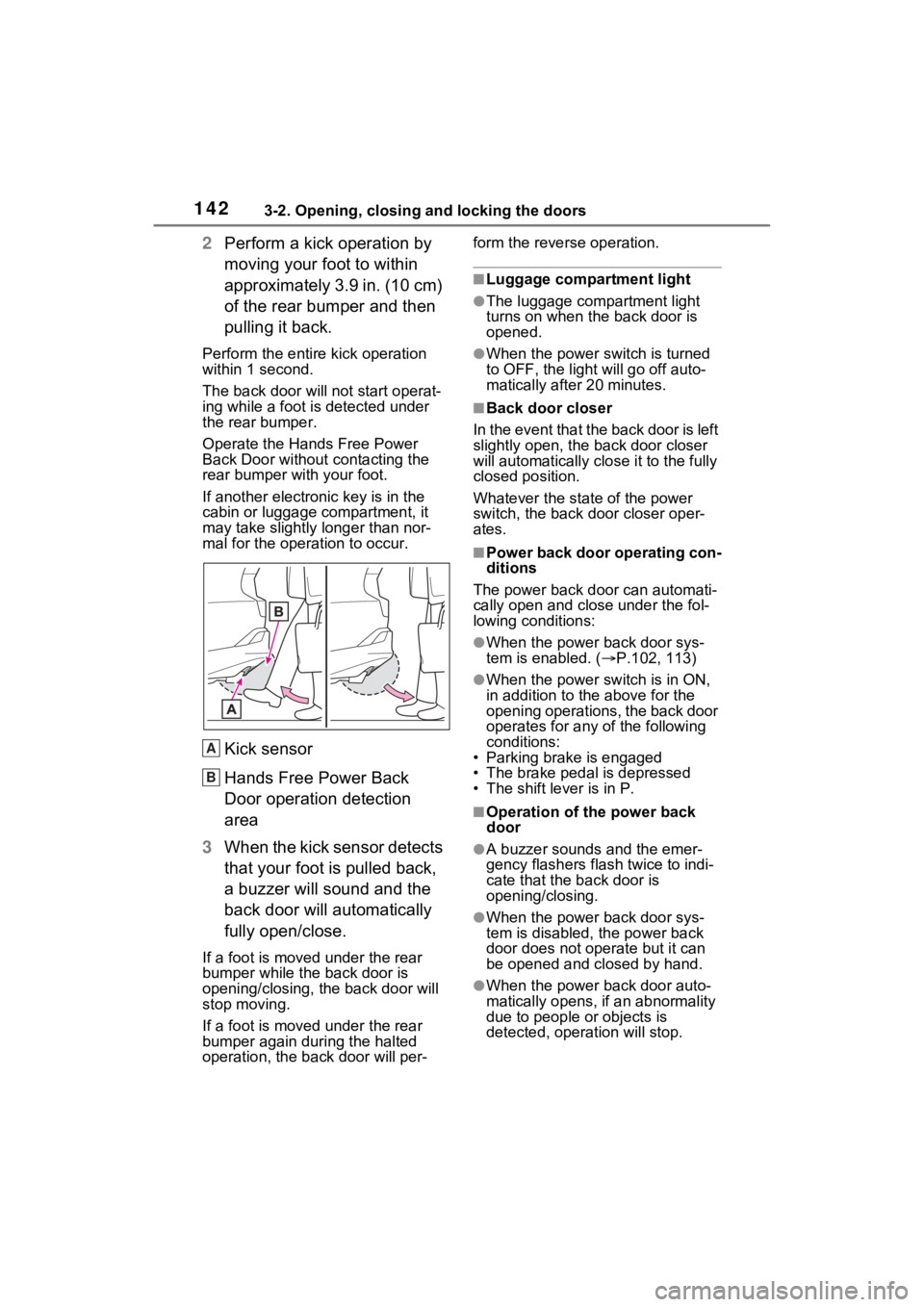
2Perform a kick operation by
moving your foot to within
approximately 3.9 in. (10 cm)
of the rear bumper and then
pulling it back.
Perform the entire kick operation
within 1 second.
The back door will not start operat-
ing while a foot is detected under
the rear bumper.
Operate the Hands Free Power
Back Door without contacting the
rear bumper with your foot.
If another electronic key is in the
cabin or luggage compartment, it
may take slightly longer than nor-
mal for the operation to occur.
Kick sensor
Hands Free Power Back
Door operation detection
area
3 When the kick sensor detects
that your foot is pulled back,
a buzzer will sound and the
back door will automatically
fully open/close.
If a foot is moved under the rear
bumper while the back door is
opening/closing, the back door will
stop moving.
If a foot is moved under the rear
bumper again during the halted
operation, the back door will per- form the rever
se operation.
■Luggage compartment light
●The luggage compartment light
turns on when the back door is
opened.
●When the power switch is turned
to OFF, the light will go off auto-
matically after 20 minutes.
■Back door closer
In the event that the back door is left
slightly open, the back door closer
will automatically clo se it to the fully
closed position.
Whatever the state of the power
switch, the back door closer oper-
ates.
■Power back door operating con-
ditions
The power back doo r can automati-
cally open and close under the fol-
lowing conditions:
●When the power back door sys-
tem is enabled. ( P.102, 113)
●When the power switch is in ON,
in addition to the above for the
opening operations, the back door
operates for any of the following
conditions:
• Parking brake is engaged
• The brake pedal is depressed
• The shift lever is in P.
■Operation of the power back
door
●A buzzer sounds and the emer-
gency flashers flash twice to indi-
cate that the back door is
opening/closing.
●When the power back door sys-
tem is disabled, t he power back
door does not operate but it can
be opened and closed by hand.
●When the power back door auto-
matically opens, if an abnormality
due to people or objects is
detected, operation will stop.
A
B
Page 159 of 548
1583-3. Adjusting the seats
*: If equipped
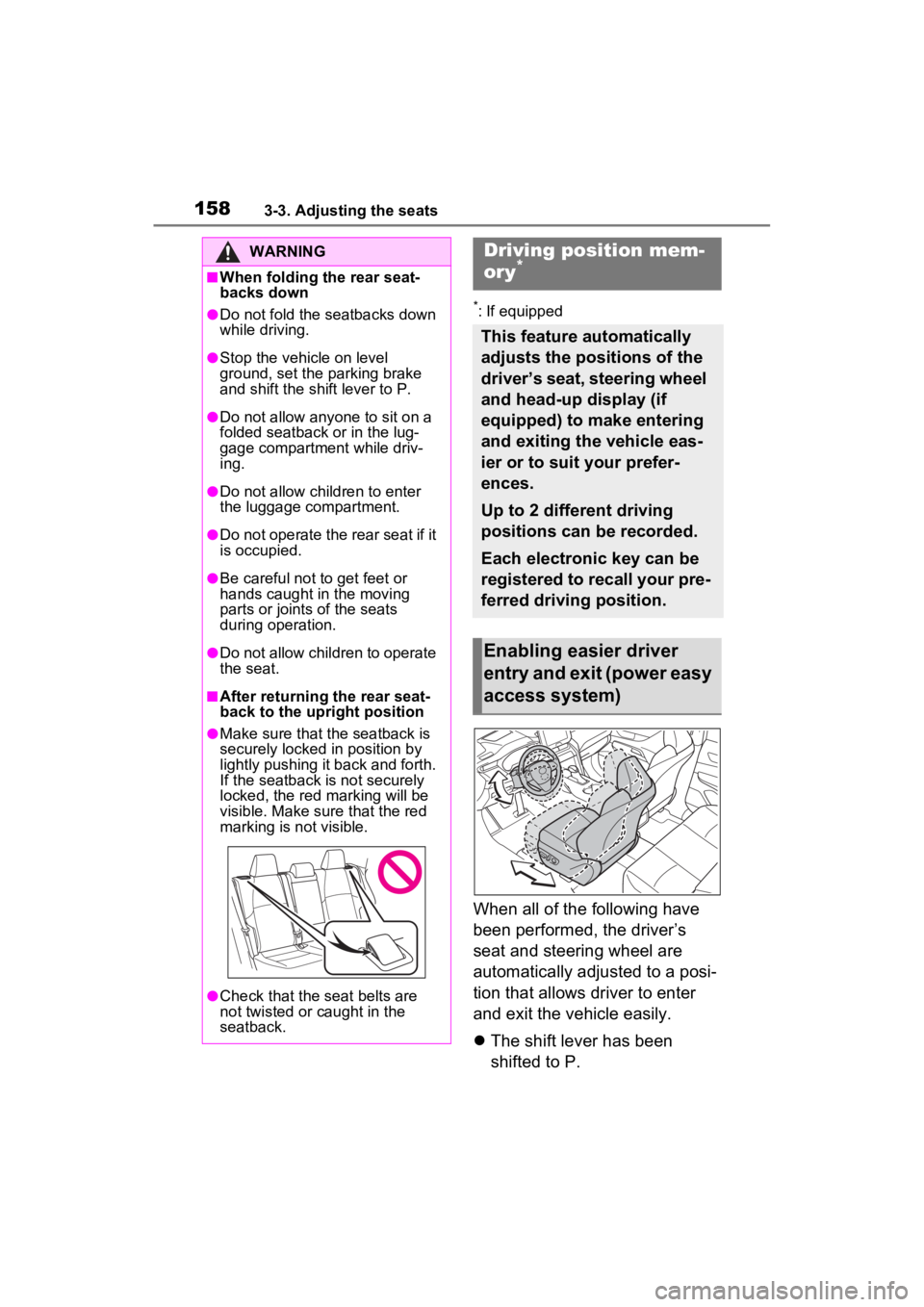
When all of the following have
been performed, the driver’s
seat and steering wheel are
automatically adjusted to a posi-
tion that allows driver to enter
and exit the vehicle easily.
The shift lever has been
shifted to P.
WARNING
■When folding the rear seat-
backs down
●Do not fold the seatbacks down
while driving.
●Stop the vehicle on level
ground, set the parking brake
and shift the shift lever to P.
●Do not allow anyo ne to sit on a
folded seatback or in the lug-
gage compartment while driv-
ing.
●Do not allow child ren to enter
the luggage compartment.
●Do not operate the rear seat if it
is occupied.
●Be careful not to get feet or
hands caught in the moving
parts or joints of the seats
during operation.
●Do not allow children to operate
the seat.
■After returning the rear seat-
back to the upright position
●Make sure that the seatback is
securely locked in position by
lightly pushing it back and forth.
If the seatback is not securely
locked, the red marking will be
visible. Make sure that the red
marking is not visible.
●Check that the seat belts are
not twisted or caught in the
seatback.
Driving position mem-
ory*
This feature automatically
adjusts the positions of the
driver’s seat, steering wheel
and head-up display (if
equipped) to make entering
and exiting the vehicle eas-
ier or to suit your prefer-
ences.
Up to 2 different driving
positions can be recorded.
Each electronic key can be
registered to recall your pre-
ferred driving position.
Enabling easier driver
entry and exit (power easy
access system)
Page 183 of 548
183
4
4
Driving
Driving
4-1. Before drivingDriving the vehicle....... 184
Cargo and luggage ..... 191
Vehicle load limits ....... 194
Trailer towing .............. 195
Dinghy towing ............. 196
4-2. Driving procedures Power (ignition) switch 197
EV drive mode ............ 202
Hybrid transmission .... 204
Turn signal lever ......... 208
Parking brake .............. 209
Brake Hold .................. 212
4-3. Operating the lights and wipers
Headlight switch .......... 215
AHB (Automatic High Beam)........................ 218
Fog light switch ........... 221
Windshield wipers and washer....................... 222
Rear window wiper and washer....................... 225
4-4. Refueling Opening the fuel tank cap.................................. 227
4-5. Using the driving support
systems
Toyota Safety Sense 2.0 .................................. 230PCS (Pre-Collision System)
.................................. 236
LTA (Lane Tracing Assist) .................................. 244
RSA (Road Sign Assist) .................................. 254
Dynamic radar cruise con- trol with full-speed range.................................. 257
BSM (Blind Spot Monitor) .................................. 268
Intuitive parking assist . 278
PKSB (Parking Support Brake) ........................ 286
Parking Support Brake func- tion (static objects)
.................................. 291
Parking Support Brake function (rear-crossing
vehicles) .................... 293
Driving mode select switch .................................. 295
Driving assist systems. 296
4-6. Driving tips Hybrid Electric Vehicle driv-ing tips ....................... 302
Winter driving tips........ 304
Utility vehicle precautions .................................. 307
Page 184 of 548
1844-1. Before driving
4-1.Before driving
■Starting the hybrid system
P.197
■Driving
1 With the brake pedal
depressed, shift the shift
lever to D. ( P.205)
2 Release the parking brake.
( P.209)
If the parking brake is in automatic
mode, the parkin g brake will be
released automatically. ( P.210)
3 Gradually release the brake
pedal and gently depress the
accelerator pedal to acceler-
ate the vehicle.
■Stopping
1 With the shift lever in D,
depress the brake pedal.
2 If necessary, set the parking
brake. ( P.209)
If the vehicle is to be stopped for an
extended period of time, shift the
shift lever to P. ( P.205)
■Parking the vehicle
1 With the shift lever in D,
depress the brake pedal.
2 Set the parking brake.
( P.209)
Make sure the parking brake indi-
cator light is on.
3Shift the shift lever to P.
( P.205)
4 Turn the power switch to
OFF to stop the hybrid sys-
tem.
5 Lock the door, making sure
that you have the electronic
key on your person.
If parking on a hill, block the wheels
as needed.
■Starting off on a steep
uphill
1 With the brake pedal
depressed, shift the shift
lever to D. ( P.205)
2 Pull the parking brake switch
and parking brake is set
manually. ( P.209)
3 Release the brake pedal and
gently depress the accelera-
tor pedal to accelerate the
vehicle.
4 Press the parking brake
switch and parking brake is
released manually.
■When starting off on an uphill
The hill-start assist control will acti-
vate. ( P.297)
■For fuel-efficient driving
Keep in mind that Hybrid Electric
Vehicles are simila r to conventional
vehicles, and it is necessary to
refrain from activities such as sud-
den acceleration. ( P.302)
■Driving in the rain
●Drive carefully whe n it is raining,
because visibility will be reduced,
the windows may become fogged-
up, and th e road will be slippery.
Driving the vehicle
The following procedures
should be observed to
ensure safe driving:
Driving procedure