belt TOYOTA YARIS 2009 2.G Owners Manual
[x] Cancel search | Manufacturer: TOYOTA, Model Year: 2009, Model line: YARIS, Model: TOYOTA YARIS 2009 2.GPages: 392, PDF Size: 8.52 MB
Page 1 of 392
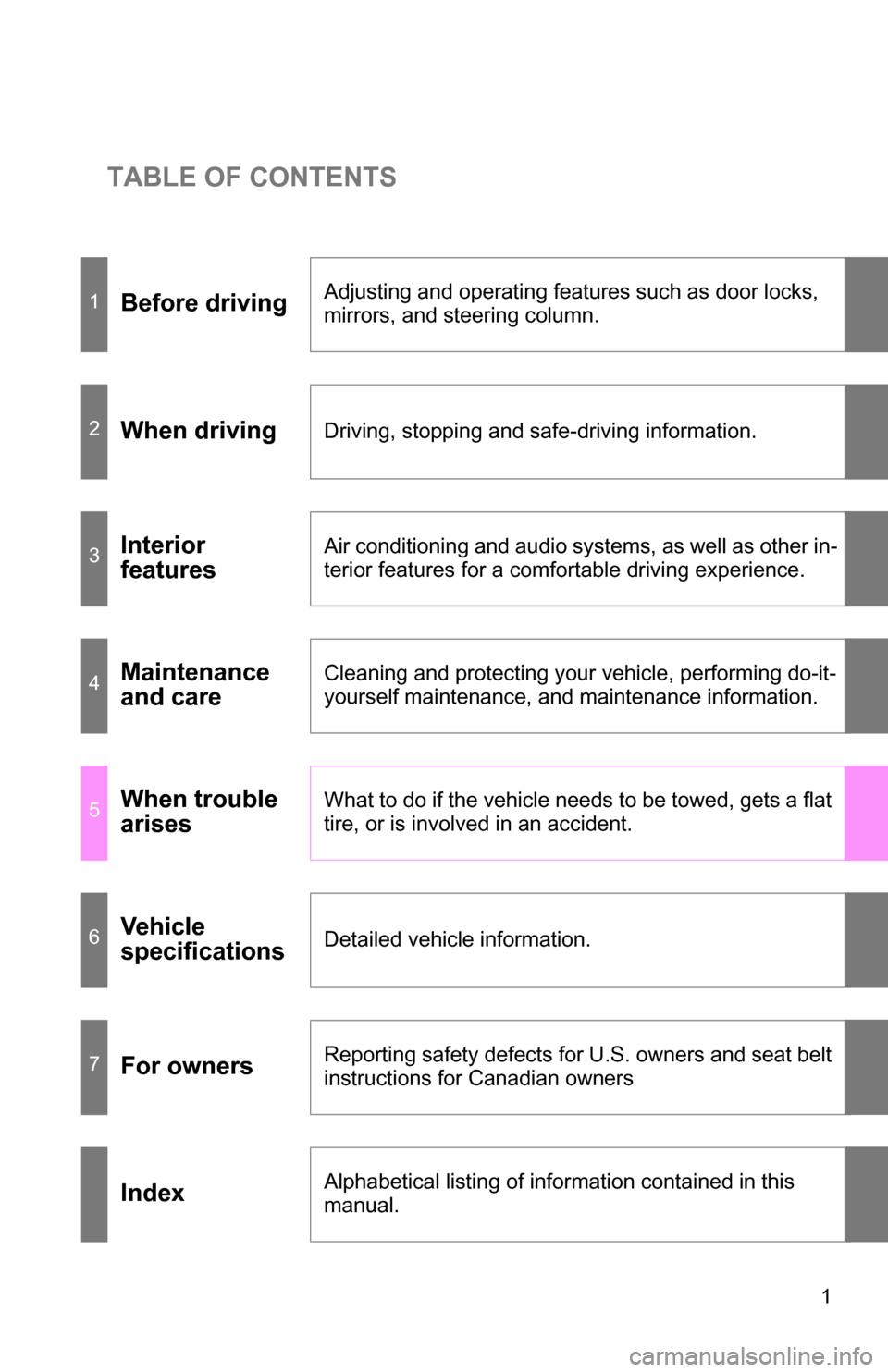
TABLE OF CONTENTS
1
1Before drivingAdjusting and operating features such as door locks,
mirrors, and steering column.
2When drivingDriving, stopping and safe-driving information.
3Interior
featuresAir conditioning and audio systems, as well as other in-
terior features for a comfortable driving experience.
4Maintenance
and careCleaning and protecting your vehicle, performing do-it-
yourself maintenance, and maintenance information.
5When trouble
arisesWhat to do if the vehicle needs to be towed, gets a flat
tire, or is involved in an accident.
6Vehicle
specificationsDetailed vehicle information.
7For ownersReporting safety defects for U.S. owners and seat belt
instructions for Canadian owners
IndexAlphabetical listing of information contained in this
manual.
Page 2 of 392
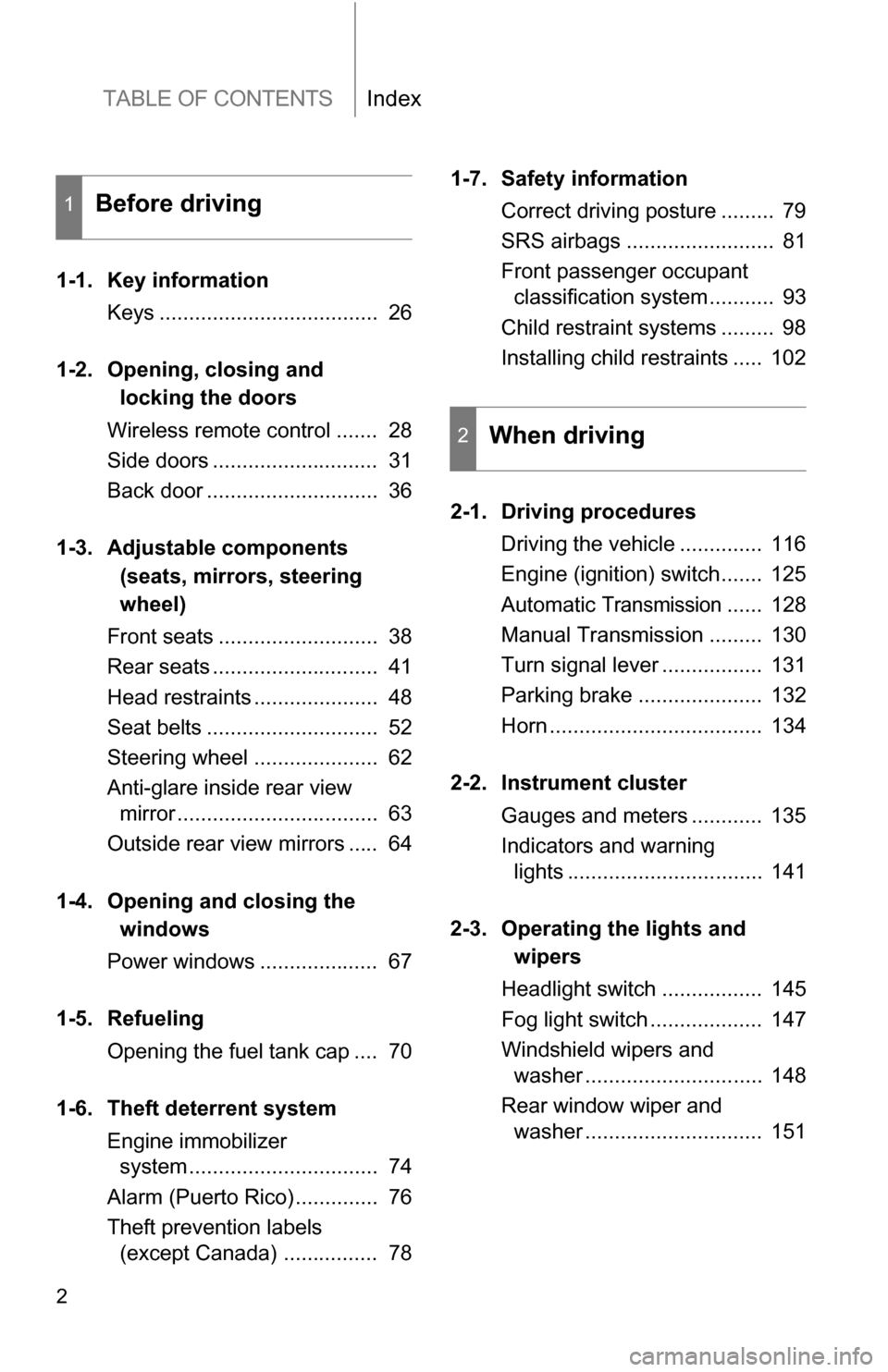
TABLE OF CONTENTSIndex
2
1-1. Key informationKeys ..................................... 26
1-2. Opening, closing and
locking the doors
Wireless remote control ....... 28
Side doors ............................ 31
Back door ............................. 36
1-3. Adjustable components
(seats, mirrors, steering
wheel)
Front seats ........................... 38
Rear seats ............................ 41
Head restraints ..................... 48
Seat belts ............................. 52
Steering wheel ..................... 62
Anti-glare inside rear view mirror .................................. 63
Outside rear view mirrors ..... 64
1-4. Opening a nd closing the
windo ws
Power windows .................... 67
1-5. Refueling Opening the fuel tank cap .... 70
1-6. Theft deterrent system Engine immobilizer system ................................ 74
Alarm (Puerto Rico).............. 76
Theft prevention labels (except Canada) ................ 78 1-7. Safety information
Correct driving posture ......... 79
SRS airbags ......................... 81
Front passenger occupant classification system ........... 93
Child restraint systems ......... 98
Installing child restraints ..... 102
2-1. Driving procedures Driving the vehicle .............. 116
Engine (ignition) switch....... 125
Automatic
Transmission...... 128
Manual Transmission ......... 130
Turn signal lever ................. 131
Parking brake ..................... 132
Horn .................................... 134
2-2. Instrument cluster Gauges and meters ............ 135
Indicators and warning lights ................................. 141
2-3. Operating the li ghts and
wipers
Headlight switch ................. 145
Fog light switch ................... 147
Windshield wipers and washer .............................. 148
Rear window wiper and washer .............................. 151
1Before driving
2When driving
Page 4 of 392
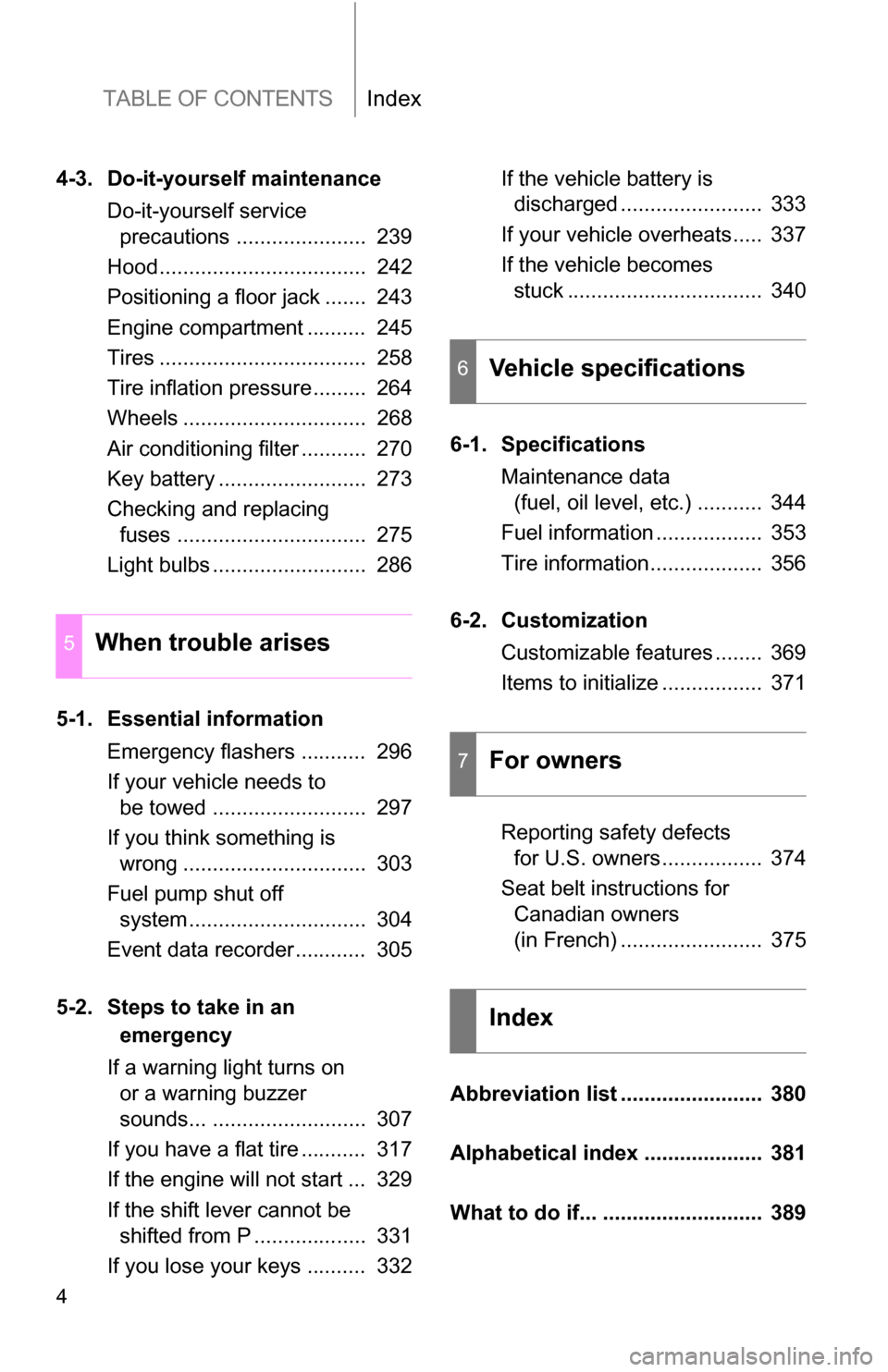
TABLE OF CONTENTSIndex
4
4-3. Do-it-yourself maintenanceDo-it-yourself service precautions ...................... 239
Hood................................... 242
Positioning a floor jack ....... 243
Engine compartment .......... 245
Tires ................................... 258
Tire inflation pressure......... 264
Wheels ............................... 268
Air conditioning filter ........... 270
Key battery ......................... 273
Checking and replacing fuses ................................ 275
Light bulbs .......................... 286
5-1. Essential information Emergency flashers ........... 296
If your vehicle needs to be towed .......................... 297
If you think something is wrong ............................... 303
Fuel pump shut off system .............................. 304
Event data recorder............ 305
5-2. Steps to take in an emergency
If a warning light turns on or a warning buzzer
sounds... .......................... 307
If you have a flat tire ........... 317
If the engine will not start ... 329
If the shift lever cannot be shifted from P ................... 331
If you lose your keys .......... 332 If the vehicle battery is
discharged ........................ 333
If your vehicle overheats..... 337
If the vehicle becomes stuck ................................. 340
6-1. Specifications Maintenance data (fuel, oil level, etc.) ........... 344
Fuel information .................. 353
Tire information................... 356
6-2. Customization Customizable features ........ 369
Items to initialize ................. 371
Reporting safety defects for U.S. owners ................. 374
Seat belt instructions for Canadian owners
(in French) ........................ 375
Abbreviation list ........................ 380
Alphabetical index .................... 381
What to do if... ........................... 389
5When trouble arises
6Vehicle specifications
7For owners
Index
Page 10 of 392
10
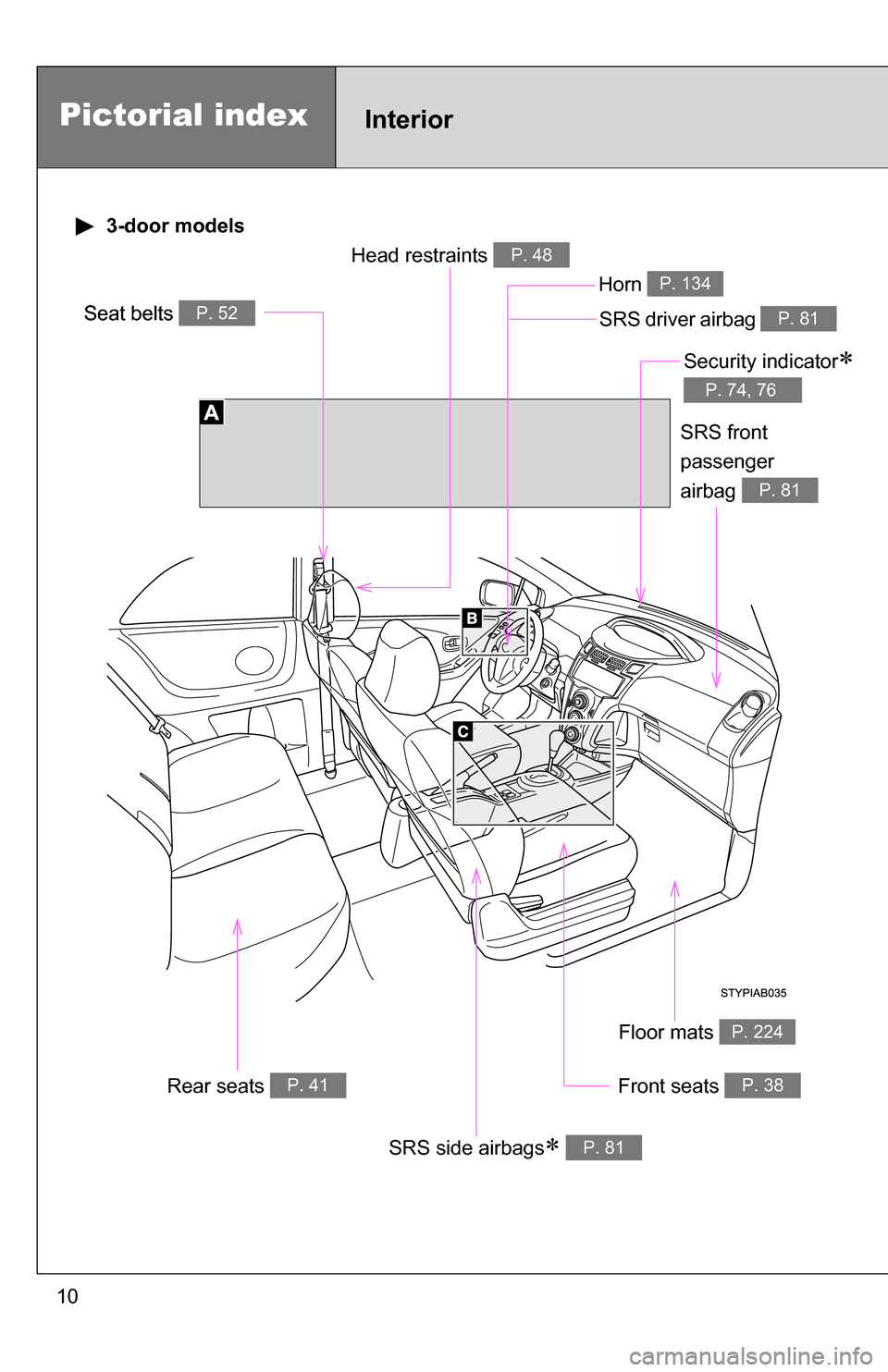
Pictorial indexInterior
Seat belts P. 52SRS driver airbag P. 81
Head restraints P. 48
Front seats P. 38
SRS side airbags P. 81
Floor mats P. 224
SRS front
passenger
airbag
P. 81
Security indicator
P. 74, 76
3-door models
Rear seats P. 41
Seat belts P. 52
Horn P. 134
Page 11 of 392
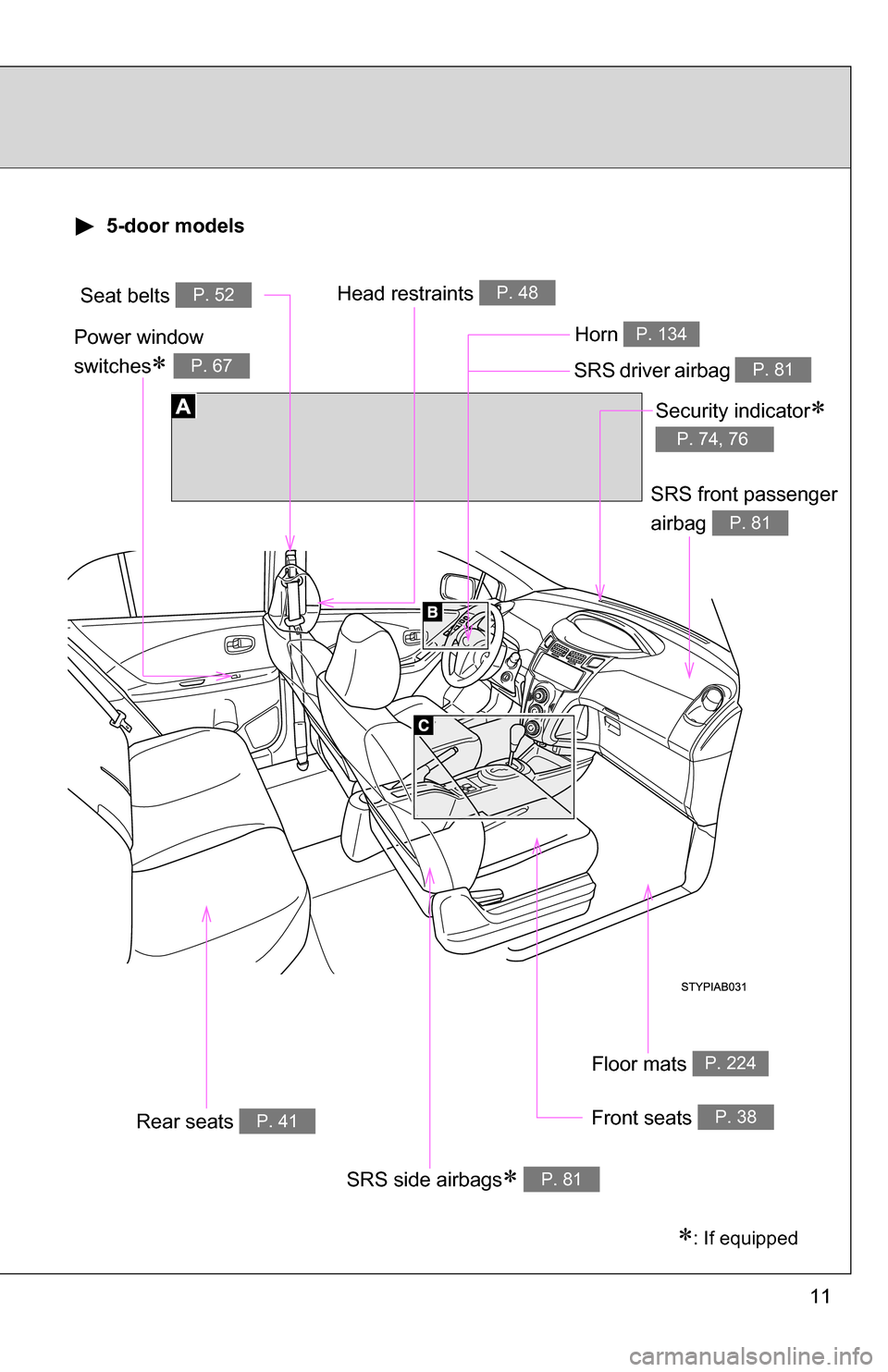
11
Seat belts P. 52
SRS driver airbag P. 81
Head restraints P. 48
Front seats P. 38
SRS side airbags P. 81
Floor mats P. 224
SRS front passenger
airbag
P. 81
Security indicator
P. 74, 76
Power window
switches
P. 67
5-door models
Rear seats P. 41
: If equipped
Horn P. 134
Page 20 of 392
20
For your information
Main Owners Manual
Please note that this manual applies to all models explains and all equip-
ment, including options. Therefore, you may find some explanations for
equipment not installed on your vehicle.
All specifications provided in this manual are current at the time of printing.
However, because of the Toyota policy of continual product improvement, we
reserve the right to make changes at any time without notice.
Depending on specifications, the vehicle shown in the illustrations may differ
from your vehicle in terms of equipment.
Accessories, spare parts and modification of your Toyota
A wide variety of non-genuine spare parts and accessories for Toyota
vehicles are currently available in the market. You should know that Toyota
does not warrant these products and is not responsible for their
performance, repair, or replacement, or for any damage they may cause to,
or adverse effect they may have on, your Toyota vehicle.
This vehicle should not be modified with non-genuine Toyota products.
Modification with non-genuine Toyota products could affect its performance,
safety or durability, and may even violate governmental regulations. In
addition, damage or performance problems resulting from the modification
may not be covered under warranty.
Installation of a mobile two-way radio system
As the installation of a mobile two-way radio system in your vehicle could
affect electronic systems such as the multiport fuel injection system/sequen-
tial multiport fuel injection system, anti-lock brake system, SRS airbag sys-
tem and seat belt pretensioner system, be sure to check with your Toyota
dealer for precautionary measures or special instructions regarding installa-
tion.
Page 21 of 392
21
Scrapping your Toyota
The SRS airbag and seat belt pretensioner devices in your Toyota contain
explosive chemicals. If the vehicle is scrapped with the airbags and seat belt
pretensioners left as they are, this may cause an accident such as fire. Be
sure to have the systems of the SRS airbag and seat belt pretensioner
removed and disposed of by a qualified service shop or by your Toyota
dealer before you scrap your vehicle.
Perchlorate Material
Special handling may apply,
See www.dtsc.ca.gov/hazardouswaste/perchlorate.
Your vehicle has components that may contain perchlorate. These compo-
nents may include airbag, seat belt pretensioners, and wireless remote con-
trol batteries.
Page 25 of 392
Before driving1
25
1-1. Key informationKeys ................................... 26
1-2. Opening, closing and locking the doors
Wireless remote control ..... 28
Side doors .......................... 31
Back door ........................... 36
1-3. Adjustable components (seats, mirrors,
steering wheel)
Front seats ......................... 38
Rear seats.......................... 41
Head restraints................... 48
Seat belts ........................... 52
Steering wheel ................... 62
Anti-glare inside rear view mirror ....................... 63
Outside rear view mirrors ... 64
1-4. Opening and closing the windows
Power windows .................. 67
1-5. Refueling Opening the fuel tank cap ................................... 70 1-6. Theft deterrent system
Engine immobilizer system ............................. 74
Alarm (Puerto Rico) ........... 76
Theft prevention labels (except Canada) .............. 78
1-7. Safety information Correct driving posture....... 79
SRS airbags ....................... 81
Front passenger occupant classification system ........ 93
Child restraint systems....... 98
Installing child restraints... 102
Page 35 of 392
35
1-2. Opening, closing and locking the doors
1
Before driving
CAUTION
■
To prevent an accident
Observe the following precautions while driving the vehicle.
Failing to do so may result in a door opening and an occupant falling out,
resulting in death or serious injury.
●Always use a seat belt.
● Always lock all doors.
● Ensure that all doors are properly closed.
● Do not pull the inside handle of the doors while driving.
The doors may be opened and the passengers are thrown out of the vehi-
cle and it may result in serious injury or death.
● Be especially careful for the front doors, the doors may be opened even if
the inside lock buttons are in locked position.
● Set the rear door child protector locks when children are seated in the rear
seat.
Page 40 of 392
40 1-3. Adjustable components (seats, mirrors, steering wheel)
CAUTION
■Seat adjustment
●Do not recline the seat more than necessary when the vehicle is in motion
to reduce the risk of sliding under the lap belt.
If the seat is too reclined, the lap belt may slide past the hips and apply
restraint forces directly to the abdomen or your neck may contact the
shoulder belt, increasing the risk of death or serious injury in the event of
an accident.
● After adjusting the seat, make sure that the seat is locked in position.
■ After returning the seatback
Push and pull the seatback to confirm that it is securely locked.
■ Caution while driving
Never operate the seatback lock release lever.