spare tire TOYOTA YARIS 2014 3.G User Guide
[x] Cancel search | Manufacturer: TOYOTA, Model Year: 2014, Model line: YARIS, Model: TOYOTA YARIS 2014 3.GPages: 400, PDF Size: 9 MB
Page 315 of 400
5
When trouble arises
315
5-2. Steps to take in an emergency
If you have a flat tire
Remove the flat tire and replace it with the spare tire provided.
■Before jacking up the vehicle
●Stop the vehicle on a hard, flat surface.
● Set the parking brake.
● Shift the shift lever to P (vehicles with an automatic transmis-
sion) or R (vehicles with a manual transmission).
● Stop the engine.
● Turn on the emergency flashers.
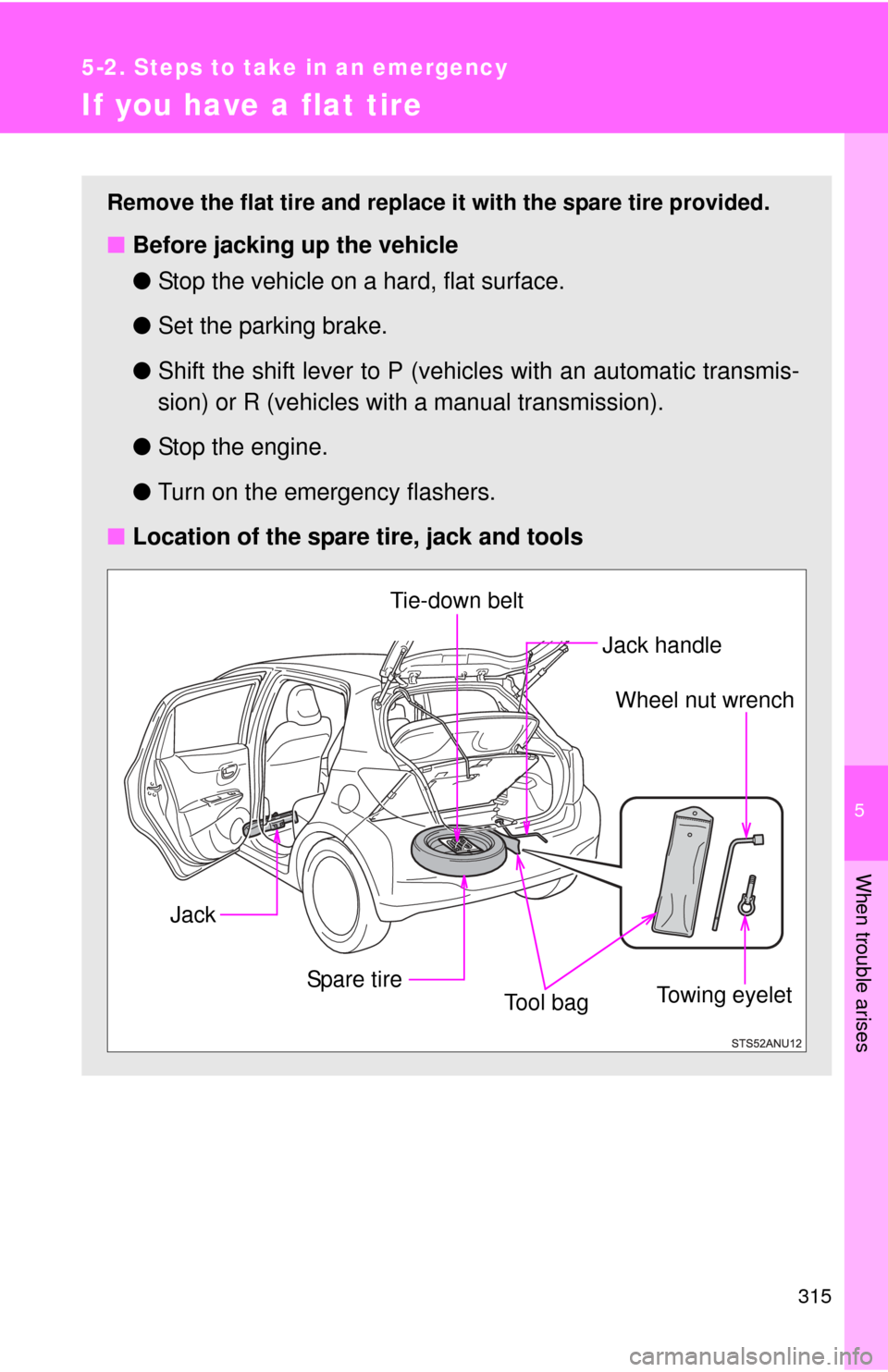
■ Location of the spare tire, jack and tools
Jack handle
Tie-down belt
Tool bag
Spare tire
Jack
Wheel nut wrench
Towing eyelet
Page 316 of 400
316 5-2. Steps to take in an emergency
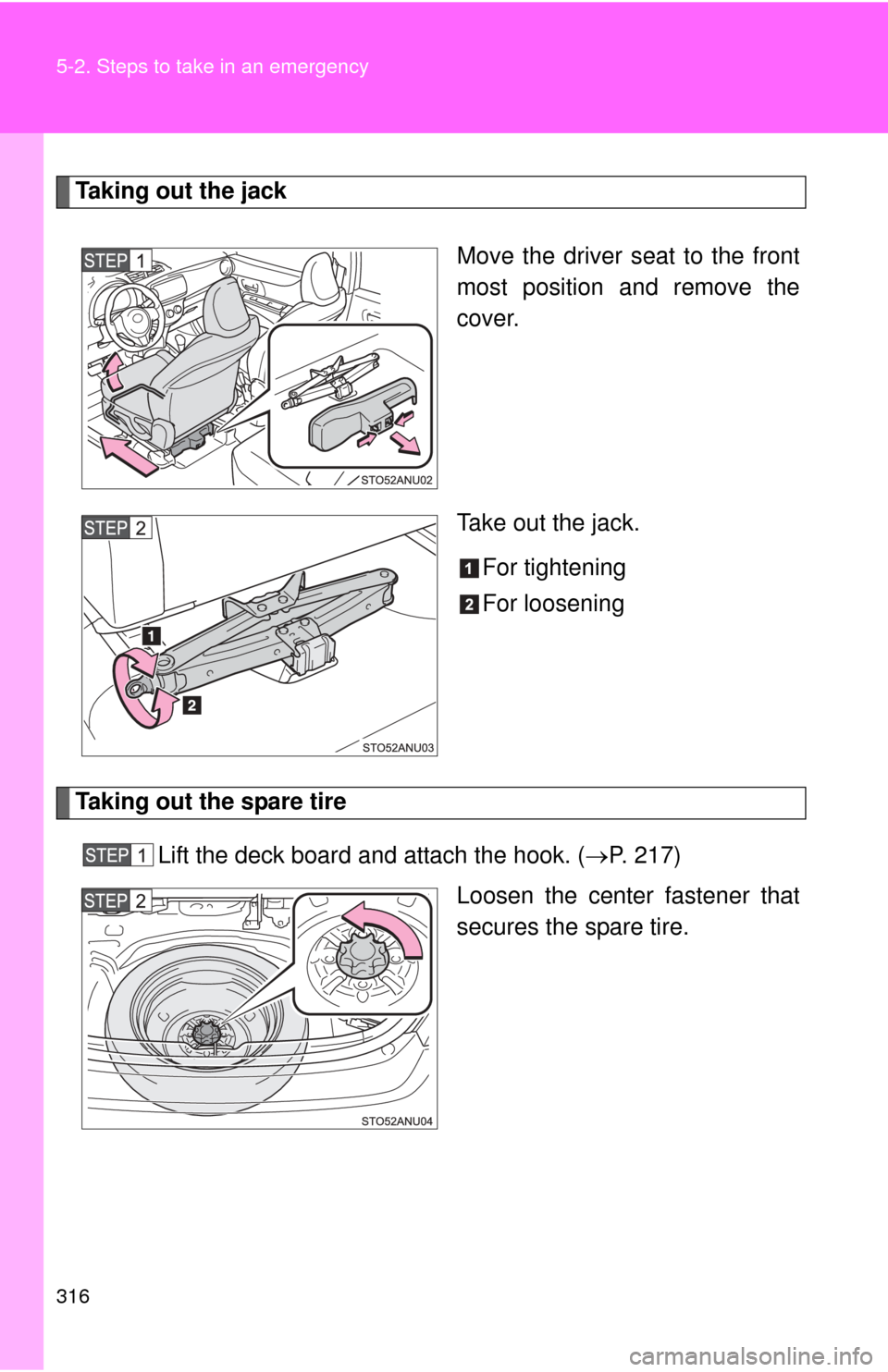
Taking out the jackMove the driver seat to the front
most position and remove the
cover.
Take out the jack.For tightening
For loosening
Taking out the spare tire
Lift the deck board and attach the hook. ( P. 217)
Loosen the center fastener that
secures the spare tire.
Page 319 of 400
5
When trouble arises
319
5-2. Steps to take in an emergency
Installing the tire
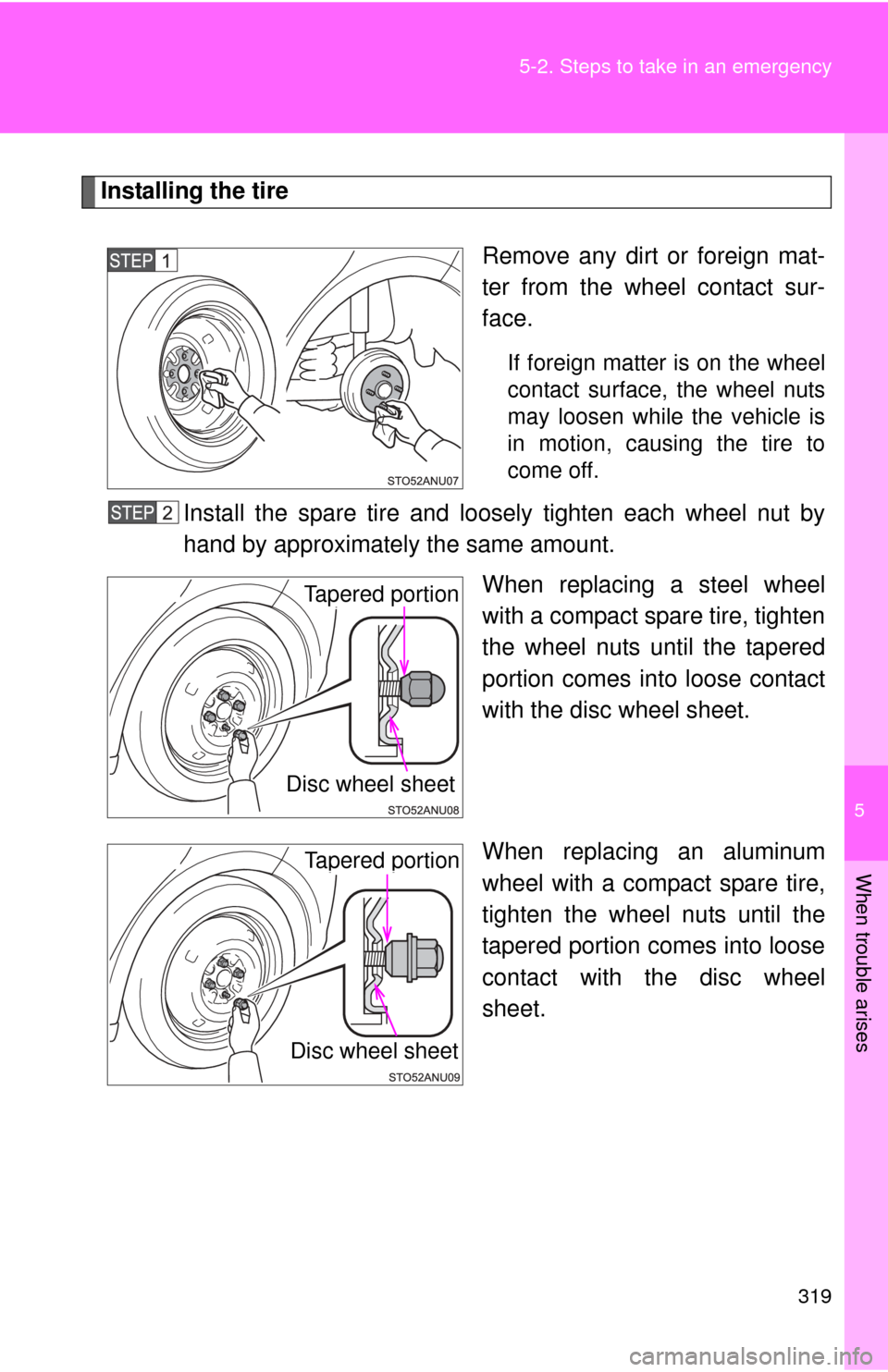
Remove any dirt or foreign mat-
ter from the wheel contact sur-
face.
If foreign matter is on the wheel
contact surface, the wheel nuts
may loosen while the vehicle is
in motion, causing the tire to
come off.
Install the spare tire and loosely tighten each wheel nut by
hand by approximately the same amount.When replacing a steel wheel
with a compact spare tire, tighten
the wheel nuts until the tapered
portion comes into loose contact
with the disc wheel sheet.
When replacing an aluminum
wheel with a compact spare tire,
tighten the wheel nuts until the
tapered portion comes into loose
contact with the disc wheel
sheet.
Disc wheel sheet
Tapered portion
Disc wheel sheet
Tapered portion
Page 322 of 400
322 5-2. Steps to take in an emergency
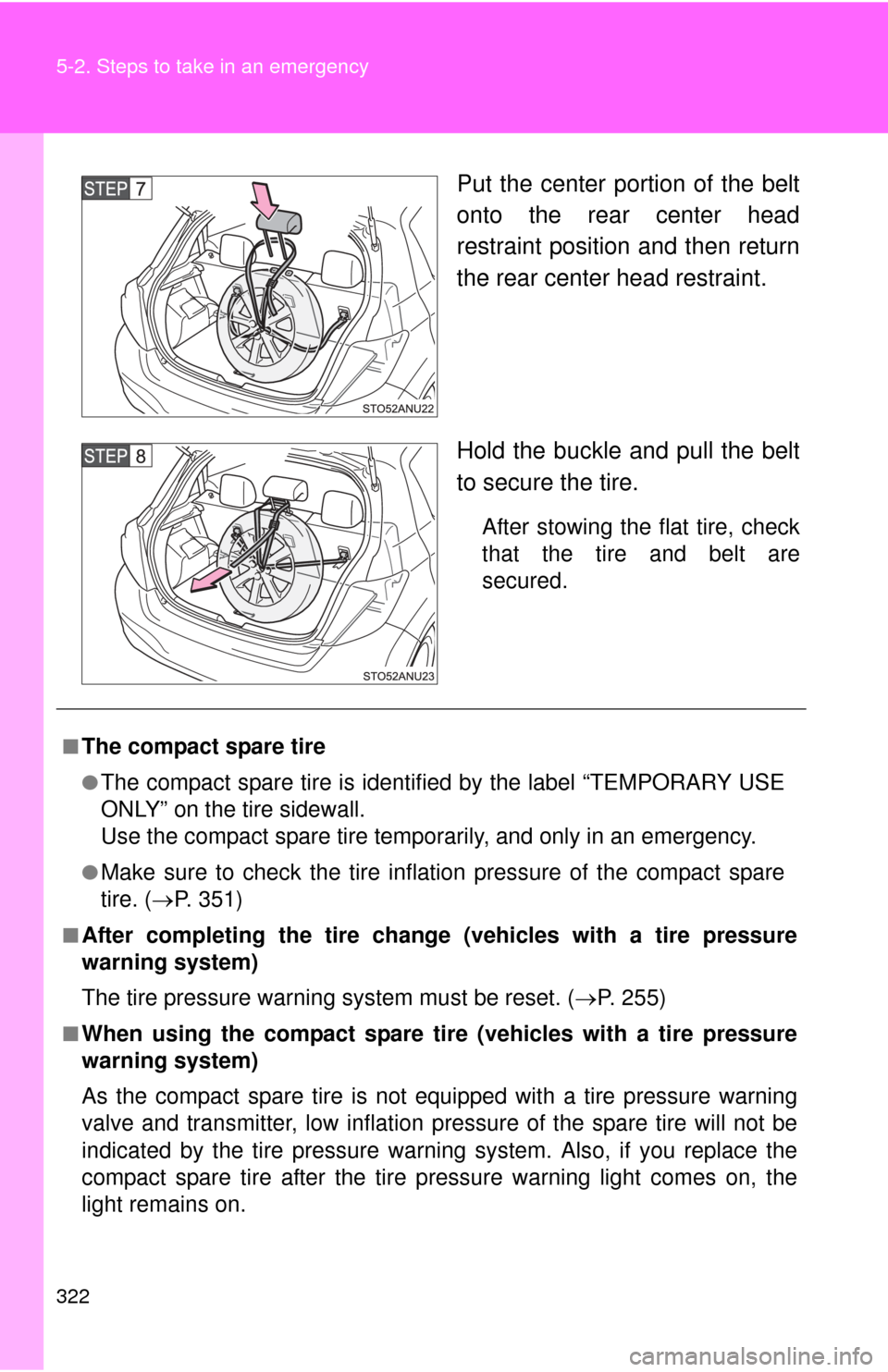
Put the center portion of the belt
onto the rear center head
restraint position and then return
the rear center head restraint.
Hold the buckle and pull the belt
to secure the tire.
After stowing the flat tire, check
that the tire and belt are
secured.
■The compact spare tire
●The compact spare tire is identified by the label “TEMPORARY USE
ONLY” on the tire sidewall.
Use the compact spare tire temporarily, and only in an emergency.
●Make sure to check the tire inflation pressu re of the compact spare
tire. ( P. 351)
■After completing the tire change (vehicles with a tire pressure
warning system)
The tire pressure warnin g system must be reset. ( P. 255)
■When using the compact spare tire (vehicles with a tire pressure
warning system)
As the compact spare tire is not equipped with a tire pressure warning
valve and transmitter, low inflation pressure of the spare tire will not be
indicated by the tire pressure warn ing system. Also, if you replace the
compact spare tire after the tire pressure warning light comes on, the
light remains on.
Page 323 of 400

5
When trouble arises
323
5-2. Steps to take in an emergency
■If you have a flat front tire on a road covered with snow or ice
Install the compact spare tire on one of the rear wheels of the vehicle.
Perform the following steps and fit tire chains to the front tires:
Replace a rear tire with the compact spare tire.
Replace the flat front tire with the tire removed from the rear of
the vehicle.
Fit tire chains to the front tires.
CAUTION
■When using the compact spare tire
●Remember that the compact spare tire provided is specifically
designed for use with your vehicle. Do not use your compact spare tire
on another vehicle.
●Do not use more than one compact spare tire simultaneously.
●Replace the compact spare tire with a standard tire as soon as possi-
ble.
●Avoid sudden acceleration, deceleration and braking, as well as sharp
cornering.
■When storing the compact spare tire
Be careful not to catch fingers or other body parts between the compact
spare tire and the body of the vehicle.
■When the compact spare tire is attached
The vehicle speed may not be correctly detected, and the following sys-
tems may not operate correctly:
●ABS
●Brake assist
●VSC
●TRAC
●Cruise control (if equipped)
Page 324 of 400

324 5-2. Steps to take in an emergency
CAUTION
■Speed limit when using the compact spare tire
Do not drive at speeds in excess of 50 mph (80 km/h) when a compact
spare tire is installed on the vehicle.
The compact spare tire is not designed for driving at high speeds. Failure
to observe this precaution may lead to an accident causing death or seri-
ous injury.
■Using the tire jack
Improper use of the tire jack may cause the vehicle to suddenly fall off
the jack, leading to death or serious injury.
●Do not use the tire jack for any pu rpose other than replacing tires or
installing and removing tire chains.
●Only use the tire jack that comes with this vehicle for replacing a flat
tire.
Do not use it on other vehicles, an d do not use other jacks for replac-
ing tires on this vehicle.
●Always check that the tire jack is securely set to the jack point.
●Do not put any part of your body under the vehicle while it is supported
by the jack.
●Do not start or run the engine while your vehicle is supported by the
jack.
●Do not raise the vehicle while someone is inside.
●When raising the vehicle, do not put an object on or under the jack.
●Do not raise the vehicle to a hei ght greater than that required to
replace the tire.
●Use a jack stand if it is necessary to get under the vehicle.
Take particular care when lowering the vehicle to ensure that no one
working on or near the vehicle may be injured.
Page 326 of 400

326 5-2. Steps to take in an emergency
NOTICE
■Do not drive the vehicle with a flat tire
Do not continue driving with a flat tire.
Driving even a short distance with a flat tire can damage the tire and the
wheel beyond repair.
■Be careful when driving over bumps with the compact spare tire
installed on the vehicle
The vehicle becomes lower when driving with the compact spare tire
compared to when driving with standard tires. Be careful when driving
over uneven road surfaces.
■Driving with tire chains and the compact spare tire
Do not fit tire chains to the compact spare tire.
Tire chains may damage the vehicle body and adversely affect driving
performance.
■When replacing the tires (vehicles with a tire pressure warning sys-
tem)
When removing or fitting the wheels, tires or the tire pressure warning
valve and transmitter, contact your Toyota dealer as the tire pressure
warning valve and transmitter may be damaged if not handled correctly.
■To avoid damage to the tire pressure warning valves and transmit-
ters (vehicles with a tire pressure warning system)
When a tire is repaired with liquid se alants, the tire pressure warning
valve and transmitter may not operate properly. If a liquid sealant is
used, contact your Toyota dealer or other qualified service shop as soon
as possible. Make sure to replace the tire pressure warning valve and
transmitter when replacing the tire. ( P. 255)
Page 351 of 400
351
6-1. Specifications
6
Vehicle specifications
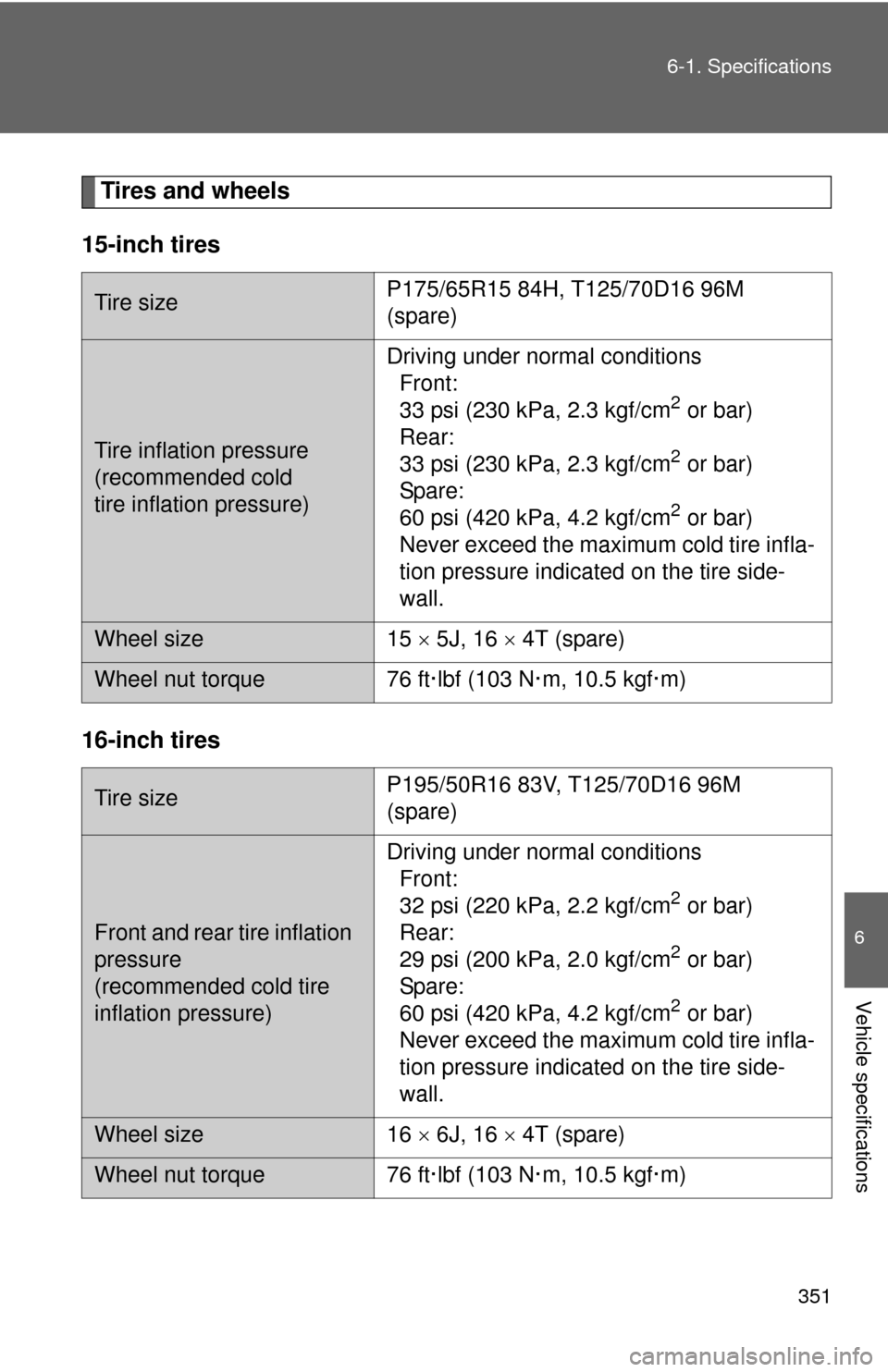
Tires and wheels
15-inch tires
16-inch tires
Tire size P175/65R15 84H, T125/70D16 96M
(spare)
Tire inflation pressure
(recommended cold
tire inflation pressure)Driving under normal conditions
Front:
33 psi (230 kPa, 2.3 kgf/cm
2 or bar)
Rear:
33 psi (230 kPa, 2.3 kgf/cm
2 or bar)
Spare:
60 psi (420 kPa, 4.2 kgf/cm
2 or bar)
Never exceed the maximum cold tire infla-
tion pressure indicated on the tire side-
wall.
Wheel size 15 5J, 16 4T (spare)
Wheel nut torque 76 ft·lbf (103 N·m, 10.5 kgf·m)
Tire sizeP195/50R16 83V, T125/70D16 96M
(spare)
Front and rear tire inflation
pressure
(recommended cold tire
inflation pressure)Driving under normal conditions
Front:
32 psi (220 kPa, 2.2 kgf/cm
2 or bar)
Rear:
29 psi (200 kPa, 2.0 kgf/cm
2 or bar)
Spare:
60 psi (420 kPa, 4.2 kgf/cm
2 or bar)
Never exceed the maximum cold tire infla-
tion pressure indicated on the tire side-
wall.
Wheel size 16 6J, 16 4T (spare)
Wheel nut torque 76 ft·lbf (103 N·m, 10.5 kgf·m)
Page 356 of 400
356
6-1. Specifications
Tire infor mation
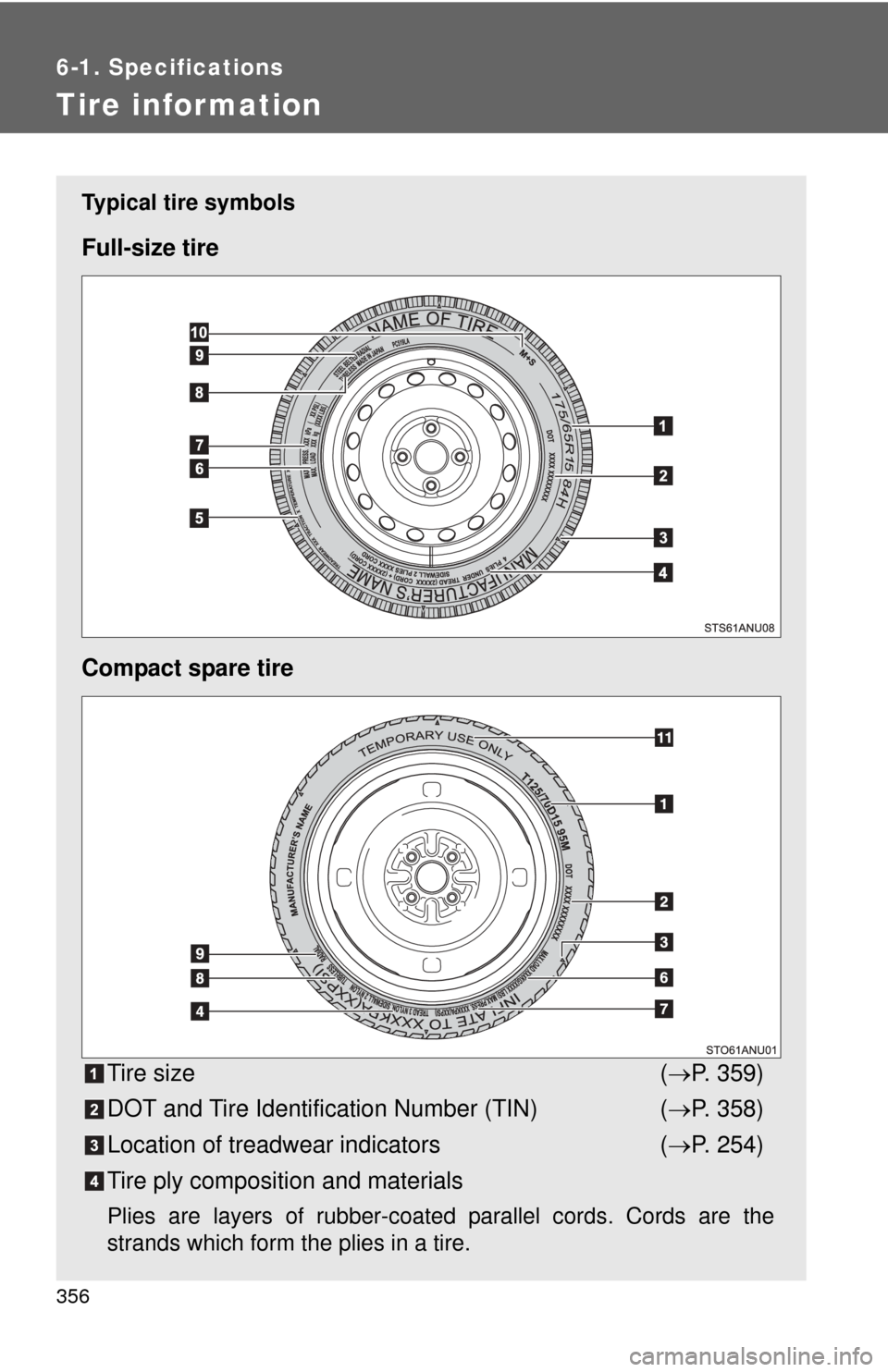
Typical tire symbols
Full-size tire
Compact spare tireTire size ( P. 359)
DOT and Tire Identification Number (TIN) ( P. 358)
Location of treadwear indicators ( P. 254)
Tire ply composition and materials
Plies are layers of rubber-coated parallel cords. Cords are the
strands which form the plies in a tire.
Page 357 of 400
357
6-1. Specifications
6
Vehicle specifications
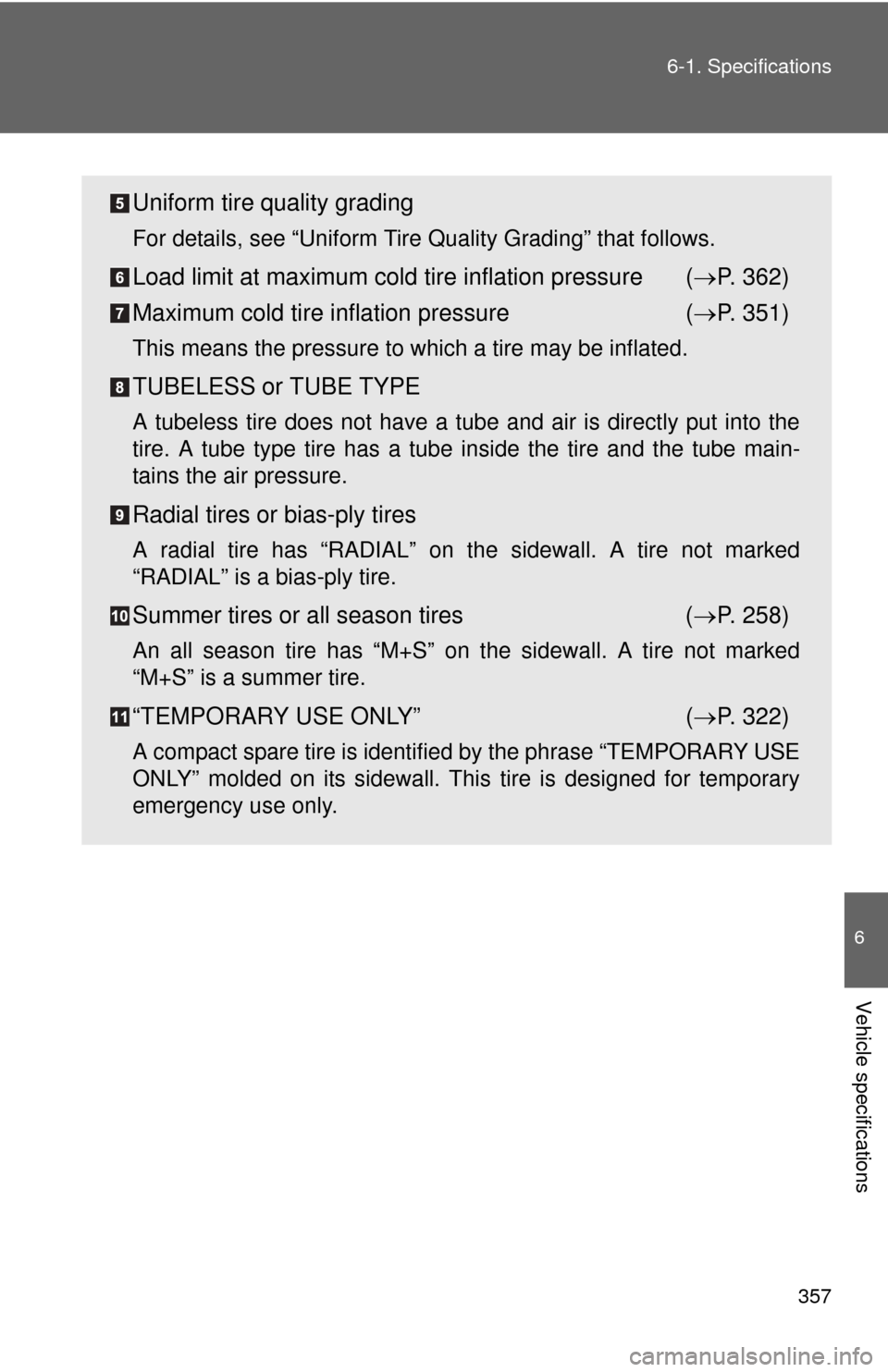
Uniform tire quality grading
For details, see “Uniform Tire Quality Grading” that follows.
Load limit at maximum cold tire inflation pressure (
P. 362)
Maximum cold tire inflation pressure ( P. 351)
This means the pressure to which a tire may be inflated.
TUBELESS or TUBE TYPE
A tubeless tire does not have a tube and air is directly put into the
tire. A tube type tire has a tube inside the tire and the tube main-
tains the air pressure.
Radial tires or bias-ply tires
A radial tire has “RADIAL” on the sidewall. A tire not marked
“RADIAL” is a bias-ply tire.
Summer tires or all season tires ( P. 258)
An all season tire has “M+S” on the sidewall. A tire not marked
“M+S” is a summer tire.
“TEMPORARY USE ONLY” ( P. 322)
A compact spare tire is identified by the phrase “TEMPORARY USE
ONLY” molded on its sidewall. This tire is designed for temporary
emergency use only.