door lock TOYOTA YARIS HATCHBACK 2016 Owner's Manual
[x] Cancel search | Manufacturer: TOYOTA, Model Year: 2016, Model line: YARIS HATCHBACK, Model: TOYOTA YARIS HATCHBACK 2016Pages: 368, PDF Size: 7.86 MB
Page 117 of 368
1174-1. Before driving
4
Driving
Vehicles with an automatic transmission
With the shift lever in D, depress the brake pedal.
If necessary, set the parking brake.
If the vehicle is to be stopped for an extended period of time, shift the shift
lever to P or N. (P. 139)
Vehicles with a manual transmission
While depressing the clutch pedal, depress the brake pedal.
If necessary, set the parking brake.
If the vehicle is to be stopped for an extended period of time, shift the shift
lever to N. (P. 141)
Vehicles with an automatic transmission
With the shift lever in D, depress the brake pedal.
Set the parking brake. ( P. 143)
Shift the shift lever to P. ( P. 139)
If parking on a hill, block the wheels as needed.
Turn the engine switch to the “L OCK” position to stop the engine.
Lock the door, making sure that you have the key on your person.
Stopping
Parking the vehicle
1
2
1
2
1
2
3
4
5
Page 118 of 368
1184-1. Before driving
Vehicles with a manual transmission
While depressing the clutch pedal, depress the brake pedal.
Set the parking brake. (P. 143)
Shift the shift lever to N. ( P. 141)
If parking on a hill, shift the shift lever to 1 or R and block the wheels as
needed.
Turn the engine switch to the “L OCK” position to stop the engine.
Lock the door, making sure that you have the key on your person.
Vehicles with an automatic transmission
Firmly set the parking brake with the brake pedal depressed, and
then shift the shift lever to D.
Release the brake pedal and gently depress the accelerator pedal.
Release the parking brake.
Vehicles with a manual transmission
With the parking brake firmly set and the clutch pedal fully
depressed, shift the shift lever to 1.
Lightly depress the accelerator pedal at the same time as gradually
releasing the clutch pedal.
Release the parking brake.
Starting off on a steep uphill
1
2
3
4
5
1
2
3
1
2
3
Page 124 of 368
1244-1. Before driving
WARNING
●Do not attach adhesive discs to the windshield or windows. Do not place
containers such as air fresheners on the instrument panel or dashboard.
Adhesive discs or containers may act as lenses, causing a fire in the vehi-
cle.
● Do not leave a door or window open if the curved glass is coated with a
metallized film such as a silver-colored one. Reflected sunlight may cause
the glass to act as a lens, causing a fire.
● Always apply the parking brake, shift the shift lever to P (automatic trans-
mission), stop the engine and lock the vehicle.
Do not leave the vehicle unattended while the engine is running.
● Do not touch the exhaust pipes while the engine is running or immediately
after turning the engine off.
Doing so may cause burns.
■ When taking a nap in the vehicle
Always turn the engine off. Otherwise, if you accidentally move the shift
lever or depress the accelerator pedal, this could cause an accident or fire
due to engine overheating. Additionally, if the vehicle is parked in a poorly
ventilated area, exhaust gases may collect and enter the vehicle, leading to
death or a serious health hazard.
■ When braking
● When the brakes are wet, drive more cautiously.
Braking distance increases when the brakes are wet, and this may cause
one side of the vehicle to brake differently than the other side. Also, the
parking brake may not securely hold the vehicle.
● If the power brake assist function does not operate, do not follow other\
vehicles closely and avoid hills or sharp turns that require braking.
In this case, braking is still possible, but the brake pedal should be
depressed more firmly than usual. Also, the braking distance will increase.
Have your brakes fixed immediately.
● Do not pump the brake pedal if the engine stalls.
Each push on the brake pedal uses up the reserve for the power-assisted
brakes.
● The brake system consists of 2 individual hydraulic systems; if one of the
systems fails, the other will still operate. In this case, the brake pedal
should be depressed more firmly than usual and the braking distance will
increase. Have your brakes fixed immediately.
Page 137 of 368
1374-2. Driving procedures
4
Driving
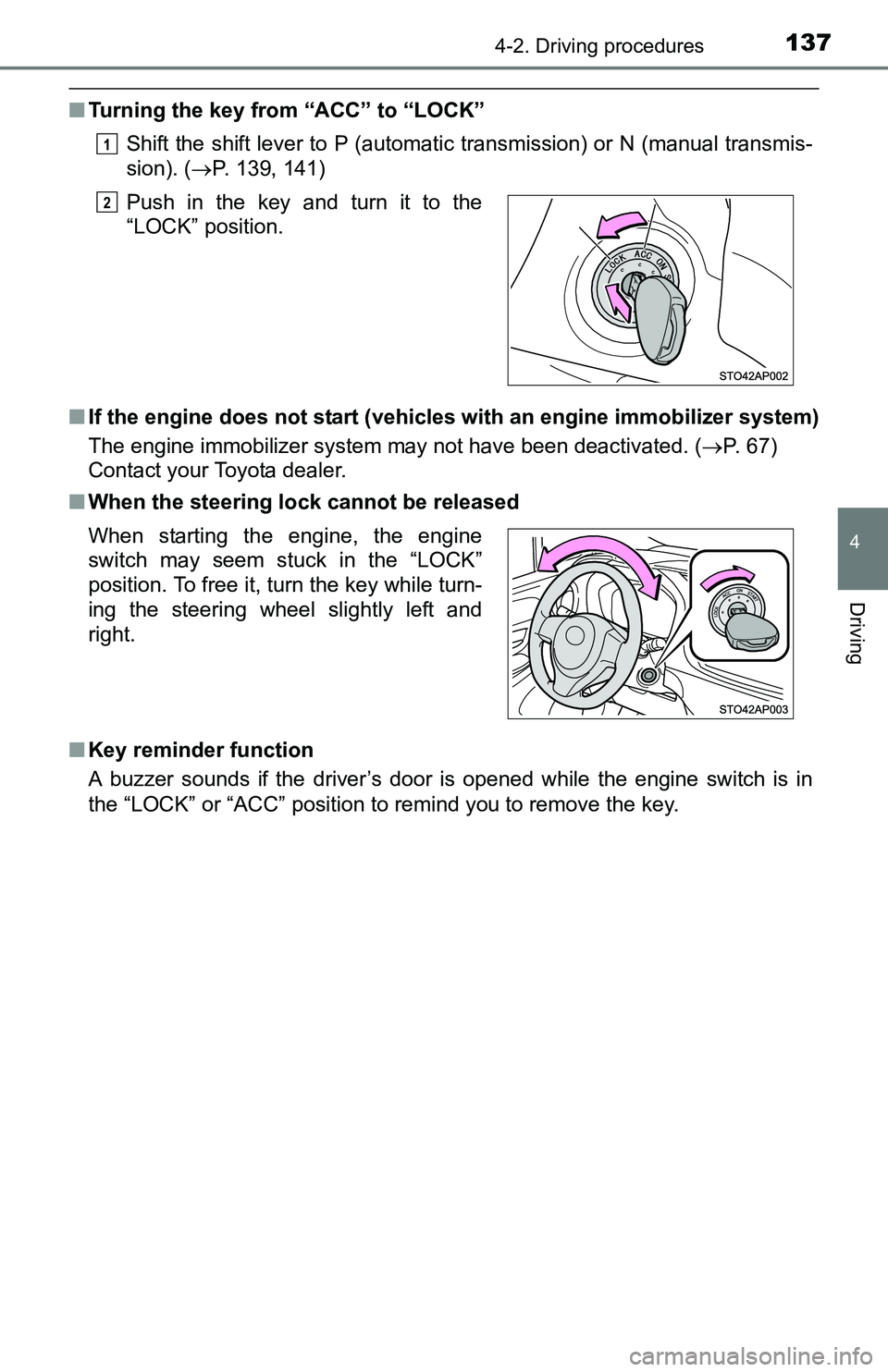
■Turning the key from “ACC” to “LOCK”
Shift the shift lever to P (automatic transmission) or N (manual transmis-
sion). ( P. 139, 141)
■ If the engine does not start (vehicl es with an engine immobilizer system)
The engine immobilizer system may not have been deactivated. ( P. 67)
Contact your Toyota dealer.
■ When the steering lock cannot be released
■ Key reminder function
A buzzer sounds if the driver’s door is opened while the engine switch is in
the “LOCK” or “ACC” position to remind you to remove the key. Push in the key and turn it to the
“LOCK” position.
When starting the engine, the engine
switch may seem stuck in the “LOCK”
position. To free it, turn the key while turn-
ing the steering wheel slightly left and
right.
1
2
Page 146 of 368
1464-3. Operating the lights and wipers
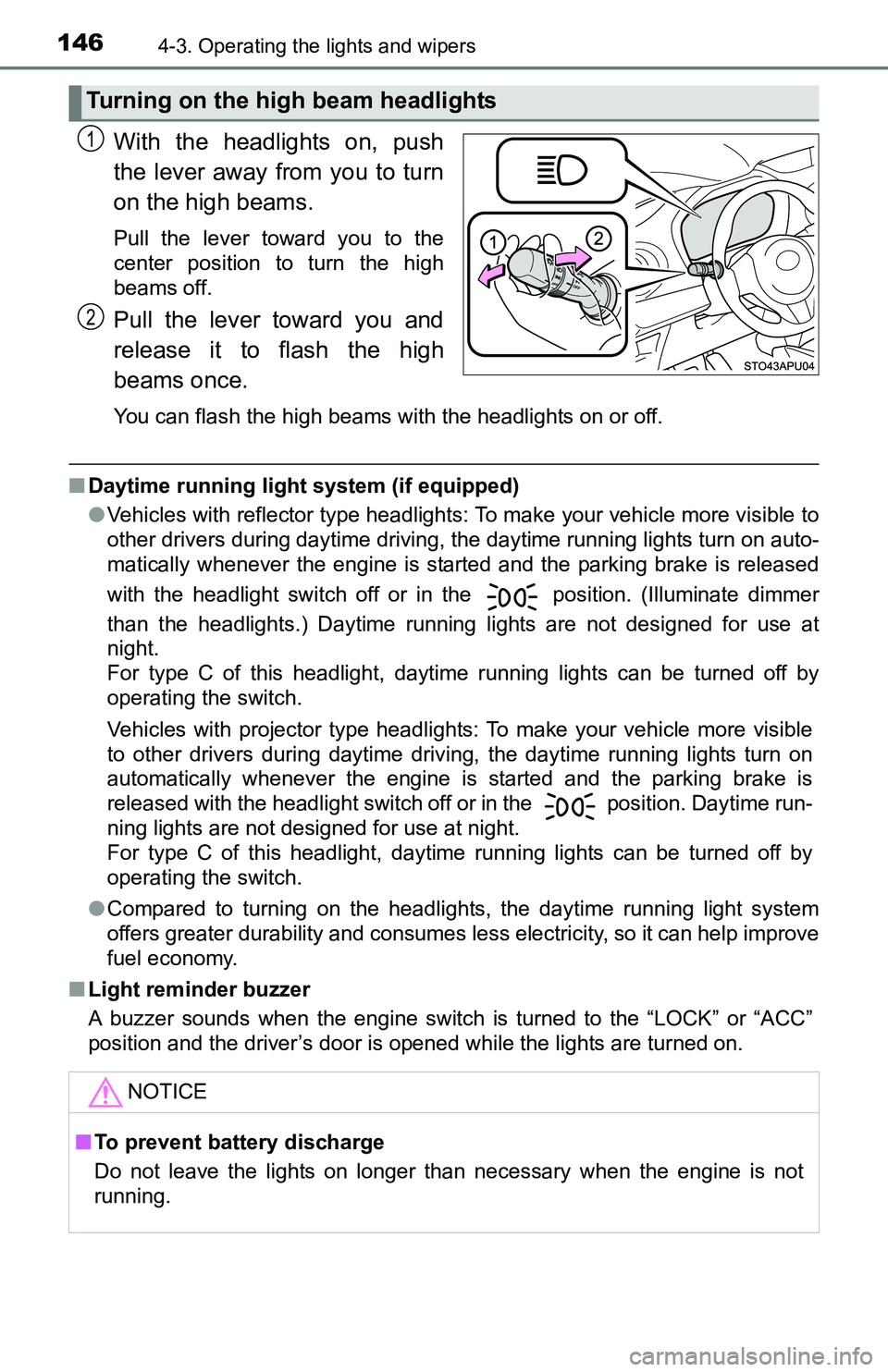
With the headlights on, push
the lever away from you to turn
on the high beams.
Pull the lever toward you to the
center position to turn the high
beams off.
Pull the lever toward you and
release it to flash the high
beams once.
You can flash the high beams with the headlights on or off.
■Daytime running light system (if equipped)
●Vehicles with reflector type headlights: To make your vehicle more visible to
other drivers during daytime driving, the daytime running lights turn on auto-
matically whenever the engine is started and the parking brake is released
with the headlight switch off or in the position. (Illuminate dimmer
than the headlights.) Daytime running lights are not designed for use at
night.
For type C of this headlight, daytime running lights can be turned off by
operating the switch.
Vehicles with projector type headlights: To make your vehicle more visible
to other drivers during daytime driving, the daytime running lights turn on
automatically whenever the engine is started and the parking brake is
released with the headlight switch off or in the position. Daytime run-
ning lights are not designed for use at night.
For type C of this headlight, daytime running lights can be turned off by
operating the switch.
● Compared to turning on the headlights, the daytime running light system
offers greater durability and consumes less electricity, so it can help improve
fuel economy.
■ Light reminder buzzer
A buzzer sounds when the engine switch is turned to the “LOCK” or “ACC”
position and the driver’s door is opened while the lights are turned on.
Turning on the high beam headlights
1
2
NOTICE
■To prevent battery discharge
Do not leave the lights on longer than necessary when the engine is not
running.
Page 183 of 368
1835-3. Using the interior lights
5
Interior features
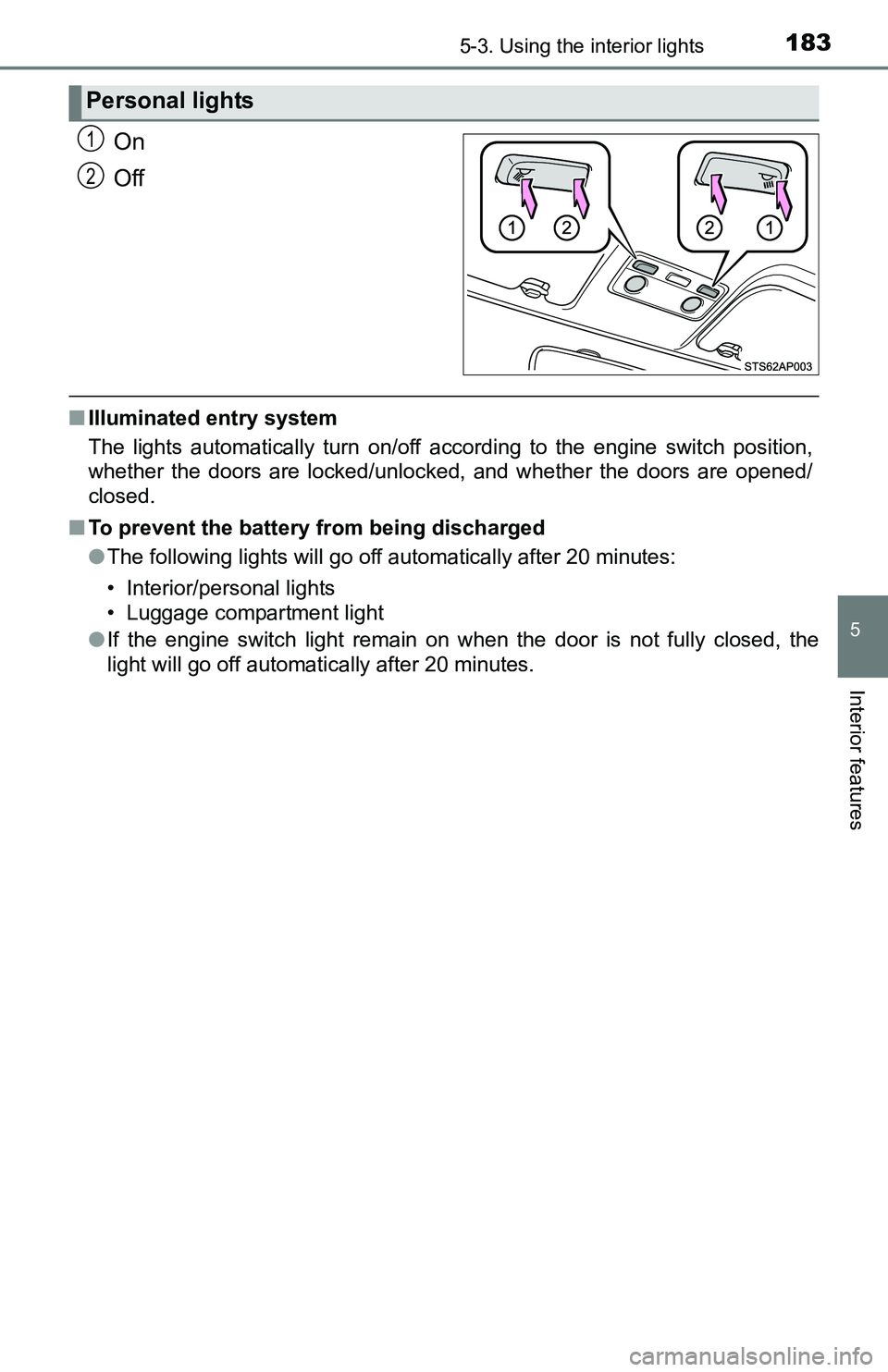
On
Off
■Illuminated entry system
The lights automatically turn on/off according to the engine switch position,
whether the doors are locked/unlocked, and whether the doors are opened/
closed.
■ To prevent the battery from being discharged
●The following lights will go off automatically after 20 minutes:
• Interior/personal lights
• Luggage compartment light
● If the engine switch light remain on when the door is not fully closed, \
the
light will go off automatically after 20 minutes.
Personal lights
1
2
Page 204 of 368
2046-2. Maintenance
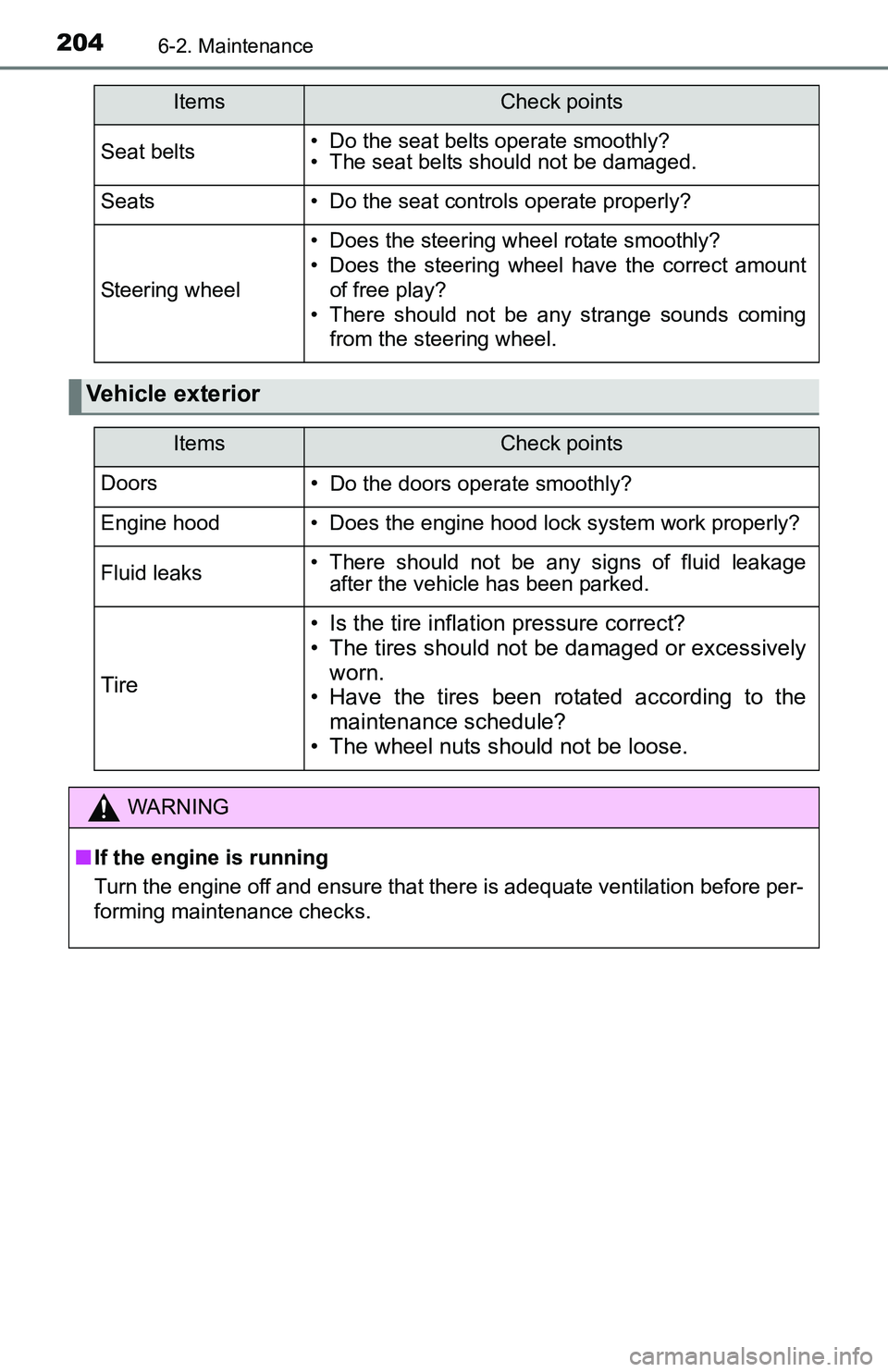
Seat belts• Do the seat belts operate smoothly?
• The seat belts should not be damaged.
Seats• Do the seat controls operate properly?
Steering wheel
• Does the steering wheel rotate smoothly?
• Does the steering wheel have the correct amountof free play?
• There should not be any strange sounds coming from the steering wheel.
Vehicle exterior
ItemsCheck points
ItemsCheck points
Doors•Do the doors operate smoothly?
Engine hood• Does the engine hood lock system work properly?
Fluid leaks• There should not be any signs of fluid leakageafter the vehicle has been parked.
Tire
• Is the tire inflation pressure correct?
• The tires should not be damaged or excessively
worn.
• Have the tires been rotated according to the
maintenance schedule?
• The wheel nuts should not be loose.
WARNING
■ If the engine is running
Turn the engine off and ensure that there is adequate ventilation before per-
forming maintenance checks.
Page 255 of 368
2556-3. Do-it-yourself maintenance
6
Maintenance and care
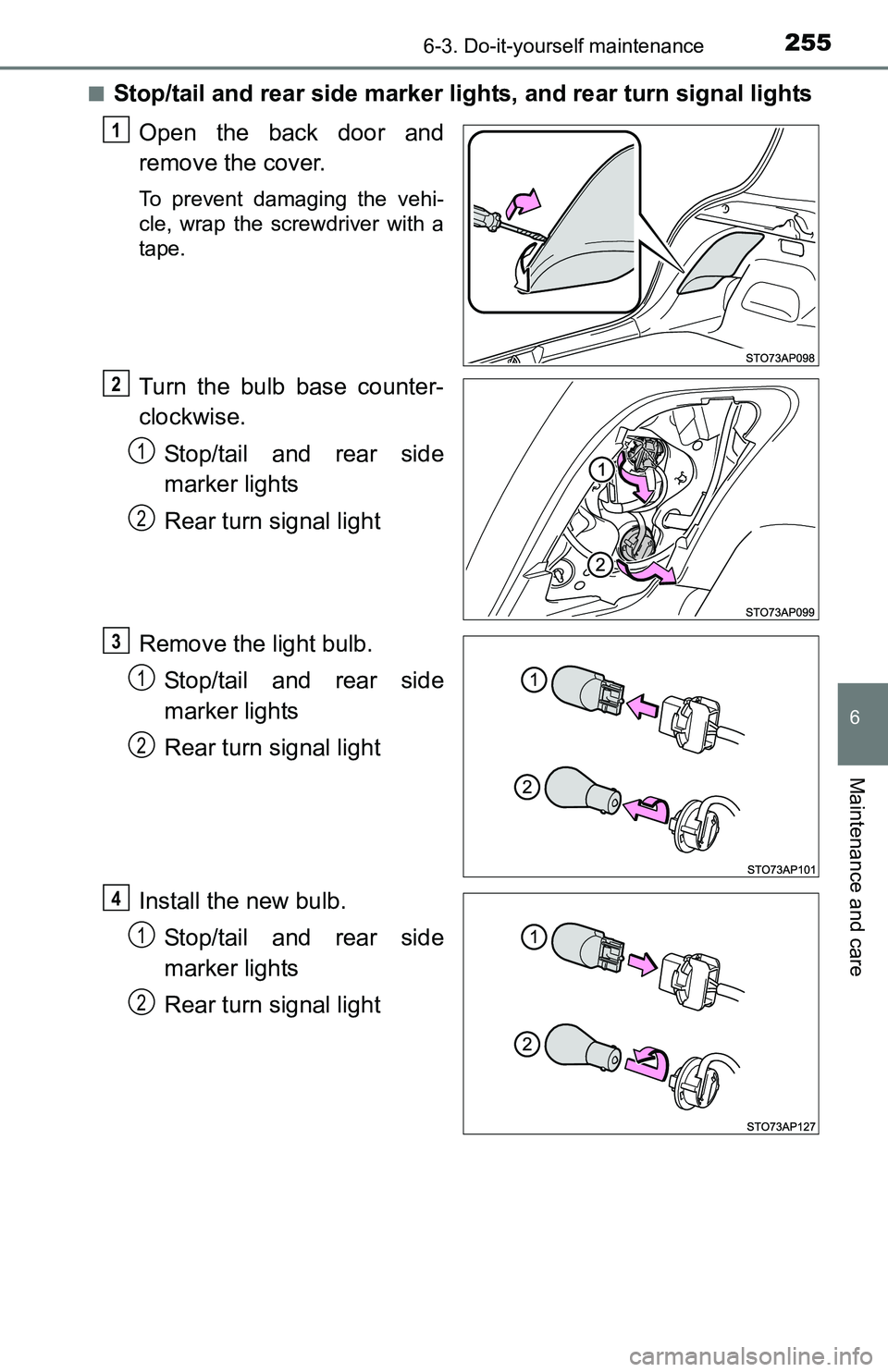
■Stop/tail and rear side marker lights, and rear turn signal lightsOpen the back door and
remove the cover.
To prevent damaging the vehi-
cle, wrap the screwdriver with a
tape.
Turn the bulb base counter-
clockwise.Stop/tail and rear side
marker lights
Rear turn signal light
Remove the light bulb. Stop/tail and rear side
marker lights
Rear turn signal light
Install the new bulb. Stop/tail and rear side
marker lights
Rear turn signal light
1
2
1
2
3
1
2
4
1
2
Page 333 of 368
3338-2. Customization
8
Vehicle specifications
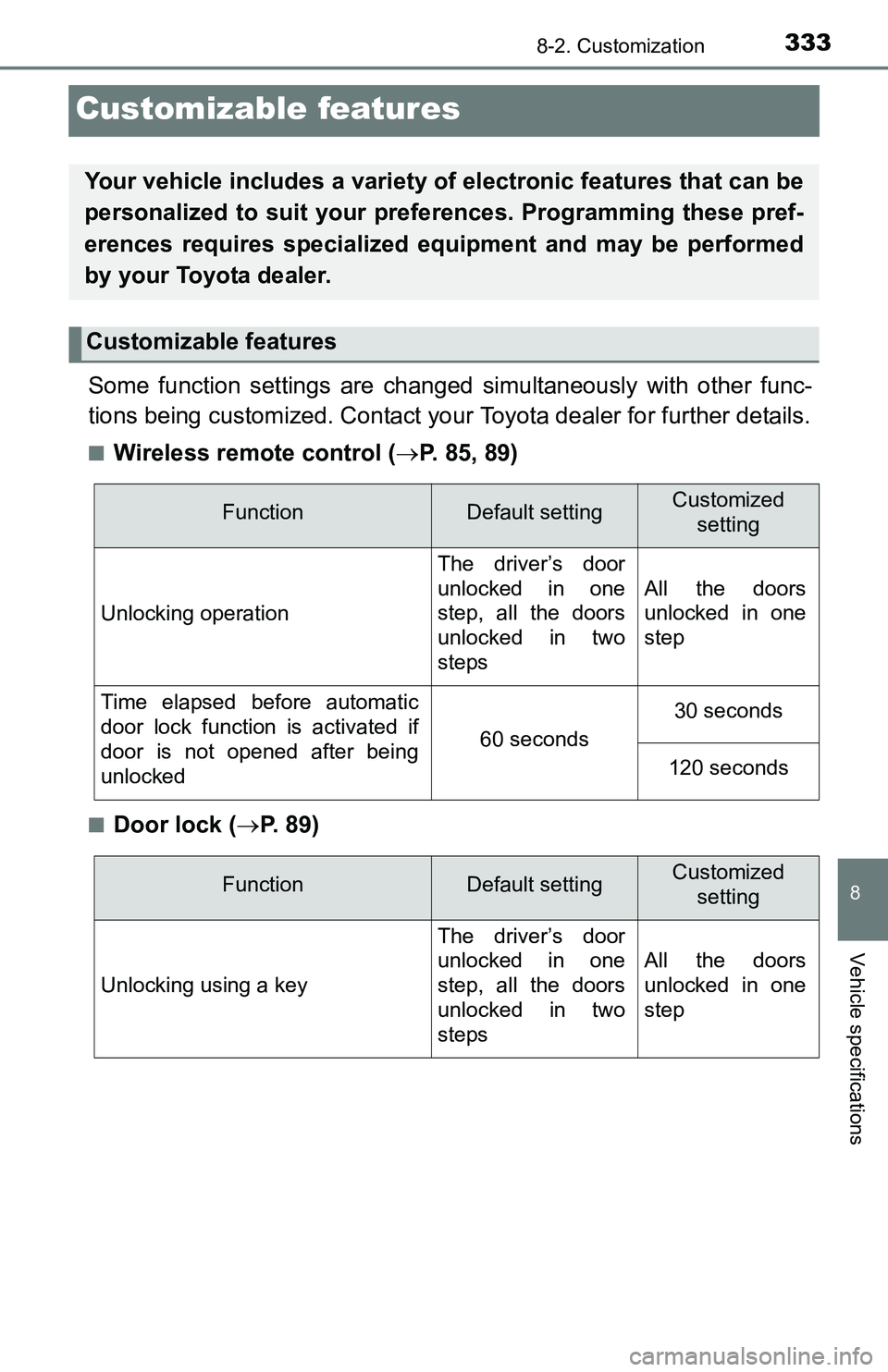
Customizable features
Some function settings are changed simultaneously with other func-
tions being customized. Contact your Toyota dealer for further details.
■Wireless remote control ( P. 85, 89)
■Door lock ( P. 8 9 )
Your vehicle includes a variety of electronic features that can be
personalized to suit your preferences. Programming these pref-
erences requires specialized e quipment and may be performed
by your Toyota dealer.
Customizable features
FunctionDefault settingCustomized setting
Unlocking operation The driver’s door
unlocked in one
step, all the doors
unlocked in two
stepsAll the doors
unlocked in one
step
Time elapsed before automatic
door lock function is activated if
door is not opened after being
unlocked
60 seconds
30 seconds
120 seconds
FunctionDefault settingCustomized setting
Unlocking using a key The driver’s door
unlocked in one
step, all the doors
unlocked in two
stepsAll the doors
unlocked in one
step
Page 352 of 368
352What to do if... (Troubleshooting)
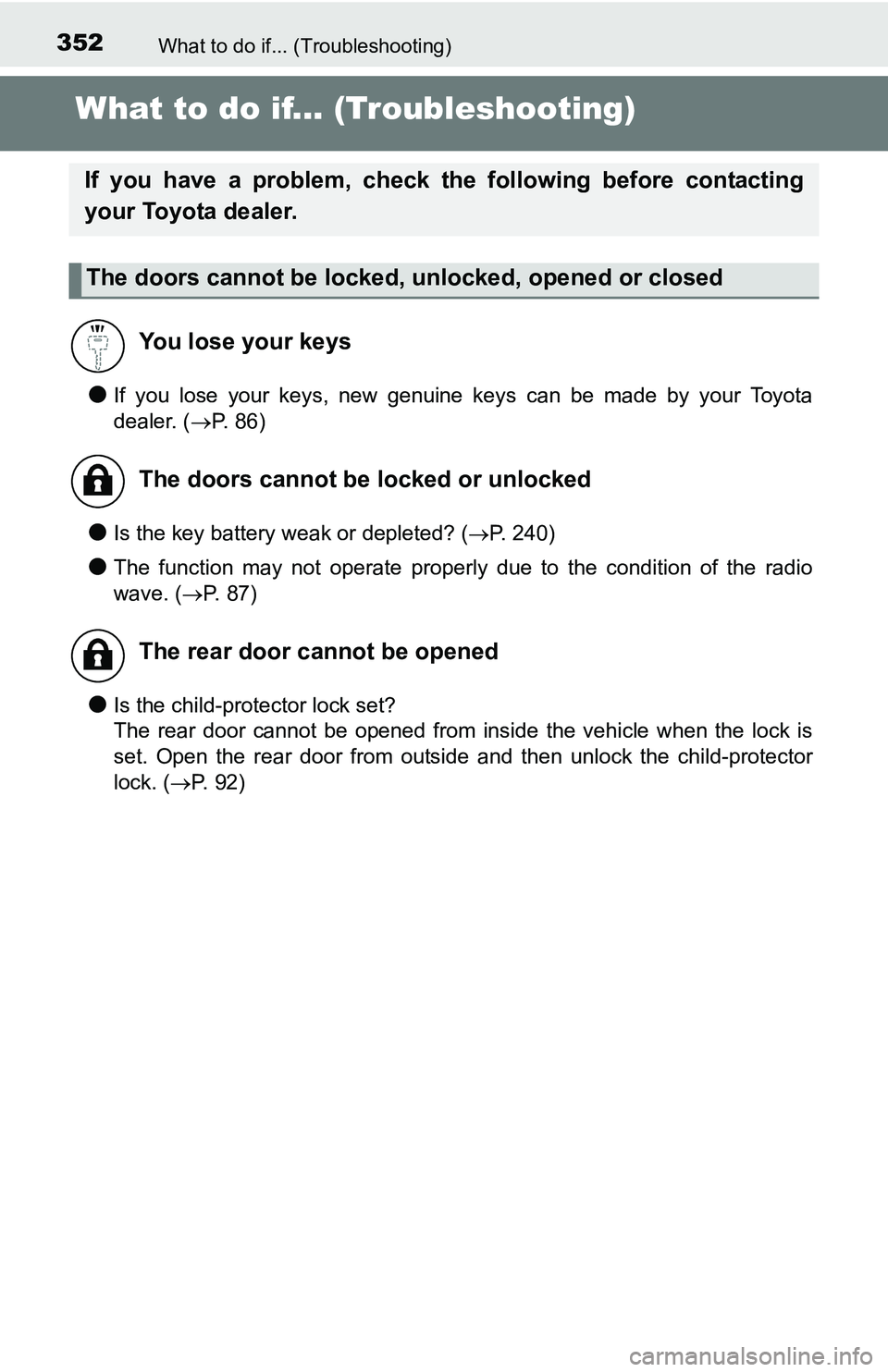
What to do if... (Troubleshooting)
●If you lose your keys, new genuine keys can be made by your Toyota
dealer. (P. 86)
●Is the key battery weak or depleted? ( P. 240)
●The function may not operate properly due to the condition of the radio
wave. (P. 87)
●Is the child-protector lock set?
The rear door cannot be opened from inside the vehicle when the lock is
set. Open the rear door from outside and then unlock the child-protector
lock. (P. 92)
If you have a problem, check the following before contacting
your Toyota dealer.
The doors cannot be locked, unlocked, opened or closed
You lose your keys
The doors cannot be locked or unlocked
The rear door cannot be opened