key TOYOTA YARIS SEDAN 2011 User Guide
[x] Cancel search | Manufacturer: TOYOTA, Model Year: 2011, Model line: YARIS SEDAN, Model: TOYOTA YARIS SEDAN 2011Pages: 406, PDF Size: 9.23 MB
Page 48 of 406
34 1-2. Opening, closing and locking the doors
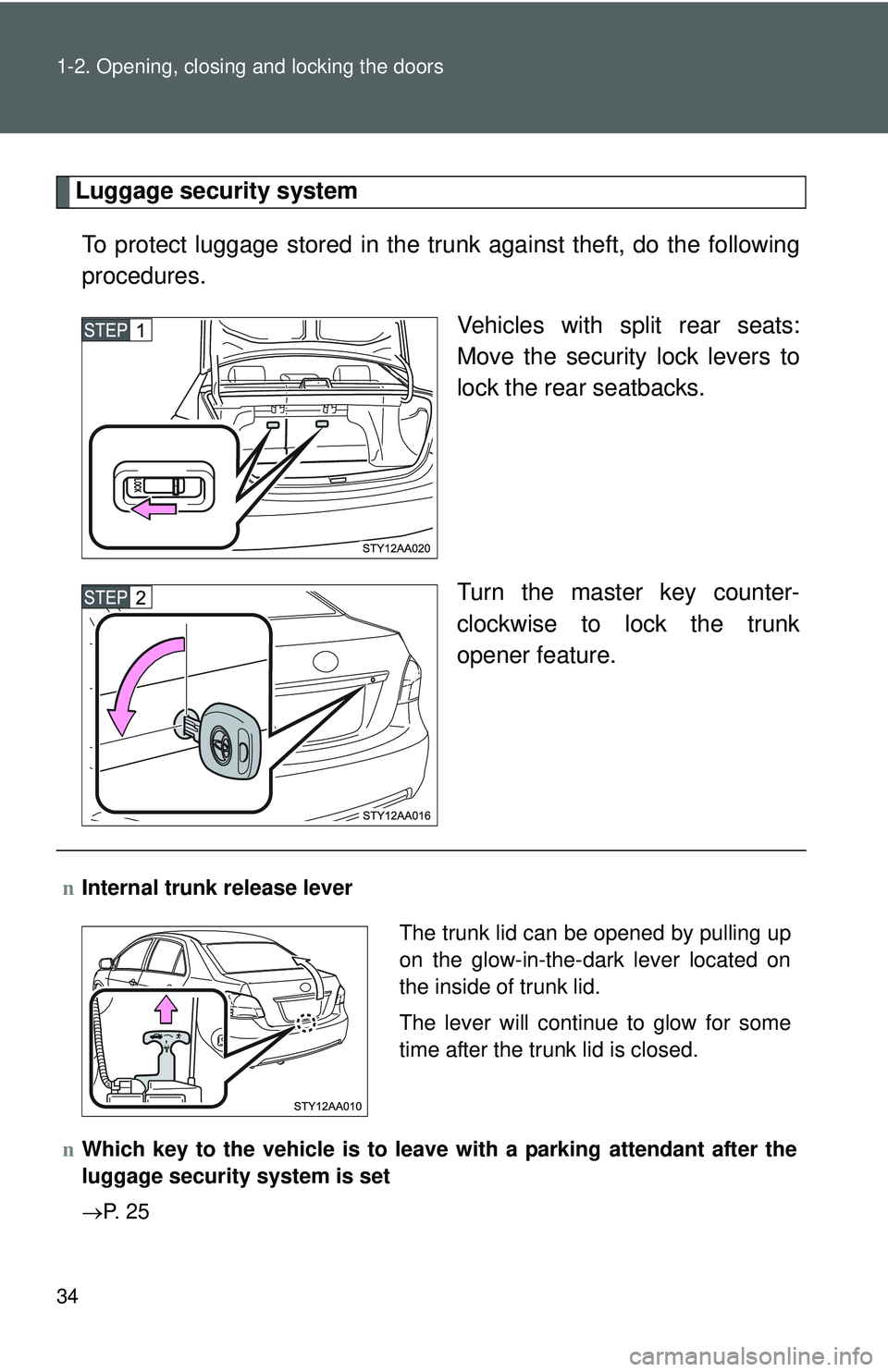
Luggage security systemTo protect luggage stored in the trunk against theft, do the following
procedures. Vehicles with split rear seats:
Move the security lock levers to
lock the rear seatbacks.
Turn the master key counter-
clockwise to lock the trunk
opener feature.
nInternal trunk release lever
n Which key to the vehicle is to leave with a parking attendant after the
luggage security system is set
→ P. 2 5 The trunk lid can be opened by pulling up
on the glow-in-the-dark lever located on
the inside of trunk lid.
The lever will continue to glow for some
time after the trunk lid is closed.
Page 52 of 406
38
1-3. Adjustable components (seats, mirrors, steering wheel)
Rear seats (split rear seats only)
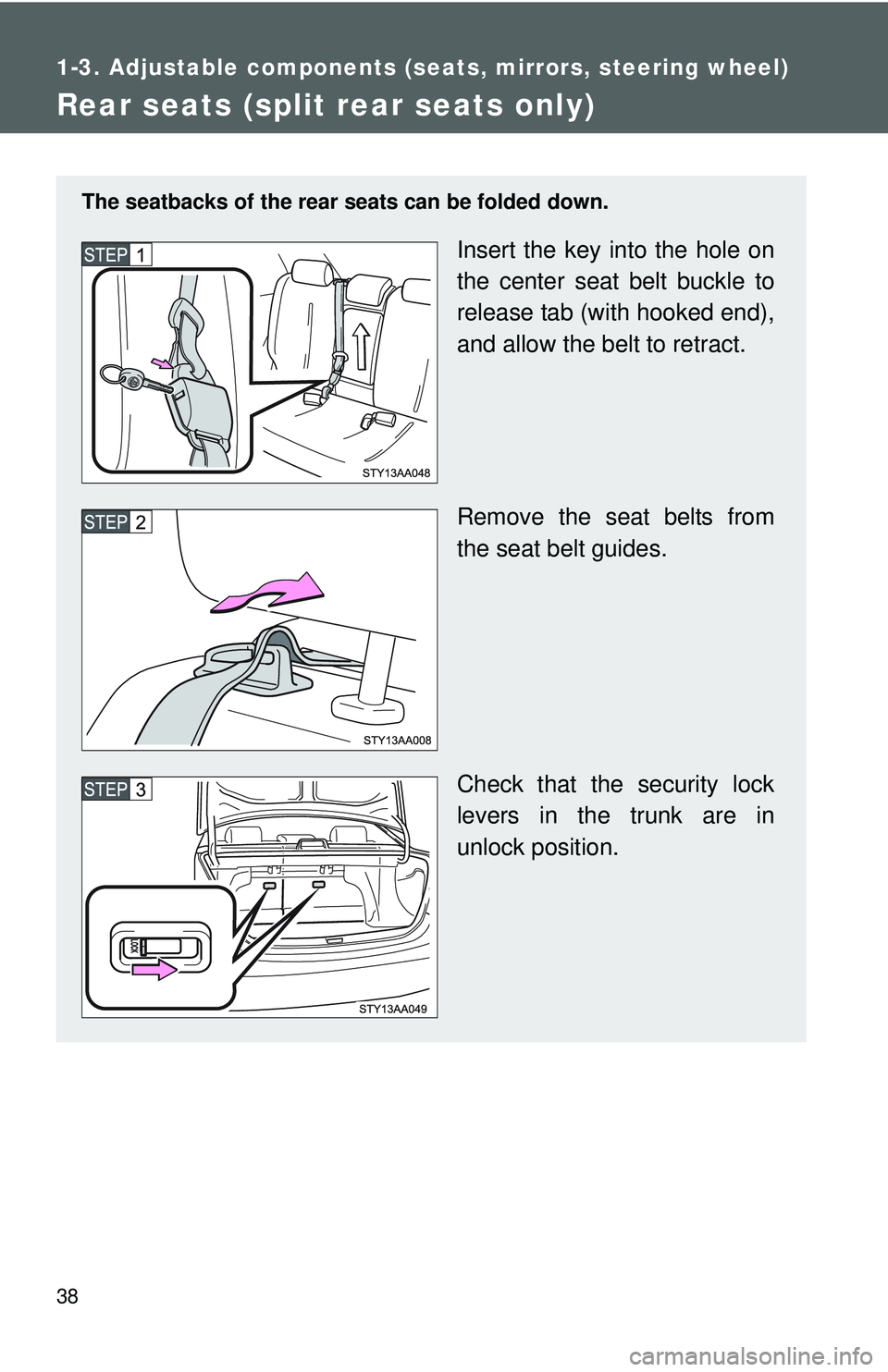
The seatbacks of the rear seats can be folded down.
Insert the key into the hole on
the center seat belt buckle to
release tab (with hooked end),
and allow the belt to retract.
Remove the seat belts from
the seat belt guides.
Check that the security lock
levers in the trunk are in
unlock position.
Page 60 of 406
46 1-3. Adjustable components (seats, mirrors, steering wheel)
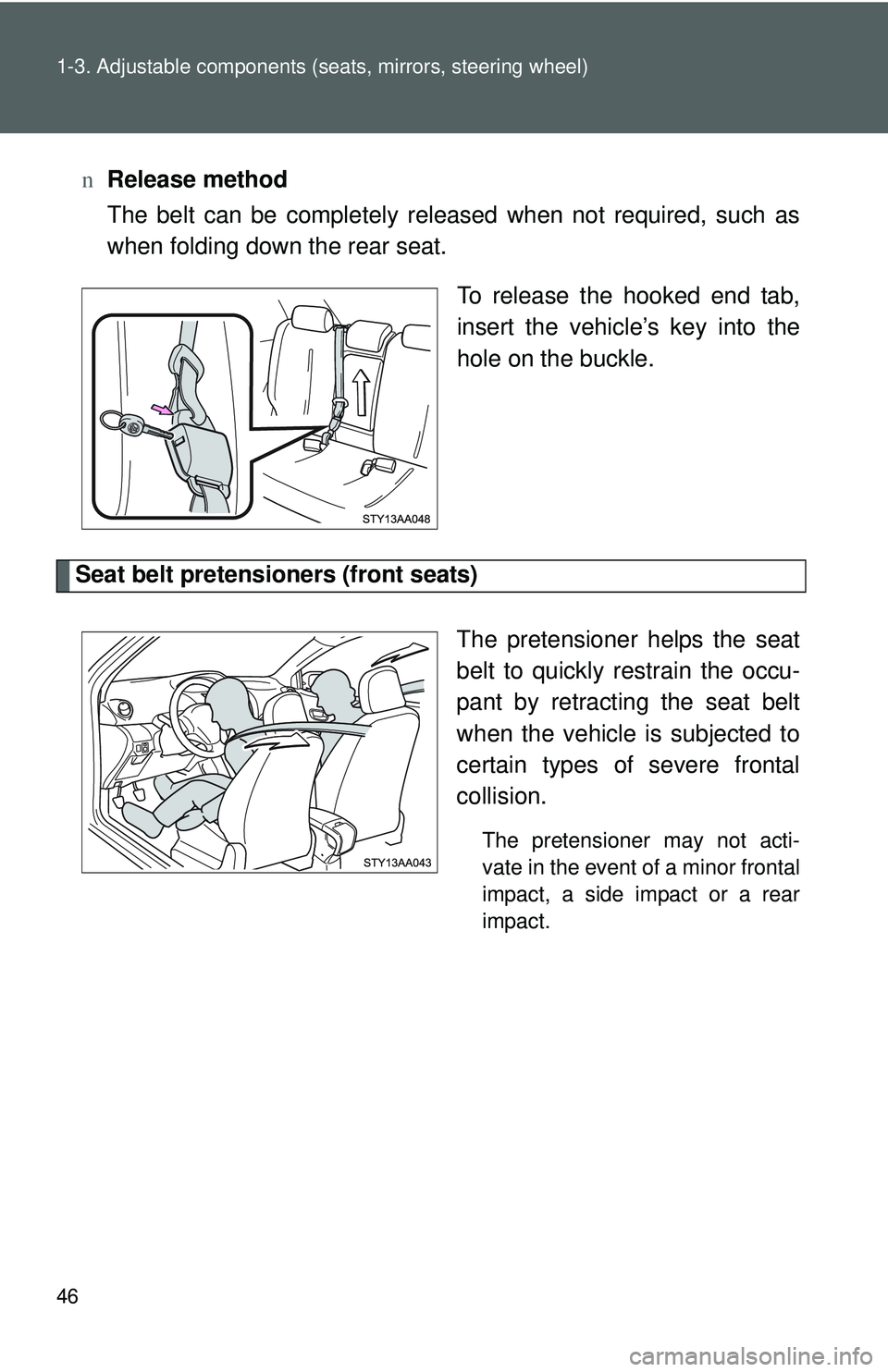
nRelease method
The belt can be completely released when not required, such as
when folding down the rear seat.
To release the hooked end tab,
insert the vehicle’s key into the
hole on the buckle.
Seat belt pretensioners (front seats)
The pretensioner helps the seat
belt to quickly restrain the occu-
pant by retracting the seat belt
when the vehicle is subjected to
certain types of severe frontal
collision.
The pretensioner may not acti-
vate in the event of a minor frontal
impact, a side impact or a rear
impact.
Page 77 of 406
63
1
Before driving
1-6. Theft deterrent system
Engine immobilizer system∗
∗: If equipped
nSystem maintenance
The vehicle has a maintenance-free type engine immobilizer system.
n Conditions that may cause the system to malfunction
l If the key is in contact with a metallic object
l If the key is in close proximity to or touching a key to the security system
(key with a built-in transponder chip) of another vehicle
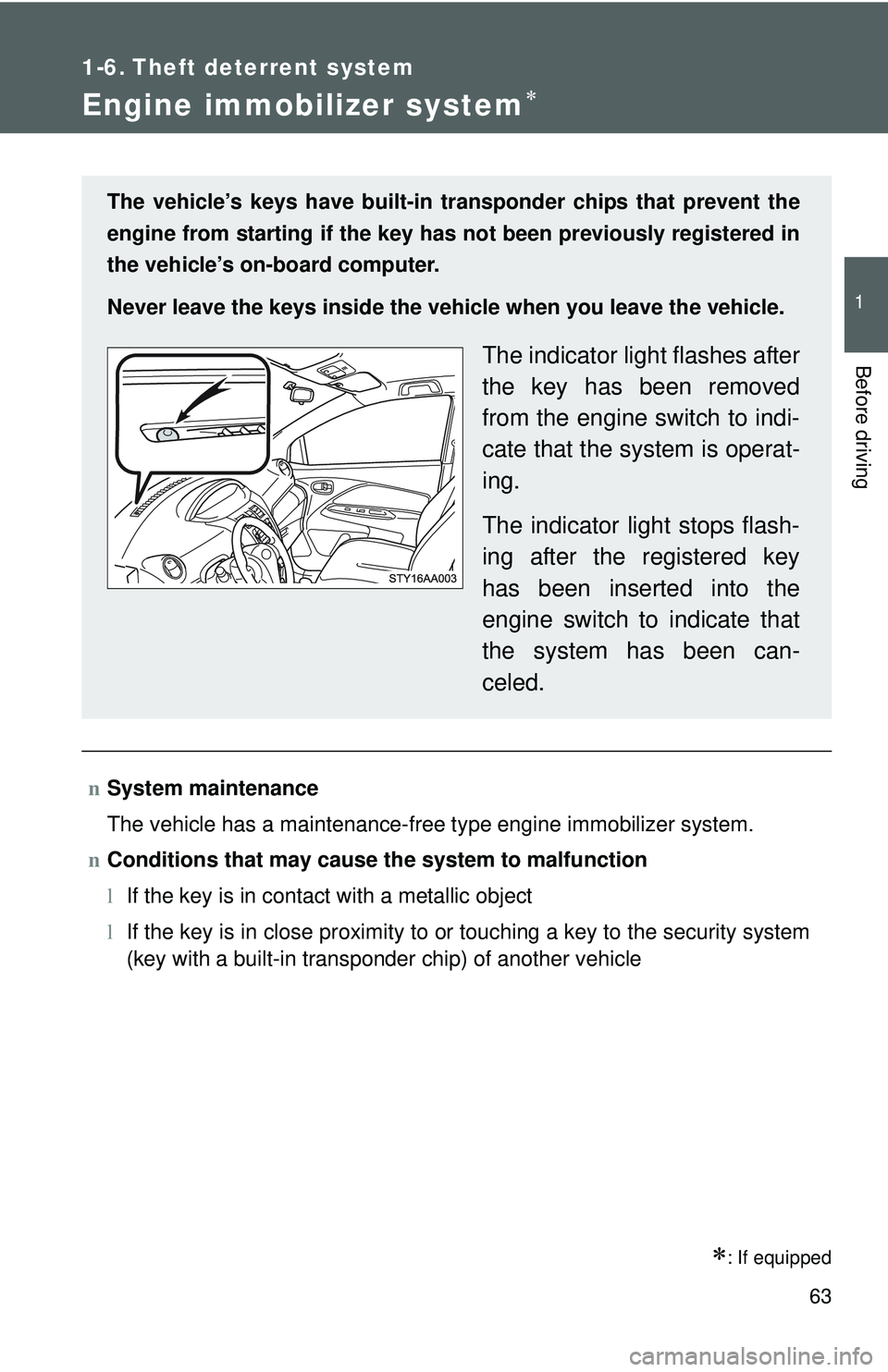
The vehicle’s keys have built-in tr
ansponder chips that prevent the
engine from starting if the key has not been previously registered in
the vehicle’s on-board computer.
Never leave the keys inside the vehicle when you leave the vehicle.
The indicator light flashes after
the key has been removed
from the engine switch to indi-
cate that the system is operat-
ing.
The indicator light stops flash-
ing after the registered key
has been inserted into the
engine switch to indicate that
the system has been can-
celed.
Page 79 of 406
65
1
1-6. Theft deterrent system
Before driving
Alarm (Puerto Rico)
The system sounds the alarm and flashes lights when forcible entry
is detected.
n Triggering of the alarm
The alarm is triggered in the fo llowing situations when the alarm
is set.
l A locked door or trunk is unlocked or opened in any way other
than using the key (vehicles without wireless remote control)
or wireless remote control d oor lock function (vehicles with
wireless remote control). (The doors will lock again automati-
cally.)
l The hood is opened.
l The battery is reconnected.
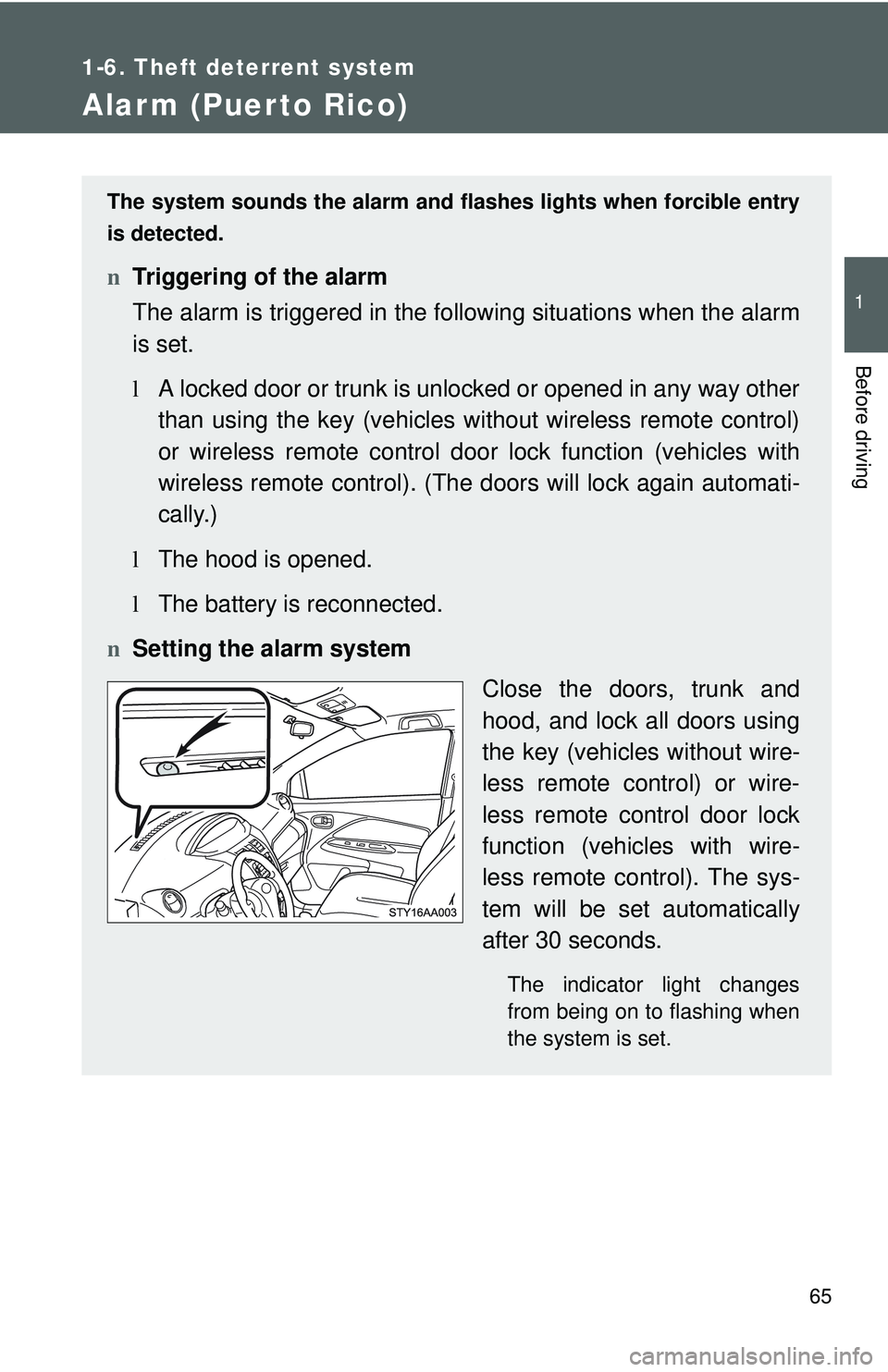
n Setting the alarm system
Close the doors, trunk and
hood, and lock all doors using
the key (vehicles without wire-
less remote control) or wire-
less remote control door lock
function (vehicles with wire-
less remote control). The sys-
tem will be set automatically
after 30 seconds.
The indicator light changes
from being on to flashing when
the system is set.
Page 81 of 406
67
1-6. Theft deterrent system
1
Before driving
n
When the battery is disconnected
Be sure to deactivate the alarm system.
If the battery is discharged before deactivating the alarm system, the alarm
may be triggered when the battery is reconnected.
n Alarm-operated door lock
lWhen the alarm is operating, the doors are locked automatically to pre-
vent intruders.
l Do not leave the key inside the vehicle when the alarm is operating, and
make sure the key is not inside the vehicle when recharging or replacing
the battery.
NOTICE
nTo ensure the system operates correctly
Do not modify or remove the system. If modified or removed, the proper
operation of the system cannot be guaranteed.
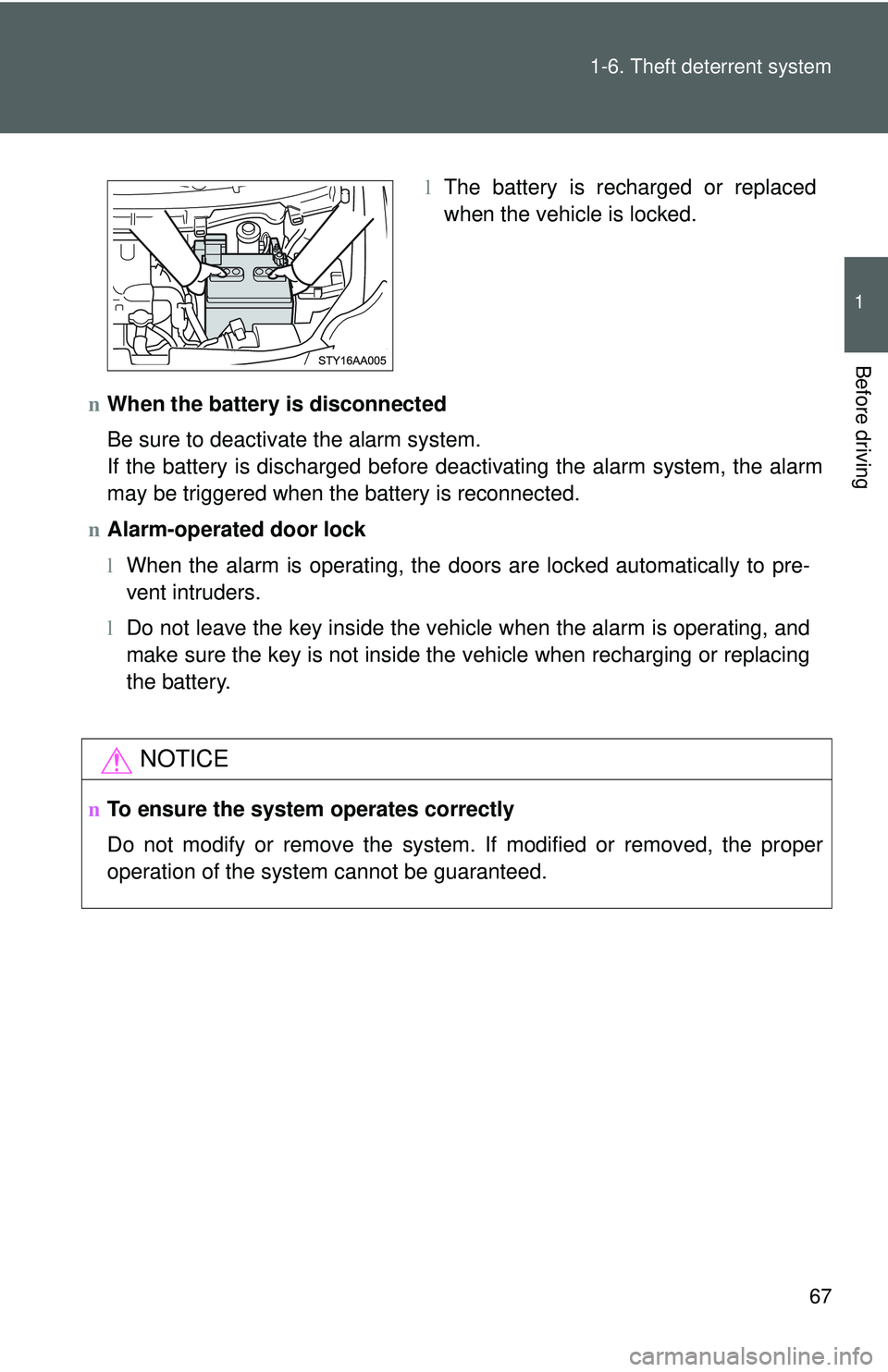
lThe battery is recharged or replaced
when the vehicle is locked.
Page 116 of 406
103
2-1. Driving procedures
2
When driving
Starting on a steep uphill
Automatic transmission With the brake pedal depressed, firmly set the parking brake
and shift the shift lever to D.
Gently depress the accelerator pedal.
Release the parking brake.
Manual transmission With the parking brake firmly set and the clutch pedal fully
depressed, shift the shift lever to 1.
nParking the vehicle
Automatic transmission
With the shift lever in D, depress the brake pedal.
Set the parking brake. ( →P. 120)
Shift the shift lever to P. ( →P. 116)
When parking on a hill, if necessary, block the wheels.
Turn the engine switch off to stop the engine.
Lock the door, making sure that you have the key on your
person.
Manual transmission
With the clutch pedal fully depressed, depress the brake
pedal.
Set the parking brake. ( →P. 120)
Shift the shift lever to N. ( →P. 118)
When parking on a hill, shift the shift lever to 1 or R. If necessary,
block the wheels.
Turn the engine switch off to stop the engine.
Lock the door, making sure that you have the key on your
person.
Page 125 of 406
112
2-1. Driving procedures
Engine (ignition) switch
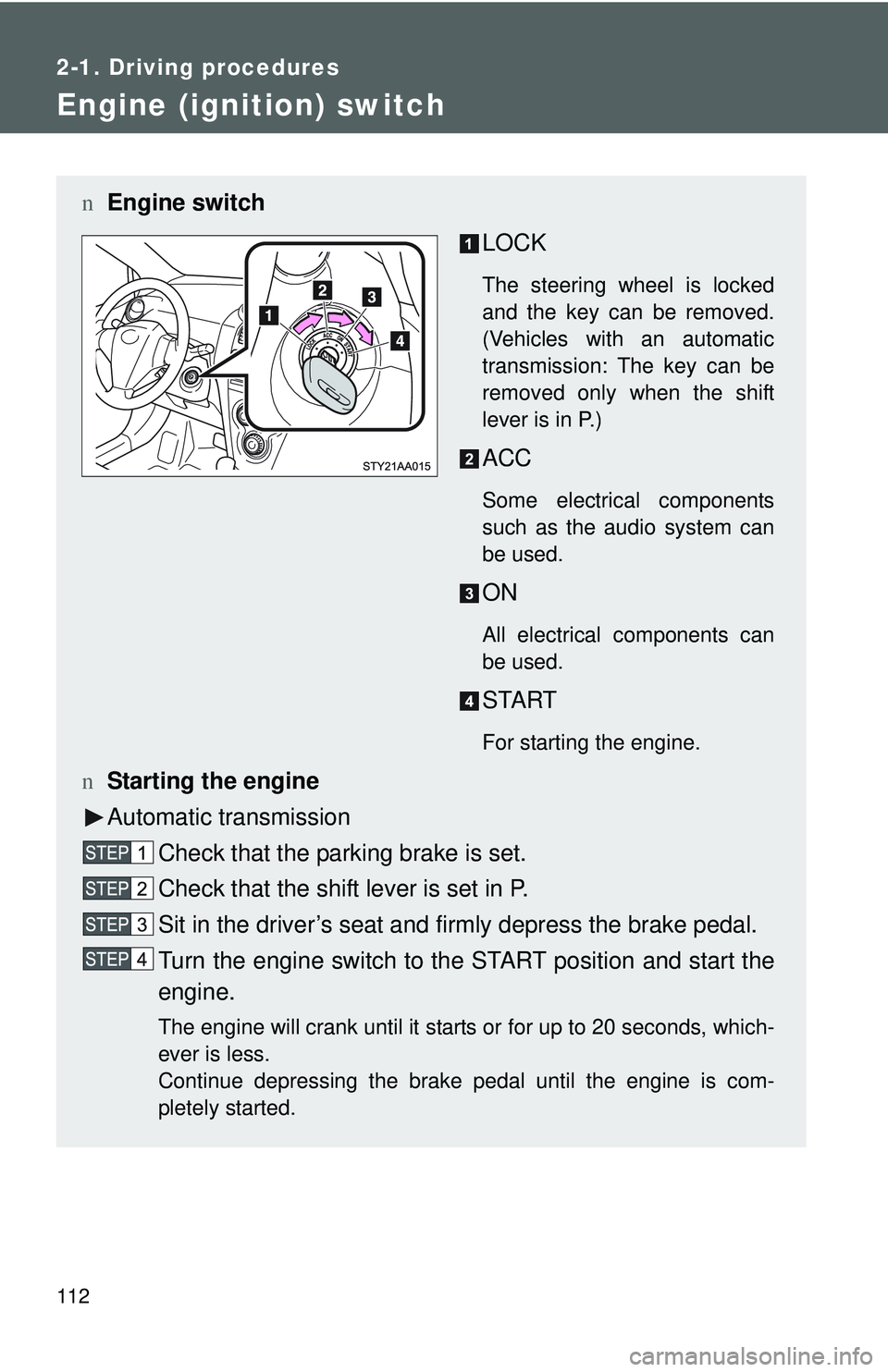
nEngine switch
LOCK
The steering wheel is locked
and the key can be removed.
(Vehicles with an automatic
transmission: The key can be
removed only when the shift
lever is in P.)
ACC
Some electrical components
such as the audio system can
be used.
ON
All electrical components can
be used.
START
For starting the engine.
nStarting the engine
Automatic transmission
Check that the parking brake is set.
Check that the shift lever is set in P.
Sit in the driver’s seat and firmly depress the brake pedal.
Turn the engine switch to the START position and start the
engine.
The engine will crank until it starts or for up to 20 seconds, which-
ever is less.
Continue depressing the brake pedal until the engine is com-
pletely started.
Page 127 of 406
114 2-1. Driving procedures
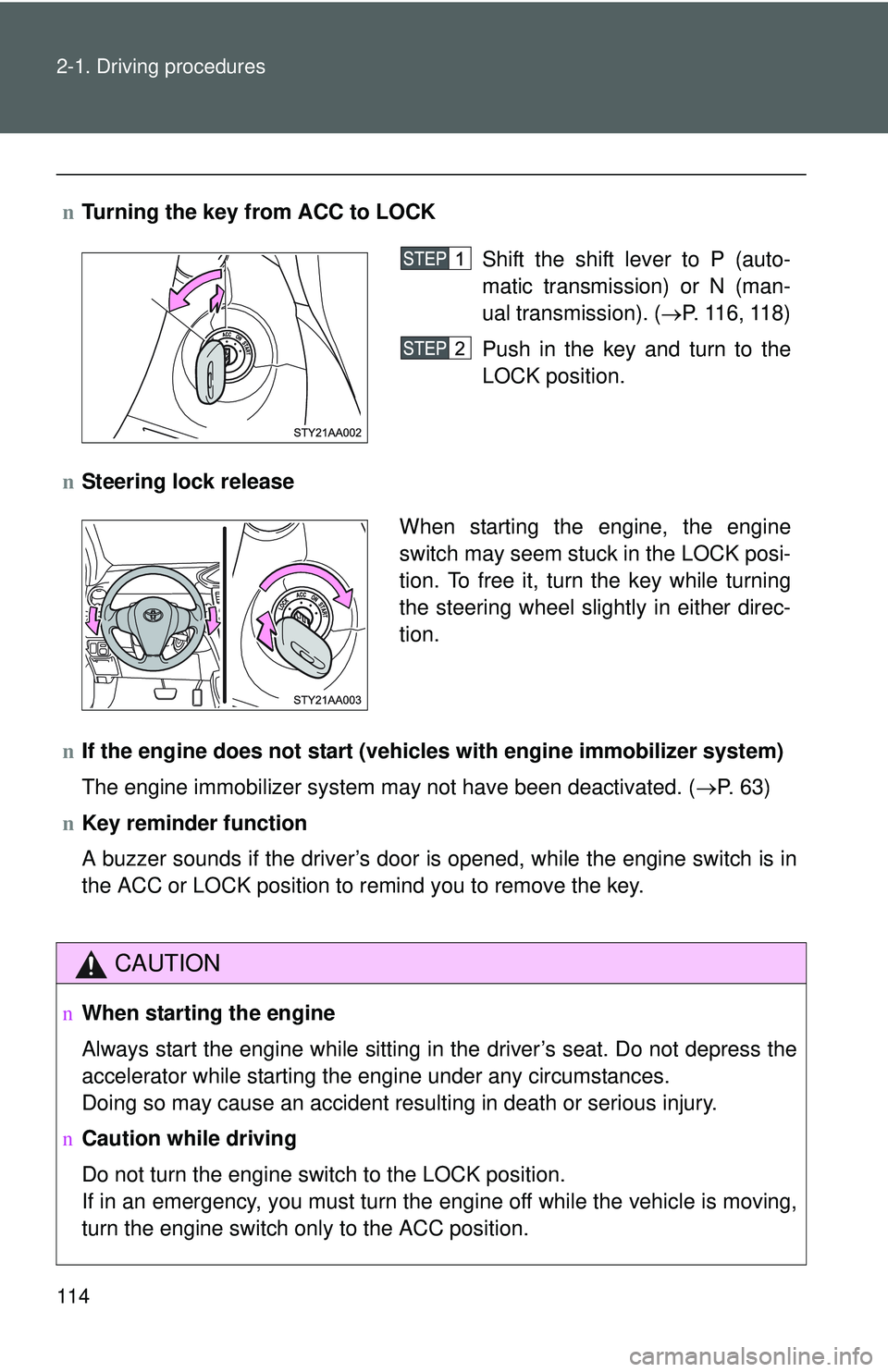
nTurning the key from ACC to LOCK
n Steering lock release
n If the engine does not start (vehic les with engine immobilizer system)
The engine immobilizer system may not have been deactivated. ( →P. 63)
n Key reminder function
A buzzer sounds if the driver’s door is opened, while the engine switch is in
the ACC or LOCK position to remind you to remove the key.
CAUTION
nWhen starting the engine
Always start the engine while sitting in the driver’s seat. Do not depress the
accelerator while starting the engine under any circumstances.
Doing so may cause an accident resulting in death or serious injury.
n Caution while driving
Do not turn the engine switch to the LOCK position.
If in an emergency, you must turn the engine off while the vehicle is moving,
turn the engine switch only to the ACC position.
Shift the shift lever to P (auto-
matic transmission) or N (man-
ual transmission). ( →P. 116, 118)
Push in the key and turn to the
LOCK position.
When starting the engine, the engine
switch may seem stuck in the LOCK posi-
tion. To free it, turn the key while turning
the steering wheel slightly in either direc-
tion.
Page 146 of 406
133
2-3. Operating the lights and wipers
2
When driving
n
Daytime running light system (if equipped)
lTo make your vehicle more visible to other drivers, the headlights turn on
automatically (at a reduced intensity) whenever the engine is started and
the parking brake is released. Daytime running lights are not designed for
use at night.
l Compared to turning on the headlights, the daytime running light system
offers greater durability and consumes less electricity, so it can help
improve fuel economy.
n Light reminder buzzer
A buzzer sounds when the key is removed and the driver’s door is opened
while the lights are turned on.
NOTICE
nTo prevent battery discharge
Do not leave the lights on longer than necessary when the engine is not run-
ning.