brake light VAUXHALL CORSA 2014.5 Owner's Manual
[x] Cancel search | Manufacturer: VAUXHALL, Model Year: 2014.5, Model line: CORSA, Model: VAUXHALL CORSA 2014.5Pages: 231, PDF Size: 6.8 MB
Page 13 of 231

In brief11
1Side air vents ...................... 112
2 Light switch .......................... 98
Instrument illumination .......103
Rear fog light ....................... 102
Front fog lights ...................102
Headlight range
adjustment ........................... 99
3 Turn and lane-change
signals, headlight flash,
low beam and high beam ...101
Exit lighting .......................... 105
Parking lights ...................... 102
Cruise control ....................... 85
4 Steering wheel controls ........70
5 Horn ...................................... 71
Driver airbag ......................... 44
6 Instruments .......................... 76
7 Windscreen wiper,
windscreen washer system ...72
Trip computer ........................ 91
8 Centre air vents ................... 1129Info-Display ........................... 86
Trip computer ........................ 91
Electronic climate control
system ................................. 109
10 Left heated seat ....................38
Heated steering wheel ..........71
Tyre deflation detection
system ................................. 175
Parking assist ...................... 132
Hazard warning flashers .....101
Central locking system ..........21
Electronic stability program . 130
Airbag deactivation ...............46
Right heated seat ..................38
Eco button ........................... 116
Fuel selector ........................ 77
11 Front passenger airbag .........44
12 Glovebox .............................. 53
13 Climate control system ........ 10614Cigarette lighter ..................... 75
Power outlet .......................... 75
15 Ashtray .................................. 75
16 Ignition switch with
steering wheel lock .............115
17 Accelerator pedal ................115
18 Brake pedal ......................... 128
19 Clutch pedal ........................ 114
20 Steering wheel adjustment ...70
21 Bonnet release lever ...........147
Page 18 of 231
16In brief
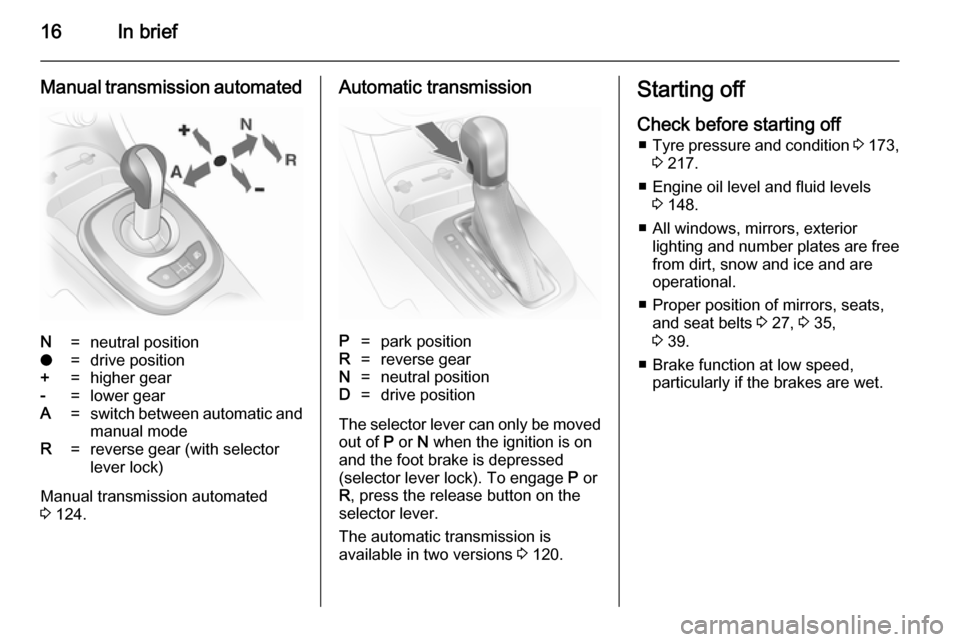
Manual transmission automatedN=neutral positiono=drive position+=higher gear-=lower gearA =switch between automatic and
manual modeR=reverse gear (with selector
lever lock)
Manual transmission automated
3 124.
Automatic transmissionP=park positionR=reverse gearN=neutral positionD=drive position
The selector lever can only be moved
out of P or N when the ignition is on
and the foot brake is depressed
(selector lever lock). To engage P or
R , press the release button on the
selector lever.
The automatic transmission is
available in two versions 3 120.
Starting off
Check before starting off ■ Tyre pressure and condition 3 173,
3 217.
■ Engine oil level and fluid levels 3 148.
■ All windows, mirrors, exterior lighting and number plates are free
from dirt, snow and ice and are
operational.
■ Proper position of mirrors, seats, and seat belts 3 27, 3 35,
3 39.
■ Brake function at low speed, particularly if the brakes are wet.
Page 19 of 231
In brief17
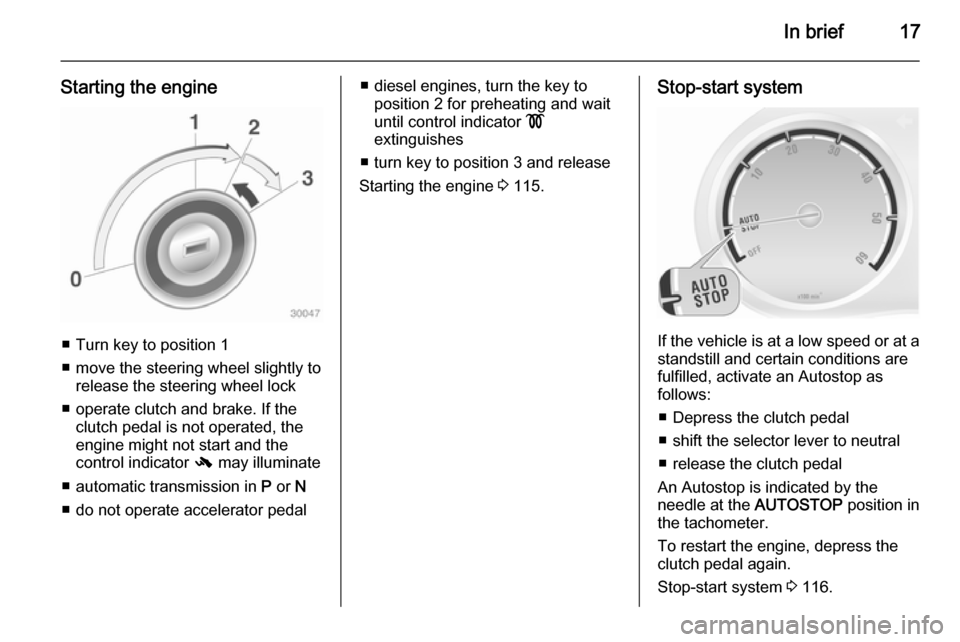
Starting the engine
■ Turn key to position 1
■ move the steering wheel slightly to release the steering wheel lock
■ operate clutch and brake. If the clutch pedal is not operated, the
engine might not start and the
control indicator - may illuminate
■ automatic transmission in P or N
■ do not operate accelerator pedal
■ diesel engines, turn the key to position 2 for preheating and wait
until control indicator !
extinguishes
■ turn key to position 3 and release
Starting the engine 3 115.Stop-start system
If the vehicle is at a low speed or at a
standstill and certain conditions are
fulfilled, activate an Autostop as
follows:
■ Depress the clutch pedal
■ shift the selector lever to neutral
■ release the clutch pedal
An Autostop is indicated by the
needle at the AUTOSTOP position in
the tachometer.
To restart the engine, depress the
clutch pedal again.
Stop-start system 3 116.
Page 83 of 231

Instruments and controls81
Illuminates when the engine is
running Stop, switch off engine. Battery is not
charging. Engine cooling may be
interrupted. In diesel engines, power
to the brake servo unit may be cut.
Seek the assistance of a workshop.
Flashes during or after engine start Battery voltage too low. Have
electrical system tested by a
workshop.
Malfunction indicator light
Z illuminates or flashes yellow.
Illuminates when the ignition is
switched on and extinguishes shortly
after the engine starts.
Illuminates when the engine isrunning
Fault in the emission control system. The permitted emission limits may be
exceeded. Immediately seek the
assistance of a workshop.Flashes when the engine is
running
Fault that could lead to catalytic
converter damage. Ease up on the
accelerator until the flashing stops.
Seek the assistance of a workshop
immediately.
Service vehicle soon A illuminates or flashes yellow.
Illuminates when the engine is
running
Fault in engine or transmission
electronics. The electronics switch to
an emergency running programme.
Fuel consumption may be increased
and the vehicle handling may be
impaired.
If the fault persists after restarting the vehicle, consult a workshop.
Illuminates together with InSP4
in the service display
Seek the assistance of a workshop for
draining the diesel fuel filter.Flashes with switched on
ignition
Fault in the immobiliser system. The
engine cannot be started 3 26.
Brake and clutch system
Brake and clutch fluid level R illuminates red.
Illuminates when the parking brake is
released if the brake and clutch fluid
level is too low 3 150.9 Warning
Stop. Do not continue your
journey. Consult a workshop.
Illuminates after the ignition is
switched on if the parking brake is
applied 3 129.
Apply parking brake
R flashes red.
On vehicles with manual transmission
automated, R flashes for a few
seconds when the ignition is switched
off if the parking brake is not applied.
Page 87 of 231

Instruments and controls85
With manual transmission
automated, the engine can only be started if the foot brake is depressed. If the foot brake is not depressed, the
control indicator illuminates 3 124.
Exterior light 8 illuminates green.
Illuminated when the exterior lights
are on 3 98.
High beam P illuminates blue.
Illuminated when high beam is on and
during headlight flash 3 99.
Adaptive forward lighting B illuminates yellow.
Illuminates when the engine is running
Fault in system.
Seek the assistance of a workshop.Illuminates after ignition is switched on Control indicator B illuminates for
approx. 4 seconds as a functionality
test.
Control indicator B illuminates for
approx. 8 seconds as a reminder that
the headlights have been set to
symmetrical low beam 3 100.
Fog light > illuminates green.
Illuminated when the front fog lights
are on 3 102.
Rear fog light
r illuminates yellow.
Illuminated when the rear fog light is
on 3 102.
Cruise control
m illuminates or flashes green.Illuminates
Illuminates when the system is on3 131.
Flashes Cruise control was enabled without
depressing the brake pedal
beforehand.
Page 92 of 231

90Instruments and controlsVehicle messagesMessages are given via the
instrument panel display or as
warning and signal buzzers. Check
control messages appear on the
Info-Display. Some appear in an
abbreviated form. Confirm warning
messages with the multifunction
control 3 86.
Warning chimes When starting the engine or
whilst driving ■ If seat belt is not fastened.
■ If a door or the tailgate is not fully closed when starting-off.
■ If a certain speed is exceeded with the parking brake applied.
■ If the speed programmed at the factory is exceeded.
■ If the vehicle has manual transmission automated and the
driver's door is opened when theengine is running, a gear is
engaged and the foot brake is not
depressed.
■ Warning signal sounds three times if the rear carrier system is
extended and reverse gear is
selected.
When the vehicle is parked and
the driver's door is opened ■ When the key is in the ignition switch.
■ With exterior lights on.
■ For manual transmission automated, if the parking brake is
not applied and no gear is engaged when the engine is switched off.
During an Autostop ■ If the driver's door is opened.
Battery voltage Low battery voltage in the radio
remote control. On vehicles without
check control, the message InSP3
appears in the instrument panel
display. Replace the battery 3 20.Brake light switch
Brake light does not come on during
braking. Have the cause of the fault
remedied immediately by a
workshop.
Drain diesel fuel filter
If there is water in the diesel fuel filter, the message InSP4 appears in the
instrument panel. In some models
InSP4 illuminates together with A in
the instrument. Consult a workshop.
Lighting
Important exterior lighting lamps,
including cables and fuses, are
monitored. In trailer mode, trailer
lighting is also monitored. Trailers
with LED lighting must have an
adapter that enables lamp monitoring as with conventional bulbs.
Page 126 of 231
124Driving and operatingCaution
It is not advisable to drive with thehand resting on the selector lever.
Manual transmission
automated
This transmission permits manual
(manual mode) or automatic gear
shifting (automatic mode), both with
automatic clutch control.
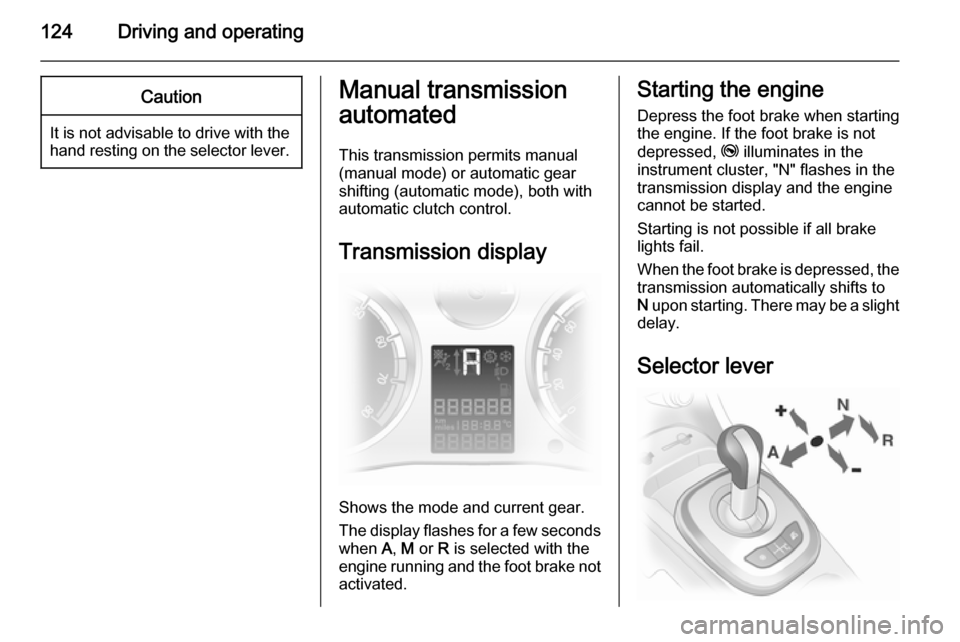
Transmission display
Shows the mode and current gear.
The display flashes for a few seconds
when A, M or R is selected with the
engine running and the foot brake not
activated.
Starting the engine
Depress the foot brake when starting
the engine. If the foot brake is not
depressed, j illuminates in the
instrument cluster, "N" flashes in the
transmission display and the engine
cannot be started.
Starting is not possible if all brake
lights fail.
When the foot brake is depressed, the
transmission automatically shifts to
N upon starting. There may be a slight
delay.
Selector lever
Page 131 of 231
Driving and operating129
ABS starts to regulate brake pressureas soon as a wheel shows a tendency to lock. The vehicle remains
steerable, even during hard braking.
ABS control is made apparent though
a pulse in the brake pedal and the
noise of the regulation process.
For optimum braking, keep the brake
pedal fully depressed throughout the
braking process, despite the fact that
the pedal is pulsating. Do not reduce
the pressure on the pedal.
After starting off the system performs a self-test which may be audible.
Control indicator u 3 82.
Adaptive brake light
During full braking, all three brake
lamps flash for the duration of ABS
control.Fault9 Warning
If there is a fault in the ABS, the
wheels may be liable to lock due
to braking that is heavier than
normal. The advantages of ABS are no longer available. During
hard braking, the vehicle can no longer be steered and may
swerve.
Have the cause of the fault remedied
by a workshop.
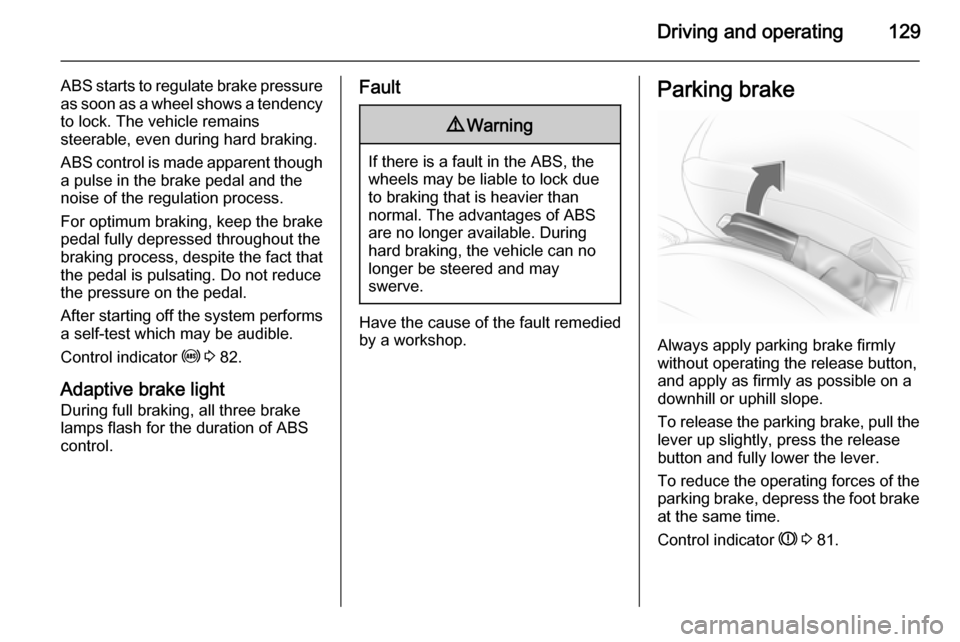
Parking brake
Always apply parking brake firmly
without operating the release button,
and apply as firmly as possible on a
downhill or uphill slope.
To release the parking brake, pull the lever up slightly, press the release
button and fully lower the lever.
To reduce the operating forces of the
parking brake, depress the foot brake
at the same time.
Control indicator R 3 81.
Page 143 of 231

Driving and operating141
1000 kg a speed of 50 mph must not
be exceeded; the use of a stabiliser is recommended.
If the trailer starts snaking, drive more
slowly, do not attempt to correct the
steering and brake sharply if
necessary.
When driving downhill, drive in the
same gear as if driving uphill and
drive at a similar speed.
Adjust tyre pressure to the value
specified for full load 3 217.
Trailer towing Trailer loads The permissible trailer loads are
vehicle and engine-dependent
maximum values which must not be
exceeded. The actual trailer load is
the difference between the actual
gross weight of the trailer and the
actual coupling socket load with the
trailer coupled.
The permissible trailer loads are
specified in the vehicle documents. In
general, they are valid for gradients
up to max. 12 %The permitted trailer loads apply up to the specified incline and up to an
altitude of 1000 metres above sea
level. Since engine power decreases as altitude increases due to the airbecoming thinner, therefore reducing
climbing ability, the permissible gross train weight also decreases by 10 %
for every 1000 metres of additional
altitude. The gross train weight does
not have to be reduced when driving
on roads with slight inclines (less than
8 %, e.g. motorways).
The permissible gross train weight
must not be exceeded. This weight is
specified on the identification plate
3 197.
Vertical coupling load
The vertical coupling load is the load
exerted by the trailer on the coupling
ball. It can be varied by changing the
weight distribution when loading the
trailer.
The maximum permissible vertical
coupling load (vehicles with 1.2
engine: 45 kg, other engines: 55 kg)
is specified on the towing equipment
identification plate and in the vehicledocuments. Always aim for the
maximum load, especially in the case
of heavy trailers. The vertical coupling load should never fall below 25 kg.
Rear axle load When the trailer is coupled and the
towing vehicle fully loaded, the
permissible rear axle load (see
identification plate or vehicle
documents) for passenger vehicles
may be exceeded by 45 kg and the
gross vehicle weight rating by 50 kg
(on vehicles with 1.2 engine and
specific rear axle application: 30 kg).
For vans the permitted rear axle load
may be exceeded by 25 kg. The
permitted total load may be exceeded
by the following amounts with the
engines specified below:A10XEP=30 kgA12XEL, A12XER=25 kgA13DTR=40 kgA13DTE, A13DTC=35 kg
Trailer operation is not permitted for
vans with tyre size 215/45 R 17.
Page 163 of 231

Vehicle care161
5. Gently press the three lockinglugs on the outside of the bulb
holder outwards and remove bulb
holder.
6. Push bulb into socket slightly, rotate anti-clockwise, remove and
renew bulb.
Rear fog light, may be only on one side ( 1)
Reverse light ( 2)
Turn signal light ( 3)
Tail light/side light ( 4)
Tail light/brake light ( 5)
7. Engage bulb holder in bulb
housing, ensuring that it properly
engages.
8. Ensure that the bulb holder seal is
positioned as illustrated.
9. Insert bulb housing in vehicle body, tighten securing nuts by
hand. Engage plug connector.
Close cover.
After bulb replacement, check the tail lights for proper functionality: switch
on the ignition, operate the brake,
switch on the sidelights.