transmission VAUXHALL MOKKA 2014.5 User Guide
[x] Cancel search | Manufacturer: VAUXHALL, Model Year: 2014.5, Model line: MOKKA, Model: VAUXHALL MOKKA 2014.5Pages: 219, PDF Size: 6 MB
Page 129 of 219
Driving and operating127FaultIn the event of a fault, g illuminates.
Additionally a code number or a
vehicle message is displayed in the
Driver Information Centre. Vehicle
messages 3 94.
The transmission no longer shifts automatically. Continued travel is possible with manual shifting.
Only the highest gear is available.
Depending on the fault, 2nd gear may also be available in manual mode.
Shift only when vehicle is at a
standstill.
Have the cause of the fault remedied by a workshop.
Interruption of power
supply
In the event of an interruption of
power supply, the selector lever
cannot be moved out of the P
position. The ignition key cannot be
removed from the ignition switch.
If the battery is discharged, start the
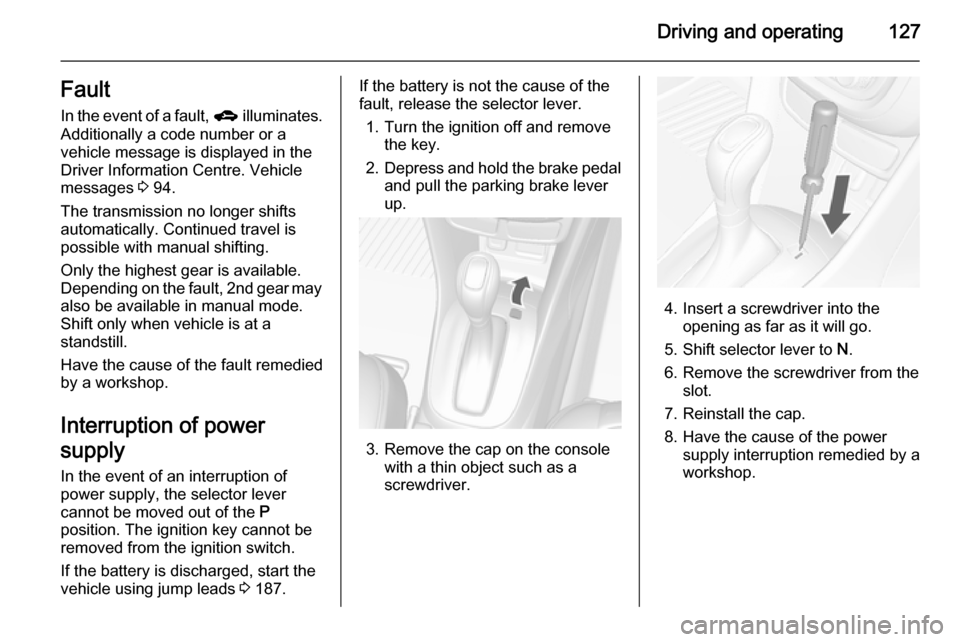
vehicle using jump leads 3 187.If the battery is not the cause of the
fault, release the selector lever.
1. Turn the ignition off and remove the key.
2. Depress and hold the brake pedal
and pull the parking brake lever
up.
3. Remove the cap on the console with a thin object such as ascrewdriver.
4. Insert a screwdriver into the opening as far as it will go.
5. Shift selector lever to N.
6. Remove the screwdriver from the slot.
7. Reinstall the cap.
8. Have the cause of the power supply interruption remedied by a
workshop.
Page 130 of 219

128Driving and operatingManual transmission
To engage reverse, with the vehicle
stationary wait 3 seconds after
depressing the clutch pedal and then press the release button on the
selector lever and engage the gear.
If the gear does not engage, set the
lever to neutral, release the clutch
pedal and depress again; then repeat
gear selection.
Do not slip the clutch unnecessarily.
When operating, depress the clutch
pedal completely. Do not use the
pedal as a foot rest.
Caution
It is not advisable to drive with the hand resting on the selector lever.
Drive systems
All-wheel drive
The All-Wheel Drive (AWD) system
enhances driving characteristics and
stability, and helps to achieve the best possible driveability regardless of
ground surface. The system is always
active and cannot be deactivated.
The torque is distributed steplessly
between the wheels of the front and rear axle, depending on the driving
conditions. Additionally the torque
between the rear wheels is distributed
depending on the surface.
For optimum system performance,
the vehicle's tyres should not have
varying degrees of wear.
When using a temporary spare
wheel, the AWD system is
automatically disabled.
The AWD system will also be
temporarily disabled to protect the
system from overheating if there is
excessive wheel spin. When the
system cools down, AWD will be
restored.
Page 135 of 219

Driving and operating133
accelerated or decelerated to a speed
between 3 and 12 mph. When DCS is active, u flashes.
DCS will only be activated on roads with a certain incline.
Deactivation
DCS is deactivated if the vehicle is
decelerated below 1.2 mph or
accelerated above 22 mph.
Switching off
Press button u again. Control
indicator u extinguishes.
At speeds above 37 mph the system
is deactivated automatically.Driver assistance
systems9 Warning
Driver assistance systems are
developed to support the driver
and not to replace the driver's
attention.
The driver accepts full
responsibility when driving the
vehicle.
When using driver assistance
systems, always take care
regarding the current traffic
situation.
Cruise control
The Cruise control can store and
maintain speeds of approx. 20 to
120 mph. Deviations from the stored
speeds may occur when driving uphill or downhill.
For safety reasons the cruise controlcannot be activated until the foot
brake has been operated once.
Activating in first gear is not possible.
Do not use the cruise control if it is not advisable to maintain a constant
speed.
With automatic transmission, only
activate cruise control in automatic
mode.
Control indicator m 3 89.
Switching on
Press button m: control indicator m in
instrument cluster illuminates white.
Page 171 of 219

Vehicle care169
Fuse extractorA fuse extractor may be located in the fuse box in the engine compartment.
Place the fuse extractor on the
various types of use from the top or
side, and withdraw fuse.
Engine compartment fuse
box
The fuse box is in the engine
compartment.
Disengage the cover, lift it upwards
and remove.
Mini Fuses
No.Circuit1Sunroof2Exterior mirrors3–4–5Electrical brake control module6Intelligent battery sensor7–8Transmission control module9Body control module10Headlight levelling11Rear window wiper12Heated rear window13Headlight actuator (left hand)14Heated exterior mirrors15–16Seat heating17Transmission control module
Page 173 of 219

Vehicle care171
Mini Fuses
No.Circuit1Body control module2Body control module3Body control module4Body control module5Body control module6Body control module7Body control module8Body control module9Door locks10Safety diagnosis module11Door locks12Climate control13Tailgate14Park assist15Lane departure warning, Interior
mirror16Adaptive forward lightingNo.Circuit17Power window driver18Rain sensor19Spare20Steering wheel21Transmission control module22Cigarette lighter23Spare24Spare25Spare26Display27Instrument panel cluster28Adaptive forward lighting29Spare30Spare31Instrument panel cluster32Infotainment, auxiliary, power
outlet
Page 190 of 219

188Vehicle care
■ Apply the parking brake,transmission in neutral, automatic
transmission in P.
■ Open the positive terminal protection caps of both batteries.
Lead connection order:
1. Connect the red lead to the positive terminal of the booster
battery.
2. Connect the other end of the red lead to the positive terminal of the
discharged battery.
3. Connect the black lead to the negative terminal of the booster
battery.
4. Connect the other end of the black
lead to a vehicle grounding point,
such as the engine block or an
engine mounting bolt. Connect as far away from the discharged
battery as possible, however at
least 60 cm.
Route the leads so that they cannot
catch on rotating parts in the engine
compartment.
To start the engine: 1. Start the engine of the vehicle providing the jump.
2. After 5 minutes, start the other engine. Start attempts should be
made for no longer than
15 seconds at an interval of
1 minute.
3. Allow both engines to idle for approx. 3 minutes with the leads
connected.4. Switch on electrical consumers (e.g. headlights, heated rear
window) of the vehicle receiving
the jump start.
5. Reverse above sequence exactly when removing leads.
Page 191 of 219

Vehicle care189Towing
Towing the vehicle
Disengage cap by using a
screwdriver and remove.
The towing eye is stowed with the vehicle tools 3 173.
Screw in the towing eye as far as it will
go until it stops in a horizontal
position.
Attach a tow rope – or better still a tow
rod – to the towing eye.
The towing eye must only be used for towing and not for recovering the
vehicle.
Switch on ignition to release steering
wheel lock and to permit operation of
brake lights, horn and windscreen
wiper.
Transmission in neutral.
Caution
Never tow your vehicle equipped
with All Wheel Drive (AWD) with the front or rear tyres on the road.
If you tow the vehicle equipped with AWD while the front or rear
tyres are rolling on the road the
drive system in the vehicle could
be severely damaged. When
towing vehicles equipped with
AWD all 4 tyres may not be in
contact with the road.
Caution
Drive slowly. Do not drive jerkily.
Excessive tractive force can
damage the vehicle.
When the engine is not running,
considerably more force is needed to
brake and steer.
To prevent the entry of exhaust gases from the towing vehicle, switch on the
air recirculation system 3 113 and
close the windows.
Page 192 of 219

190Vehicle care
Vehicles with manual transmission:
The vehicle must be towed facing
forwards. The maximum speed is
50 mph. In all other cases, and when
the transmission is defective, the front axle must be raised off the ground.
Vehicle with automatic transmission:
Do not tow the vehicle using tow eye.
Towing with a tow rope could cause
severe automatic transmission
damage. When towing vehicle with
automatic transmission, use flat bed or wheel lift equipment.
Seek the assistance of a workshop.
After towing, unscrew the towing eye.
Insert cap and close cap.Towing another vehicle
Disengage the cap by using a
screwdriver and remove.
The towing eye is stowed with the
vehicle tools 3 173.
Screw in the towing eye as far as it will
go until it stops in a horizontal
position.
The lashing eye at the rear
underneath the vehicle must never be used as a towing eye.
Attach a tow rope – or even better a
tow bar – to the towing eye.
The towing eye must only be used for
towing and not for recovering a
vehicle.
Switch on the hazard warning
flashers on both vehicles.
Page 205 of 219
![VAUXHALL MOKKA 2014.5 User Guide Technical data203PerformanceEngineA14NET
B14NET
LPG
A16XERA17DTS
Maximum speed 3)
[mph]Manual transmission120120106118/115 4)Automatic transmission116––1143)
The maximum speed indicated is achiev](/img/38/19526/w960_19526-204.png "VAUXHALL MOKKA 2014.5 User Guide Technical data203PerformanceEngineA14NET
B14NET
LPG
A16XERA17DTS
Maximum speed 3)
[mph]Manual transmission120120106118/115 4)Automatic transmission116––1143)
The maximum speed indicated is achiev")
Technical data203PerformanceEngineA14NET
B14NET
LPG
A16XERA17DTS
Maximum speed 3)
[mph]Manual transmission120120106118/115 4)Automatic transmission116––1143)
The maximum speed indicated is achievable at kerb weight (without driver) plus 200 kg payload. Optional equipment could reduce the specified maximum
speed of the vehicle.
4) Vehicles with All-wheel drive system.
Page 206 of 219
![VAUXHALL MOKKA 2014.5 User Guide 204Technical dataVehicle weight
Kerb weight, basic model without any optional equipmentEngineManual transmissionAutomatic transmission[kg]A14NET13941409B14NET
LPG1464–A16XER1355–A17DTS14491462A17D](/img/38/19526/w960_19526-205.png "VAUXHALL MOKKA 2014.5 User Guide 204Technical dataVehicle weight
Kerb weight, basic model without any optional equipmentEngineManual transmissionAutomatic transmission[kg]A14NET13941409B14NET
LPG1464–A16XER1355–A17DTS14491462A17D")
204Technical dataVehicle weight
Kerb weight, basic model without any optional equipmentEngineManual transmissionAutomatic transmission[kg]A14NET13941409B14NET
LPG1464–A16XER1355–A17DTS14491462A17DTS 5)1504–5)
Vehicles with All-wheel drive system.
Optional equipment and accessories increase the kerb weight.
Loading information 3 70.
Vehicle dimensionsLength [mm]4278Width without exterior mirrors [mm]1764Width with two exterior mirrors [mm]2038Height (without antenna) [mm]1658