roof VAUXHALL VIVARO 2016.5 Owner's Manual
[x] Cancel search | Manufacturer: VAUXHALL, Model Year: 2016.5, Model line: VIVARO, Model: VAUXHALL VIVARO 2016.5Pages: 211, PDF Size: 5 MB
Page 45 of 211

Seats, restraints43Stow head restraints securely in load
compartment. Do not drive with head
restraints removed if the seat is
occupied.Front seats
Seat position9 Warning
Only drive with the seat correctly
adjusted.
9 Danger
Do not sit nearer than 25 cm from
the steering wheel, to permit safe
airbag deployment.
9 Warning
Never adjust seats while driving as
they could move uncontrollably.
9 Warning
Never store any loose objects
under the seats.
Underseat storage, storage box 3 68.
● Sit with buttocks as far back
against the backrest as possible.
Adjust the distance between the
seat and the pedals so that legs
are slightly angled when pressing
the pedals. Slide the front
passenger seat as far back as
possible.
● Set seat height high enough to have a clear field of vision on allsides and of all display
instruments. There should be at
least one hand of clearance
between head and the roof
frame. Thighs should rest lightly on the seat without pressing into
it.
Page 52 of 211
50Seats, restraintsSeat belts are only designed for use
by one person at a time. Child
restraint system 3 59.
Periodically check all parts of the belt system for damage and proper
functionality.
Have damaged components
replaced. After an accident, have the
belts and triggered belt tensioners
replaced by a workshop.
Notice
Make sure that the belts are not
damaged by shoes or sharp-edged
objects or are trapped. Prevent dirt
from getting into the belt retractors.
Seat belt reminder
Front seat is equipped with a seat belt
reminder, indicated by control
indicator X in the roof console
3 85.
Belt force limiters
On the front seats, stress on the body is reduced by the gradual release of
the belt during a collision.Belt tensioners
In the event of a head-on or rear-end
collision of a certain severity, the front seat belts are tightened.9 Warning
Incorrect handling (e.g. removal or
fitting of belts) can trigger the belt
tensioners with risk of injury.
Deployment of the belt tensioners is
indicated by continuous illumination
of control indicator v 3 85.
Triggered belt tensioners must be
replaced by a workshop. Belt
tensioners can only be triggered
once.
Notice
Do not affix or install accessories or
other objects that may interfere with
the operation of the belt tensioners.
Do not make any modifications to
belt tensioner components as this
will invalidate the vehicle type
approval.
Three-point seat belt
Fasten
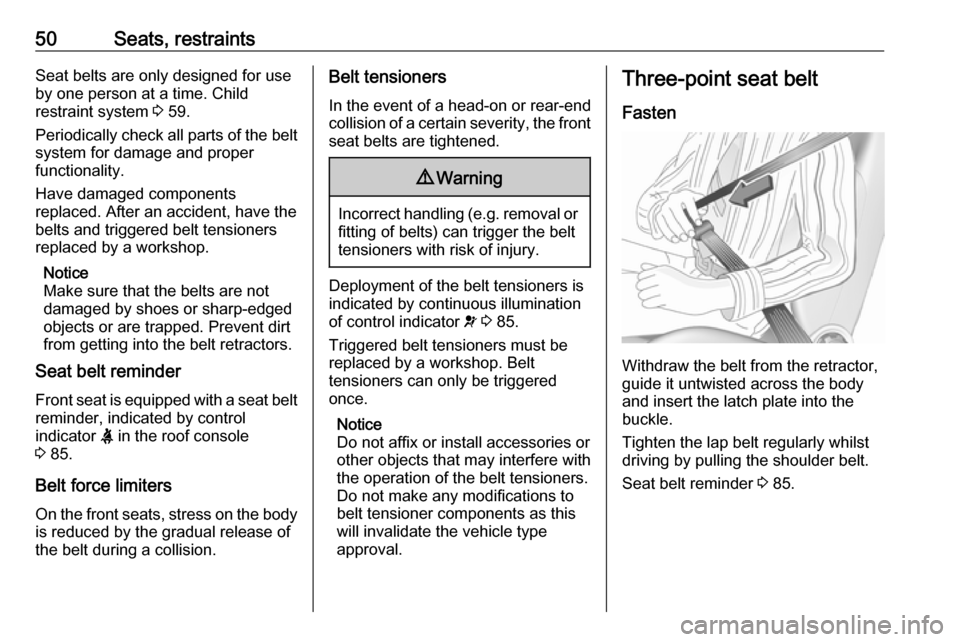
Withdraw the belt from the retractor,
guide it untwisted across the body
and insert the latch plate into the
buckle.
Tighten the lap belt regularly whilst
driving by pulling the shoulder belt.
Seat belt reminder 3 85.
Page 59 of 211
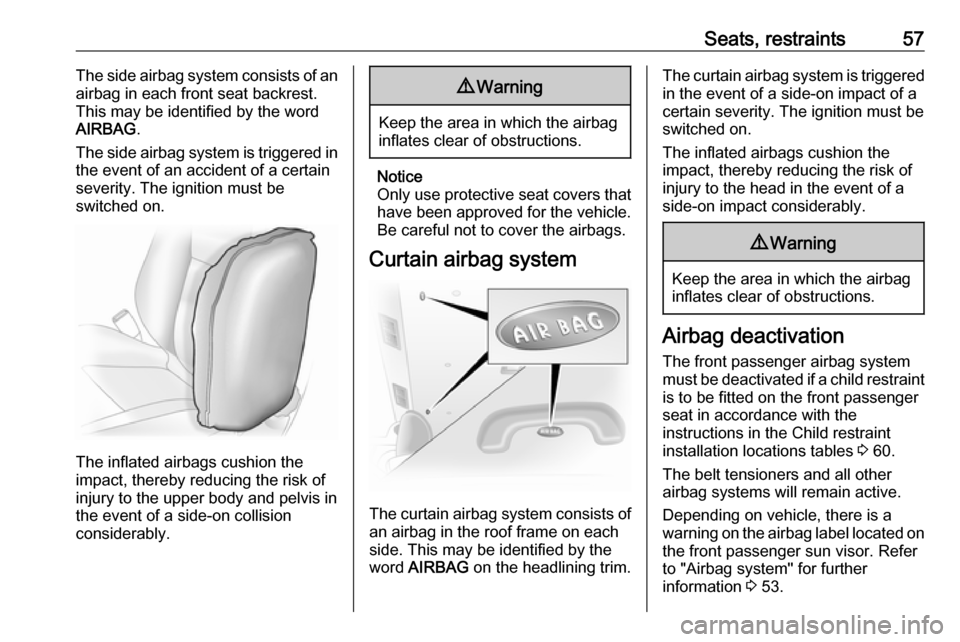
Seats, restraints57The side airbag system consists of an
airbag in each front seat backrest.
This may be identified by the word AIRBAG .
The side airbag system is triggered in
the event of an accident of a certain
severity. The ignition must be
switched on.
The inflated airbags cushion the
impact, thereby reducing the risk of
injury to the upper body and pelvis in
the event of a side-on collision
considerably.
9 Warning
Keep the area in which the airbag
inflates clear of obstructions.
Notice
Only use protective seat covers that have been approved for the vehicle.Be careful not to cover the airbags.
Curtain airbag system
The curtain airbag system consists of an airbag in the roof frame on each
side. This may be identified by the
word AIRBAG on the headlining trim.
The curtain airbag system is triggered
in the event of a side-on impact of a
certain severity. The ignition must be
switched on.
The inflated airbags cushion the
impact, thereby reducing the risk of
injury to the head in the event of a
side-on impact considerably.9 Warning
Keep the area in which the airbag
inflates clear of obstructions.
Airbag deactivation
The front passenger airbag system
must be deactivated if a child restraint
is to be fitted on the front passenger
seat in accordance with the
instructions in the Child restraint
installation locations tables 3 60.
The belt tensioners and all other
airbag systems will remain active.
Depending on vehicle, there is a
warning on the airbag label located on
the front passenger sun visor. Refer
to "Airbag system" for further
information 3 53.
Page 60 of 211
58Seats, restraints
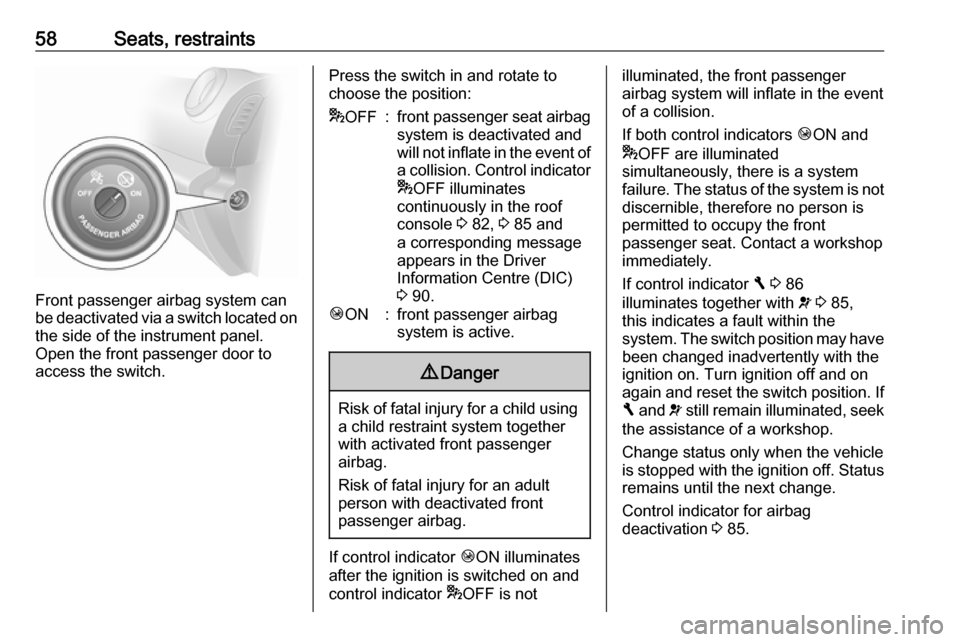
Front passenger airbag system can
be deactivated via a switch located on the side of the instrument panel.
Open the front passenger door to
access the switch.
Press the switch in and rotate to
choose the position:* OFF:front passenger seat airbag
system is deactivated and
will not inflate in the event of
a collision. Control indicator
* OFF illuminates
continuously in the roof
console 3 82, 3 85 and
a corresponding message
appears in the Driver
Information Centre (DIC)
3 90.Ó ON:front passenger airbag
system is active.9 Danger
Risk of fatal injury for a child using
a child restraint system together
with activated front passenger
airbag.
Risk of fatal injury for an adult
person with deactivated front
passenger airbag.
If control indicator ÓON illuminates
after the ignition is switched on and
control indicator *OFF is not
illuminated, the front passenger
airbag system will inflate in the event
of a collision.
If both control indicators ÓON and
* OFF are illuminated
simultaneously, there is a system
failure. The status of the system is not discernible, therefore no person is
permitted to occupy the front
passenger seat. Contact a workshop immediately.
If control indicator F 3 86
illuminates together with v 3 85,
this indicates a fault within the
system. The switch position may have been changed inadvertently with the
ignition on. Turn ignition off and on
again and reset the switch position. If
F and v still remain illuminated, seek
the assistance of a workshop.
Change status only when the vehicle
is stopped with the ignition off. Status remains until the next change.
Control indicator for airbag
deactivation 3 85.
Page 68 of 211

66StorageStorageStorage compartments................66
Instrument panel storage ...........66
Glovebox ................................... 66
Cupholders ................................ 67
Front storage ............................. 67
Door panel storage ....................68
Underseat storage .....................68
Overcab storage ........................70
Load compartment .......................70
Load compartment cover ...........70
Lashing eyes ............................. 71
Safety net .................................. 71
Warning triangle ........................72
First aid kit ................................. 72
Roof rack system .........................72
Roof rack ................................... 72
Loading information .....................73Storage compartments9Warning
Do not store heavy or sharp
objects in the storage
compartments. Otherwise, the
storage compartment lid could
open and vehicle occupants could be injured by objects being thrown
around in the event of hard
braking, a sudden change in
direction or an accident.
Instrument panel storage
Storage compartments, pockets and
trays are located in the instrument
panel.
A coin holder, a phone holder, and a
tablet holder may be located on the
instrument panel.
The tray located on top of the
instrument panel has a lid.
Glovebox
To open, pull the handle.
Depending on version, the glovebox
may feature a light that comes on
when the glovebox is opened, and
may also be lockable.
The glovebox should be closed while
driving.
Page 69 of 211
Storage67Cupholders
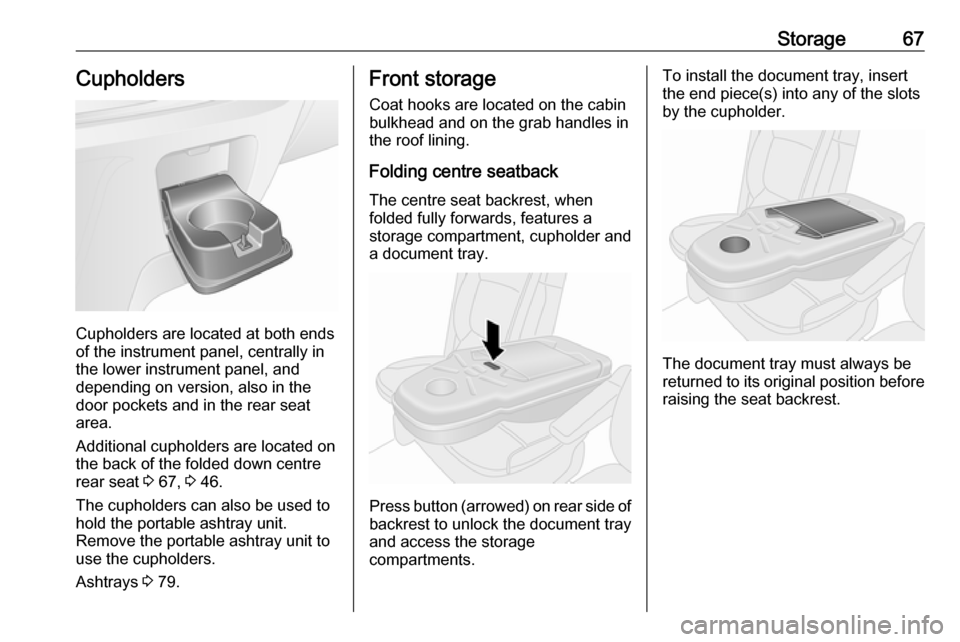
Cupholders are located at both ends
of the instrument panel, centrally in the lower instrument panel, and
depending on version, also in the
door pockets and in the rear seat
area.
Additional cupholders are located on
the back of the folded down centre
rear seat 3 67, 3 46.
The cupholders can also be used to hold the portable ashtray unit.
Remove the portable ashtray unit to
use the cupholders.
Ashtrays 3 79.
Front storage
Coat hooks are located on the cabin
bulkhead and on the grab handles in
the roof lining.
Folding centre seatback The centre seat backrest, when
folded fully forwards, features a
storage compartment, cupholder and
a document tray.
Press button (arrowed) on rear side of
backrest to unlock the document tray
and access the storage
compartments.
To install the document tray, insert
the end piece(s) into any of the slots
by the cupholder.
The document tray must always be
returned to its original position before
raising the seat backrest.
Page 73 of 211
Storage71Installing
Refit the parcel shelf by engaging in
the retainers on both sides.
Lashing eyes
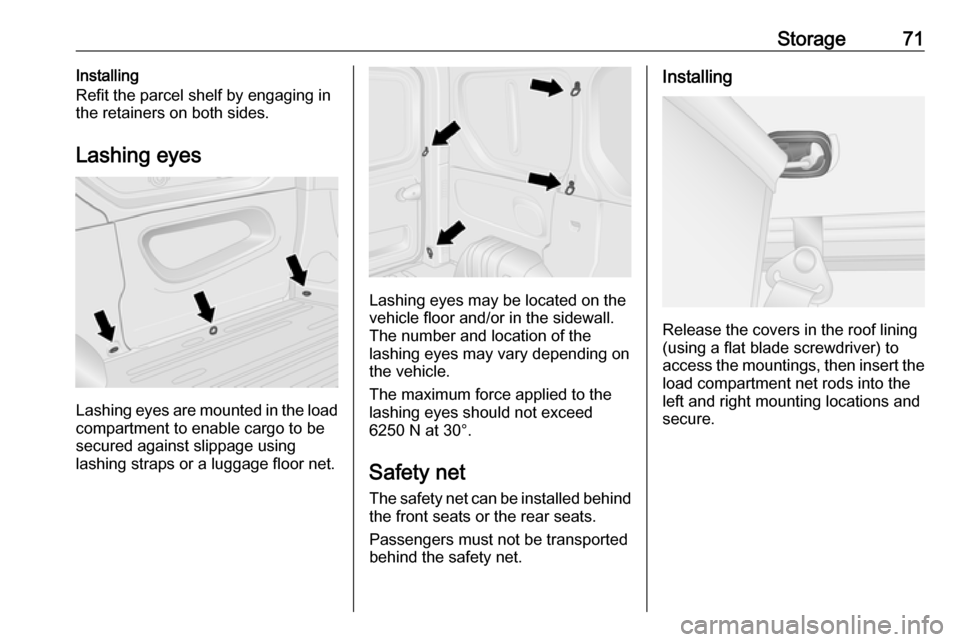
Lashing eyes are mounted in the load
compartment to enable cargo to be secured against slippage using
lashing straps or a luggage floor net.
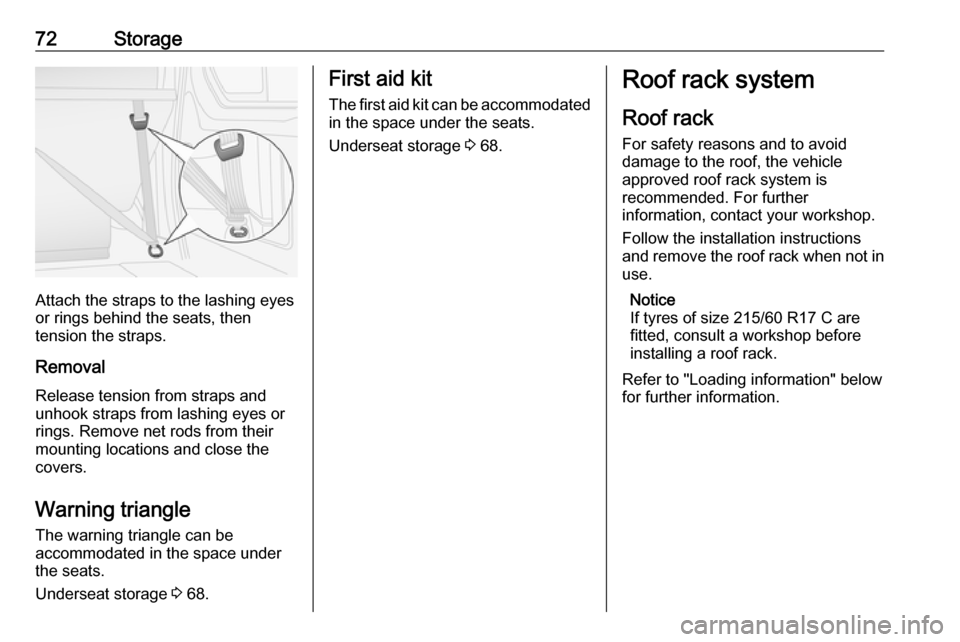
Lashing eyes may be located on the
vehicle floor and/or in the sidewall.
The number and location of the
lashing eyes may vary depending on
the vehicle.
The maximum force applied to the
lashing eyes should not exceed
6250 N at 30°.
Safety net The safety net can be installed behind
the front seats or the rear seats.
Passengers must not be transported
behind the safety net.
Installing
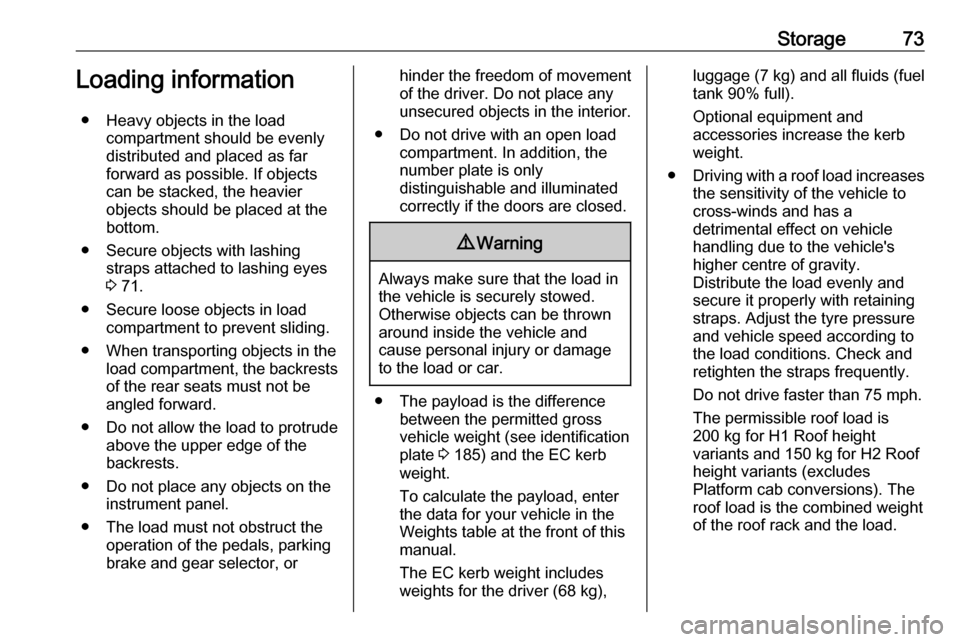
Release the covers in the roof lining
(using a flat blade screwdriver) to
access the mountings, then insert the
load compartment net rods into the
left and right mounting locations and secure.
Page 74 of 211
72Storage
Attach the straps to the lashing eyes
or rings behind the seats, then
tension the straps.
Removal Release tension from straps and
unhook straps from lashing eyes or
rings. Remove net rods from their
mounting locations and close the
covers.
Warning triangle
The warning triangle can be
accommodated in the space under
the seats.
Underseat storage 3 68.
First aid kit
The first aid kit can be accommodated
in the space under the seats.
Underseat storage 3 68.Roof rack system
Roof rackFor safety reasons and to avoid
damage to the roof, the vehicle
approved roof rack system is
recommended. For further
information, contact your workshop.
Follow the installation instructions
and remove the roof rack when not in
use.
Notice
If tyres of size 215/60 R17 C are
fitted, consult a workshop before
installing a roof rack.
Refer to "Loading information" below
for further information.
Page 75 of 211
Storage73Loading information● Heavy objects in the load compartment should be evenly
distributed and placed as far
forward as possible. If objects
can be stacked, the heavier
objects should be placed at the
bottom.
● Secure objects with lashing straps attached to lashing eyes
3 71.
● Secure loose objects in load compartment to prevent sliding.
● When transporting objects in the load compartment, the backrestsof the rear seats must not be
angled forward.
● Do not allow the load to protrude above the upper edge of the
backrests.
● Do not place any objects on the instrument panel.
● The load must not obstruct the operation of the pedals, parking
brake and gear selector, orhinder the freedom of movement
of the driver. Do not place any
unsecured objects in the interior.
● Do not drive with an open load compartment. In addition, the
number plate is only
distinguishable and illuminated correctly if the doors are closed.9 Warning
Always make sure that the load in
the vehicle is securely stowed.
Otherwise objects can be thrown
around inside the vehicle and
cause personal injury or damage
to the load or car.
● The payload is the difference between the permitted gross
vehicle weight (see identification
plate 3 185) and the EC kerb
weight.
To calculate the payload, enter
the data for your vehicle in the
Weights table at the front of this
manual.
The EC kerb weight includes
weights for the driver (68 kg),
luggage (7 kg) and all fluids (fuel
tank 90% full).
Optional equipment and
accessories increase the kerb
weight.
● Driving with a roof load increases
the sensitivity of the vehicle to
cross-winds and has a
detrimental effect on vehicle
handling due to the vehicle's
higher centre of gravity.
Distribute the load evenly and
secure it properly with retaining
straps. Adjust the tyre pressure
and vehicle speed according to
the load conditions. Check and
retighten the straps frequently.
Do not drive faster than 75 mph.
The permissible roof load is
200 kg for H1 Roof height
variants and 150 kg for H2 Roof
height variants (excludes
Platform cab conversions). The
roof load is the combined weight
of the roof rack and the load.
Page 86 of 211
84Instruments and controlsControl indicators in the roof
console
Overview
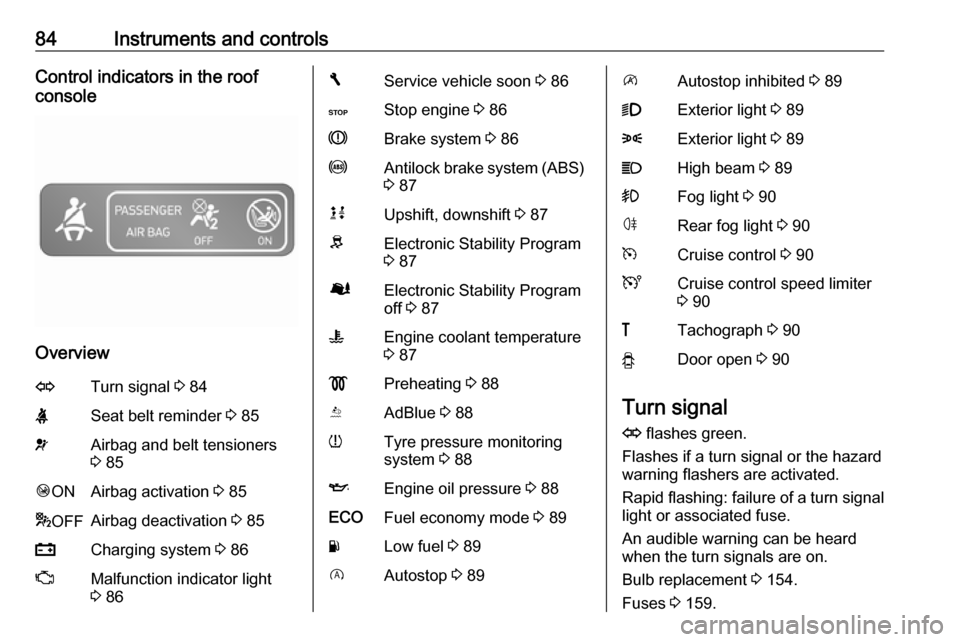
OTurn signal 3 84XSeat belt reminder 3 85vAirbag and belt tensioners
3 85Ó ONAirbag activation 3 85* OFFAirbag deactivation 3 85pCharging system 3 86ZMalfunction indicator light
3 86FService vehicle soon 3 86CStop engine 3 86RBrake system 3 86uAntilock brake system (ABS)
3 87kjUpshift, downshift 3 87RElectronic Stability Program
3 87ØElectronic Stability Program
off 3 87WEngine coolant temperature
3 87!Preheating 3 88YAdBlue 3 88wTyre pressure monitoring
system 3 88IEngine oil pressure 3 88ECOFuel economy mode 3 89YLow fuel 3 89DAutostop 3 89\Autostop inhibited 3 899Exterior light 3 898Exterior light 3 89CHigh beam 3 89>Fog light 3 90øRear fog light 3 90mCruise control 3 90UCruise control speed limiter
3 90&Tachograph 3 90yDoor open 3 90
Turn signal
O flashes green.
Flashes if a turn signal or the hazard
warning flashers are activated.
Rapid flashing: failure of a turn signal
light or associated fuse.
An audible warning can be heard
when the turn signals are on.
Bulb replacement 3 154.
Fuses 3 159.