engine VOLKSWAGEN GOLF 2012 Owners Manual
[x] Cancel search | Manufacturer: VOLKSWAGEN, Model Year: 2012, Model line: GOLF, Model: VOLKSWAGEN GOLF 2012Pages: 516, PDF Size: 105.12 MB
Page 404 of 516
N
N N
Introduction
this section fin d information about:
Storage . . . . . . . . . . . . . . . . . . . .
Contents . . . . . . . . . . . . . . . . . . . . . . . . . . .
applicable legal requ irements .
More information:
Preparat ions for working in th e engine ment 222
an eme rge ncy
Changing a wheel
Loose tools and other items in the veh icle tool kit and a loose spare (or compact spare)
wheel may be thrown through the passenger
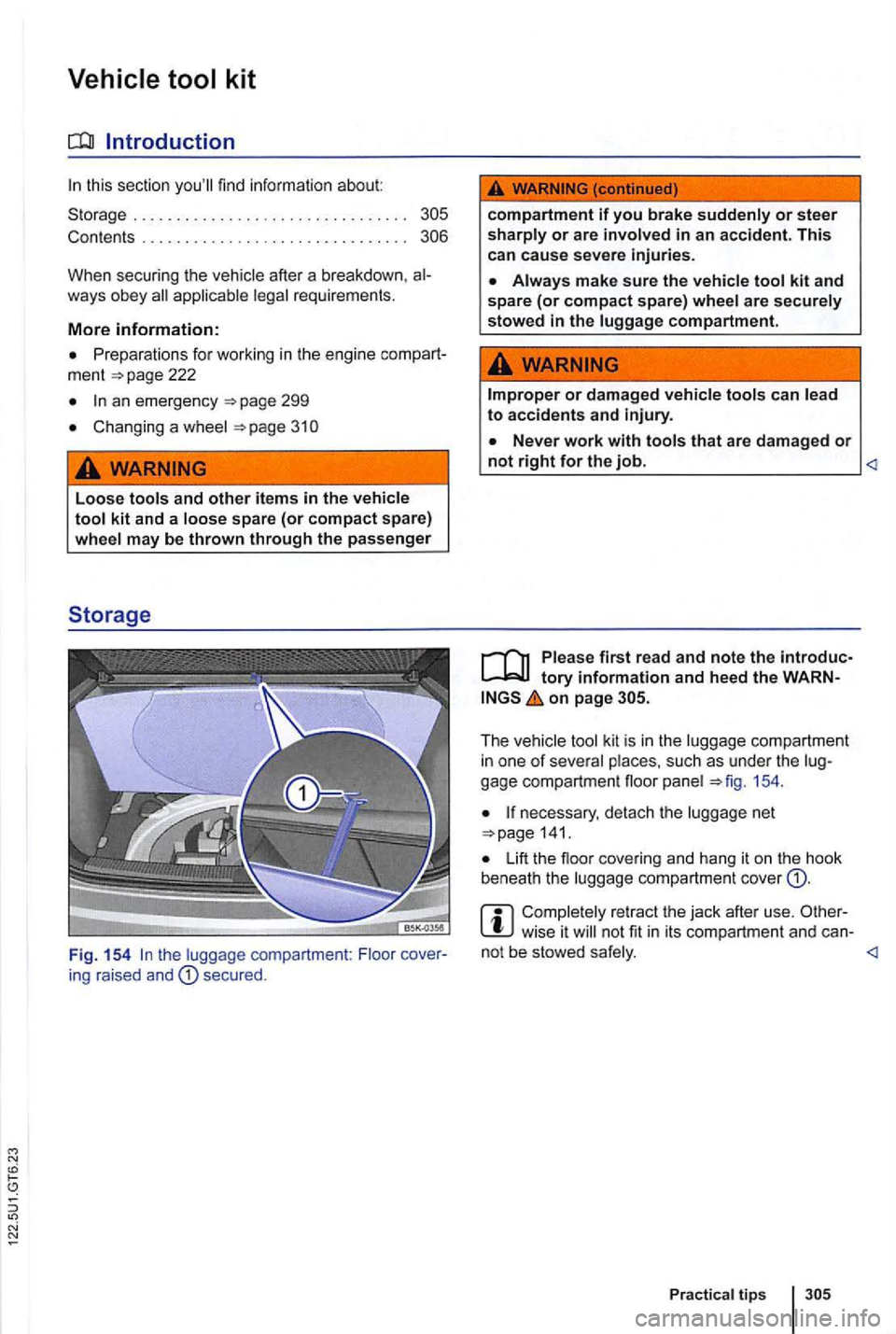
F ig. 154
the luggage compartment: Floor
compartment
Always make sure the vehicle tool kit and spare (or compact spare) wheel are securely stowed in the luggage compartment.
or damaged vehicle tools can lead to accidents and injury.
on page 305.
Th e vehic le tool kit is i n the luggage compartment
in on e of severa l pla ces, such as under the 154.
If necessary , detach the luggage net 141.
Lift the noor covering and hang it on the hook
beneath the luggage compartment cover
Completely re tract the jack after use. wise it not fit in its compartme nt and can-
Page 413 of 516
in side To do so,
up the jack so it just fits underneath the point.
9. Positio n the jack so that its base is directly underneath the 163, making sure that the
en tire base of t he jack rests
the jack and wind up the jack at the same lime, derneath the
cranking up the jack the
to ous personal injury. To
eve n those approved for other Volkswagen
ground. Th e ground.
a hard , slippery surface (such as a use an anti-skid rubber mat or som ething to prevent the jack from
make sure the jack grips the vertical rib unde r the so that the jack does not off when you are ra ising
the 163 .
314 Do it yourself
other per-sons have any part of their body under the
you must work under a raised on a make sure that the vehi-is
the to one side or the engine is running.
is
s upported by a jack. Engine vibrations may
cause the off the jack.
Disregardi ng the safety-related checklist may to acc idents and serious personal inju-ries.
review and accep ted safety practices and use common sense .
Page 416 of 516
Fuses
Introduction
this sec tion find information about:
Fuses in the vehicle
..................... 318
Repla cing blown
fuses . . . . . . . . . . . . . . . . . . . 319
Due to on go ing deve lopmen t of the vehic le , of fuses and the bin ed fuse protection of multiple loads with one
fuse , an up-to -date overview of the fu se locat ion per load is not possible at the time of print ing . tailed information regarding fuse box layou t is from auth orized Volkswagen dealers and
author ized Vol ksw agen
ge neral , one fuse can protect several loads. load can also be protected by seve ral fuses .
Find out why the fu se blew and correct the
lem before replacing a blown fuse . placed fuse blows again after a s hort time , the
e lec tr ic al system should be chec ked by an auth o r
ized Volkswagen deale r o r an autho rized Volkswa
gen
F acility .
More information:
Prepa ration s for working in the engine compart
ment
High volta g e systems in the engin e
tronic ignition system.
Using the wrong fuse, using a blown fuse
that has been repaired , and using metal ob-jects in plac e of fuses to complete the electri-connection in the circuit can cause fires
and serious p erson al injury.
with a fuse of the same amperage (same or and same imprint) and same
Never replace fuses with a metal strip , a
paper clip, or a similar objec t.
To help preven t damage to the electrical
system , switch off ail lights and accessories ,
switch off the ignition , and remov e the key from the ignition switch before replacing a fuse .
ferent loca tions In the electrical system.
A single load (a sin gle elec trica l com ponent )
fuse may pro tect several loads (seve ral electrical co mp one nts ).
Page 419 of 516
Changing
Introduction
this sec tion
bulbs in th e body of th e vehic le . . . . . . . . . . . . . . . . . . . . . . . . . . . . . . . . 325
C hangi ng t he lice nse plate
lig ht bulb . . . . . . . . 32 6
C hang ing a light bulb
requ ir es a certa in am ount of
sh ould a lwa ys kee p a box in the ve h icle with th e rep lace ment bulbs require d f or traffic safety .
R ep lacemen t bulbs are ava ilab le from you r autho r
i z ed
Additional
E xte rior views
Lig hts a nd 122
P repa ra tions for workin g in the eng ine compart
m en t
too l kit
F uses
Stop Always read and heed the before doing any work in the engine
c ompartment
Always let a burned out
of the necessary procedures. particular, never remove a headlight unless you know how to carry out the job and have the correct tools and bulbs.
you are uncertain about what to do,
have the work performed by an authorized
Volkswagen dealer, an authorized
and H7 bulbs replaced by a qualified
technic ian .
Page 420 of 516
N
After replacing a headlight bulb or other light bulb, always make sure that the rubber covers or plastic caps have been properly and secure-
Indicator light
to help prevent water from getting into the electrical connections and headlight housing and damaging the electrical system.
on
Lights up Possible cause Proper response
Light bulb of the exterior vehicle lighting not Replace the light bulb that isn't working .
working .
When the ignition is switched on, several warning
and indicator lights come on briefly for a function
check . They go
out after a few seconds.
WARNING
Failure to heed warning lights and instrument cluster text messages can cause the vehicle to break down in traffic and result in a
can result in vehicle damage.
indicated. However, indicator light come on if LEO s fail.
on
Checklist
for replacing a light bulb. Please carry out these steps only in the order listed
1.
179.
3.
4.
5.
6 .
7.
8.
9 .
position
122 .
Automatic transmission :
the transmission into Park (P) 171.
the engine and remove the key from the ignition switch 165.
Manual transmission: Engage a gear
122.
Let the burned
out light cool down.
Check
if the fuse is blown 317 .
Replace the burned
out light according to
Practical tips 321
Page 421 of 516
Checklist (continued)
12. Never touch the glass
of the light bulb with your bare hands. Fingerprints can cloud the out er surface of the light bulb when heated , affecting the lighting power, clouding the reflector, and reduc ing
the bright ness .
1 3 . Always make sure tha t the new bulb works .
cor
rectly ; the connection plug may not be complete ly seated ; the corresponding fuse may be burned
out ; or the bulb may be bad .
14. Always have the headlights adjusted by an authorized Volkswage n dealer or an author ized Vol ks
wagen Facility after a headlight bulb has been replaced.
Disregarding the safety-related checklist may
lead to accidents and serious personal injuries.
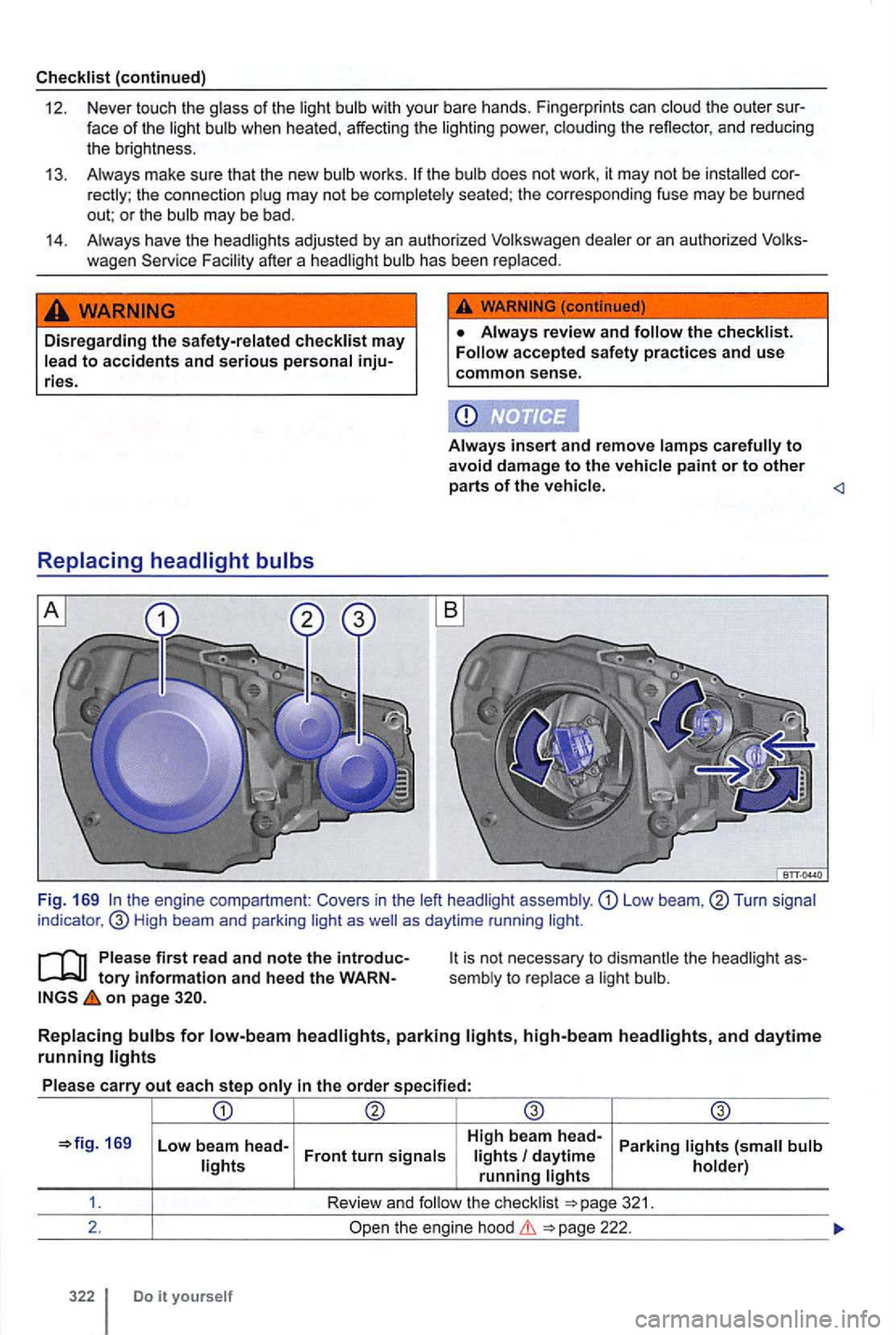
Replacing headlight bulbs
the checklist. Follow accepted safety practices and use common sense .
Always insert and remove lamps carefully to avoid damage to the vehicle paint or to other parts of the vehicle.
on page
169 Low be am head- High
beam head-
Parking
321.
2 .
the engine hood
Do
Page 426 of 516
Jump-starting
this sect ion find inform atio n about:
U sing jum per cables . . . . . . . . . . . . . . . . . . . . . 328
your eng ine does not start because the
the battery acid
l evel indicator window on the vehicle battery before
jump -starting
with gasoline engines , the cross -sec tion of the jumper
cable wire must be at least
assistance systems 195
Prepara tions for worki ng i n the engine compa rt
ment 222
Vehicle battery
Working on the batterie s or the electrical syste m in your vehicle can cause serious acid burns, fires , or electrical shock.
Never lean over a vehicl e battery. Always
w ea r protective gloves and eye protection. To
r educe your risk o f injury, never tilt the bat
t e rie s; acid could spill out through the vents and burn you.
A highly explosive mixture of gases is give n off when the battery being charged.
you an y battery acid,
g et medical attention immediately .
work on the batterie s or the e lectrica l system in your vehicle can cause serious acid burns, fires, or electrical shocks. Always
read and heed the
Never jump-start a vehicle with a t hawed or frozen vehicle battery. The battery can explode. A d ead battery can freeze at tempera
tures around +32
A batt ery that is frozen or was frozen , but has since thawed, must be replaced.
Wh en the vehicle battery is jump-s ta rted ,
i t give s off hydrogen gas, which is highly ex
plosive! Always keep fire, s park s, open flame,
an d smoking mater ials far aw ay from vehicle batteries. Neve r use a telephon e while connecting or disconnecting jumper ca
bl es.
Practica l tips
Page 427 of 516
{continued)
the non-insulated parts of the
battery clamps to touch.
the jumper cable attached to the positive battery terminal to contact metal parts of the vehicle.
Using jumper cables
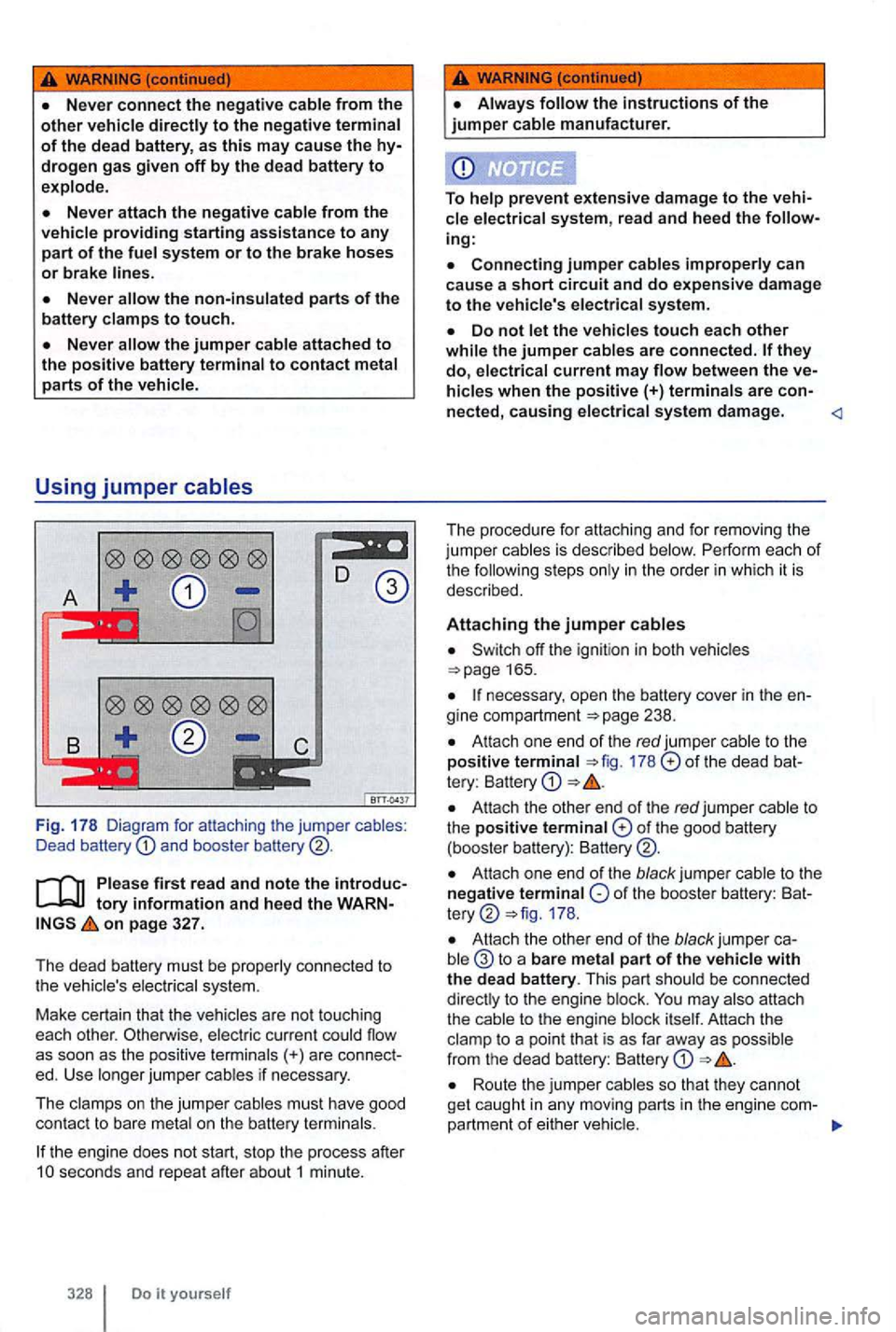
Fig . 17 8 Diagram for attaching the jumper cables:
Dead battery and booste r
on page 327.
The dead battery must be properly connected to
the vehicle's electr ical system .
Make ce
rtain tha t the vehicles are not touchi ng
each other. Otherwise , electric curr ent could flow
as soo n as the positive terminal
s(+) are connec t
ed. Use longer jumper cables if necessary .
Th e clamps on the jumper cables must have good
con tac t to bare metal on
the battery termina ls.
the engine does not start, stop the process after seconds and repeat after about1 minute.
cle electrical system, read and heed the
Connecting jumper cable s improperly can
ca use a short circuit and do ex pen sive dama ge to the vehicle's electrical system .
Switch off the ignition in both vehicles 165.
necessary , open the battery cover in the
At tach one end of the red jumper cable to t he
po sitive terminal 178 of the dead tery : Battery
Attach the othe r end of the red ju mper cable to the positive terminal of the good battery
(booster battery):
Atta ch one end of the black jump er of the booste r battery: 178 .
Attach the other end of the black jumper to a bare meta l part of the vehicle with the dead battery. This part shou ld be connected
dire ctly to the eng ine blo ck.
Route the jumper cables so that they cannot
ge t ca ught in any moving parts in the engine com-
partment of e ith er vehic le.
Page 428 of 516
the engine
the engine of the vehicle with the good
battery that is providing help and let it run at idle
speed .
Turn on the ignition of the vehicle with the dead
b attery. the engine starts, wait 2 to 3 minutes
the engine does
not start within about seconds , turn off the tion and wait at least 1 minute ; then try again .
Removing the jumper cables
Before you remove the jumper cables. swi tch
off the headlights (if they are on) .
the vehic le with the dead batte ry , switc h on
t he heater fa n and the rea r window defroster. This
he lps
to m in im ize voltage spikes when the cables
a re disconnected.
With the engine running , remove the jumper
nected .
Disconnect the black (- ) cab le f rom the vehicle
wit h the dead battery .
Disconnec t the black (-) cable from the other
vehicle (vehicle with the good battery) .
Disconnect the red(+) cable from the other
Disconnect the red (+ ) cable from the vehicle
with the dead battery .
Close the battery cover.
Improper use of jumper cables when starting a vehicle with a dead battery can
cause the battery to explode , leading to
Always wear proper eye protection. Never
lean over the vehicle battery.
Attach the jumper cables in the correct
Never connect the negative cable from the
vehicle providing starting assistance to parts of the fuel system or to the brake hoses or brake lines.
Never
sistance.
Avoid electrostatic discharge in the may cause the hydrogen gas escaping from the vehicle battery to ignite.
Never jump-start a vehicle with a battery
that is damaged or frozen or that was frozen
and has thawed. The battery can explode.
Always the instructions of the jumper cable manufacturer.
Never connect the negati ve cable from the other vehicle directly to the negative terminal of the dead battery . The hydrogen gas from
the battery is explosive.
Never short out the battery terminals by connecting the positive(+) and negative
Practical tips 329
Page 430 of 516
When not to tow your
there is in the tr ansmission be
cause of damage to you r it must be moved
with the drive wheels off the ground . The vehicle
can only be towed if its ignition is switched on and
i ts electrica l system is operating. the following
situat ions, the vehicle cannot be towed at
the front and rear whee ls can not turn .
the vehic le battery is dead {because the elec
troni c steering column lock engages and cannot be
r e leased).
you have to tow an automatic transmission
vehic le more than 30
first read and note the introduc
on page
Towing eye; tow rope or tow bar
A towing eye is included in your vehic le 's tool kit. This can be inserted in a threaded hole in the front
bumper and used when your vehicl e is being tow
ed by ano ther vehicle.
The tow rope should be flexib le enough to he lp
protect both vehicles from damage. Use a synthet
ic fiber rope or similar rope .
Attach the tow rope or tow bar only
to the towing
eye in the vehic le
For the towed vehic le, note the following :
Put the transmission in Neu tral (N) .
Do not tow faster than 30 mph (50 km/h). The
drive rotates while the i
s being towe d with its rear wheels off the ground. This can damage the automatic transmission .
can
Do not tow more than 30 miles (50 km).
When a commerc ial towing truck is being used,
the must be towed with the front
wheels
transmiss ion fluid ha s out of the trans
mission.
the re is in the transmissio n be
cause of damage to your vehicle, it must be moved
w ith the drive whee ls off the ground.
the front and rear whee ls cannot turn.
When the vehicle battery is dead , since the
steering may remain disabl ed, and it may not be
poss ib le to rele ase the electronic steering column
lock.
you have to tow an auto matic transmiss ion
veh icle mor e than 30 miles (50 km).
A veh icle can be towed only if the electronic steer ing column lock is r e leased. case of a
power system,
the engine may have to be jump-started in order to release the electronic steering column lock .