trailer VOLKSWAGEN PASSAT CC 2015 1.G Owner's Manual
[x] Cancel search | Manufacturer: VOLKSWAGEN, Model Year: 2015, Model line: PASSAT CC, Model: VOLKSWAGEN PASSAT CC 2015 1.GPages: 578, PDF Size: 8.42 MB
Page 225 of 578

Engine Engine
ID
code
Trailer with
brakes
Trailer
without
brakes
Trailer
hitch
tongue
weight
All gasoline
engines
all 2000 lbs
(907 kg)
1650 lbs
(748 kg)
200 lbs
(91 kg)
The Gross Vehicle Weight Rating and the Gross Axle Weight Rating
must not be exceeded, even with a trailer. These ratings are listed on
the safety compliance label on the driver door jamb ⇒ page 55, Im-
portant vehicle labels. When a trailer is towed, the weight of the ball
mount and the tongue weight of the trailer are added to the vehicle
weight ⇒ Determining the correct load limit.
The trailer weight ratings given above are valid only up to altitudes of
3000 ft (1000 m) above sea level. The maximum permissible com-
bined towing weight must be reduced by about 10% for every 3000 ft
(1000 m), or portion thereof, of additional altitude.
WARNING
Exceeding the gross trailer weight rating and tongue weight
can cause accidents and serious personal injury.
Never let the actual weights at the front and rear axles exceed
the Gross Axle Weight Rating (GAWR). Never let the combined
front and rear weights exceed the Gross Vehicle Weight Rating
(GVWR).
NOTICE
Exceeding the gross weight ratings can cause extensive vehicle
damage that is not covered by any Volkswagen Limited Warran-
ty.
Page 262 of 578

There are limits to the load any vehicle or any tire can carry. A vehicle
that is overloaded will not handle well and is more difficult to stop.
Overloading can damage important parts of the vehicle. Overloading
can also lead to blowout, sudden loss of pressure or other tire failure
that can cause loss of control.
Your safety and the safety of your passengers depends on making
sure that load limits are not exceeded. Vehicle load includes every-
body and everything in and on the vehicle. These load limits are
technically referred to as the vehicle's Gross Vehicle Weight Rating
(GVWR).
The GVWR includes the weight of the basic vehicle, all factory-
installed and other accessories, a full tank of fuel, oil, coolant and
other fluids plus maximum load. The maximum load includes the
number of passengers that the vehicle is intended to carry (seating
capacity) with an assumed weight of 150 lbs (68 kg) for each passen-
ger at a designated seating position and the total weight of any lug-
gage in the vehicle. If you tow a trailer, the weight of the trailer hitch
and the tongue weight of the loaded trailer must be included as part
of the vehicle weight. At altitudes above 3000 ft (1000 m), combined
towing weight (vehicle plus trailer) must be reduced by 10% for every
3000 ft (1000 m).
The Gross Axle Weight Rating (GAWR) is the maximum load that
can be carried at each of the vehicle's 2 axles (by the front or rear
tires). GVWR and GAWR are listed on the safety compliance label on
the driver door jamb. Because there is an upper limit to your vehicle's
total weight (GVWR), the weight of whatever is being carried (includ-
ing the weight of a trailer hitch and the tongue weight of the loaded
trailer) is also limited. More passengers, or passengers who are heav-
ier than the assumed 150 lbs (68 kg), mean that less weight can be
carried as luggage or other cargo. The tire pressure label on your
Volkswagen also lists the maximum combined weight of all of the oc-
cupants and luggage or other cargo that the vehicle can carry.
Page 263 of 578

WARNING
Overloading a vehicle can cause loss of vehicle control, a crash
or other accident, serious personal injury, and even death.
Carrying more weight than your vehicle was designed to car-
ry will prevent the vehicle from handling properly and increase
the risk of the loss of vehicle control.
The brakes on a vehicle that has been overloaded may not be
able to stop the vehicle in a safe distance.
Tires on a vehicle that has been overloaded can fail sudden-
ly, including a blowout and sudden deflation, causing loss of
control and a crash.
Always make sure that the total load being transported – in-
cluding the weight of a trailer hitch and the tongue weight of a
loaded trailer – does not make the vehicle heavier than the ve-
hicle's Gross Vehicle Weight Rating.
Determining the correct load limit
Page 264 of 578

Steps for Determining Correct Load Limit:
4. The resulting figure equals the available amount of cargo and
luggage load capacity.
For example, if the “XXX” amount equals 1400 lbs. and there
will be five 150 lb. passengers in your vehicle, the amount of
available cargo and luggage load capacity is 650 lbs. (1400-
750 (5 x 150) = 650 lbs.)
5. Determine the combined weight of luggage and cargo being
loaded on the vehicle. That weight may not safely exceed the
available cargo and luggage load capacity calculated in Step 4.
6. If your vehicle will be towing a trailer, load from your trailer will
be transferred to your vehicle. Consult this Manual to determine
how this reduces the available cargo and luggage capacity of
your vehicle.
Check the tire sidewall to determine the load index specified for
the tire.
UTQG classification
Page 357 of 578
outside temperature. It may be helpful to ventilate the vehicle before
driving and then to drive a short distance with the windows open. Af-
ter that, switch on the air conditioner with the windows closed. Keep
the windows closed when driving at high speeds. Open windows in-
crease fuel consumption.
Switch off seat heating once it has served its purpose.
Switch off the rear window defroster as soon as the windows are
free of fog and ice.
Additional factors that increase fuel consumption (examples):
Malfunctioning engine control.
Driving in the mountains.
Towing a trailer.
NOTICE
Never let the vehicle coast or roll down a hill in Neutral (N), es-
pecially when the engine is not running. The transmission will
not be lubricated and will be damaged.
Fuel-efficient driving
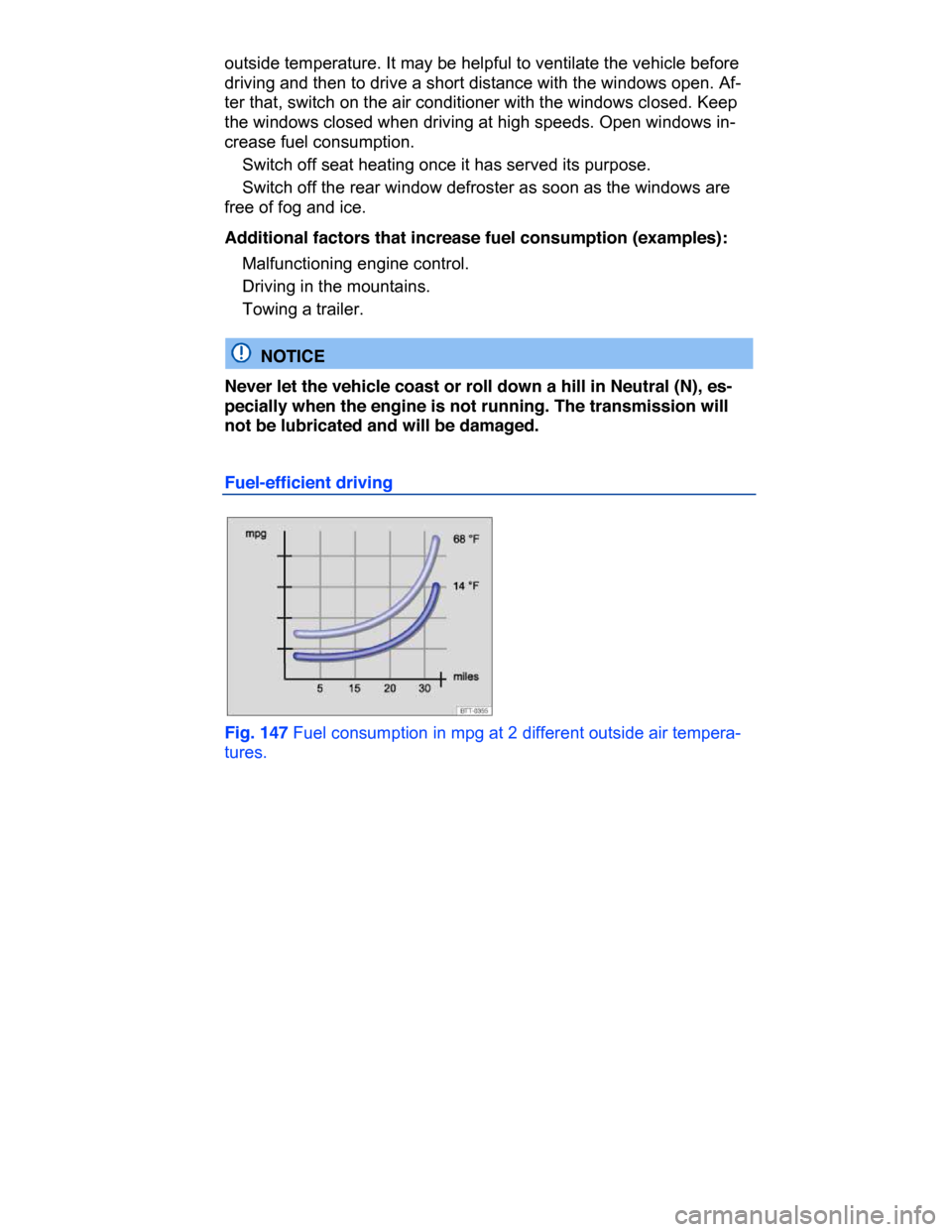
Fig. 147 Fuel consumption in mpg at 2 different outside air tempera-
tures.
Page 379 of 578

WARNING
Park Distance Control is no substitute for careful and attentive
driving. Never rely completely on these systems for information
about people and objects that might be in the way of the vehicle
and could be struck resulting in serious personal injuries.
The sensors have blind spots in which they cannot detect
people, animals, and objects.
Always be careful and look around you when parking. The
sensors cannot always detect people, animals, and objects.
Watch out for small children and animals in particular.
Certain types of clothing and the surfaces of certain objects
do not reflect the ultrasonic waves that the sensors send and
receive. Such objects and persons wearing such clothing will
not be detected by PDC or will not be detected accurately.
Noise in the area can interfere with the signals of the Park
Distance Control sensors. Under certain circumstances, the
system will not detect people and objects for this reason.
NOTICE
Things like trailer draw bars, thin rods, fences, trees, narrow
painted vertical poles, posts, or a luggage compartment lid that
is opening may not be detected by the Park Distance Control
sensors and could damage the vehicle.
If you continue driving closer to an object that the Park Dis-
tance Control has already detected and reported, the object may
disappear from the sensor range and may no longer be detected.
This is especially true for low or high objects. The system will no
longer sound warnings about these objects. Ignoring signals
from the Park Distance Control system could result in serious
damage to the vehicle.
The sensors in the bumpers can be damaged or become misa-
ligned in low speed impacts and parking maneuvers. Damaged
or misaligned sensors cannot accurately detect or report objects
that might be within range of the PDC system.
To help make sure that the system works properly, always
keep the sensors in the bumpers clean and free of snow and ice;
do not cover the sensors with stickers or other objects.
Page 478 of 578

Engine life is influenced by how you drive the vehicle for the first
1000 miles (1600 km). Even afterwards, driving at moderate engine
speeds, especially when the engine is cold, will tend to reduce engine
wear and help the engine to last longer and go farther. But do not
drive at an excessively low engine speed, either. Always downshift if
the engine is not running smoothly. For the first 600 miles
(1000 km):
Do not use full throttle.
Don't let the engine speed get above 2/3 the maximum speed.
Do not tow a trailer.
From 600 to 1000 miles (1000 to 1600 km): Speed may gradually
be increased to maximum permissible road and engine speed.
New tires and brake pads
New tires and replacement tires ⇒ Tires and wheels
Brakes ⇒ About the brakes
Breaking in a new engine gently will increase service life and
reduce oil consumption.
Parts and accessories
Page 500 of 578

Description Possible causes,
among others Possible remedy
Electrical con-
sumers do not
work.
Vehicle battery
charge too low. Charge vehicle battery
Remaining fuel level
too low. Refuel
Fuse blown. Check fuse and replace if
necessary
Fuel consumption
higher than indi-
cated.
– Short hauls.
– “Jumpy” accelera-
tor pedal.
– Avoid short distance
driving.
– Drive defensively.
– Accelerate smoothly.
Electrical loads
switched on.
Switch off unnecessary
loads.
Engine control
malfunction.
Have the malfunction cor-
rected
Tire pressure too
low. Adjust tire pressure
Driving in the
mountains.
No direct corrective action
possible.
Towing a trailer or
driving with a roof
rack.
– Check use.
– Remove if not in use.
Driving with heavy
payload.
No direct corrective action
possible.
Driving at high en-
gine speed. Select a higher gear.
Page 524 of 578

WARNING
Changing a wheel, especially on the side of the road, can be
dangerous. To help reduce the risk of serious personal injury:
Always stop the vehicle as soon as it is safe to do so. Move
the vehicle a safe distance off the road where it is safe to
change the wheel.
Always make sure that all passengers, especially children,
are in a safe place outside the vehicle and away from the vehi-
cle and traffic (such as behind a guard rail).
Turn on the emergency flashers and set up another warning
device about 25 yards (25 meters) behind the vehicle to warn
approaching traffic.
Change a wheel by yourself only if you are familiar with the
necessary steps. Otherwise, get expert assistance.
Always switch the engine off, set the electronic parking
brake, and shift the transmission into Park (P) (automatic
transmission) or any gear (manual only) to help prevent the ve-
hicle from moving suddenly and slipping off the jack.
Always make sure that the ground is level and firm. If neces-
sary, place the jack on a large and sturdy board or on a similar
ground support.
Always block the wheel diagonally opposite the wheel being
changed with chocks or other similar things.
If you are towing a trailer, always unhitch it from your vehicle
before starting to change the wheel. Always apply the trailer
brakes firmly and make sure the trailer cannot move uninten-
tionally.
Always use proper and undamaged tools when changing a
wheel.
Once a wheel is lifted off the ground, having the transmission
in Park (P) or in gear will not prevent sudden vehicle move-
ment.
Always use a jack that has been approved by the manufac-
turer for your vehicle. Never use other jacks, even if they have
been approved for use on other Volkswagen models.
To reduce the risk of losing control, crashes, and serious
personal injuries, never loosen the screws on rims with thread-
ed rim rings.
Page 529 of 578

2. Switch off the engine. Automatic transmission: shift the transmis-
sion into Park (P)) ⇒ Automatic transmission: Selector lever. Man-
ual transmission only: shift into a gear ⇒ Manual transmission:
Gearshift lever. Then set the electronic parking brake ⇒ Braking
and parking to help prevent the vehicle from moving.
3. If towing a trailer: Unhitch the trailer from the vehicle and park the
trailer properly.
4. Straighten the steering wheel so that the front wheels point straight
forward.
5. Block the diagonally opposite wheel with chocks or other suitable
things.
6. Loosen the wheel bolts of the wheel to be changed ⇒ Wheel bolts.
7. Find the jack lift point ⇒ fig. 191 on the vehicle frame that is closest
to the wheel to be changed.
8. Crank up the jack so that it still just fits underneath the lift point.
9. Position the jack so that its base is directly underneath the lift point
⇒ fig. 192, making sure that the entire base of the jack rests se-
curely on the ground.
10. Align the jack and wind up the jack claw at the same time, until
the claw cradles the vertical rib underneath the vehicle ⇒ fig. 192.
11. Continue cranking up the jack until the wheel is just a little off
the ground.