Off VOLKSWAGEN TIGUAN 2017 Owner´s Manual
[x] Cancel search | Manufacturer: VOLKSWAGEN, Model Year: 2017, Model line: TIGUAN, Model: VOLKSWAGEN TIGUAN 2017Pages: 341, PDF Size: 9.14 MB
Page 50 of 341
Description and function of the airbags
First read and observe the introductoryinformation and safety warnings⇒
Introduction
The airbags can protect vehicle occupants during frontal and side collisions by reducing their
movement in the direction of the collision.
When an airbag is triggered, it is inflated by a gas generator. This causes the airbag covers to
break, and the airbags inflate forcefully to cover their deployment zones within milliseconds. Once a
vehicle occupant wearing a seat belt starts to sink into the inflated airbag, the gas inside the airbag
starts to escape to cushion the occupant and slow down their movement. This can reduce the risk
of severe and fatal injuries. A triggered airbag will not always prevent other injuries from occurring,
such as swelling, bruising, burning and grazing. The deployment of the airbag can also produce
frictional heat.
Airbags provide no protection for the arms or lower body. Exception: in vehicles with a knee airbag,
the knee area of the driver will be protected.
The most important factors for triggering the airbag are the type of accident, the angle of impact,
the vehicle speed and the type of object with which the vehicle collides. Therefore, visible damage
to the vehicle does not always mean that the airbag should have been triggered.
Whether or not the airbag triggers is determined by the vehicle deceleration rate caused by the
collision and registered by the electronic control unit. If this rate is below the reference value
programmed into the control unit, the airbags will not be triggered, even though the vehicle may be
badly damaged as a result of the collision. Vehicle damage, repair costs or even the lack of vehicle
damage in an accident do not necessarily give an indication of whether an airbag should inflate or
not. It is not possible to define a range of vehicle speeds and reference values, since the
circumstances will vary considerably between one collision and another. It is therefore impossible to
cover every possible kind and angle of impact that would trigger the airbags. Important factors in
the triggering of the airbag include the nature (hard or soft) of the object that the vehicle hits, the
angle of impact, and the vehicle speed.
Airbags only serve as a supplement to the three-point seat belt in some accident situations when
the vehicle braking is sufficient to trigger the airbags. Airbags can only be triggered once and only
in certain situations. The seat belts are always there to provide protection in situations in which the
airbags are not triggered or have already been triggered. For example, if the vehicle collides with a
further vehicle following the initial collision, or is hit by another vehicle.
The airbag system is part of the vehicle's overall passive safety concept. The airbag system can
only work effectively when the occupants are wearing their seat belts correctly and have assumed a
proper sitting position ⇒ Sitting position.
Components of the vehicle safety concept
The following vehicle safety equipment makes up the vehicle's safety concept to reduce the risk of
severe and fatal injuries. Some of this equipment may not be fitted in your particular vehicle. It may
not be available at all in some countries.
•Optimised seat belts for all seats.
•Belt tensioners for the driver and front passenger and also on the rear outer seats if in
conjunction with side airbags.
•Belt tension limiter for the driver, front passenger and, if applicable, for the rear outer seats.
•Belt height adjuster for the front seats.
•Warning lamp and belt status display.
•Front airbags for driver and front passenger.
•Side airbags for the driver, front passenger and, if applicable, for the rear outer seats.
•Curtain airbags on the left and right.
•If applicable, knee airbag for the driver.
•Airbag indicator lamp .
•Indicator lamp PASSENGER AIR BAG in the upper section of the centre console.
•Indicator lamp PASSENGER AIR BAG in the upper section of the centre console.
•Control units and sensors.
•Whiplash-optimised and height-adjustable head restraints.
•Adjustable steering column.
•If applicable, anchor points for child seats on the rear outer seats and on the front passenger
seat.
•If applicable, securing points for the top tether for child seats.
Situations when the front, knee, side and curtain airbags will not be
triggered:
•If the ignition is switched off during a collision.
•If the level of deceleration measured by the control unit is too low during a collision at the front
of the vehicle.
•During a minor side collision.
•During rear collisions.
Page 52 of 341
Switching the front passenger front airbag on and off
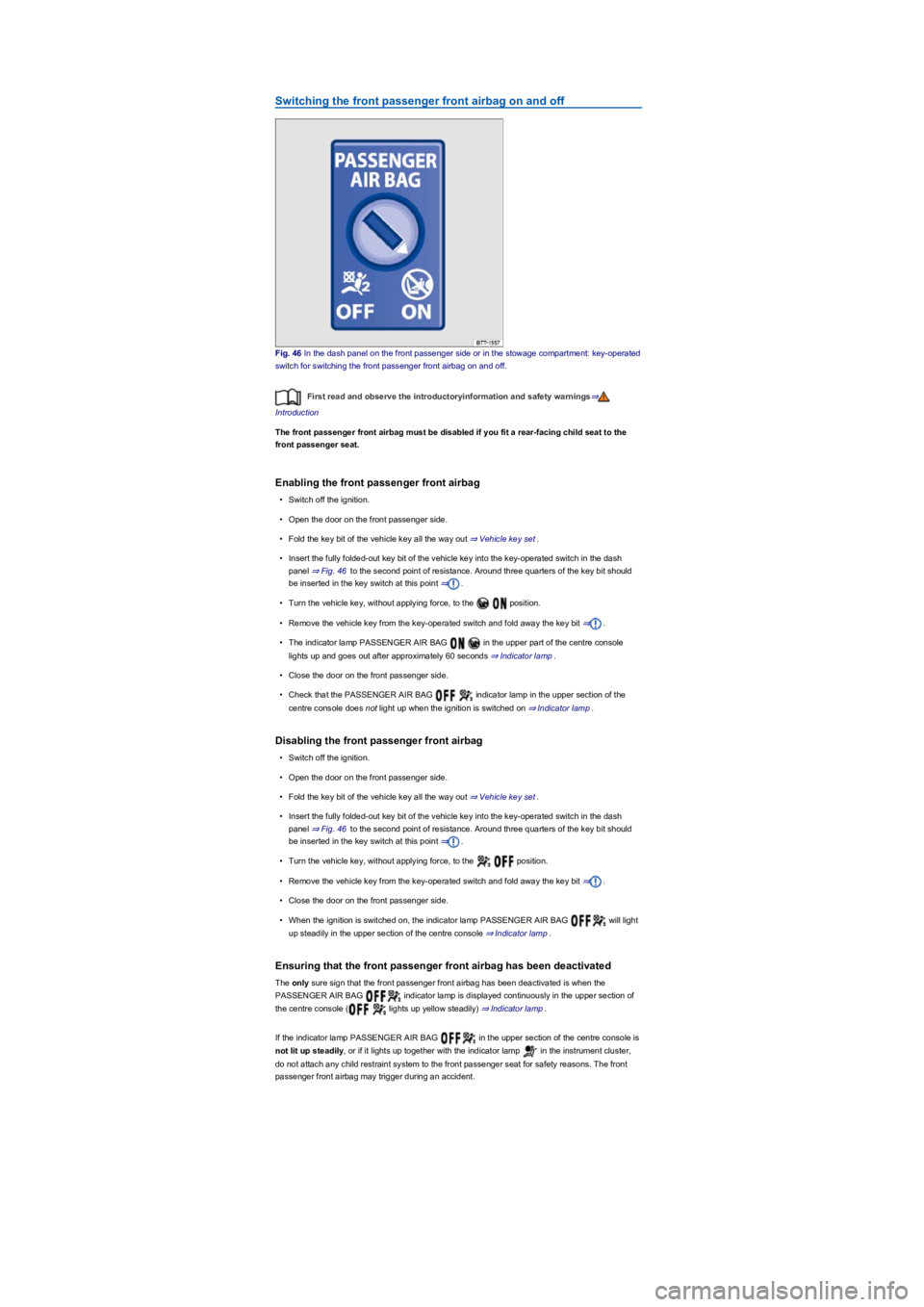
Fig. 46 In the dash panel on the front passenger side or in the stowage compartment: key-operated
switch for switching the front passenger front airbag on and off.
First read and observe the introductoryinformation and safety warnings⇒
Introduction
The front passenger front airbag must be disabled if you fit a rear-facing child seat to the
front passenger seat.
Enabling the front passenger front airbag
•Switch off the ignition.
•Open the door on the front passenger side.
•Fold the key bit of the vehicle key all the way out ⇒ Vehicle key set.
•Insert the fully folded-out key bit of the vehicle key into the key-operated switch in the dash
panel ⇒ Fig. 46 to the second point of resistance. Around three quarters of the key bit should
be inserted in the key switch at this point ⇒.
•Turn the vehicle key, without applying force, to the position.
•Remove the vehicle key from the key-operated switch and fold away the key bit ⇒.
•The indicator lamp PASSENGER AIR BAG in the upper part of the centre console
lights up and goes out after approximately 60 seconds ⇒ Indicator lamp.
•Close the door on the front passenger side.
•Check that the PASSENGER AIR BAG indicator lamp in the upper section of the
centre console does not light up when the ignition is switched on ⇒ Indicator lamp.
Disabling the front passenger front airbag
•Switch off the ignition.
•Open the door on the front passenger side.
•Fold the key bit of the vehicle key all the way out ⇒ Vehicle key set.
•Insert the fully folded-out key bit of the vehicle key into the key-operated switch in the dash
panel ⇒ Fig. 46 to the second point of resistance. Around three quarters of the key bit should
be inserted in the key switch at this point ⇒.
•Turn the vehicle key, without applying force, to the position.
•Remove the vehicle key from the key-operated switch and fold away the key bit ⇒.
•Close the door on the front passenger side.
•When the ignition is switched on, the indicator lamp PASSENGER AIR BAG will light
up steadily in the upper section of the centre console ⇒ Indicator lamp.
Ensuring that the front passenger front airbag has been deactivated
The only sure sign that the front passenger front airbag has been deactivated is when the
PASSENGER AIR BAG indicator lamp is displayed continuously in the upper section of
the centre console ( lights up yellow steadily) ⇒ Indicator lamp.
If the indicator lamp PASSENGER AIR BAG in the upper section of the centre console is
not lit up steadily, or if it lights up together with the indicator lamp in the instrument cluster,
do not attach any child restraint system to the front passenger seat for safety reasons. The front
passenger front airbag may trigger during an accident.
Page 53 of 341
Side airbags
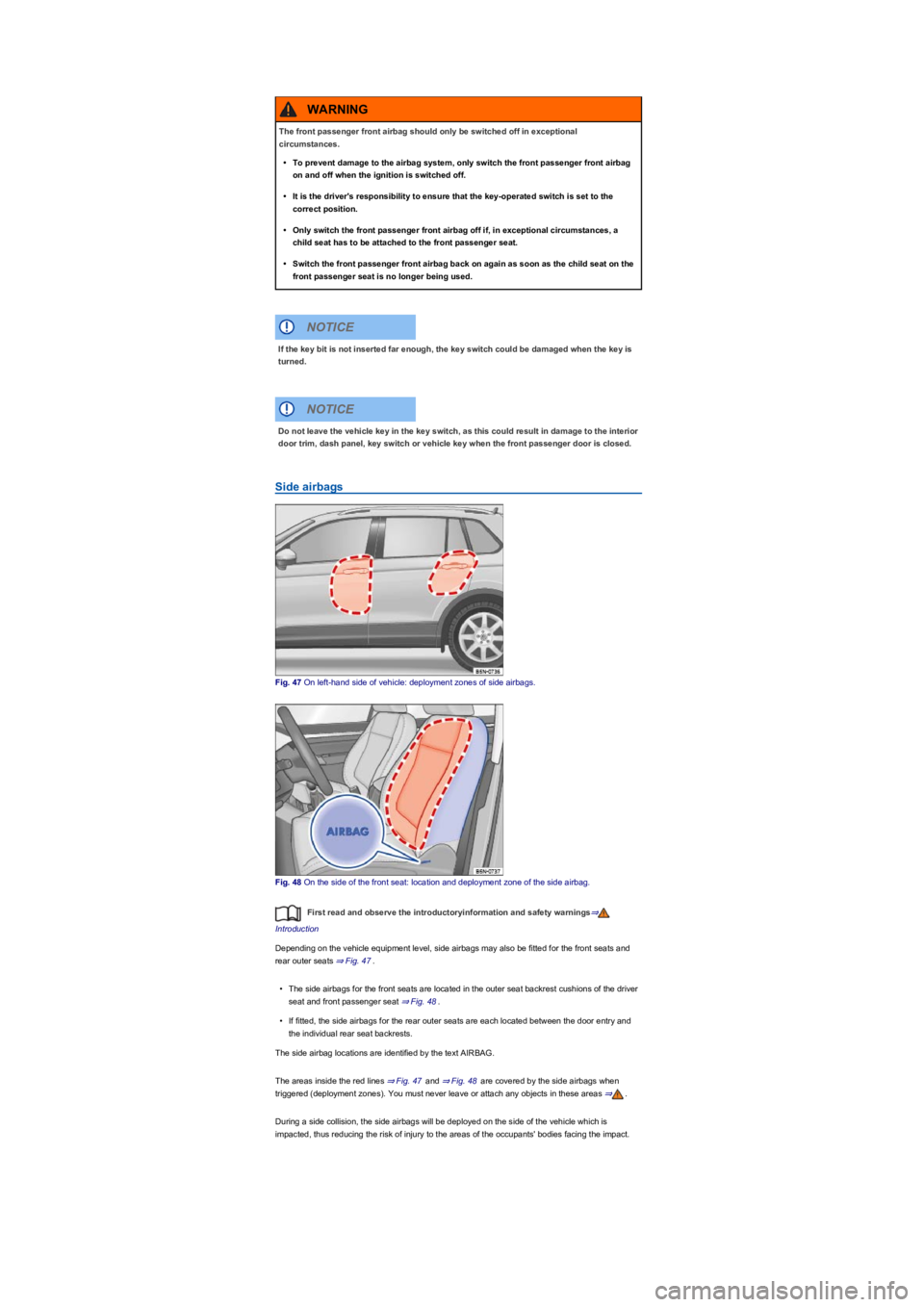
Fig. 47 On left-hand side of vehicle: deployment zones of side airbags.
Fig. 48 On the side of the front seat: location and deployment zone of the side airbag.
First read and observe the introductoryinformation and safety warnings⇒
Introduction
Depending on the vehicle equipment level, side airbags may also be fitted for the front seats and
rear outer seats ⇒ Fig. 47.
•The side airbags for the front seats are located in the outer seat backrest cushions of the driver
seat and front passenger seat ⇒ Fig. 48.
•If fitted, the side airbags for the rear outer seats are each located between the door entry and
the individual rear seat backrests.
The side airbag locations are identified by the text AIRBAG.
The areas inside the red lines ⇒ Fig. 47 and ⇒ Fig. 48 are covered by the side airbags when
triggered (deployment zones). You must never leave or attach any objects in these areas ⇒.
During a side collision, the side airbags will be deployed on the side of the vehicle which is
impacted, thus reducing the risk of injury to the areas of the occupants' bodies facing the impact.
The front passenger front airbag should only be switched off in exceptional
circumstances.
•To prevent damage to the airbag system, only switch the front passenger front airbag
on and off when the ignition is switched off.
•It is the driver's responsibility to ensure that the key-operated switch is set to the
correct position.
•Only switch the front passenger front airbag off if, in exceptional circumstances, a
child seat has to be attached to the front passenger seat.
•Switch the front passenger front airbag back on again as soon as the child seat on the
front passenger seat is no longer being used.
WARNING
If the key bit is not inserted far enough, the key switch could be damaged when the key is
turned.
NOTICE
Do not leave the vehicle key in the key switch, as this could result in damage to the interior
door trim, dash panel, key switch or vehicle key when the front passenger door is closed.
NOTICE
Page 56 of 341
Types of child seat
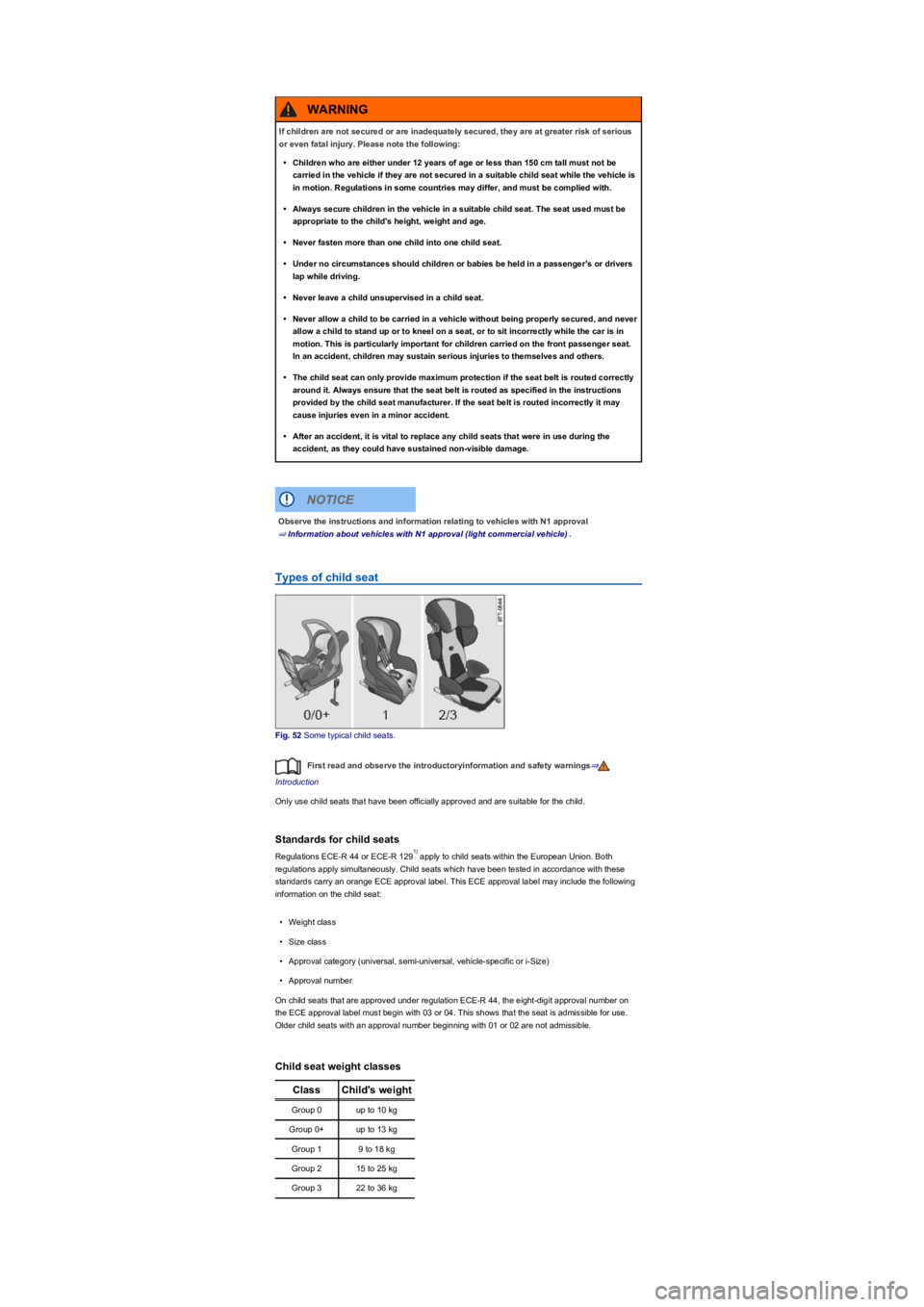
Fig. 52 Some typical child seats.
First read and observe the introductoryinformation and safety warnings⇒
Introduction
Only use child seats that have been officially approved and are suitable for the child.
Standards for child seats
Regulations ECE-R 44 or ECE-R 129 apply to child seats within the European Union. Both
regulations apply simultaneously. Child seats which have been tested in accordance with these
standards carry an orange ECE approval label. This ECE approval label may include the following
information on the child seat:
•Weight class
•Size class
•Approval category (universal, semi-universal, vehicle-specific or i-Size)
•Approval number
On child seats that are approved under regulation ECE-R 44, the eight-digit approval number on
the ECE approval label must begin with 03 or 04. This shows that the seat is admissible for use.
Older child seats with an approval number beginning with 01 or 02 are not admissible.
Child seat weight classes
ClassChild's weight
Group 0up to 10 kg
Group 0+up to 13 kg
Group 19 to 18 kg
Group 215 to 25 kg
Group 322 to 36 kg
If children are not secured or are inadequately secured, they are at greater risk of serious
or even fatal injury. Please note the following:
•Children who are either under 12 years of age or less than 150 cm tall must not be
carried in the vehicle if they are not secured in a suitable child seat while the vehicle is
in motion. Regulations in some countries may differ, and must be complied with.
•Always secure children in the vehicle in a suitable child seat. The seat used must be
appropriate to the child's height, weight and age.
•Never fasten more than one child into one child seat.
•Under no circumstances should children or babies be held in a passenger's or drivers
lap while driving.
•Never leave a child unsupervised in a child seat.
•Never allow a child to be carried in a vehicle without being properly secured, and never
allow a child to stand up or to kneel on a seat, or to sit incorrectly while the car is in
motion. This is particularly important for children carried on the front passenger seat.
In an accident, children may sustain serious injuries to themselves and others.
•The child seat can only provide maximum protection if the seat belt is routed correctly
around it. Always ensure that the seat belt is routed as specified in the instructions
provided by the child seat manufacturer. If the seat belt is routed incorrectly it may
cause injuries even in a minor accident.
•After an accident, it is vital to replace any child seats that were in use during the
accident, as they could have sustained non-visible damage.
WARNING
Observe the instructions and information relating to vehicles with N1 approval
⇒ Information about vehicles with N1 approval (light commercial vehicle).
NOTICE
1)
Page 58 of 341
•Deactivate the front passenger front airbag if fitting a rear-facing child seat on the front
passenger seat.
•When fitting on the front passenger seat, push the front passenger seat back fully and adjust
the seat to the highest position. Adjust the backrest to an upright position ⇒ Sitting position.
•When using child seats from groups 0 or 1 on the rear bench seat, push the rear bench seat
backwards as far as possible ⇒ Sitting position.
•When using child seats from groups 2 or 3 on the rear bench seat, push the rear bench seat
into a central position ⇒ Sitting position.
•Always ensure that there is enough space around the child seat. If necessary, adjust the
position of the seat in front. When doing so, ensure that the driver or front passenger can still
maintain a correct sitting position ⇒ Sitting position.
•The backrest of the child seat must lay as flat as possible against the vehicle seat backrest.
Adjust the seat backrest angle if necessary so that the child seat lies flush against the backrest.
If the child seat, once fitted, touches the vehicle head restraint so that it cannot lie flat against
the backrest, push the vehicle head restraint up as far as it will go or remove it and stow it away
safely in the vehicle ⇒ Sitting position.
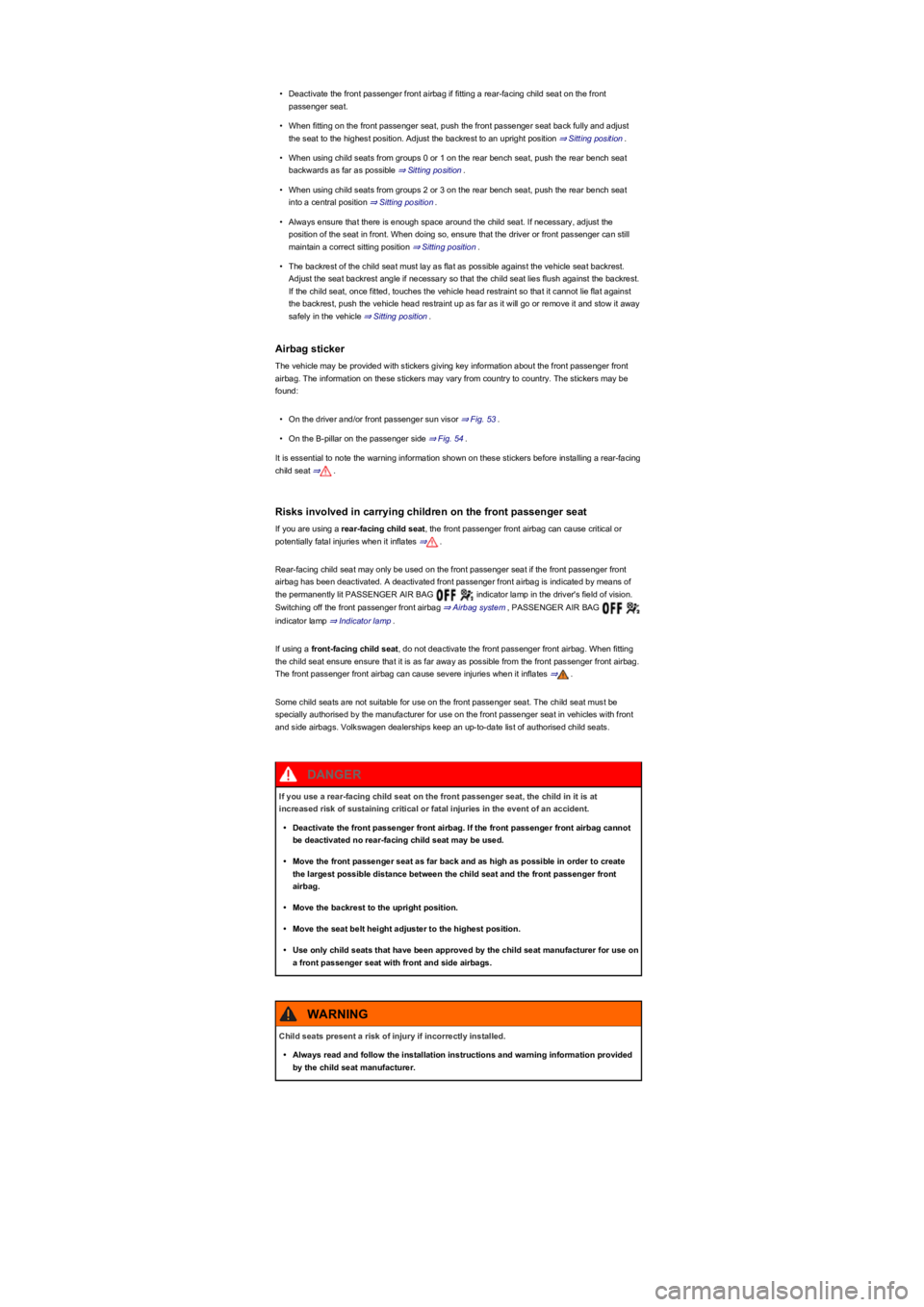
Airbag sticker
The vehicle may be provided with stickers giving key information about the front passenger front
airbag. The information on these stickers may vary from country to country. The stickers may be
found:
•On the driver and/or front passenger sun visor ⇒ Fig. 53.
•On the B-pillar on the passenger side ⇒ Fig. 54.
It is essential to note the warning information shown on these stickers before installing a rear-facing
child seat ⇒.
Risks involved in carrying children on the front passenger seat
If you are using a rear-facing child seat, the front passenger front airbag can cause critical or
potentially fatal injuries when it inflates ⇒.
Rear-facing child seat may only be used on the front passenger seat if the front passenger front
airbag has been deactivated. A deactivated front passenger front airbag is indicated by means of
the permanently lit PASSENGER AIR BAG indicator lamp in the driver's field of vision.
Switching off the front passenger front airbag ⇒ Airbag system, PASSENGER AIR BAG
indicator lamp ⇒ Indicator lamp.
If using a front-facing child seat, do not deactivate the front passenger front airbag. When fitting
the child seat ensure ensure that it is as far away as possible from the front passenger front airbag.
The front passenger front airbag can cause severe injuries when it inflates ⇒.
Some child seats are not suitable for use on the front passenger seat. The child seat must be
specially authorised by the manufacturer for use on the front passenger seat in vehicles with front
and side airbags. Volkswagen dealerships keep an up-to-date list of authorised child seats.
If you use a rear-facing child seat on the front passenger seat, the child in it is at
increased risk of sustaining critical or fatal injuries in the event of an accident.
•Deactivate the front passenger front airbag. If the front passenger front airbag cannot
be deactivated no rear-facing child seat may be used.
•Move the front passenger seat as far back and as high as possible in order to create
the largest possible distance between the child seat and the front passenger front
airbag.
•Move the backrest to the upright position.
•Move the seat belt height adjuster to the highest position.
•Use only child seats that have been approved by the child seat manufacturer for use on
a front passenger seat with front and side airbags.
DANGER
Child seats present a risk of injury if incorrectly installed.
•Always read and follow the installation instructions and warning information provided
by the child seat manufacturer.
WARNING
Page 60 of 341
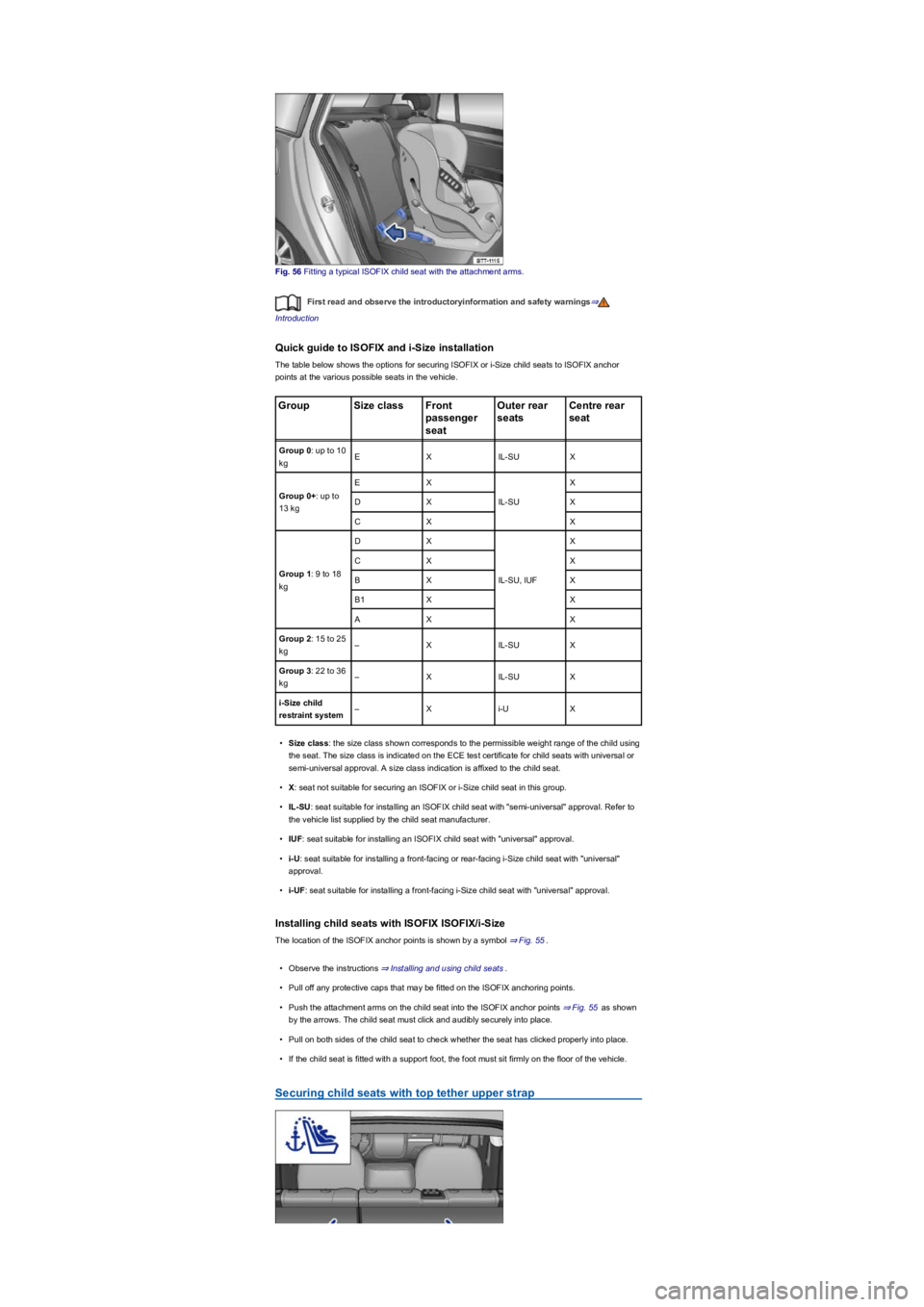
Fig. 56 Fitting a typical ISOFIX child seat with the attachment arms.
First read and observe the introductoryinformation and safety warnings⇒
Introduction
Quick guide to ISOFIX and i-Size installation
The table below shows the options for securing ISOFIX or i-Size child seats to ISOFIX anchor
points at the various possible seats in the vehicle.
GroupSize classFront
passenger
seat
Outer rear
seats
Centre rear
seat
Group 0: up to 10
kgEXIL-SUX
Group 0+: up to
13 kg
EX
IL-SU
X
DXX
CXX
Group 1: 9 to 18
kg
DX
IL-SU, IUF
X
CXX
BXX
B1XX
AXX
Group 2: 15 to 25
kg–XIL-SUX
Group 3: 22 to 36
kg–XIL-SUX
i-Size child
restraint system–Xi-UX
•Size class: the size class shown corresponds to the permissible weight range of the child using
the seat. The size class is indicated on the ECE test certificate for child seats with universal or
semi-universal approval. A size class indication is affixed to the child seat.
•X: seat not suitable for securing an ISOFIX or i-Size child seat in this group.
•IL-SU: seat suitable for installing an ISOFIX child seat with "semi-universal" approval. Refer to
the vehicle list supplied by the child seat manufacturer.
•IUF: seat suitable for installing an ISOFIX child seat with "universal" approval.
•i-U: seat suitable for installing a front-facing or rear-facing i-Size child seat with "universal"
approval.
•i-UF: seat suitable for installing a front-facing i-Size child seat with "universal" approval.
Installing child seats with ISOFIX ISOFIX/i-Size
The location of the ISOFIX anchor points is shown by a symbol ⇒ Fig. 55.
•Observe the instructions ⇒ Installing and using child seats.
•Pull off any protective caps that may be fitted on the ISOFIX anchoring points.
•Push the attachment arms on the child seat into the ISOFIX anchor points ⇒ Fig. 55 as shown
by the arrows. The child seat must click and audibly securely into place.
•Pull on both sides of the child seat to check whether the seat has clicked properly into place.
•If the child seat is fitted with a support foot, the foot must sit firmly on the floor of the vehicle.
Securing child seats with top tether upper strap
Page 63 of 341
The 12-volt vehicle battery will discharge if the hazard warning lights are left on over a long
period of time – even when the ignition is switched off.
Depending on the vehicle equipment, the brake lights flash rapidly if you brake sharply or
initiate full braking at a speed of more than 80 km/h (50 mph). This is a particularly effective way of
attracting the attention of vehicles behind you. If you then continue to brake, the hazard warning
lights will be switched on automatically at speeds under approximately 10 km/h (6 mph). Once the
vehicle starts to accelerate, the hazard warning lights will switch off again.
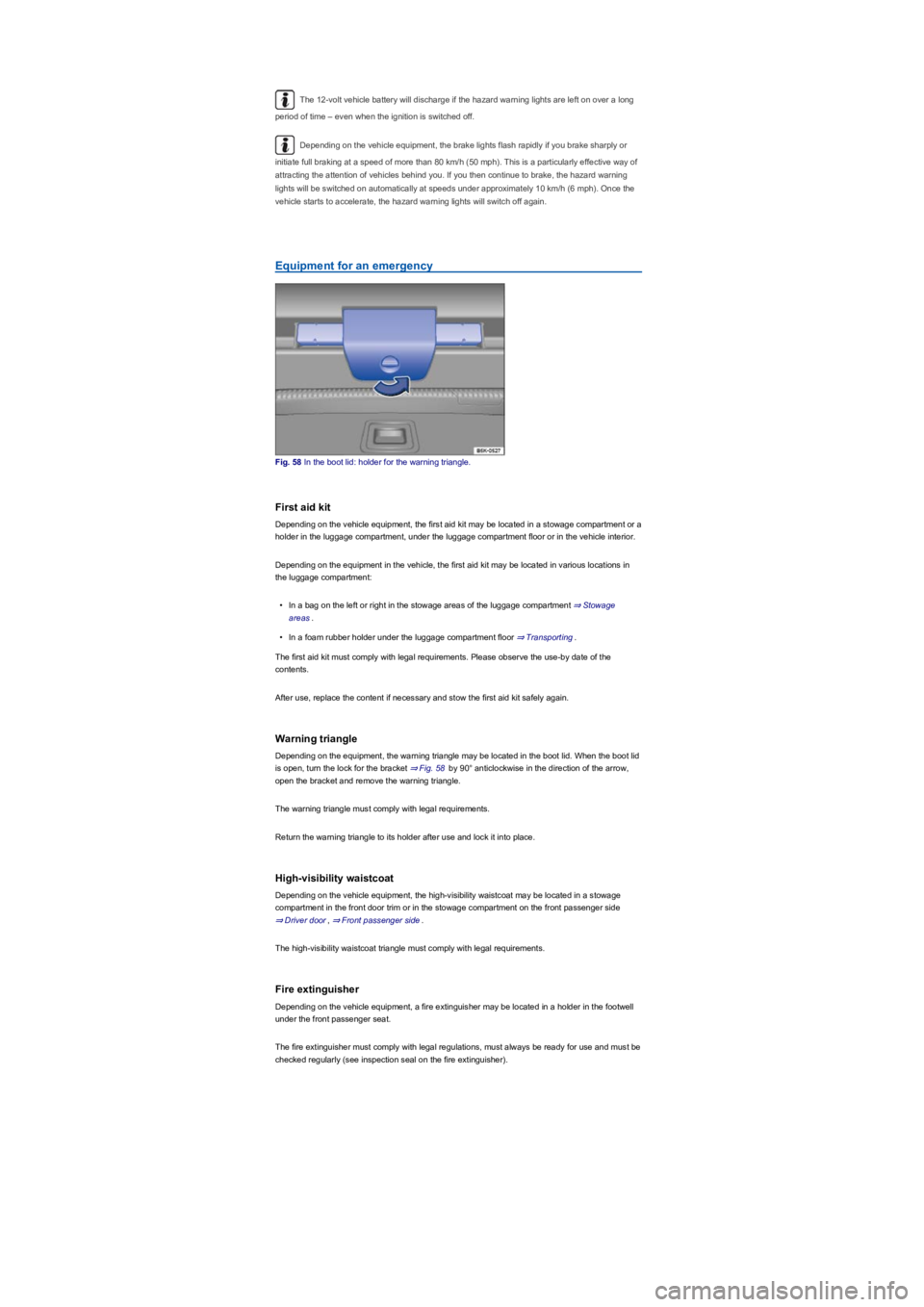
Equipment for an emergency
Fig. 58 In the boot lid: holder for the warning triangle.
First aid kit
Depending on the vehicle equipment, the first aid kit may be located in a stowage compartment or a
holder in the luggage compartment, under the luggage compartment floor or in the vehicle interior.
Depending on the equipment in the vehicle, the first aid kit may be located in various locations in
the luggage compartment:
•In a bag on the left or right in the stowage areas of the luggage compartment ⇒ Stowage
areas.
•In a foam rubber holder under the luggage compartment floor ⇒ Transporting.
The first aid kit must comply with legal requirements. Please observe the use-by date of the
contents.
After use, replace the content if necessary and stow the first aid kit safely again.
Warning triangle
Depending on the equipment, the warning triangle may be located in the boot lid. When the boot lid
is open, turn the lock for the bracket ⇒ Fig. 58 by 90° anticlockwise in the direction of the arrow,
open the bracket and remove the warning triangle.
The warning triangle must comply with legal requirements.
Return the warning triangle to its holder after use and lock it into place.
High-visibility waistcoat
Depending on the vehicle equipment, the high-visibility waistcoat may be located in a stowage
compartment in the front door trim or in the stowage compartment on the front passenger side
⇒ Driver door, ⇒ Front passenger side.
The high-visibility waistcoat triangle must comply with legal requirements.
Fire extinguisher
Depending on the vehicle equipment, a fire extinguisher may be located in a holder in the footwell
under the front passenger seat.
The fire extinguisher must comply with legal regulations, must always be ready for use and must be
checked regularly (see inspection seal on the fire extinguisher).
Page 65 of 341
The symbol can differ depending on the version of the instrument cluster.
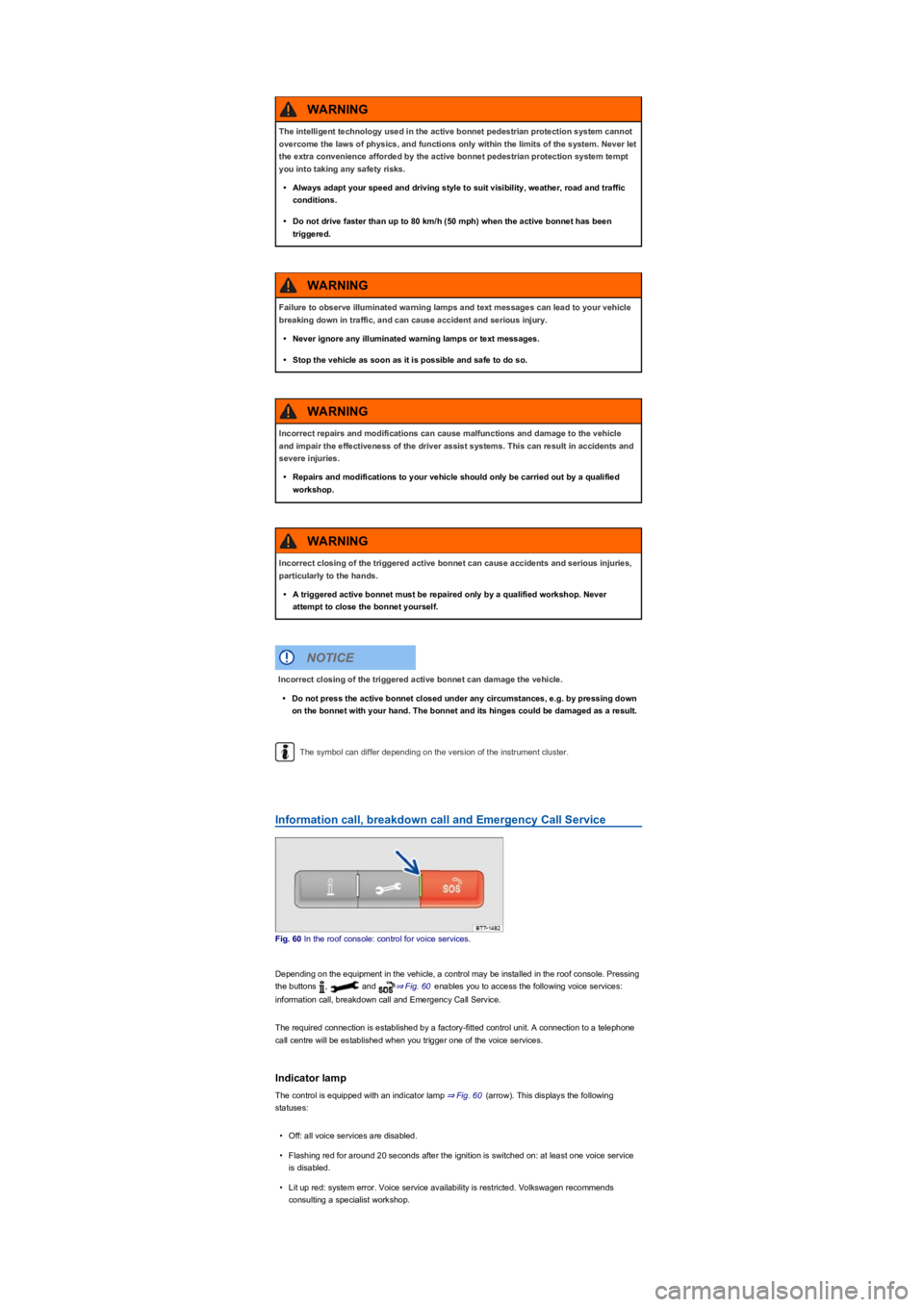
Information call, breakdown call and Emergency Call Service
Fig. 60 In the roof console: control for voice services.
Depending on the equipment in the vehicle, a control may be installed in the roof console. Pressing
the buttons , and ⇒ Fig. 60 enables you to access the following voice services:
information call, breakdown call and Emergency Call Service.
The required connection is established by a factory-fitted control unit. A connection to a telephone
call centre will be established when you trigger one of the voice services.
Indicator lamp
The control is equipped with an indicator lamp ⇒ Fig. 60 (arrow). This displays the following
statuses:
•Off: all voice services are disabled.
•Flashing red for around 20 seconds after the ignition is switched on: at least one voice service
is disabled.
•Lit up red: system error. Voice service availability is restricted. Volkswagen recommends
consulting a specialist workshop.
The intelligent technology used in the active bonnet pedestrian protection system cannot
overcome the laws of physics, and functions only within the limits of the system. Never let
the extra convenience afforded by the active bonnet pedestrian protection system tempt
you into taking any safety risks.
•Always adapt your speed and driving style to suit visibility, weather, road and traffic
conditions.
•Do not drive faster than up to 80 km/h (50 mph) when the active bonnet has been
triggered.
WARNING
Failure to observe illuminated warning lamps and text messages can lead to your vehicle
breaking down in traffic, and can cause accident and serious injury.
•Never ignore any illuminated warning lamps or text messages.
•Stop the vehicle as soon as it is possible and safe to do so.
WARNING
Incorrect repairs and modifications can cause malfunctions and damage to the vehicle
and impair the effectiveness of the driver assist systems. This can result in accidents and
severe injuries.
•Repairs and modifications to your vehicle should only be carried out by a qualified
workshop.
WARNING
Incorrect closing of the triggered active bonnet can cause accidents and serious injuries,
particularly to the hands.
•A triggered active bonnet must be repaired only by a qualified workshop. Never
attempt to close the bonnet yourself.
WARNING
Incorrect closing of the triggered active bonnet can damage the vehicle.
•Do not press the active bonnet closed under any circumstances, e.g. by pressing down
on the bonnet with your hand. The bonnet and its hinges could be damaged as a result.
NOTICE
Page 67 of 341
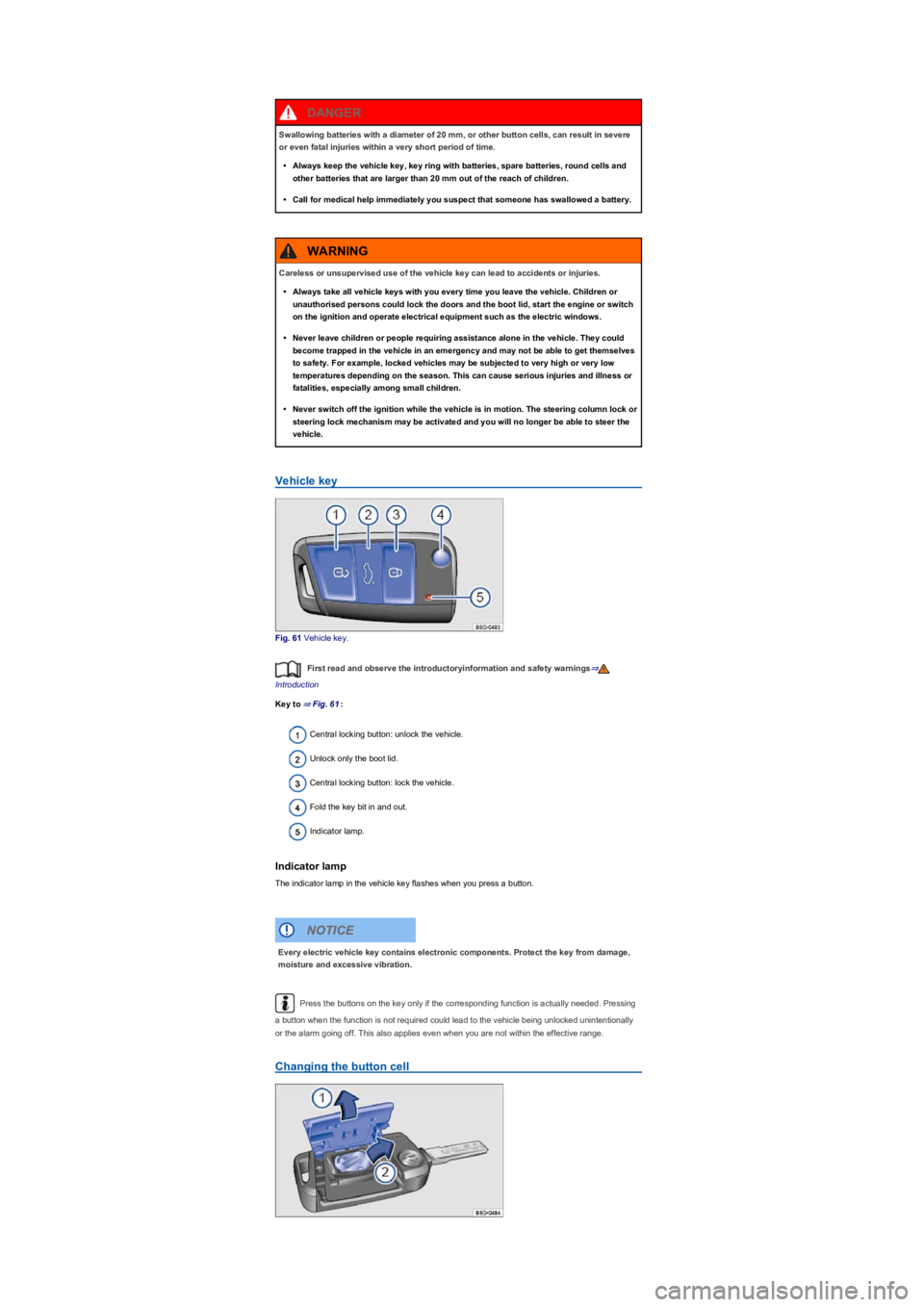
Vehicle key
Fig. 61 Vehicle key.
First read and observe the introductoryinformation and safety warnings⇒
Introduction
Key to ⇒ Fig. 61:
Central locking button: unlock the vehicle.
Unlock only the boot lid.
Central locking button: lock the vehicle.
Fold the key bit in and out.
Indicator lamp.
Indicator lamp
The indicator lamp in the vehicle key flashes when you press a button.
Press the buttons on the key only if the corresponding function is actually needed. Pressing
a button when the function is not required could lead to the vehicle being unlocked unintentionally
or the alarm going off. This also applies even when you are not within the effective range.
Changing the button cell
Swallowing batteries with a diameter of 20 mm, or other button cells, can result in severe
or even fatal injuries within a very short period of time.
•Always keep the vehicle key, key ring with batteries, spare batteries, round cells and
other batteries that are larger than 20 mm out of the reach of children.
•Call for medical help immediately you suspect that someone has swallowed a battery.
DANGER
Careless or unsupervised use of the vehicle key can lead to accidents or injuries.
•Always take all vehicle keys with you every time you leave the vehicle. Children or
unauthorised persons could lock the doors and the boot lid, start the engine or switch
on the ignition and operate electrical equipment such as the electric windows.
•Never leave children or people requiring assistance alone in the vehicle. They could
become trapped in the vehicle in an emergency and may not be able to get themselves
to safety. For example, locked vehicles may be subjected to very high or very low
temperatures depending on the season. This can cause serious injuries and illness or
fatalities, especially among small children.
•Never switch off the ignition while the vehicle is in motion. The steering column lock or
steering lock mechanism may be activated and you will no longer be able to steer the
vehicle.
WARNING
Every electric vehicle key contains electronic components. Protect the key from damage,
moisture and excessive vibration.
NOTICE
Page 68 of 341
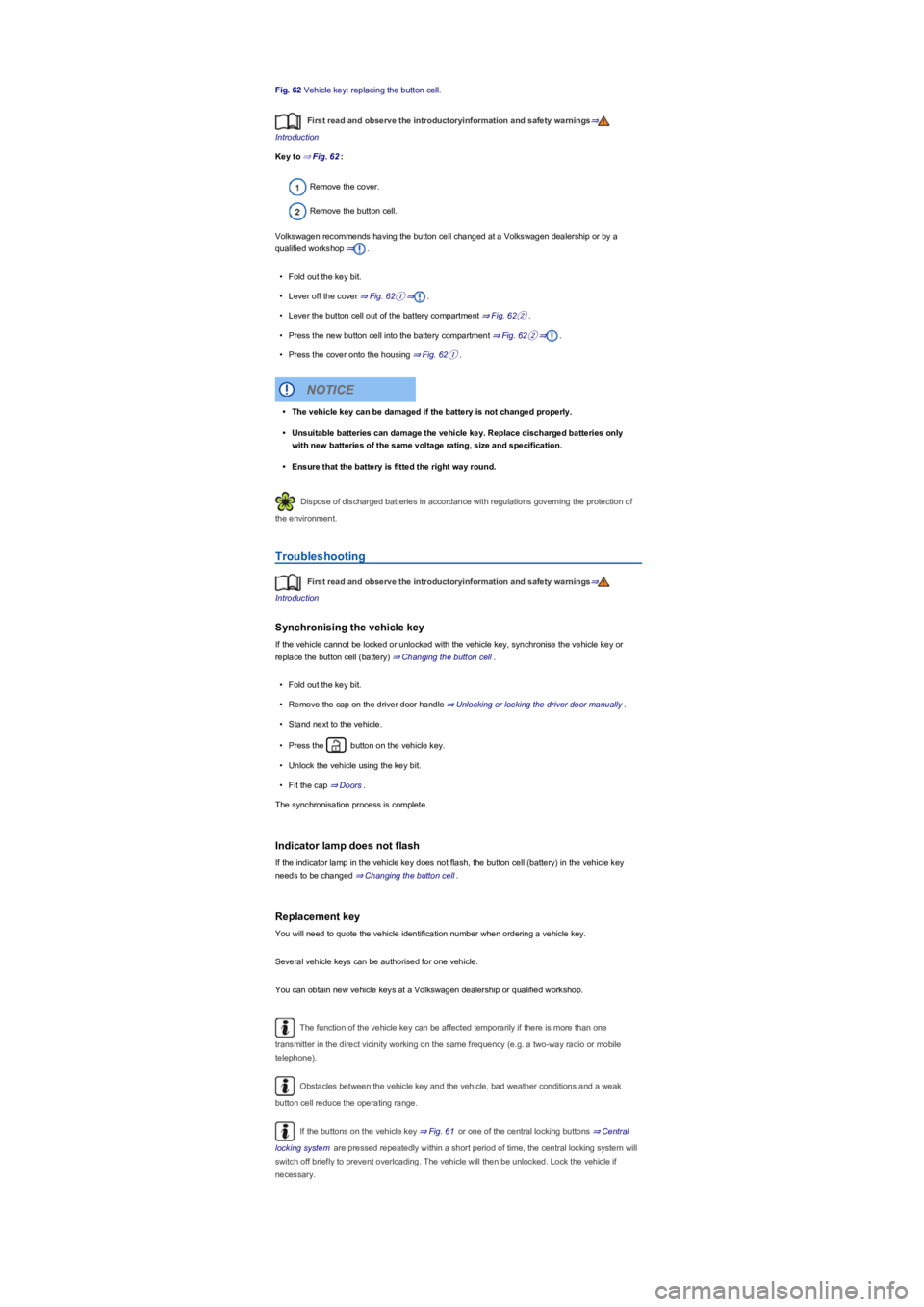
Fig. 62 Vehicle key: replacing the button cell.
First read and observe the introductoryinformation and safety warnings⇒
Introduction
Key to ⇒ Fig. 62:
Remove the cover.
Remove the button cell.
Volkswagen recommends having the button cell changed at a Volkswagen dealership or by a
qualified workshop ⇒.
•Fold out the key bit.
•Lever off the cover ⇒ Fig. 62①⇒.
•Lever the button cell out of the battery compartment ⇒ Fig. 62②.
•Press the new button cell into the battery compartment ⇒ Fig. 62②⇒.
•Press the cover onto the housing ⇒ Fig. 62①.
Dispose of discharged batteries in accordance with regulations governing the protection of
the environment.
Troubleshooting
First read and observe the introductoryinformation and safety warnings⇒
Introduction
Synchronising the vehicle key
If the vehicle cannot be locked or unlocked with the vehicle key, synchronise the vehicle key or
replace the button cell (battery) ⇒ Changing the button cell.
•Fold out the key bit.
•Remove the cap on the driver door handle ⇒ Unlocking or locking the driver door manually.
•Stand next to the vehicle.
•Press the button on the vehicle key.
•Unlock the vehicle using the key bit.
•Fit the cap ⇒ Doors.
The synchronisation process is complete.
Indicator lamp does not flash
If the indicator lamp in the vehicle key does not flash, the button cell (battery) in the vehicle key
needs to be changed ⇒ Changing the button cell.
Replacement key
You will need to quote the vehicle identification number when ordering a vehicle key.
Several vehicle keys can be authorised for one vehicle.
You can obtain new vehicle keys at a Volkswagen dealership or qualified workshop.
The function of the vehicle key can be affected temporarily if there is more than one
transmitter in the direct vicinity working on the same frequency (e.g. a two-way radio or mobile
telephone).
Obstacles between the vehicle key and the vehicle, bad weather conditions and a weak
button cell reduce the operating range.
If the buttons on the vehicle key ⇒ Fig. 61 or one of the central locking buttons ⇒ Central
locking system are pressed repeatedly within a short period of time, the central locking system will
switch off briefly to prevent overloading. The vehicle will then be unlocked. Lock the vehicle if
necessary.
•The vehicle key can be damaged if the battery is not changed properly.
•Unsuitable batteries can damage the vehicle key. Replace discharged batteries only
with new batteries of the same voltage rating, size and specification.
•Ensure that the battery is fitted the right way round.
NOTICE