lock VOLKSWAGEN TRANSPORTER 2015 Owner´s Manual
[x] Cancel search | Manufacturer: VOLKSWAGEN, Model Year: 2015, Model line: TRANSPORTER, Model: VOLKSWAGEN TRANSPORTER 2015Pages: 486, PDF Size: 72.17 MB
Page 238 of 486
Fresh water system
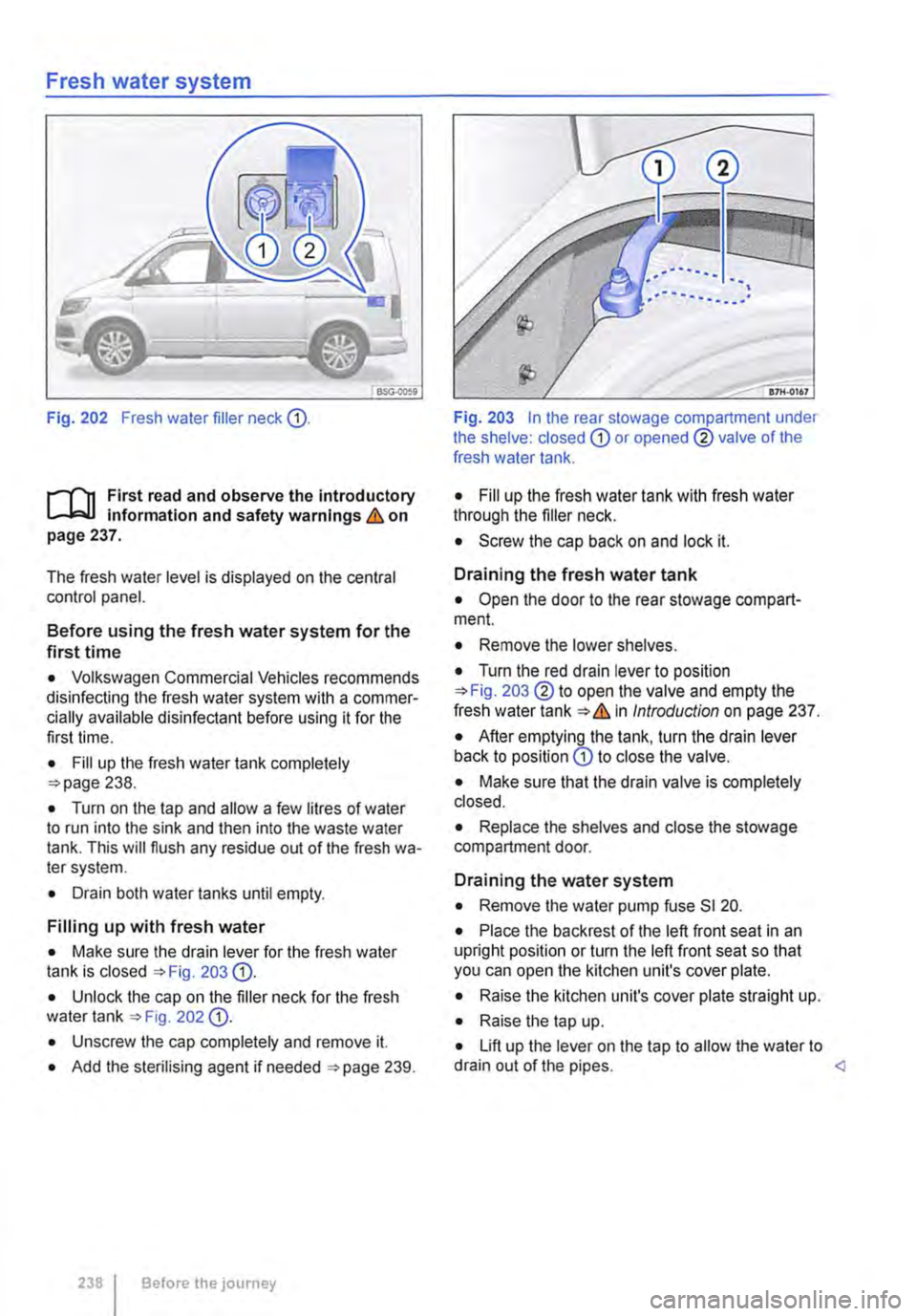
Fig. 202 Fresh water filler neck CD.
l"'""'('n First read and observe the introductory L-J.:.I.I Information and safety warnings & on page 237.
The fresh water level is displayed on the central control panel.
Before using the fresh water system for the first time
• Volkswagen Commercial Vehicles recommends disinfecting the fresh water system with a commer-cially available disinfectant before using it for the first time.
• Fill up the fresh water tank completely =>page 238.
• Turn on the tap and allow a few litres of water to run into the sink and then into the waste water tank. This will flush any residue out of the fresh wa-ter system.
• Drain both water tanks until empty.
Filling up with fresh water
• Make sure the drain lever for the fresh water tank is closed =>Fig. 203 CD.
• Unlock the cap on the filler neck for the fresh water tank =>Fig 202 CD.
• Unscrew the cap completely and remove it.
• Add the sterilising agent if needed =>page 239.
238 I Before the journey
Fig. 203 In the rear stowage compartment under the shelve: closed CD or opened ® valve of the fresh water tank.
• Fill up the fresh water tank with fresh water through the filler neck.
• Screw the cap back on and lock it.
Draining the fresh water tank
• Open the door to the rear stowage compart-ment.
• Remove the lower shelves.
• Turn the red drain lever to position =>Fig. 203 ®to open the valve and empty the fresh water tank=>& In Introduction on page 237.
• After emptying the tank, turn the drain lever back to position CD to close the valve.
• Make sure that the drain valve is completely closed.
• Replace the shelves and close the stowage compartment door.
Draining the water system
• Remove the water pump fuse SI 20.
• Place the back rest of the left front seat in an upright position or turn the left front seat so that you can open the kitchen unit's cover plate.
• Raise the kitchen unit's cover plate straight up.
• Raise the tap up.
• Lift up the lever on the tap to allow the water to drain out of the pipes. <
Page 239 of 486
Sterilising agent
f"""('n First read and observe the Introductory L-J,:,U information and safety warnings & on page 237.
Volkswagen Commercial Vehicles recommends adding a sterilising agent to the fresh water through the fresh water filler neck =>&.After add-ing sterilising agent, turn on the tap and allow ap-proximately one litre of water to run out and down the drain. This will distribute the sterilising agent through the fresh water system.
You may also pour sterilising agent down the sink, followed by a little water, to sterilize the waste wa-ter tank.
Cleaning the fresh water tank
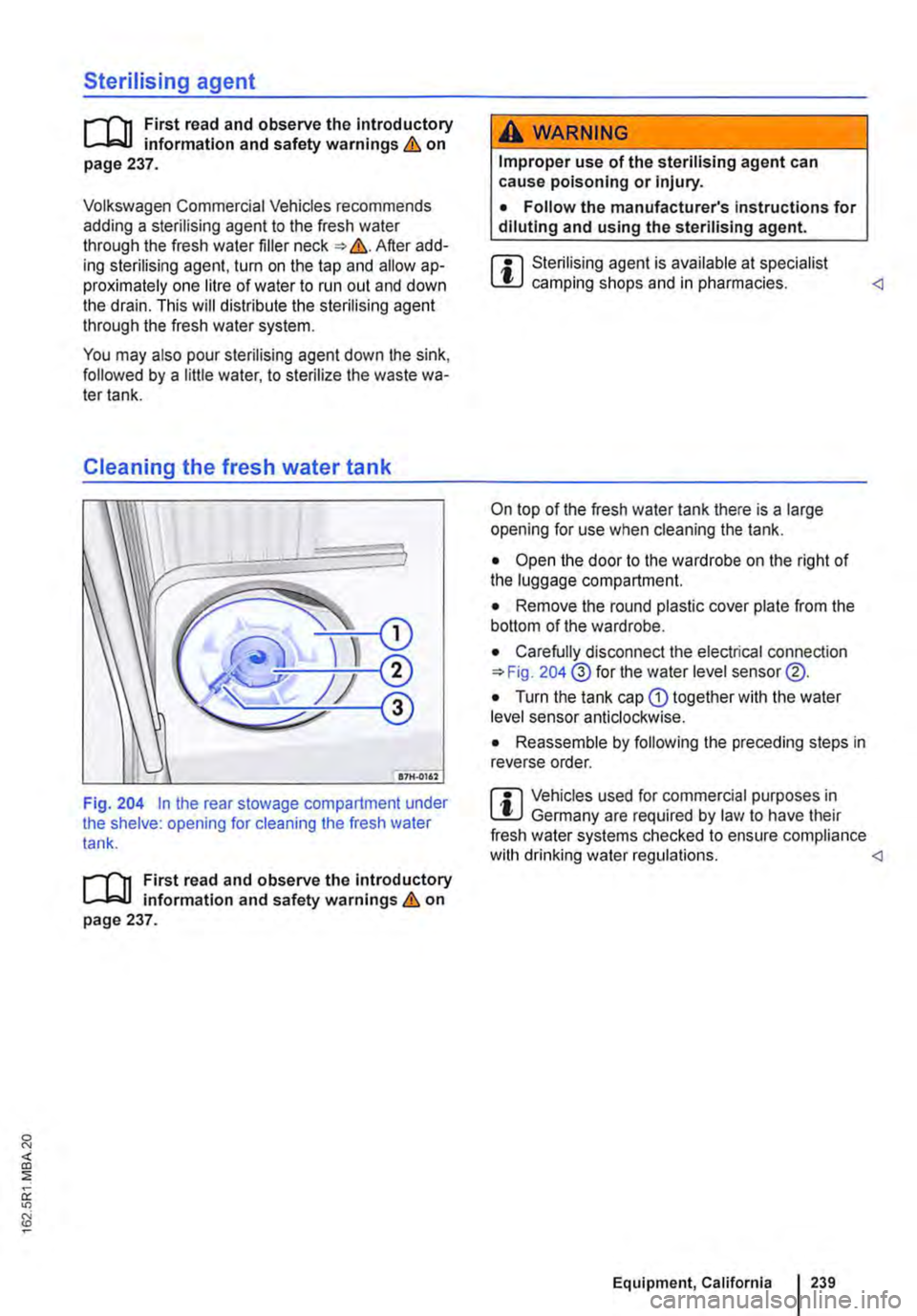
Fig. 204 In the rear stowage compartment under the shelve: opening for cleaning the fresh water tank.
f"""('n First read and observe the introductory l-J,:,,J information and safety warnings & on page 237.
A WARNING
Improper use of the sterilising agent can cause poisoning or Injury.
• Follow the manufacturer's instructions for diluting and using the sterilising agent.
m Sterilising agent is available at specialist L!J camping shops and in pharmacies.
• Open the door to the wardrobe on the right of the luggage compartment.
• Remove the round plastic cover plate from the bottom of the wardrobe.
• Carefully disconnect the electrical connection =>Fig. 204@ for the water level sensor@.
• Turn the tank cap Q) together with the water level sensor anticlockwise.
• Reassemble by following the preceding steps in reverse order.
m Vehicles used for commercial purposes in L!J Germany are required by law to have their fresh water systems checked to ensure compliance with drinking water regulations.
Page 241 of 486
Cleaning the drain
r-f'n First read and observe the introductory l.-.lo=-U information and safety warnings & on page 237.
• Make sure that there is no food debris or water in the sink.
• You will need a suitable container to catch any water that is drained out.
• Open the cupboard door under the sink.
• Pull out the drawer.
• Loosen the clamp on the drain hose on top of the waste water tank and carefully pull the drain hose from its waste water tank connection.
• Drain the water out of the drain hose into the container.
Refrigerator box, California
CClJ Introduction
This chapter contains information on the following subjects:
Using the refrigerator box . . . . . . . . . . . . . . . . . 242
Cleaning the refrigerator box . . . . . . . . . . 242
Additional information:
• Central control panel 204.
• Rectifying faults on the camping equipment 254
• Fuses for the camping equipment 249.
A WARNING
Objects that are not secured, or are secured Incorrectly, can cause serious injuries in the event of a sudden driving or braking manoeu-vre or accident.
• The refrigerator box lid must always be kept closed and locked when the vehicle is in motion.
• Never use the refrigerator box as a table or stowage compartment when the vehicle is in motion.
• Clean the drain hose and the drain in the sink using a soft flexible object such as a pipe cleaner.
• Insert the drain hose back into the waste water tank connection.
• Tighten the drain hose clamp on the waste wa-ter tank connection.
• Make sure that the drain hose is connected properly and check that the connection is water-tight
CD
Water leaking from a poor connection on the waste water drain hose can cause damage.
• Always check to make sure the waste water drain hose connection Is not leaking.
If the ambient temperature in the vehicle is too low, the temperature in the refrigerator box could fall below +2 oc (+35 °F) degrees. This could cause the contents of the refriger-ator box to freeze and bottles and other con-tainers to burst, potentially causing injuries.
• Do not use the refrigerator box when the ambient temperature is too low.
CD
Handling the refrigerator box incorrectly could damage it.
• Do not place containers, food or other ob-jects which are warmer than +50 oc (+122 °F) in the refrigerator box.
• Do not place corrosive substances or sol-vents In the refrigerator box.
• Never expose the refrigerator box to rain or humidity.
• To prevent mould and mildew from forming In the refrigerator box when it is not being used for long periods, place a folded dry towel be-tween the box and Its lid.
r.:l The refrigerator box is not intended to cool or W heat the vehicle interior. The refrigerator box should only be used to keep food cool and for transporting heat-sensitive items on short journeys.
Page 243 of 486
• Pump for fresh water
• Auxiliary heater
230-volt grounded safety socket
The 230-volt grounded safety socket is supplied with 230 V alternating current via electrical feed from the external socket 242.
The following electrical consumers are supplied from the 230-volt power supply via the external socket:
• Battery charger
• Depending on the vehicle equipment, the 230-volt grounded safety socket is located in the side trim panel behind the left front seat or on the side of the kitchen unit 246.
230-volt Euro socket
The 230-volt Euro socket is supplied via additional batteries or via an inverter and is located in the side trim panel behind the left front seat 245.
Additional information:
• Electrical sockets page 163
• Battery 362
• Cigarette lighter 161
• Accessories, modifications, repairs and renewal of parts 394
• Fuses 429
• Consumer information 404
• Rectifying faults on the camping equipment 254
High voltage in the electrical system!
• Never pour any liquid over the socket.
• Do not plug any adapters or extension ca-bles into the 230-volt Euro socket. Otherwise the built-in child lock will disengage and pow-er will be supplied to the socket.
• Do not insert any items which will conduct electricity, such as knitting needles, into the contacts of the 230-volt Euro socket.
A WARNING
Improper use of the sockets and electrical ac-cessories can cause fires and severe Injuries.
• Never leave children in the vehicle unat-tended. Sockets and the devices connected to them can be used when the ignition is switched on.
A WARNING (Continued)
• If the electrical device gets too hot, switch off the device Immediately and disconnect it from the socket.
CD
• Observe the operating instructions for any device that you plug into the socket.
• Never exceed the maximum power rating as this could damage the whole vehicle electrical system.
• Only use accessories that have been ap-proved in accordance with valid guidelines concerning electromagnetic compatibility.
• Never feed electricity into the socket.
• Do not plug any heavy devices or connec-tions, such as mains adapters, directly Into the socket.
• Only connect devices to the socket with a voltage that matches the voltage of the socket.
CD
• In order to prevent damage to the electrical system, never connect equipment that gener-ates electricity, such as solar panels or battery chargers for charging the vehicle battery, to the 12-volt socket.
• Only use accessories that have been ap-proved in accordance with current guidelines concerning electromagnetic compatibility.
• In order to avoid damage due to voltage fluctuation, always switch any electrical con-sumers connected to the 12-volt sockets off be-fore switching the ignition or the engine on or off. When the start/stop system automatically switches off and restarts the engine, it is not necessary to switch off any connected electri-cal consumers.
• Never connect electrical devices requiring more electrical power to a 12-volt socket. The vehicle's electrical system can be damaged if the maximum power output is exceeded.
CD
• Observe the operating instructions for any device that you plug Into the socket.
• 230-volt Euro socket:
-Do not plug any heavy devices or connec-tions, such as mains adapters, directly into the socket. .,..
Equipment, California I 243
Page 245 of 486
230-volt power supply
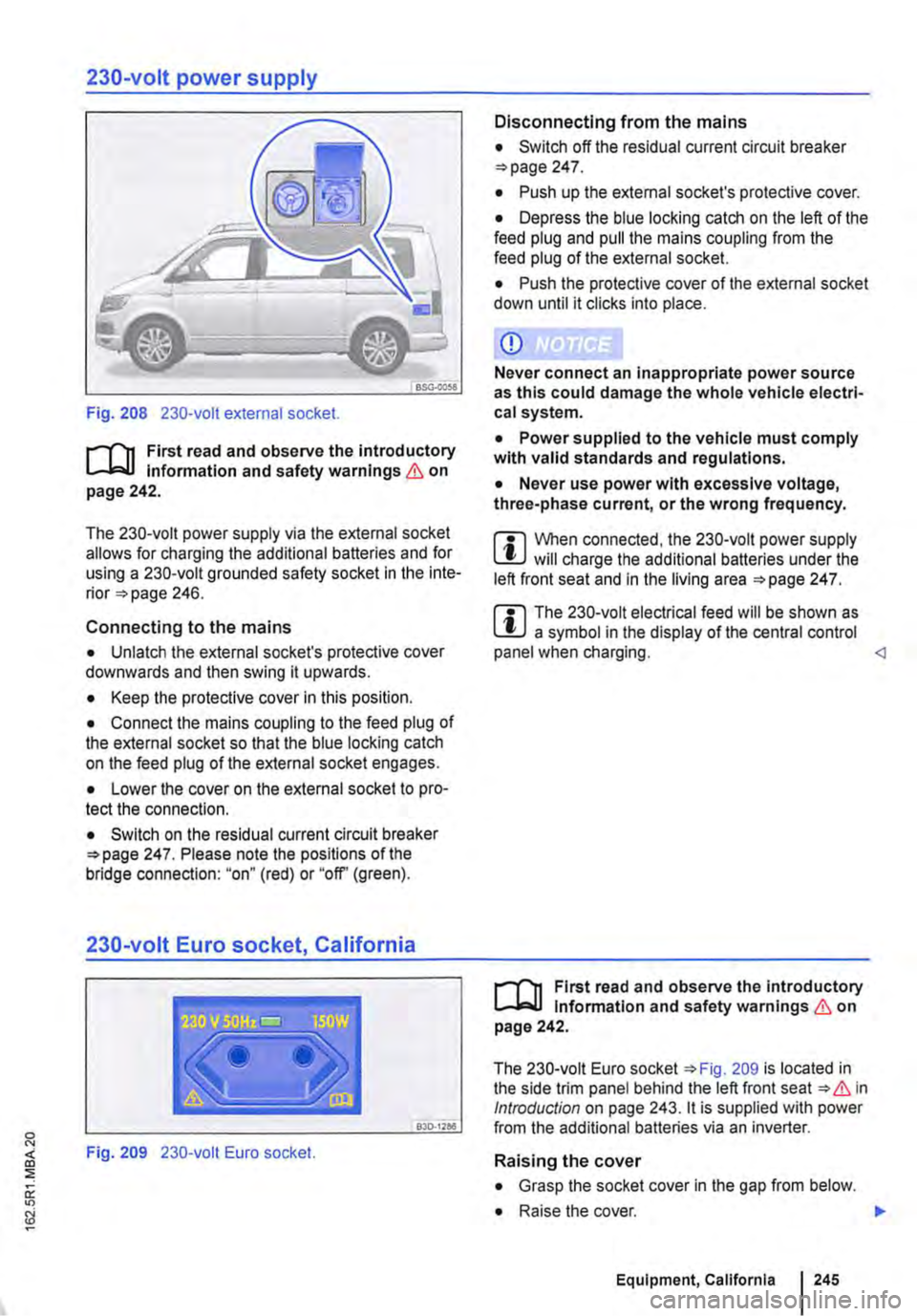
Fig. 208 230-volt external socket.
r-'('n First read and observe the introductory l.-Jo:-11 Information and safety warnings & on page 242.
The 230-volt power supply via the external socket allows for charging the additional batteries and for using a 230-volt grounded safety socket in the inte-rior 246.
Connecting to the mains
• Unlatch the external socket's protective cover downwards and then swing it upwards.
• Keep the protective cover in this position.
• Connect the mains coupling to the feed plug of the external socket so that the blue locking catch on the feed plug of the external socket engages.
• Lower the cover on the external socket to pro-tect the connection.
• Switch on the residual current circuit breaker 247. Please note the positions of the bridge connection: "on" (red) or "off' (green).
230-volt Euro socket, California
Disconnecting from the mains
• Switch off the residual current circuit breaker 247.
• Push up the external socket's protective cover.
• Depress the blue locking catch on the left of the feed plug and pull the mains coupling from the feed plug of the external socket.
• Push the protective cover of the external socket down until it clicks into place.
CD
Never connect an inappropriate power source as this could damage the whole vehicle electri-cal system.
• Power supplied to the vehicle must comply with valid standards and regulations.
• Never use power with excessive voltage, three-phase current, or the wrong frequency.
m When connected, the 230-volt power supply l!J will charge the additional batteries under the left front seat and in the living area 247.
m The 230-volt electrical feed will be shown as l!J a symbol in the display of the central control panel when charging.
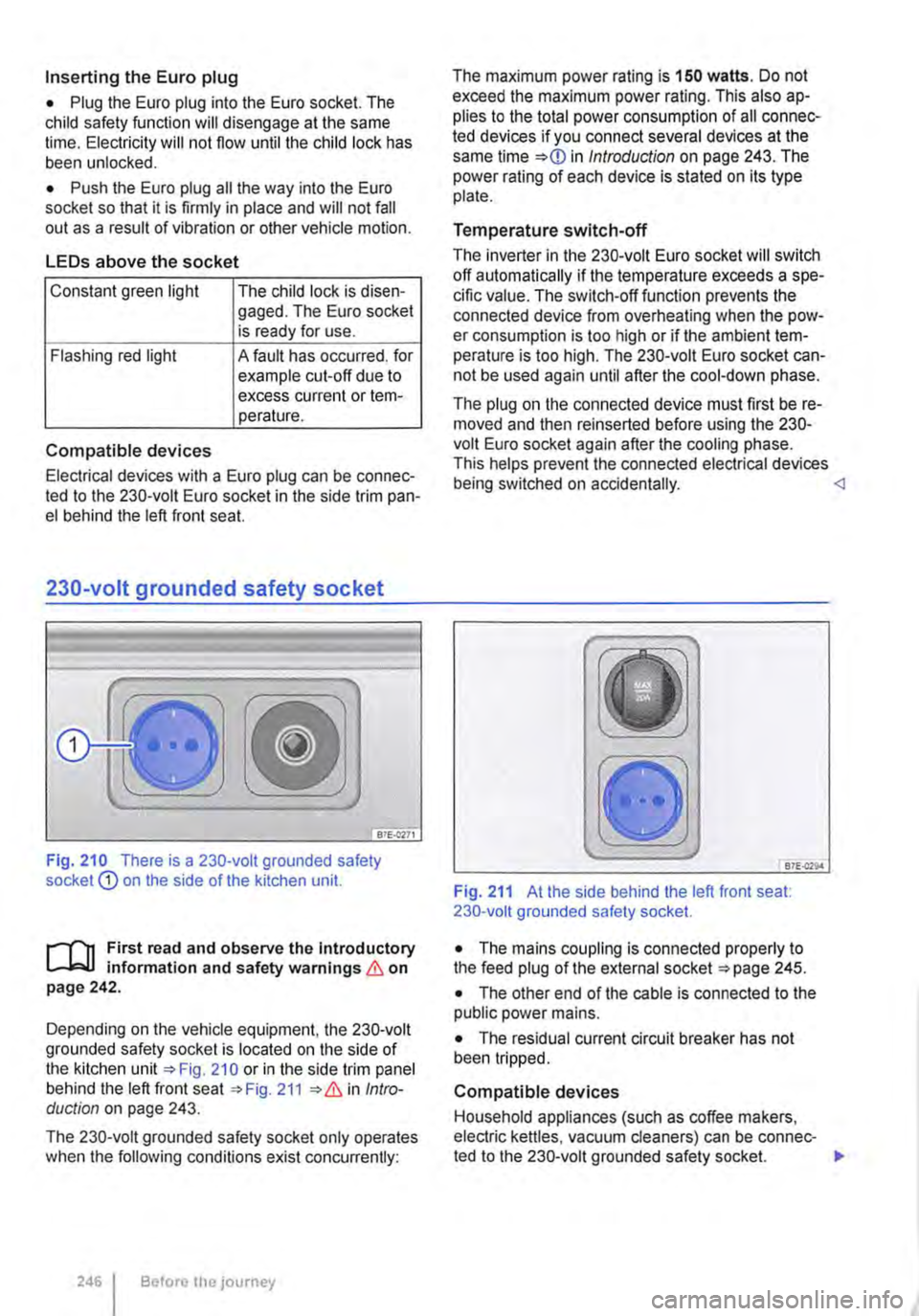
The 230-volt Euro socket 209 is located in the side trim panel behind the left front seat & in Introduction on page 243. it is supplied with power L..---------------"'"30::c·.::."='" from the additional batteries via an inverter.
Fig. 209 230-volt Euro socket. Raising the cover
• Grasp the socket cover in the gap from below.
• Raise the cover. .,.
Equipment, California 245
Page 246 of 486
Inserting the Euro plug
• Plug the Euro plug into the Euro socket. The child safety function will disengage at the same time. Electricity will not flow until the child lock has been unlocked.
• Push the Euro plug all the way into the Euro socket so that it is firmly in place and will not fall out as a result of vibration or other vehicle motion.
LEDs above the socket
Constant green light The child lock is disen-gaged. The Euro socket is ready for use.
Flashing red light A fault has occurred. for example cut-off due to excess current or tem-perature.
Compatible devices
Electrical devices with a Euro plug can be connec-ted to the 230-volt Euro socket in the side trim pan-el behind the left front seat.
230-volt grounded safety socket
Fig. 210 There is a 230-volt grounded safety socket Q) on the side of the kitchen unit.
r--T'n First read and observe the Introductory L-k.U information and safety warnings & on page 242.
Depending on the vehicle equipment, the 230-volt grounded safety socket is located on the side of the kitchen unit 210 or in the side trim panel behind the left front seat 211 Intro-duction on page 243.
The 230-volt grounded safety socket only operates when the following conditions exist concurrently:
246 I Before the journey
The maximum power rating is 150 watts. Do not exceed the maximum power rating. This also ap-plies to the total power consumption of all connec-ted devices if you connect several devices at the same time in Introduction on page 243. The power rating of each device is stated on its type plate.
Temperature switch-off
The inverter in the 230-volt Euro socket will switch off automatically if the temperature exceeds a spe-cific value. The switch-off function prevents the connected device from overheating when the pow-er consumption is too high or if the ambient tem-perature is too high. The 230-volt Euro socket can-not be used again until after the cool-down phase.
The plug on the connected device must first be re-moved and then reinserted before using the 230-volt Euro socket again after the cooling phase. This helps prevent the connected electrical devices being switched on accidentally. <1
B7E.Q29.4
Fig. 211 At the side behind the left front seat: 230-volt grounded safety socket.
• The mains coupling is connected properly to the feed plug of the external socket 245.
• The other end of the cable is connected to the public power mains.
• The residual current circuit breaker has not been tripped.
Compatible devices
Household appliances (such as coffee makers, electric kettles, vacuum cleaners) can be connec-ted to the 230-volt grounded safety socket. .,.
Page 249 of 486
Fuses for the camping equipment
87E-0221
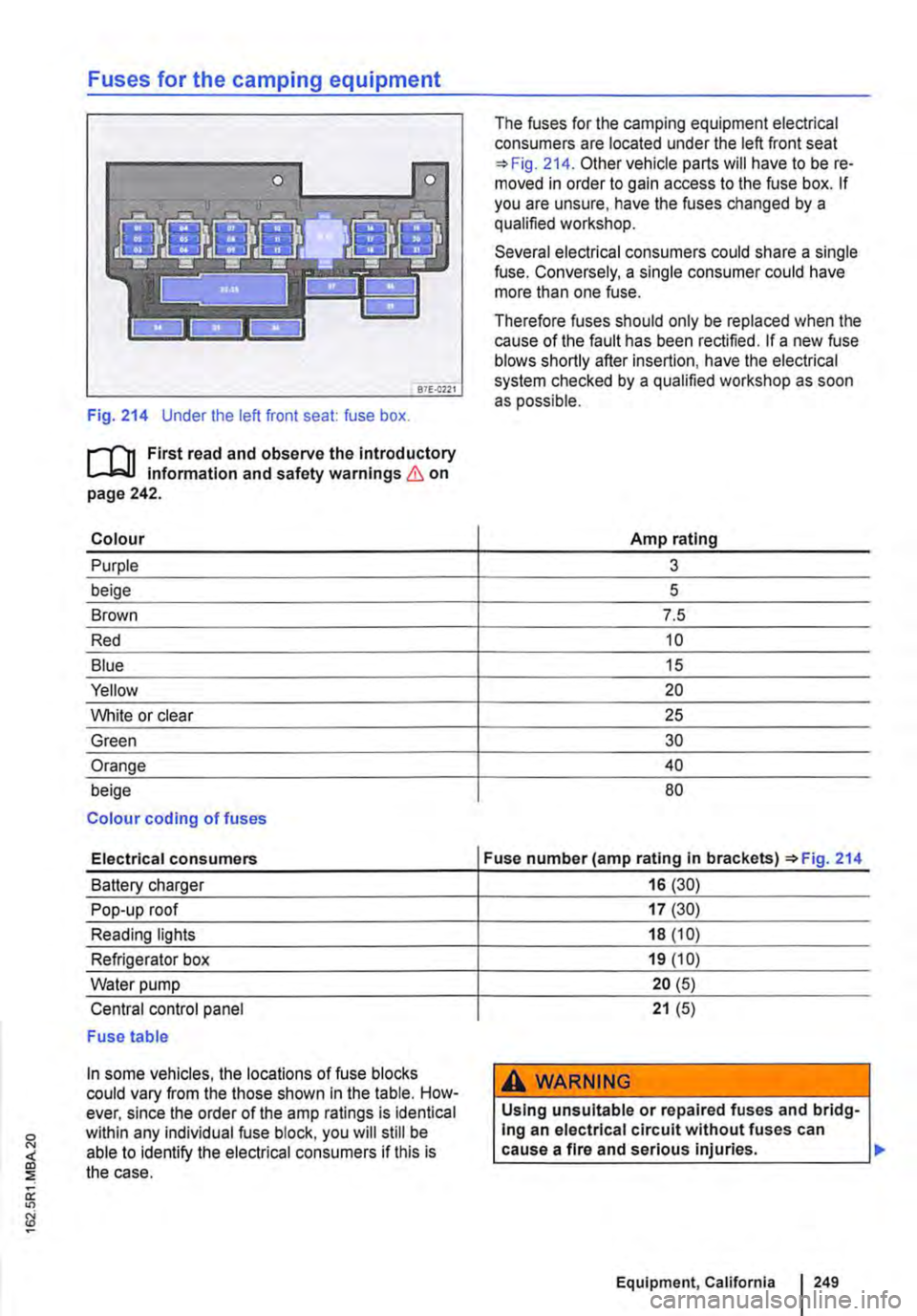
Fig. 214 Under the left front seat: fuse box.
l"""'('n First read and observe the introductory L-Jr:,.U information and safety warnings & on page 242.
Colour
Purple
beige
Brown
Red
Blue
Yellow
White or clear
Green
Orange
beige
Colour coding of fuses
Electrical consumers
Battery charger
Pop-up roof
Reading lights
Refrigerator box
Water pump
Central control panel
Fuse table
In some vehicles, the locations of fuse blocks could vary from the those shown In the table. How-ever, since the order of the amp ratings is identical within any individual fuse block, you will still be able to identify the electrical consumers if this is the case.
The fuses for the camping equipment electrical consumers are located under the left front seat 214. Other vehicle parts will have to be re-moved in order to gain access to the fuse box. If you are unsure, have the fuses changed by a qualified workshop.
Several electrical consumers could share a single fuse. Conversely, a single consumer could have more than one fuse.
Therefore fuses should only be replaced when the cause of the fault has been rectified. If a new fuse blows shortly after insertion, have the electrical system checked by a qualified workshop as soon as possible.
Amp rating
3
5
7.5
10
15
20
25
30
40
80
Fuse number (amp rating in Fig. 214
16 (30)
17 (30)
18 (10)
19 (10)
20 (5)
21 (5)
A WARNING
Using unsuitable or repaired fuses and bridg-Ing an electrical circuit without fuses can cause a fire and serious injuries.
Equipment, California 249
Page 250 of 486
A WARNING (Continued)
• Never fit fuses that have a higher fuse pro-tection limit. Fuses must always be replaced by a new fuse with the same amp rating (same colour and markings) and size.
• Never repair a fuse.
• Never use a metal strip, paper clip or simi-lar objects to replace a fuse.
CD
• To avoid damage to the electrical system in the vehicle, switch the ignition, the lights and all electrical consumers off and remove the ve-hicle key from the ignition before changing a fuse.
• You can damage another position in the electrical system by using a fuse with a higher amp rating.
• Fuse boxes must be protected from dirt and moisture when opened. Dirt and moisture in the fuse boxes can damage the electrical system.
o::n Introduction
This chapter contains information on the following subjects:
Controls for the living area 250
Controls for the living area
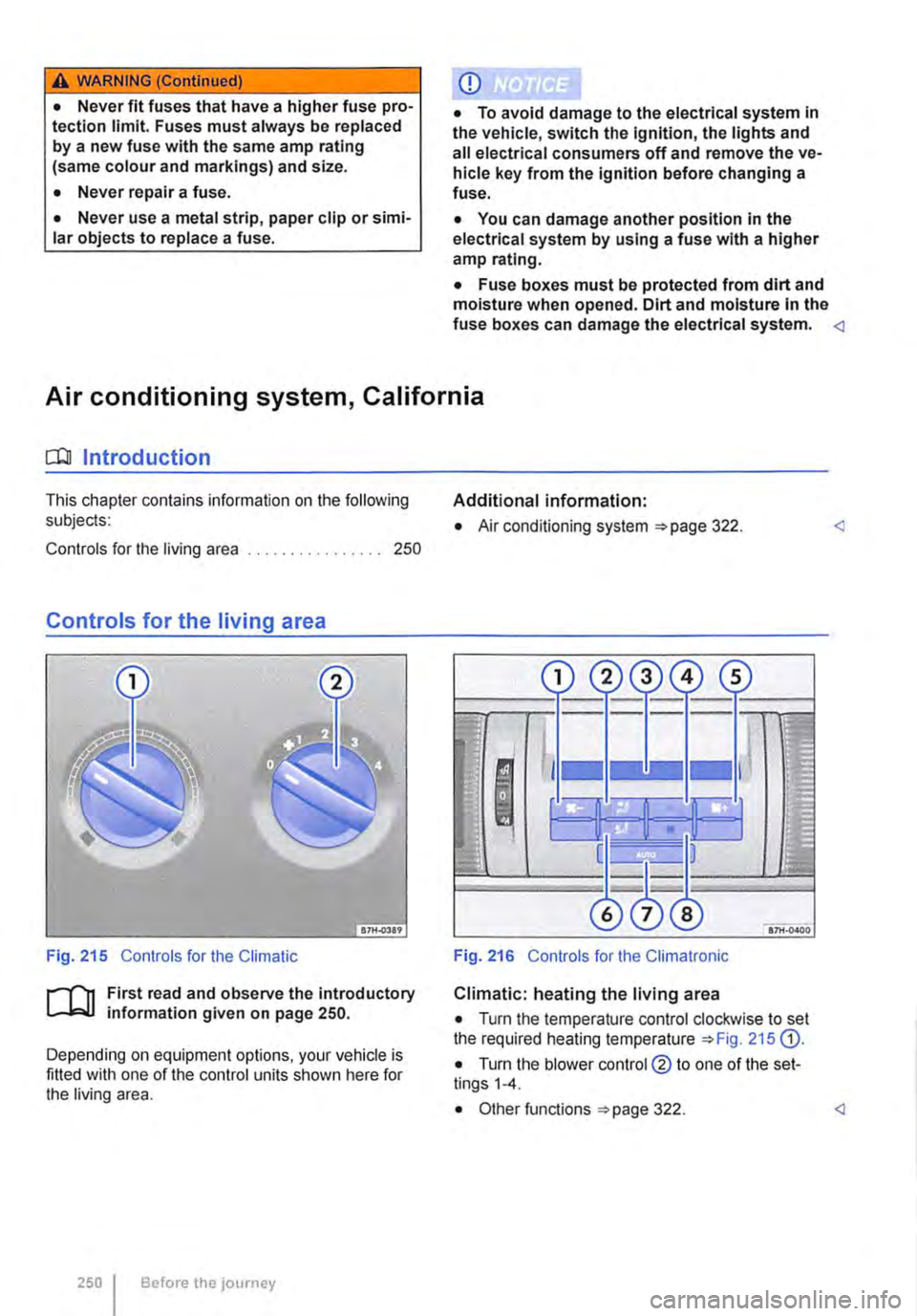
Fig. 215 Controls for the Climatic
ifl1 First read and observe the introductory L-.J.=.IJ information given on page 250.
Depending on equipment options, your vehicle is fitted with one of the control units shown here for the living area.
250 I Before the journey
Additional information:
• Air conditioning system 322.
Fig. 216 Controls for the Climatronic
Climatic: heating the living area
• Turn the temperature control clockwise to set the required heating temperature 215 G).
• Turn the blower control @ to one of the set-tings 1-4.
Page 254 of 486
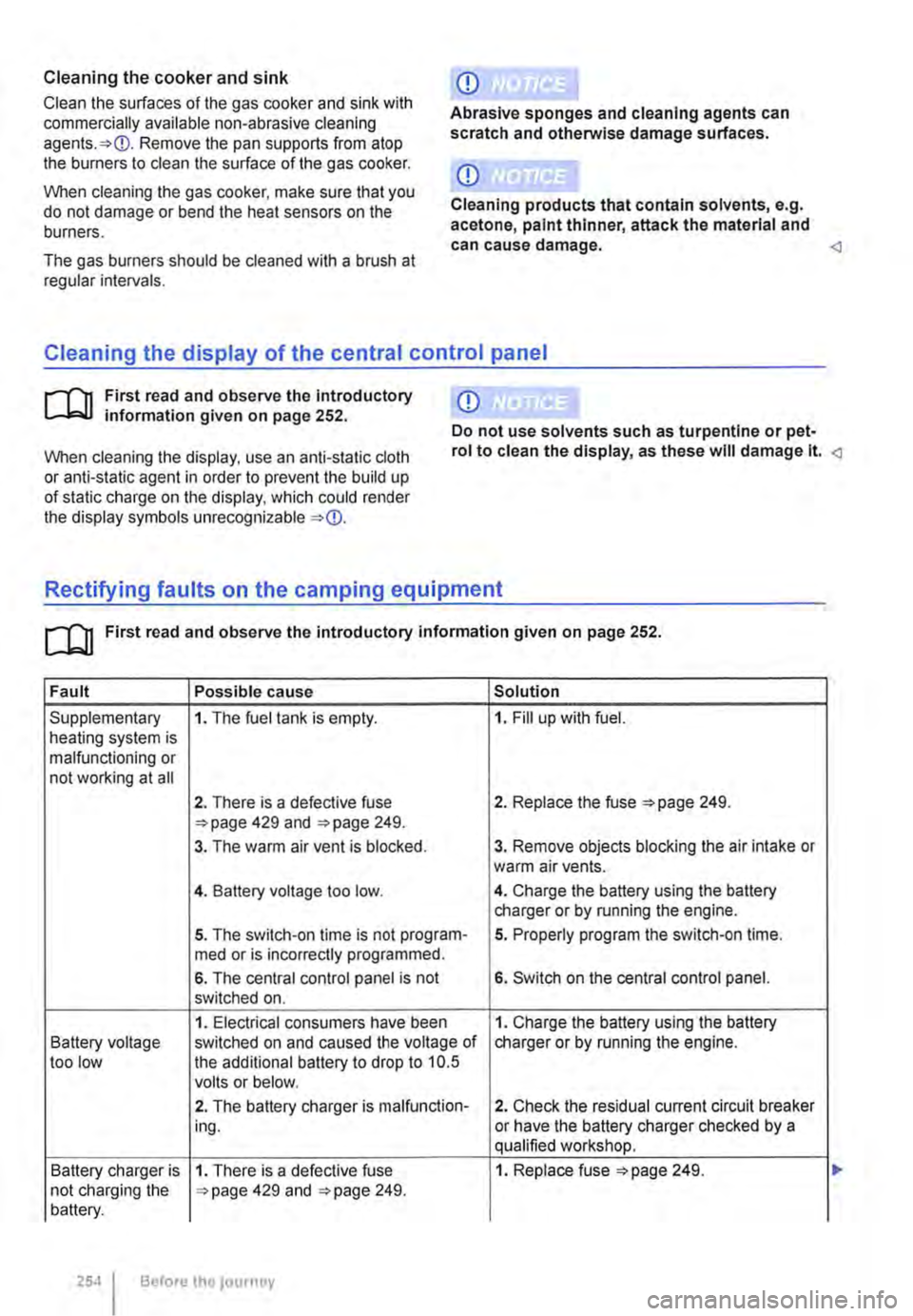
Cleaning the cooker and sink
Clean the surfaces of the gas cooker and sink with commercially available non-abrasive cleaning Remove the pan supports from atop the burners to clean the surface of the gas cooker.
When cleaning the gas cooker, make sure that you do not damage or bend the heat sensors on the burners.
The gas burners should be cleaned with a brush at regular intervals.
CD
Abrasive sponges and cleaning agents can scratch and otherwise damage surfaces.
CD
Cleaning products that contain solvents, e.g. acetone, paint thinner, attack the material and can cause damage. <1
Cleaning the display of the central control panel
CD r-l'n First read and observe the Introductory L-l.::JJ information given on page 252. Do not use solvents such as turpentine or pet-
When cleaning the display, use an anti-static cloth or anti-static agent in order to prevent the build up of static charge on the display, which could render the display symbols unrecognizable
rol to clean the display, as these will damage lt.
[]J First read and observe the introductory information given on page 252.
Fault Possible cause Solution
Supplementary 1. The fuel tank is empty. 1. Fill up with fuel. heating system is malfunctioning or not working at all
2. There is a defective fuse 2. Replace the fuse 249. 429 and 249.
3. The warm air vent is blocked. 3. Remove objects blocking the air intake or warm air vents.
4. Battery voltage too low. 4. Charge the battery using the battery charger or by running the engine.
5. The switch-on time is not program-5. Properly program the switch-on time. med or is incorrectly programmed.
6. The central control panel is not 6. Switch on the central control panel. switched on.
1. Electrical consumers have been 1. Charge the battery using the battery Battery voltage switched on and caused the voltage of charger or by running the engine. too low the additional battery to drop to 10.5 volts or below.
2. The battery charger is malfunction-2. Check the residual current circuit breaker ing. or have the battery charger checked by a qualified workshop.
Battery charger is 1. There is a defective fuse 1. Replace fuse =>page 249. not charging the 429 and 249. battery.
254 Before the journey
Page 255 of 486
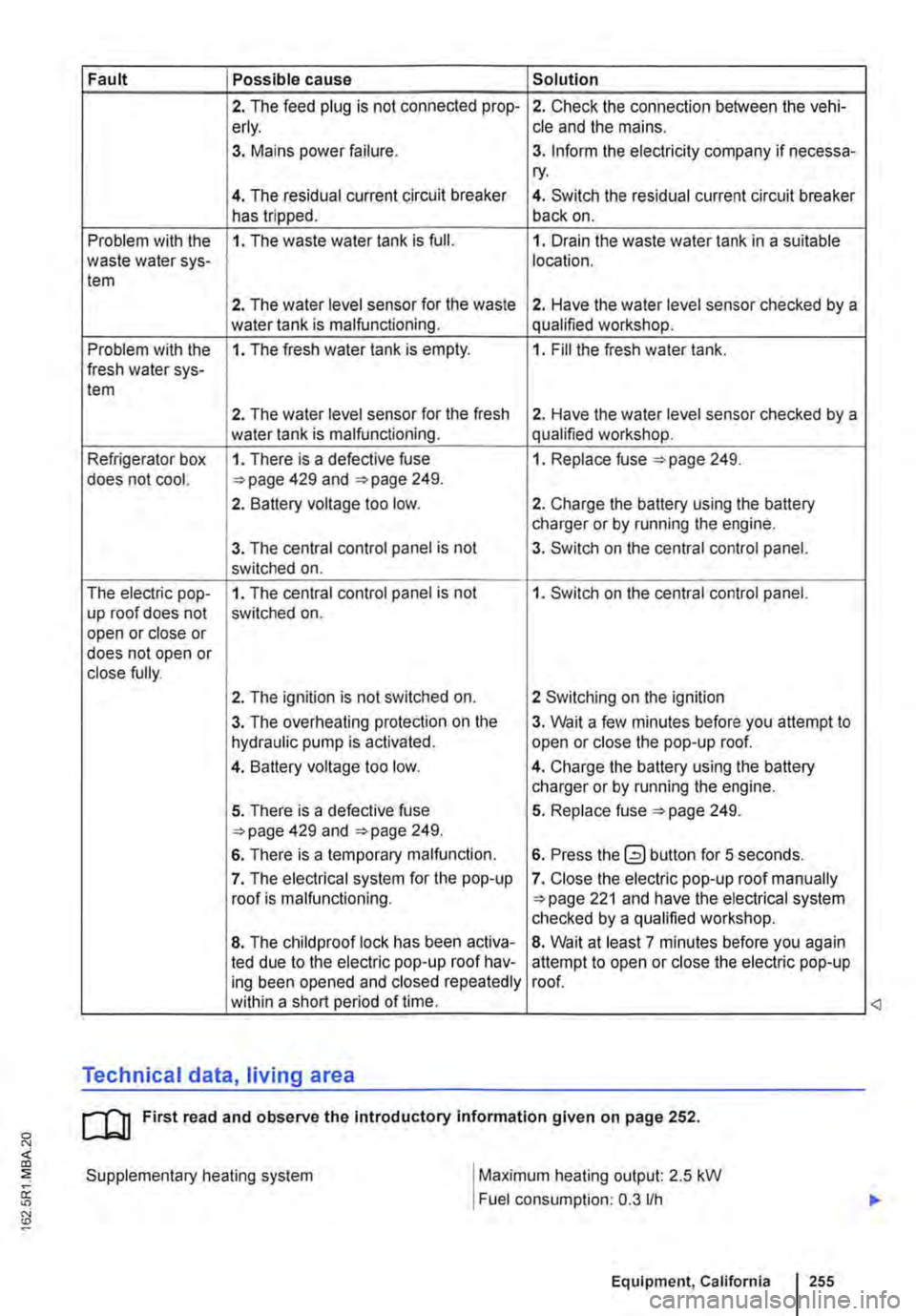
Fault Possible cause Solution
2. The feed plug is not connected prop-2. Check the connection between the vehi-erly. cle and the mains.
3. Mains power failure. 3. Inform the electricity company if necessa-ry.
4. The residual current circuit breaker 4. Switch the residual current circuit breaker has tripped. back on.
Problem with the 1. The waste water tank is full. 1. Drain the waste water tank in a suitable waste water sys-location. tem
2. The water level sensor for the waste 2. Have the water level sensor checked by a water tank is malfunctioning. qualified workshop.
Problem with the 1. The fresh water tank is empty. 1. Fill the fresh water tank. fresh water sys-tem
2. The water level sensor for the fresh 2. Have the water level sensor checked by a water tank is malfunctioning. qualified workshop.
Refrigerator box 1. There is a defective fuse 1. Replace fuse 249. does not cool. 429 and 249.
2. Battery voltage too low. 2. Charge the battery using the battery charger or by running the engine.
3. The central control panel is not 3. Switch on the central control panel. switched on.
The electric pop-1. The central control panel is not 1. Switch on the central control panel. up roof does not switched on. open or close or does not open or close fully.
2. The ignition is not switched on. 2 Switching on the ignition
3. The overheating protection on the 3. Wait a few minutes before you attempt to hydraulic pump is activated. open or close the pop-up roof.
4. Battery voltage too low. 4. Charge the battery using the battery charger or by running the engine.
5. There is a defective fuse 5. Replace fuse 249. 429 and 249.
6. There is a temporary malfunction. 6. Press the button for 5 seconds.
7. The electrical system for the pop-up 7. Close the electric pop-up roof manually roof is malfunctioning. 221 and have the electrical system checked by a qualified workshop.
8. The child proof lock has been activa-8. Wait at least 7 minutes before you again led due to the electric pop-up roof hav-attempt to open or close the electric pop-up ing been opened and closed repeatedly roof. within a short period of time.
Technical data, living area
cu First read and observe the Introductory information given on page 252.
Supplementary heating system
I
Maximum heating output: 2.5 kW
Fuel consumption: 0.3 lfh
Equipment, California I 255
<3