window VOLKSWAGEN TRANSPORTER 2018 Owner's Manual
[x] Cancel search | Manufacturer: VOLKSWAGEN, Model Year: 2018, Model line: TRANSPORTER, Model: VOLKSWAGEN TRANSPORTER 2018Pages: 486, PDF Size: 69.28 MB
Page 60 of 486
m The sliding/tilting roof rotary switch remains W in the last position selected If the roof is closed from outside the vehicle using convenience closing. lt will have to be re-positioned the next time you drive. <1
Roll-back function for the sliding/tilting roof
r-111 First read and observe the introductory l..-J.::-1.1 Information and safety warnings & on page 58.
The roll-back function can reduce the risk of injury when closing the sliding/tilting roof => &. If the slid-ing/tilting roof is unable to close because it is stuck or obstructed, it will open again automatically.
• Check to see why the sliding/tilting roof has not closed.
• Try to close the sliding/tilting roof again.
• If the sliding/tilting roof is still obstructed, the sliding/tilting roof stops at this point. The sliding/tilt-ing roof then closes without the roll-back function.
Closing without the roll-back function
• Push the rotary knob at the front in position =>Fig. 38 ®until the sliding/tilting roof Is fully closed.
• The sliding/tilting roof then closes without the roll-back function.
• Please go to a qualified workshop if the sliding/ tilting roof still cannot be closed.
Before the journey
A WARNING
Closing the sliding/tilting roof without the roll-back function can lead to severe injuries.
• Always close the sliding/tilting roof care-fully.
• Ensure that nobody obstructs the operat-Ing area of the sliding/tilting roof, especially if the roll-back function Is not active.
• The roll-back function does not prevent fingers or other body parts from being press-ed against the roof frame and sustaining in-jury.
m The roll-back function is also activated if the W windows and sliding/tilting roof are closed us-ing the driver door lock for convenience clos-Ing =>page 57. <1
Page 61 of 486
Sitting correctly and safely
Adjusting the seat position
COl Introduction
This chapter contains information on the following subjects:
The dangers of assuming an incorrect sitting position . . . .............. .
Correct sitting position . . . . . . ......... . Overview of seats ...................... .
Mechanical controls on the front seats ..... .
Electrical controls on the front seats ....... . Adjusting and removing head restraints .... .
Adjusting the steering wheel position ...... .
Additional information and warnings:
• Seat functions, front 69
• Seat functions, passenger compartment 72
• Seat belts 79
• Airbag system 87
• Child seats (accessories) 96
A WARNING
62
63
64
65
66
67
68
Assuming an incorrect sitting position in the vehicle can increase the risk of severe or fa-tal injuries during a sudden driving or brak-ing manoeuvre, in the event of a collision or accident, or if the airbags are triggered.
• All vehicle occupants must assume a cor-rect sitting position before setting off and maintain this position throughout the trip. This also applies to the fastening of seat belts.
• The number of vehicle occupants must never exceed the number of seats with seat belts in the vehicle.
• Always secure children in the vehicle in an authorised restraint system which Is suita-ble for their height and page 96, 87.
• Always keep your feet in the footweli while the vehicle is in motion. Never place your feet on the seat or dash panel, for example, and never ride with your feet out the window. When you are sat like this, the airbag and seat belt cannot provide optimal protection and could actually increase the risk of Injury during an accident.
A WARNING
Always adjust seats, seat belts and head re-straints to their correct position before any journey and ensure that ail passengers have fastened their seat belt.
• Push the front passenger seat as far back as possible.
• Adjust the driver seat so that there is at least 25 cm between your breastbone and the hub of the steering wheel. If your build makes it impossible to fulfil this requirement then you must contact a qualified workshop so they can make any necessary modifications.
• Never travel with the back rest tilted far back. The further back the backrest is tilted, the greater the risk of injury caused by incor-rect seat belt routing or an incorrect sitting position.
• Never travel with the back rest tilted far forwards. When a front airbag is triggered it could force the seat backrest backwards and injure vehicle occupants on the back seats.
• Adopt and maintain the greatest possible distance from the steering wheel and dash panel.
• You should always sit upright with your back against the seat back rest with the front seats properly adjusted. Do not position any body part too close where the airbags are fit-ted.
• The risk of serious injury Is increased for passengers on the rear seat if they are not sitting upright because the seat belts are in-correctly positioned.
A WARNING
Incorrect adjustment of the seats can cause accidents and serious injuries.
• The seats may only be adjusted when the vehicle is stationary, or else the seat could change position unexpectedly while the vehi-cle is in motion, leading to a loss of control of the vehicle. Furthermore, an incorrect seating position is adopted while adjusting the seat. .,.
Sitting correctly and safely 61
Page 62 of 486
A WARNING (Continued)
• Only adjust the height and tilt of the seat or move lt forwards and backwards when the area around the seat is clear.
• There should be no objects in the adjust-ment area of the front seats.
• Make sure that there is no dirt in the areas within which the front seats can be adjusted (and locked In place).
A WARNING
Cigarette lighters in the vehicle could be damaged or accidentally lit. This could lead to serious burns and other Injuries.
• Before adjusting the seats always make sure that there is no lighter on or near the moveable parts of the seat.
• Before closing stowage areas or compart-ments always ensure that there Is no lighter in the way.
• Never stow lighters in stowage areas or compartments or on other surfaces In the ve-hicle. Cigarette lighters may self-Ignite on high-temperature surfaces, especially In sum-
The dangers of assuming an incorrect sitting position
.....-m First read and observe the Introductory L-.bU information and safety warnings & on page 61.
If the seat belts are not worn or are worn incorrect-ly, the risk of severe or fatal injuries increases. Seat belts can only provide optimal protection if the seat belt routing is correct. Assuming an incorrect sitting position considerably impairs the level of protection provided by a seat belt. This could lead to severe or even fatal injuries. The risk of severe or fatal injuries is especially increased when a de-ploying airbag strikes a vehicle occupant who has assumed an incorrect sitting position. The driver is responsible for all occupants transported in the ve-hicle, especially children.
The following list contains examples of sitting posi-tions that can be dangerous for all vehicle occu-pants.
Whenever the vehicle is in motion:
• Never stand in the vehicle.
• Never stand on the seats.
• Never kneel on the seats.
• Never tilt the backrest too far to the rear.
• Never lean against the dash panel.
• Never lie on the seats in the passenger com-partment.
• Never sit on the front edge of a seat.
• Never sit sideways.
Before the journey
• Never lean out of a window .
• Never put your feet out of a window.
• Never put your feet on the dash panel.
• Never place your feet on the seat cushion or seat backrest.
• Never travel in a footwell.
• Never sit on the armrest.
• Never travel on a seat without wearing the seat belt.
• Never use the bed.
• Never travel in the luggage compartment or on the load surface.
A WARNING
Every Incorrect sitting position In the vehicle Increases the risk of severe or fatal Injuries In the event of an accident or sudden driving or braking manoeuvre.
• All vehicle occupants must maintain a cor-rect sitting position and wear their seat belt properly while the vehicle Is In motion.
• Sitting In an incorrect position, not fasten-ing the seat belt, or too short a distance to the alrbag exposes the occupants to critical or fatal injuries, especially if the alrbags de-ploy and strike an occupant who has as-sumed an Incorrect sitting position.
Page 65 of 486
Additional information and warnings:
• Sitting correctly and safely 61
• Child seats (accessories) 96
A WARNING
Assuming an Incorrect sitting position In the vehicle can Increase the risk of severe or fa-tal injuries during a sudden driving or brak-Ing manoeuvre, In the event of a collision or accident, or If the alrbags are triggered.
• The number of vehicle occupants must never exceed the number of seats with seat belts In the vehicle.
• All vehicle occupants must assume a cor-rect sitting position before setting off and maintain this position throughout the trip. This also applies to the fastening of seat belts.
• Always secure children in the vehicle in an authorised restraint system which is suita-ble for their height and page 61.
• Always keep your feet in the footwell while the vehicle is in motion. Never place your feet on the seat or dash panel, for example, and never ride with your feet out the window. When you are sat like this, the airbag and
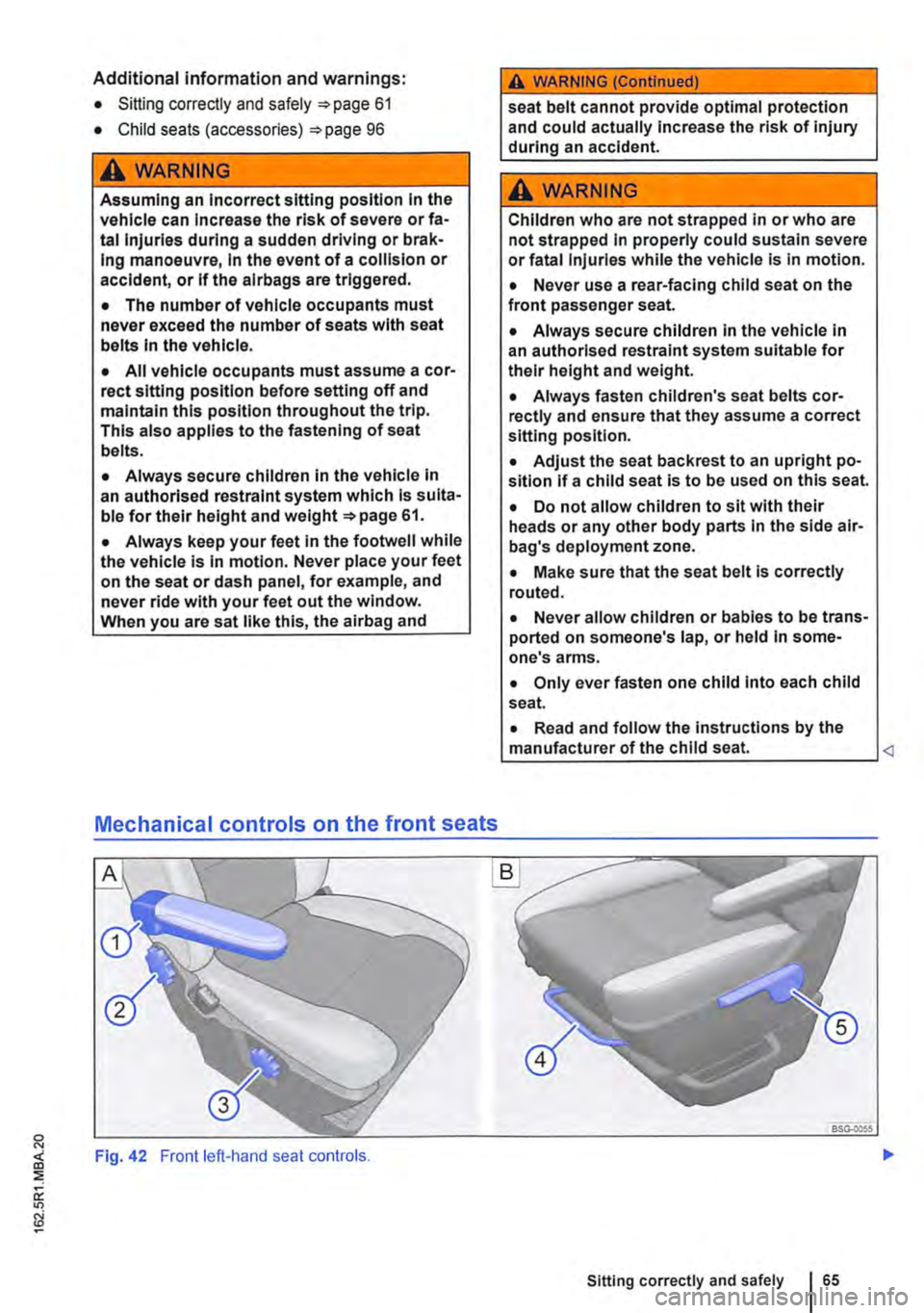
Mechanical controls on the front seats
Fig. 42 Front left-hand seat controls.
A WARNING (Continued)
seat belt cannot provide optimal protection and could actually increase the risk of injury during an accident.
A WARNING
Children who are not strapped in or who are not strapped in properly could sustain severe or fatal Injuries while the vehicle Is In motion.
• Never use a rear-facing child seat on the front passenger seat.
• Always secure children in the vehicle in an authorised restraint system suitable for their height and weight.
• Always fasten children's seat belts cor-rectly and ensure that they assume a correct sitting position.
• Adjust the seat backrest to an upright po-sition If a child seat is to be used on this seat.
• Do not allow children to sit with their heads or any other body parts in the side air-bag's deployment zone.
• Make sure that the seat belt is correctly routed.
• Never allow children or babies to be trans-ported on someone's lap, or held in some-one's arms.
• Only ever fasten one child Into each child seat.
• Read and follow the instructions by the manufacturer of the child seat.
Page 88 of 486
are not a substitute for seat belts. Seat belts must always be worn, even when the front seats are equipped with front airbags.
Additional information and warnings:
• Driving tips 33
• Central locking system 39
• Correct sitting position 61
• Seat belts 79
• Child seats (accessories) 96
• Cleaning and caring for the interior 388
• Accessories, modifications, repairs and renewal of parts 394
• Consumer information 404
A WARNING
Never rely solely on the airbag system for your protection.
• Even if an alrbag is triggered, it only offers auxiliary protection.
• The airbag system offers the best level of protection, and reduces the risk of injury, when seat belts are properly worn 79, Seat belts.
• Before every trip, each vehicle occupant must adopt the correct sitting position, cor-rectly fasten the seat belt belonging to their seat and keep it fastened properly throughout the trip. This applies to ail vehicle occupants and also in urban traffic.
A WARNING
The risk of injury increases if there are any objects between the vehicle occupants and the deployment area of the airbag when it is triggered. This will alter the deployment zone of the airbag, or the objects will be flung against the body.
• Never hold any objects in your hand or on your lap while the vehicle is in motion.
• Never transport any objects on the front passenger seal The objects could enter the deployment zone of the airbag during sudden braking or driving manoeuvres and then be flung dangerously through the vehicle interi-or if the airbag is activated.
• Vehicle occupants sitting on the front seats and rear outer seats must never carry any people, pets or objects in the deployment zone between themselves and the airbags. Make sure that children and passengers also keep to this rule.
BB I Before the journey
A WARNING
External devices in the vehicle that are not properly secured can be flung though the in-terior and cause injuries, if there is a sudden driving or braking manoeuvre, or in the event of an accident.
• You should never position or attach an ex-ternal device on a door, on the windscreen or above or near to the areas marked "AIRBAG" on the steering wheel, the dash panel and the seat backrests, or between these areas and the vehicle occupants. External devices can cause serious Injury in an accident, especial-ly when the airbags deploy.
A WARNING
The alrbag system can only be triggered once. The system will have to be replaced if the airbags have been triggered.
• Alrbags that have deployed and any affec-ted system parts must be immediately re-placed with new parts that are approved by Volkswagen Commercial Vehicles for the re-spective vehicle.
• Repairs and modifications to your vehicle should only be carried out by a qualified workshop. Qualified workshops have the nec-essary tools, diagnostic equipment, repair in-formation and qualified personnel.
• Never use recycled alrbag components or components that have been taken from end-of-life vehicles in your vehicle.
• Never alter any components of the airbag system.
A WARNING
Fine dust particles or steam may be released when the alrbags trigger. This Is normal and does not mean that there is a fire in the vehi-cle.
• The fine dust can cause irritation to the skin and eye membranes and cause breath-ing difficulties, particularly for people suffer-ing from asthma or people who have {had) other respiratory problems. To help reduce breathing difficulties, get out of the vehicle or open the windows or doors for more fresh air.
• If you come into contact with the dust, you should wash your hands and face with a mild soap and water before eating.
• Do not let the dust get into your eyes or into open wounds.
Page 94 of 486
A WARNING
The front passenger front airbag should only be switched off in exceptional circumstances.
• To prevent damage to the airbag system, only switch the front passenger front airbag on and off when the ignition is switched off.
• lt is the driver's responsibility to ensure that the key-operated switch is set to the cor-rect position.
Combined curtain and side airbags
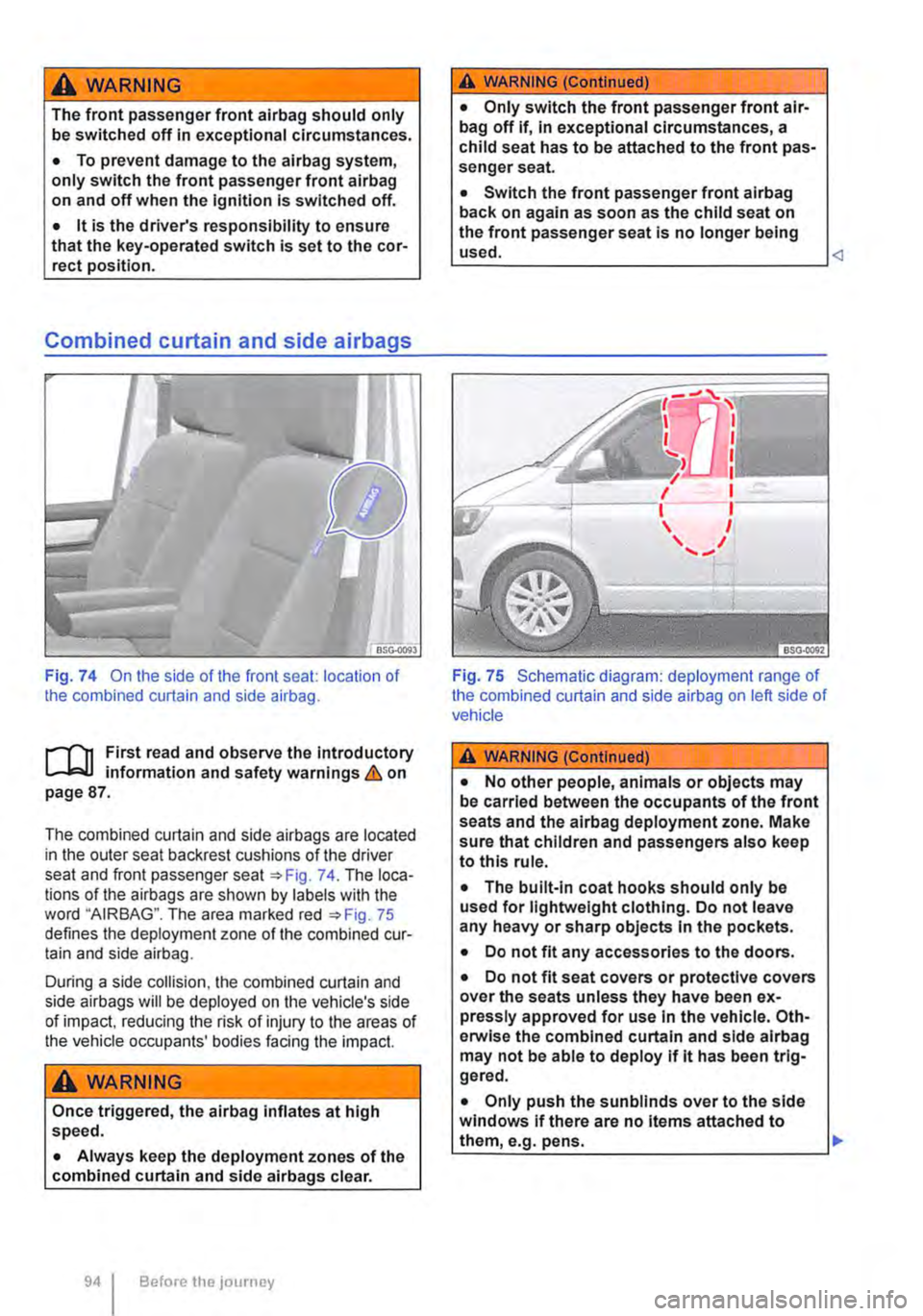
Fig. 74 On the side of the front seat: location of the combined curtain and side airbag.
l""'"'fl1 and observe the introductory L-.lr:J.J mformat1on and safety warnings & on page 87.
The combined curtain and side airbags are located in the outer seat backrest cushions of the driver seat and front passenger seat =:oFig. 74. The loca-tions of the airbags are shown by labels with the word "AIRBAG". The area marked red =:oFig. 75 defines the deployment zone of the combined cur-tain and side airbag.
During a side collision, the combined curtain and side airbags will be deployed on the vehicle's side of impact, reducing the risk of injury to the areas of the vehicle occupants' bodies facing the impact.
A WARNING
Once triggered, the airbag inflates at high speed.
• Always keep the deployment zones of the combined curtain and side airbags clear.
94 Before the journey
A WARNING (Continued)
• Only switch the front passenger front air-bag off if, In exceptional circumstances, a child seat has to be attached to the front pas-senger seat.
• Switch the front passenger front alrbag back on again as soon as the child seat on the front passenger seat is no longer being used.
Fig. 75 Schematic diagram: deployment range of the combined curtain and side airbag on left side of vehicle
A WARNING (Continued)
• No other people, animals or objects may be carried between the occupants of the front seats and the airbag deployment zone. Make sure that children and passengers also keep to this rule.
• The built-in coat hooks should only be used for lightweight clothing. Do not leave any heavy or sharp objects In the pockets.
• Do not fit any accessories to the doors.
• Do not fit seat covers or protective covers over the seats unless they have been ex-pressly approved for use In the vehicle. Oth-erwise the combined curtain and side alrbag may not be able to deploy If lt has been trig-gered.
• Only push the sunblinds over to the side windows if there are no Items attached to them, e.g. pens. .,..
Page 95 of 486
A wARNING
Incorrect use of the driver and front passen-ger seat could hinder the proper function of the combined curtain and side airbags and cause serious injury.
• Never remove the front seats from the ve-hicle or alter any components of these seats.
Curtain airbags
A WARNING (Continued)
• If too much pressure is applied to the back rest side bolster, the combined curtain and side airbags may not be triggered cor-rectly, may not trigger at all or may trigger unexpectedly.
• Any damage to the original seat uphols-tery or around the seams of the combined curtain and side airbag units must be re-paired immediately by a qualified workshop.
r-111 First read and observe the introductory l..-W information and safety warnings & on page 87.
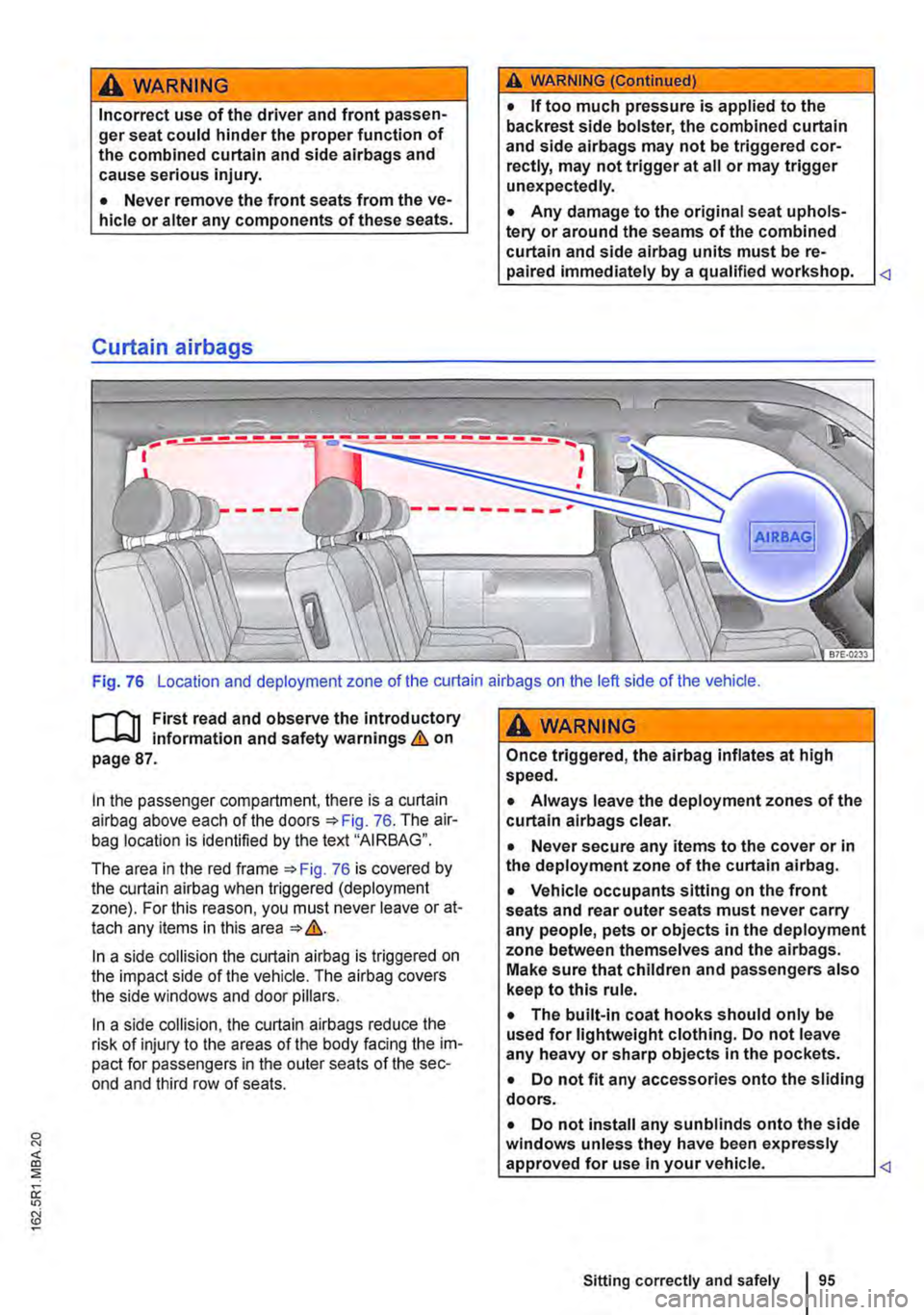
In the passenger compartment, there is a curtain airbag above each of the doors =>Fig. 76. The air-bag location is identified by the text "AIRBAG".
The area in the red frame =>Fig. 76 is covered by the curtain airbag when triggered (deployment zone). For this reason, you must never leave or at-tach any items in this area => &.
In a side collision the curtain airbag is triggered on the impact side of the vehicle. The airbag covers the side windows and door pillars.
In a side collision, the curtain airbags reduce the risk of injury to the areas of the body facing the im-pact for passengers in the outer seats of the sec-ond and third row of seats.
A WARNING
Once triggered, the airbag inflates at high speed.
• Always leave the deployment zones of the curtain alrbags clear.
• Never secure any items to the cover or in the deployment zone of the curtain airbag.
• Vehicle occupants sitting on the front seats and rear outer seats must never carry any people, pets or objects in the deployment zone between themselves and the airbags. Make sure that children and passengers also keep to this rule.
• The built-in coat hooks should only be used for lightweight clothing. Do not leave any heavy or sharp objects in the pockets.
• Do not fit any accessories onto the sliding doors.
• Do not install any sun blinds onto the side windows unless they have been expressly approved for use In your vehicle.
Page 115 of 486
Protection from the sun
a:n Introduction
This chapter contains information on the following subjects:
Sun visors . . . . . . . . . . . . . . . . . . . . . . . . . . . . . 115
Sun blind for the rear side windows 115
Windscreens made of heat-insulating glass . . 116
Sun visors
J
ltf·OOSl
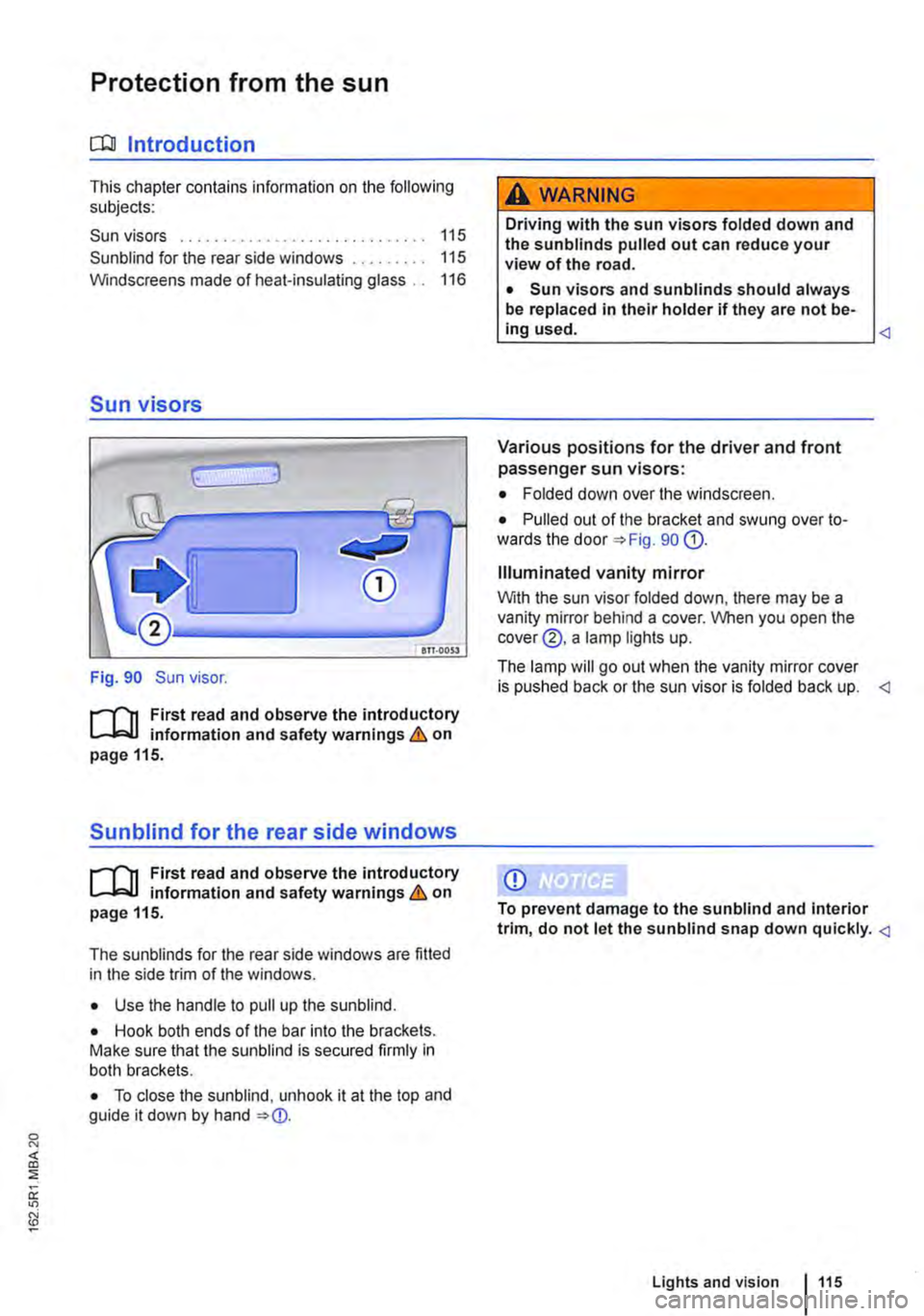
Fig. 90 Sun visor.
t"'l1 First read and observe the introductory L-bll information and safety warnings Lh on page 115.
Sunblind for the rear side windows
t"'l1 First read and observe the introductory L-blJ information and safety warnings Lh on page 115.
The sunblinds for the rear side windows are fitted in the side trim of the windows.
• Use the handle to pull up the sunblind.
• Hook both ends of the bar into the brackets. Make sure that the sun blind is secured firmly in both brackets.
• To close the sunblind, unhook it at the top and guide it down by hand => (]).
A WARNING
Driving with the sun visors folded down and the sun blinds pulled out can reduce your view of the road.
• Sun visors and sun blinds should always be replaced in their holder if they are not be-ing used.
Various positions for the driver and front passenger sun visors:
• Folded down over the windscreen.
• Pulled out of the bracket and swung over to-wards the door 90 Q).
Illuminated vanity mirror
With the sun visor folded down. there may be a vanity mirror behind a cover. When you open the cover@, a lamp lights up.
The lamp will go out when the vanity mirror cover is pushed back or the sun visor is folded back up.
CD
To prevent damage to the sun blind and interior trim, do not let the sunblind snap down quickly.
Lights and vision 115
Page 116 of 486
Windscreens made of heat-insulating glass
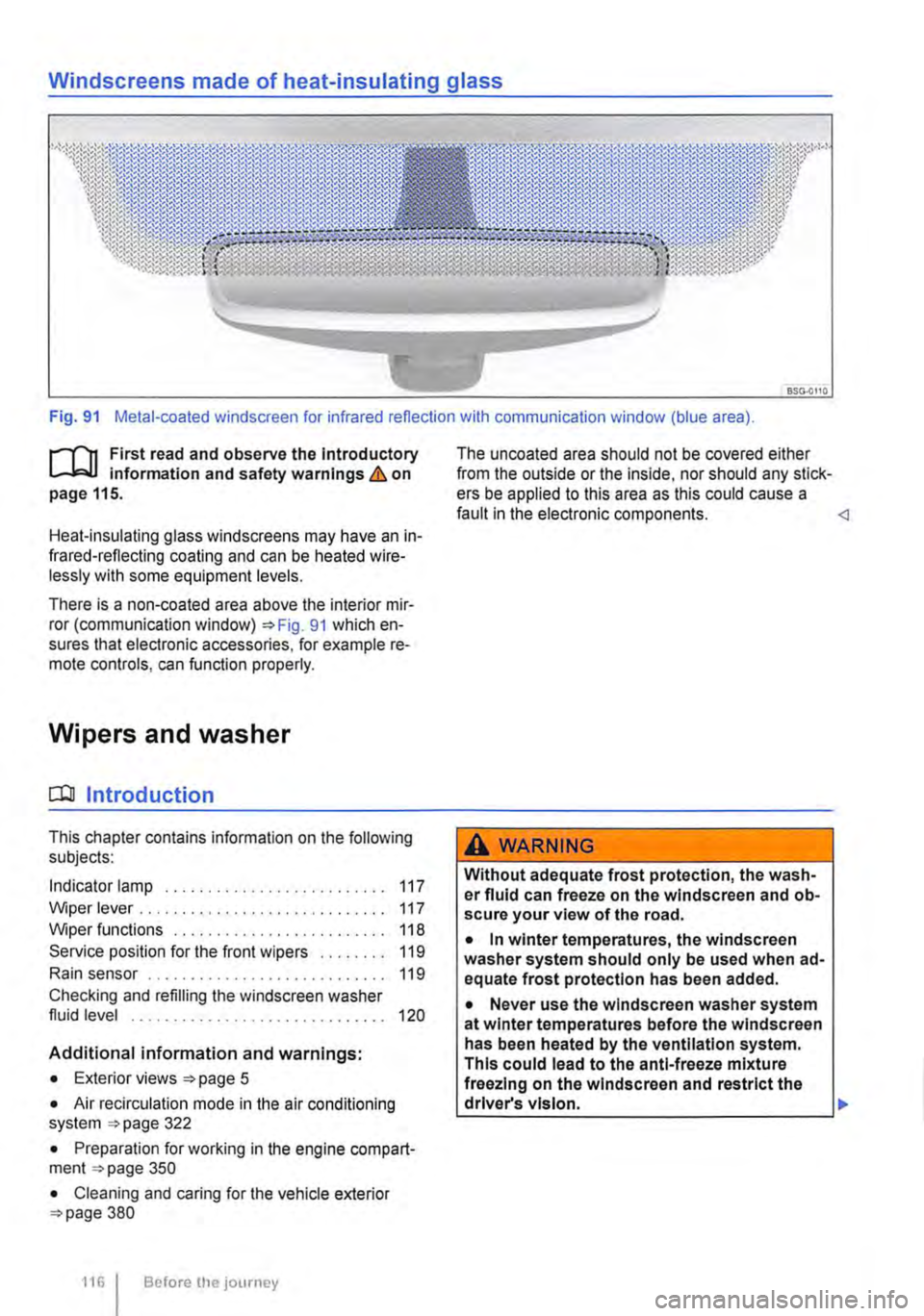
Fig. 91 Metal-coated windscreen for infrared reflection with communication window (blue area).
r-111 First read and observe the Introductory L-W.! Information and safety warnings & on page 115.
Heat-insulating glass windscreens may have an in-frared-reflecting coating and can be heated wire-lessly with some equipment levels.
There is a non-coated area above the interior mir-ror (communication window) 91 which en-sures that electronic accessories, for example re-mote controls, can function properly.
Wipers and washer
CQJ Introduction
This chapter contains information on the following subjects:
Indicator lamp . . . . . . . . . . . . . . . . . . . . . . . 117
Wiper lever . . . . . . . . . . . . . . . . . . . . . . . . . . . . . 117 Wiper functions . . . . . . . . . . 118 Service position for the front wipers . . . . . . . . 119
Rain sensor . . . . . . . . . . . . . . . . . . . . 119
Checking and refilling the windscreen washer fluid level . . . . . . . . . . . . . . . . . . . . . . . . . . . . . . 120
Additional information and warnings:
• Exterior views page 5
• Air recirculation mode in the air conditioning system 322
• Preparation for working in the engine compart-ment page 350
• Cleaning and caring for the vehicle exterior 380
116 I Before the journey
The uncoated area should not be covered either from the outside or the inside, nor should any stick-ers be applied to this area as this could cause a fault in the electronic components.
Without adequate frost protection, the wash-er fluid can freeze on the windscreen and ob-scure your view of the road.
• In winter temperatures, the windscreen washer system should only be used when ad-equate frost protection has been added.
• Never use the windscreen washer system at winter temperatures before the windscreen has been heated by the ventilation system. This could lead to the anti-freeze mixture freezing on the windscreen and restrict the driver's vision. .,.
Page 118 of 486
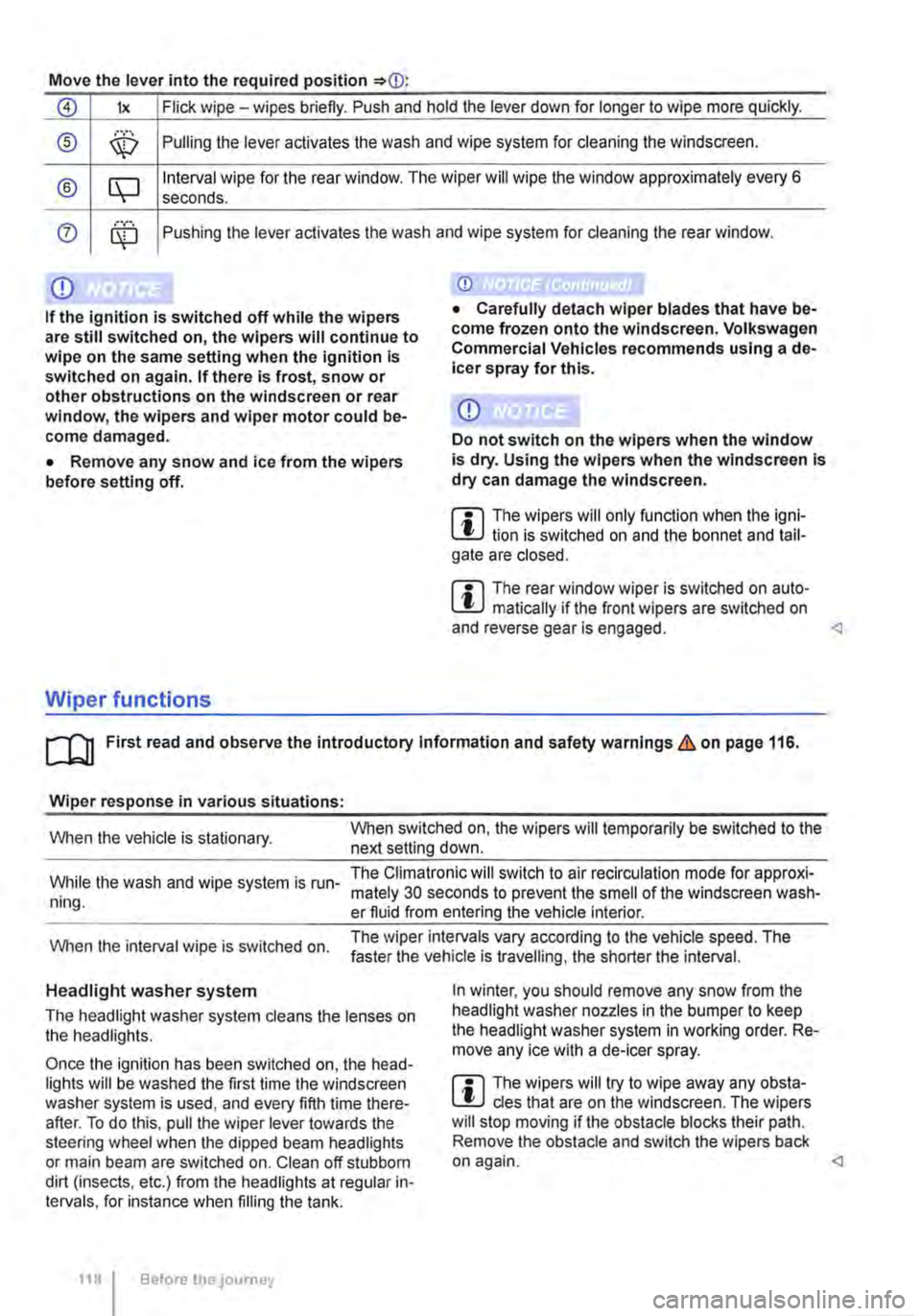
Move the lever into the required position
0 lx Flick wipe -wipes briefly. Push and hold the lever down for longer to wipe more quickly.
® ,··.··· \X:) Pulling the lever aclivates the wash and wipe system for cleaning the windscreen.
® CQ Interval wipe for the rear window. The wiper will wipe the window approximately every 6 seconds .
0 ........ Pushing the lever activates the wash and wipe system for cleaning the rear window.
Q)
If the ignition is switched off while the wipers are still switched on, the wipers will continue to wipe on the same setting when the ignition Is switched on again. If there Is frost, snow or other obstructions on the windscreen or rear window, the wipers and wiper motor could be-come damaged.
• Remove any snow and ice from the wipers before setting off.
Wiper functions
Q)
Do not switch on the wipers when the window is dry. Using the wipers when the windscreen Is dry can damage the windscreen.
m The wipers will only function when the igni-W lion is switched on and the bonnet and tail-gate are closed.
m The rear window wiper is switched on auto-W matically if the front wipers are switched on and reverse gear is engaged.
Wiper response in various situations:
When the vehicle is stationary. When switched on, the wipers will temporarily be switched to the next setting down.
While the wash and wipe system is run-ning.
The Climatronic will switch to air recirculation mode for approxi-mately 30 seconds to prevent the smell of the windscreen wash-er fluid from entering the vehicle interior.
When the interval wipe is switched on. The wiper intervals vary according to the vehicle speed. The faster the vehicle is travelling, the shorter the interval.
Headlight washer system
The headlight washer system cleans the lenses on the headlights.
Once the ignition has been switched on, the head-lights will be washed the first time the windscreen washer system is used, and every fifth time there-after. To do this, pull the wiper lever towards the steering wheel when the dipped beam headlights or main beam are switched on. Clean off stubborn dirt (insects, etc.) from the headlights at regular in-tervals, for instance when filling the tank.
118 Before the journey
In winter, you should remove any snow from the headlight washer nozzles in the bumper to keep the headlight washer system in working order. Re-move any ice with a de-icer spray.
m The wipers will try to wipe away any obsta-W cles that are on the windscreen. The wipers will stop moving if the obstacle blocks their path. Remove the obstacle and switch the wipers back on again.