child seat VOLKSWAGEN TRANSPORTER 2019 Owner's Manual
[x] Cancel search | Manufacturer: VOLKSWAGEN, Model Year: 2019, Model line: TRANSPORTER, Model: VOLKSWAGEN TRANSPORTER 2019Pages: 486, PDF Size: 69.28 MB
Page 98 of 486
DANGER (Continued)
• Only use child seats that have been ap· proved by the child seat manufacturer for use on a front passenger seat with front and side airbag.
A WARNING
Child seats present a risk of Injury if incor-rectly installed.
• Always read and follow the installation in· structions and warning information provided by the child seat manufacturer.
A wARNING
Using a front-facing child seat on the front passenger seat presents a risk of injury.
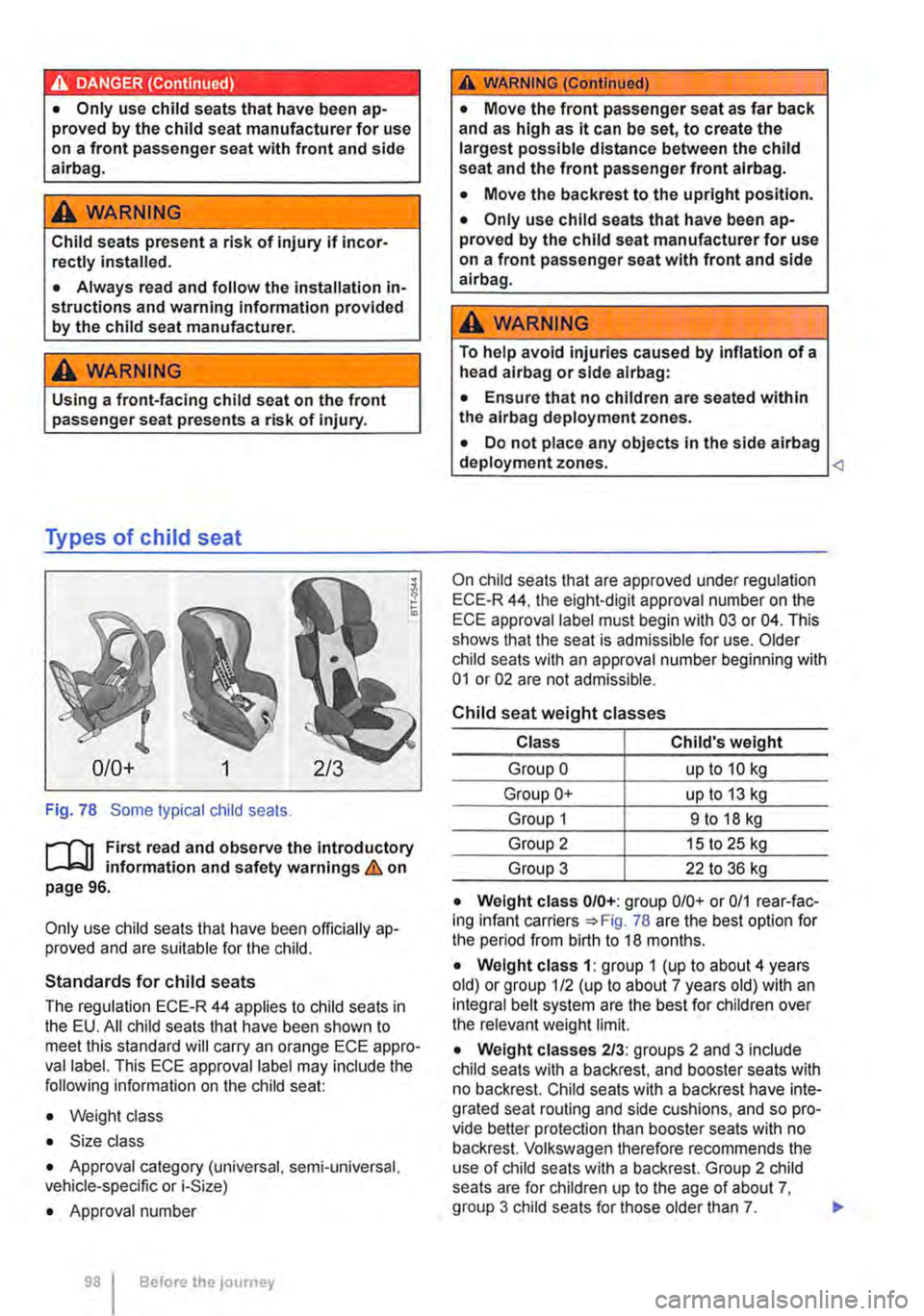
Types of child seat
0/0+
Fig. 78 Some typical child seats.
l""""("'n First read and observe the introductory L-J,::,lJ information and safety warnings & on page 96.
Only use child seats that have been officially ap-proved and are suitable for the child.
Standards for child seats
The regulation ECE·R 44 applies to child seats in the EU. All child seats that have been shown to meet this standard will carry an orange ECE appro· vallabel. This ECE approval label may include the following information on the child seat:
• Weight class
• Size class
• Approval category (universal. semi-universal, vehicle-specific or i-Size)
• Approval number
98 Before the journey
A WARNING (Continued)
• Move the front passenger seat as far back and as high as it can be set, to create the largest possible distance between the child seat and the front passenger front airbag.
• Move the backrest to the upright position .
• Only use child seats that have been ap-proved by the child seat manufacturer for use on a front passenger seat with front and side airbag.
A WARNING
To help avoid injuries caused by inflation of a head airbag or side alrbag:
• Ensure that no children are seated within the airbag deployment zones.
• Do not place any objects in the side airbag deployment zones.
On child seats that are approved under regulation ECE-R 44, the eight-digit approval number on the ECE approval label must begin with 03 or 04. This shows that the seat is admissible for use. Older child seats with an approval number beginning with 01 or 02 are not admissible.
Child seat weight classes
Class Child's weight
Group 0 up to 10 kg
Group 0+ up to 13 kg
Group 1 9 to 18 kg
Group 2 15 to 25 kg
Group 3 22 to 36 kg
• Weight class 0/0+: group 0/0+ or 0/1 rear-fac· ing infant carriers =:>Fig. 78 are the best option for the period from birth to 18 months.
• Weight class 1: group 1 (up to about 4 years old) or group 1/2 (up to about 7 years old) with an integral belt system are the best for children over the relevant weight limit.
• Weight classes 2/3: groups 2 and 3 include child seats with a backrest, and booster seats with no backrest. Child seats with a backrest have inte-grated seat routing and side cushions, and so pro-vide better protection than booster seats with no backrest. Volkswagen therefore recommends the use of child seats with a backrest. Group 2 child seats are for children up to the age of about 7,
Page 99 of 486
Not every child will fit in the child seat specified for their weight group. Likewise, not every seat will fit in every vehicle. Therefore it is vital to check that the child fits properly in their child seat and that the child seat can be securely fastened in the vehicle.
Child seat approval categories
Child seats can be classified as universal, semi-universal or vehicle-specific (all in accordance with regulation ECE-R 44), or as i-Size (in accordance with regulation ECE-R 129).
• Universal: child seats with universal approval are approved for use in all vehicles. No type list is required. ISOFIX child seats with universal appro-val must also be securing using a strap over the top of the vehicle seat (top tether).
• Semi-universal: semi-universal approval re-quires other safety devices for attaching the seat (that require additional testing) in addition to the
Securing systems
1""111 First read and observe the introductory L-J,::.U information and safety warnings & on page 96.
Different countries use different securing systems for safely fitting child seats in the vehicle.
Key terms for securing systems
• ISO FIX: ISOFIX is a standardised securing sys-tem for fitting child seats in the vehicle quickly and safely. The SOFIX attachment system creates a rigid connection between the child seat and the car body.
Any compatible child seat has two rigid attachment arms that click into ISOFIX attachment points at the bottom of the backrest. The ISOFIX securing system as described here is specific to the EU =:o page 100. An upper strap (top tether) and/or support leg may sometimes have to be used in ad-dition to the ISO FIX anchor points described above.
• Three-point automatic seat belt. lt is better to secure child seats using the ISOFIX system, if available, rather than with a three-point automatic seat belt =>page 102.
standard requirements for universal approval. Child seats with semi-universal approval come with a type list. The seats should only be used in vehi-cles that are included on this list.
• Vehicle-specific: child seats with vehicle spe-cific approval must have undergone dynamic test-ing in each model of vehicle for which it is ap-proved. These child seats also come with a type list.
• i-Size: child seats classified as must conform to the installation and safety requirements prescribed in regulation ECE-R 129. Contact the child seat manufacturer to find out which child seats are ap-proved for this vehicle in accordance with i-Size. <1
Additional securing points:
• Top tether: this strap at the top of the child seat is routed over the vehicle seat backrest and hooked to an anchor ring on the seat backs =:.page 101.
• Support leg: some child seats are propped up with a support leg resting on the floor of the vehi-cle. This support leg helps to prevent the child seat from tipping forward in a crash =:.&.
Recommended child seat securing systems
Volkswagen Commercial Vehicles recommends that child seats are secured as follows:
• Infant carrier or rear-facing child seat: ISO-FIX and support leg.
• Front-facing child seat: ISOFIX and top tether and possibly support leg also.
A WARNING
Incorrect use of the support leg can cause severe or fatal injuries.
• Make sure that the support leg is always correctly and safely Installed.
Sitting correctly and safely 99
Page 100 of 486
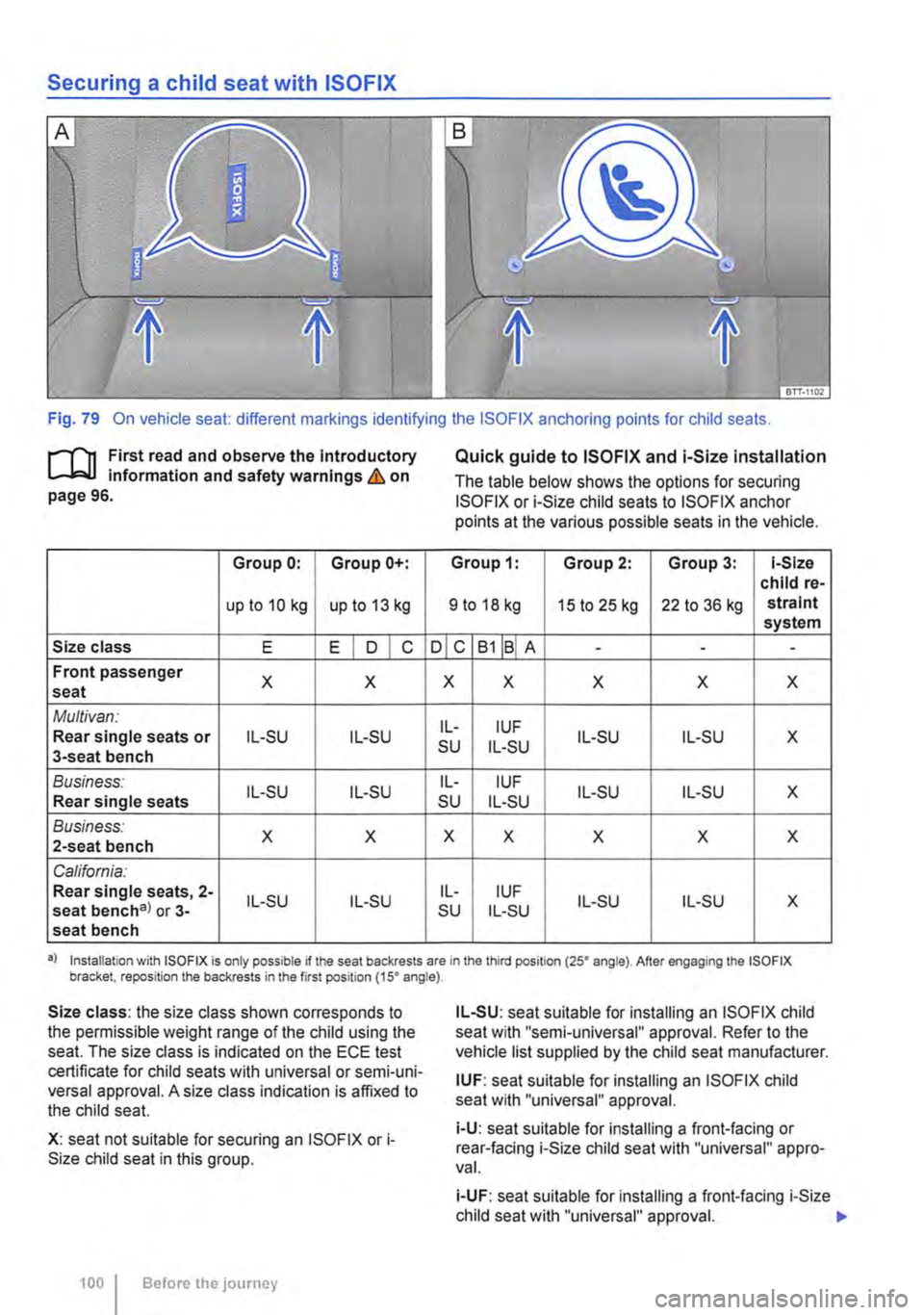
Fig. 79 On vehicle seat: different markings identifying the ISOFIX anchoring points for child seats.
1"'1'11 First read and observe the Introductory l..-J,::,IJ information and safety warnings & on page 96.
Group 0: Group 0+:
upto10kg up to 13 kg
Size class E EIDIC
Front passenger X X seat
Multivan: Rear single seats or IL-SU IL-SU 3-seat bench
Business: IL-SU IL-SU Rear single seats
Business: X X 2-seat bench
California: Rear single seats, 2-IL-SU IL-SU seat bencha> or 3-seat bench
Quick guide to ISO FIX and i-Size installation
The table below shows the options for securing ISO FIX or i-Size child seats to ISOFIX anchor points at the various possible seats in the vehicle.
Group 1: Group 2: Group 3: 1-Size child re-
9 to 18 kg 15 to 25 kg 22 to 36 kg strain! system
ojc B1jBI A ---
X X X X X
IL-IUF su IL-SU IL-SU IL-SU X
IL-IUF IL-SU IL-SU X su IL-SU
X X X X X
IL-IUF IL-SU IL-SU X su IL-SU
•> Installation with ISOFIX is only possible if the seat backrests are in the third position (25' angle). After engaging the ISOFIX bracket, reposition the backrests in the first position (15' angle).
Size class: the size class shown corresponds to the permissible weight range of the child using the seat. The size class is indicated on the ECE test certificate for child seats with universal or semi-uni-versal approval. A size class indication is affixed to the child seat.
X: seat not suitable for securing an ISOFIX or i-Size child seat in this group.
100 I Before the journey
IL-SU: seat suitable for installing an ISOFIX child seat with "semi-universal" approval. Refer to the vehicle list supplied by the child seat manufacturer.
IUF: seat suitable for installing an ISOFIX child seat with "universal" approval.
i-U: seat suitable for installing a front-facing or rear-facing i-Size child seat with "universal" appro-val.
i-UF: seat suitable for installing a front-facing i-Size child seat with "universal" approval.
Page 101 of 486
Installing child seats with ISOFIX ISOFIX/i-
Size
The location of the ISO FIX anchor points is shown either by a symbol or by a label marked "ISOFIX" 79.
• Observe the warnings 97, Basic infor-mation on fitting and using child seats.
• Push the attachment arms on the child seat into the ISOFIX anchor points 79 as shown by the arrows. The child seat must click and audibly securely into place.
• Pull on both sides of the child seat to check whether the seat has clicked properly into place.
• If the child seat is fitted with a support foot, the foot must sit firmly on the floor of the vehicle.
Using insert guides
If the child seat anchor points are not directly ac-cessible, insert guides make fitting and removing the child seat easier. First attach the insert guides to the anchor points. Then secure the child seat as per the installation guide.
CD
Avoid damage to the upholstery and seat cush-ions caused by the Insert guides.
• Always pull the insert guides off the anchor points before folding the rear seat forward, or when removing the child seat.
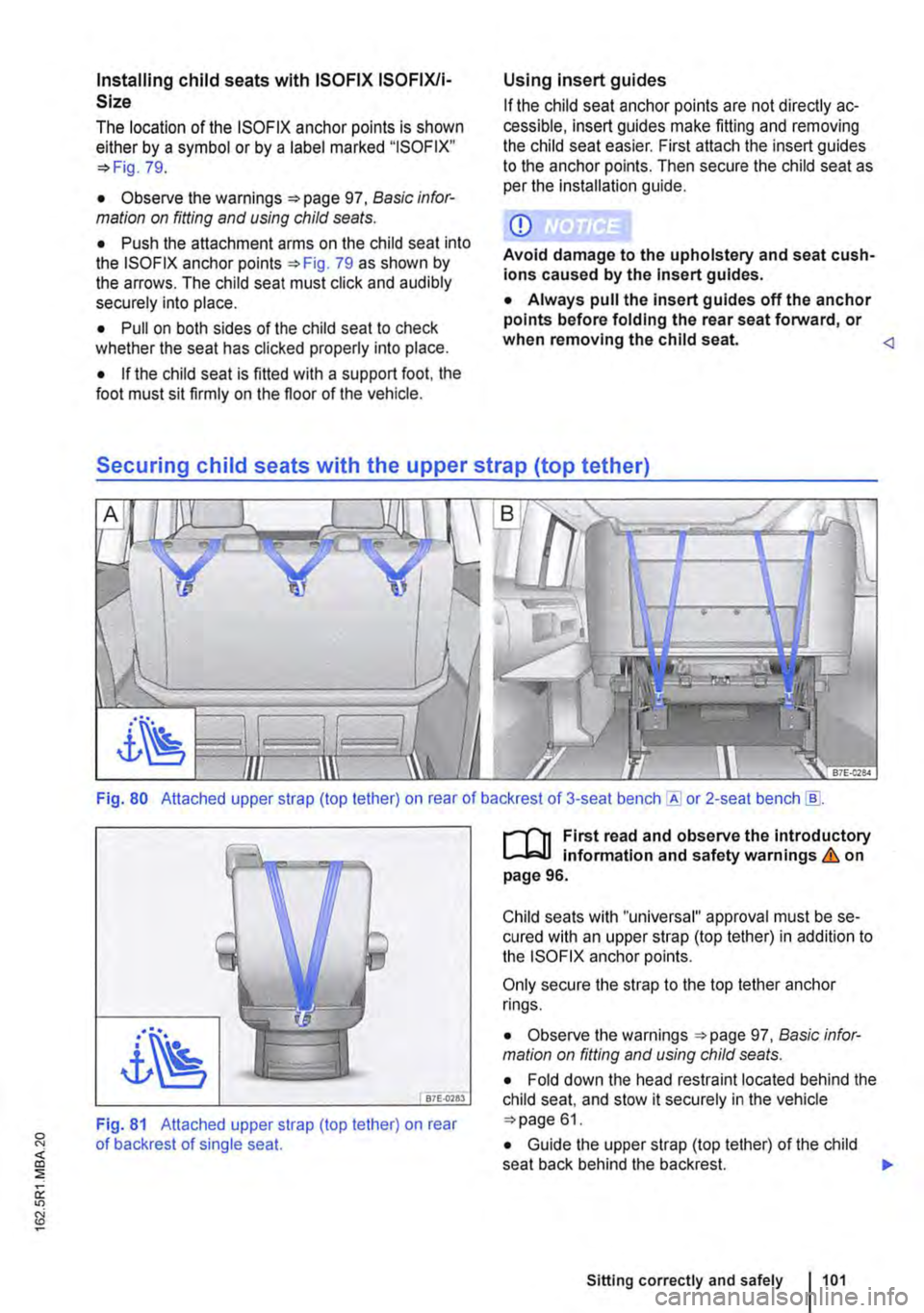
Fig. 80 Attached upper strap (top tether) on rear of backrest of 3-seat or 2-seat bench [ID.
87E-0783
Fig. 81 Attached upper strap (top tether) on rear of backrest of single seat.
r-1'11 First read and observe the Introductory L-lcJ.I Information and safety warnings & on page 96.
Child seats with "universal" approval must be se-cured with an upper strap (top tether) in addition to the ISOFIX anchor points.
Only secure the strap to the top tether anchor rings.
• Observe the warnings 97, Basic infor-mation on fitting and using child seats.
• Fold down the head restraint located behind the child seat, and stow it securely in the vehicle 61.
• Guide the upper strap (top tether) of the child seat back behind the backrest. )I>
Sitting correctly and safely 1101
Page 102 of 486
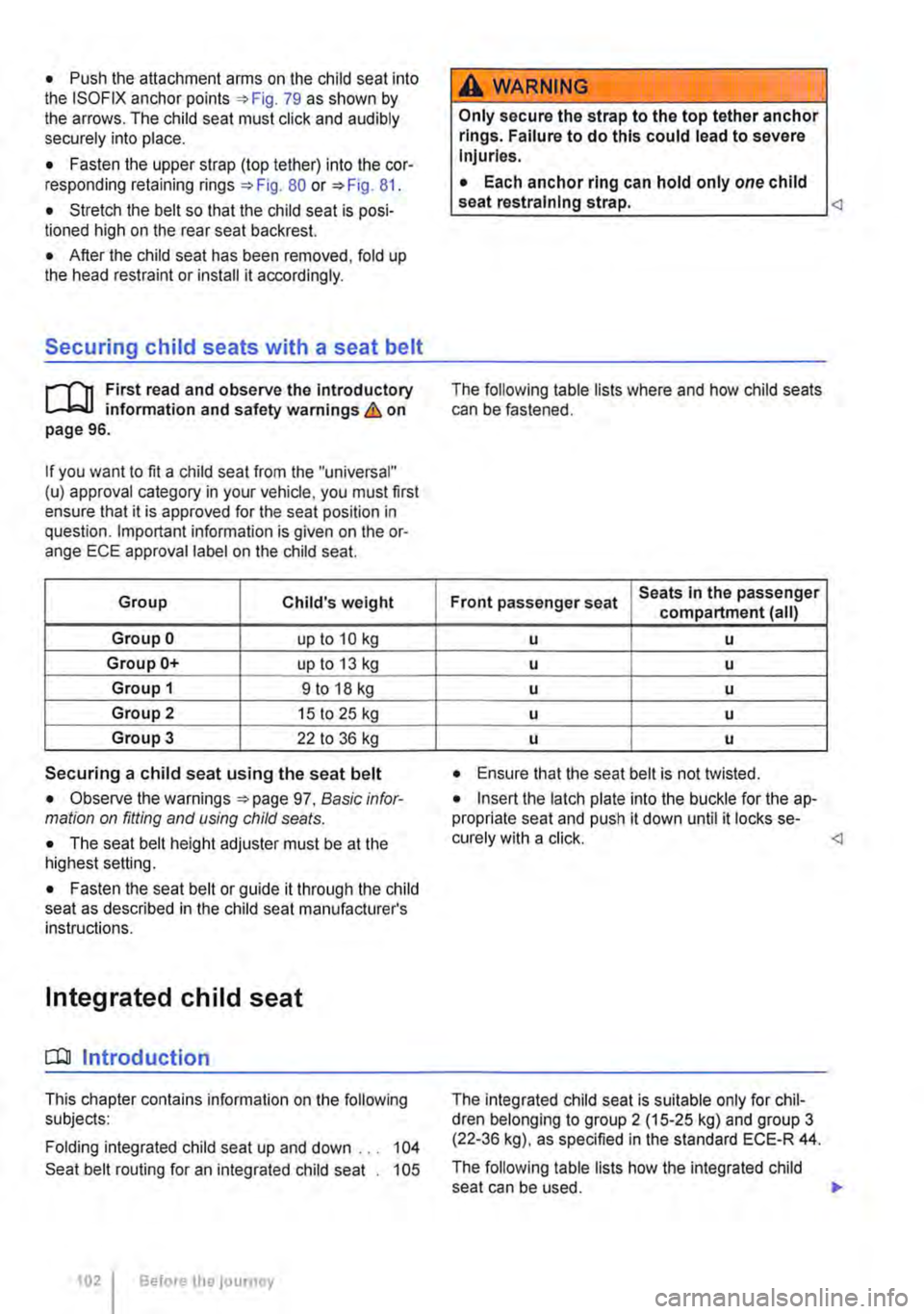
• Push the attachment arms on the child seat into the ISOFIX anchor points 79 as shown by the arrows. The child seat must click and audibly securely into place.
• Fasten the upper strap (top tether) into the cor-responding retaining rings 80 or 81.
• Stretch the belt so that the child seat is posi-tioned high on the rear seat backrest.
• After the child seat has been removed, fold up the head restraint or install it accordingly.
Securing child seats with a seat belt
r-111 First read and observe the Introductory L--lo:oU information and safety warnings & on page 96.
If you want to fit a child seat from the "universal" (u) approval category in your vehicle. you must first ensure that it is approved for the seat position in question. Important information is given on the or-ange ECE approval label on the child seat.
Group Child's weight
Group 0 up to 10 kg
Group 0+ up to 13 kg
Group 1 9 to 18 kg
Group 2 15 to 25 kg
Group 3 22 to 36 kg
Securing a child seat using the seat belt
• Observe the warnings 97, Basic infor-mation on fitting and using child seals.
• The seat belt height adjuster must be at the highest setting.
• Fasten the seat belt or guide it through the child seat as described in the child seat manufacturer's instructions.
Integrated child seat
o::n Introduction
This chapter contains information on the following subjects:
Folding integrated child seat up and down ... 104
Seat belt routing for an integrated child seat . 105
102 Before the journey
A WARNING
Only secure the strap to the top tether anchor rings. Failure to do this could lead to severe Injuries.
• Each anchor ring can hold only one child seat restraining strap.
Front passenger seat Seats In the passenger compartment (all)
u u
u u
u u
u u
u u
• Ensure that the seat belt is not twisted.
• Insert the latch plate into the buckle for the ap-propriate seat and push it down until it locks se-curely with a click.
The following table lists how the integrated child seat can be used. .,..
Page 103 of 486
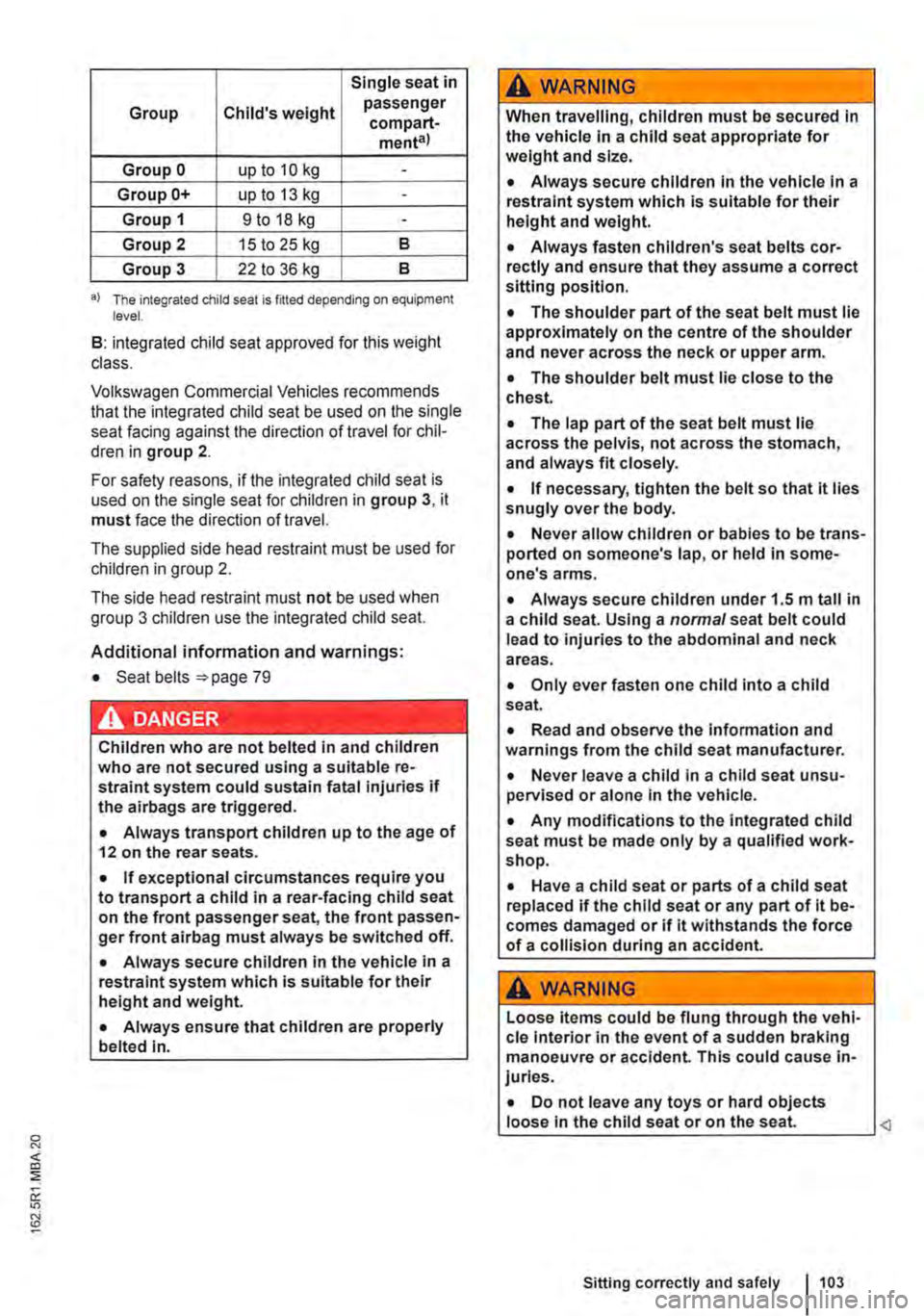
Single seat in
Group Child's weight passenger compart-menta)
Group 0 up to 10 kg -
Group 0+ up to 13 kg -
Group 1 9 to 18 kg -
Group 2 15 to 25 kg 8
Group 3 22 to 36 kg 8
a) The integrated child seat is fijted depending on equipment level.
8: integrated child seat approved for this weight class.
Volkswagen Commercial Vehicles recommends that the integrated child seat be used on the single seat facing against the direction of travel for chil-dren in group 2.
For safety reasons, if the integrated child seat is used on the single seat for children in group 3, it must face the direction of travel.
The supplied side head restraint must be used for children in group 2.
The side head restraint must not be used when group 3 children use the integrated child seat.
Additional information and warnings:
• Seat belts =:. page 79
Children who are not belted in and children who are not secured using a suitable re-straint system could sustain fatal injuries if the airbags are triggered.
• Always transport children up to the age of 12 on the rear seats.
• If exceptional circumstances require you to transport a child in a rear-facing child seat on the front passenger seat, the front passen-ger front airbag must always be switched off.
• Always secure children in the vehicle in a restraint system which is suitable for their height and weight.
• Always ensure that children are properly belted In.
A WARNING
When travelling, children must be secured In the vehicle In a child seat appropriate for weight and size.
• Always secure children In the vehicle in a restraint system which is suitable for their height and weight.
• Always fasten children's seat belts cor-rectly and ensure that they assume a correct sitting position.
• The shoulder part of the seat belt must lie approximately on the centre of the shoulder and never across the neck or upper arm.
• The shoulder belt must lie close to the chest.
• The lap part of the seat belt must lie across the pelvis, not across the stomach, and always fit closely.
• If necessary, tighten the belt so that it lies snugly over the body.
• Never allow children or babies to be trans-ported on someone's lap, or held In some-one's arms.
• Always secure children under 1.5 m tall in a child seat. Using a normal seat belt could lead to injuries to the abdominal and neck areas.
• Only ever fasten one child into a child seat.
• Read and observe the information and warnings from the child seat manufacturer.
• Never leave a child in a child seat unsu-pervised or alone In the vehicle.
• Any modifications to the integrated child seat must be made only by a qualified work-shop.
• Have a child seat or parts of a child seat replaced if the child seat or any part of it be-comes damaged or if it withstands the force of a collision during an accident.
A WARNING
Loose items could be flung through the vehi-cle interior in the event of a sudden braking manoeuvre or accident. This could cause in-juries.
• Do not leave any toys or hard objects loose in the child seat or on the seat. <1
Sitting correctly and safely 103
Page 104 of 486
Folding integrated child seat up and down
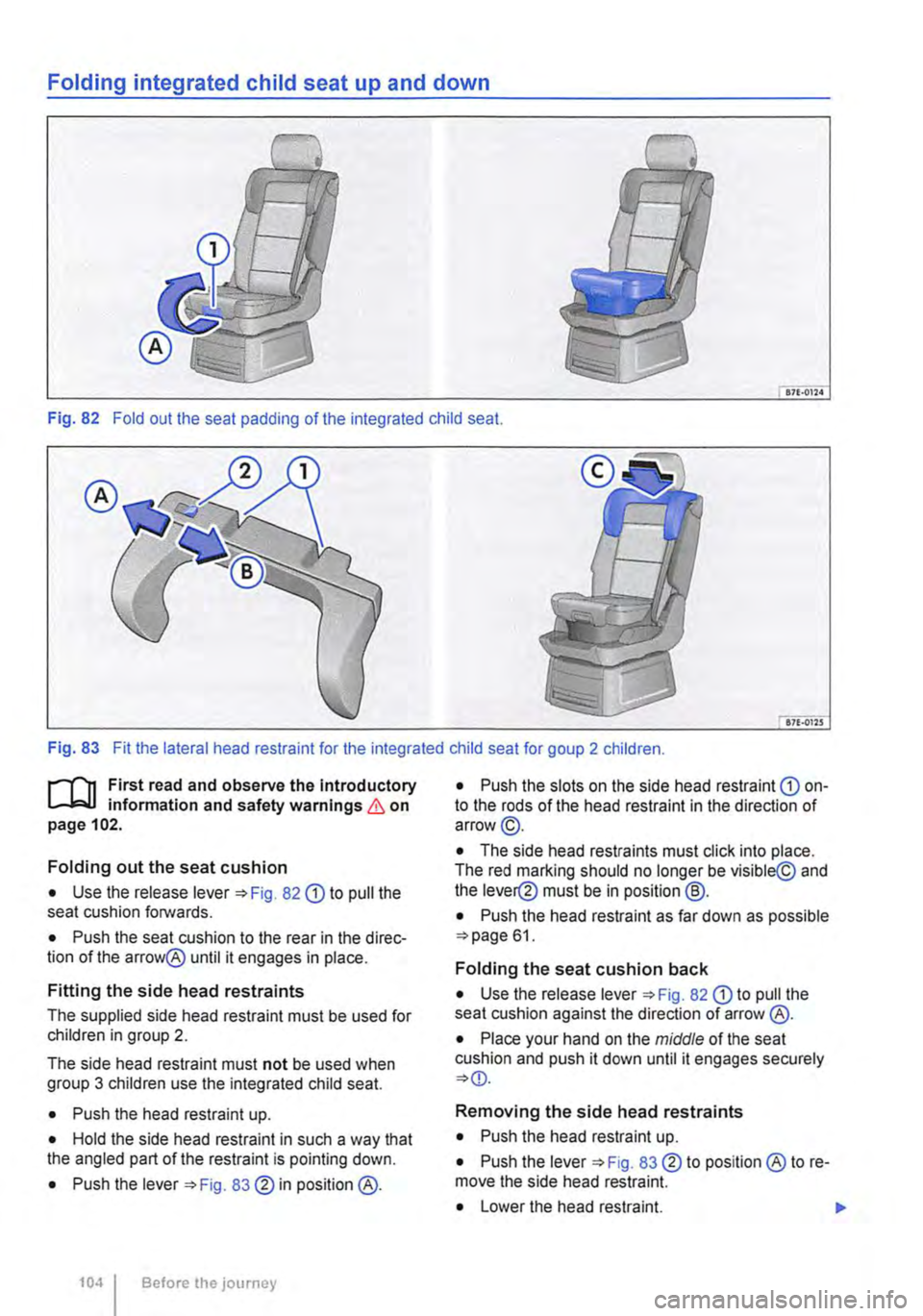
Fig. 82 Fold out the seat padding of the integrated child seat.
Fig. 83 Fit the lateral head restraint for the integrated child seat for goup 2 children.
r"'1'1t First read and observe the Introductory information and safety warnings & on page 102.
Folding out the seat cushion
• Use the release lever 82 Q) to pull the seat cushion forwards.
• Push the seat cushion to the rear in the direc-tion of the arrow@ until it engages in place.
Fitting the side head restraints
The supplied side head restraint must be used for children in group 2.
The side head restraint must not be used when group 3 children use the integrated child seat.
• Push the head restraint up.
• Hold the side head restraint in such a way that the angled part of the restraint is pointing down.
• Push the lever 83 ®in position@.
104 Before the journey
• Push the slots on the side head restraint Q) on-to the rods of the head restraint in the direction of arrow@.
• The side head restraints must click into place. The red marking should no longer be visible@ and the lever@ must be in position @.
• Push the head restraint as far down as possible 61.
Folding the seat cushion back
• Use the release lever 82 Q) to pull the seat cushion against the direction of arrow @.
• Place your hand on the middle of the seat cushion and push it down until it engages securely
Removing the side head restraints
• Push the head restraint up.
• Push the lever 83 ® to position ® to re-move the side head restraint.
• Lower the head restraint. ...
Page 105 of 486
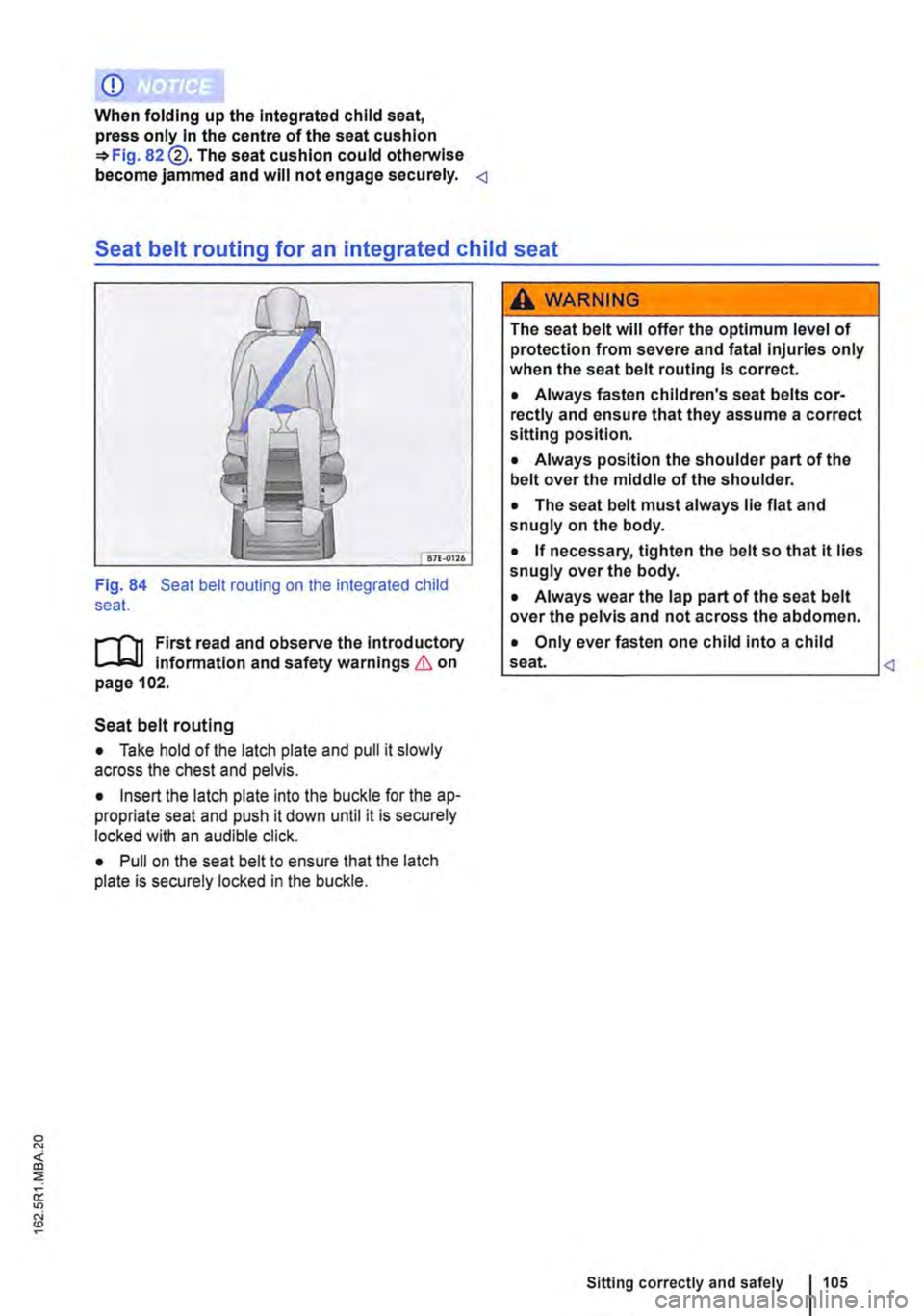
Fig. 84 Seat belt routing on the integrated child seat.
r-flt First read and observe the Introductory 1.-J,::.U Information and safety warnings & on page 102.
Seat belt routing
• Take hold of the latch plate and pull it slowly across the chest and pelvis.
• Insert the latch plate into the buckle for the ap-propriate seat and push it down until it is securely locked with an audible click.
• Pull on the seat belt to ensure that the latch plate is securely locked in the buckle.
A WARNING
The seat belt will offer the optimum level of protection from severe and fatal injuries only when the seat belt routing Is correct.
• Always fasten children's seat belts cor-rectly and ensure that they assume a correct sitting position.
• Always position the shoulder part of the belt over the middle of the shoulder.
• The seat belt must always lie flat and snugly on the body.
• If necessary, tighten the belt so that lt lies snugly over the body.
• Always wear the lap part of the seat belt over the pelvis and not across the abdomen.
• Only ever fasten one child into a child
Sitting correctly and safely 105
Page 126 of 486
A WARNING (Continued)
• Transporting heavy objects changes the vehicle's handling and the centre of gravity.
• The load should be distributed as evenly and low as possible In the vehicle.
• Always secure heavy objects in the lug-gage compartment as far in front of the rear axle as possible.
A WARNING
The vehicle handling and braking effect may alter significantly If large or heavy objects are being transported.
• Always adapt your speed and driving style to suit visibility, weather, road and traffic con-ditions.
• Accelerate carefully and gently .
• Avoid sudden braking and driving ma-noeuvres.
• Brake earlier than in normal driving.
A WARNING
Unsuitable or damaged securing straps could rip In the event of a braking manoeuvre or ac-cident. This could cause objects to be flung through the interior and lead to severe or fa-tal injuries.
• Always use suitable and undamaged se-curing straps.
• Attach securing straps securely to the fas-tening rings.
• Never load the securing straps in excess of the load rating.
A wARNING
Securing straps, if used incorrectly, may get detached in the event of a sudden braking manoeuvre or accident. This could cause ob-jects to be flung through the interior and lead to severe or fatal injuries.
Stowing items of luggage
1'"'1'11 First read and observe the introductory L-.lr::.U information and safety warnings & on page 125. .,..
1261 Before the journey
A WARNING (Continued)
• Never fix securing straps between the fas-tening rings In the side panel and the fasten-ing rings in the vehicle floor.
• Never fix securing straps between oppo-site side walls.
• Observe the Information on the side trim panels.
A WARNING
Incorrect use of fastening rings can cause se-vere or fatal accidents.
• Always use suitable and undamaged se-curing straps.
• Attach securing straps securely to the fas-tening rings.
• loose objects in the vehicle can suddenly slide and change the way the vehicle han-dles.
• Never exceed the maximum load rating of the fastening rings when securing objects.
• Small and light objects should also be se-cured.
• Never secure a child seat to the fastening rings.
• Rotating single seats must always be turned In the direction of travel If a load is se-cured behind this seat using fastening rings.
• Never use elastic straps or nets to tie down loads.
• Distribute the load on the fastening rings evenly.
• Ensure that the load retains its form and position once it has been secured. Use stable packaging and anti-slip floor surfacing for your load.
m Suitable fastening belts and luggage stowage L!.J systems are available from a qualified work-shop. Volkswagen Commercial Vehicles recom-mends using a Voikswagen Commercial Vehicles dealership for this purpose.
Page 135 of 486
A WARNING (Continued)
• Attach securing straps securely to the fas-tening rings.
• Loose objects in the vehicle can suddenly slide and change the way the vehicle han-dles.
• Never exceed the maximum load rating of the fastening rings when securing objects.
• Small and light objects should also be se-cured.
• Never secure a child seat to the fastening rings.
• Rotating single seats must always be turned in the direction of travel if a load is se-cured behind this seat using fastening rings.
T-shaped fastening ring
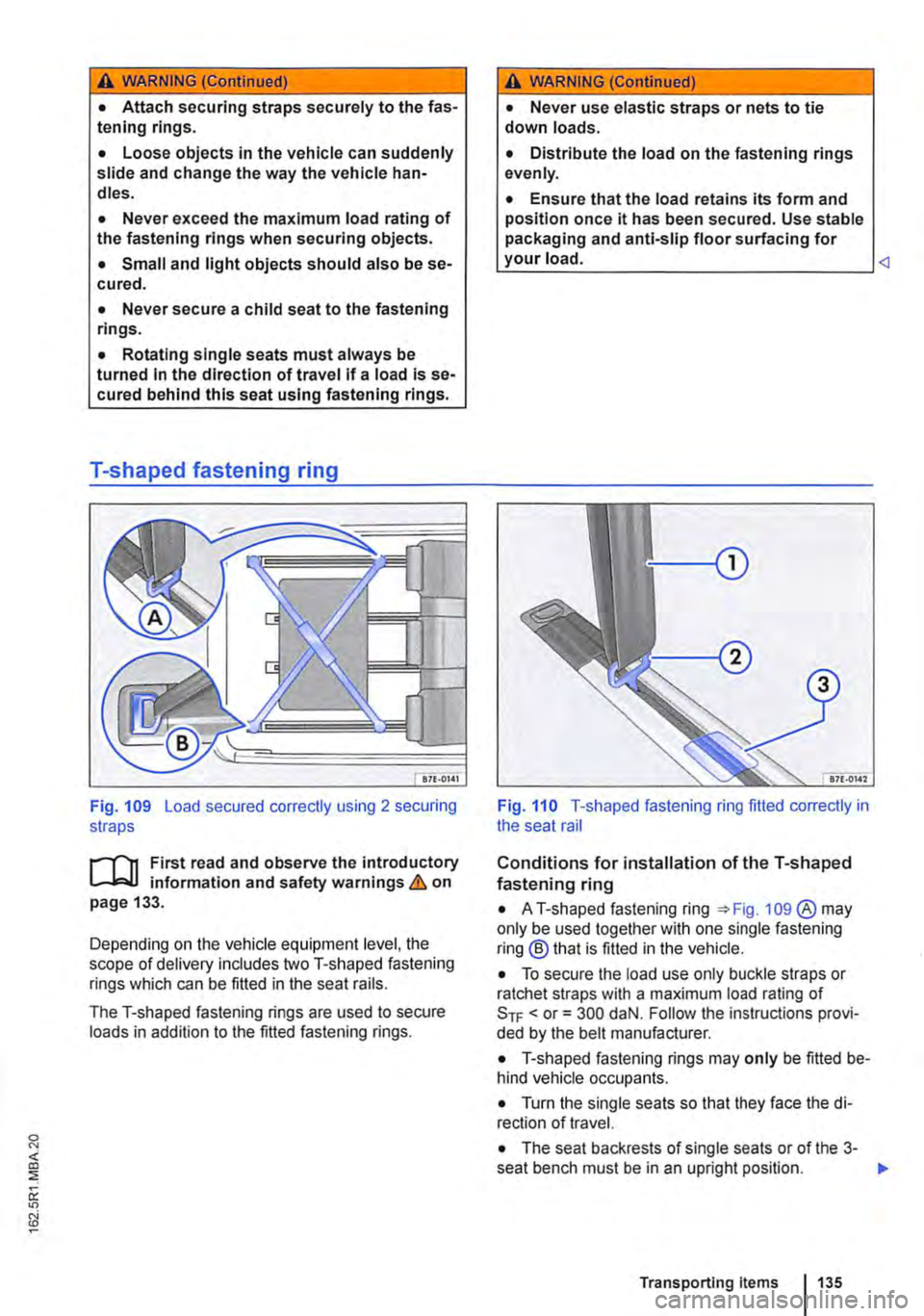
Fig. 109 Load secured correctly using 2 securing straps
il11 First read and observe the introductory L-J,.:.U information and safety warnings & on page 133.
Depending on the vehicle equipment level, the scope of delivery includes two T-shaped fastening rings which can be fitted in the seat rails.
The T-shaped fastening rings are used to secure loads in addition to the fitted fastening rings.
A WARNING (Continued)
• Never use elastic straps or nets to tie down loads.
• Distribute the load on the fastening rings evenly.
• Ensure that the load retains its form and position once it has been secured. Use stable packaging and anti-slip floor surfacing for your load.
Conditions for installation of the T-shaped fastening ring
• AT-shaped fastening ring 109 ®may only be used together with one single fastening ring® that is fitted in the vehicle.
• To secure the load use only buckle straps or ratchet straps with a maximum load rating of SrF < or= 300 daN. Follow the instructions provi-ded by the belt manufacturer.
• T-shaped fastening rings may only be fitted be-hind vehicle occupants.
• Turn the single seats so that they face the di-rection of travel.
• The seat backrests of single seats or of the 3-seat bench must be in an upright position. .,.
Transporting Items 135