child seat VOLKSWAGEN TRANSPORTER 2019 Service Manual
[x] Cancel search | Manufacturer: VOLKSWAGEN, Model Year: 2019, Model line: TRANSPORTER, Model: VOLKSWAGEN TRANSPORTER 2019Pages: 486, PDF Size: 69.28 MB
Page 219 of 486
Opening the manual pop-up roof
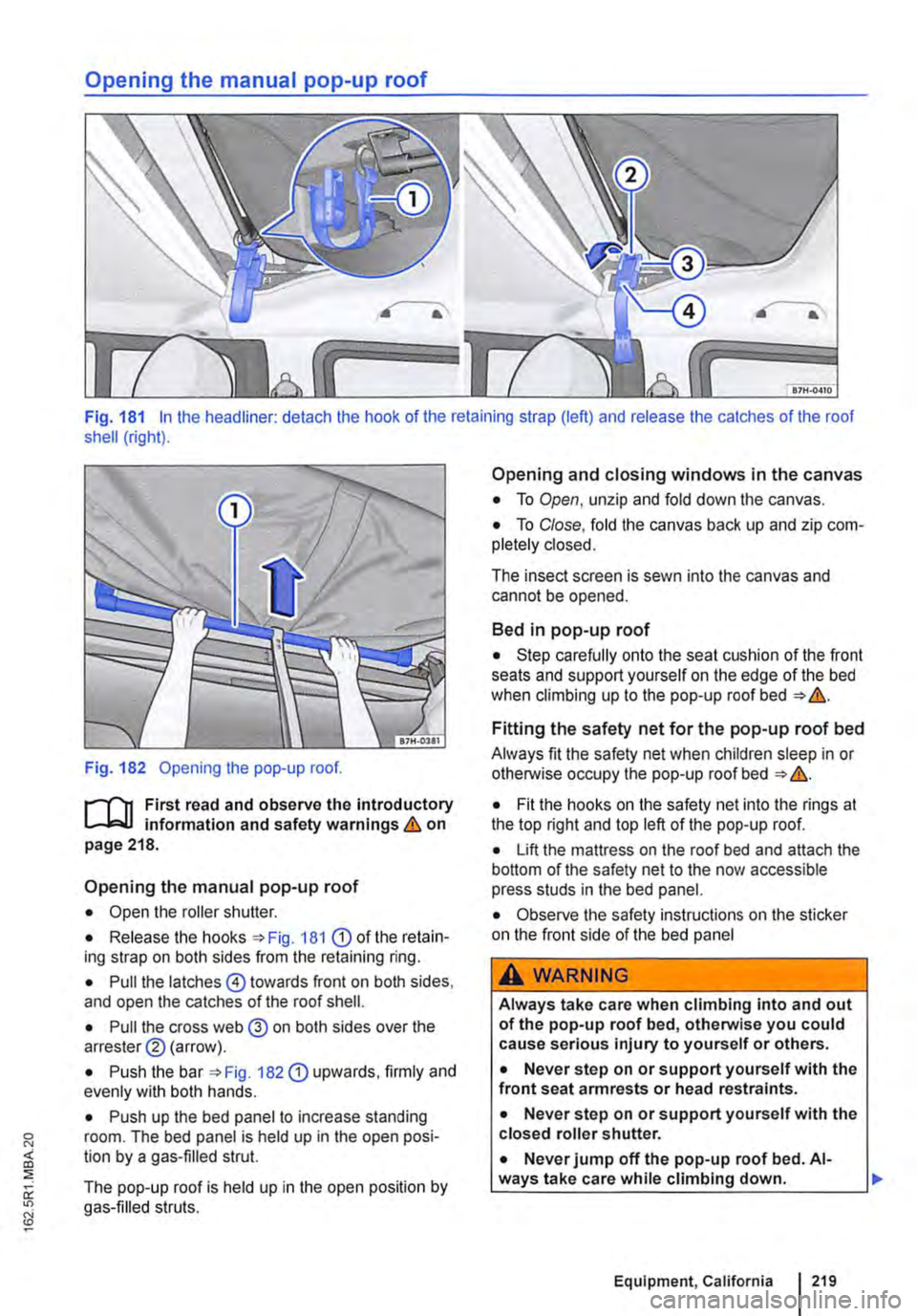
Fig. 181 In the headliner: detach the hook of the retaining strap (left) and release the catches of the roof shell (right).
Fig. 182 Opening the pop-up roof.
r""'('n First read and observe the introductory L-W.I information and safety warnings & on page 218.
Opening the manual pop-up roof
• Open the roller shutter.
• Release the hooks =>Fig. 181 CD of the retain-ing strap on both sides from the retaining ring.
• Pull the latches @) towards front on both sides, and open the catches of the roof shell.
• Pull the cross web @ on both sides over the arrester® (arrow).
• Push the bar 182 CD upwards, firmly and evenly with both hands.
• Push up the bed panel to increase standing room. The bed panel is held up in the open posi-tion by a gas-filled strut.
The pop-up roof is held up in the open position by gas-filled struts.
Opening and closing windows in the canvas
• To Open, unzip and fold down the canvas.
• To Close, fold the canvas back up and zip com-pletely closed.
The insect screen is sewn into the canvas and cannot be opened.
Bed in pop-up roof
• Step carefully onto the seat cushion of the front seats and support yourself on the edge of the bed when climbing up to the pop-up roof bed => &.
Fitting the safety net for the pop-up roof bed
Always fit the safety net when children sleep in or otherwise occupy the pop-up roof bed => &.
• Fit the hooks on the safety net into the rings at the top right and top left of the pop-up roof.
• Lift the mattress on the roof bed and attach the bottom of the safety net to the now accessible press studs in the bed panel.
• Observe the safety instructions on the sticker on the front side of the bed panel
aAWARNING
Always take care when climbing into and out of the pop-up roof bed, otherwise you could cause serious injury to yourself or others.
• Never step on or support yourself with the front seat armrests or head restraints.
• Never step on or support yourself with the closed roller shutter.
• Never jump off the pop-up roof bed. Al-ways take care while climbing down. Ill>
Equipment, California I 219
Page 221 of 486
Electric pop-up roof, California
o:IJ Introduction
This chapter contains information on the following subjects:
Opening the electric pop-up roof . . . . . . . . . . . 222
Closing the electric pop-up roof . . . 223
Preliminary work for closing the electric pop-up roof manually . . . . . . . . . . . . . . . . . . . . . . . . 224
Closing the electric pop-up roof manually . 225 Securing the pop-up roof manually from outside the vehicle . . . . . 225
Roller shutter
Above the front seats there is a roller shutter, which must always be closed while the vehicle is in motion. This prevents the pop-up roof canvas from hanging down through the ceiling access and blocking the driver's view. Keeping the roller shut-ter closed also reduces wind noise while the vehi-cle is in motion.
Additional information:
• Central control panel 204
• Rectifying faults on the camping equipment 254
• Winter conditions 253
• Vehicle tool kit 416
A WARNING
Incorrect handling of the pop-up roof can cause accidents and serious Injuries.
• Never drive the vehicle with the pop-up roof open. The pop-up roof must always be completely closed and securely locked while the vehicle Is In motion.
• Never drive with people In the pop-up roof.
• Only open or close the pop-up roof while the vehicle Is stationary.
• Only mount a luggage roof rack when the pop-up roof is completely closed and secure-ly locked.
A WARNING
Careless or inattentive use of the pop-up roof could cause serious Injuries.
• The pop-up roof should only be opened or closed when you are sure that nobody is in its operating area.
A WARNING (Continued)
• Never leave children or people requiring assistance alone In the vehicle.
• Always take all vehicle keys with you ev-ery time you leave the vehicle.
A WARNING
Driving at high vehicle speeds and with a strong headwind after closing the pop-up roof manually could cause the pop-up roof to lift up or open on Its own and potentially cause serious Injuries.
• If you close the pop-up roof manually, do not drive faster than 60 km/h.
• Drive especially carefully and slowly In the presence of a strong headwind.
• The pop-up roof should be checked by a qualified workshop as soon as possible.
CD
Incorrect handling of the pop-up roof can cause damage to it or to other parts of the vehi-cle.
• Make sure there is adequate space before opening the pop-up roof.
• When closing the pop-up roof, always open the roller shutter and one of the vehicle doors to allow the excess air pressure to escape.
• Only close the pop-up roof when it is dry to prevent the build up of mould or mildew.
• Open the pop-up roof occasionally to air it out when it is not being used for long periods of time.
• Clean the pop-up roof bellows with water only. Never use household cleaners or Impreg-nating fabric treatment products.
• Close the pop-up roof during storms with driving rain and wind gusts. Otherwise the bel-lows could leak despite their specially treated fabric.
m Roof hydraulics: the pop-up height of the W pop-up roof will be checked automatically and altered if necessary at regular intervals after the ignition has been switched off and the ignition key removed: first after 10 hours and then every five hours. .,.
Equipment, California 221
Page 222 of 486
m If the pop-up roof cannot be closed even l!J when the ignition is switched on and the clos-ing function is used, please check all possible cau-ses. If the cause cannot be found or there are oth-er malfunctions, please close the pop-up roof man-
Opening the electric pop-up roof
r--'('n First read and observe the introductory L-.lo:.U information and safety warnings & on page 221.
Opening the pop-up roof
• Switch on the ignition.
• Switch on the central control panel.
• Open the roller shutter and release the reading lamp retaining strap.
• Select the menu option Pop-up roof in the central control panel.
• Select menu option Open (dark background).
• Press and hold the rotary/push knob until the hydraulic motor has switched off automatically and the pop-up roof has opened fully. The symbol for the open pop-up roof will be displayed. The hy-draulic motor has a run-on time of approx. 5 sec-onds to bleed the hydraulic system.
• Switch off the ignition and remove the ignition key.
• Push up the bed panel to increase standing room.
Opening and closing the windows in the canvas
• To Open, unzip and fold down the canvas.
• To Close, fold the canvas back up and zip com-pletely closed.
The insect screen is sewn into the canvas and cannot be opened.
Bed in pop-up roof
• Step carefully onto the seat cushion of the front seats and support yourself on the edge of the bed when climbing up to the pop-up roof bed &.
Fitting the safety net for the pop-up roof bed
Always fit the safety net when children sleep in or otherwise occupy the pop-up roof bed &.
222 I Before the journey
ually 224, and drive carefully and at re-duced speed to the nearest qualified workshop. Volkswagen Commercial Vehicles recommends us-ing a Volkswagen Commercial Vehicles dealership for this purpose.
• Lift the mattress on the roof bed and attach the bottom of the safety net to the now accessible press studs in the bed panel.
• Observe the safety instructions on the sticker on the front side of the bed panel
A WARNING
Always take care when climbing Into and out of the pop-up roof bed, otherwise you could cause serious injury to yourself or others.
• Never step on or support yourself with the front seat armrests or head restraints.
• Never step on or support yourself with the closed roller shutter.
• Never jump off the pop-up roof bed. Al-ways take care while climbing down.
• Help others, especially children, to climb up and down safely.
A WARNING
If the safecy net is not fitted or not properly fitted, children could fall off the pop-up roof bed and seriously Injure themselves.
• Always fit the safety net when children sleep In or otherwise occupy the pop-up roof bed.
m Volkswagen Commercial Vehicles recom-l!J mends that small children not be allowed to sleep in the pop-up roof bed. <
Page 243 of 486
• Pump for fresh water
• Auxiliary heater
230-volt grounded safety socket
The 230-volt grounded safety socket is supplied with 230 V alternating current via electrical feed from the external socket 242.
The following electrical consumers are supplied from the 230-volt power supply via the external socket:
• Battery charger
• Depending on the vehicle equipment, the 230-volt grounded safety socket is located in the side trim panel behind the left front seat or on the side of the kitchen unit 246.
230-volt Euro socket
The 230-volt Euro socket is supplied via additional batteries or via an inverter and is located in the side trim panel behind the left front seat 245.
Additional information:
• Electrical sockets page 163
• Battery 362
• Cigarette lighter 161
• Accessories, modifications, repairs and renewal of parts 394
• Fuses 429
• Consumer information 404
• Rectifying faults on the camping equipment 254
High voltage in the electrical system!
• Never pour any liquid over the socket.
• Do not plug any adapters or extension ca-bles into the 230-volt Euro socket. Otherwise the built-in child lock will disengage and pow-er will be supplied to the socket.
• Do not insert any items which will conduct electricity, such as knitting needles, into the contacts of the 230-volt Euro socket.
A WARNING
Improper use of the sockets and electrical ac-cessories can cause fires and severe Injuries.
• Never leave children in the vehicle unat-tended. Sockets and the devices connected to them can be used when the ignition is switched on.
A WARNING (Continued)
• If the electrical device gets too hot, switch off the device Immediately and disconnect it from the socket.
CD
• Observe the operating instructions for any device that you plug into the socket.
• Never exceed the maximum power rating as this could damage the whole vehicle electrical system.
• Only use accessories that have been ap-proved in accordance with valid guidelines concerning electromagnetic compatibility.
• Never feed electricity into the socket.
• Do not plug any heavy devices or connec-tions, such as mains adapters, directly Into the socket.
• Only connect devices to the socket with a voltage that matches the voltage of the socket.
CD
• In order to prevent damage to the electrical system, never connect equipment that gener-ates electricity, such as solar panels or battery chargers for charging the vehicle battery, to the 12-volt socket.
• Only use accessories that have been ap-proved in accordance with current guidelines concerning electromagnetic compatibility.
• In order to avoid damage due to voltage fluctuation, always switch any electrical con-sumers connected to the 12-volt sockets off be-fore switching the ignition or the engine on or off. When the start/stop system automatically switches off and restarts the engine, it is not necessary to switch off any connected electri-cal consumers.
• Never connect electrical devices requiring more electrical power to a 12-volt socket. The vehicle's electrical system can be damaged if the maximum power output is exceeded.
CD
• Observe the operating instructions for any device that you plug Into the socket.
• 230-volt Euro socket:
-Do not plug any heavy devices or connec-tions, such as mains adapters, directly into the socket. .,..
Equipment, California I 243
Page 246 of 486
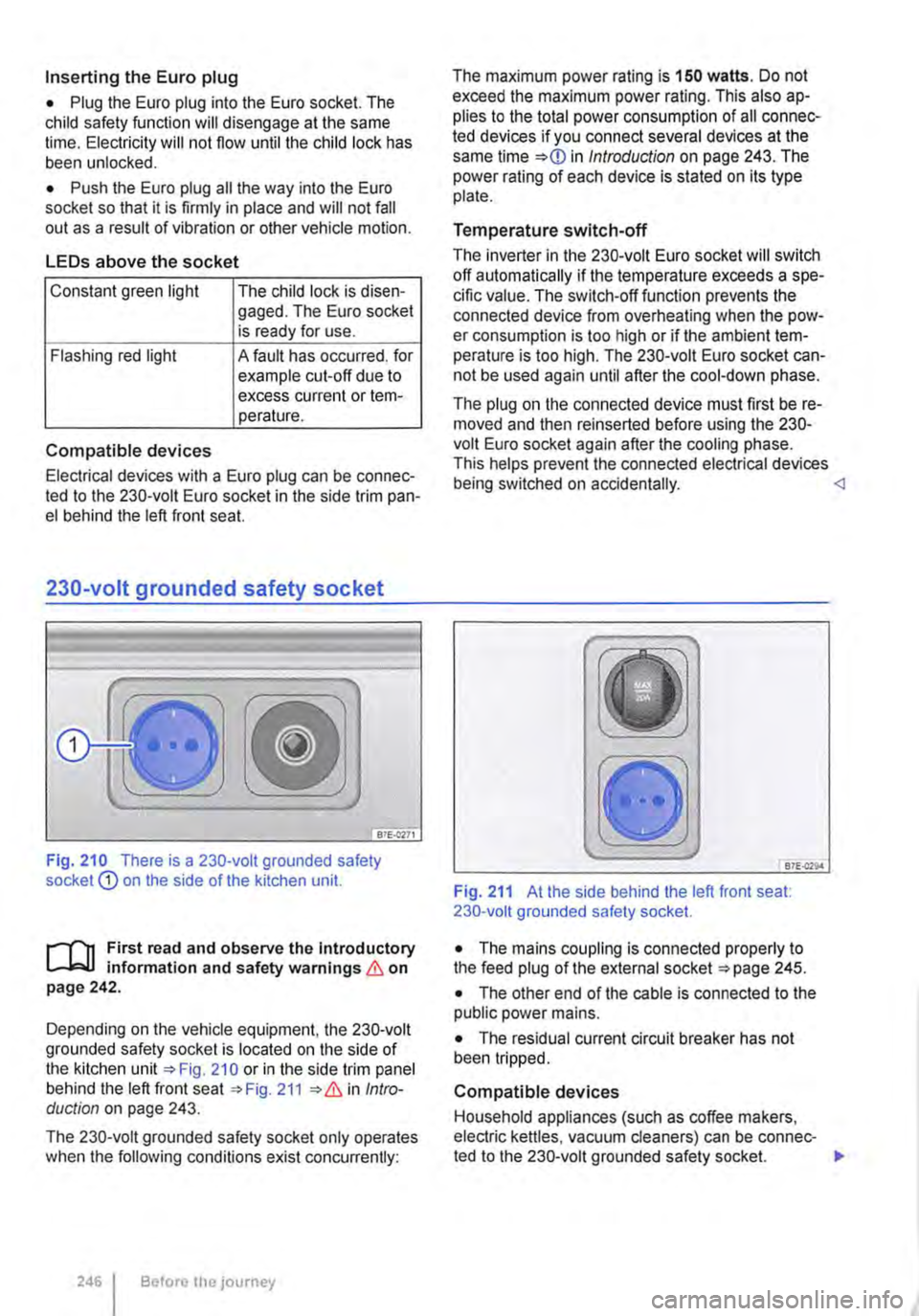
Inserting the Euro plug
• Plug the Euro plug into the Euro socket. The child safety function will disengage at the same time. Electricity will not flow until the child lock has been unlocked.
• Push the Euro plug all the way into the Euro socket so that it is firmly in place and will not fall out as a result of vibration or other vehicle motion.
LEDs above the socket
Constant green light The child lock is disen-gaged. The Euro socket is ready for use.
Flashing red light A fault has occurred. for example cut-off due to excess current or tem-perature.
Compatible devices
Electrical devices with a Euro plug can be connec-ted to the 230-volt Euro socket in the side trim pan-el behind the left front seat.
230-volt grounded safety socket
Fig. 210 There is a 230-volt grounded safety socket Q) on the side of the kitchen unit.
r--T'n First read and observe the Introductory L-k.U information and safety warnings & on page 242.
Depending on the vehicle equipment, the 230-volt grounded safety socket is located on the side of the kitchen unit 210 or in the side trim panel behind the left front seat 211 Intro-duction on page 243.
The 230-volt grounded safety socket only operates when the following conditions exist concurrently:
246 I Before the journey
The maximum power rating is 150 watts. Do not exceed the maximum power rating. This also ap-plies to the total power consumption of all connec-ted devices if you connect several devices at the same time in Introduction on page 243. The power rating of each device is stated on its type plate.
Temperature switch-off
The inverter in the 230-volt Euro socket will switch off automatically if the temperature exceeds a spe-cific value. The switch-off function prevents the connected device from overheating when the pow-er consumption is too high or if the ambient tem-perature is too high. The 230-volt Euro socket can-not be used again until after the cool-down phase.
The plug on the connected device must first be re-moved and then reinserted before using the 230-volt Euro socket again after the cooling phase. This helps prevent the connected electrical devices being switched on accidentally. <1
B7E.Q29.4
Fig. 211 At the side behind the left front seat: 230-volt grounded safety socket.
• The mains coupling is connected properly to the feed plug of the external socket 245.
• The other end of the cable is connected to the public power mains.
• The residual current circuit breaker has not been tripped.
Compatible devices
Household appliances (such as coffee makers, electric kettles, vacuum cleaners) can be connec-ted to the 230-volt grounded safety socket. .,.
Page 362 of 486
A WARNING (Continued)
-Always keep children away from the en-gine compartment and never leave the ve-hicle unattended.
• The engine cooling system is under pres-sure when the engine is hot. Never open the cap of the coolant expansion tank when the engine is hot. Coolant may spray out and cause serious burns and other injuries.
-Turn the cap slowly and very carefully anti-clockwise while exerting gentle down-ward pressure on the cap.
-Always protect the face, hands and arms from hot coolant or steam with a large, thick cloth.
• When refilling, do not spill any service flu-ids on engine components or on the exhaust system. The spilt service fluids can start a fire. In certain circumstances, the ethylene glycol in the engine can catch fire.
CD
• Refill only with distilled water. All other types of water can cause corrosion in the en-gine due to the chemical components con-
Vehicle battery
CQJ Introduction
This chapter conlains information on the following subjects:
Warning lamp . . . . . . . . . . . . . . . . . . . . . . . . . . . 364
Checking the electrolyte level of the vehicle battery ................................. 364 Charging, replacing, disconnecling and connecting the vehicle battery . . . . . . . . . . . . . 365
The vehicle battery is a component of the electrical system in the vehicle.
Never carry out any work on the electrical system if you are not familiar with the necessary procedures and the general safety requirements and only un-suitable tools are available => &. The work should be carried out by a qualified workshop if you are uncertain. Volkswagen Commercial Vehicles rec-ommends using a Volkswagen Commercial Vehi-cles dealership for this purpose. Serious injuries can be caused if work is carried out incorrectly.
3621 Cleaning and maintenance
(j)
tained therein. This can also lead to engine fail-ure. If any other type of water is refilled, the flu-id in the engine cooling system should be com-pletely replaced immediately by a qualified workshop.
• Do not fill coolant above the top of the marked area =>Fig. 277. Otherwise the excess coolant will be pressed out of the cooling sys-tem when the engine is hot and could cause damage.
• If a large amount of coolant has been lost, do not refill the coolant until the engine has cooled completely. Heavy coolant loss is an in-dication of leaks in the engine cooling system. The engine cooling system should be checked by a qualified workshop as soon as possible. Failure to do so can result in engine damage.
• Do not top up with coolant if there is no more coolant in the coolant expansion tank. Air could enter the cooling system. Do not drive on! Seek expert assistance. Failure to do so can result in engine damage.
• When refilling service fluids, please ensure that the correct container is filled. The use of incorrect service fluids can result In serious faults and engine damage.
The vehicle battery is located on the left of the en-gine compartment.
Depending on the vehicle equipment level, the ve-hicle could have two vehicle batteries. Camper vans can have up to three vehicle batteries. The second vehicle battery is located under the left front seat: the third battery in camper vans is loca-ted in the wardrobe on the rear left of the vehicle. •
Page 388 of 486
r1ih In the interests of environmental protection, 'r!!S the engine compartment should be washed only in specially provided wash bays. This pre-vents toxic waste water containing oil, grease and
fuel from entering the sewerage system. In some districts, washing the engine compartment any-where else may be prohibited.
o::JJ Introduction
This chapter contains information on the following subjects:
Handling seat covers . . . . . . . . . . . . . . . . . . . . 389
Cleaning cloth seat covers, fabric trim and Alcantara® upholstery . . . . . . . . . . . . . . . . . . . . 389
Cleaning and caring for natural leather covers 391
Cleaning leatherette upholstery . . 392
Cleaning stowage compartments, drink holders and ash trays . . . . . . . . . . . . . . . . . . . . 392 Cleaning and caring for the dash panel, wooden trims and plastic parts . . . . . . . . . . 392
Cleaning seat belts . . . . . . . . . . . . . . . . . . . . . . 392 Cleaning cool box . . . . . . . . . . . . . • . . . . . . . . . 393
Cleaning seat rails . . . . . . . . . . . . . . . . . . . 393
Cleaning opaque shades 393
Modern fabrics, such as dark denim, are often not colourfast. Light-coloured upholstery (soft materials or leather) is particularly sensitive to staining caused by these fabrics, even if you are careful. This is not caused by a fault in the upholstery, but by the non-colourfast nature of the garments.
Leaving stains, dirt and other deposits on the sur-face of vehicle components and cloth seat covers for a long time can make it difficult to clean and treat them. Stains, dirt and deposits may become impossible to remove, particularly if left for a long time.
Additional information and warnings:
• Cleaning and caring for the vehicle exterior 380
• Accessories, modifications, repairs and renewal of parts 394
A WARNING
Car care products can be toxic and hazard-ous. Unsuitable care products and Incorrect application of care products can cause acci-dents, serious injuries, burns or poisoning.
388 Cleaning and maintenance
A WARNING (Continued)
• The care product must be kept In its origi-nal sealed container.
• Read the manufacturer's Instructions.
• Never store car care products in empty food containers, bottles or any other non-original containers as people finding these containers may not know that they contain care products.
• Keep children away from care products.
• The products can give off harmful fumes during use. They should therefore only be used outside or In well-ventilated spaces.
• Never use fuel, turpentine, engine oil, nail varnish remover or other volatile fluids to wash, clean or care for your vehicle. These substances are toxic and highly Inflammable.
A WARNING
Incorrect care and cleaning of vehicle parts can Impair the safety features of the vehicle and cause serious Injury.
• Vehicle parts must be cleaned according to the manufacturer's Instructions.
• Only use approved or recommended cleaning products.
CD
• Cleaning products that contain solvents at-tack the material and may cause Irreparable damage.
• Stains, dirt and other deposits containing aggressive and solvent-based Ingredients at-tack the material and may cause Irreparable damage, even If only left for a short time.
• Stains, dirt and other deposits should be re-moved as quickly as possible and not allowed to dry In.
• To avoid damage, stubborn stains should be removed by a specialist cleaning company, .,.
Page 426 of 486

• If the tyre pressure is very low or the tyres are flat.
• If the use-by date on the tyre filler bottle has ex-pired.
Additional information and warnings:
• Vehicle key set 36
• Seat functions, front 69
• Stowage 150
• Braking, stopping and parking =>page 269
• Wheels and tyres 367
• In an emergency 411
• Hubcaps 417
A WARNING
Using the breakdown set can be dangerous, especially if the tyres are inflated at the road-side. Please note the following points In or-der to reduce the risk of serious injuries:
• Stop the vehicle as soon as possible and when safe to do so. Park the vehicle at a safe distance from moving traffic in order to fill the tyre.
• Check that the surface the vehicle is parked on is level and firm.
• All passengers, and children in particular, must be at a safe distance and away from your area of work.
• Switch on the hazard warning lights to warn other road users.
• The breakdown set should only be used if you feel confident with carrying out the pro-cedure. If not, seek expert assistance.
Storing
rT'n First read and observe the introductory L-W.I information and safety warnings & on page 425.
Model
Multivan
California
426 I If and when
A WARNING (Continued)
• Tyres repaired with the breakdown set are intended for temporary, emergency use only. They should only be used until you can reach the nearest qualified workshop.
• Tyres that have been repaired using the breakdown set should be replaced as soon as possible.
• Sealant Is hazardous to health and must be washed off Immediately if it gets onto the skin.
• The breakdown set must be stored out of the reach of children.
• Never use a vehicle jack, even If it Is ap-proved for the vehicle.
• Always switch off the engine, apply the handbrake and move the selector lever to the position P or select a gear on a manual gear-box In order to reduce the risk of unintended vehicle movement.
A WARNING
Tyres that have been filled with sealant will not handle In the same way as a standard tyre.
• Never drive faster than 80 km/h (50 mph).
• Avoid full acceleration, sudden braking and fast driving through bends In the road.
• Drive for just 10 minutes at no more than 80 km/h (50 m ph) and then check the tyre.
Dispose of used or out-of-date sealant in ac-W cordance with legal requirements.
m You can get a new tyre filler bottle from a L!:J Volkswagen Commercial Vehicles dealership.
m Observe the separate instructions from the l!:J manufacturer of the breakdown set. <1
The breakdown set can be located in different pla-ces depending on the model.
Stowage
In the drawer in the 3-seat bench or in the drawer of the rear left single seat.
Behind the load-through hatch cover on the side of the bench seat/bed. <1
Page 465 of 486
Index
Numbers and Symbols
12-volt socket California . . . . . . . . . . . . . . . . . . . . . . . . . 244
2-seat arrangement Stowage compartment in armrest . . . . . . 184
2-seat arrangement, Business . . . . . . . . . . 182 Adjusting armrest . . . . . . . . . . . . . . . . . . . 184 Adjusting seats . . . . . . . . . . . . . . . . . . . . . 183 Ash tray . .. .. . . . .. . . .. . . • . .. . .. .. . 186 Centre console . . . . . • . . . . . . . . . . . . . . . 185 Cigarette lighter . . . . . . . • . . • . . . . . . . . . 186 Controls . . . . . . . . . . . . . . . . . . . . . . . . . . 183 Drink holder . . . . . . . . . . . . . . . . . . . . . . . 186 Features . . . . . . . . . . . . . . . . . . . . . . . . . . 182 Front stowage compartment . . . . . . . . . . 186 Moving . . . . . . . . . . . . . . . . . . . . . . . . . . . 185 Refrigerator box . . . . . . . . . . . . . . . . . . . . 186 Seat heater . . . . . . . . . . . . . . . . . . . . . . . 183 Upper stowage compartment . . . . . . . . . . 186 230-volt Euro socket . . . . . . . . . . . . . . . . . . 245
230-volt grounded safety socket . . . . . . . . 246
230-volt power supply . . . . . . . . . . . . . . . . . 245 Residual current circuit breaker . . . . . . . . 247
3-seat bench
A
Folding out the table . . . . . . . . . . . . . . . . . 74 Setting up the bed . . . . . . . . . . . . . • . . . . . 74
Abroad Extended trips with your vehicle 405 Selling the vehicle . . . . . . . . . . . . . . . . . . 405
ABS see Brake support systems . . . . . . . . . . . 275
ACC see Adaptive cruise control (ACC) . . . . . . 298
Accessing a service message . . . . . . . . . . . 23
Accessories . . . . . . . . . . . . . . . . . . . . . . . . . 394
Acoustic warnings Seat belt not fastened . . . . . . . . . . . . . . . . 80
Adaptive chassis control Fault . . . . . . . . . . . . . . . . . . . . . . . . . 317, 318 Function . . . . . . . . . . . . . . . . . . . . . . . . . . 318 Operation . . . . . . . . . . . . . . . . . 318
Adaptive chassis control (DCC) . . . . . . . . . 317 Indicator lamp . . . . . . . . . . . . . . . . . . . . . 317
Adaptive cruise control (ACC) . . . . . . . . . . 298 Displays . . . . . . . . . . . . . . . . . . . . . . . . . . 300 Fault . . . . . . . . . . . . . . . . . . . . . . . . . . . . . 299 Indicator lamp . . . . . . . . . . . . . . . . . . . . . 300 Operating . . . . . . . . . . . . . . . . . . . . . . . . . 302 Radar sensor . . . . . . . . . . . . . . . . . . . . . . 301 Special driving situations . . . . . . . . . . . . . 305
Switching off temporarily . . . . . . . . . . . . . 304 Warning lamp . . . . . . . . . . . . . . . • . . • . . . 300
Ad Blue Indicator lamp . . . . . . . . . . . . . . . . . • . . . 347 Information . . . . . . . . . . . . . . . . . . . . . . . . 346 Refilling . . . . . . . . . . . . . . . . . . . . . . . . . . 348 Specification . . . . . . . . . . . . . . . . . . . . . . . 348 Tank capacity . . . . . . . . . . . . . . . . . . . . . . 346 Warning lamp . . . . . . . . . . . . . . . . . . . . . . 347
Additional battery California . . . . . . . . . . . . . . . . . . . . . . . . . 248 Charging . . . . . . . . . . . . . . . . . . . . . . . . . 247
Adjust Electrically adjustable front seat . . . . . . . . 66 Single seats in the passenger compartment .7.3
Adjusting Correct sitting position . . . . . . . . . . . . . . . . 63 Headlight range ..................... 113 Head restraints . . . . . . . . . . . . . . . . . . . . . . 67 Mechanical front seats . . . . . . . . . . . . . . . . 65 Memory seats . . . . . . . . . . . . . . . . . . . . . . 70 Single seats in the passenger compartment .73 Steering wheel . . . . . . . . . . . . . . . . . . . . . . 68
Adjusts Electric lumbar support adjustment . . . . . . 66
Aerial . . . . . . . . . . . . . . . . . . . . . . . . . . 124.406
AGM battery . . . . . . . . . . . . . . . . . . . . . . . . . 248
........................ Cleaning the dash panel . . . . . . . . . . . . . 392 Combined curtain and side airbags . . . . . . 94 Curtain airbags . . . . . . . . . . . . . . . . . . . . . . 95 Description . . . . . . . . . . . . . . . . . . . . . . . . . 90 Differences between front passenger front airbag systems . . . . . . . . . . . . . . . . . . . . 89 Faults . . . . . . . . . . . . • . . • . . . . . . . . . . . . 397 Front airbags . . . • . . • . . . . . • . . . . . • . . . . 92 Function . . . . . . . . . . . . . . . . . . . . . . . . . . . 90 Indicator lamp . . . . . . . . . . . . . . . . . . . . . . 89 Repairs . . . . . . . . . . . . . . . . . . . . . . . . . . . 397 Switching off the front passenger front air-bag . . . . . . . . . . . . . . . . . . . . . . . . . . . . . 93 Switching off with the key switch . . . . . . . . 93 Using child seats . . . . . . . . . . . . . . . . . . . . 93 Vehicle care . . . . . . . . . . . . . . . . . . . . . . . 392
Air conditioning system . . . . . . . . . . . . . . . 322 Air recirculation mode . . . . . . . . . . . . . . . 330 Climatic . . . . . . . . . . . . . . . . . . . . . . . . . . 323 Climatronic . . . . . • . . . . . . . . . . . . . . . . . . 325 Controls . . . . . . . . . . . . . . . . . . . . . . 323, 325 Fault . . . . . . . . . . . . . . . . . . . . . . . . . . . . . 328 Indirect ventilation . . . . . . . . . . . . . . . . . . 329 Information . . . . . . . . . . • . . • . . . . . . . . . . 328 Settings . . . . . . . . . . . . . . . . . . . . . . . . . . 328 Things to note . . . . . . . . . . . . . . . . . . . . . 328
Index 465
Page 468 of 486
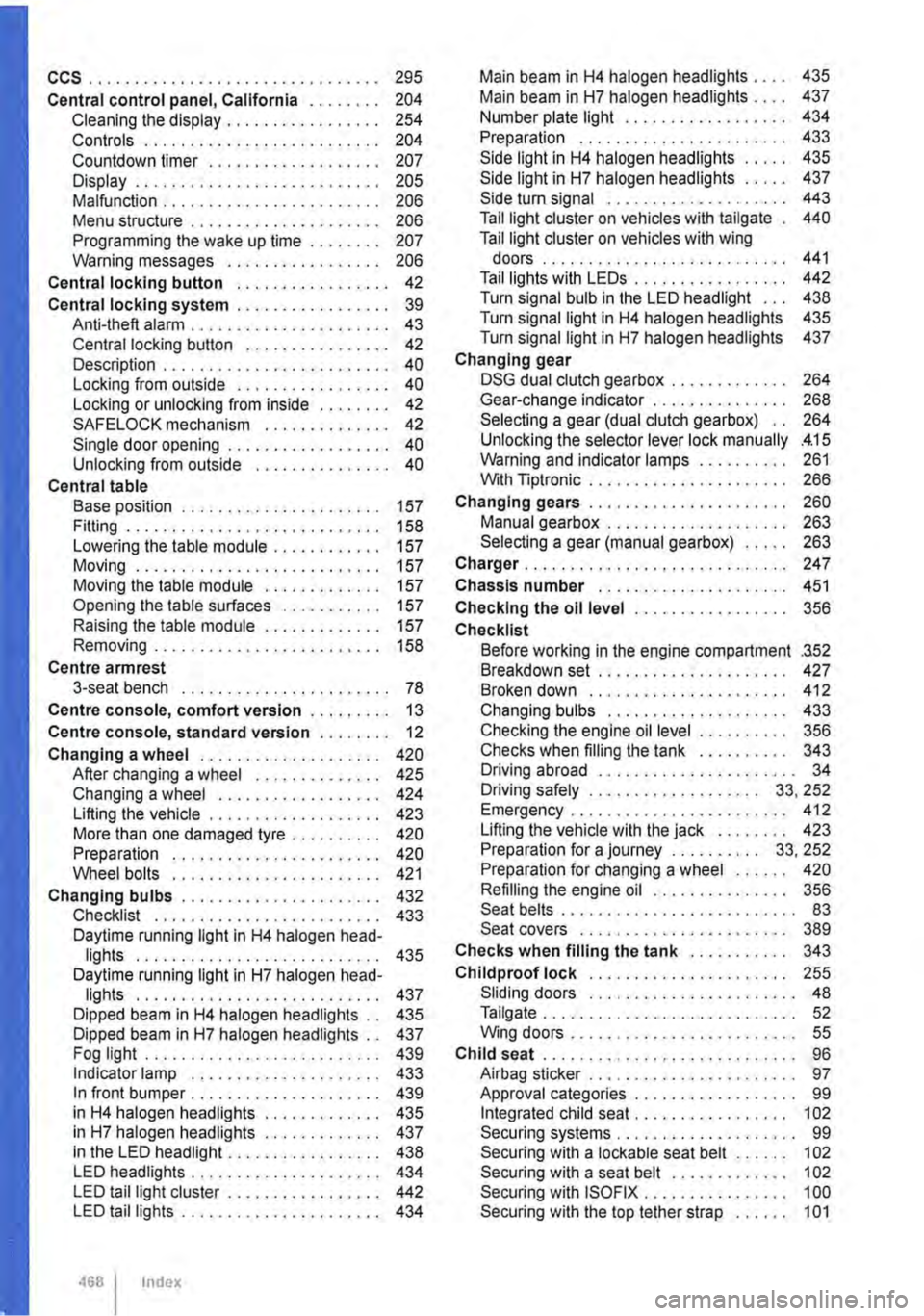
ccs ................................ 295
Central control panel, California . . . . . . . . 204 Cleaning the display . . . . . . . . . . . . . . . . . 254 Controls . . . . . . . . . . . . . . . . . . . . . . . . . . 204 Countdown timer . . . . . . . . . . . . . . . . . . . 207 Display . . . . . . . . . . . . . . . . . . . . . . . . . . . 205 Malfunction . . . . . . . . . . . . . . . . . . . • . . . . 206 Menu structure . . . . . . . . . . . . . . . . . . . . . 206 Programming the wake up time . . . • . . . . 207 Warning messages . . . . . . . . . . . . . . . . . 206
Central locking button . . . . . . . . . . . . . . . . . 42
Central locking system . . . . . . . . . . . . . . . . . 39 Anti-theft alarm . . . . . . . . • . . . . . . . . . . • . . 43 Central locking button . . . . . . . . . . . . . • . . 42 Description . . . . . . . . . . . . . . . . . . . . . . . . . 40 Locking from outside . . . . . . . . . . . . . . . . . 40 Locking or unlocking from inside . . . . . . . . 42 SAFELOCK mechanism . . . . . . . . . . . . . . 42 Single door opening . . . . . . . . . . . . . . . . . . 40 Unlocking from outside . . . . . . . . . . . . . . . 40
Central table Base position . . . . . . . . . . . . . . . • . . . . . . 157 Filling . . . . . . . . . . . . . . . . . . . . . . . . . . . . 158 Lowering the table module . . . . . • . . . . . . 157 Moving . . . . . . . . . . . . . . . . . . . . . . . . . . . 157 Moving the table module . . . . . . • . . . . . . 157 Opening the table surfaces . . . . . . . • . . . 157 Raising the table module . . . . . . . . . . . . . 157 Removing . . . . . . . . . . . . . . . . . . . . . . . . . 158
Centre armrest 3-seat bench . . . . . . . . . . . . . . . . . . • . . . . 78
Centre console, comfort version . . . . . . . . . 13
Centre console, standard version . . . . . . . . 12
Changing a wheel . . . . . . . . . . . . . . . . • . . . 420 After changing a wheel . . . . . . . . • . . . . . 425 Changing a wheel . . . . . . . . . . . . . . . . . . 424 Lifting the vehicle . . . . . . . . . . . . . . . . . . . 423 More than one damaged tyre . . . . . . . . . . 420 Preparation . . . . . . . . . . . . . . . . . . . . . . . 420 Wheel bolts . . . . . • . . . . . . . . . . . . . . . . . 421
Changing bulbs . . . . . . . . . . . . . . . . . . . . . . 432 Checklist . . . . . . . . . . . . . . . . . . . . . . . . . 433 Daytime running light in H4 halogen head-lights . . . . . . . . . . . . . . . . . . . . . . . . . . . 435 Daytime running light in H7 halogen head-lights . . . . . . . . . . . . . . . . . . . . . . . . . . . 437 Dipped beam in H4 halogen headlights . . 435 Dipped beam In H7 halogen headlights . . 437 Fog light . . . . . . . . . . . . . . . . . . . . . . . . . . 439 Indicator lamp . . . . . . . . . . . . . . . . . . . . . 433 In front bumper . . . . . . . . . . . . . . . . . . . . . 439 in H4 halogen headlights . . . . . . . . . . • . . 435 in H7 halogen headlights . . . . . . . . . . . . . 437 in the LED headlight . . . . . . . . . . . . . . . . . 438 LED headlights . . . . . . . . . . • . . . . . . . . . . 434 LED tail light cluster . . . . . . • . . . . . . . . . . 442 LED tail lights . . . . . . . . • . . . . . . . . . . . . . 434
468 I Index
Main beam in H4 halogen headlights . . . . 435 Main beam in H7 halogen headlights . . . . 437 Number plate light . . . . . . . . . . . . . . . . . . 434 Preparation . . . . . . . . . . . . . . . . . . . . . . . 433 Side light in H4 halogen headlights . . . . . 435 Side light in H7 halogen headlights . . . . . 437 Side turn signal . . . . . . . . . . . . . . . . . . . . 443 Tail light cluster on vehicles with tailgate . 440 Tail light cluster on vehicles with wing doors . . . . . . . . . . . . . . . . . . . . . . . . . . . 441 Tail lights with LEDs . . . . . . . . . . . . . . . . . 442 Turn signal bulb in the LED headlight . . . 438 Turn signal light in H4 halogen headlights 435 Turn signal light in H7 halogen headlights 437
Changing gear DSG dual clutch gearbox . . . . . . . . . . . . . 264 Gear-change indicator . . . . . . . . . . . . . . . 268 Selecting a gear (dual clutch gearbox) . . 264 Unlocking the selector lever lock manually .4.15 Warning and indicator lamps . . . . . . . . . . 261 With Tiptronic . . . . . . . . . . . . . . . . . . • . . . 266
Changing gears . . . . . . . . . . . . . . . . . . . . . . 260 Manual gearbox . . . . . . . . . . . . . . . . . . . . 263 Selecting a gear (manual gearbox) . . . . . 263
Charger.. . . . . . . . . . . . . . . . . . . . . . . . . . . . 247
Chassis number . . . . . . . . . . . . . . • . . . . . . 451
Checking the oil level . . . . . . . . . . . . . . . . . 356
Checklist Before working in the engine compartment .352 Breakdown set . . . . . . . . . . . . . . . . . . . . . 427 Broken down . . . . . . . . . . . . . . . . • . . . . . 412 Changing bulbs . . . . . . . . . . . . . . . . . . . . 433 Checking the engine oil level . . . . . . . . . . 356 Checks when filling the tank . . . . . . . . . . 343 Driving abroad . . . . . . . . . . . . . . . • . . . . . . 34 Driving safely . . . . . . . . . . . . . . . . . . . 33, 252 Emergency . . . . . . . . . . . . . . . . . . . . . . . . 412 Lifting the vehicle with the jack . . . . . . . . 423 Preparation for a journey . . . . . . . . . . 33, 252 Preparation for changing a wheel . . . . . . 420 Refilling the engine oil . . . . . . . . . . . . . . . 356 Seat belts . . . . . . . . . . . . . . . . . . . . . . . . . . 83 Seat covers . . . . . . . . . . . . . . . . . . . . . . . 389
Checks when filling the tank . . . . . . . . . . . 343
Childproof lock . . . . . . . . . . . . . . . . . . . . . . 255 Sliding doors . . . . . . . . . . . . . . . . . . . . . . . 48 Tailgate . . . . . . . . . . . . . . . . . . . . . . . . . . . . 52 Wing doors . . . . . . . . . . . . . . . . . . . . . . • . . 55
Child seat . . . . . . . . . . . . . . . . . . . . . . . . . . . . 96 Airbag sticker . . . . . . . . . . . . . . . . . • . . . . . 97 Approval categories . . . . . . . . . . . . . . . . . . 99 Integrated child seat . . . . . . . . . . . . . . . . . 102 Securing systems . . . . . . . . . . . . . . . . . . . . 99 Securing with a lockable seat bell . . . . . . 102 Securing with a seat belt . . . . . . . . . . . . . 102 Securing with ISO FIX . . . . . . . . . . . . . . . . 100 Securing with the top tether strap . . . . . . 101