ESP VOLVO 850 1996 User Guide
[x] Cancel search | Manufacturer: VOLVO, Model Year: 1996, Model line: 850, Model: VOLVO 850 1996Pages: 265, PDF Size: 4.57 MB
Page 165 of 265
ark position before the starting key can be removed fro\
m the ign")
1996 Volvo 850
Your car is equipped with a KEYLOCK system. When the engine is switched \
off, the gear selector must
be in the ( P )ark position before the starting key can be removed fro\
m the ignition switch.
5. Select desired gear. The gear engages after a slight delay (automati\
c transmission) which is especially
noticeable when selecting R.
CAUTION: (Automatic transmission only) The engine should be idling; ne\
ver accelerate until after
you feel the gear engage! Too rapid acceleration immediately after selec\
ting a gear will cause harsh
engagement and premature transmission wear.
NOTE: Selecting P or N (automatic transmission) when idling at a stand\
still for prolonged periods of
time will help prevent overheating of transmission oil.
WARNING! Always place the gear selector (automatic transmission) in Pa\
rk and apply the parking
brake before leaving the vehicle. Never leave the car unattended with th\
e engine running.
Always open the garage doors fully before starting the engine inside a g\
arage to ensure adequate
ventilation. The exhaust gases contain carbon monoxide, which is invisib\
le and odorless but very
poisonous.
TURBO CAUTION:
Never race the engine immediately after starting. Oil flow may not reach\
some lubricating points fast
enough to prevent engine damage.
Do not race the engine just prior to switching off!
Hydraulic valve lifters
This engine features hydraulic valve lifters which means that valve clea\
rance is adjusted automatically.
It is possible that the valve lifters will produce a ticking sound for t\
he first few seconds after the engine
is started, while the oil pressure is increasing.
If the car has not been used for a long period of time, this ticking sou\
nd may last for up to 15 minutes.
This is entirely normal.
Do not exceed 300 rpm until the ticking sound disappears.
file:///K|/ownersdocs/1996/1996_850/96850_401.htm (7 of 8)12/30/2006 9\
:59:32 AMClassic Cars & Cycles www.ClassicCycles.org
Page 173 of 265

1996 Volvo 850
pg. 4:9 Automatic transmission
Special Tips - automatic transmission
l For driving down steep hills and when driving for prolonged periods at l\
ow speeds, position L should
be selected. Avoid, however, repeated changes since this can cause overh\
eating of the transmission oil.
For driving on long continuous uphill gradients, select position 3.
l See caution on page 4:7.
l Do not hold the car stationary on an incline by using the accelerator pe\
dal. Instead, apply the hand
brake (parking brake). This prevents the transmission oil from becomin\
g overheated.
l When towing a trailer, select shift position 3.
l The (E)conomy mode should be selected when the cruise control is engag\
ed.
l While towing a trailer in hilly terrain, do not drive continuously at en\
gine speeds above 4500 rpm to
help avoid high engine oil temperatures.
pg. 4:10 Points to remember
Cooling system
The risk for engine overheating is greatest, especially in hot weather, \
when:
l towing a trailer up steep inclines for prolonged periods at wide open th\
rottle and low engine rpm.
l stopping the engine suddenly after high speed driving (so-called "after\
-boiling" can occur).
l To avoid overheating, the following rules should be followed:
l Do not drive for prolonged periods at engine speeds above 4500 rpm if yo\
u are towing a trailer in
hilly terrain.
l Reduce speed and downshift when towing a trailer up long, steep inclines\
. The risk of overheating can
be reduced by switching off the air conditioning system for a short time\
.
l Do not let the engine idle unnecessarily for prolonged periods.
l Do not mount auxiliary lamps in front of the grill.
When the risk of overheating is imminent, or in the event of overheating\
, (the temperature gauge goes
repeatedly into, or stays continually in, the red section) the followin\
g precautions should be taken:
l Switch off the air conditioning system.
l Stop the car and put the gear lever into neutral. Do not stop the engine\
!
l Switch the heater to full (maximum) position. Increase the engine spee\
d to approx. 2000 rpm (twice
idling speed) until the temperature begins to drop.
file:///K|/ownersdocs/1996/1996_850/96850_406.htm (7 of 10)12/30/2006 \
9:59:34 AMClassic Cars & Cycles www.ClassicCycles.org
Page 196 of 265

1996 Volvo 850
WARNING!
Current legislation prohibits the use of the "Temporary Spare" tire othe\
r than as a temporary
replacement for a punctured tire. In other words, it must be replaced as\
soon as possible by a standard
tire. Roadholding, etc.., may be affected with the "Temporary Spare" in \
use. Do not, therefore, exceed
50 mph (80 km/h).
Temporary Spare (certain models)
The spare tire of your car is what is called a "Temporary Spare". It has\
the following designation:
T115/70 R15 or T125/90R15.
Recommended tire pressure (see decal on fuel filler flap) should be ma\
intained irrespective of which
position of the car the Temporary Spare tire is used on.
In the event of damage to this tire a new one can be purchased from your\
Volvo retailer.
Contents | Top of Page
file:///K|/ownersdocs/1996/1996_850/96850_601.htm (5 of 5)12/30/2006 9\
:59:39 AMClassic Cars & Cycles www.ClassicCycles.org
Page 197 of 265

1996 Volvo 850
pg. 6:5 Replacing bulbs
Replacing bulbs
Make sure when installing bulbs, that the guide pin on the socket fits i\
nto its corresponding recess.
When installing Halogen bulbs, do not touch the glass with your fingers \
because grease, oil or any other
impurities can be carbonized onto the bulb and damage the reflector. Use\
bulbs of correct type and
voltage. Failure to do so could cause the bulb failure warning light to \
activate.
NOTE: Turn the ignition and the light switch off before replacing any bu\
lbs.
Parking light/direction indicator
1. Loosen the spring which retains the lamp housing.
2. Withdraw the entire lamp housing; separate the bulb holder from the l\
amp unit.
3. Leave the connector with its wires in the bulb holder.
4. Remove the bulb from the holder by pressing in and turning counter-cl\
ockwise.
5. Insert a new bulb and reinstall the unit in the reverse order. pg. 6:6 Replacing bulbs
file:///K|/ownersdocs/1996/1996_850/96850_605.htm (1 of 13)12/30/2006 \
9:59:43 AMClassic Cars & Cycles www.ClassicCycles.org
Page 223 of 265

1996 Volvo 850
Bumpers: Wash the bumpers with the same cleaning agent used on the rest \
of the car. Never clean the
bumpers with gasoline or paint thinner. Difficult spots can be removed w\
ith denatured alcohol. To avoid
scratches, do not dry the bumpers with paper. pg. 7:5 Automatic car washing, Polishing and waxing
Automatic washing - simple and quick
An automatic wash is a simple and quick way to clean your car, but it is\
worth remembering that it may
not be as thorough as when you yourself go over the car with sponge and \
water. Keeping the underbody
clean is most important, especially in the winter. Some automatic washer\
s do not have facilities for
washing the underbody.
Before driving into an automatic wash, make sure that the side view mirr\
ors, auxiliary lamps, etc., are
secure, otherwise there is risk of the machine dislodging them. You shou\
ld also lower the antenna
(sedans).
We do NOT recommend washing your car in an automatic wash during the fir\
st six months (because the
paint will not have hardened sufficiently).
Polishing and waxing
Normally, polishing is not required during the first year after delivery\
, however, waxing may be
beneficial.
Before applying polish or wax the car must be washed and dried. Tar spot\
s can be removed with
kerosene or tar remover. Difficult spots may require a fine rubbing comp\
ound.
After polishing use liquid or paste wax.
Several commercially available products contain both polish and wax.
file:///K|/ownersdocs/1996/1996_850/96850_701.htm (6 of 8)12/30/2006 9\
:59:48 AMClassic Cars & Cycles www.ClassicCycles.org
Page 224 of 265

1996 Volvo 850
Waxing alone does not substitute for polishing of a dull surface.
A wide range of polymer-based car waxes can be purchased today. The waxe\
s are easy to use and
produce a long-lasting, high-gloss finish that protects the bodywork aga\
inst oxidation, road dirt and
fading. pg. 7:6 Cleaning the upholstery
Cleaning the upholstery
The fabric can be cleaned with soapy water or a detergent. For more diff\
icult spots caused by oil, ice
cream, shoe polish, grease, etc., use a clothing/clothing fabric stain r\
emover.
The plastic in the upholstery can be cleaned with a soft cloth and mild \
soap solution.
Leather upholstery can be cleaned with a soft cloth and mild soap soluti\
on. For more different spots,
Volvo offers a leather care kit.
On no account must gasoline, naphtha or similar cleaning agents be used \
on the plastic or the leather
since these can cause damage.
Cleaning the seat belts
Clean only with lukewarm water and mild soap solution.
Cleaning floor mats
The floor mats should be vacuumed or brushed clean regularly, especially\
during winter when they
should be taken out for drying. Spots on textile mats can be removed wit\
h a mild detergent.
Bear in mind
file:///K|/ownersdocs/1996/1996_850/96850_701.htm (7 of 8)12/30/2006 9\
:59:48 AMClassic Cars & Cycles www.ClassicCycles.org
Page 227 of 265
 *
The VIN plate is located on the top left surface of the dashboard. The V\
IN is also stamped on the right
hand door")
1996 Volvo 850
above right headlight.
5 Vehicle Identification Number (VIN) *
The VIN plate is located on the top left surface of the dashboard. The V\
IN is also stamped on the right
hand door pillar.
6 Federal Motor Vehicle Safety Standards (FMVSS) specifications (USA)\
and Ministry of Transport
(CMVSS) Standards (Canada)
Your Volvo is designed to meet all applicable safety standards, as evide\
nced by the certification label on
the facing side of the driver's door. For further information regarding \
these regulations, please consult
your Volvo retailer.
7 Child safety latch label
* The Vehicle Identification Number (VIN) should always be quoted in a\
ll correspondence concerning
your vehicle with the retailer and when ordering parts.
** These decals are located on the underside of the hood.
All specifications are subject to change without notice. pg. 8:3 Maintenance service, Warranty
Maintenance service
Volvo advises you to follow the service program which is outlined in the\
"Maintenance Records
Manual". This maintenance program contains inspections and services nece\
ssary for the proper function
of your car. The maintenance services contain several checks which requi\
re special instruments and
tools and therefore must be performed by a qualified technician. To keep\
your Volvo in top condition,
specify time tested and proven Genuine Volvo Parts and Accessories.
The Federal Clean Air Act - U.S.
The Clean Air Act requires vehicle manufacturers to furnish written inst\
ructions to the ultimate
purchaser to assure the proper functioning of those components that cont\
rol emissions. The maintenance
instructions listed in the "Servicing" section of this Manual represent \
the minimum maintenance
required. These services are not covered by the warranty. You will be re\
quired to pay for labor and
material used. Refer to your Warranty booklet for further details.
file:///K|/ownersdocs/1996/1996_850/96850_801.htm (2 of 6)12/30/2006 9\
:59:50 AMClassic Cars & Cycles www.ClassicCycles.org
Page 237 of 265
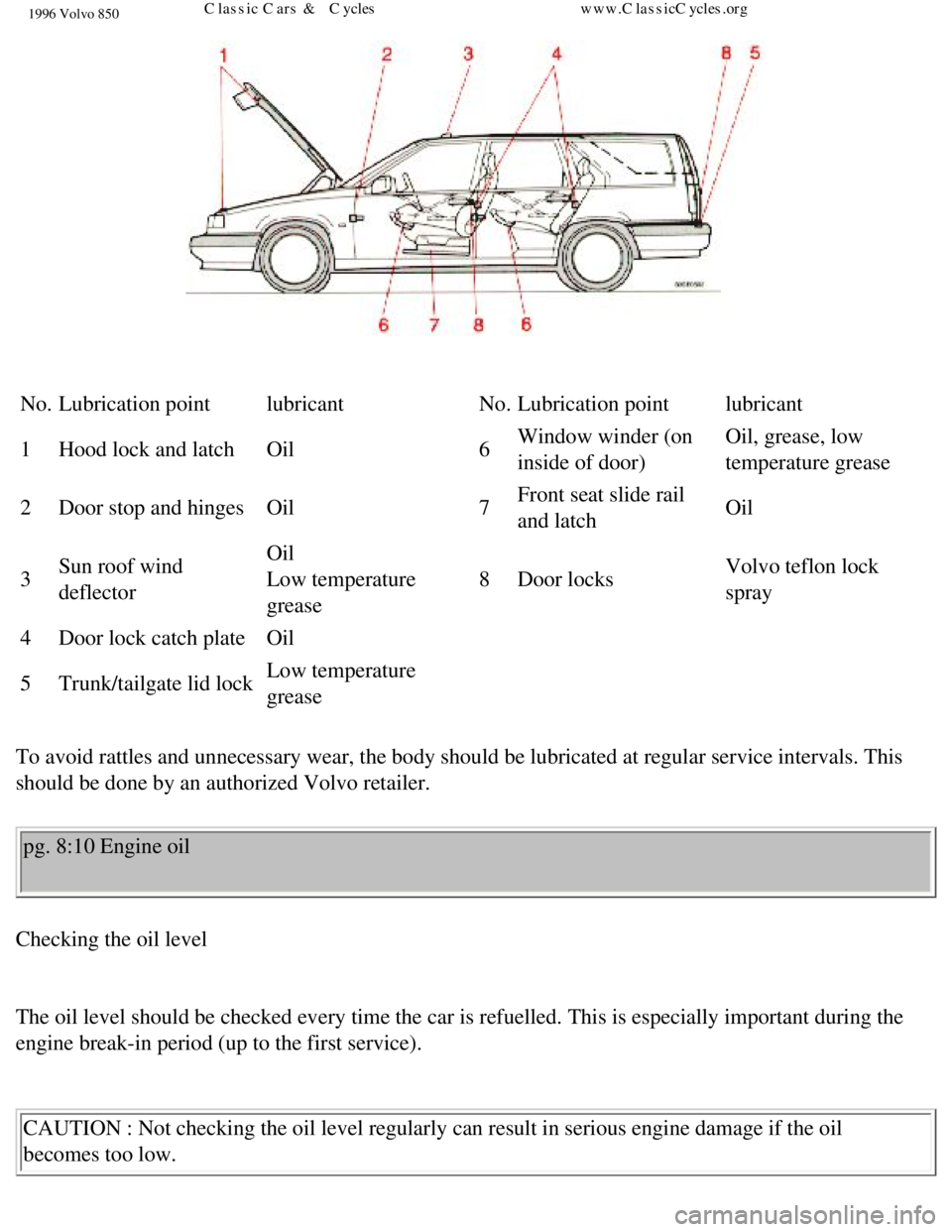
1996 Volvo 850
No. Lubrication point lubricant No. Lubrication point lubricant
1 Hood lock and latch Oil 6 Window winder (on
inside of door) Oil, grease, low
temperature grease
2 Door stop and hinges Oil 7 Front seat slide rail
and latch Oil
3 Sun roof wind
deflector Oil
Low temperature
grease
8
Door locks Volvo teflon lock
spray
4 Door lock catch plate Oil
5 Trunk/tailgate lid lock Low temperature
grease
To avoid rattles and unnecessary wear, the body should be lubricated at \
regular service intervals. This
should be done by an authorized Volvo retailer.
pg. 8:10 Engine oil
Checking the oil level
The oil level should be checked every time the car is refuelled. This is\
especially important during the
engine break-in period (up to the first service).
CAUTION : Not checking the oil level regularly can result in serious eng\
ine damage if the oil
becomes too low.
file:///K|/ownersdocs/1996/1996_850/96850_806.htm (6 of 11)12/30/2006 \
9:59:52 AMClassic Cars & Cycles www.ClassicCycles.org
Page 243 of 265

1996 Volvo 850
pg. 8:13 Automatic transmission fluid
Check the oil level as follows:
Park the car on a level surface with the engine idling . Slowly move the\
gear selector lever through all
the shift positions and then to position P. Wait 3 minutes before checki\
ng the oil level.
As the illustration shows, the dipstick has a COLD and a HOT side. The o\
il level should between the
MIN and MAX marks. Wipe the dipstick with a clean cloth.
WARNING! The oil may be very
hot.
Do not use rags that could leave lint on the dipstick. The transmission \
is topped up via the dipstick tube.
The space between the MIN and MAX marks on the dipstick corresponds to 0\
.5 US qt. (0.5 liter). Do
not fill the transmission with too much oil, since this can result in oi\
l being ejected from the
transmission. Too little oil, on the other hand, can negatively affect t\
ransmission operation, particularly
in very cold weather.
A Cold transmission: oil temperature 105° F (40° C). This is a n\
ormal temperature for the transmission
after idling for about 10 minutes. At oil temperatures below 105° F (\
40° C), the level may be below the
MIN mark.
B Warm transmission: oil temperature 169° F (80° C). This temper\
ature after driving for about 30
minutes. At oil temperatures above 190° F (90° C), the level may\
be above the MAX mark.
Fluid type: ATF Dexron IIE/III and Mercon.
file:///K|/ownersdocs/1996/1996_850/96850_813.htm (1 of 7)12/30/2006 9\
:59:53 AMClassic Cars & Cycles www.ClassicCycles.org