lock VOLVO V90 2017 Owners Manual
[x] Cancel search | Manufacturer: VOLVO, Model Year: 2017, Model line: V90, Model: VOLVO V90 2017Pages: 594, PDF Size: 15.07 MB
Page 432 of 594
STARTING AND DRIVING
* Option/accessory.
430
Towing eye
Use the towing eye for towing. The towing eye is screwed into a threaded socket behind a coveron the right-hand side of the bumper, front orrear.
NOTE
If the car is equipped with a towing bracket, there is no rear mounting for a towing eye.
Fitting the towing eye
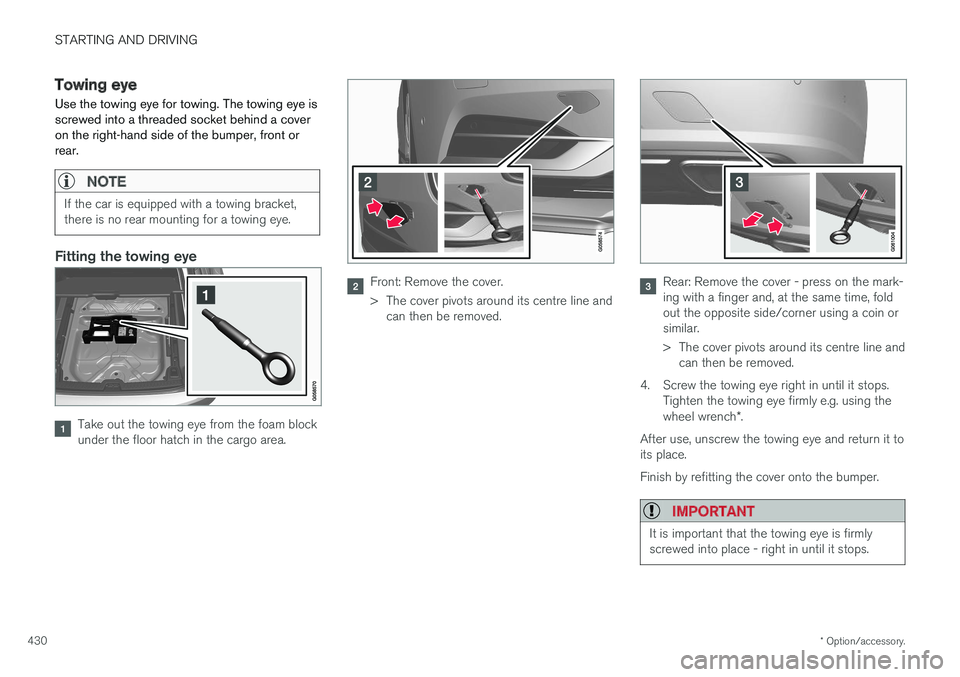
Take out the towing eye from the foam block under the floor hatch in the cargo area.
Front: Remove the cover.
> The cover pivots around its centre line and can then be removed.Rear: Remove the cover - press on the mark- ing with a finger and, at the same time, foldout the opposite side/corner using a coin orsimilar.
> The cover pivots around its centre line andcan then be removed.
4. Screw the towing eye right in until it stops. Tighten the towing eye firmly e.g. using the wheel wrench *.
After use, unscrew the towing eye and return it to its place. Finish by refitting the cover onto the bumper.
IMPORTANT
It is important that the towing eye is firmly screwed into place - right in until it stops.
Page 433 of 594
STARTING AND DRIVING
}}
431
The towing eye may be used to pull the car up onto a recovery vehicle with a flatbed platform.The car's position and ground clearance deter-mine whether it is possible. If the slope of the recovery vehicle's ramp is too steep, or if the ground clearance under the car isinadequate, then the car may be damaged if youtry to pull it up using the towing eye. If necessary, raise the car by using the recovery vehicle's lifting device. Do not use the towing eye.
WARNING
No one/nothing is allowed to remain behind the recovery vehicle while the car pulled uponto the flatbed platform.
IMPORTANT
The towing eye is only designed for towing on roads -
not for pulling the car unstuck or out
of a ditch. Call a recovery service for recovery assistance.
Related information
• Towing (p. 431)
• Recovering the car (p. 432)
Towing
During towing, one vehicle pulls another vehicle along behind it by means of a towline.
Find out the statutory maximum speed limit for towing before the towing begins.
Preparations and towing1. Activate the car's hazard warning flashers.
2. Secure the towline in the towing eye.
3. Deactivate the steering lock by unlocking the car.
NOTE
In ignition position II the steering lock is
deactivated if the car has been unlocked. See section “Ignition position” for more informa-tion.
4. Set the car in ignition position II by turning
the ignition dial to START and holding the
ignition dial in the START position for
approx. 4 seconds. Then release the knob, which automatically returns to its startingposition.
5. Move the gear selector to neutral position N
and release the parking brake.
> The towing vehicle can now start towing. 6. Keep the towline taut when the towing vehi-
cle reduces speed by holding your foot gen- tly pressed on the brake pedal - therebyavoiding unnecessary jerking.
7. Be prepared to brake to stop.
IMPORTANT
Note that the car must always be towed with the wheels rolling forward. • Do not tow cars with automatic transmis- sion at speeds higher than 80 km/h(50 mph) or for distances in excess of 80km.
WARNING
•Check that the steering lock is unlocked before towing.
• Ignition position
II must be active - in
ignition position I all airbags are deacti-
vated.
• Always keep the remote control key in thecar when it is being towed.
WARNING
The brake servo and power steering do not work when the engine is switched off - thebrake pedal needs to be depressedabout 5 times more heavily and the steering isconsiderably heavier than normal.
Page 492 of 594
WHEELS AND TYRES
490
Emergency puncture repair kitThe emergency puncture repair kit, Temporary Mobility Kit (TMK), is used to seal a puncture aswell as to check and adjust the air pressure.
The puncture repair kit consists of a compressor and a bottle with sealing fluid. The sealing worksas a temporary repair. The sealing fluid effectivelyseals tyres punctured in the tread. The puncture repair kit has limited capacity to seal tyres which have punctures in the wall. Donot use the puncture repair kit on tyres that havelarger slits, cracks or similar damage.
NOTE
The emergency puncture repair kit is only intended for sealing tyres with a puncture inthe tread.
NOTE
The compressor for temporary emergency puncture repair has been tested andapproved by Volvo.
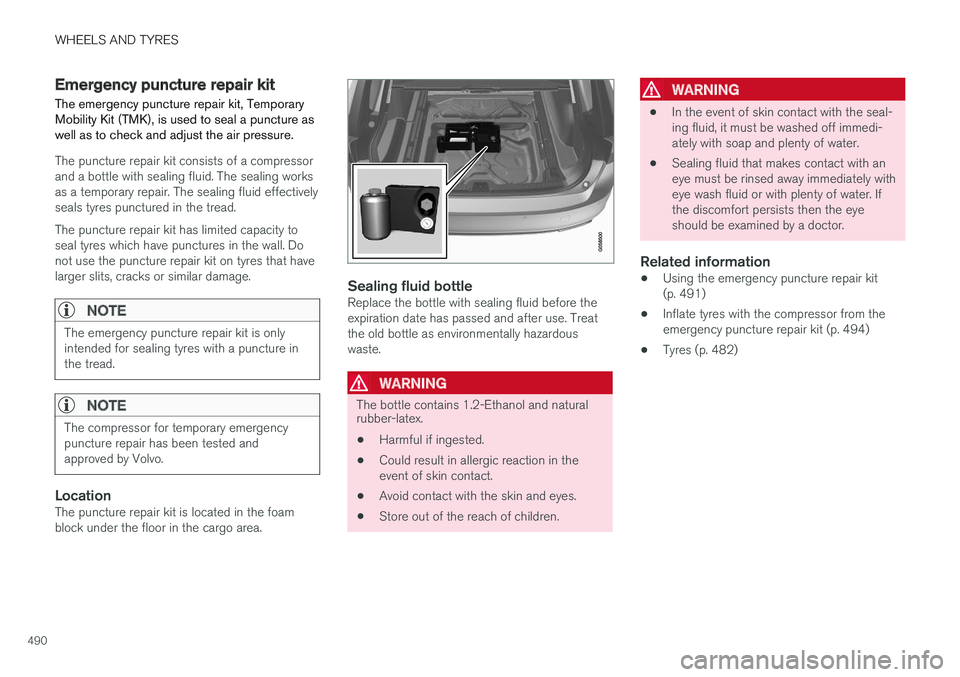
LocationThe puncture repair kit is located in the foam block under the floor in the cargo area.
Sealing fluid bottleReplace the bottle with sealing fluid before the expiration date has passed and after use. Treatthe old bottle as environmentally hazardouswaste.
WARNING
The bottle contains 1.2-Ethanol and natural rubber-latex.
• Harmful if ingested.
• Could result in allergic reaction in the event of skin contact.
• Avoid contact with the skin and eyes.
• Store out of the reach of children.
WARNING
• In the event of skin contact with the seal- ing fluid, it must be washed off immedi-ately with soap and plenty of water.
• Sealing fluid that makes contact with aneye must be rinsed away immediately witheye wash fluid or with plenty of water. Ifthe discomfort persists then the eyeshould be examined by a doctor.
Related information
• Using the emergency puncture repair kit(p. 491)
• Inflate tyres with the compressor from theemergency puncture repair kit (p. 494)
• Tyres (p. 482)
Page 498 of 594
||
WHEELS AND TYRES
* Option/accessory.
496
WARNING
Check that the jack is not damaged, that the threads are thoroughly lubricated and that it isfree from dirt.
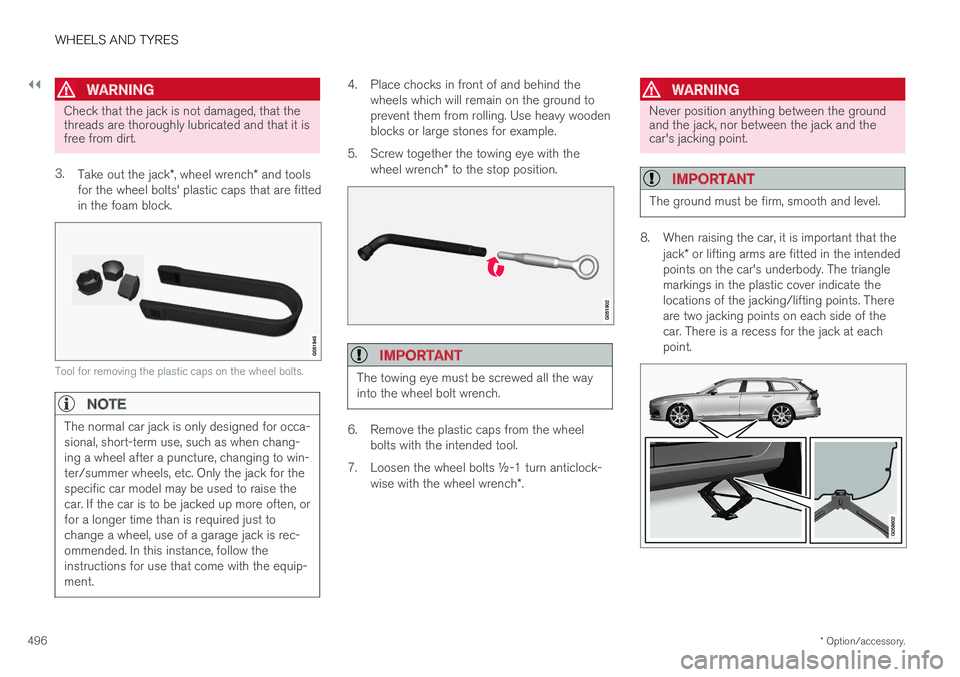
3. Take out the jack *, wheel wrench * and tools
for the wheel bolts' plastic caps that are fitted in the foam block.
Tool for removing the plastic caps on the wheel bolts.
NOTE
The normal car jack is only designed for occa- sional, short-term use, such as when chang-ing a wheel after a puncture, changing to win-ter/summer wheels, etc. Only the jack for thespecific car model may be used to raise thecar. If the car is to be jacked up more often, orfor a longer time than is required just tochange a wheel, use of a garage jack is rec-ommended. In this instance, follow theinstructions for use that come with the equip-ment.
4. Place chocks in front of and behind the wheels which will remain on the ground to prevent them from rolling. Use heavy woodenblocks or large stones for example.
5. Screw together the towing eye with the wheel wrench * to the stop position.
IMPORTANT
The towing eye must be screwed all the way into the wheel bolt wrench.
6. Remove the plastic caps from the wheel
bolts with the intended tool.
7. Loosen the wheel bolts ½-1 turn anticlock- wise with the wheel wrench *.
WARNING
Never position anything between the ground and the jack, nor between the jack and thecar's jacking point.
IMPORTANT
The ground must be firm, smooth and level.
8. When raising the car, it is important that the
jack* or lifting arms are fitted in the intended
points on the car's underbody. The triangle markings in the plastic cover indicate thelocations of the jacking/lifting points. Thereare two jacking points on each side of thecar. There is a recess for the jack at eachpoint.
Page 500 of 594
WHEELS AND TYRES
* Option/accessory.
498
Wheel bolts
Wheel bolts are used to attach the wheels to the hubs.
IMPORTANT
The wheel bolts must be tightened to 140 Nm. Overtightening or loose tightening maydamage the nuts and the bolts.
Only use rims that are tested and approved by Volvo and which are Volvo genuine accessories. Check the tightening torque of the wheel bolts with a torque wrench. Do not use lubricant on the threads of the wheel
bolts.
Locking wheel bolts *In the foam block under the cargo area floor there is space for the sleeve for the lockablewheel bolts.
Related information
•When changing wheels (p. 495)
Spare wheel
*
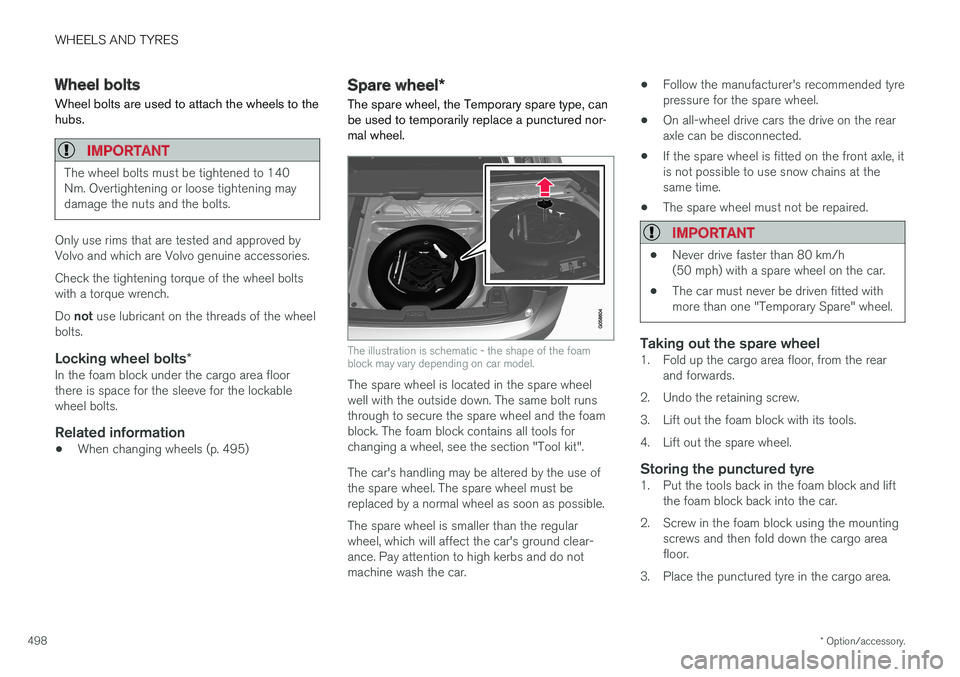
The spare wheel, the Temporary spare type, can be used to temporarily replace a punctured nor-mal wheel.
The illustration is schematic - the shape of the foam block may vary depending on car model.
The spare wheel is located in the spare wheel well with the outside down. The same bolt runsthrough to secure the spare wheel and the foamblock. The foam block contains all tools forchanging a wheel, see the section "Tool kit". The car's handling may be altered by the use of the spare wheel. The spare wheel must bereplaced by a normal wheel as soon as possible. The spare wheel is smaller than the regular wheel, which will affect the car's ground clear-ance. Pay attention to high kerbs and do notmachine wash the car. •
Follow the manufacturer's recommended tyrepressure for the spare wheel.
• On all-wheel drive cars the drive on the rearaxle can be disconnected.
• If the spare wheel is fitted on the front axle, itis not possible to use snow chains at thesame time.
• The spare wheel must not be repaired.
IMPORTANT
• Never drive faster than 80 km/h (50 mph) with a spare wheel on the car.
• The car must never be driven fitted withmore than one "Temporary Spare" wheel.
Taking out the spare wheel1. Fold up the cargo area floor, from the rear
and forwards.
2. Undo the retaining screw.
3. Lift out the foam block with its tools.
4. Lift out the spare wheel.
Storing the punctured tyre1. Put the tools back in the foam block and lift the foam block back into the car.
2. Screw in the foam block using the mounting screws and then fold down the cargo area floor.
3. Place the punctured tyre in the cargo area.
Page 502 of 594
WHEELS AND TYRES
* Option/accessory.
500
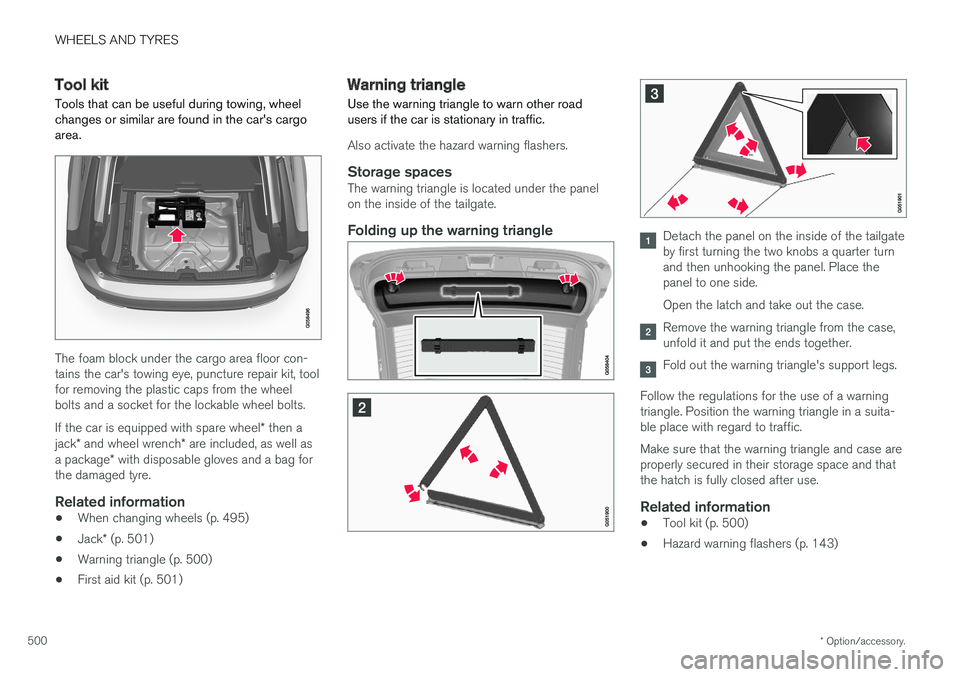
Tool kit Tools that can be useful during towing, wheel changes or similar are found in the car's cargoarea.
The foam block under the cargo area floor con- tains the car's towing eye, puncture repair kit, toolfor removing the plastic caps from the wheelbolts and a socket for the lockable wheel bolts. If the car is equipped with spare wheel * then a
jack * and wheel wrench * are included, as well as
a package * with disposable gloves and a bag for
the damaged tyre.
Related information
• When changing wheels (p. 495)
• Jack
* (p. 501)
• Warning triangle (p. 500)
• First aid kit (p. 501)
Warning triangle
Use the warning triangle to warn other road users if the car is stationary in traffic.
Also activate the hazard warning flashers.
Storage spacesThe warning triangle is located under the panel on the inside of the tailgate.
Folding up the warning triangleDetach the panel on the inside of the tailgate by first turning the two knobs a quarter turnand then unhooking the panel. Place thepanel to one side. Open the latch and take out the case.
Remove the warning triangle from the case, unfold it and put the ends together.
Fold out the warning triangle's support legs.
Follow the regulations for the use of a warning triangle. Position the warning triangle in a suita-ble place with regard to traffic. Make sure that the warning triangle and case are properly secured in their storage space and thatthe hatch is fully closed after use.
Related information
• Tool kit (p. 500)
• Hazard warning flashers (p. 143)
Page 516 of 594
MAINTENANCE AND SERVICE
514
Opening and closing the bonnet
The bonnet can be opened using the handle in the passenger compartment and a handle underthe bonnet.
Open the bonnet
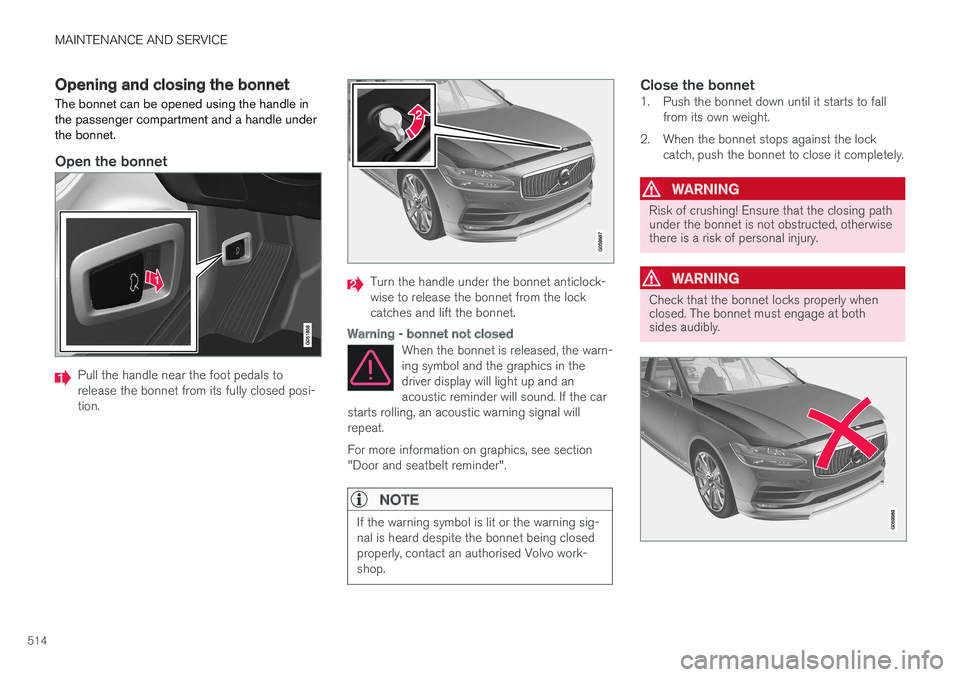
Pull the handle near the foot pedals to release the bonnet from its fully closed posi-tion.
Turn the handle under the bonnet anticlock- wise to release the bonnet from the lockcatches and lift the bonnet.
Warning - bonnet not closed
When the bonnet is released, the warn- ing symbol and the graphics in thedriver display will light up and anacoustic reminder will sound. If the car
starts rolling, an acoustic warning signal willrepeat. For more information on graphics, see section "Door and seatbelt reminder".
NOTE
If the warning symbol is lit or the warning sig- nal is heard despite the bonnet being closedproperly, contact an authorised Volvo work-shop.
Close the bonnet1. Push the bonnet down until it starts to fall from its own weight.
2. When the bonnet stops against the lock catch, push the bonnet to close it completely.
WARNING
Risk of crushing! Ensure that the closing path under the bonnet is not obstructed, otherwisethere is a risk of personal injury.
WARNING
Check that the bonnet locks properly when closed. The bonnet must engage at bothsides audibly.
Page 525 of 594
MAINTENANCE AND SERVICE
523
2. Unplug the connector from the bulb.
3. Detach the bulb by pushing it gently upwards
and pulling it straight out.
4. Fit a new bulb in the socket. The bulb's guide pin must be aimed straight upwards.
5. Press in the connector.
6. Refit the headlamp's rubber cover.
Related information
• Bulb replacement (p. 520)
• Bulb specifications (p. 526)
Replacing the main beam lamp
The main beam lamp in halogen headlamps can be replaced by the driver.
Before the bulb can be replaced, the plastic cover over the headlamp must be removed; seethe section "Bulb replacement".
IMPORTANT
Never touch the glass part of the bulbs with your fingers. Grease from your fingers isvaporised by the heat, coating the reflectorand then causing damage.
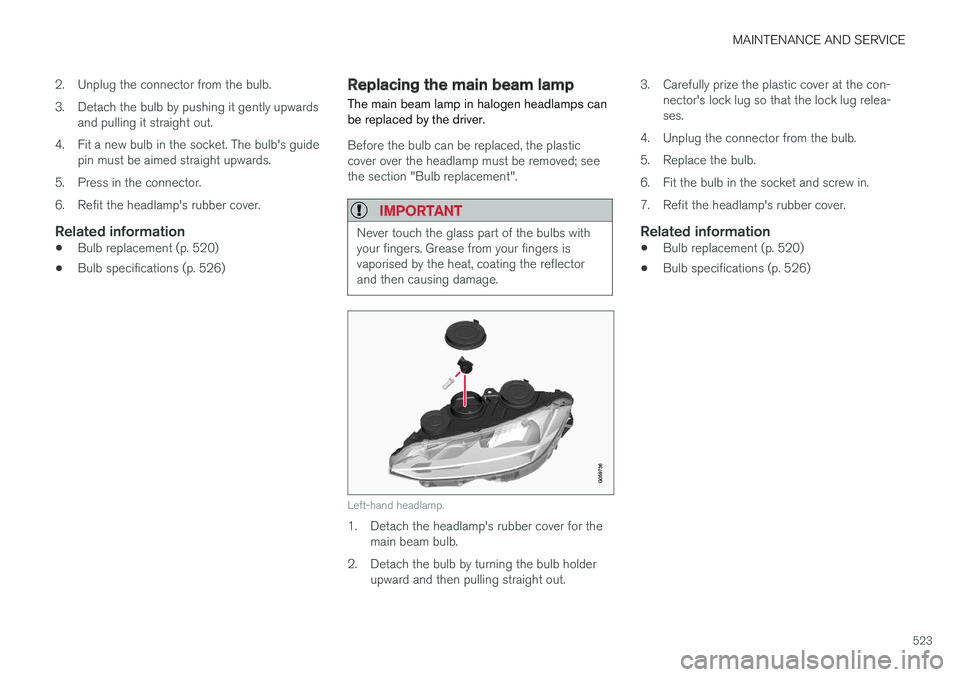
Left-hand headlamp.
1. Detach the headlamp's rubber cover for the main beam bulb.
2. Detach the bulb by turning the bulb holder upward and then pulling straight out. 3. Carefully prize the plastic cover at the con-
nector's lock lug so that the lock lug relea- ses.
4. Unplug the connector from the bulb.
5. Replace the bulb.
6. Fit the bulb in the socket and screw in.
7. Refit the headlamp's rubber cover.
Related information
• Bulb replacement (p. 520)
• Bulb specifications (p. 526)
Page 527 of 594
MAINTENANCE AND SERVICE
525
Related information
•Bulb replacement (p. 520)
• Bulb specifications (p. 526)
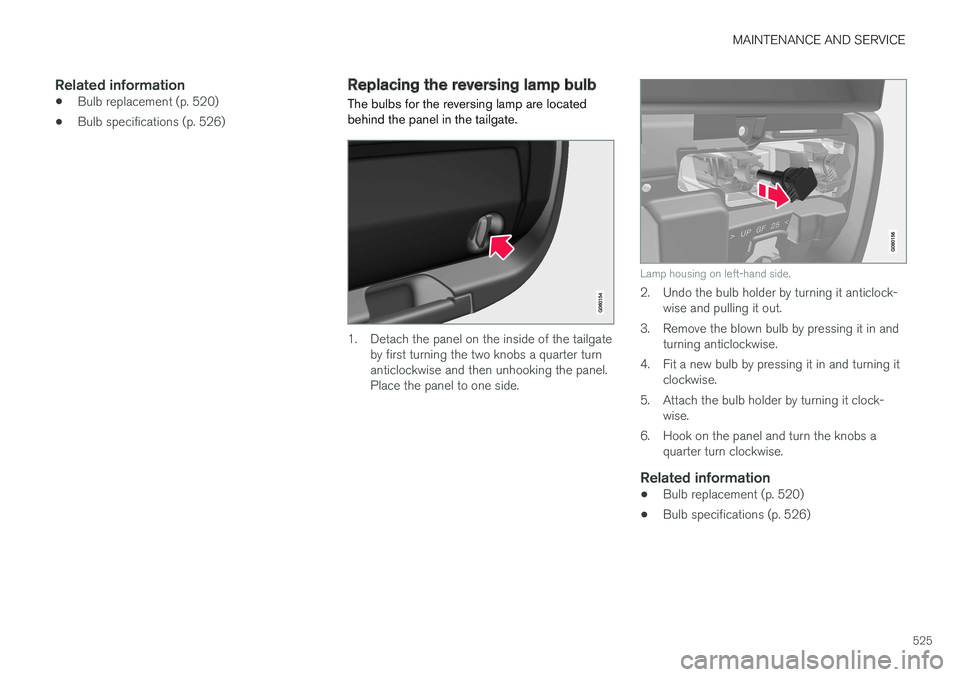
Replacing the reversing lamp bulb
The bulbs for the reversing lamp are located behind the panel in the tailgate.
1. Detach the panel on the inside of the tailgate by first turning the two knobs a quarter turn anticlockwise and then unhooking the panel.Place the panel to one side.
Lamp housing on left-hand side.
2. Undo the bulb holder by turning it anticlock- wise and pulling it out.
3. Remove the blown bulb by pressing it in and turning anticlockwise.
4. Fit a new bulb by pressing it in and turning it clockwise.
5. Attach the bulb holder by turning it clock- wise.
6. Hook on the panel and turn the knobs a quarter turn clockwise.
Related information
• Bulb replacement (p. 520)
• Bulb specifications (p. 526)
Page 528 of 594
MAINTENANCE AND SERVICE
526
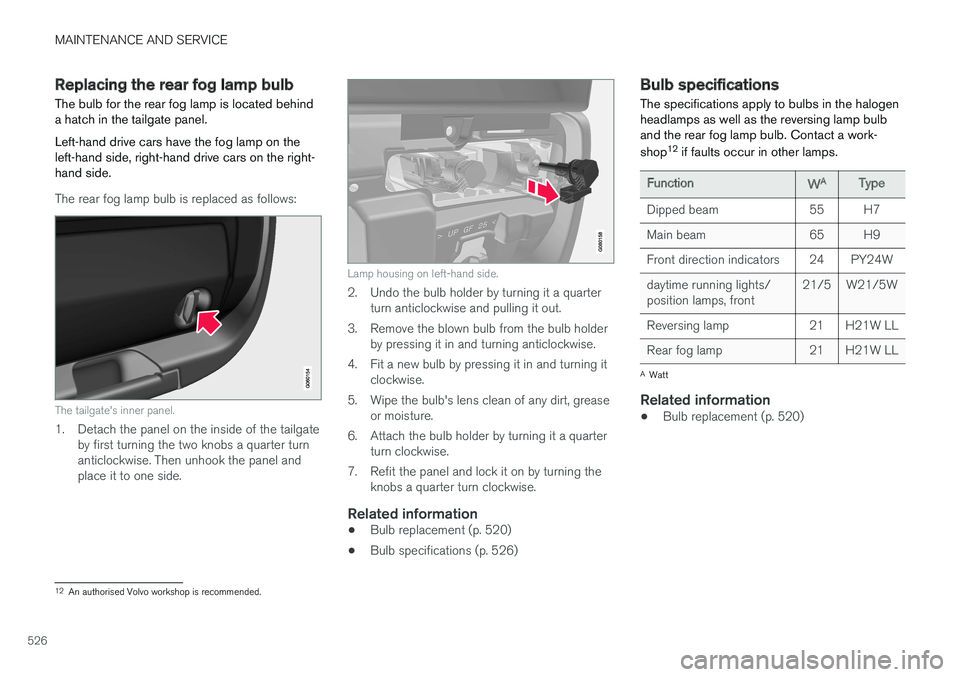
Replacing the rear fog lamp bulb The bulb for the rear fog lamp is located behind a hatch in the tailgate panel. Left-hand drive cars have the fog lamp on the left-hand side, right-hand drive cars on the right-hand side.
The rear fog lamp bulb is replaced as follows:
The tailgate's inner panel.
1. Detach the panel on the inside of the tailgateby first turning the two knobs a quarter turn anticlockwise. Then unhook the panel andplace it to one side.
Lamp housing on left-hand side.
2. Undo the bulb holder by turning it a quarterturn anticlockwise and pulling it out.
3. Remove the blown bulb from the bulb holder by pressing it in and turning anticlockwise.
4. Fit a new bulb by pressing it in and turning it clockwise.
5. Wipe the bulb's lens clean of any dirt, grease or moisture.
6. Attach the bulb holder by turning it a quarter turn clockwise.
7. Refit the panel and lock it on by turning the knobs a quarter turn clockwise.
Related information
• Bulb replacement (p. 520)
• Bulb specifications (p. 526)
Bulb specifications The specifications apply to bulbs in the halogen headlamps as well as the reversing lamp bulband the rear fog lamp bulb. Contact a work- shop 12
if faults occur in other lamps.
Function WA
Type
Dipped beam 55 H7
Main beam 65 H9
Front direction indicators 24 PY24Wdaytime running lights/ position lamps, front 21/5 W21/5W
Reversing lamp 21 H21W LL
Rear fog lamp 21 H21W LL
A Watt
Related information
• Bulb replacement (p. 520)
12
An authorised Volvo workshop is recommended.