belt VOLVO V90 CROSS COUNTRY 2021 Workshop Manual
[x] Cancel search | Manufacturer: VOLVO, Model Year: 2021, Model line: V90 CROSS COUNTRY, Model: VOLVO V90 CROSS COUNTRY 2021Pages: 683, PDF Size: 14.19 MB
Page 336 of 683

||
DRIVER SUPPORT
* Option/accessory.
334
Related information
City Safety
™ (p. 331)
City Safety in crossing traffic (p. 337)
City Safety braking for oncoming vehicles (p. 340)
City Safety limitations (p. 341)
Head-up display
* (p. 146)
Seat belt tensioners (p. 52)
Setting a warning distance for City Safety
City Safety 77
is always active, but the func-
tion's warning distance can be adjusted.
NOTE
The City Safety function cannot be deacti- vated. It is activated automatically eachtime the engine/electric motor is started.
The alert distance determines the sensitivity of the system and regulates the distance atwhich the light, sound and brake pulsationswill be activated. To select warning distance:
1. Select
SettingsMy CarIntelliSafein the center display's Top view.
2. Under
City Safety Warning, tap Late,Normal or Early to set the desired warn-
ing distance.
If the driver feels that the
Early setting is giv-
ing too many warnings or finds them irritating, the
Normal or Late warning distance settings
can be selected instead. If the driver feels that the warnings are too fre- quent and distracting, the warning distancecan be reduced. This will reduce the total number of warnings, but it will also result inCity Safety providing warnings at a later stage. The
Late warning distance setting should
therefore only be used in exceptional cases, such as when a more dynamic driving style ispreferred.
77 This function is not available on all markets.
Page 353 of 683
DRIVER SUPPORT
}}
* Option/accessory.351
Rear Collision Warning *85
The Rear Collision Warning 86
(RCW) function
can help the driver avoid rear-end collisions from vehicles approaching from behind.
The function can alert drivers of following vehi- cles of the risk of a collision by rapidly flashingthe turn signals. If, at a speed below 30 km/h (20 mph), the function detects that the vehicle is in dangerof being hit from behind, the seat belt tension-ers may tension the front seat belts. TheWhiplash Protection System will also be acti-vated in a collision. Immediately before a collision from behind, the function may also activate the brakes inorder to reduce the forward acceleration of thevehicle during the collision. However, thebrakes will only be applied if your vehicle isstationary. The brakes will be immediatelyreleased if the accelerator pedal is depressed. The function is automatically activated each time the engine is started.
WARNING
The function is supplementary driver support intended to facilitate drivingand help make it safer – it cannot han-dle all situations in all traffic, weatherand road conditions.
The driver is advised to read all sec-tions in the Owner's Manual about thisfunction to learn of its limitations,which the driver must be aware ofbefore using the function.
Driver support functions are not a sub-stitute for the driver's attention andjudgment. The driver is always respon-sible for ensuring the vehicle is drivenin a safe manner, at the appropriatespeed, with an appropriate distance toother vehicles, and in accordance withcurrent traffic rules and regulations.
Related information
Driver support systems (p. 278)
Rear Collision Warning
* limitations
(p. 351)
Whiplash Protection System (p. 48)
Rear Collision Warning
*87
limitations In some situations, it may be difficult for Rear Collision Warning (RCW) to warn the driverof a collision risk.
This may be the case if: the vehicle approaching from the rear is detected at a late stage
the vehicle approaching from the rearchanges lanes at a late stage
a trailer, bicycle holder or similar is con-nected to the vehicle's electrical system -the function will then be automaticallydeactivated.
NOTE
In certain markets RCW does
not warn
with the direction indicators due to local traffic regulations – in such cases, that partof the function is deactivated.
NOTE
The function uses the vehicle's camera and radar sensor, which has certain generallimitations.
85 Warning of collision from the rear.
86 This function is not available on all markets.
87 Warning of collision from the rear.
Page 400 of 683
STARTING AND DRIVING
* Option/accessory.
398
Starting the vehicle
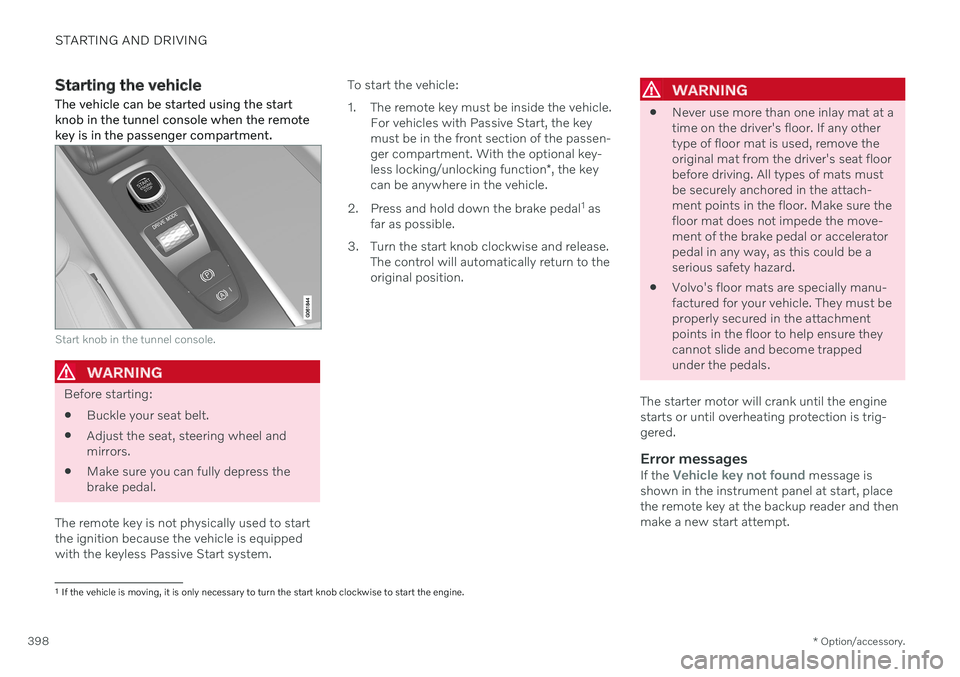
The vehicle can be started using the start knob in the tunnel console when the remotekey is in the passenger compartment.
Start knob in the tunnel console.
WARNING
Before starting:
Buckle your seat belt.
Adjust the seat, steering wheel and mirrors.
Make sure you can fully depress thebrake pedal.
The remote key is not physically used to startthe ignition because the vehicle is equippedwith the keyless Passive Start system. To start the vehicle:
1. The remote key must be inside the vehicle.
For vehicles with Passive Start, the key must be in the front section of the passen-ger compartment. With the optional key- less locking/unlocking function *, the key
can be anywhere in the vehicle.
2. Press and hold down the brake pedal 1
as
far as possible.
3. Turn the start knob clockwise and release. The control will automatically return to the original position.
WARNING
Never use more than one inlay mat at a time on the driver's floor. If any othertype of floor mat is used, remove theoriginal mat from the driver's seat floorbefore driving. All types of mats mustbe securely anchored in the attach-ment points in the floor. Make sure thefloor mat does not impede the move-ment of the brake pedal or acceleratorpedal in any way, as this could be aserious safety hazard.
Volvo's floor mats are specially manu-factured for your vehicle. They must beproperly secured in the attachmentpoints in the floor to help ensure theycannot slide and become trappedunder the pedals.
The starter motor will crank until the enginestarts or until overheating protection is trig-gered.
Error messagesIf the Vehicle key not found message is
shown in the instrument panel at start, place the remote key at the backup reader and thenmake a new start attempt.
1 If the vehicle is moving, it is only necessary to turn the start knob clockwise to start the engine.
Page 409 of 683
STARTING AND DRIVING
407
Symbol in the instrument panel
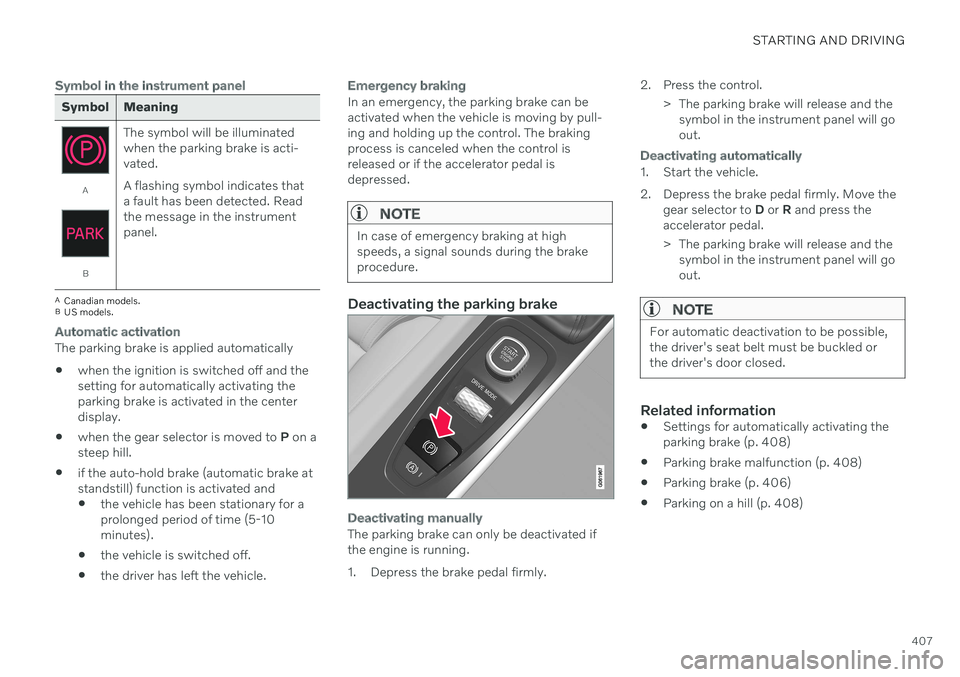
Symbol Meaning
A
BThe symbol will be illuminated when the parking brake is acti-vated. A flashing symbol indicates that a fault has been detected. Readthe message in the instrumentpanel.
A
Canadian models.
B US models.
Automatic activation
The parking brake is applied automatically when the ignition is switched off and the setting for automatically activating theparking brake is activated in the centerdisplay.
when the gear selector is moved to
P on a
steep hill.
if the auto-hold brake (automatic brake atstandstill) function is activated and
the vehicle has been stationary for aprolonged period of time (5-10minutes).
the vehicle is switched off.
the driver has left the vehicle.
Emergency braking
In an emergency, the parking brake can be activated when the vehicle is moving by pull-ing and holding up the control. The brakingprocess is canceled when the control isreleased or if the accelerator pedal isdepressed.
NOTE
In case of emergency braking at high speeds, a signal sounds during the brakeprocedure.
Deactivating the parking brake
Deactivating manually
The parking brake can only be deactivated if the engine is running.
1. Depress the brake pedal firmly. 2. Press the control.
> The parking brake will release and thesymbol in the instrument panel will go out.
Deactivating automatically
1. Start the vehicle.
2. Depress the brake pedal firmly. Move the gear selector to D or R and press the
accelerator pedal.
> The parking brake will release and the symbol in the instrument panel will go out.
NOTE
For automatic deactivation to be possible, the driver's seat belt must be buckled orthe driver's door closed.
Related information
Settings for automatically activating the parking brake (p. 408)
Parking brake malfunction (p. 408)
Parking brake (p. 406)
Parking on a hill (p. 408)
Page 411 of 683
STARTING AND DRIVING
}}
409
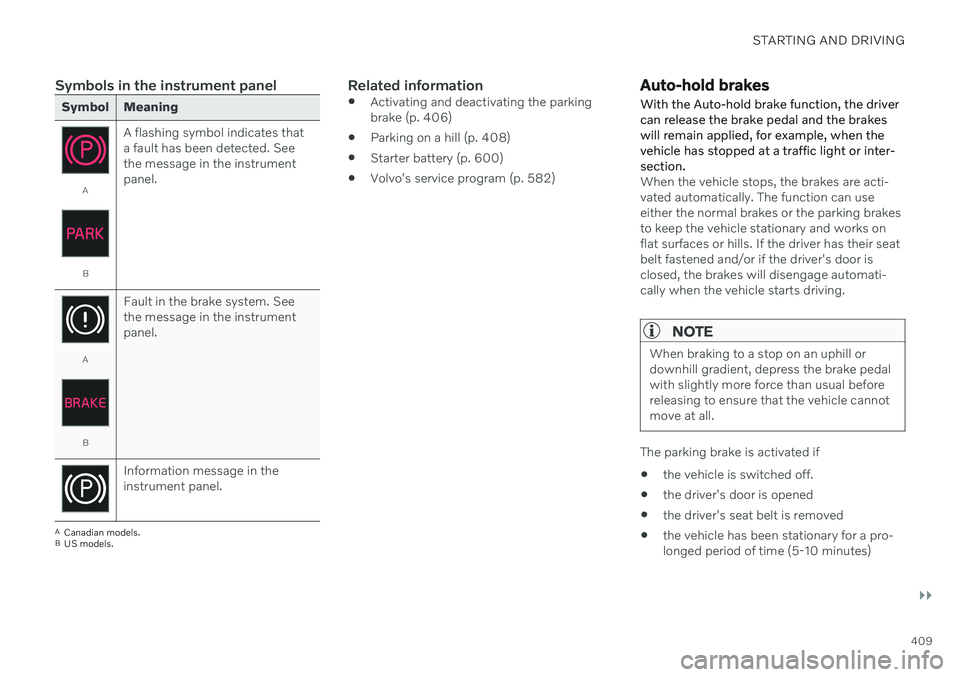
Symbols in the instrument panel
Symbol Meaning
A
BA flashing symbol indicates that a fault has been detected. Seethe message in the instrumentpanel.
A
BFault in the brake system. See the message in the instrumentpanel.
Information message in the instrument panel.
A
Canadian models.
B US models.
Related information
Activating and deactivating the parking brake (p. 406)
Parking on a hill (p. 408)
Starter battery (p. 600)
Volvo's service program (p. 582)
Auto-hold brakes
With the Auto-hold brake function, the driver can release the brake pedal and the brakeswill remain applied, for example, when thevehicle has stopped at a traffic light or inter-section.
When the vehicle stops, the brakes are acti- vated automatically. The function can useeither the normal brakes or the parking brakesto keep the vehicle stationary and works onflat surfaces or hills. If the driver has their seatbelt fastened and/or if the driver's door isclosed, the brakes will disengage automati-cally when the vehicle starts driving.
NOTE
When braking to a stop on an uphill or downhill gradient, depress the brake pedalwith slightly more force than usual beforereleasing to ensure that the vehicle cannotmove at all.
The parking brake is activated if
the vehicle is switched off.
the driver's door is opened
the driver's seat belt is removed
the vehicle has been stationary for a pro- longed period of time (5-10 minutes)
Page 413 of 683
STARTING AND DRIVING
* Option/accessory.411
Hill Start Assist
The function for assisting when starting the vehicle on inclines (HSA 4
) helps prevent the
vehicle from rolling backward when starting on an uphill gradient. When backing up a hill,HSA helps prevent the vehicle from rollingforward.
The function retains pressure from the brake pedal in the brake system for several secondsafter the brake pedal has been released. This temporary braking effect is released after a few seconds or when the driver begins driv-ing. Hill Start Assist is activated when the vehicle is stopped on steep inclines. The function isavailable even when the Auto-hold brake func-tion is switched off.
Related information
Auto-hold brakes (p. 409)
Brakes (p. 403)
Braking assist after a collision
In a collision in which the activation level is reached for the pyrotechnic seat belt tension-ers or airbags, or if a collision with a large ani-mal is detected, the vehicle's brakes will beautomatically activated. This function isintended to help prevent or reduce the effectsof any subsequent collision.
After a serious collision, it may no longer be possible to control and steer the vehicle. Inorder to avoid or mitigate a possible furthercollision with a vehicle or an object in the vehi-cle's path, the brake assist system is activatedautomatically to help stop the vehicle safely. If braking is not appropriate, e.g. if there is a risk of being hit by passing traffic, the drivercan override the system by depressing theaccelerator pedal. This function assumes that the brake system is intact after a collision.
Related information
Rear Collision Warning
* (p. 351)
BLIS
* (p. 352)
Brake functions (p. 403)
Regenerative braking
*
The vehicle recovers kinetic energy during braking in order to reduce fuel consumptionand emissions.
The battery symbol is shown in the instrument panel when the vehicle is generating power for the battery 5
.
The function is available in all drive modes together with gear selector position D or M.
Activating brake regeneration
Brake regeneration is activated by gentle pres- sure on the brake pedal or during engine brak-ing. Regeneration increases during engine braking if manual gear selector position M is selected.
Related information
Drive modes
* (p. 419)
Shifting gears with automatic transmis-sion (p. 413)
4
Hill Start Assist
5 The symbol is used in vehicles with 48 V batteries.
Page 416 of 683
||
STARTING AND DRIVING
414Help functions
6
The system will switch to the P position auto-
matically:
if the ignition is switched off while
D or R
is selected.
if the driver unbuckles the seat belt and opens the driver's door while the vehicle isrunning with a gear other than
P selected.
To park a vehicle with an unbuckled seat beltand open door – end P mode by shifting to R
or D again.
If the vehicle is switched off in gear positionN , it will not automatically switch to the P
position. This makes it possible to wash thevehicle in an automatic car wash.
Reverse – R
Select R when backing up. The vehicle must
be stationary when R is selected.
Neutral – N
In N position, the vehicle can roll freely. The
vehicle can be started when it is in N position.
Apply the parking brake if the vehicle is sta- tionary with the gear selector in the N posi-
tion. To move to another gear position when N is
selected, the brake pedal must be depressed and the ignition in mode II. For vehicles with the small gear selector, the engine must berunning.
D
drive mode
D is the normal driving gear position. The
transmission shifts up or down automatically depending on acceleration and speed. The vehicle must be stationary when the gear selector is moved from R to D.
Manual position – M
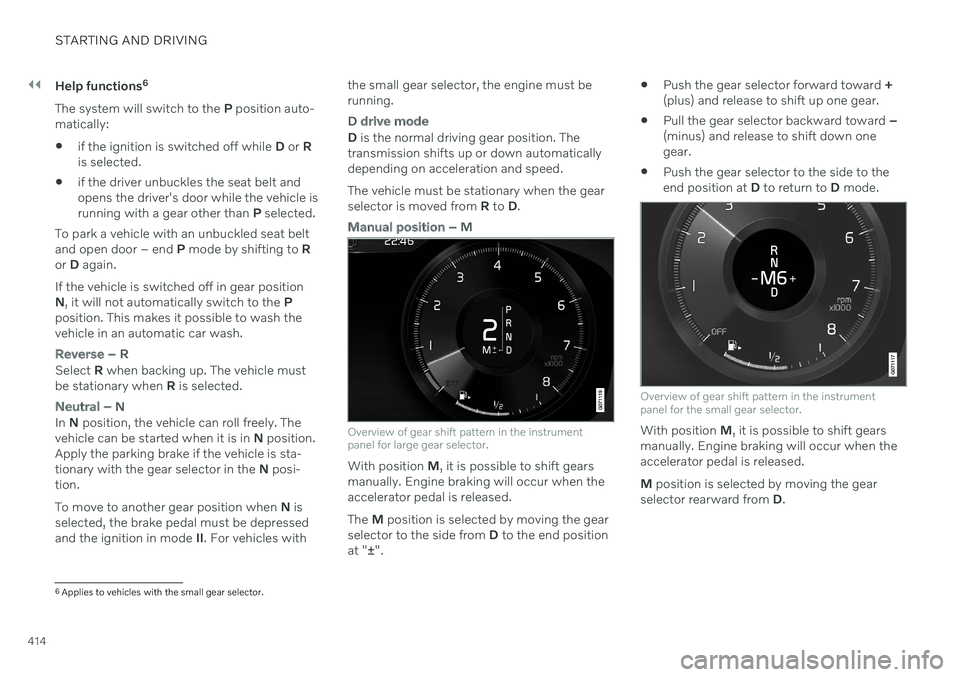
Overview of gear shift pattern in the instrument panel for large gear selector.
With position M, it is possible to shift gears
manually. Engine braking will occur when the accelerator pedal is released. The M position is selected by moving the gear
selector to the side from D to the end position
at " ±".
Push the gear selector forward toward
+
(plus) and release to shift up one gear.
Pull the gear selector backward toward
–
(minus) and release to shift down one gear.
Push the gear selector to the side to theend position at
D to return to D mode.
Overview of gear shift pattern in the instrument panel for the small gear selector.
With position M, it is possible to shift gears
manually. Engine braking will occur when the accelerator pedal is released. M position is selected by moving the gear
selector rearward from D.
6
Applies to vehicles with the small gear selector.
Page 429 of 683
STARTING AND DRIVING
}}
427
Conditions for the Start/Stop functionCertain conditions must be met for Start/ Stop to function.
If any condition is not met, this will be indi- cated in the instrument panel.
The engine does not auto-stopThe engine will not auto-stop if: The vehicle has not reached a speed of ca 10 km/h (6 mph) after starting.
After several auto-stops, the speed mustagain exceed approximately ca 10 km/h(6 mph) before the next auto-stop.
The driver has not fastened the seatbelt.
The engine is not running at its normaloperating temperature.
The ambient temperature is underapproximately -5 °C (23 °F) or overapproximately 30 °C (86 °F).
Windshield heating is activated.
The climate system settings and theactual climate in the passenger compart-ment differ.
The vehicle is in reverse.
The driver is making large steering wheelmovements.
The road gradient is very steep.
The hood is open.
Driving at high altitude and the engine hasnot reached its normal operating tempera-ture.
ABS has been activated.
Hard braking (even if the ABS system hasnot been activated).
Many starts during a short period of timehave triggered the starter motor's over-heating protection.
The exhaust system's particulate filter isfull.
A trailer is connected to the vehicle's elec-trical system.
The transmission is not running at its nor-mal operating temperature.
The gear selector is in mode
M (±
).
If traffic conditions allow it (for example ina traffic jam).
The engine does not auto-startThe engine will not auto-start after an auto-stop if:
The driver is not wearing a seat belt, thegear selector is in the
P position and the
driver's door is open. The engine must bestarted normally.
The engine auto-starts while the brake pedal is depressed
In the following situations, the engine will auto-start even if the brake pedal isdepressed:
High levels of condensation on the insideof the windows.
The climate system settings and theactual climate in the passenger compart-ment differ.
The brake pedal is pumped repeatedly.
The hood is open.
The vehicle begins to roll or increasesspeed slightly if the engine auto-stoppedbefore the vehicle was at a standstill.
The driver's seat belt is unbuckled with thegear selector in the
D or N positions.
The gear selector is moved from
D to R or
M (± ).
The driver's door is opened with the gearselector in
D. An audible signal and a text
message informs the driver that the igni-tion is on.
WARNING
Do not open the hood if the engine has auto-stopped. Turn off the engine byswitching off the ignition before lifting thehood.
Page 574 of 683
||
LOADING, STORAGE AND PASSENGER COMPARTMENT
* Option/accessory.
572
Under the floor hatch *
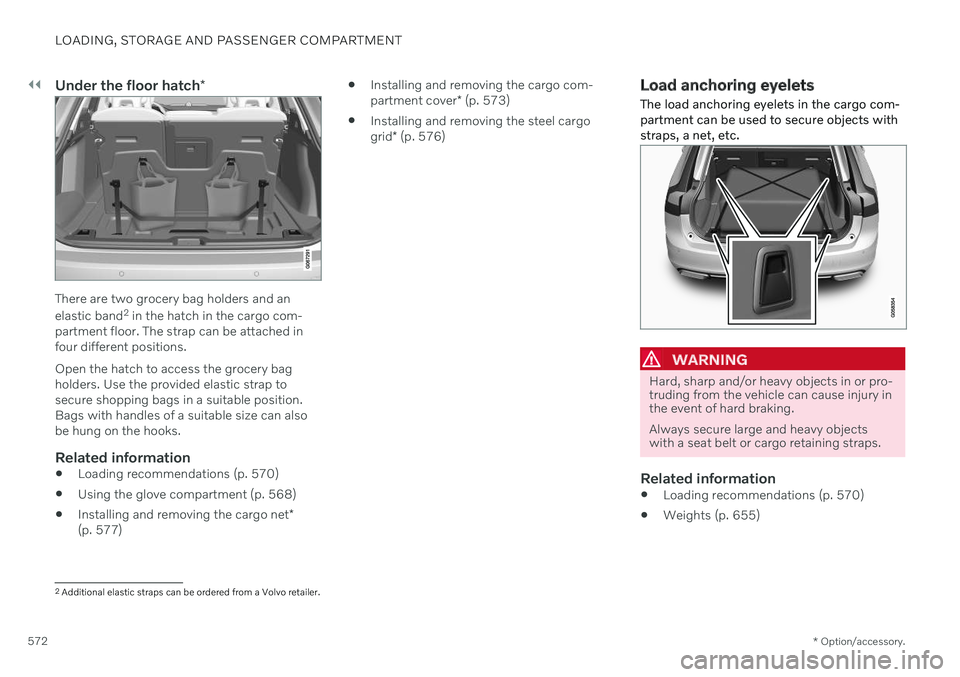
There are two grocery bag holders and an elastic band2
in the hatch in the cargo com-
partment floor. The strap can be attached in four different positions. Open the hatch to access the grocery bag holders. Use the provided elastic strap tosecure shopping bags in a suitable position.Bags with handles of a suitable size can alsobe hung on the hooks.
Related information
Loading recommendations (p. 570)
Using the glove compartment (p. 568)
Installing and removing the cargo net
*
(p. 577)
Installing and removing the cargo com- partment cover
* (p. 573)
Installing and removing the steel cargogrid
* (p. 576)
Load anchoring eyelets The load anchoring eyelets in the cargo com- partment can be used to secure objects withstraps, a net, etc.
WARNING
Hard, sharp and/or heavy objects in or pro- truding from the vehicle can cause injury inthe event of hard braking. Always secure large and heavy objects with a seat belt or cargo retaining straps.
Related information
Loading recommendations (p. 570)
Weights (p. 655)
2
Additional elastic straps can be ordered from a Volvo retailer.
Page 584 of 683
MAINTENANCE AND SERVICE
582
Volvo's service program To keep the vehicle as safe and reliable as possible, follow the Volvo service schedulespecified in the Warranty and MaintenanceRecords Information booklet.
WARNING
California Proposition 65 Operating, servicing and maintaining a pas- senger vehicle can expose you to chemi-cals including engine exhaust, carbon mon-oxide, phthalates, and lead, which areknown to the State of California to causecancer and birth defects or other reproduc-tive harm. To minimize exposure, avoidbreathing exhaust, do not idle the engineexcept as necessary, service your vehicle ina well ventilated area and wear gloves orwash your hands frequently when servicingyour vehicle. For more information go towww.P65Warnings.ca.gov/passenger-vehicle.
Volvo recommends having an authorized Volvo workshop perform service and mainte-nance. Volvo workshops have the staff, serviceliterature and special tools that can providethe highest quality of service.
CAUTION
To ensure the Volvo warranty is not invali- dated, check and follow the Warranty andService Records Information booklet.
IntroductionThe maintenance services contain several checks that require special instruments andtools and therefore must be performed by aqualified technician. To keep your Volvo in topcondition, specify time-tested and provenGenuine Volvo Parts and Accessories.
The Federal Clean Air Act - U.S.
The Federal Clean Air Act requires vehicle manufacturers to furnish written instructionsto the ultimate purchaser to assure the properservicing and function of the components thatcontrol emissions. These services, which arelisted in the "Warranty and Service RecordsInformation" booklet, are not covered by thewarranty. You will be required to pay for laborand material used.
Maintenance
Your Volvo passed several major inspections before it was delivered to you, in accordancewith Volvo specifications. The maintenanceprocedures outlined in the Warranty and Serv-ice Records Information booklet, many ofwhich will positively affect your vehicle's emis-sions, should be performed as indicated. It isrecommended that receipts for vehicle emis-sion maintenance be retained in case ques-tions arise concerning maintenance. Inspec-tion and maintenance should also be per-formed anytime a malfunction is observed orsuspected.
Applicable warranties - U.S./Canada
In accordance with applicable U.S. and Cana- dian regulations, the following list of warran-ties is provided. New Vehicle Limited Warranty
Parts and Accessories Limited Warranty
Corrosion Protection Limited Warranty
Seat Belt and Supplemental Restraint Systems Limited Warranty
Emission Design and Defect Warranty
Emission Performance Warranty
These are federal warranties; other warrantiesare provided as required by state/provinciallaw. Refer to your separate Warranty andService Records Information booklet fordetailed information concerning each of thewarranties.