warning VOLVO XC60 2009 Owner´s Manual
[x] Cancel search | Manufacturer: VOLVO, Model Year: 2009, Model line: XC60, Model: VOLVO XC60 2009Pages: 297, PDF Size: 21.16 MB
Page 233 of 297
06 Maintenance and specifications
Fluids06
231
The brake fluid should always be between the
MIN and MAX marks on the inside of the res-
ervoir. Check, without removing the cap, that
there is sufficient fluid in the reservoir.
Fluid type: DOT 4+ boiling point >536 °F
(280 °C), P/N 9437433
Replace: The fluid should be replaced accord-
ing to the intervals specified in the Warranty
and Service Records Information booklet.
When driving under extremely hard conditions
(mountain driving, etc), it may be necessary to
replace the fluid more often. Consult a trained
and qualified Volvo service technician.
Always entrust brake fluid changing to a
trained and qualified Volvo service technician.
WARNING
If the fluid level is below the MIN mark in the
reservoir or if a brake-related message is
shown in the information display:
DO NOT
DRIVE. Have the car towed to a trained and
qualified Volvo service technician and have
the brake system inspected.
Filling1. Turn and open the cover.
2. Unscrew the reservoir cap and fill the fluid.
The level must be between the MIN and
MAX marks. Power steering fluid
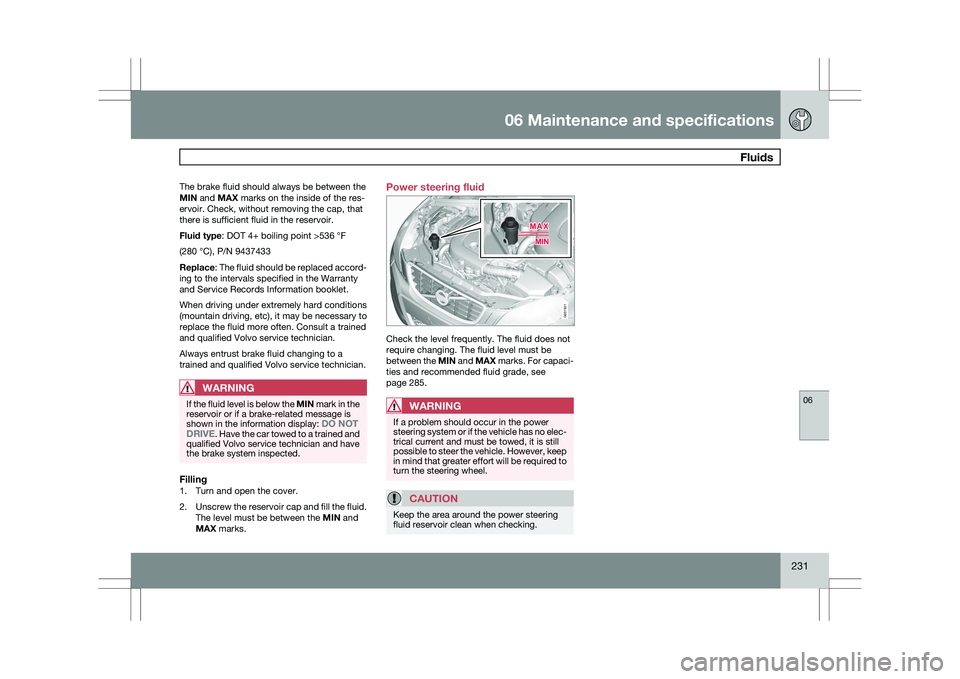
Check the level frequently. The fluid does not
require changing. The fluid level must be
between the MIN and MAX marks. For capaci-
ties and recommended fluid grade, see
page 285.
WARNING
If a problem should occur in the power
steering system or if the vehicle has no elec-
trical current and must be towed, it is still
possible to steer the vehicle. However, keep
in mind that greater effort will be required to
turn the steering wheel.
CAUTION
Keep the area around the power steering
fluid reservoir clean when checking. G031921
Page 234 of 297
06 Maintenance and specificationsReplacing bulbs 06
232
* Option/accessory, for more information, see Introduction.
Introduction
All bulb specifications are listed on page 238.
The following bulbs should only be replaced by
a trained and qualified Volvo service techni-
cian:
\b
Dome lighting
\b Reading lights
\b Glove compartment lighting
\b Turn signals in the door mirrors
\b Approach lighting in the door mirror
\b Parking lights
\b Rear side parking lights
\b Active Dual Xenon and LED bulbs
NOTE For information regarding any other bulbs
not mentioned in this section, please con-
tact your Volvo retailer or a trained and
authorized Volvo service technician.
WARNING \b
Active Dual Xenon headlights* – due to
the high voltage used by these head-
lights, these bulbs should only be
replaced by a trained and qualified
Volvo service technician.
\b Turn off the lights and remove the
remote key from the ignition before
changing any bulbs. Headlight housing
WARNING
\b
The engine should not be running when
changing bulbs.
\b When changing in the headlight hous-
ing, if the engine has been running just
prior to replacing bulbs, please be
aware that components in the engine
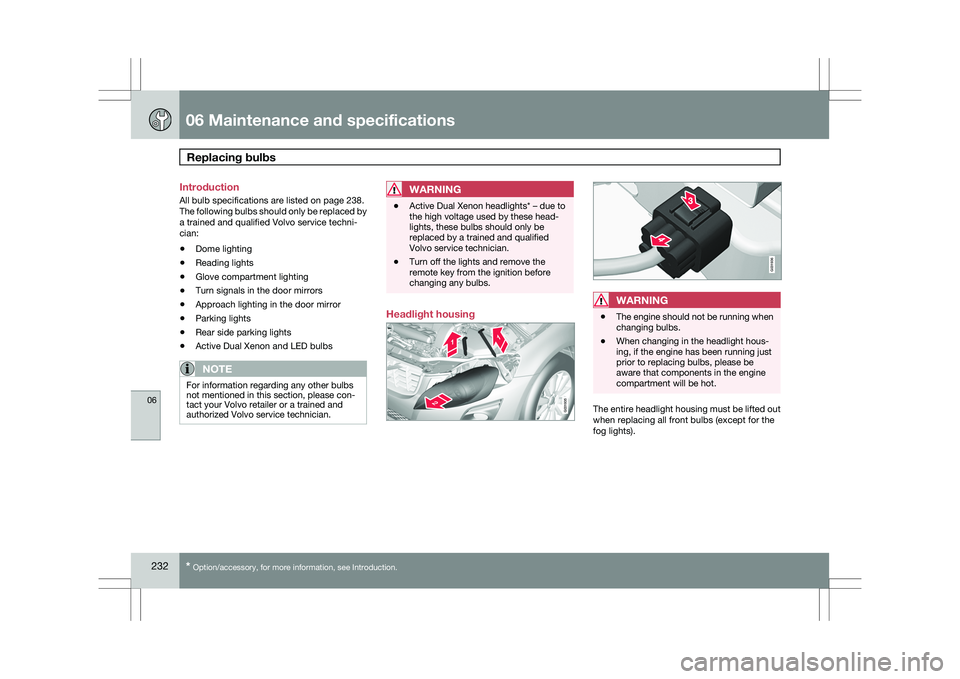
compartment will be hot. The entire headlight housing must be lifted out
when replacing all front bulbs (except for the
fog lights). G031935 G031936
Page 244 of 297
06 Maintenance and specificationsBattery 06
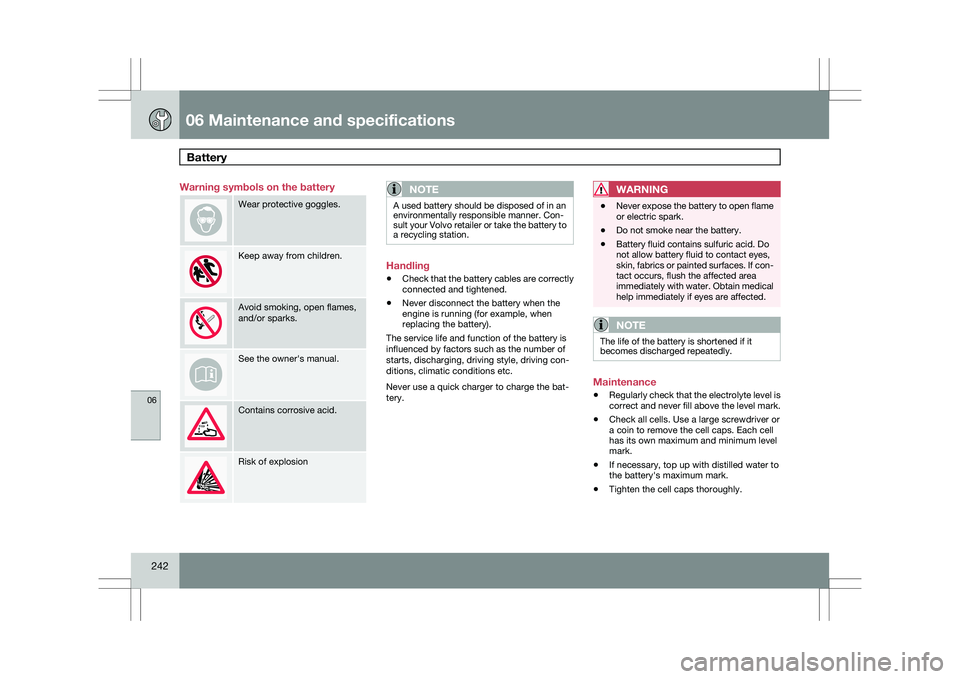
242 Warning symbols on the battery
Wear protective goggles.
Keep away from children.
Avoid smoking, open flames,
and/or sparks.
See the owner\fs manual.
Contains corrosive acid.
Risk of explosion
NOTE A used battery should be disposed of in an
environmentally responsible manner. Con-
sult your Volvo retailer or take the battery to
a recycling station.
Handling
\b
Check that the battery cables are correctly
connected and tightened.
\b Never disconnect the battery when the
engine is running (for example, when
replacing the battery).
The service life and function of the battery is
influenced by factors such as the number of
starts, discharging, driving style, driving con-
ditions, climatic conditions etc.
Never use a quick charger to charge the bat-
tery.WARNING \b
Never expose the battery to open flame
or electric spark.
\b Do not smoke near the battery.
\b Battery fluid contains sulfuric acid. Do
not allow battery fluid to contact eyes,
skin, fabrics or painted surfaces. If con-
tact occurs, flush the affected area
immediately with water. Obtain medical
help immediately if eyes are affected.
NOTE The life of the battery is shortened if it
becomes discharged repeatedly.
Maintenance
\b
Regularly check that the electrolyte level is
correct and never fill above the level mark.
\b Check all cells. Use a large screwdriver or
a coin to remove the cell caps. Each cell
has its own maximum and minimum level
mark.
\b If necessary, top up with distilled water to
the battery\fs maximum mark.
\b Tighten the cell caps thoroughly.
Page 245 of 297
06 Maintenance and specifications
Battery06
}}
243
CAUTION\b
Always use distilled or deionized water
(battery water).
\b Never fill above the level mark in the cell. ChangingWARNING Connect and disconnect the positive and
negative cables in the correct sequence.
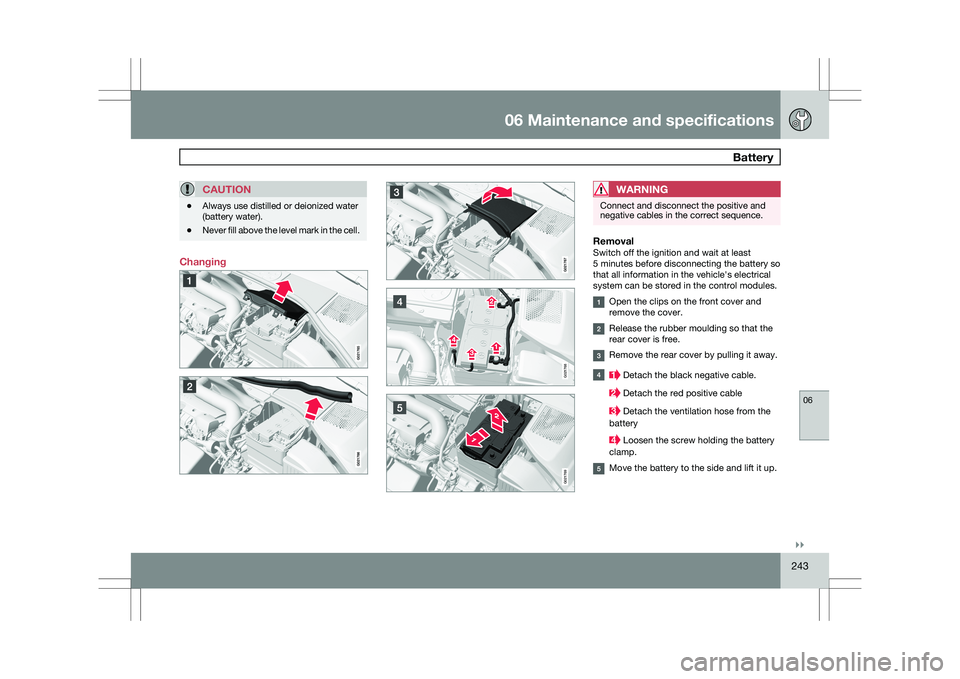
RemovalSwitch off the ignition and wait at least
5 minutes before disconnecting the battery so
that all information in the vehicle\fs electrical
system can be stored in the control modules.
Open the clips on the front cover and
remove the cover.
Release the rubber moulding so that the
rear cover is free.
Remove the rear cover by pulling it away.
Detach the black negative cable.
Detach the red positive cable
Detach the ventilation hose from the
battery Loosen the screw holding the battery
clamp. Move the battery to the side and lift it up. G021768 G021769
Page 246 of 297
06 Maintenance and specificationsBattery 06
244
WARNING PROPOSITION 65 WARNING!
Battery posts, terminals, and related acces-
sories contain lead and lead compounds,
chemicals known to the state of California
to cause cancer and reproductive harm.
Wash hands after handling.
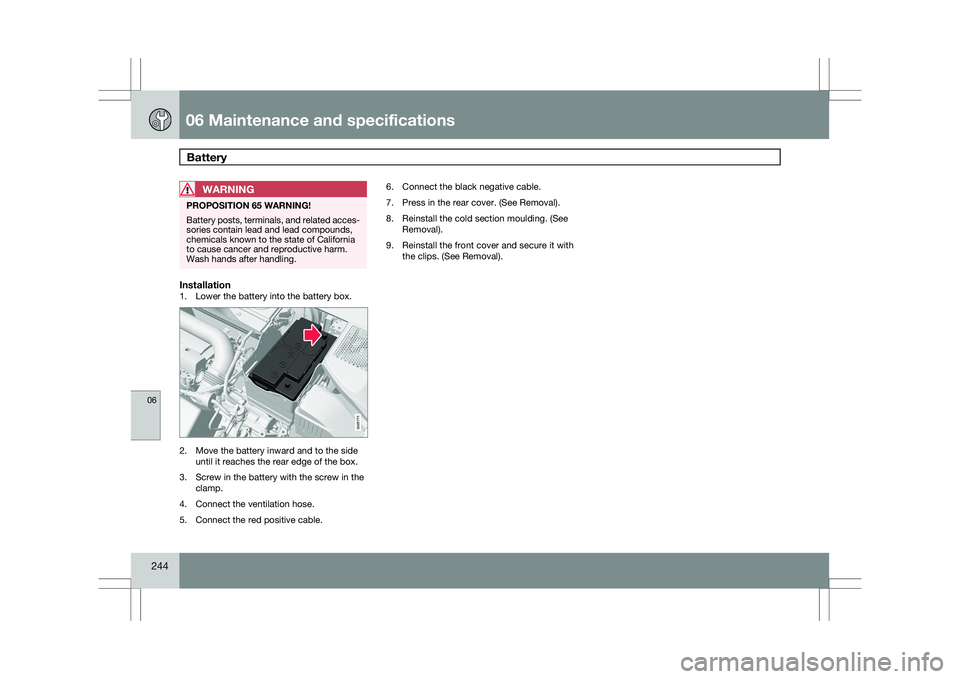
Installation1. Lower the battery into the battery box.
2. Move the battery inward and to the side
until it reaches the rear edge of the box.
3. Screw in the battery with the screw in the clamp.
4. Connect the ventilation hose.
5. Connect the red positive cable. 6. Connect the black negative cable.
7. Press in the rear cover. (See Removal).
8. Reinstall the cold section moulding. (See
Removal).
9. Reinstall the front cover and secure it with the clips. (See Removal). G021771
Page 247 of 297
06 Maintenance and specifications
Fuses06
}}
245
Replacing fuses
There are relay/fuse boxes located in the
engine compartment, the passenger compart-
ment, and the cargo area.
If an electrical component fails to function, this
may be due to a blown fuse. The easiest way
to see if a fuse is blown is to remove it.
To do so:
1.
Pull the fuse straight out. If a fuse is difficult
to remove, special fuse removal tools are
located on the inside of the fuse box cov-
ers.
2. From the side, examine the curved metal wire in the fuse to see if it is intact.
If the wire is broken, insert a new fuse of the
same color and amperage (written on the fuse).
If fuses burn out repeatedly, have the electrical
system inspected by a trained and qualified
Volvo service technician.
WARNING Never use metal objects or fuses with higher
amperage than those stated on the follow-
ing pages. Doing so could seriously damage
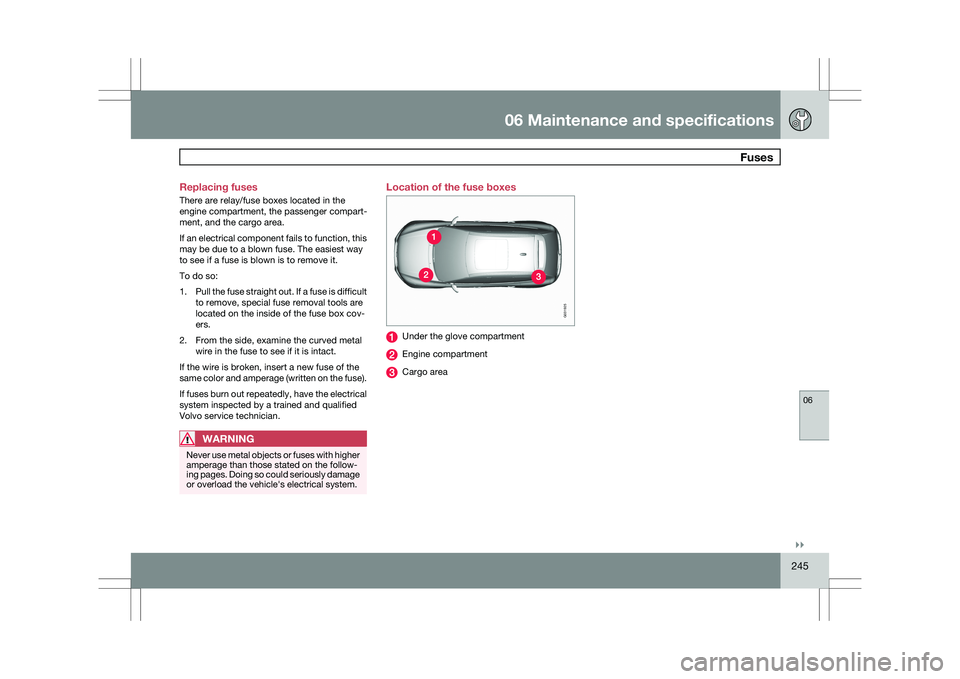
or overload the vehicle\fs electrical system. Location of the fuse boxes
Under the glove compartment
Engine compartment
Cargo area G031925
Page 256 of 297
06 Maintenance and specificationsWheels and tires 06
254 wheels to reduce the chance of oversteer
during hard braking.
\b Hitting curbs or potholes can damage the
tires and/or wheels permanently.
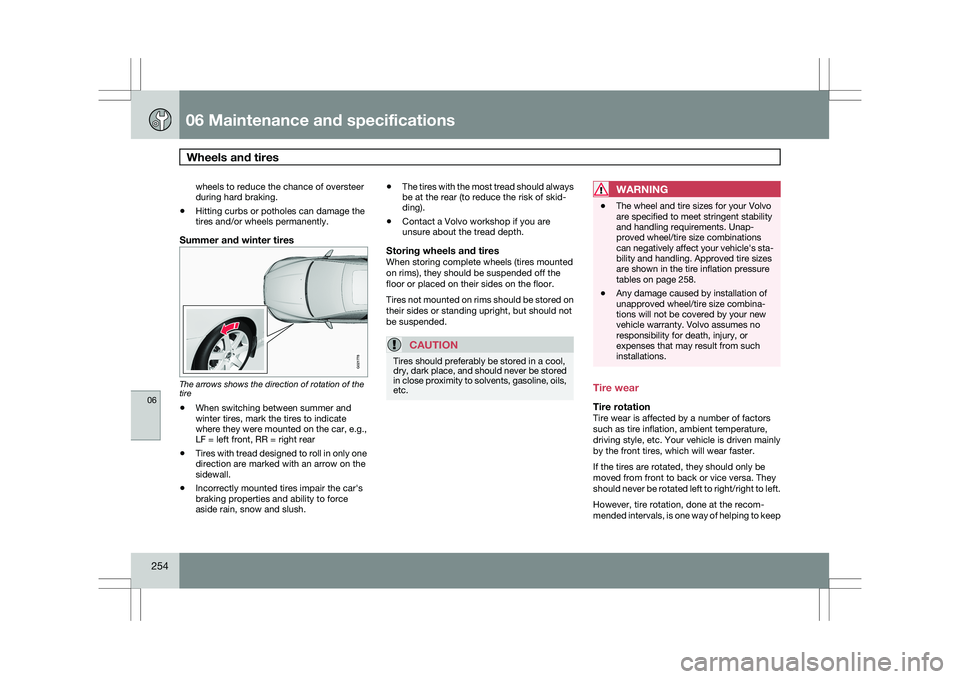
Summer and winter tires The arrows shows the direction of rotation of the
tire
\b
When switching between summer and
winter tires, mark the tires to indicate
where they were mounted on the car, e.g.,
LF = left front, RR = right rear
\b Tires with tread designed to roll in only one
direction are marked with an arrow on the
sidewall.
\b Incorrectly mounted tires impair the car\fs
braking properties and ability to force
aside rain, snow and slush. \b
The tires with the most tread should always
be at the rear (to reduce the risk of skid-
ding).
\b Contact a Volvo workshop if you are
unsure about the tread depth.Storing wheels and tiresWhen storing complete wheels (tires mounted
on rims), they should be suspended off the
floor or placed on their sides on the floor.
Tires not mounted on rims should be stored on
their sides or standing upright, but should not
be suspended.
CAUTION Tires should preferably be stored in a cool,
dry, dark place, and should never be stored
in close proximity to solvents, gasoline, oils,
etc.
WARNING \b
The wheel and tire sizes for your Volvo
are specified to meet stringent stability
and handling requirements. Unap-
proved wheel/tire size combinations
can negatively affect your vehicle\fs sta-
bility and handling. Approved tire sizes
are shown in the tire inflation pressure
tables on page 258.
\b Any damage caused by installation of
unapproved wheel/tire size combina-
tions will not be covered by your new
vehicle warranty. Volvo assumes no
responsibility for death, injury, or
expenses that may result from such
installations. Tire wear
Tire rotationTire wear is affected by a number of factors
such as tire inflation, ambient temperature,
driving style, etc. Your vehicle is driven mainly
by the front tires, which will wear faster.
If the tires are rotated, they should only be
moved from front to back or vice versa. They
should never be rotated left to right/right to left.
However, tire rotation, done at the recom-
mended intervals, is one way of helping to keep G021778
Page 258 of 297
06 Maintenance and specificationsWheels and tires 06
256
NOTE \b
The placards shown indicate inflation
pressure for the tires installed on the
vehicle at the factory only.
\b A certain amount of air seepage from
the tires occurs naturally and tire pres-
sure fluctuates with seasonal changes
in temperature. Always check tire pres-
sure regularly. \b
Use a tire gauge to check the tire inflation
pressure, including the spare, at least once
a month and before long trips. You are
strongly urged to buy a reliable tire pres-
sure gauge, as automatic service station
gauges may be inaccurate.
\b Use the recommended cold inflation pres-
sure for optimum tire performance and
wear.
\b Under-inflation or over-inflation may cause
uneven treadwear patterns.
NOTE A certain amount of air seepage from the
tires occurs naturally and tire pressure fluc-
tuates with seasonal changes in tempera-
ture. Always check tire pressure regularly.
WARNING \b
Under-inflation is the most common
cause of tire failure and may result in
severe tire cracking, tread separation,
or "blow-out," with unexpected loss of
vehicle control and increased risk of
injury.
\b Under-inflated tires reduce the load car-
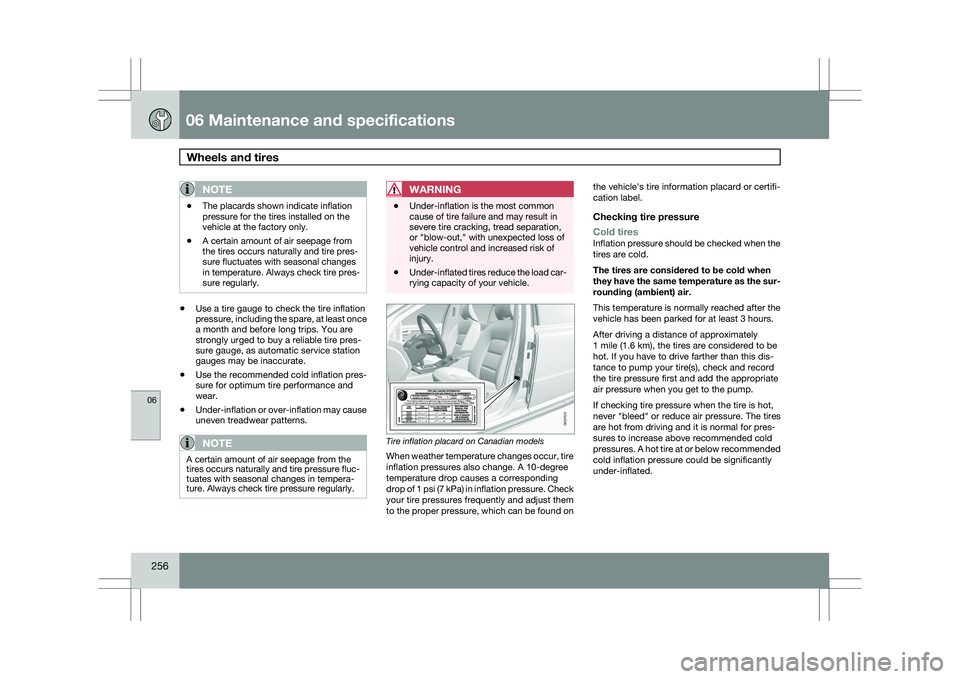
rying capacity of your vehicle. Tire inflation placard on Canadian models
When weather temperature changes occur, tire
inflation pressures also change. A 10-degree
temperature drop causes a corresponding
drop of 1 psi (7 kPa) in inflation pressure. Check
your tire pressures frequently and adjust them
to the proper pressure, which can be found onthe vehicle\fs tire information placard or certifi-
cation label.
Checking tire pressure
Cold tires
Inflation pressure should be checked when the
tires are cold.
The tires are considered to be cold when
they have the same temperature as the sur-
rounding (ambient) air.
This temperature is normally reached after the
vehicle has been parked for at least 3 hours.
After driving a distance of approximately
1 mile (1.6 km), the tires are considered to be
hot. If you have to drive farther than this dis-
tance to pump your tire(s), check and record
the tire pressure first and add the appropriate
air pressure when you get to the pump.
If checking tire pressure when the tire is hot,
never "bleed" or reduce air pressure. The tires
are hot from driving and it is normal for pres-
sures to increase above recommended cold
pressures. A hot tire at or below recommended
cold inflation pressure could be significantly
under-inflated. G032522
Page 262 of 297
06 Maintenance and specificationsWheels and tires 06
260 10.
Maximum Load: Indicates the maximum
load in pounds and kilograms that can be
carried by the tire. Refer to the vehicle\fs tire
information placard or the safety certifica-
tion label, located on the B-Pillar or the
driver\fs door or on the inside of the fuel filler
door on Canadian models, for the correct
tire pressure for your vehicle.
11. Treadwear, Traction, and Temperature
grades: see page 262 for more informa-
tion.
12. Maximum permissible inflation pressure: the greatest amount of air pressure that
should ever be put in the tire. This limit is
set by the tire manufacturer.
Glossary of tire terminology
The tire suppliers may have additional mark-
ings, notes or warnings such as standard load,
radial tubeless, etc.
\b Tire information placard: A placard
showing the OE (Original Equipment) tire
sizes, recommended inflation pressure,
and the maximum weight the vehicle can
carry.
\b Tire Identification Number (TIN)
: A num-
ber on the sidewall of each tire providing
information about the tire brand and man-
ufacturing plant, tire size and date of man-
ufacturer. \b
Inflation pressure: A measure of the
amount of air in a tire.
\b Standard load: A class of P-metric or Met-
ric tires designed to carry a maximum load
at 35 psi [37 psi (2.5 bar) for Metric tires].
Increasing the inflation pressure beyond
this pressure will not increase the tires load
carrying capability.
\b Extra load: A class of P-metric or Metric
tires designed to carry a heavier maximum
load at 41 psi [43 psi (2.9 bar) for Metric
tires]. Increasing the inflation pressure
beyond this pressure will not increase the
tire\fs load carrying capability.
\b kPa: Kilopascal, a metric unit of air pres-
sure.
\b PSI: Pounds per square inch, a standard
unit of air pressure.
\b B-pillar: The structural member at the side
of the vehicle behind the front door.
\b Bead area of the tire: Area of the tire next
to the rim.
\b Sidewall of the tire: Area between the
bead area and the tread.
\b Tread area of the tire: Area of the perim-
eter of the tire that contacts the road when
mounted on the vehicle.
\b Rim: The metal support (wheel) for a tire or
a tire and tube assembly upon which the
tire beads are seated. \b
Maximum load rating: a figure indicating
the maximum load in pounds and kilo-
grams that can be carried by the tire. This
rating is established by the tire manufac-
turer.
\b Maximum permissible inflation
pressure: the greatest amount of air pres-
sure that should ever be put in the tire. This
limit is set by the tire manufacturer.
\b Recommended tire inflation pressure:
inflation pressure, established by Volvo,
which is based on the type of tires that are
mounted on a vehicle at the factory. This
inflation pressure is affected by the number
of occupants in the vehicle, the amount of
cargo, and the speed at which the vehicle
will be driven for a prolonged period. This
information can be found on the tire infla-
tion placard(s) located on the driver\fs side
B-pillar or on the inside of the fuel filler door
on Canadian models, and in the tire infla-
tion table in this chapter.
\b Cold tires: The tires are considered to be
cold when they have the same temperature
as the surrounding (ambient) air. This tem-
perature is normally reached after the vehi-
cle has been parked for at least 3 hours.
Page 264 of 297
06 Maintenance and specificationsWheels and tires 06
262
WARNING \b
Exceeding the permissible axle weight,
gross vehicle weight, or any other
weight rating limits can cause tire over-
heating resulting in permanent defor-
mation or catastrophic failure.
\b Do not use replacement tires with lower
load carrying capacities than the tires
that were original equipment on the
vehicle because this will lower the vehi-
cle\fs GVW rating. Replacement tires
with a higher limit than the originals do
not increase the vehicle\fs GVW rating
limitations. Uniform Tire Quality Grading
ALL PASSENGER VEHICLE TIRES MUST
CONFORM TO FEDERAL SAFETY
REQUIREMENTS IN ADDITION TO THESE
GRADES
Quality grades can be found, where appli-
cable, on the tire sidewall between the tread
shoulder and maximum section width. For
example:
Treadwear 200 Traction AA Temperature A
TREADWEARThe treadwear grade is a comparative rating
based on the wear rate of the tire when tested
under controlled conditions on a specified gov- ernment test course. For example, a tire gra-
ded 150 would wear one and one half (1 1/2)
times as well on the government course as a
tire graded 100. The relative performance of
tires depends upon the actual conditions of
their use, however, and many depart signifi-
cantly from the norm due to variation in driving
habits, maintenance practices and differences
in road characteristics and climate.
TRACTIONThe traction grades, from highest to lowest, are
AA, A, B, and C, as measured under controlled
conditions on specified government test sur-
faces of asphalt and concrete. A tire marked C
may have poor traction performance. The trac-
tion grade assigned to this tire is based on
braking (straight-ahead) traction tests and is
not a measure of cornering (turning) traction.
WARNING
The traction grade assigned to this tire is
based on braking (straight-ahead) traction
tests and is not a measure of cornering
(turning) traction.
TEMPERATUREThe temperature grades are AA (the highest),
A, B, and C, representing the tire\fs resistance
to the generation of heat and its ability to dis-
sipate heat when tested under controlled con-ditions on a specified indoor laboratory test
wheel. Sustained high temperature can cause
the material of the tire to degenerate and
reduce tire life, and excessive temperature can
lead to sudden tire failure. The grade C corre-
sponds to a minimum level of performance that
all passenger vehicle tires must meet under the
Federal Motor Safety Standard No. 109.
Grades B and A represent higher levels of per-
formance on the laboratory test wheel than the
minimum required by law.
WARNING
The temperature grade for this tire is estab-
lished for a tire that is properly inflated and
not overloaded. Excessive speed, under-
inflation, or excessive loading, either sepa-
rately or in combination, can cause heat
buildup and tire failure.
Snow chains, snow tires, studded tires
Snow chainsSnow chains can be used on your Volvo with
the following restrictions:
\b
Snow chains should be installed on front
wheels only. Use only Volvo approved
snow chains.
\b If accessory, aftermarket or "custom" tires
and wheels are installed and are of a size
different than the original tires and wheels,