driver VOLVO XC60 2016 Owner´s Manual
[x] Cancel search | Manufacturer: VOLVO, Model Year: 2016, Model line: XC60, Model: VOLVO XC60 2016Pages: 398, PDF Size: 9.98 MB
Page 32 of 398
02 Safety
02
30
Seat belt reminder
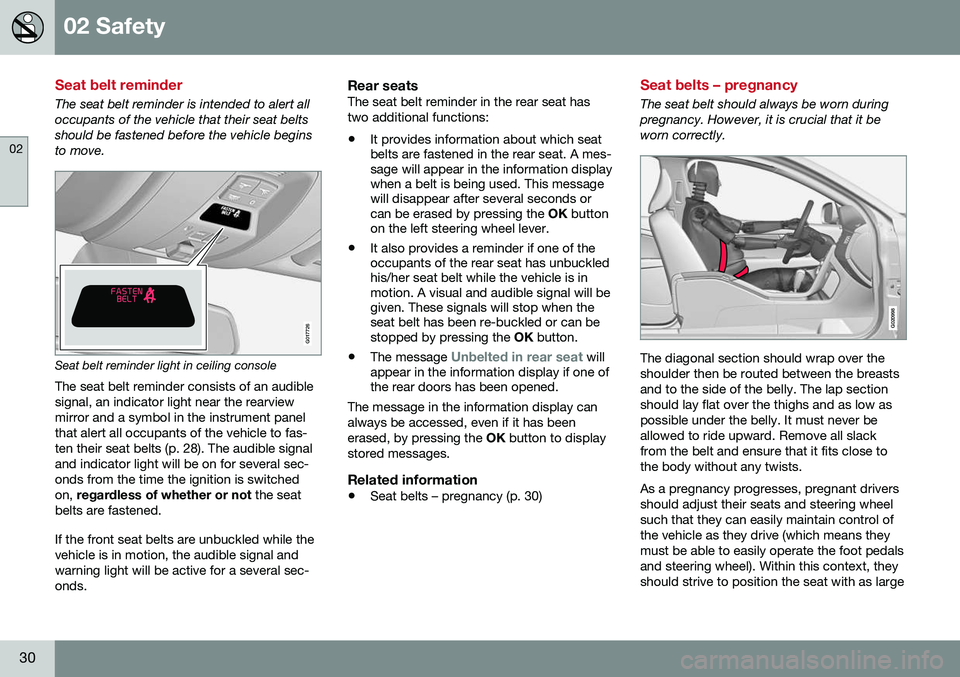
The seat belt reminder is intended to alert all occupants of the vehicle that their seat beltsshould be fastened before the vehicle beginsto move.
G017726
Seat belt reminder light in ceiling consoleThe seat belt reminder consists of an audible signal, an indicator light near the rearviewmirror and a symbol in the instrument panelthat alert all occupants of the vehicle to fas-ten their seat belts (p. 28). The audible signaland indicator light will be on for several sec-onds from the time the ignition is switchedon, regardless of whether or not the seat
belts are fastened. If the front seat belts are unbuckled while the vehicle is in motion, the audible signal andwarning light will be active for a several sec-onds.
Rear seatsThe seat belt reminder in the rear seat hastwo additional functions:
• It provides information about which seat belts are fastened in the rear seat. A mes-sage will appear in the information displaywhen a belt is being used. This messagewill disappear after several seconds orcan be erased by pressing the
OK button
on the left steering wheel lever.
• It also provides a reminder if one of theoccupants of the rear seat has unbuckledhis/her seat belt while the vehicle is inmotion. A visual and audible signal will begiven. These signals will stop when theseat belt has been re-buckled or can bestopped by pressing the
OK button.
• The message
Unbelted in rear seat will
appear in the information display if one of the rear doors has been opened.
The message in the information display can always be accessed, even if it has beenerased, by pressing the OK button to display
stored messages.
Related information
• Seat belts – pregnancy (p. 30)
Seat belts – pregnancy
The seat belt should always be worn during pregnancy. However, it is crucial that it beworn correctly.
G020998
The diagonal section should wrap over the shoulder then be routed between the breastsand to the side of the belly. The lap sectionshould lay flat over the thighs and as low aspossible under the belly. It must never beallowed to ride upward. Remove all slackfrom the belt and ensure that it fits close tothe body without any twists. As a pregnancy progresses, pregnant drivers should adjust their seats and steering wheelsuch that they can easily maintain control ofthe vehicle as they drive (which means theymust be able to easily operate the foot pedalsand steering wheel). Within this context, theyshould strive to position the seat with as large
Page 35 of 398
02 Safety
02
}}
33
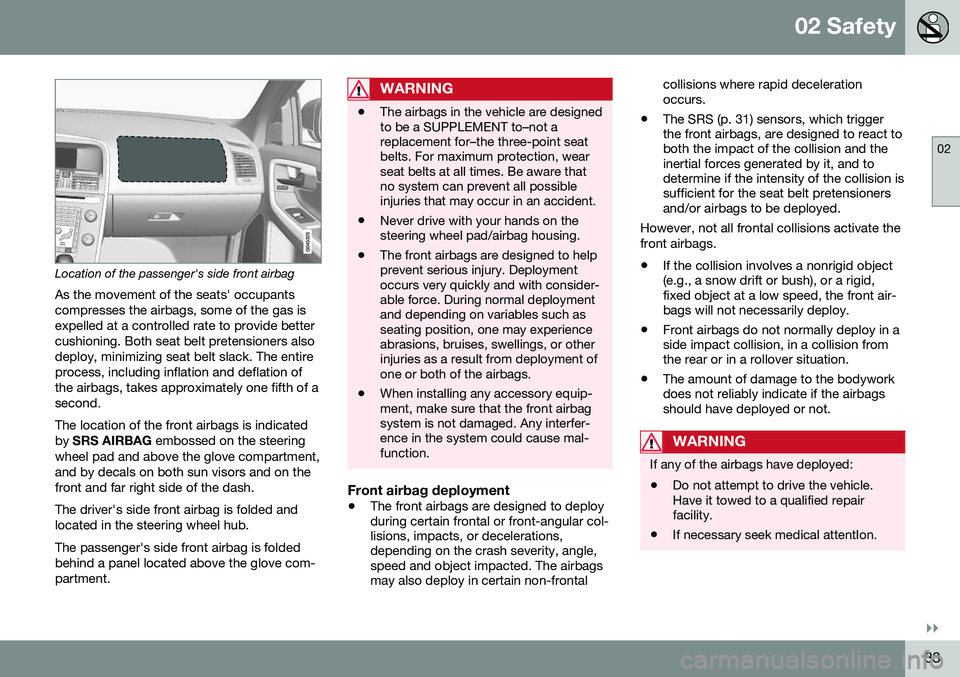
Location of the passenger's side front airbagAs the movement of the seats' occupants compresses the airbags, some of the gas isexpelled at a controlled rate to provide bettercushioning. Both seat belt pretensioners alsodeploy, minimizing seat belt slack. The entireprocess, including inflation and deflation ofthe airbags, takes approximately one fifth of asecond. The location of the front airbags is indicated by SRS AIRBAG embossed on the steering
wheel pad and above the glove compartment,and by decals on both sun visors and on thefront and far right side of the dash. The driver's side front airbag is folded and located in the steering wheel hub. The passenger's side front airbag is folded behind a panel located above the glove com-partment.
WARNING
• The airbags in the vehicle are designed to be a SUPPLEMENT to–not areplacement for–the three-point seatbelts. For maximum protection, wearseat belts at all times. Be aware thatno system can prevent all possibleinjuries that may occur in an accident.
• Never drive with your hands on thesteering wheel pad/airbag housing.
• The front airbags are designed to helpprevent serious injury. Deploymentoccurs very quickly and with consider-able force. During normal deploymentand depending on variables such asseating position, one may experienceabrasions, bruises, swellings, or otherinjuries as a result from deployment ofone or both of the airbags.
• When installing any accessory equip-ment, make sure that the front airbagsystem is not damaged. Any interfer-ence in the system could cause mal-function.
Front airbag deployment
•
The front airbags are designed to deploy during certain frontal or front-angular col-lisions, impacts, or decelerations,depending on the crash severity, angle,speed and object impacted. The airbagsmay also deploy in certain non-frontal collisions where rapid decelerationoccurs.
• The SRS (p. 31) sensors, which triggerthe front airbags, are designed to react toboth the impact of the collision and theinertial forces generated by it, and todetermine if the intensity of the collision issufficient for the seat belt pretensionersand/or airbags to be deployed.
However, not all frontal collisions activate the front airbags.
• If the collision involves a nonrigid object (e.g., a snow drift or bush), or a rigid,fixed object at a low speed, the front air-bags will not necessarily deploy.
• Front airbags do not normally deploy in aside impact collision, in a collision fromthe rear or in a rollover situation.
• The amount of damage to the bodyworkdoes not reliably indicate if the airbagsshould have deployed or not.
WARNING
If any of the airbags have deployed:
• Do not attempt to drive the vehicle. Have it towed to a qualified repairfacility.
• If necessary seek medical attentIon.
Page 39 of 398
02 Safety
02
}}
37
WARNING
•Never try to open, remove, or repair any components in the OWS system.This could result in system malfunc-tion. Maintenance or repairs shouldonly be carried out by an a trained andqualified Volvo service technician.
• The front passenger's seat should notbe modified in any way. This couldreduce pressure on the seat cushion,which might interfere with the OWSsystem's function.
Passeng- er's seatoccu-pancy sta-tusOWS indicatorlight sta-tusPasseng- er's sidefront air-bag status
Seat unoc- cupiedOWS indi- cator lightlights up.Passenger's side front air-bag disabled
Seat occu- pied by lowweightoccupant/ object AOWS indi- cator lightlights upPassenger's side front air-bag disabled
Seat occu- pied byheavy occu-pant/objectOWS indi- cator lightis
not litPassenger's side front air-bag enabled
A
Volvo recommends that children always be properly restrained in appropriate child restraints in the rear seats.Do not assume that the passenger's side front airbag isdisabled unless the PASSENGER AIRBAG OFF indicatorlamp is lit. Make sure the child restraint is properly instal-led. If there is any doubt as to the status of the passeng-er's side front airbag, move the child restraint to the rearseat.
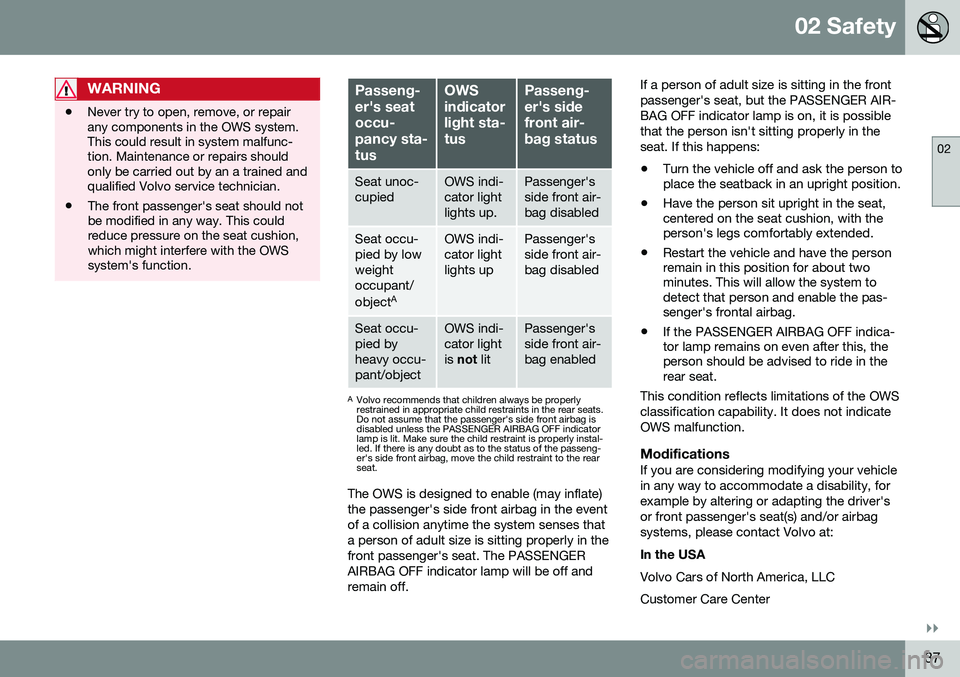
The OWS is designed to enable (may inflate) the passenger's side front airbag in the eventof a collision anytime the system senses thata person of adult size is sitting properly in thefront passenger's seat. The PASSENGERAIRBAG OFF indicator lamp will be off andremain off. If a person of adult size is sitting in the frontpassenger's seat, but the PASSENGER AIR-BAG OFF indicator lamp is on, it is possiblethat the person isn't sitting properly in theseat. If this happens:
• Turn the vehicle off and ask the person to place the seatback in an upright position.
• Have the person sit upright in the seat,centered on the seat cushion, with theperson's legs comfortably extended.
• Restart the vehicle and have the personremain in this position for about twominutes. This will allow the system todetect that person and enable the pas-senger's frontal airbag.
• If the PASSENGER AIRBAG OFF indica-tor lamp remains on even after this, theperson should be advised to ride in therear seat.
This condition reflects limitations of the OWS classification capability. It does not indicateOWS malfunction.
ModificationsIf you are considering modifying your vehiclein any way to accommodate a disability, forexample by altering or adapting the driver'sor front passenger's seat(s) and/or airbagsystems, please contact Volvo at: In the USA Volvo Cars of North America, LLC Customer Care Center
Page 41 of 398
02 Safety
02
}}
39
WARNING
•Do not place any type of object on the front passenger's seat in such a waythat jamming, pressing, or squeezingoccurs between the object and thefront seat, other than as a direct resultof the correct use of the AutomaticLocking Retractor/Emergency LockingRetractor (ALR/ELR) seat belt (Childrestraints (p. 47)).
• No objects should be placed under thefront passenger's seat. This couldinterfere with the OWS system's func-tion.
Related information
•
Supplemental Restraint System (SRS) (p. 31)
Side impact protection (SIPS) airbags
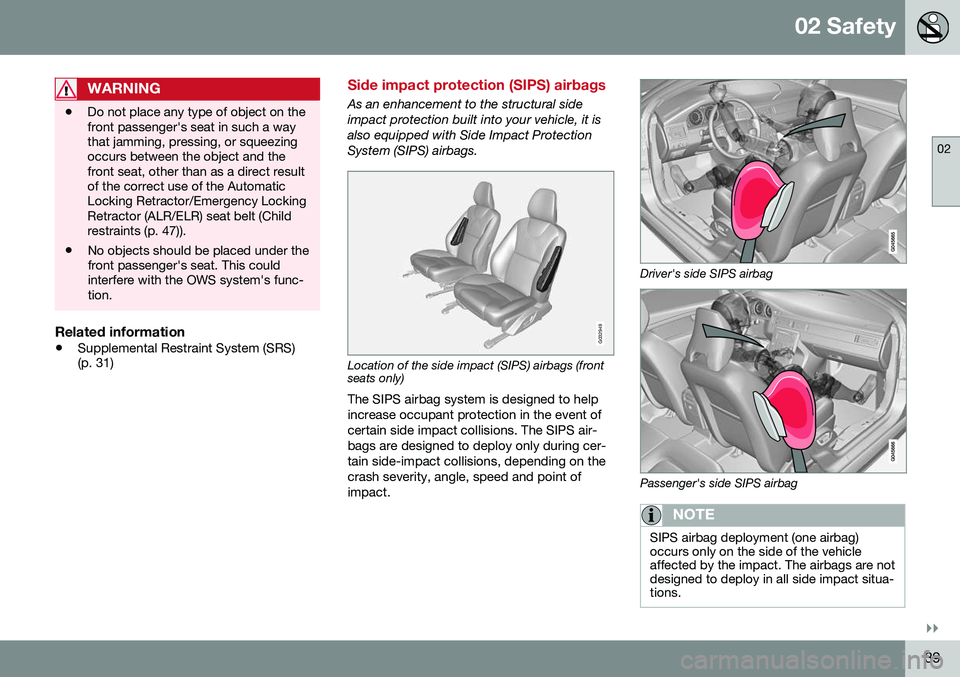
As an enhancement to the structural side impact protection built into your vehicle, it isalso equipped with Side Impact ProtectionSystem (SIPS) airbags.
G032949
Location of the side impact (SIPS) airbags (front seats only) The SIPS airbag system is designed to help increase occupant protection in the event ofcertain side impact collisions. The SIPS air-bags are designed to deploy only during cer-tain side-impact collisions, depending on thecrash severity, angle, speed and point ofimpact.
Driver's side SIPS airbag
Passenger's side SIPS airbag
NOTE
SIPS airbag deployment (one airbag) occurs only on the side of the vehicleaffected by the impact. The airbags are notdesigned to deploy in all side impact situa-tions.
Page 46 of 398
02 Safety
02
44* Option/accessory, for more information, see Introduction.
Rollover Protection System (ROPS)
Volvo's Roll-Over Protection System (ROPS) utilizes the Roll Stability Control (RSC) func-tion and has been designed to help minimizethe risk of a rollover in emergency maneuversor if a skid should occur. RSC uses a gyroscopic sensor that registers the amount of change in the lateral angle atwhich the vehicle is leaning. Using this infor-mation, RSC calculates the likelihood of arollover. If there is an imminent risk of a roll-over, the stability system is activated, powerto the engine is cut and the brakes areapplied to one or more of the wheels until thevehicle regains stability.
WARNING
The vehicle’s stability systems, including ROPS and RSC, do not replace thedriver’s responsibility for operating thevehicle in a safe manner. Speed and driv-ing style should always be adapted to thecurrent road, traffic and weather condi-tions. Posted speed limits should alwaysbe respected.
Crash mode – general information
After a collision, the functionality of some of the vehicle's systems may be reduced as asafety precaution.
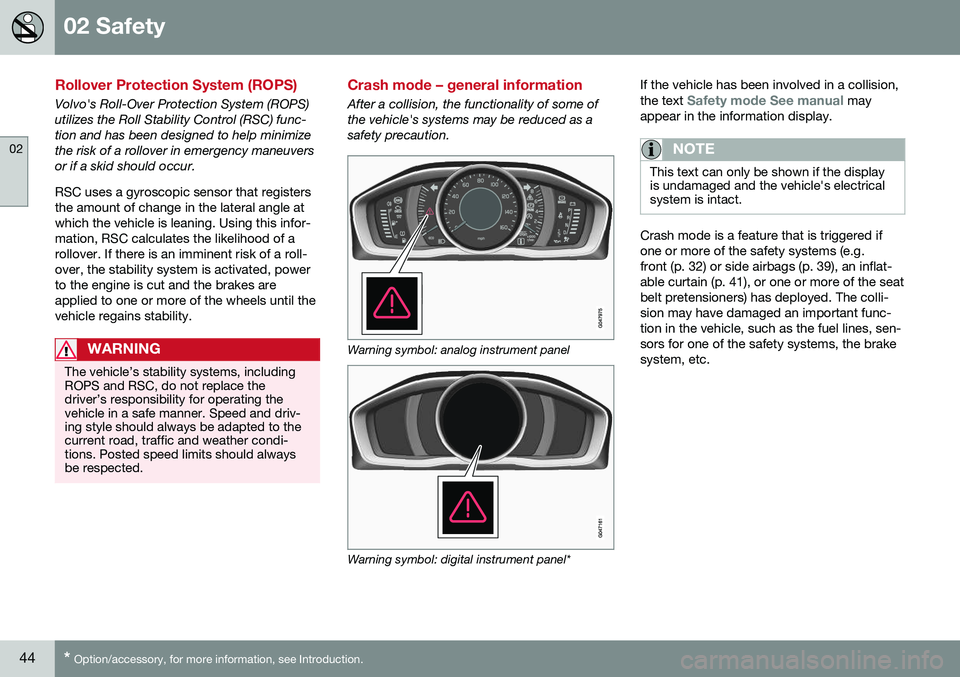
Warning symbol: analog instrument panel
Warning symbol: digital instrument panel* If the vehicle has been involved in a collision, the text
Safety mode See manual may
appear in the information display.
NOTE
This text can only be shown if the display is undamaged and the vehicle's electricalsystem is intact.
Crash mode is a feature that is triggered if one or more of the safety systems (e.g.front (p. 32) or side airbags (p. 39), an inflat-able curtain (p. 41), or one or more of the seatbelt pretensioners) has deployed. The colli-sion may have damaged an important func-tion in the vehicle, such as the fuel lines, sen-sors for one of the safety systems, the brakesystem, etc.
Page 47 of 398
02 Safety
02
45
WARNING
•Never attempt to repair the vehicle yourself or to reset the electrical sys-tem after the vehicle has displayed
Safety mode See manual. This could
result in injury or improper system function.
• Restoring the vehicle to normal operat-ing status should only be done by atrained and qualified Volvo servicetechnician.
• After
Safety mode See manual has
been displayed, if you detect the odor of fuel vapor, or see any signs of fuelleakage, do not attempt to start thevehicle. Leave the vehicle immediately.
Related information
• Crash mode – starting the vehicle (p. 45)
• Crash mode – moving the vehicle(p. 45)
Crash mode – starting the vehicle
If Crash mode has been set Crash mode (p. 44)) and damage to the vehicle isminor and there is no fuel leakage, you mayattempt to start the engine. To do so:
1. Remove the remote key from the ignition
slot and open the driver's door. If a mes- sage is displayed that the ignition is on,press the start button.
2. Close the driver's door and reinsert the remote key in the ignition slot.
3. Try to start the vehicle.
WARNING
If the message Safety mode See manualis still displayed, the vehicle should not be driven and must be towed. Concealedfaults may make the vehicle difficult tocontrol.
Related information
• Crash mode – general information (p. 44)
• Crash mode – moving the vehicle (p. 45)
Crash mode – moving the vehicle
If the message Normal mode appears after
an attempt has been made to start the engine, Starting the vehicle after a crash (p. 45), thevehicle may be moved carefully from its pres-ent position, if for example, it is blocking traf-fic. It should, however, not be moved fartherthan is absolutely necessary.
WARNING
Even if the vehicle appears to be drivable after Crash mode has been set, it shouldnot be driven or towed (pulled by anothervehicle). There may be concealed damagethat could make it difficult or impossible tocontrol. The vehicle should be transportedon a flatbed tow truck to a trained andqualified Volvo service technician forinspection/repairs.
Related information
• Crash mode – general information (p. 44)
Page 50 of 398
||
02 Safety
02
48
G022847
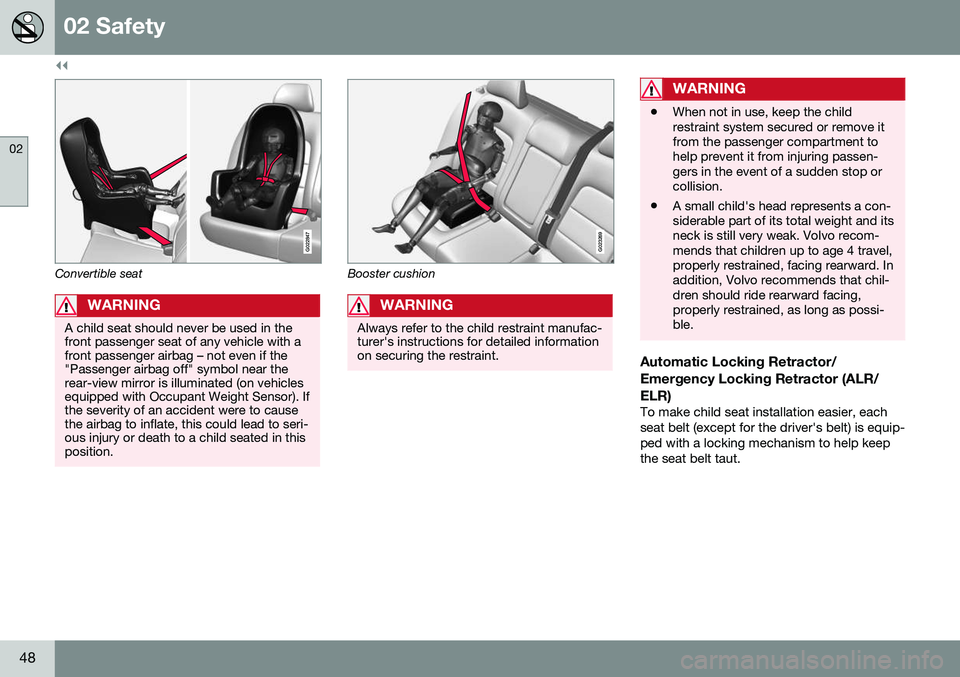
Convertible seat
WARNING
A child seat should never be used in the front passenger seat of any vehicle with afront passenger airbag – not even if the"Passenger airbag off" symbol near therear-view mirror is illuminated (on vehiclesequipped with Occupant Weight Sensor). Ifthe severity of an accident were to causethe airbag to inflate, this could lead to seri-ous injury or death to a child seated in thisposition.
G023269
Booster cushion
WARNING
Always refer to the child restraint manufac- turer's instructions for detailed informationon securing the restraint.
WARNING
•When not in use, keep the child restraint system secured or remove itfrom the passenger compartment tohelp prevent it from injuring passen-gers in the event of a sudden stop orcollision.
• A small child's head represents a con-siderable part of its total weight and itsneck is still very weak. Volvo recom-mends that children up to age 4 travel,properly restrained, facing rearward. Inaddition, Volvo recommends that chil-dren should ride rearward facing,properly restrained, as long as possi-ble.
Automatic Locking Retractor/ Emergency Locking Retractor (ALR/ELR)
To make child seat installation easier, each seat belt (except for the driver's belt) is equip-ped with a locking mechanism to help keepthe seat belt taut.
Page 52 of 398
||
02 Safety
02
50
G023270
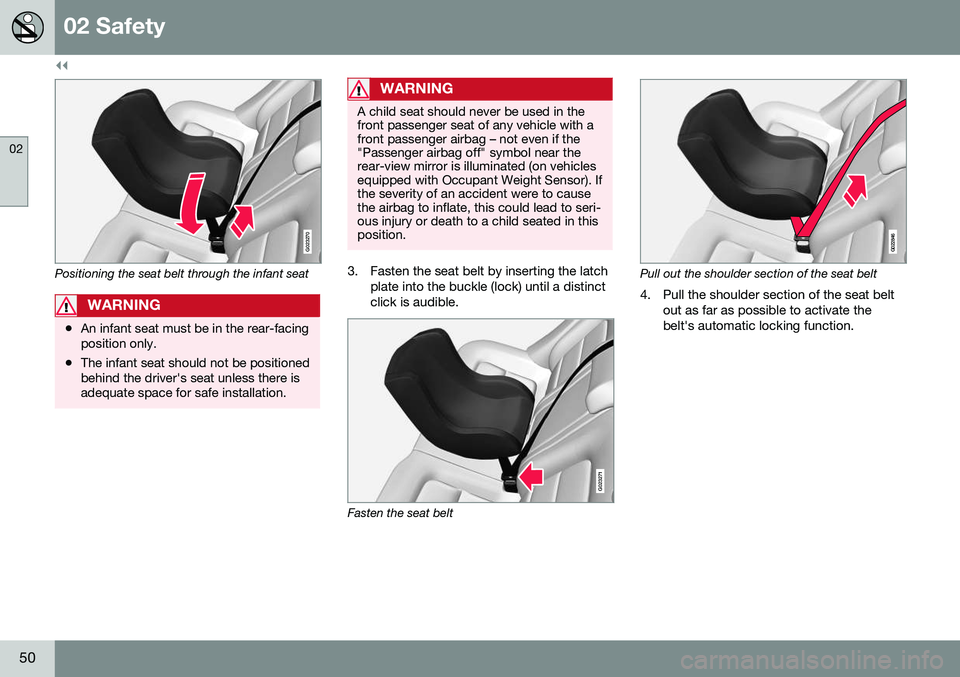
Positioning the seat belt through the infant seat
WARNING
•An infant seat must be in the rear-facing position only.
• The infant seat should not be positionedbehind the driver's seat unless there isadequate space for safe installation.
WARNING
A child seat should never be used in the front passenger seat of any vehicle with afront passenger airbag – not even if the"Passenger airbag off" symbol near therear-view mirror is illuminated (on vehiclesequipped with Occupant Weight Sensor). Ifthe severity of an accident were to causethe airbag to inflate, this could lead to seri-ous injury or death to a child seated in thisposition.
3. Fasten the seat belt by inserting the latch
plate into the buckle (lock) until a distinct click is audible.
G023271
Fasten the seat belt
G022846
Pull out the shoulder section of the seat belt
4. Pull the shoulder section of the seat belt out as far as possible to activate the belt's automatic locking function.
Page 54 of 398
||
02 Safety
02
52
G022847
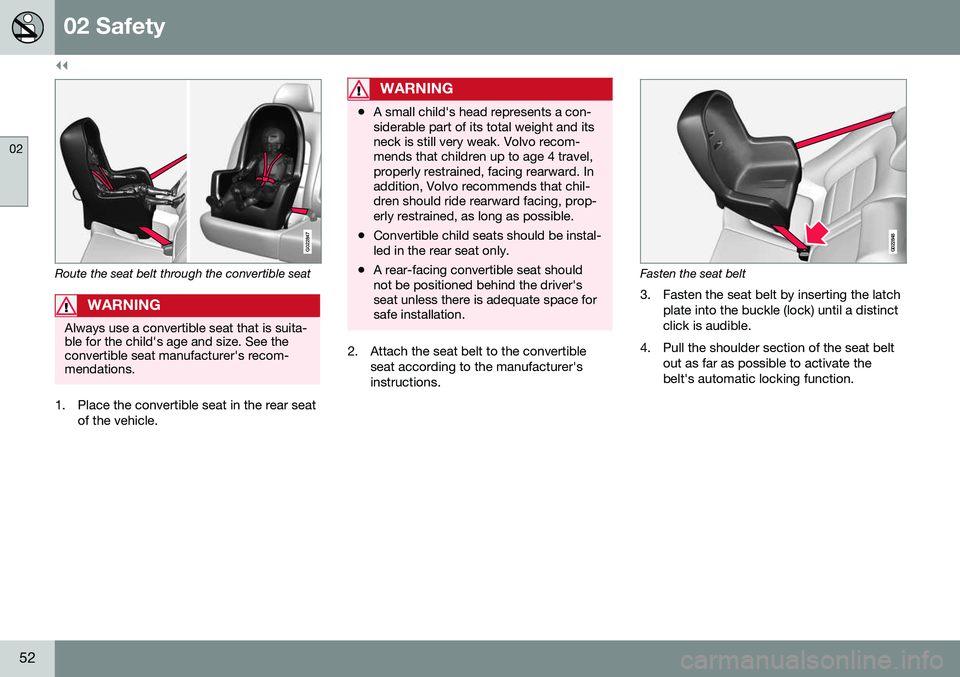
Route the seat belt through the convertible seat
WARNING
Always use a convertible seat that is suita- ble for the child's age and size. See theconvertible seat manufacturer's recom-mendations.
1. Place the convertible seat in the rear seatof the vehicle.
WARNING
•A small child's head represents a con- siderable part of its total weight and itsneck is still very weak. Volvo recom-mends that children up to age 4 travel,properly restrained, facing rearward. Inaddition, Volvo recommends that chil-dren should ride rearward facing, prop-erly restrained, as long as possible.
• Convertible child seats should be instal-led in the rear seat only.
• A rear-facing convertible seat shouldnot be positioned behind the driver'sseat unless there is adequate space forsafe installation.
2. Attach the seat belt to the convertible
seat according to the manufacturer's instructions.
G022848
Fasten the seat belt
3. Fasten the seat belt by inserting the latch plate into the buckle (lock) until a distinct click is audible.
4. Pull the shoulder section of the seat belt out as far as possible to activate thebelt's automatic locking function.
Page 63 of 398
02 Safety
02
}}
* Option/accessory, for more information, see Introduction.61
WARNING
DEATH or SERIOUS INJURY can occur Follow all instructions on the booster cushion and in the vehi-cle's owner's manual. MAKE SURE THE BOOSTER CUSHION IS SECURELYLOCKED BEFORE THE CHILD ISSEATED. • Use this booster cushion only with children whose height and weight arewithin the permitted limits shown inthe table (Integrated booster cushion –general information (p. 57)).
• In the event of a collision while theintegrated booster cushion was occu-pied, the entire booster cushion andseat belt must be replaced. Thebooster cushion should also bereplaced if it is badly worn or damagedin any way. This work should be per-formed by a trained and qualifiedVolvo service technician only.
Related information
•
Integrated booster cushion – using (p. 59)
Child safety locks
Power child safety locks* help prevent chil- dren from inadvertently opening one of therear doors or windows from inside the vehicle.
Manual child safety locks
G021077
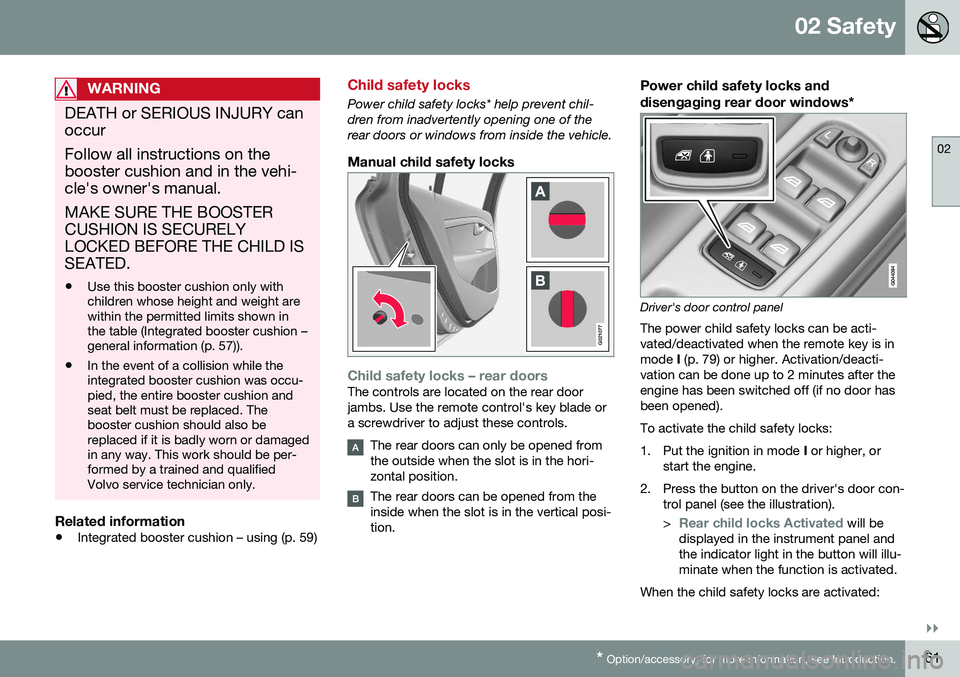
Child safety locks – rear doorsThe controls are located on the rear door jambs. Use the remote control's key blade ora screwdriver to adjust these controls.
The rear doors can only be opened from the outside when the slot is in the hori-zontal position.
The rear doors can be opened from the inside when the slot is in the vertical posi-tion.
Power child safety locks and
disengaging rear door windows*
Driver's door control panel
The power child safety locks can be acti- vated/deactivated when the remote key is inmode I (p. 79) or higher. Activation/deacti-
vation can be done up to 2 minutes after theengine has been switched off (if no door hasbeen opened). To activate the child safety locks:
1. Put the ignition in mode I or higher, or
start the engine.
2. Press the button on the driver's door con- trol panel (see the illustration). >
Rear child locks Activated will be
displayed in the instrument panel and the indicator light in the button will illu-minate when the function is activated.
When the child safety locks are activated: