low beam VOLVO XC70 2016 Owner´s Manual
[x] Cancel search | Manufacturer: VOLVO, Model Year: 2016, Model line: XC70, Model: VOLVO XC70 2016Pages: 396, PDF Size: 10.01 MB
Page 101 of 396
03 Instruments and controls
03
* Option/accessory, for more information, see Introduction.99
DeactivatingDeactivate the rain sensor by pressing the button
or press the lever down to
another wiper position. The rain sensor is automatically deactivated when the key is removed from the ignitionslot or five minutes after the ignition has beenswitched off.
CAUTION
The rain sensor should be deactivated when washing the car in an automatic carwash, etc. If the rain sensor function is lefton, the wipers will start inadvertently in thecar wash and could be damaged.
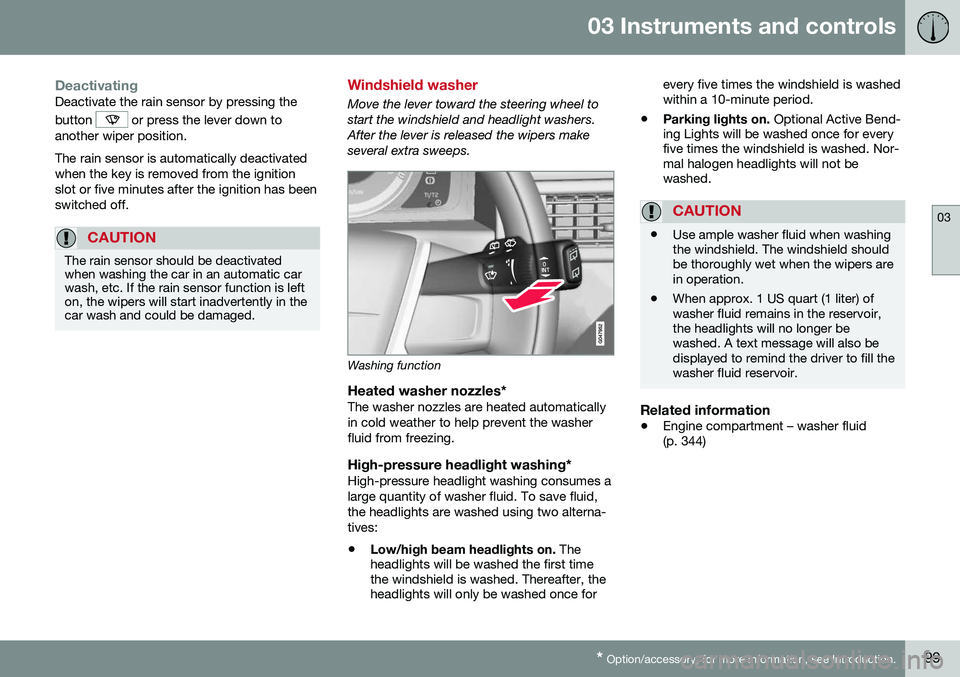
Windshield washer
Move the lever toward the steering wheel to start the windshield and headlight washers.After the lever is released the wipers makeseveral extra sweeps.
Washing function
Heated washer nozzles*The washer nozzles are heated automatically in cold weather to help prevent the washerfluid from freezing.
High-pressure headlight washing*High-pressure headlight washing consumes alarge quantity of washer fluid. To save fluid,the headlights are washed using two alterna-tives:
• Low/high beam headlights on.
The
headlights will be washed the first time the windshield is washed. Thereafter, theheadlights will only be washed once for every five times the windshield is washedwithin a 10-minute period.
• Parking lights on.
Optional Active Bend-
ing Lights will be washed once for everyfive times the windshield is washed. Nor-mal halogen headlights will not bewashed.
CAUTION
• Use ample washer fluid when washing the windshield. The windshield shouldbe thoroughly wet when the wipers arein operation.
• When approx. 1 US quart (1 liter) ofwasher fluid remains in the reservoir,the headlights will no longer bewashed. A text message will also bedisplayed to remind the driver to fill thewasher fluid reservoir.
Related information
•
Engine compartment – washer fluid (p. 344)
Page 206 of 396
07 Driver support
07
204
City Safety – operation
Using City Safety™
NOTE
The City Safety™ function is activated automatically each time the engine hasbeen switched off and restarted.
On and OffIn certain situations, it may be desirable to switch City Safety™ off, such as when drivingin close quarters where leaves, branches, etc.may obscure the hood and windshield. When the engine is running, City Safety™ can be switched off as follows: Press My Car in the center console control
panel and go to
SettingsCar settings
Driver support systemsCity Safety.
Select
Off.
If the engine is switched off, City Safety™ will reactivate when the engine is restarted.
WARNING
The laser sensor emits light when the igni- tion is in mode II or higher, even if City
Safety™ has been switched off.
To switch City Safety™ on again:
• Follow the same procedure as for switch- ing City Safety™ off but select
On.
Related information
•City Safety – introduction (p. 202)
• City Safety – function (p. 203)
• City Safety – limitations (p. 204)
• City Safety – troubleshooting (p. 205)
• City Safety – symbols and messages (p. 207)
• City Safety – Laser sensor (p. 208)
• My Car – introduction (p. 76)
City Safety – limitations
Limitations
WARNING
The laser sensor has certain limitations and its function may be reduced (or it maynot function at all) in conditions such asheavy rain or snowfall, or by dense fog orthick, blowing dust or snow. Condensa-tion, dirt, ice or snow on the windshieldmay also interfere with the sensor’s func-tion.
The sensor used by City Safety™ is designed to detect cars and other larger motor vehiclesahead of your vehicle in both daylight anddarkness. Objects such as warning flags hanging from long objects on the roof or accessories suchas auxiliary lights or protective arches on thefront of the vehicle that are higher than thehood may also impede the sensor’s function. Braking distance to the vehicle ahead increa- ses on slippery road surfaces, which mayreduce City Safety’s capacity to avoid a colli-sion. In situations like this, the stability sys-tem (see Stability system – introduction(p. 175)) will help provide the best possiblebraking capacity and stability. City Safety™ emits a laser beam and meas- ures the way in which the light is reflected.
Page 210 of 396
07 Driver support
07
208
City Safety – Laser sensor
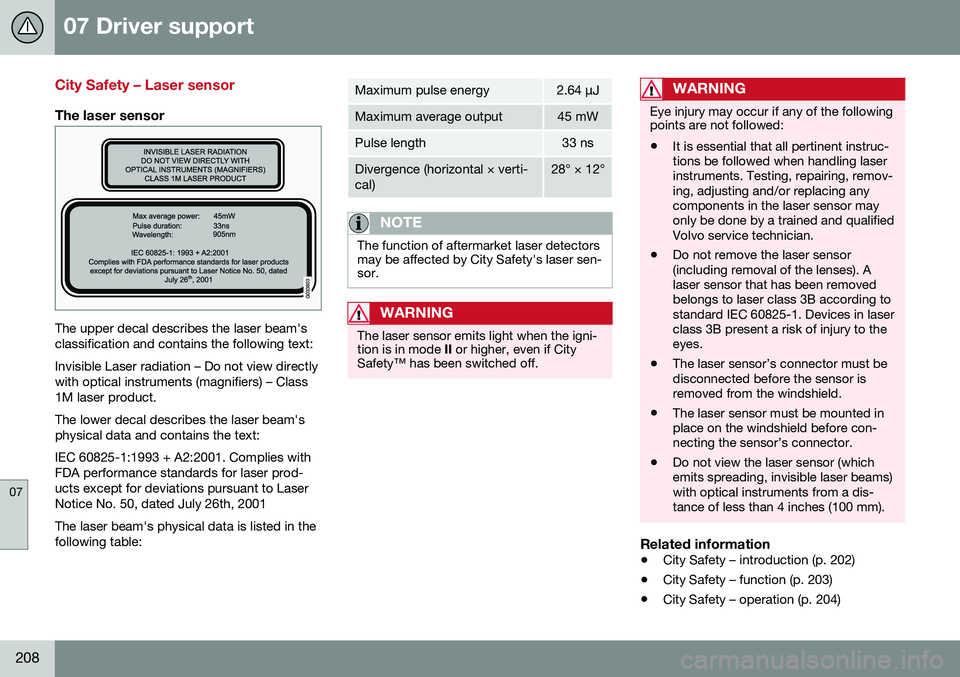
The laser sensor
The upper decal describes the laser beam's classification and contains the following text: Invisible Laser radiation – Do not view directly with optical instruments (magnifiers) – Class1M laser product. The lower decal describes the laser beam's physical data and contains the text: IEC 60825-1:1993 + A2:2001. Complies with FDA performance standards for laser prod-ucts except for deviations pursuant to LaserNotice No. 50, dated July 26th, 2001 The laser beam's physical data is listed in the following table:
Maximum pulse energy2.64 μJ
Maximum average output45 mW
Pulse length33 ns
Divergence (horizontal × verti- cal)28° × 12°
NOTE
The function of aftermarket laser detectors may be affected by City Safety's laser sen-sor.
WARNING
The laser sensor emits light when the igni- tion is in mode II or higher, even if City
Safety™ has been switched off.
WARNING
Eye injury may occur if any of the following points are not followed: • It is essential that all pertinent instruc- tions be followed when handling laserinstruments. Testing, repairing, remov-ing, adjusting and/or replacing anycomponents in the laser sensor mayonly be done by a trained and qualifiedVolvo service technician.
• Do not remove the laser sensor(including removal of the lenses). Alaser sensor that has been removedbelongs to laser class 3B according tostandard IEC 60825-1. Devices in laserclass 3B present a risk of injury to theeyes.
• The laser sensor’s connector must bedisconnected before the sensor isremoved from the windshield.
• The laser sensor must be mounted inplace on the windshield before con-necting the sensor’s connector.
• Do not view the laser sensor (whichemits spreading, invisible laser beams)with optical instruments from a dis-tance of less than 4 inches (100 mm).
Related information
•
City Safety – introduction (p. 202)
• City Safety – function (p. 203)
• City Safety – operation (p. 204)
Page 219 of 396
07 Driver support
07
* Option/accessory, for more information, see Introduction.217
The camera’s limitations
The camera has the same limitations as the human eye. The camera is used by Pedestrian and Cyclist Detection with Full Auto Brake Collision warn-ing – introduction (p. 209), Active High Beams(Active high beams (AHB)* (p. 90)), Road SignInformation (Road Sign Information (RSI)* –introduction (p. 179)) and Driver Alert System(Driver Alert System (p. 222)) with LaneDeparture Warning.
NOTE
• To help protect the camera in very hot conditions, it may be temporarilyswitched off for approximately 15minutes after the engine has beenstarted.
• Keep the section of the windshield infront of the camera clean and free ofice, snow, or condensation.
WARNING
•
The camera has the same type of limi- tations as the human eye, i.e., it can-not see as well in heavy snowfall orrain, thick fog or in heavy blowing dustor snow. In such conditions, systemsdepending on the camera may experi-ence greatly reduced functionality ormay be temporarily deactivated.
• Never place any objects, decals, etc.,on the windshield in front of the cam-era. This could reduce or block thecamera’s function, and could causeone or more of the systems that utilizethe camera to stop functioning.
• Strong sunlight, reflections from theroad surface, ice or snow covering theroad, a dirty road surface, or unclearlane marker lines may drasticallyreduce the camera’s capacity todetect the side of a lane, a pedestrian,a cyclist or another vehicle.
Related information
•
Collision warning – introduction (p. 209)
• Collision warning* – function (p. 211)
• Collision warning* – operation (p. 212)
• Collision warning* – Pedestrian detection (p. 214)
• Collision warning* – Cyclist detection(p. 213)
• Collision warning* – limitations (p. 215) •
Collision warning – troubleshooting(p. 218)
• Collision warning – symbols and mes-sages (p. 220)
• Road Sign Information (RSI)* – introduc-tion (p. 179)
• Driver Alert System (p. 222)
• Active high beams (AHB)* (p. 90)
Page 275 of 396
08 Starting and driving
08
}}
273
Engine and cooling system
Under special conditions, for example when driving in hilly terrain, extreme heat or withheavy loads, there is a risk that the engine andcooling system will overheat. Proceed as follows to avoid overheating the engine. •Maintain a low speed when driving with a trailer up long, steep hills. For informa-tion, see Towing a trailer (p. 281)
• Do not turn the engine off immediatelywhen stopping after a hard drive.
WARNING
The cooling fan may start or continue to operate (for up to 6 minutes) after theengine has been switched off.
•
Remove any auxiliary lights from in front of the grille when driving in hot weatherconditions.
• Do not exceed engine speeds of4500 rpm if driving with a trailer in hillyterrain. The oil temperature could becometoo high.
Conserving electrical current
Keep the following in mind to help minimize battery drain:
• When the engine is not running, avoid using ignition mode
II. Many electrical
systems (the audio system, the optionalnavigation system, power windows, etc)will function in ignition modes 0 and I.
These modes reduce drain on the battery.
• Please keep in mind that using systems,accessories, etc., that consume a greatdeal of current when the engine is notrunning could result in the battery beingcompletely drained. Driving or having theengine running for approximately15 minutes will help keep the batterycharged.
• The optional 12-volt socket in the cargoarea (p. 141) area provides electrical cur-rent even with the ignition switched off,which drains the battery.
Before a long distance trip
It is always worthwhile to have your vehicle checked by a trained and qualified Volvo serv-ice technician before driving long distances.Your retailer will also be able to supply youwith bulbs, fuses, spark plugs and wiperblades for your use in the event that problemsoccur. As a minimum, the following items should be checked before any long trip:
• Check that engine runs smoothly and that fuel consumption is normal.
• Check for fuel, oil, and fluid leakage.
• Have the transmission oil level (p. 377)checked.
• Check condition of drive belts.
• Check state of the battery's charge.
• Examine tires carefully (the spare tire aswell), and replace those that areworn (p. 290). Check tire pres-sure (p. 297).
• The brakes, front wheel alignment, andsteering gear should be checked by atrained and qualified Volvo service techni-cian only.
• Check all lights, including high beams.
• Reflective warning triangles are legallyrequired in some states/provinces.
• Have a word with a trained and qualifiedVolvo service technician if you intend to
Page 338 of 396
10 Maintenance and servicing
10
336
Bulbs – cover
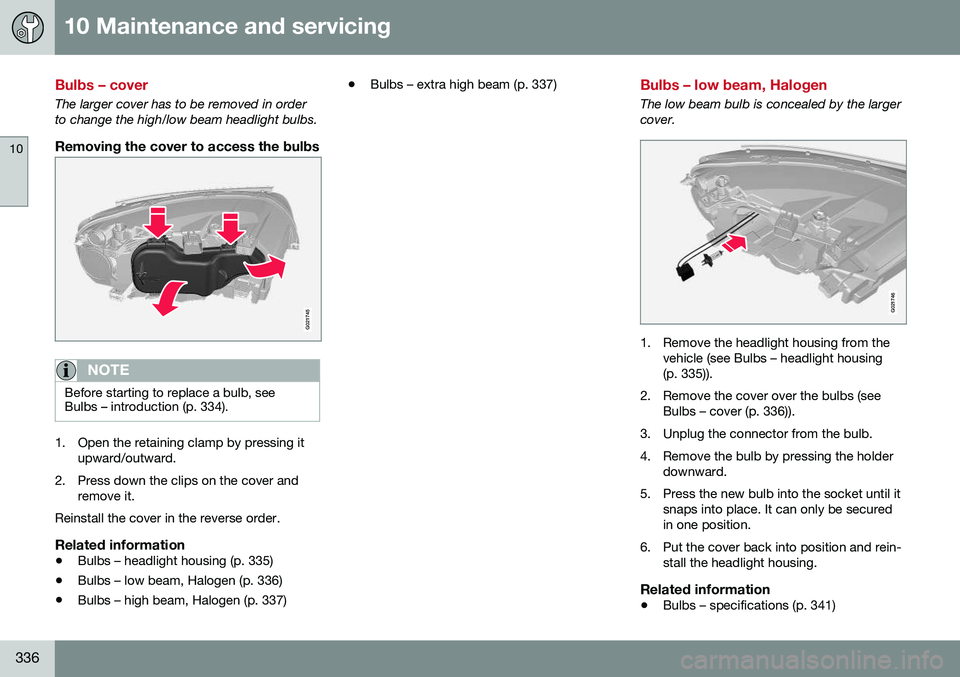
The larger cover has to be removed in order to change the high/low beam headlight bulbs.
Removing the cover to access the bulbs
G021745
NOTE
Before starting to replace a bulb, see Bulbs – introduction (p. 334).
1. Open the retaining clamp by pressing itupward/outward.
2. Press down the clips on the cover and remove it.
Reinstall the cover in the reverse order.
Related information
• Bulbs – headlight housing (p. 335)
• Bulbs – low beam, Halogen (p. 336)
• Bulbs – high beam, Halogen (p. 337) •
Bulbs – extra high beam (p. 337)
Bulbs – low beam, Halogen
The low beam bulb is concealed by the larger cover.
G021746
1. Remove the headlight housing from the
vehicle (see Bulbs – headlight housing (p. 335)).
2. Remove the cover over the bulbs (see Bulbs – cover (p. 336)).
3. Unplug the connector from the bulb.
4. Remove the bulb by pressing the holder downward.
5. Press the new bulb into the socket until it snaps into place. It can only be secured in one position.
6. Put the cover back into position and rein- stall the headlight housing.
Related information
• Bulbs – specifications (p. 341)
Page 343 of 396
10 Maintenance and servicing
10
* Option/accessory, for more information, see Introduction.341
Bulbs – vanity mirror lighting
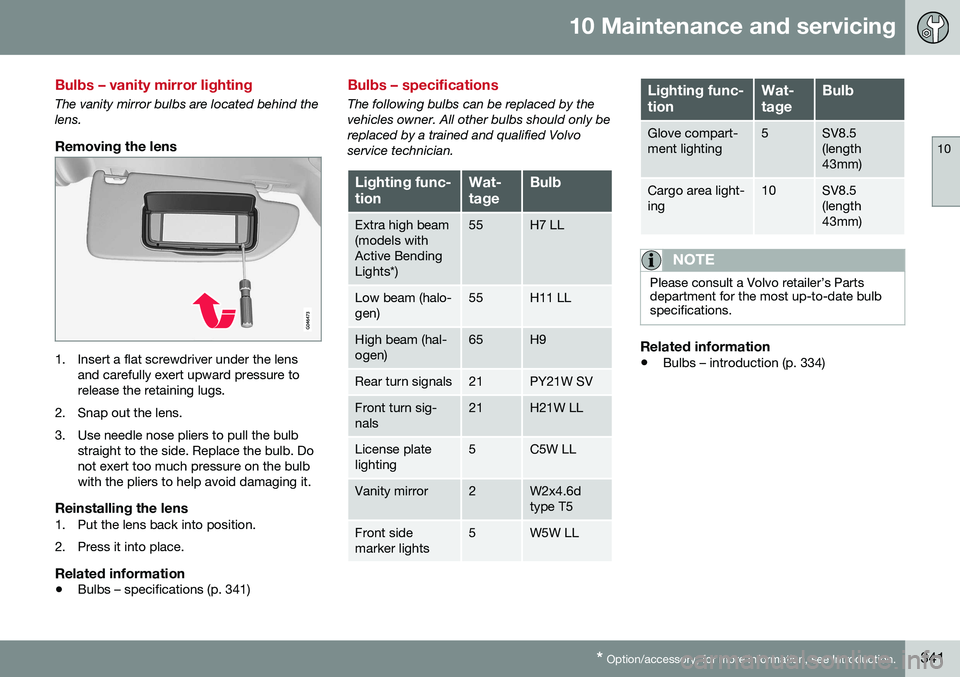
The vanity mirror bulbs are located behind the lens.
Removing the lens
1. Insert a flat screwdriver under the lens
and carefully exert upward pressure to release the retaining lugs.
2. Snap out the lens.
3. Use needle nose pliers to pull the bulb straight to the side. Replace the bulb. Do not exert too much pressure on the bulbwith the pliers to help avoid damaging it.
Reinstalling the lens1. Put the lens back into position.
2. Press it into place.
Related information
• Bulbs – specifications (p. 341)
Bulbs – specifications
The following bulbs can be replaced by the vehicles owner. All other bulbs should only bereplaced by a trained and qualified Volvoservice technician.
Lighting func- tionWat- tageBulb
Extra high beam (models withActive BendingLights*)55H7 LL
Low beam (halo- gen)55H11 LL
High beam (hal- ogen)65H9
Rear turn signals21PY21W SV
Front turn sig- nals21H21W LL
License plate lighting5C5W LL
Vanity mirror2W2x4.6d type T5
Front side marker lights5W5W LL
Lighting func- tionWat- tageBulb
Glove compart- ment lighting5SV8.5 (length43mm)
Cargo area light- ing10SV8.5 (length43mm)
NOTE
Please consult a Volvo retailer’s Parts department for the most up-to-date bulbspecifications.
Related information
•Bulbs – introduction (p. 334)
Page 382 of 396
||
11 Specifications
11
380* Option/accessory, for more information, see Introduction.
Symbols in the main instrument panel
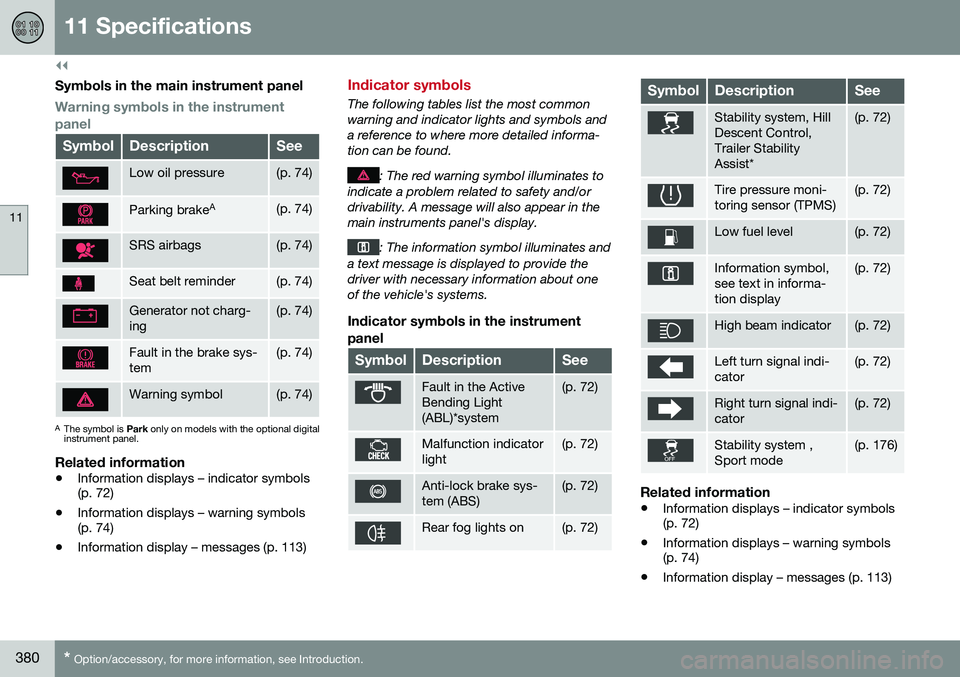
Warning symbols in the instrument panel
SymbolDescriptionSee
Low oil pressure(p. 74)
Parking brake A(p. 74)
SRS airbags(p. 74)
Seat belt reminder(p. 74)
Generator not charg- ing(p. 74)
Fault in the brake sys- tem(p. 74)
Warning symbol(p. 74)
A
The symbol is Park only on models with the optional digital
instrument panel.
Related information
• Information displays – indicator symbols (p. 72)
• Information displays – warning symbols(p. 74)
• Information display – messages (p. 113)
Indicator symbols
The following tables list the most common warning and indicator lights and symbols anda reference to where more detailed informa-tion can be found.
: The red warning symbol illuminates to
indicate a problem related to safety and/or drivability. A message will also appear in themain instruments panel's display.
: The information symbol illuminates and
a text message is displayed to provide the driver with necessary information about oneof the vehicle's systems.
Indicator symbols in the instrument
panel
SymbolDescriptionSee
Fault in the Active Bending Light(ABL)*system(p. 72)
Malfunction indicator light(p. 72)
Anti-lock brake sys- tem (ABS)(p. 72)
Rear fog lights on(p. 72)
SymbolDescriptionSee
Stability system, Hill Descent Control,Trailer StabilityAssist*(p. 72)
Tire pressure moni- toring sensor (TPMS)(p. 72)
Low fuel level(p. 72)
Information symbol, see text in informa-tion display(p. 72)
High beam indicator(p. 72)
Left turn signal indi- cator(p. 72)
Right turn signal indi- cator(p. 72)
Stability system , Sport mode(p. 176)
Related information
• Information displays – indicator symbols (p. 72)
• Information displays – warning symbols(p. 74)
• Information display – messages (p. 113)
Page 383 of 396
11 Specifications
11
* Option/accessory, for more information, see Introduction.381
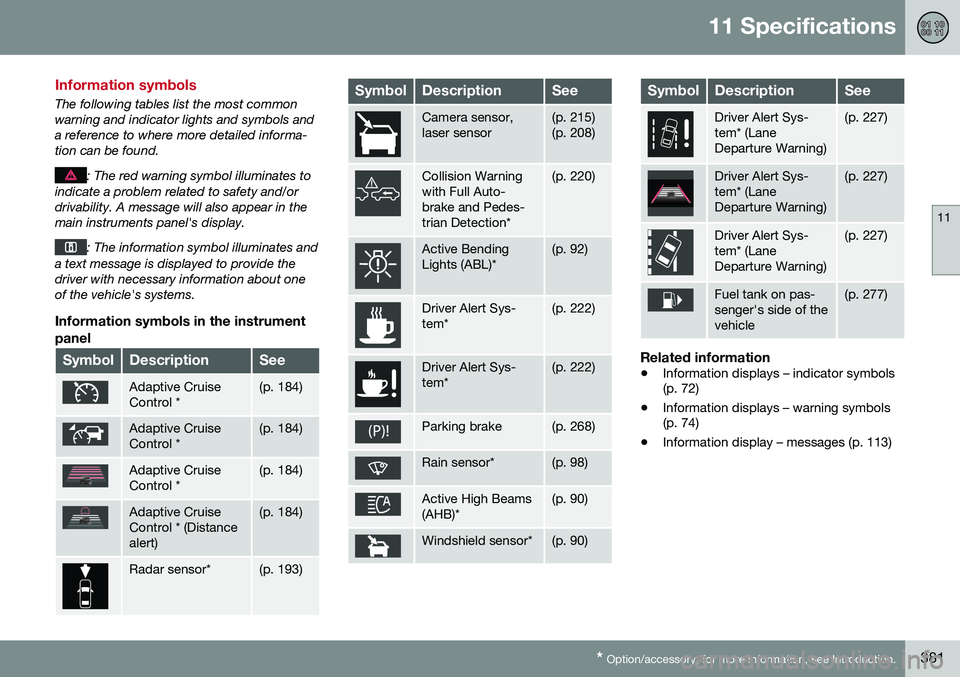
Information symbols
The following tables list the most common warning and indicator lights and symbols anda reference to where more detailed informa-tion can be found.
: The red warning symbol illuminates to
indicate a problem related to safety and/or drivability. A message will also appear in themain instruments panel's display.
: The information symbol illuminates and
a text message is displayed to provide the driver with necessary information about oneof the vehicle's systems.
Information symbols in the instrument
panel
SymbolDescriptionSee
Adaptive Cruise Control *(p. 184)
Adaptive Cruise Control *(p. 184)
Adaptive Cruise Control *(p. 184)
Adaptive Cruise Control * (Distancealert)(p. 184)
Radar sensor*(p. 193)
SymbolDescriptionSee
Camera sensor, laser sensor(p. 215) (p. 208)
Collision Warning with Full Auto-brake and Pedes-trian Detection*(p. 220)
Active Bending Lights (ABL)*(p. 92)
Driver Alert Sys- tem*(p. 222)
Driver Alert Sys- tem*(p. 222)
Parking brake(p. 268)
Rain sensor*(p. 98)
Active High Beams (AHB)*(p. 90)
Windshield sensor*(p. 90)
SymbolDescriptionSee
Driver Alert Sys- tem* (LaneDeparture Warning)(p. 227)
Driver Alert Sys- tem* (LaneDeparture Warning)(p. 227)
Driver Alert Sys- tem* (LaneDeparture Warning)(p. 227)
Fuel tank on pas- senger's side of thevehicle(p. 277)
Related information
• Information displays – indicator symbols (p. 72)
• Information displays – warning symbols(p. 74)
• Information display – messages (p. 113)
Page 388 of 396
12 Index
12
386
Interior Air Quality System.................. 125
ventilated seats................................... 130
Electronic oil level sensor........................ 330
Electronic stability control....................... 175
Emergency locking retractor...................... 47
Emergency starting.................................. 250
Emergency towing........................... 284, 285
Emission inspection readiness................ 325Engine overheating........................................... 75
specifications...................................... 373
Start/Stop........... 256, 257, 258, 259, 260
starting................................................ 246
switching off............................... 248, 249
Engine compartment overview................ 328
Engine oil................................................. 374 checking............................................. 329
low pressure warning light.................... 74
volumes.............................................. 375
Engine remote start (ERS)........................ 248
Environment............................................... 22F
Federal Clean Air Act............................... 322 Flat tires repairing with tire sealing system....... 313
Floor mats cleaning.............................................. 363
placing correctly................................. 246
Floor rails................................................. 144
Fluid specifications.......................... 376, 377
Fog lights................................................... 73 rear........................................................ 94
Four C (active chassis system)................ 175
Front airbags.............................................. 32 disconnecting passenger’s side airbag 36
Front park assist.............................. 232, 236
Front seats................................................. 80 heated................................................. 129
Fuel filler cap........................................... 278
Fuel filler door, opening................... 277, 278
Fuel level warning light.............................. 73
Fuel requirements............................ 275, 276
Fuel tank volume..................................... 377
Fuses....................................... 348, 350, 357
G
Garage door opener HomeLink ®
Wireless Control
System........................................ 108, 109
Gasoline requirements............................. 276
Gas tank volume...................................... 377
Gauges...................................................... 68
Geartronic................................................ 253
Geartronic automatic transmission.......... 253
Generator warning light............................. 75
Glossary of tire terminology..................... 302
Grocery bag holder.................................. 146
Gross vehicle weight............................... 301
H
Hazard warning flashers............................ 94 Headlights Active Bending Lights........................... 92
active high beams................................. 90
changing bulbs... 335, 336, 337, 338, 339
daytime running lights.......................... 89
high/low beams.................................... 90
high beam flash.................................... 90
tunnel detection.................................... 92