weight VOLVO XC90 2009 Owner´s Manual
[x] Cancel search | Manufacturer: VOLVO, Model Year: 2009, Model line: XC90, Model: VOLVO XC90 2009Pages: 282, PDF Size: 8.76 MB
Page 156 of 282
06 Starting and drivingLoad carriers (accessory)
06156
Positioning load carriersIf wing-shaped load carriers are used, make
sure that they are installed on the roof rails with
the rounded edge forward. Load carriers of this
type are identical and can be placed anywhere
along the roof rails.
When not in use, we recommend that the front
load carrier be placed approximately 2 inches
(5 cm) in front of the center roof rail anchorage
point and the rear load carrier approximately
1.5 inches (3.5 cm) in front of the rear rail
anchorage. This will help to reduce wind noise.Installing load carriersMake sure that the load carriers are pressed
firmly out against the roof rail and securely
tightened place. Check regularly that any load
carriers are securely in place.
WARNING
Loads carried on the vehicle's roof should
not exceed 220 lbs (100 kg), including the
weight of the load carriers and any other
load carrying equipment (ski boxes, bicycle
racks, etc.). Excessive loads on the roof can
adversely affect the handling and roadhold-
ing characteristics of the vehicle.
Page 174 of 282
07 Wheels and tiresGlossary of tire terminology
07174
•
Tire information placard: A placard
showing the OE (Original Equipment) tire
sizes, recommended inflation pressure,
and the maximum weight the vehicle can
carry.
•
Tire Identification Number (TIN): A num-
ber on the sidewall of each tire providing
information about the tire brand and man-
ufacturing plant, tire size and date of man-
ufacturer.
•
Inflation pressure: A measure of the
amount of air in a tire.
•
Standard load: A class of P-metric or Met-
ric tires designed to carry a maximum load
at 35 psi [37 psi (2.5 bar) for Metric tires].
Increasing the inflation pressure beyond
this pressure will not increase the tires load
carrying capability.
•
Extra load: A class of P-metric or Metric
tires designed to carry a heavier maximum
load at 41 psi [43 psi (2.9 bar) for Metric
tires]. Increasing the inflation pressure
beyond this pressure will not increase the
tires load carrying capability.
•
kPa: Kilopascal, a metric unit of air pres-
sure.
•
PSI: Pounds per square inch, a standard
unit of air pressure.
•
B-pillar: The structural member at the side
of the vehicle behind the front door.
•
Bead area of the tire: Area of the tire next
to the rim.
•
Sidewall of the tire: Area between the
bead area and the tread.
•
Tread area of the tire: Area of the perim-
eter of the tire that contacts the road when
mounted on the vehicle.
•
Rim: The metal support (wheel) for a tire or
a tire and tube assembly upon which the
tire beads are seated.
•
Maximum load rating: a figure indicating
the maximum load in pounds and kilo-
grams that can be carried by the tire. This
rating is established by the tire manufac-
turer.
•
Maximum permissible inflation pres-
sure: the greatest amount of air pressure
that should ever be put in the tire. This limit
is set by the tire manufacturer.
•
Recommended tire inflation pressure:
inflation pressure, established by Volvo,
which is based on the type of tires that are
mounted on a vehicle at the factory. This
inflation pressure is affected by the number
of occupants in the vehicle, the amount of
cargo, and the speed at which the vehicle
will be driven for a prolonged period. This
information can be found on the tire infla-
tion placard(s) located on the driver's side
B-pillar or on the inside of the fuel filler dooron Canadian models, and in the tire infla-
tion table in this chapter.
•
Cold tires: The tires are considered to be
cold when they have the same temperature
as the surrounding (ambient) air. This tem-
perature is normally reached after the vehi-
cle has been parked for at least 3 hours.
Page 175 of 282
07 Wheels and tires
Vehicle loading
07
175
Properly loading your vehicle will provide maxi-
mum return of vehicle design performance.
Before loading your vehicle, familiarize yourself
with the following terms for deter-mining your
vehicle's weight ratings, with or without a
trailer, from the vehicle's Federal/ Canadian
Motor Vehicle Safety Standards (FMVSS/
CMVSS) label, and the vehicle's tire informa-
tion placard.Curb weightThe weight of the vehicle including a full tank
of fuel and all standard equipment. It does not
include passengers, cargo, or optional equip-
ment.Capacity weightAll weight added to the curb weight, including
cargo and optional equipment. When towing,
trailer hitch tongue load is also part of cargo
weight.
NOTE
For trailer towing information, please refer to
the section "Towing a trailer."Permissible axle weightThe maximum allowable weight that can be
carried by a single axle (front or rear). Thesenumbers are shown on the Federal/Canadian
Motor Vehicle Safety Standards (FMVSS/
CMVSS) label. The total load on each axle must
never exceed its maximum permissible weight.
Gross vehicle weight (GVW)The vehicle's curb weight + cargo + passen-
gers.
A table listing important weight limits for your
vehicle, is in chapter "Dimension and weights".
For the location of the various labels in your
vehicle, see page 258Steps for Determining Correct Load
Limit•
Locate the statement "the combined
weight of occupants and cargo should
never exceed XXX pounds" on your vehi-
cle's placard.
•
Determine the combined weight of the
driver and passengers that will be riding in
your vehicle.
•
Subtract the combined weight of the driver
and passengers from XXX kilograms or
XXX pounds.
•
The resulting figure equals the available
amount of cargo and luggage load
capacity. For example, if the "XXX" amount
equals 1400 lbs. and there will be five150 lb. passengers in your vehicle, the
amount of available cargo and luggage
load capacity is 650 lbs. (1400-750 (5 x
150) = 650 lbs.)
•
Determine the combined weight of luggage
and cargo being loaded on the vehicle.
That weight may not safely exceed the
available cargo and luggage load capacity
calculated in Step 4.
•
If your vehicle will be towing a trailer, load
from your trailer will be transferred to your
vehicle. Consult this manual
1 to determine
how this reduces the available cargo and
luggage load capacity of your vehicle.
WARNING
•
Exceeding the permissible axle weight,
gross vehicle weight, or any other
weight rating limits can cause tire over-
heating resulting in permanent defor-
mation or catastrophic failure.
•
Do not use replacement tires with lower
load carrying capacities than the tires
that were original equipment on the
vehicle because this will lower the vehi-
cle's GVW rating. Replacement tires
with a higher limit than the originals do
not increase the vehicle's GVW rating
limitations.
1For "Towing a trailer" see page 151.
Page 184 of 282
07 Wheels and tiresChanging wheels
07184
WARNING
•
The jack must correctly engage the bar
in the jack attachment. The vehicle's
weight must not rest on the jack attach-
ment. See illustration "Attaching the
jack" on the previous page.
•
Be sure the jack is on a firm, level, non-
slippery surface.
•
Never allow any part of your body to be
extended under a vehicle supported by
a jack.
•
Use the jack intended for the vehicle
when replacing a wheel. For any other
job, use stands to support the side of
the vehicle being worked on.
•
Apply the parking brake and put the
gear selector in the (P)ark position.
•
Block the wheels standing on the
ground, use rigid wooden blocks or
large stones.
•
The jack should be kept well-greased
and clean, and should not be damaged.
•
No objects should be placed between
the base of jack and the ground, or
between the jack and the attachment
bar on the vehicle.
The jack and tools should be returned to their
storage spaces. The jack should be cranked
down fully so that it fits into the intended space.
Page 205 of 282
09 Maintenance and servicing
Working on your vehicle
09``205
G027001
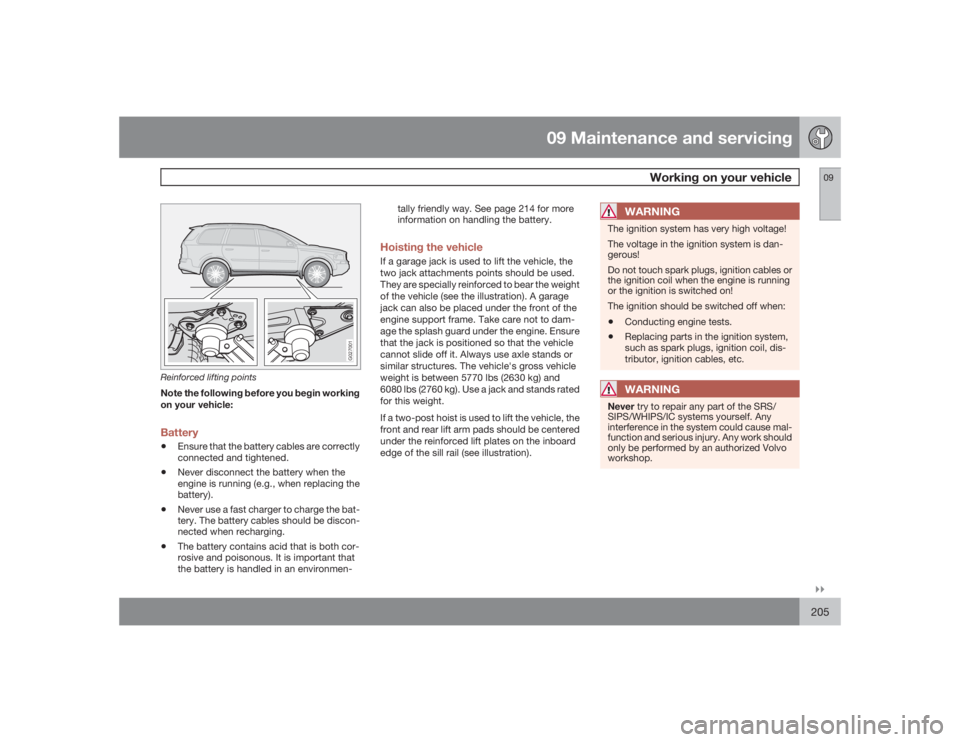
Reinforced lifting pointsNote the following before you begin working
on your vehicle:Battery•
Ensure that the battery cables are correctly
connected and tightened.
•
Never disconnect the battery when the
engine is running (e.g., when replacing the
battery).
•
Never use a fast charger to charge the bat-
tery. The battery cables should be discon-
nected when recharging.
•
The battery contains acid that is both cor-
rosive and poisonous. It is important that
the battery is handled in an environmen-tally friendly way. See page 214 for more
information on handling the battery.
Hoisting the vehicleIf a garage jack is used to lift the vehicle, the
two jack attachments points should be used.
They are specially reinforced to bear the weight
of the vehicle (see the illustration). A garage
jack can also be placed under the front of the
engine support frame. Take care not to dam-
age the splash guard under the engine. Ensure
that the jack is positioned so that the vehicle
cannot slide off it. Always use axle stands or
similar structures. The vehicle's gross vehicle
weight is between 5770 lbs (2630 kg) and
6080 lbs (2760 kg). Use a jack and stands rated
for this weight.
If a two-post hoist is used to lift the vehicle, the
front and rear lift arm pads should be centered
under the reinforced lift plates on the inboard
edge of the sill rail (see illustration).
WARNING
The ignition system has very high voltage!
The voltage in the ignition system is dan-
gerous!
Do not touch spark plugs, ignition cables or
the ignition coil when the engine is running
or the ignition is switched on!
The ignition should be switched off when:•
Conducting engine tests.
•
Replacing parts in the ignition system,
such as spark plugs, ignition coil, dis-
tributor, ignition cables, etc.WARNING
Never try to repair any part of the SRS/
SIPS/WHIPS/IC systems yourself. Any
interference in the system could cause mal-
function and serious injury. Any work should
only be performed by an authorized Volvo
workshop.
Page 208 of 282
09 Maintenance and servicingEngine oil
09208
Oil specificationsEngine oil must meet the minimum ILSAC
specification GF-4, API SL, or ACEA A1/B1.
Lower quality oils may not offer the same fuel
economy, engine performance, or engine pro-
tection.
Volvo recommends Castrol.
Depending on your driving habits, premium or
synthetic oils may provide superior fuel econ-
omy and engine protection. Consult your Volvo
retailer or a trained and qualified Volvo service
technician for recommendations on premium
or synthetic oils.
Oil additives must not be used.
NOTE
Synthetic oil is not used when the oil is
changed at the normal maintenance serv-
ices. This oil is only used at customer
request, at additional charge. Please con-
sult a trained and qualified Volvo service
technician.
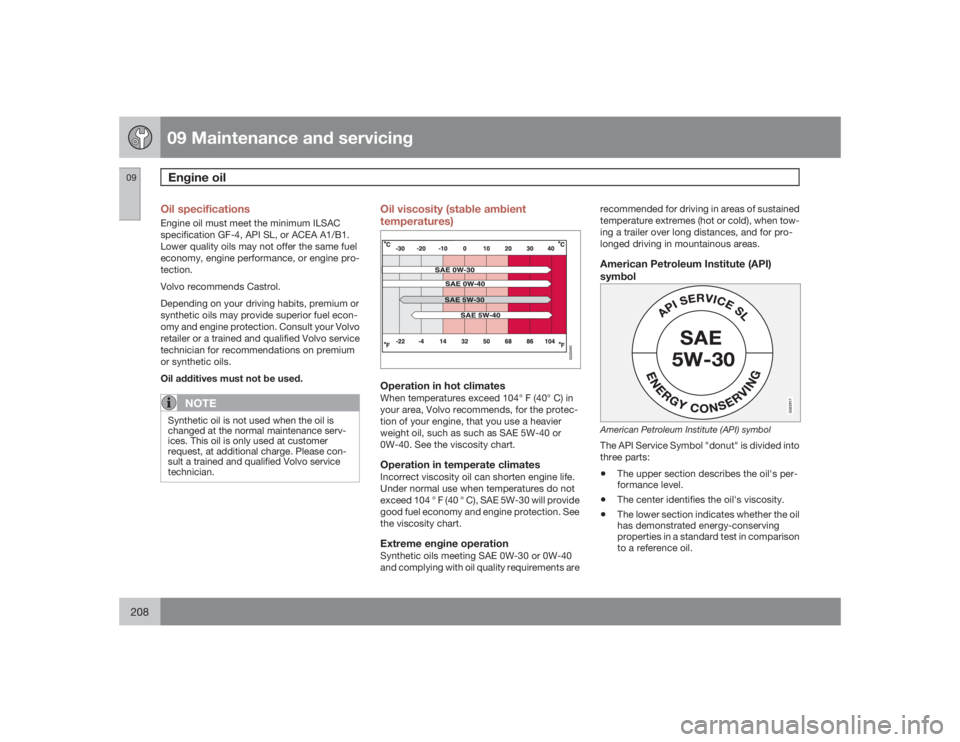
Oil viscosity (stable ambient
temperatures)
G023491
Operation in hot climatesWhen temperatures exceed 104° F (40° C) in
your area, Volvo recommends, for the protec-
tion of your engine, that you use a heavier
weight oil, such as such as SAE 5W-40 or
0W-40. See the viscosity chart.Operation in temperate climatesIncorrect viscosity oil can shorten engine life.
Under normal use when temperatures do not
exceed 104 ° F (40 ° C), SAE 5W-30 will provide
good fuel economy and engine protection. See
the viscosity chart.Extreme engine operationSynthetic oils meeting SAE 0W-30 or 0W-40
and complying with oil quality requirements arerecommended for driving in areas of sustained
temperature extremes (hot or cold), when tow-
ing a trailer over long distances, and for pro-
longed driving in mountainous areas.
American Petroleum Institute (API)
symbol
G022917
American Petroleum Institute (API) symbolThe API Service Symbol "donut" is divided into
three parts:•
The upper section describes the oil's per-
formance level.
•
The center identifies the oil's viscosity.
•
The lower section indicates whether the oil
has demonstrated energy-conserving
properties in a standard test in comparison
to a reference oil.
Page 229 of 282
09 Maintenance and servicing
Fuses
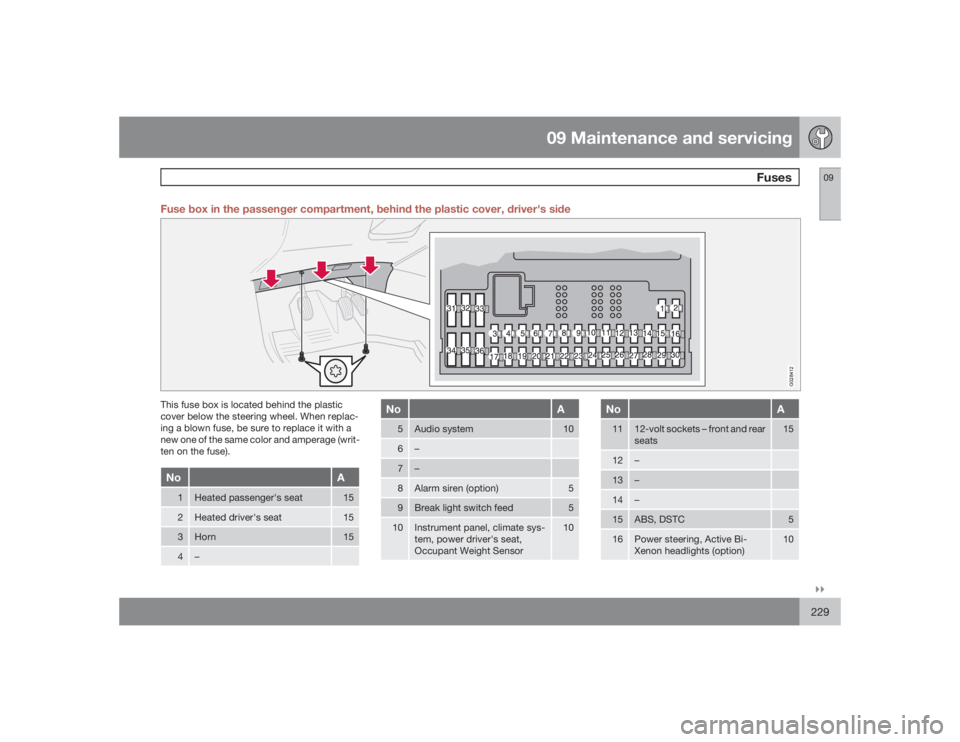
09``229 Fuse box in the passenger compartment, behind the plastic cover, driver's side
G028412
This fuse box is located behind the plastic
cover below the steering wheel. When replac-
ing a blown fuse, be sure to replace it with a
new one of the same color and amperage (writ-
ten on the fuse).No
A
1
Heated passenger's seat
15
2
Heated driver's seat
15
3
Horn
15
4
–
No
A
5
Audio system
10
6
–
7
–
8
Alarm siren (option)
5
9
Break light switch feed
5
10
Instrument panel, climate sys-
tem, power driver's seat,
Occupant Weight Sensor
10
No
A
11
12-volt sockets – front and rear
seats
15
12
–
13
–
14
–
15
ABS, DSTC
5
16
Power steering, Active Bi-
Xenon headlights (option)
10
Page 256 of 282
G000000
256
Label information.................................................................................. 258
Dimensions.......................................................................................... 260
Weights ................................................................................................ 262
Fluids..................................................................................................... 265
Suspension........................................................................................... 267
Engine oil............................................................................................... 268
Engine specifications............................................................................ 269
Electrical system................................................................................... 270
Three-way catalytic converter............................................................... 272
Volvo programs..................................................................................... 273
Page 262 of 282
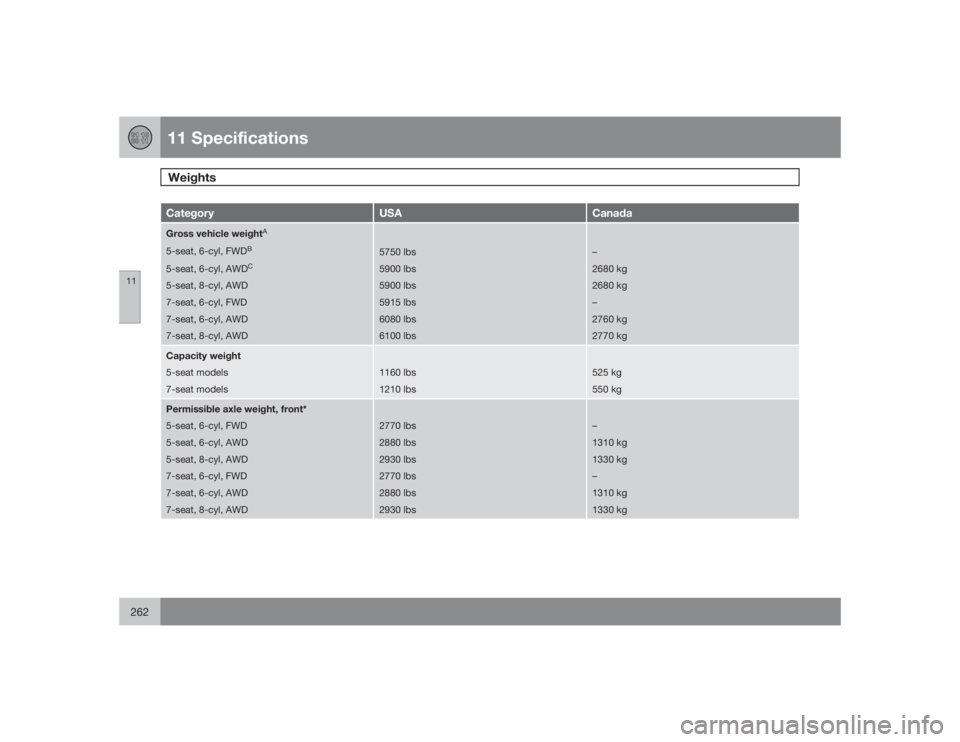
11 SpecificationsWeights
11262
Category
USA
Canada
Gross vehicle weight
A
5-seat, 6-cyl, FWD
B
5-seat, 6-cyl, AWD
C
5-seat, 8-cyl, AWD
7-seat, 6-cyl, FWD
7-seat, 6-cyl, AWD
7-seat, 8-cyl, AWD
5750 lbs
5900 lbs
5900 lbs
5915 lbs
6080 lbs
6100 lbs
–
2680 kg
2680 kg
–
2760 kg
2770 kg
Capacity weight
5-seat models
7-seat models
1160 lbs
1210 lbs
525 kg
550 kg
Permissible axle weight, front*
5-seat, 6-cyl, FWD
5-seat, 6-cyl, AWD
5-seat, 8-cyl, AWD
7-seat, 6-cyl, FWD
7-seat, 6-cyl, AWD
7-seat, 8-cyl, AWD
2770 lbs
2880 lbs
2930 lbs
2770 lbs
2880 lbs
2930 lbs
–
1310 kg
1330 kg
–
1310 kg
1330 kg
Page 263 of 282
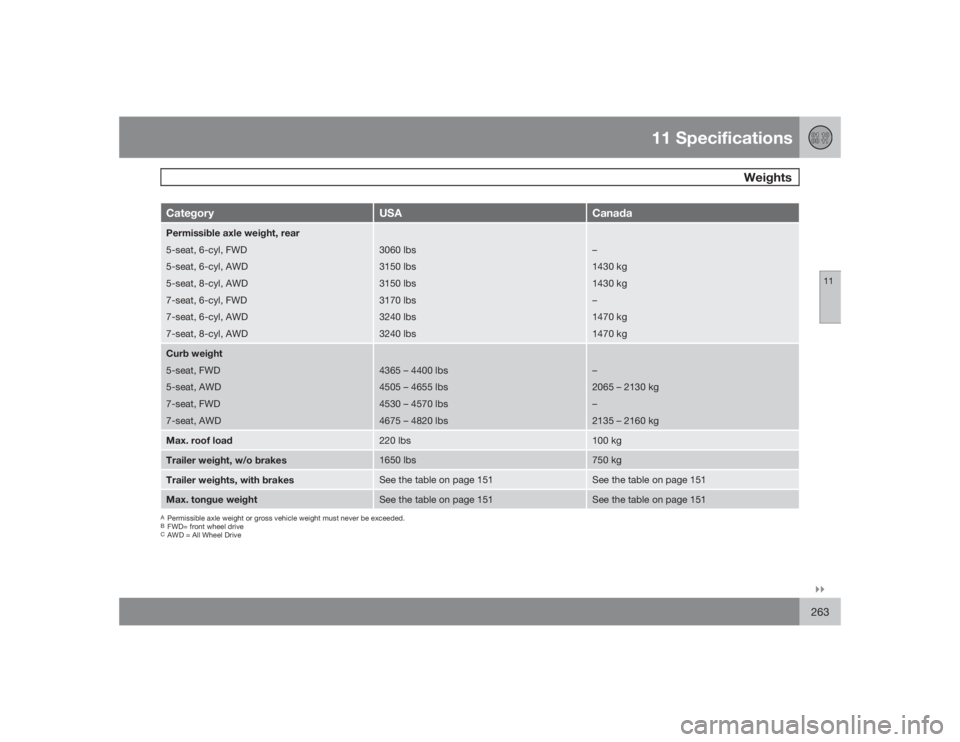
11 Specifications
Weights
11``263
Category
USA
Canada
Permissible axle weight, rear
5-seat, 6-cyl, FWD
5-seat, 6-cyl, AWD
5-seat, 8-cyl, AWD
7-seat, 6-cyl, FWD
7-seat, 6-cyl, AWD
7-seat, 8-cyl, AWD
3060 lbs
3150 lbs
3150 lbs
3170 lbs
3240 lbs
3240 lbs
–
1430 kg
1430 kg
–
1470 kg
1470 kg
Curb weight
5-seat, FWD
5-seat, AWD
7-seat, FWD
7-seat, AWD
4365 – 4400 lbs
4505 – 4655 lbs
4530 – 4570 lbs
4675 – 4820 lbs
–
2065 – 2130 kg
–
2135 – 2160 kg
Max. roof load
220 lbs
100 kg
Trailer weight, w/o brakes
1650 lbs
750 kg
Trailer weights, with brakes
See the table on page 151
See the table on page 151
Max. tongue weight
See the table on page 151
See the table on page 151
APermissible axle weight or gross vehicle weight must never be exceeded.BFWD= front wheel driveCAWD = All Wheel Drive