brake pads YAMAHA CYGNUS 125 2012 Owners Manual
[x] Cancel search | Manufacturer: YAMAHA, Model Year: 2012, Model line: CYGNUS 125, Model: YAMAHA CYGNUS 125 2012Pages: 80, PDF Size: 0.97 MB
Page 6 of 80

TABLE OF CONTENTSSAFETY INFORMATION .................... 1-1
Further safe-riding points ................. 1-5
DESCRIPTION .................................... 2-1
Left view ........................................... 2-1
Right view ......................................... 2-2
Controls and instruments ................. 2-3
INSTRUMENT AND CONTROL FUNC-
TIONS .................................................. 3-1
Main switch/steering lock ................. 3-1
Keyhole cover .................................. 3-2
Indicator and warning lights ............. 3-2
Speedometer .................................... 3-3
Multi-function display ........................ 3-3
Handlebar switches .......................... 3-5
Front brake lever .............................. 3-6
Rear brake lever ............................... 3-6
Fuel tank cap .................................... 3-7
Fuel .................................................. 3-7
Catalytic converters .......................... 3-9
Kickstarter ........................................ 3-9
Seat ................................................ 3-10
Storage compartments ................... 3-10
Sidestand ....................................... 3-11
Ignition circuit cut-off system .......... 3-12
FOR YOUR SAFETY - PRE-OPERATION
CHECKS ............................................. 4-1OPERATION AND IMPORTANT RIDING
POINTS ............................................... 5-1
Starting the engine ........................... 5-1
Starting off ........................................ 5-2
Acceleration and deceleration .......... 5-2
Braking ............................................. 5-2
Tips for reducing fuel consumption .. 5-3
Engine break-in ................................ 5-3
Parking ............................................. 5-4
PERIODIC MAINTENANCE AND AD-
JUSTMENT ......................................... 6-1
Owner’s tool kit ................................. 6-2
Periodic maintenance chart for the
emission control system ............... 6-3
General maintenance and lubrication
chart .............................................. 6-4
Removing and installing panels ....... 6-7
Checking the spark plug ................... 6-8
Engine oil and oil strainer ............... 6-10
Final transmission oil ...................... 6-12
Air fi lter and V-belt case air fi lter
elements ..................................... 6-13
Checking the throttle grip free
play ............................................. 6-15
Valve clearance .............................. 6-15
Tires ............................................... 6-16
Cast wheels .................................... 6-17
Checking the brake lever free
play ............................................. 6-18Adjusting the rear brake lever free
play ............................................. 6-18
Checking the front brake pads and
rear brake shoes ......................... 6-19
Checking the brake fl uid level ........ 6-19
Changing the brake fl uid ................ 6-20
Checking and lubricating the
cables ......................................... 6-21
Checking and lubricating the throttle grip
and cable .................................... 6-21
Lubricating the front and rear brake
levers .......................................... 6-21
Checking and lubricating the
centerstand and sidestand .......... 6-22
Checking the front fork ................... 6-23
Checking the steering .................... 6-23
Checking the wheel bearings ......... 6-24
Battery ............................................ 6-24
Replacing the fuses ........................ 6-26
Replacing the headlight bulb .......... 6-27
Replacing a front turn signal light
bulb ............................................. 6-28
Replacing the tail/brake light bulb or a
rear turn signal light bulb ............ 6-28
Replacing an auxiliary light bulb ..... 6-29
Troubleshooting ............................. 6-29
Troubleshooting chart .................... 6-31
SCOOTER CARE AND STORAGE .... 7-1
Matte color caution ........................... 7-1
Care ................................................. 7-1
4P9-F8199-E5_CS.indd 64P9-F8199-E5_CS.indd 6
2011/09/06 14:18:392011/09/06 14:18:39
Process BlackProcess Black
Page 12 of 80
1
2
3
4
5
6
7
8
9
1-5
Q
SAFETY INFORMATION
EAU10373
Further safe-riding points●
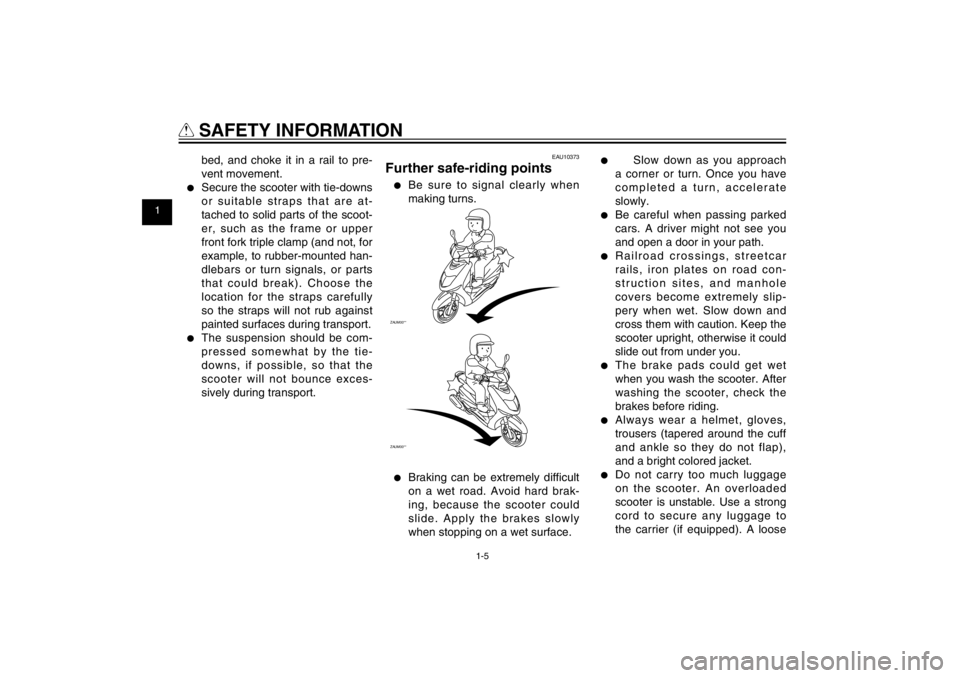
Be sure to signal clearly when
making turns.
ZAUM00**ZAUM00**●
Braking can be extremely diffi cult
on a wet road. Avoid hard brak-
ing, because the scooter could
slide. Apply the brakes slowly
when stopping on a wet surface.
●
Slow down as you approach
a corner or turn. Once you have
completed a turn, accelerate
slowly.
●
Be careful when passing parked
cars. A driver might not see you
and open a door in your path.
●
Railroad crossings, streetcar
rails, iron plates on road con-
struction sites, and manhole
covers become extremely slip-
pery when wet. Slow down and
cross them with caution. Keep the
scooter upright, otherwise it could
slide out from under you.
●
The brake pads could get wet
when you wash the scooter. After
washing the scooter, check the
brakes before riding.
●
Always wear a helmet, gloves,
trousers (tapered around the cuff
and ankle so they do not flap),
and a bright colored jacket.
●
Do not carry too much luggage
on the scooter. An overloaded
scooter is unstable. Use a strong
cord to secure any luggage to
the carrier (if equipped). A loose bed, and choke it in a rail to pre-
vent movement.
●
Secure the scooter with tie-downs
or suitable straps that are at-
tached to solid parts of the scoot-
er, such as the frame or upper
front fork triple clamp (and not, for
example, to rubber-mounted han-
dlebars or turn signals, or parts
that could break). Choose the
location for the straps carefully
so the straps will not rub against
painted surfaces during transport.
●
The suspension should be com-
pressed somewhat by the tie-
downs, if possible, so that the
scooter will not bounce exces-
sively during transport.
4P9-F8199-E5_CS.indd 1-54P9-F8199-E5_CS.indd 1-5
2011/09/06 14:18:392011/09/06 14:18:39
Process BlackProcess Black
Page 30 of 80
1
2
3
4
5
6
7
8
9
4-2
EAU15582
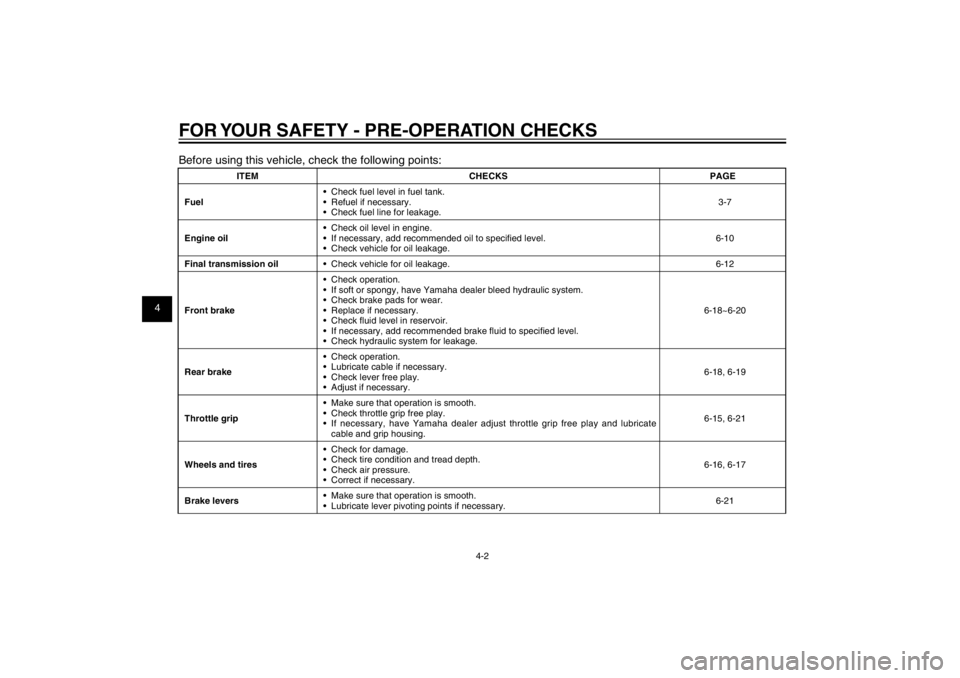
FOR YOUR SAFETY - PRE-OPERATION CHECKSBefore using this vehicle, check the following points:
ITEM CHECKS PAGE
Fuel• Check fuel level in fuel tank.
• Refuel if necessary.
• Check fuel line for leakage.3-7
Engine oil• Check oil level in engine.
• If necessary, add recommended oil to specifi ed level.
• Check vehicle for oil leakage.6-10
Final transmission oil• Check vehicle for oil leakage. 6-12
Front brake• Check operation.
• If soft or spongy, have Yamaha dealer bleed hydraulic system.
• Check brake pads for wear.
• Replace if necessary.
• Check fl uid level in reservoir.
• If necessary, add recommended brake fl uid to specifi ed level.
• Check hydraulic system for leakage.6-18~6-20
Rear brake• Check operation.
• Lubricate cable if necessary.
• Check lever free play.
• Adjust if necessary.6-18, 6-19
Throttle grip• Make sure that operation is smooth.
• Check throttle grip free play.
• If necessary, have Yamaha dealer adjust throttle grip free play and lubricate
cable and grip housing.6-15, 6-21
Wheels and tires• Check for damage.
• Check tire condition and tread depth.
• Check air pressure.
• Correct if necessary.6-16, 6-17
Brake levers• Make sure that operation is smooth.
• Lubricate lever pivoting points if necessary.6-21
4P9-F8199-E5_CS.indd 4-24P9-F8199-E5_CS.indd 4-2
2011/09/06 14:18:402011/09/06 14:18:40
Process BlackProcess Black
Page 39 of 80

1
2
3
4
5
6
7
8
9
6-4
EAU1722A
PERIODIC MAINTENANCE AND ADJUSTMENT
EAU17717
General maintenance and lubrication chartNO. ITEM CHECK OR MAINTENANCE JOBODOMETER READING
ANNUAL
CHECK
1000 km
(600 mi)6000 km
(3500 mi)
12000 km
(7000 mi)18000 km
(10500 mi)24000 km
(14000 mi)
1 Air lter element• Replace.
√√√√
2V-belt case air lter el-
ement• Clean.
• Replace if necessary.√√√√
3 * Front brake• Check operation, fl uid level and vehicle for fl uid leakage.
√√√√√ √
• Replace brake pads. Whenever worn to the limit
4 * Rear brake• Check operation and adjust brake lever free play.
√√√√√ √
• Replace brake shoes. Whenever worn to the limit
5 * Brake hose• Check for cracks or damage.
• Check for correct routing and clamping.√√√√ √
• Replace. Every 4 years
6 * Wheels• Check runout and for damage.
√√√√
7 * Tires• Check tread depth and for damage.
• Replace if necessary.
• Check air pressure.
• Correct if necessary.√√√√ √
8 * Wheel bearings• Check bearing for looseness or damage.
√√√√
9 * Steering bearings• Check bearing assemblies for looseness.
• Moderately repack with lithium-soap-based grease every
12000 km (7000 mi) or 24 months.√√Re-
pack√Re-
pack√
10 * Chassis fasteners• Make sure that all nuts, bolts and screws are properly
tightened.√√√√ √
11Front brake lever pivot
shaft• Lubricate with silicone grease.
√√√√ √
4P9-F8199-E5_CS.indd 6-44P9-F8199-E5_CS.indd 6-4
2011/09/06 14:18:402011/09/06 14:18:40
Process BlackProcess Black
Page 54 of 80
1
2
3
4
5
6
7
8
9
6-19
EAU1722A
PERIODIC MAINTENANCE AND ADJUSTMENT
EAU22380
Checking the front brake
pads and rear brake shoesThe front brake pads and the rear
brake shoes must be checked for
wear at the intervals specified in the
periodic maintenance and lubrication
chart.
EAU22420
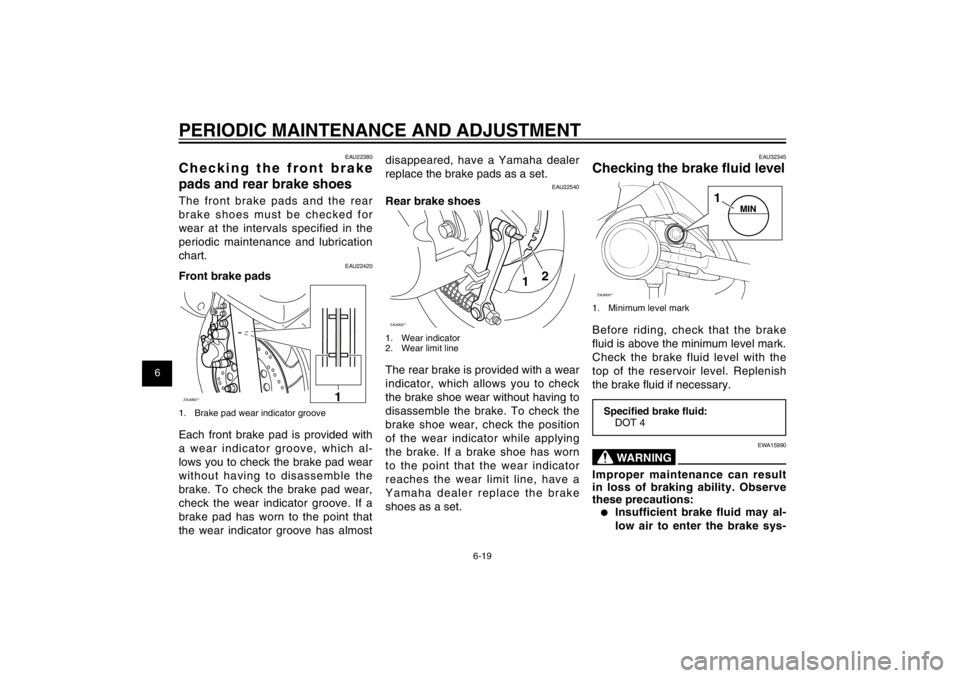
Front brake padsZAUM00**
1
1. Brake pad wear indicator grooveEach front brake pad is provided with
a wear indicator groove, which al-
lows you to check the brake pad wear
without having to disassemble the
brake. To check the brake pad wear,
check the wear indicator groove. If a
brake pad has worn to the point that
the wear indicator groove has almost disappeared, have a Yamaha dealer
replace the brake pads as a set.
EAU22540
Rear brake shoesZAUM00**
2
1
1. Wear indicator
2. Wear limit lineThe rear brake is provided with a wear
indicator, which allows you to check
the brake shoe wear without having to
disassemble the brake. To check the
brake shoe wear, check the position
of the wear indicator while applying
the brake. If a brake shoe has worn
to the point that the wear indicator
reaches the wear limit line, have a
Yamaha dealer replace the brake
shoes as a set.
EAU32345
Checking the brake uid levelZAUM00**
1
1. Minimum level markBefore riding, check that the brake
fl uid is above the minimum level mark.
Check the brake fluid level with the
top of the reservoir level. Replenish
the brake fl uid if necessary.Speci ed brake uid:
DOT 4
EWA15990
WARNING
Improper maintenance can result
in loss of braking ability. Observe
these precautions:● Insufficient brake fluid may al-
low air to enter the brake sys-
4P9-F8199-E5_CS.indd 6-194P9-F8199-E5_CS.indd 6-19
2011/09/06 14:18:412011/09/06 14:18:41
Process BlackProcess Black
Page 55 of 80
1
2
3
4
5
6
7
8
9
6-20
EAU1722A
PERIODIC MAINTENANCE AND ADJUSTMENT
tem, reducing braking perfor-
mance.
● Clean the filler cap before re-
moving. Use only DOT 4 brake
uid from a sealed container.● Use only the specified brake
fluid; otherwise, the rubber
seals may deteriorate, causing
leakage.● Refill with the same type of
brake uid. Adding a brake u-
id other than DOT 4 may result
in a harmful chemical reaction.● Be careful that water does not
enter the brake fluid reser-
voir when refilling. Water will
significantly lower the boiling
point of the fluid and may re-
sult in vapor lock.
ECA17640
NOTICEBrake fluid may damage painted
surfaces or plastic parts. Always
clean up spilled uid immediately.
As the brake pads wear, it is normal
for the brake fluid level to gradually go down. A low brake fl uid level may
indicate worn brake pads and/or brake
system leakage; therefore, be sure to
check the brake pads for wear and the
brake system for leakage. If the brake
fl uid level goes down suddenly, have
a Yamaha dealer check the cause be-
fore further riding.
EAU22721
Changing the brake uidHave a Yamaha dealer change the
brake fl uid at the intervals specifi ed in
the TIP after the periodic maintenance
and lubrication chart. In addition, have
the oil seals of the brake master cyl-
inder and caliper as well as the brake
hose replaced at the intervals listed
below or whenever they are damaged
or leaking.● Oil seals: Replace every two
years.● Brake hose: Replace every four
years.
4P9-F8199-E5_CS.indd 6-204P9-F8199-E5_CS.indd 6-20
2011/09/06 14:18:412011/09/06 14:18:41
Process BlackProcess Black
Page 76 of 80

INDEXAAcceleration and deceleration ................... 5-2
Air fi lter and V-belt case air fi lter
elements ............................................... 6-13
Auxiliary light bulb, replacing .................. 6-29BBattery ..................................................... 6-24
Brake fl uid, changing .............................. 6-20
Brake fl uid level, checking ...................... 6-19
Brake lever, front ....................................... 3-6
Brake lever, rear ....................................... 3-6
Brake levers, lubricating .......................... 6-21
Brake lever free play, checking ............... 6-18
Brake pads and shoes, checking ............ 6-19
Braking ...................................................... 5-2CCables, checking and lubricating ............ 6-21
Care .......................................................... 7-1
Catalytic converters .................................. 3-9
Centerstand and sidestand, checking and
lubricating ............................................. 6-22DDimmer switch .......................................... 3-6EEngine break-in ......................................... 5-3
Engine oil and oil strainer ........................ 6-10
Engine trouble warning light ...................... 3-2FFinal transmission oil .............................. 6-12
Front fork, checking ................................ 6-23
Fuel ........................................................... 3-7
Fuel consumption, tips for reducing .......... 5-3
Fuel tank cap ............................................ 3-7
Fuses, replacing ...................................... 6-26
HHandlebar switches ................................... 3-5
Headlight bulb, replacing ........................ 6-27
High beam indicator light .......................... 3-2
Horn switch ............................................... 3-6IIdentifi cation numbers ............................... 9-1
Ignition circuit cut-off system ................... 3-12
Indicator and warning lights ...................... 3-2KKeyhole cover ........................................... 3-2
Kickstarter ................................................. 3-9MMaintenance, emission control system ..... 6-3
Maintenance and lubrication, periodic ...... 6-4
Main switch/steering lock .......................... 3-1
Matte color, caution ................................... 7-1
Model label ................................................ 9-1
Multi-function display ................................ 3-3PPanels, removing and installing ................ 6-7
Parking ...................................................... 5-4
Part locations ............................................ 2-1RRear brake lever free play, adjusting ...... 6-18SSafe-riding points ...................................... 1-5
Safety information ..................................... 1-1
Seat ......................................................... 3-10
Sidestand ................................................ 3-11
Spark plug, checking ................................. 6-8
Specifi cations ............................................ 8-1
Speedometer ............................................ 3-3
Starting off ................................................. 5-2Starting the engine .................................... 5-1
Start switch ............................................... 3-6
Steering, checking .................................. 6-23
Storage ..................................................... 7-4
Storage compartments ............................ 3-10
TTail/brake light bulb or rear turn signal light
bulb, replacing ...................................... 6-28
Throttle grip and cable, checking and
lubricating ............................................. 6-21
Throttle grip free play, checking .............. 6-15
Tires ........................................................ 6-16
Tool kit ...................................................... 6-2
Troubleshooting ...................................... 6-29
Troubleshooting chart ............................. 6-31
Turn signal indicator light .......................... 3-2
Turn signal light bulb (front), replacing .... 6-28
Turn signal switch ..................................... 3-6VValve clearance ...................................... 6-15
Vehicle identifi cation number .................... 9-1WWheels .................................................... 6-17
Wheel bearings, checking ....................... 6-24
4P9-F8199-E5_CS.indd 9-24P9-F8199-E5_CS.indd 9-2
2011/09/06 14:18:422011/09/06 14:18:42
Process BlackProcess Black