warning YAMAHA FX HO 2014 Owner's Manual
[x] Cancel search | Manufacturer: YAMAHA, Model Year: 2014, Model line: FX HO, Model: YAMAHA FX HO 2014Pages: 114, PDF Size: 5.13 MB
Page 75 of 114
Pre-operation checks
69
EJU40113Remote control transmitter check
Make sure that the remote control transmitter
operates properly. (See page 27 for Yamaha
Security System setting procedures and
page 35 for Low RPM Mode activation pro-
cedures.)
EJU32664Engine shut-off cord (lanyard) check
Make sure that the engine shut-off cord (lan-
yard) is not damaged. If the cord is damaged,
replace it. WARNING! Never try to repair
the engine shut-off cord (lanyard) or tie it
together. The engine shut-off cord (lan-
yard) may not pull free when the operator
falls off, allowing the watercraft to contin-
ue to run and cause an accident.
[EWJ01221]
EJU32676
Switch checks
NOTICE
ECJ01311
Do not run the engine over 4000 r/min on
land. Also, do not run the engine for more
than 15 seconds without supplying water,
otherwise the engine could overheat.
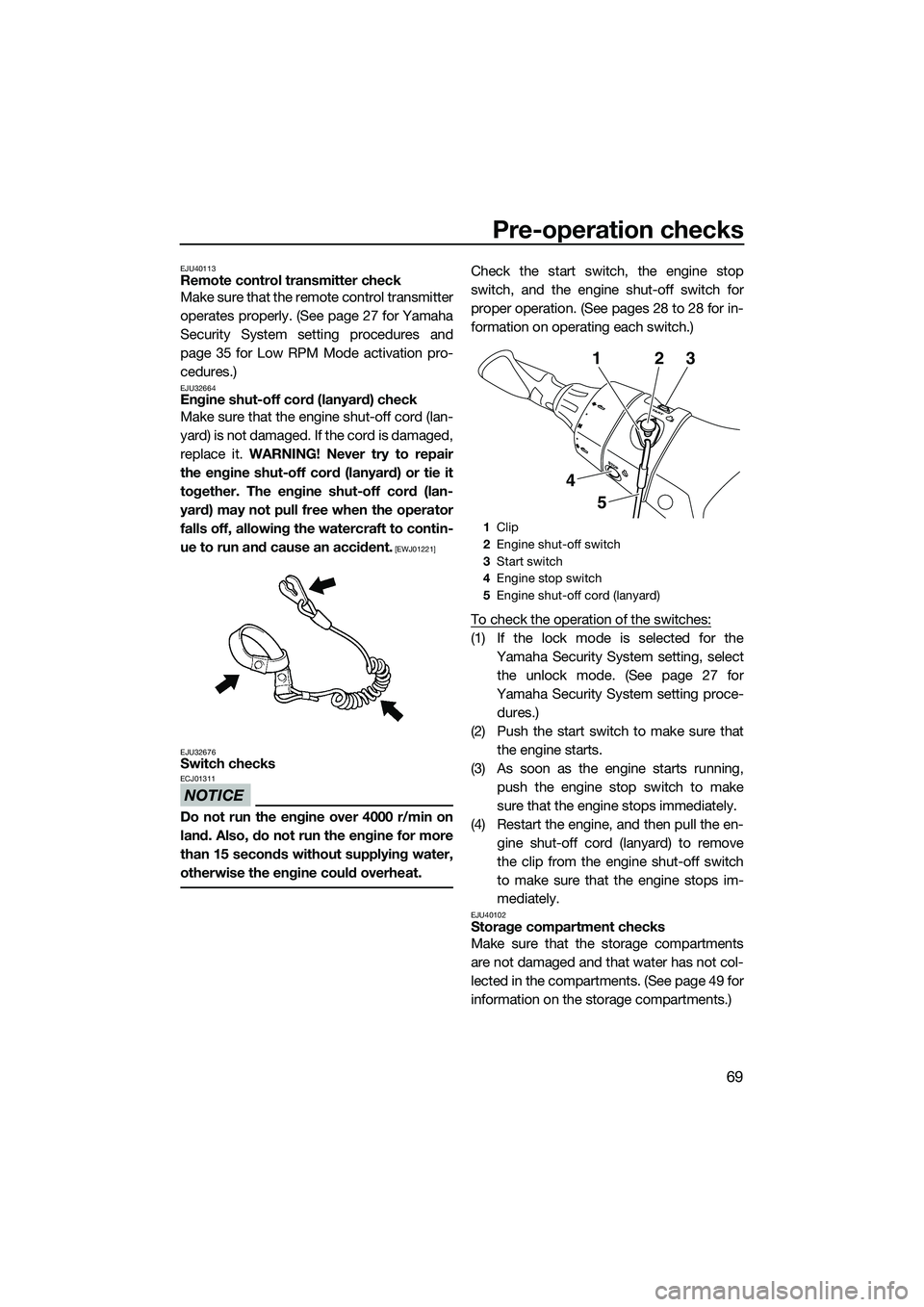
Check the start switch, the engine stop
switch, and the engine shut-off switch for
proper operation. (See pages 28 to 28 for in-
formation on operating each switch.)
To check the operation of the switches:
(1) If the lock mode is selected for the Yamaha Security System setting, selectthe unlock mode. (See page 27 for
Yamaha Security System setting proce- dures.)
(2) Push the start switch to make sure that the engine starts.
(3) As soon as the engine starts running, push the engine stop switch to make
sure that the engine stops immediately.
(4) Restart the engine, and then pull the en- gine shut-off cord (lanyard) to remove
the clip from the engine shut-off switch
to make sure that the engine stops im-
mediately.
EJU40102Storage compartment checks
Make sure that the storage compartments
are not damaged and that water has not col-
lected in the compartments. (See page 49 for
information on the storage compartments.)
1Clip
2 Engine shut-off switch
3 Start switch
4 Engine stop switch
5 Engine shut-off cord (lanyard)
132
5
4
UF2T72E0.book Page 69 Monday, July 22, 2013 2:26 PM
Page 79 of 114
Operation
73
EJU32903
Operating your watercraft
WARNING
EWJ00511
Before operating your watercraft, become
familiar with all of the controls. Consult a
Yamaha dealer about any control or func- tion that you do not fully understand. Fail-
ure to understand how the controls work
could cause an accident or prevent you
from avoiding an accident.
EJU32964Getting to know your watercraft
Operating your watercraft requires skills ac-
quired through practice over a period of time.
Take the time to learn the basic techniques
well before attempting more difficult maneu-
vers.
Operating your new watercraft can be a very
enjoyable activity, providing you with hours of
pleasure. However, it is essential to familiar-
ize yourself with the operation of the water-
craft to achieve the skill level necessary to
enjoy riding safely.
Before operating this watercraft, read this
owner’s/operator’s manual, the Riding Prac-
tice Guide, the Riding Instruction card, and all
labels on the watercraft. Pay particular atten-
tion to the safety information beginning on
page 11. These materials should give you an
understanding of the watercraft and its oper-
ation.
Remember: This watercraft is designed to
carry the operator and up to 2 passengers.
Never exceed the maximum load limit or al-
low more than 3 persons (or 2 persons if a
water-skier is being pulled) to ride the water-
craft at any time.
EJU33006Learning to operate your watercraft
Before operating the watercraft, always per-
form the pre-operation checks listed on page
62. The short time spent checking the water-
craft will reward you with added safety and
reliability.
Check local laws before operating your wa-
tercraft.
Operate defensively at safe speeds and keep
a safe distance away from people, objects,
and other watercraft. Select a wide area to
learn in, where there is good visibility and
light boat traffic.
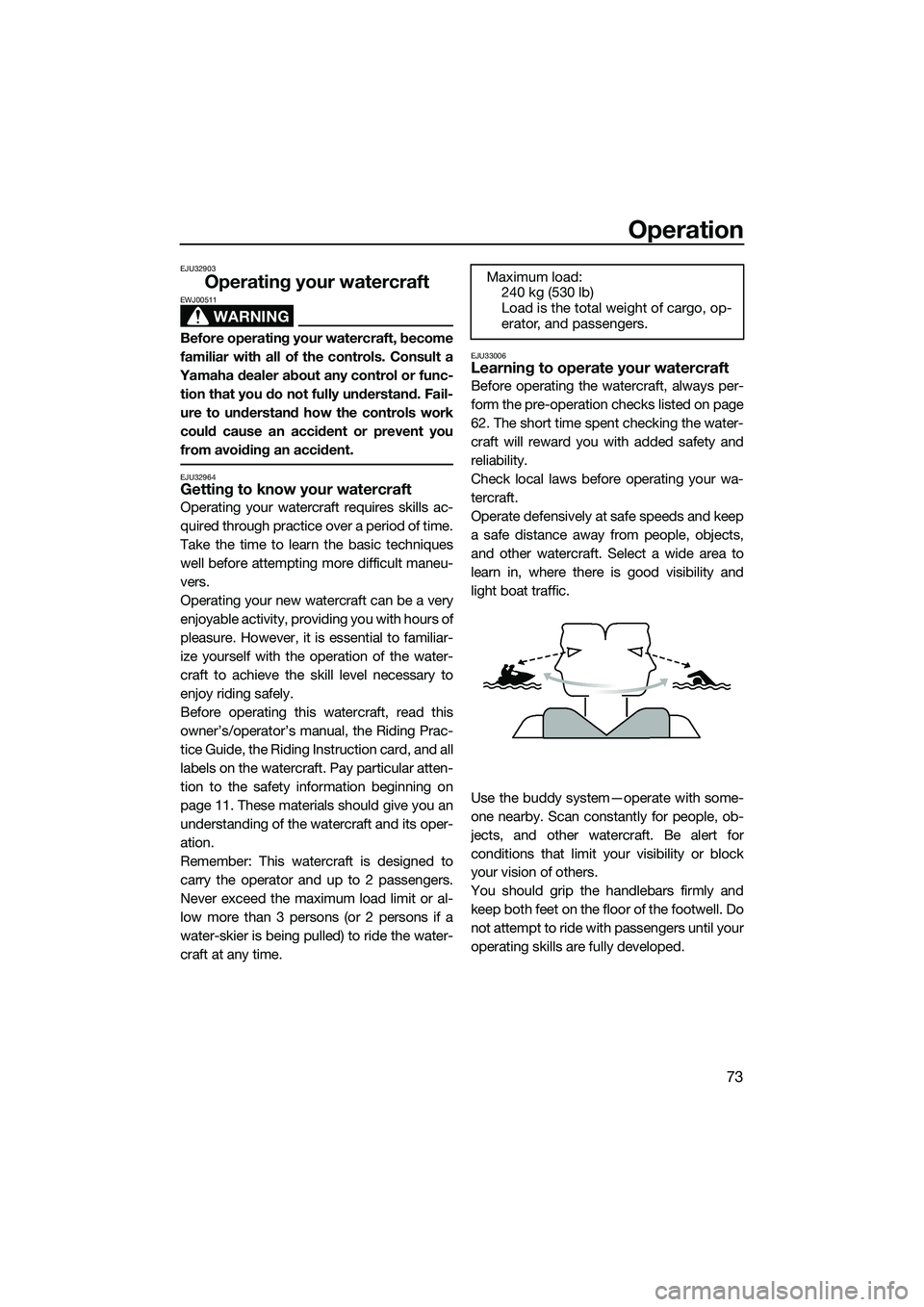
Use the buddy system—operate with some-
one nearby. Scan constantly for people, ob-
jects, and other watercraft. Be alert for
conditions that limit your visibility or block
your vision of others.
You should grip the handlebars firmly and
keep both feet on the floor of the footwell. Do
not attempt to ride with passengers until your
operating skills are fully developed. Maximum load:
240 kg (530 lb)
Load is the total weight of cargo, op-
erator, and passengers.
UF2T72E0.book Page 73 Monday, July 22, 2013 2:26 PM
Page 80 of 114
Operation
74
EJU40211Riding position
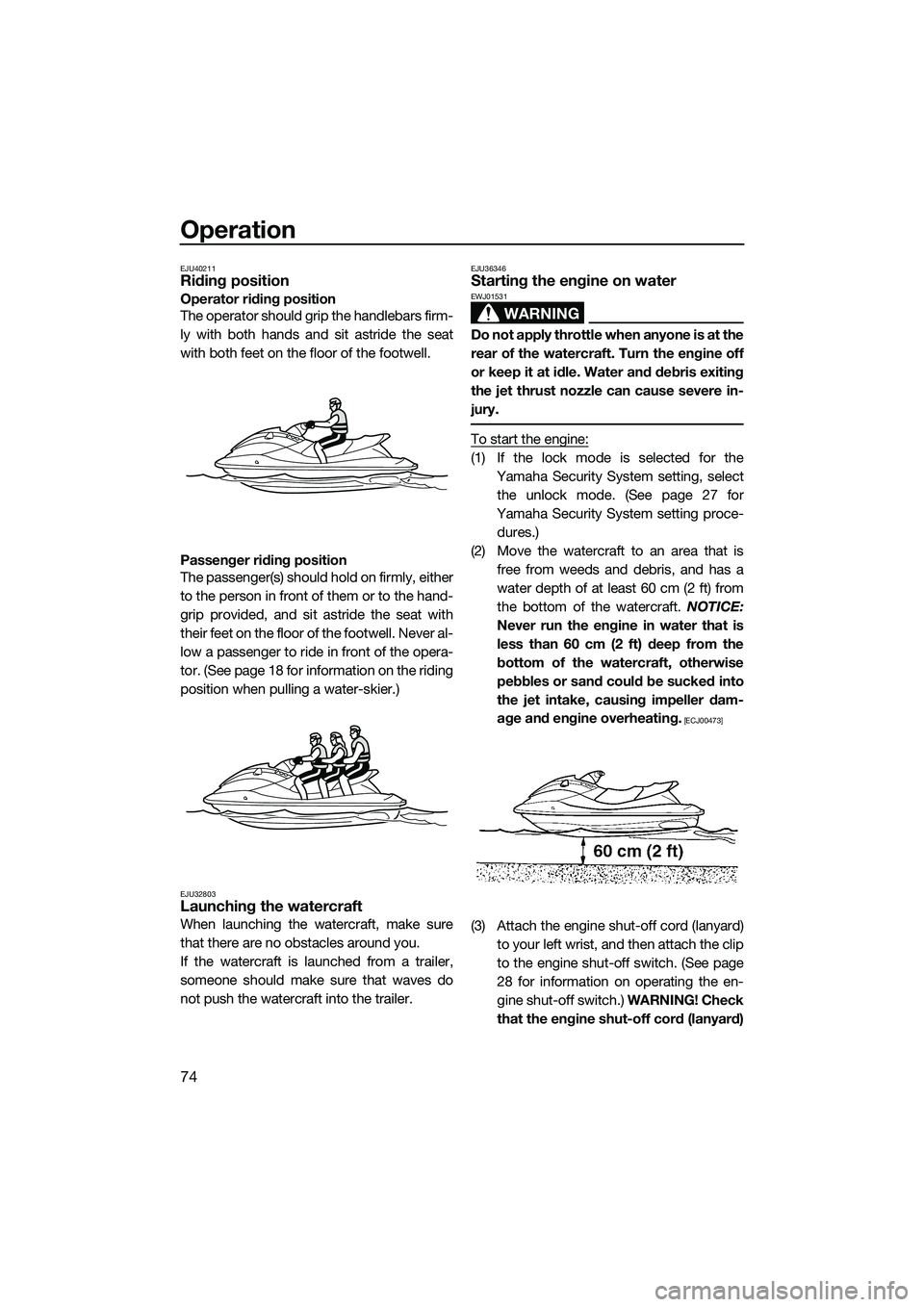
Operator riding position
The operator should grip the handlebars firm-
ly with both hands and sit astride the seat
with both feet on the floor of the footwell.
Passenger riding position
The passenger(s) should hold on firmly, either
to the person in front of them or to the hand-
grip provided, and sit astride the seat with
their feet on the floor of the footwell. Never al-
low a passenger to ride in front of the opera-
tor. (See page 18 for information on the riding
position when pulling a water-skier.)
EJU32803Launching the watercraft
When launching the watercraft, make sure
that there are no obstacles around you.
If the watercraft is launched from a trailer,
someone should make sure that waves do
not push the watercraft into the trailer.
EJU36346Starting the engine on water
WARNING
EWJ01531
Do not apply throttle when anyone is at the
rear of the watercraft. Turn the engine off
or keep it at idle. Water and debris exiting
the jet thrust nozzle can cause severe in-
jury.
To start the engine:
(1) If the lock mode is selected for theYamaha Security System setting, selectthe unlock mode. (See page 27 for
Yamaha Security System setting proce- dures.)
(2) Move the watercraft to an area that is free from weeds and debris, and has a
water depth of at least 60 cm (2 ft) from
the bottom of the watercraft. NOTICE:
Never run the engine in water that is
less than 60 cm (2 ft) deep from the
bottom of the watercraft, otherwise
pebbles or sand could be sucked into
the jet intake, causing impeller dam-
age and engine overheating.
[ECJ00473]
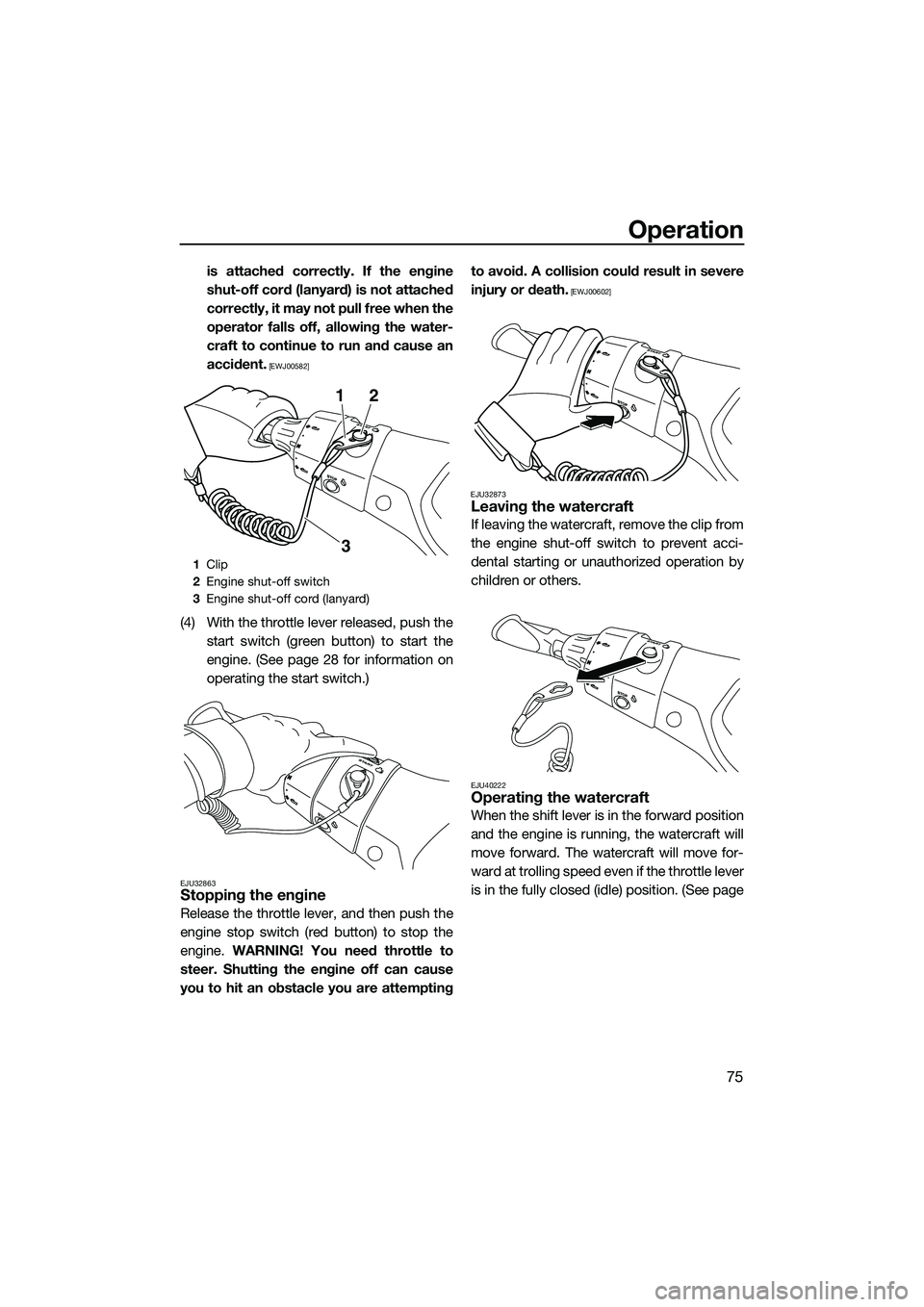
(3) Attach the engine shut-off cord (lanyard) to your left wrist, and then attach the clip
to the engine shut-off switch. (See page
28 for information on operating the en-
gine shut-off switch.) WARNING! Check
that the engine shut-off cord (lanyard)
UF2T72E0.book Page 74 Monday, July 22, 2013 2:26 PM
Page 81 of 114
Operation
75
is attached correctly. If the engine
shut-off cord (lanyard) is not attached
correctly, it may not pull free when the
operator falls off, allowing the water-
craft to continue to run and cause an
accident.
[EWJ00582]
(4) With the throttle lever released, push thestart switch (green button) to start the
engine. (See page 28 for information on
operating the start switch.)
EJU32863Stopping the engine
Release the throttle lever, and then push the
engine stop switch (red button) to stop the
engine. WARNING! You need throttle to
steer. Shutting the engine off can cause
you to hit an obstacle you are attempting to avoid. A collision could result in severe
injury or death.
[EWJ00602]
EJU32873
Leaving the watercraft
If leaving the watercraft, remove the clip from
the engine shut-off switch to prevent acci-
dental starting or unauthorized operation by
children or others.
EJU40222Operating the watercraft
When the shift lever is in the forward position
and the engine is running, the watercraft will
move forward. The watercraft will move for-
ward at trolling speed even if the throttle lever
is in the fully closed (idle) position. (See page
1 Clip
2 Engine shut-off switch
3 Engine shut-off cord (lanyard)
12
3
UF2T72E0.book Page 75 Monday, July 22, 2013 2:26 PM
Page 82 of 114
Operation
76
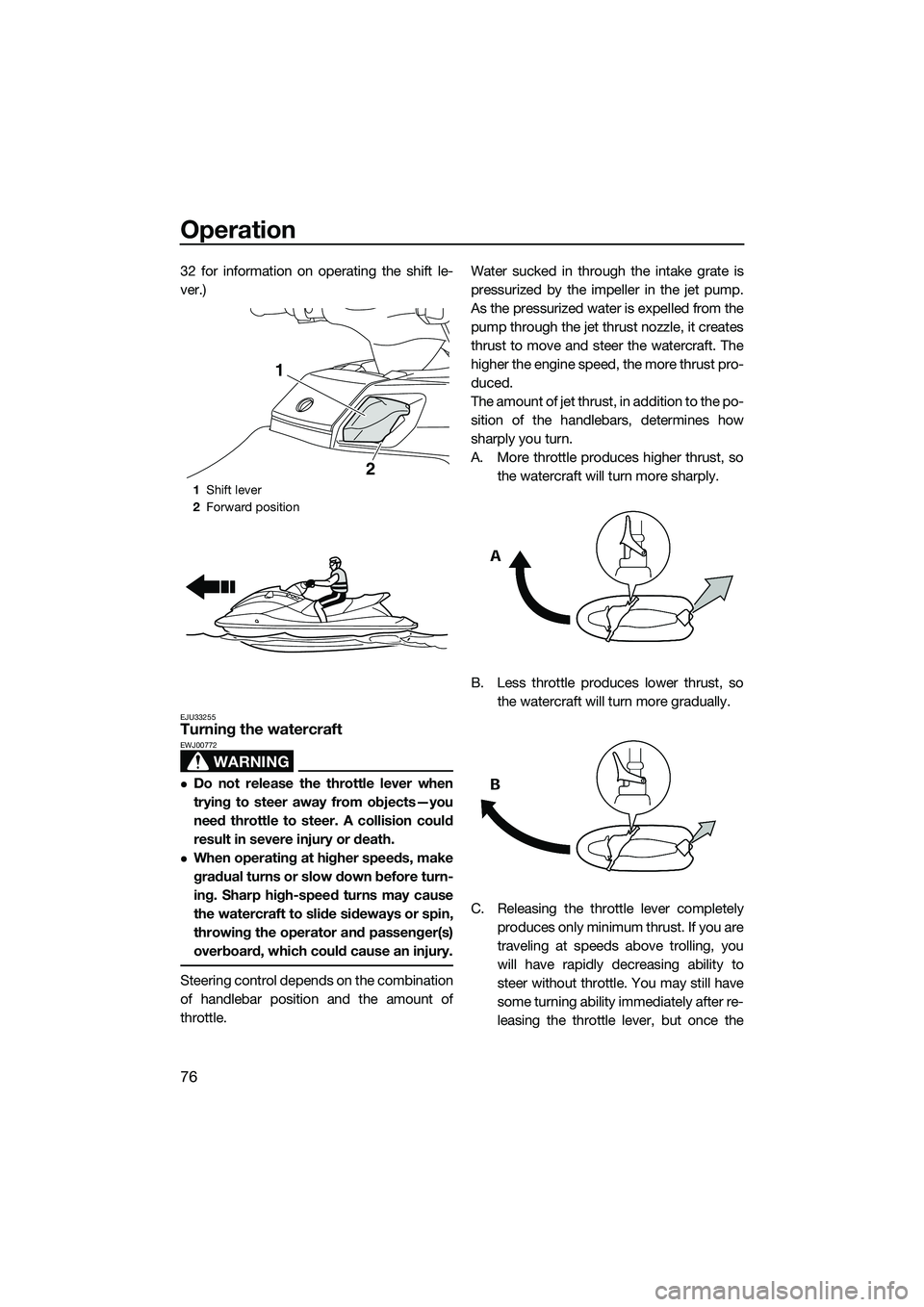
32 for information on operating the shift le-
ver.)
EJU33255Turning the watercraft
WARNING
EWJ00772
Do not release the throttle lever when
trying to steer away from objects—you
need throttle to steer. A collision could
result in severe injury or death.
When operating at higher speeds, make
gradual turns or slow down before turn-
ing. Sharp high-speed turns may cause
the watercraft to slide sideways or spin,
throwing the operator and passenger(s)
overboard, which could cause an injury.
Steering control depends on the combination
of handlebar position and the amount of
throttle.Water sucked in through the intake grate is
pressurized by the impeller in the jet pump.
As the pressurized water is expelled from the
pump through the jet thrust nozzle, it creates
thrust to move and steer the watercraft. The
higher the engine speed, the more thrust pro-
duced.
The amount of jet thrust, in addition to the po-
sition of the handlebars, determines how
sharply you turn.
A. More throttle produces higher thrust, so
the watercraft will turn more sharply.
B. Less throttle produces lower thrust, so the watercraft will turn more gradually.
C. Releasing the throttle lever completely produces only minimum thrust. If you are
traveling at speeds above trolling, you
will have rapidly decreasing ability to
steer without throttle. You may still have
some turning ability immediately after re-
leasing the throttle lever, but once the
1Shift lever
2 Forward position
1
2
UF2T72E0.book Page 76 Monday, July 22, 2013 2:26 PM
Page 83 of 114
Operation
77
engine slows down, the watercraft will no
longer respond to handlebar input until
you apply throttle again or you reach
trolling speed.
At trolling speed, the watercraft can be
turned gradually by handlebar position
alone using just the amount of thrust
available at idle.
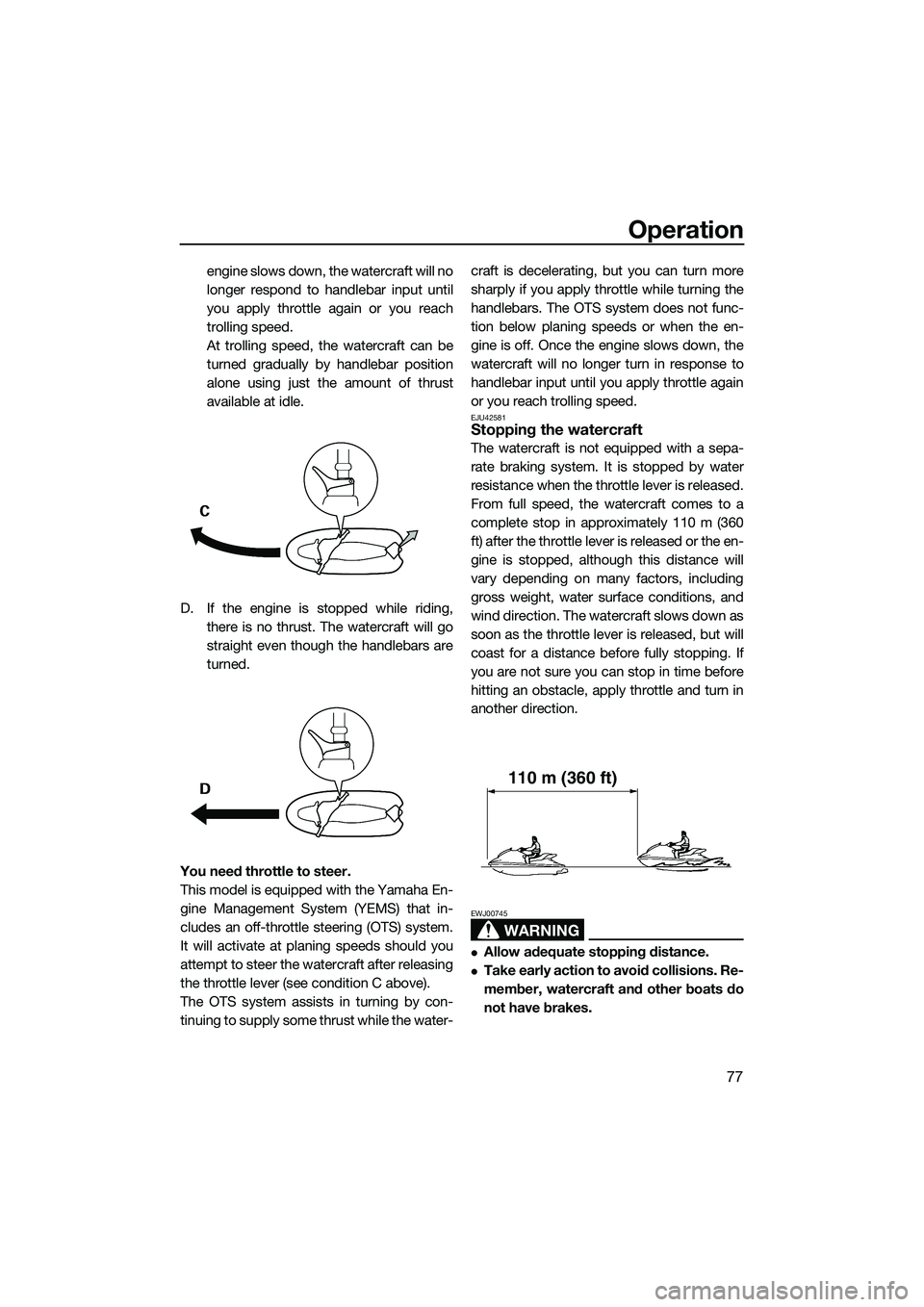
D. If the engine is stopped while riding, there is no thrust. The watercraft will go
straight even though the handlebars are
turned.
You need throttle to steer.
This model is equipped with the Yamaha En-
gine Management System (YEMS) that in-
cludes an off-throttle steering (OTS) system.
It will activate at planing speeds should you
attempt to steer the watercraft after releasing
the throttle lever (see condition C above).
The OTS system assists in turning by con-
tinuing to supply some thrust while the water- craft is decelerating, but you can turn more
sharply if you apply throttle while turning the
handlebars. The OTS system does not func-
tion below planing speeds or when the en-
gine is off. Once the engine slows down, the
watercraft will no longer turn in response to
handlebar input until you apply throttle again
or you reach trolling speed.
EJU42581Stopping the watercraft
The watercraft is not equipped with a sepa-
rate braking system. It is stopped by water
resistance when the throttle lever is released.
From full speed, the watercraft comes to a
complete stop in approximately 110 m (360
ft) after the throttle lever is released or the en-
gine is stopped, although this distance will
vary depending on many factors, including
gross weight, water surface conditions, and
wind direction. The watercraft slows down as
soon as the throttle lever is released, but will
coast for a distance before fully stopping. If
you are not sure you can stop in time before
hitting an obstacle, apply throttle and turn in
another direction.
WARNING
EWJ00745
Allow adequate stopping distance.
Take early action to avoid collisions. Re-
member, watercraft and other boats do
not have brakes.
110 m (360 ft)
UF2T72E0.book Page 77 Monday, July 22, 2013 2:26 PM
Page 85 of 114
Operation
79
movement may occur. (See page 32 for infor-
mation on operating the shift lever.)
TIP:
This model is equipped with a function which
limits the engine speed in neutral.
EJU42451Boarding the watercraft
WARNING
EWJ01112
Be sure the operator and any passengers
have practiced boarding from the water
while still close to shore before riding. A
person who has made many unsuccessful
attempts to get back on the watercraft
may become fatigued and suffer from ex-
posure, increasing the risk of injury and
drowning.
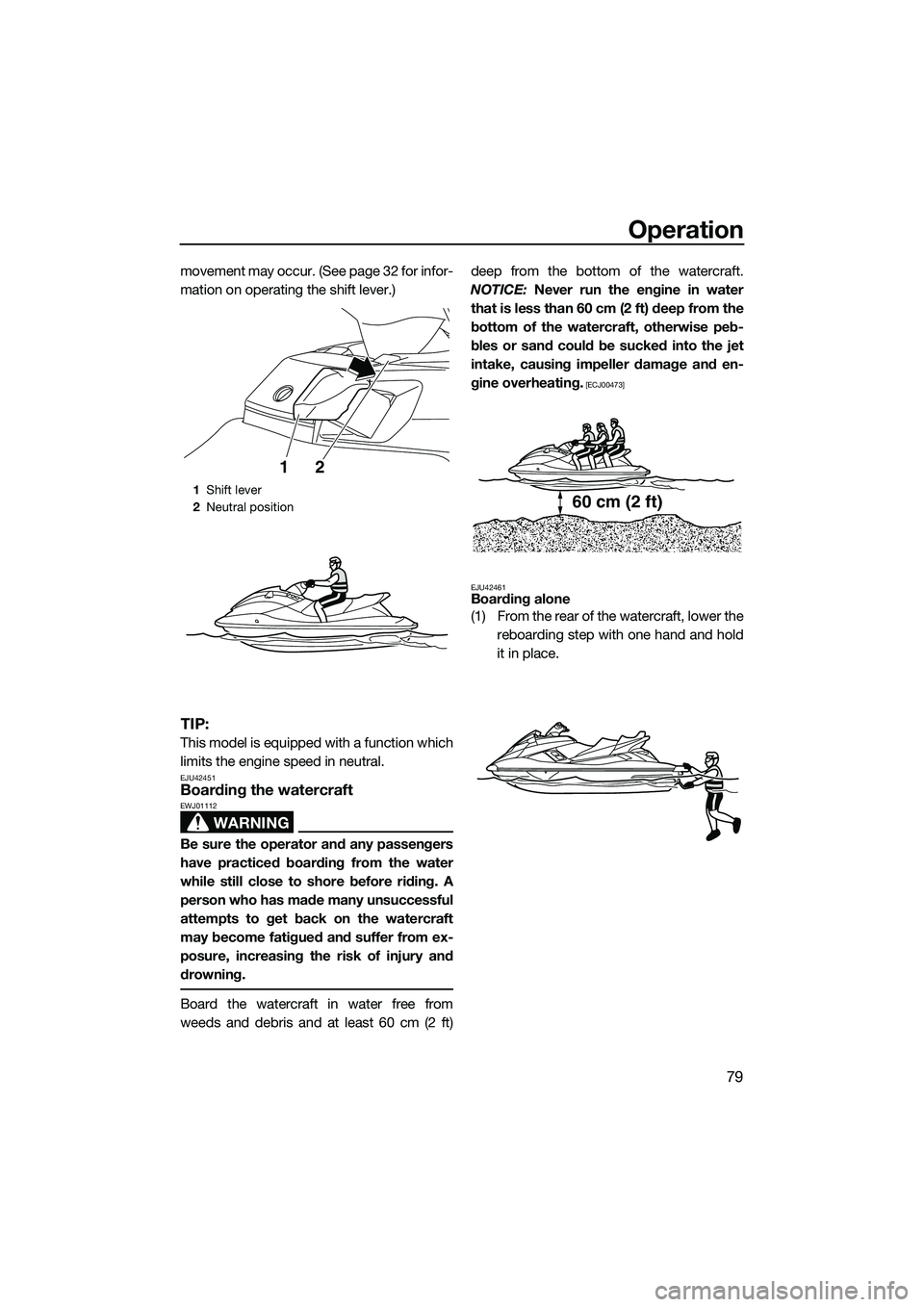
Board the watercraft in water free from
weeds and debris and at least 60 cm (2 ft)deep from the bottom of the watercraft.
NOTICE: Never run the engine in water
that is less than 60 cm (2 ft) deep from the
bottom of the watercraft, otherwise peb-
bles or sand could be sucked into the jet
intake, causing impeller damage and en-
gine overheating.
[ECJ00473]
EJU42461
Boarding alone
(1) From the rear of the watercraft, lower the reboarding step with one hand and hold
it in place.
1Shift lever
2 Neutral position
12
60 cm (2 ft)
UF2T72E0.book Page 79 Monday, July 22, 2013 2:26 PM
Page 86 of 114
Operation
80
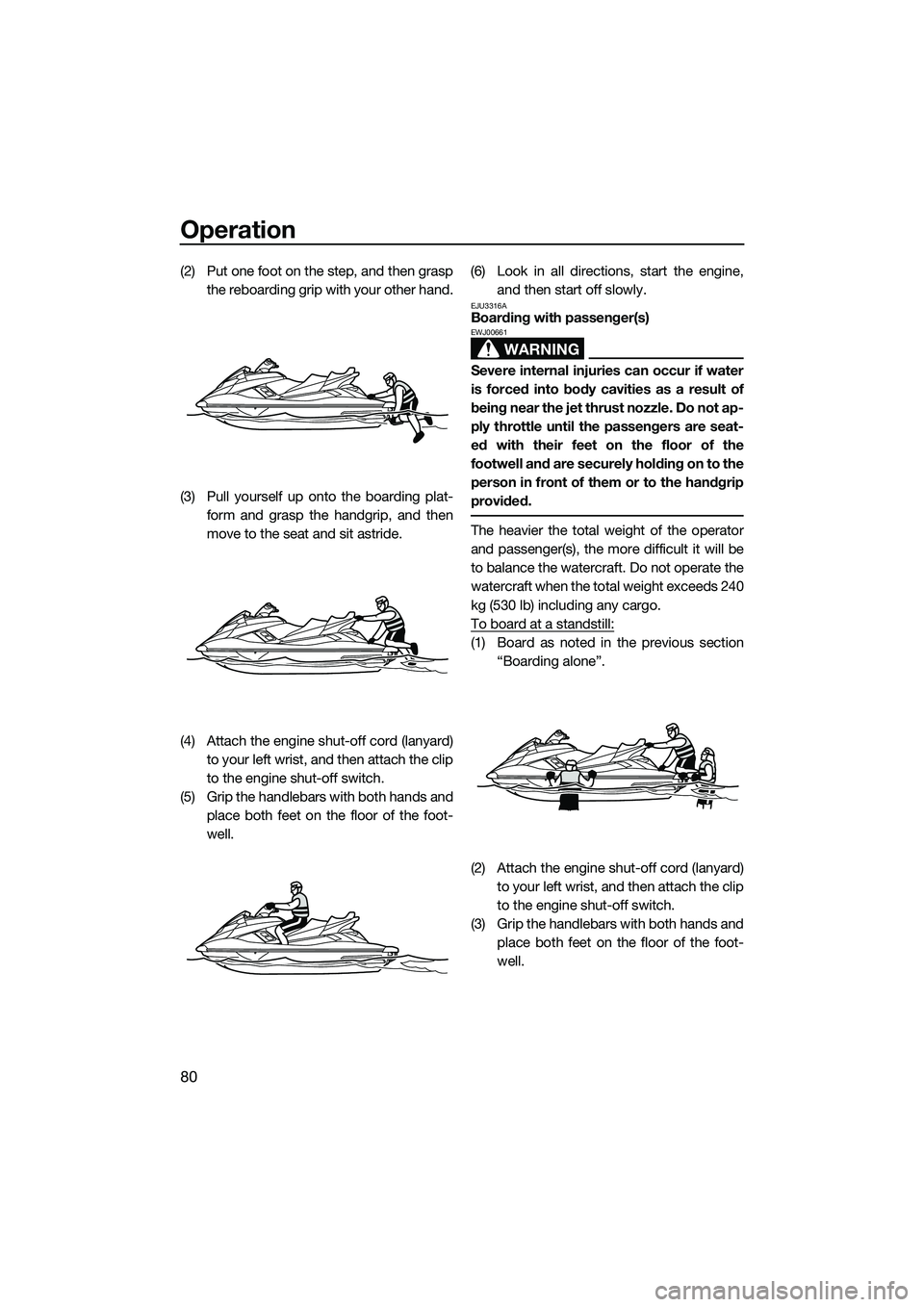
(2) Put one foot on the step, and then graspthe reboarding grip with your other hand.
(3) Pull yourself up onto the boarding plat- form and grasp the handgrip, and then
move to the seat and sit astride.
(4) Attach the engine shut-off cord (lanyard) to your left wrist, and then attach the clip
to the engine shut-off switch.
(5) Grip the handlebars with both hands and place both feet on the floor of the foot-
well. (6) Look in all directions, start the engine,
and then start off slowly.
EJU3316ABoarding with passenger(s)
WARNING
EWJ00661
Severe internal injuries can occur if water
is forced into body cavities as a result of
being near the jet thrust nozzle. Do not ap-
ply throttle until the passengers are seat-
ed with their feet on the floor of the
footwell and are securely holding on to the
person in front of them or to the handgrip
provided.
The heavier the total weight of the operator
and passenger(s), the more difficult it will be
to balance the watercraft. Do not operate the
watercraft when the total weight exceeds 240
kg (530 lb) including any cargo.
To board at a standstill:
(1) Board as noted in the previous section“Boarding alone”.
(2) Attach the engine shut-off cord (lanyard) to your left wrist, and then attach the clip
to the engine shut-off switch.
(3) Grip the handlebars with both hands and place both feet on the floor of the foot-
well.
UF2T72E0.book Page 80 Monday, July 22, 2013 2:26 PM
Page 88 of 114
Operation
82
(4) Attach the engine shut-off cord (lanyard)to your left wrist, and then attach the clip
to the engine shut-off switch.
(5) Look in all directions, and then start the engine and operate at trolling speed.
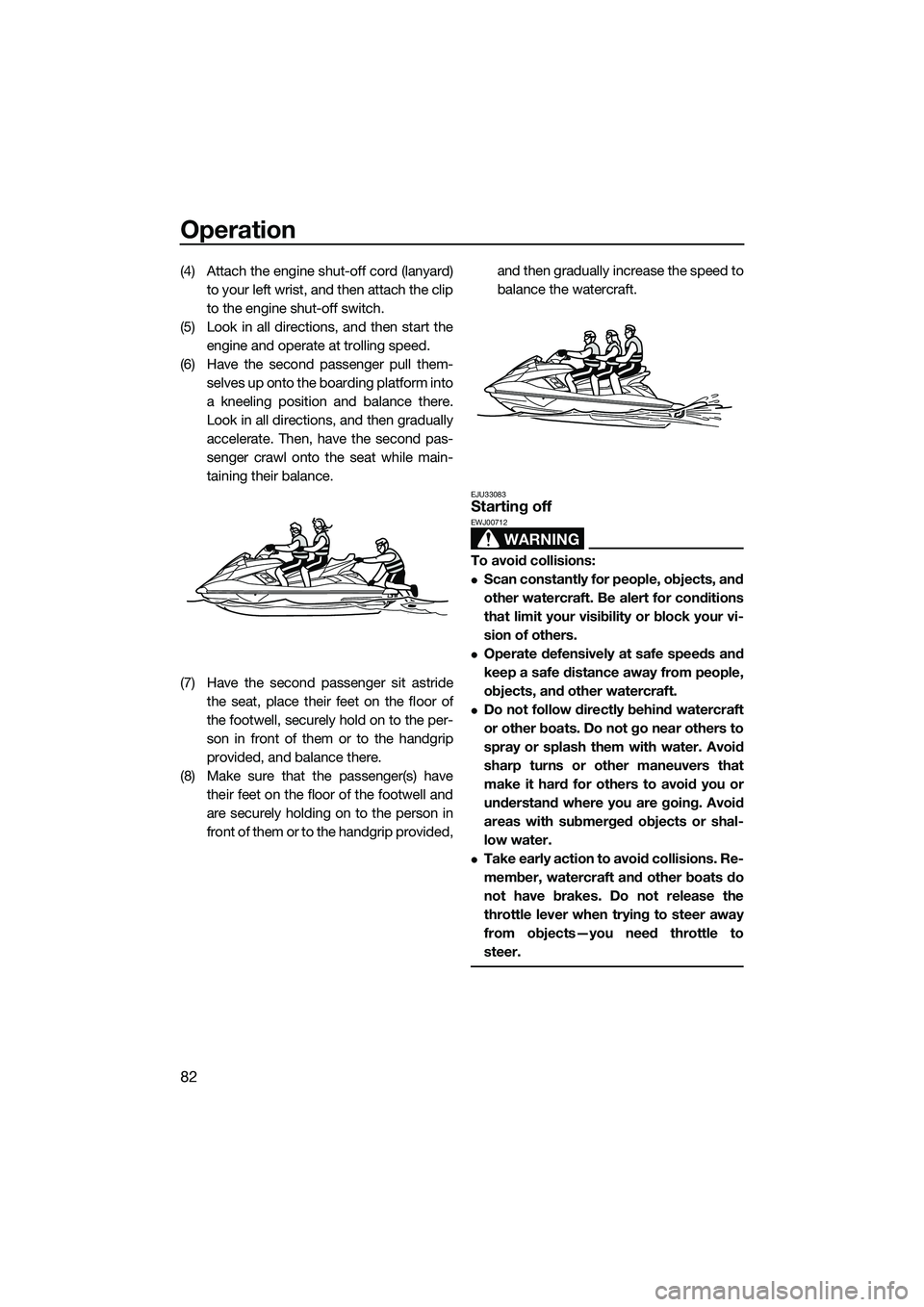
(6) Have the second passenger pull them- selves up onto the boarding platform into
a kneeling position and balance there.
Look in all directions, and then gradually
accelerate. Then, have the second pas-
senger crawl onto the seat while main-
taining their balance.
(7) Have the second passenger sit astride the seat, place their feet on the floor of
the footwell, securely hold on to the per-
son in front of them or to the handgrip
provided, and balance there.
(8) Make sure that the passenger(s) have their feet on the floor of the footwell and
are securely holding on to the person in
front of them or to the handgrip provided, and then gradually increase the speed to
balance the watercraft.
EJU33083Starting off
WARNING
EWJ00712
To avoid collisions:
Scan constantly for people, objects, and
other watercraft. Be alert for conditions
that limit your visibility or block your vi-
sion of others.
Operate defensively at safe speeds and
keep a safe distance away from people,
objects, and other watercraft.
Do not follow directly behind watercraft
or other boats. Do not go near others to
spray or splash them with water. Avoid
sharp turns or other maneuvers that
make it hard for others to avoid you or
understand where you are going. Avoid
areas with submerged objects or shal-
low water.
Take early action to avoid collisions. Re-
member, watercraft and other boats do
not have brakes. Do not release the
throttle lever when trying to steer away
from objects—you need throttle to
steer.
UF2T72E0.book Page 82 Monday, July 22, 2013 2:26 PM
Page 89 of 114
Operation
83
NOTICE
ECJ01341
Never run the engine in water that is less
than 60 cm (2 ft) deep from the bottom of
the watercraft, otherwise pebbles or sand
could be sucked into the jet intake, caus-
ing impeller damage and engine overheat-
ing.
EJU40233Starting off from a trailer
(1) Launch the watercraft and move the shiftlever to the reverse position. (See page
32 for information on the reverse sys-
tem.)
(2) Attach the engine shut-off cord (lanyard) to your left wrist, and then attach the clip
to the engine shut-off switch.
(3) Look in all directions, start the engine, and then start off slowly.
EJU33114Boarding and starting off from a dock
(1) Board the watercraft from the side.
(2) Attach the engine shut-off cord (lanyard)to your left wrist, and then attach the clip
to the engine shut-off switch.
(3) Push the watercraft away from the dock, grip the handlebars with both hands, and place both feet on the floor of the foot-
well.
(4) Look in all directions, start the engine, and then start off slowly.
EJU33236Capsized watercraft
WARNING
EWJ00672
Improper uprighting can cause injury.
Be sure to shut the engine off by pulling
on the engine shut-off cord (lanyard) to
remove the clip from the engine shut-off
switch.
Do not put your hands in the intake
grate.
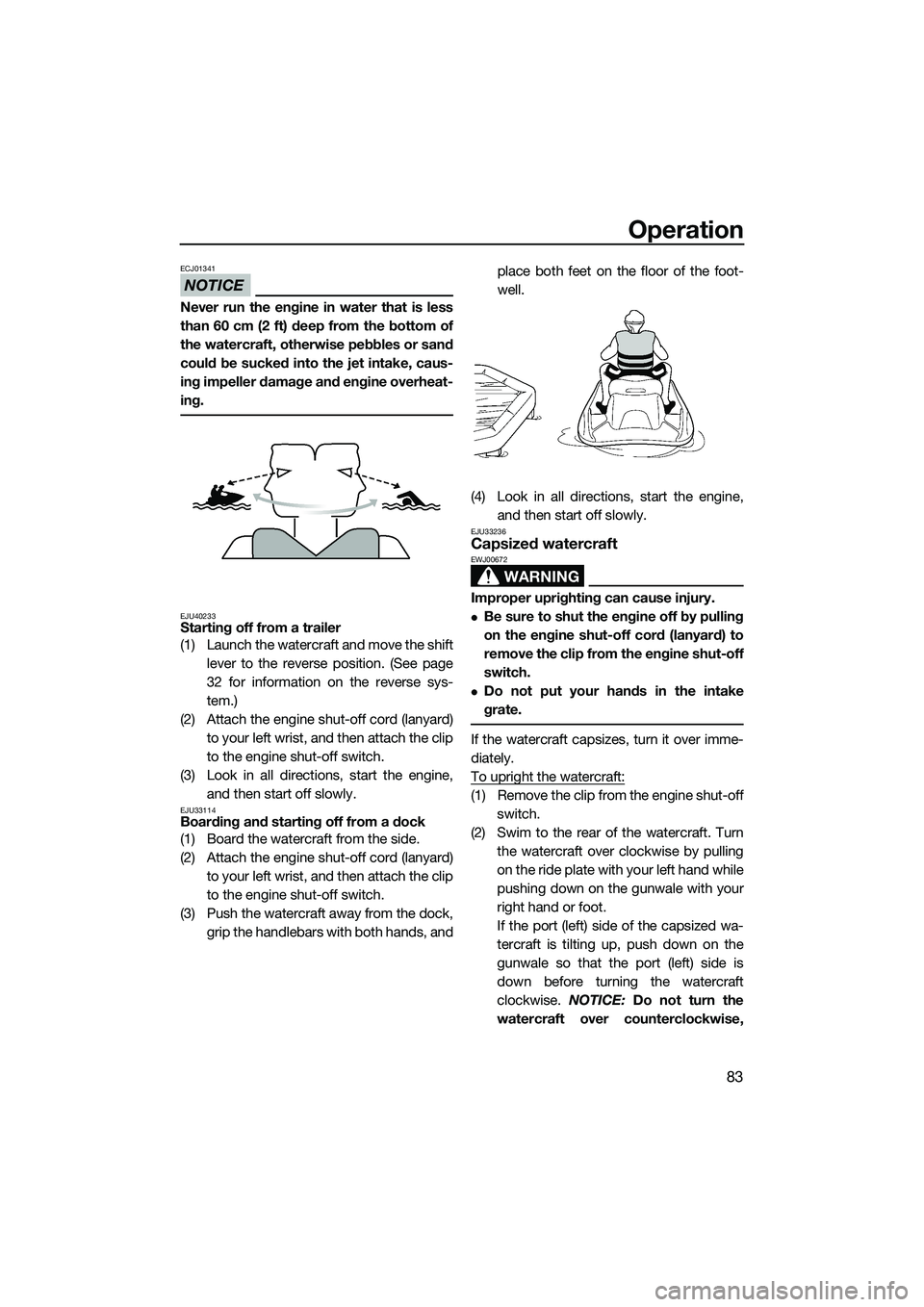
If the watercraft capsizes, turn it over imme-
diately.
To upright the watercraft:
(1) Remove the clip from the engine shut-offswitch.
(2) Swim to the rear of the watercraft. Turn the watercraft over clockwise by pulling
on the ride plate with your left hand while
pushing down on the gunwale with your
right hand or foot.
If the port (left) side of the capsized wa-
tercraft is tilting up, push down on the
gunwale so that the port (left) side is
down before turning the watercraft
clockwise. NOTICE: Do not turn the
watercraft over counterclockwise,
UF2T72E0.book Page 83 Monday, July 22, 2013 2:26 PM