cool YAMAHA MT-125 2018 User Guide
[x] Cancel search | Manufacturer: YAMAHA, Model Year: 2018, Model line: MT-125, Model: YAMAHA MT-125 2018Pages: 96, PDF Size: 7.1 MB
Page 48 of 96

Periodic maintenance and adjustment
6-6
6
EAU72740
TIP
The air filter needs more frequent service if you are riding in unusually wet or
dusty areas.
Hydraulic brake service
• Regularly check and, if necessary, correct the brake fluid level.
• Every two years change the brake fluid.
• Replace the brake hoses every four years and if cracked or damaged.
25 Engine oil• Change (warm engine before
draining).At the initial interval and when
the oil change indicator flashes
or comes on
• Check oil level and vehicle for oil
leakage.Every 3000 km (1800 mi)
26Engine oil filter el-
ement• Replace.√√√
27*Cooling system• Check coolant level and vehicle
for coolant leakage.√√√√√
• Change. Every 3 years
28*Front and rear
brake switches• Check operation.√√√√√√
29*Moving parts and
cables• Lubricate.√√√√√
30*Throttle grip hous-
ing and cable• Check operation and free play.
• Adjust the throttle cable free
play if necessary.
• Lubricate the throttle grip hous-
ing and cable.√√√√√
31*Lights, signals and
switches• Check operation.
• Adjust headlight beam.√√√√√√ NO. ITEM
X 1000 km CHECK OR
MAINTENANCE JOB
X 1000 miODOMETER
READING
ANNUAL CHECK
16121824
0.6 3.5 7 10.5 14
UBR3E1E0.book Page 6 Wednesday, August 10, 2016 9:45 AM
Page 54 of 96
Periodic maintenance and adjustment
6-12
613. Turn the engine off, and then
check the oil level and correct it if
necessary.
14. Reset the oil change indicator.
(See page 3-10.)
EAU20071
Coolant
The coolant level should be checked
before each ride. In addition, the cool-
ant must be changed at the intervals
specified in the periodic maintenance
and lubrication chart.
EAUM1726To check the coolant level
1. Place the vehicle on a level sur-
face and hold it in an upright posi-
tion.
TIP
The coolant level must be
checked on a cold engine since
the level varies with engine tem-
perature.
Make sure that the vehicle is posi-
tioned straight up when checking
the coolant level. A slight tilt to the
side can result in a false reading.
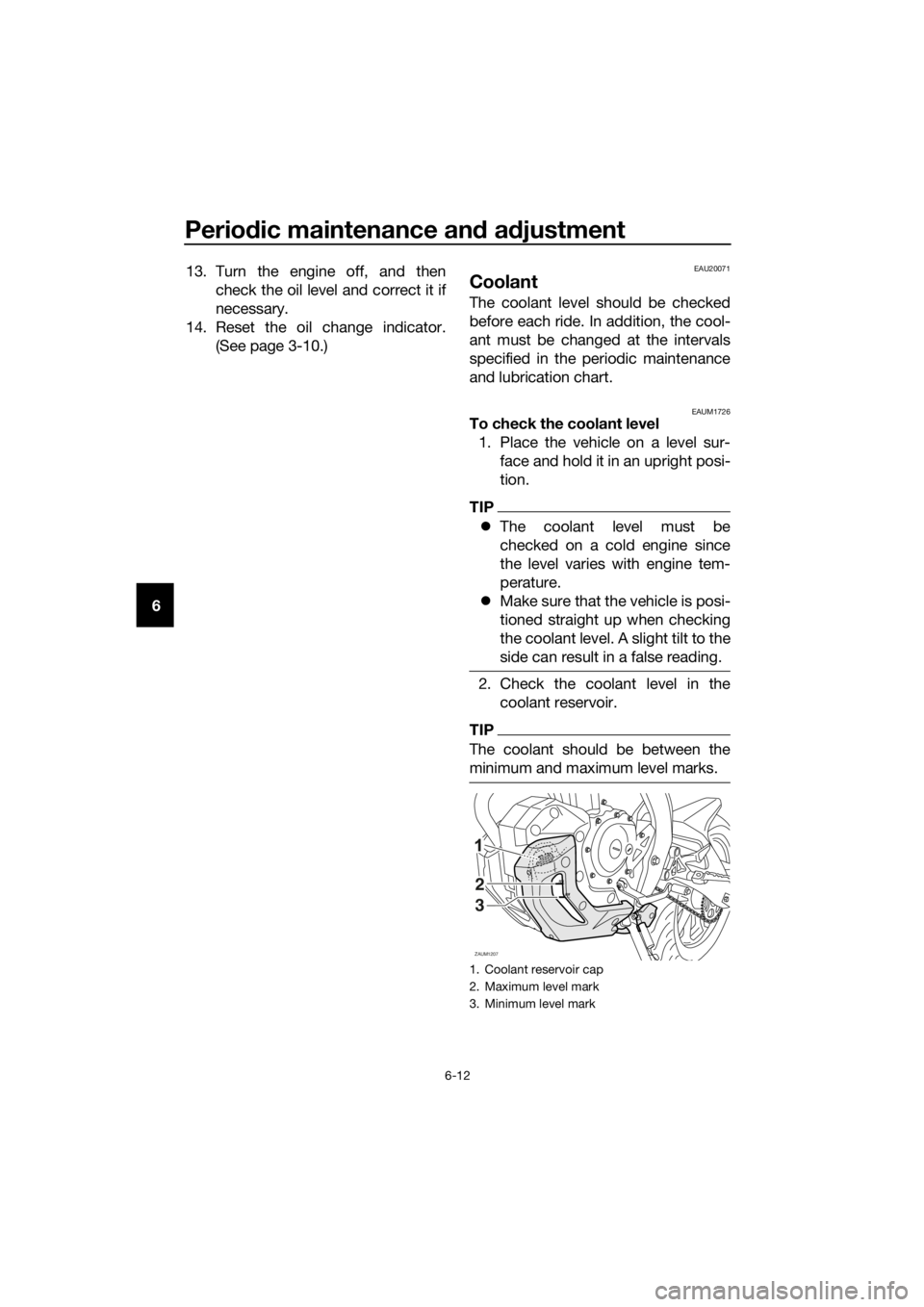
2. Check the coolant level in the
coolant reservoir.
TIP
The coolant should be between the
minimum and maximum level marks.
1. Coolant reservoir cap
2. Maximum level mark
3. Minimum level mark
ZAUM1207
FULL
LOW2
3
UBR3E1E0.book Page 12 Wednesday, August 10, 2016 9:45 AM
Page 55 of 96

Periodic maintenance and adjustment
6-13
6 3. If the coolant is at or below the
minimum level mark, remove
cowling A (See page 6-7.), and
then open the reservoir cap.
WARNING! Remove only the
coolant reservoir cap. Never at-
tempt to remove the radiator
cap when the engine is hot.
[EWA15162]
4. Add coolant to the maximum level
mark, and then close the reservoir
cap. NOTICE: If coolant is not
available, use distilled water or
soft tap water instead. Do not
use hard water or salt water
since it is harmful to the engine.
If water has been used instead
of coolant, replace it with cool-
ant as soon as possible, other-
wise the cooling system will not
be protected against frost and
corrosion. If water has been
added to the coolant, have a
Yamaha dealer check the anti-
freeze content of the coolant as
soon as possible, otherwise the
effectiveness of the coolant will
be reduced.
[ECA10473]
5. Install the cowling.
EAU33032Changing the coolant
The coolant must be changed at the in-
tervals specified in the periodic mainte-
nance and lubrication chart. Have a
Yamaha dealer change the coolant.WARNING! Never attempt to remove
the radiator cap when the engine is
hot.
[EWA10382]
Coolant reservoir capacity (up to
the maximum level mark):
0.25 L (0.26 US qt, 0.22 Imp.qt)
UBR3E1E0.book Page 13 Wednesday, August 10, 2016 9:45 AM
Page 74 of 96
Periodic maintenance and adjustment
6-32
6then place it in a cool, dry place.
NOTICE: When removing the
battery, be sure the key is
turned to “OFF”, then discon-
nect the negative lead before
disconnecting the positive lead.
[ECA16303]
2. If the battery will be stored for
more than two months, check the
specific gravity of the electrolyte
at least once a month and fully
charge the battery whenever nec-
essary.
3. Fully charge the battery before in-
stallation. NOTICE: When install-
ing the battery, be sure the key
is turned to “OFF”, then connect
the positive lead before con-
necting the negative lead.
[ECA16841]
4. After installation, make sure that
the battery leads are properly con-
nected to the battery terminals
and that the breather hose is prop-
erly routed, in good condition, and
not obstructed. NOTICE: If the
breather hose is positioned in
such a way that the frame is ex-
posed to electrolyte or gas ex-
pelled from the battery, the
frame could suffer structural
and external damages.
[ECA10602]EAUM3461
Replacing the fuses
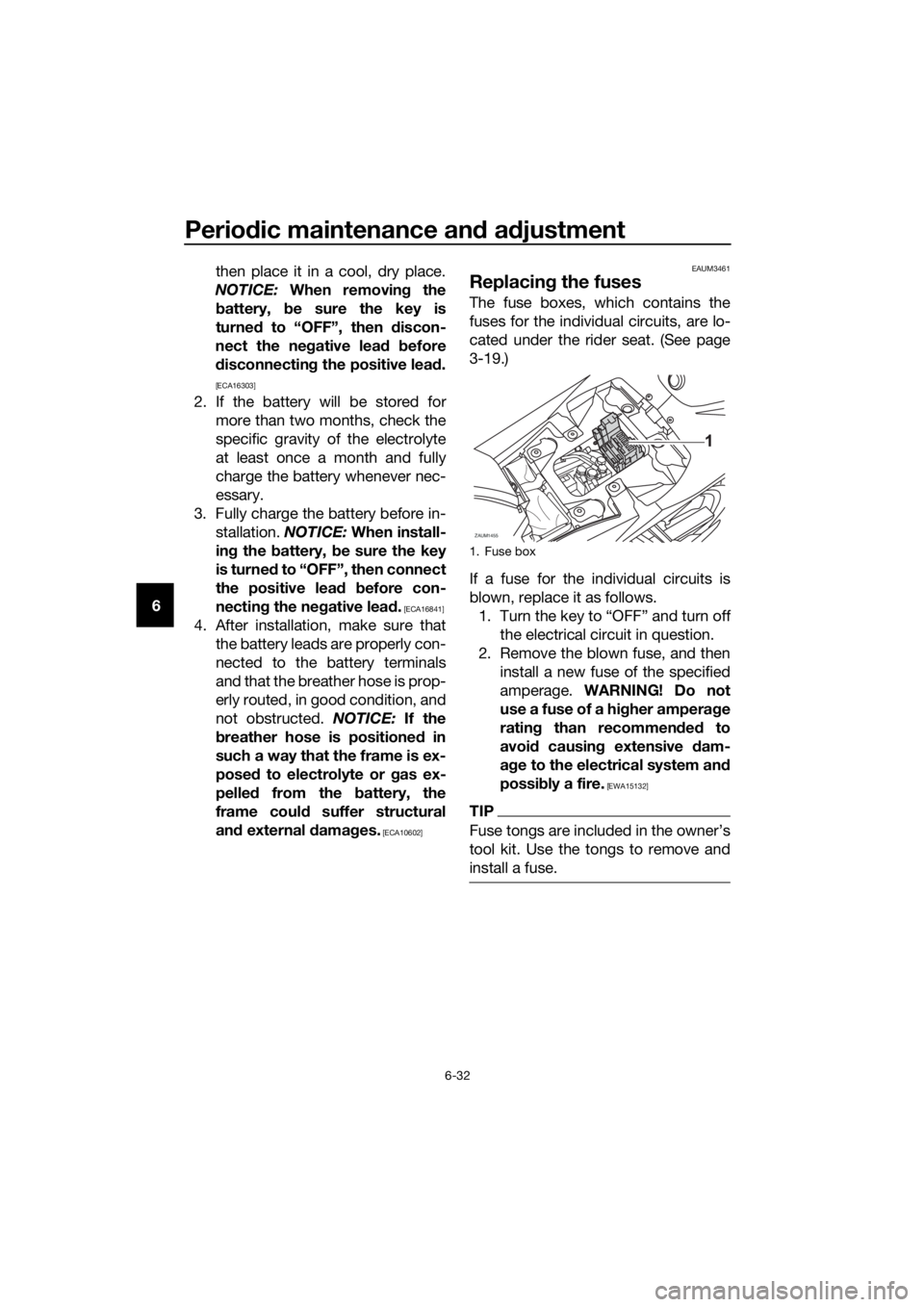
The fuse boxes, which contains the
fuses for the individual circuits, are lo-
cated under the rider seat. (See page
3-19.)
If a fuse for the individual circuits is
blown, replace it as follows.
1. Turn the key to “OFF” and turn off
the electrical circuit in question.
2. Remove the blown fuse, and then
install a new fuse of the specified
amperage. WARNING! Do not
use a fuse of a higher amperage
rating than recommended to
avoid causing extensive dam-
age to the electrical system and
possibly a fire.
[EWA15132]
TIP
tool kit. Use the tongs to remove and
install a fuse.
1. Fuse box
ZAUM1455
UBR3E1E0.book Page 32 Wednesday, August 10, 2016 9:45 AM
Page 81 of 96
Periodic maintenance and adjustment
6-39
6 Engine overheating
WARNING
EWA10401
Do not remove the radiator cap when the engine and radiator are hot.
Scalding hot fluid and steam may be blown out under pressure, which
could cause serious injury. Be sure to wait until the engine has cooled.
After removing the radiator cap retaining bolt, place a thick rag, like a
towel, over the radiator cap, and then slowly rotate the cap counter-
clockwise to the detent to allow any residual pressure to escape. When
the hissing sound has stopped, press down on the cap while turning it
counterclockwise, and then remove the cap.
TIP
If coolant is not available, tap water can be temporarily used instead, provided
that it is changed to the recommended coolant as soon as possible.
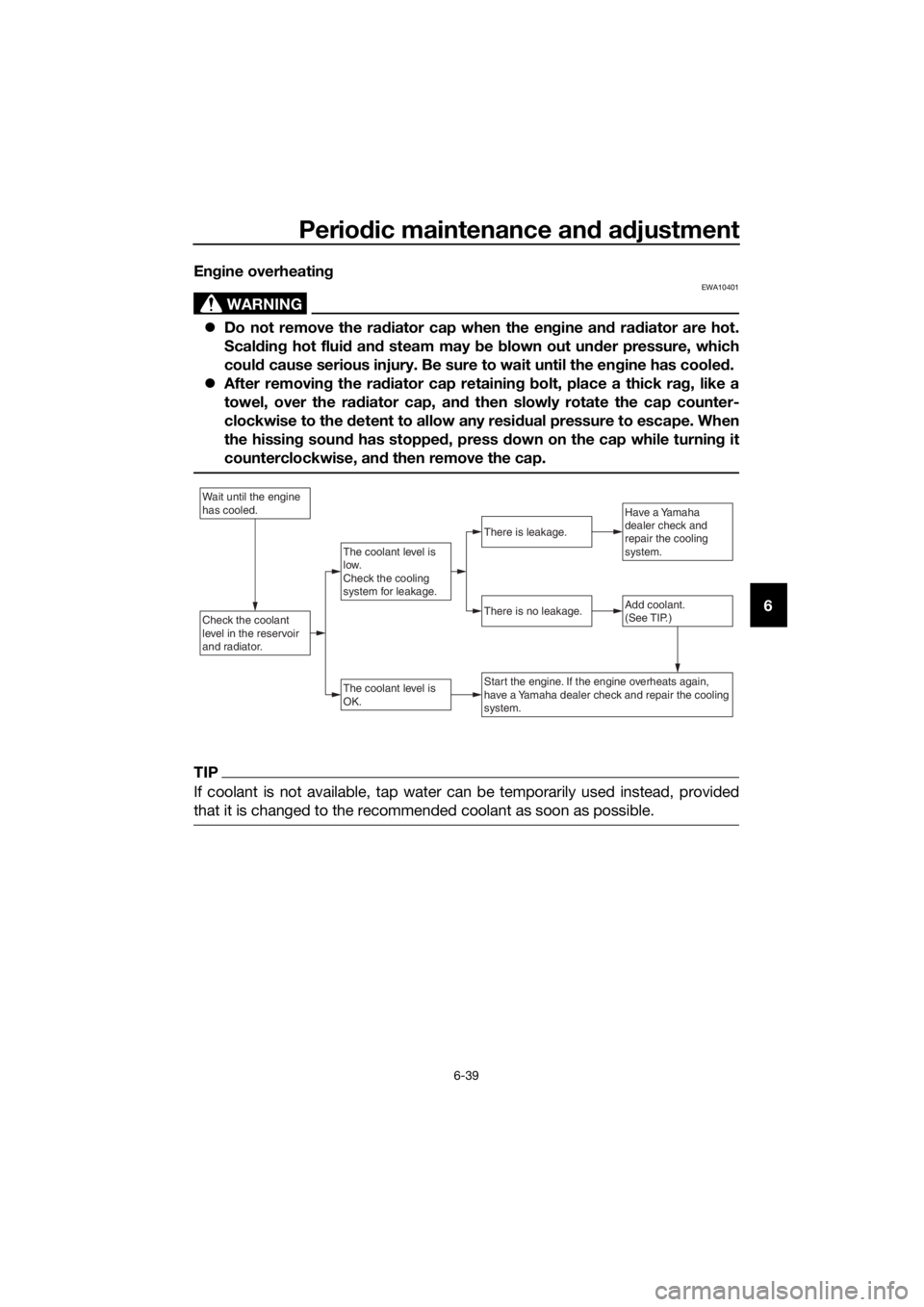
Wait until the engine
has cooled.
Check the coolant
level in the reservoir
and radiator.Add coolant.
(See TIP.)
The coolant level is
OK.
There is no leakage.
There is leakage.
The coolant level is
low.
Check the cooling
system for leakage.
Have a Yamaha
dealer check and
repair the cooling
system.
Start the engine. If the engine overheats again,
have a Yamaha dealer check and repair the cooling
system.
UBR3E1E0.book Page 39 Wednesday, August 10, 2016 9:45 AM
Page 82 of 96
Motorcycle care and storage
7-1
7
EAU37834
Matte color caution
NOTICE
ECA15193
Some models are equipped with
matte colored finished parts. Be
sure to consult a Yamaha dealer for
advice on what products to use be-
fore cleaning the vehicle. Using a
brush, harsh chemical products or
cleaning compounds when cleaning
these parts will scratch or damage
their surface. Wax also should not
be applied to any matte colored fin-
ished parts.
EAUM2453
Care
While the open design of a motorcycle
reveals the attractiveness of the tech-
nology, it also makes it more vulnera-
ble. Rust and corrosion can develop
even if high-quality components are
used. A rusty exhaust pipe may go un-
noticed on a car, however, it detracts
from the overall appearance of a mo-
torcycle. Frequent and proper care
does not only comply with the terms of
the warranty, but it will also keep your
motorcycle looking good, extend its
life and optimize its performance.
Before cleaning
1. Cover the muffler outlet with a
plastic bag after the engine has
cooled down.
2. Make sure that all caps and cov-
ers as well as all electrical cou-
plers and connectors, including
the spark plug cap, are tightly in-
stalled.
3. Remove extremely stubborn dirt,
like oil burnt onto the crankcase,
with a degreasing agent and a
brush, but never apply such prod-
ucts onto seals, gaskets, sprock-
ets, the drive chain and wheel
axles. Always rinse the dirt and
degreaser off with water.
Cleaning
NOTICE
ECA10773
Avoid using strong acidic wheel
cleaners, especially on spoked
wheels. If such products are
used on hard-to-remove dirt, do
not leave the cleaner on the af-
UBR3E1E0.book Page 1 Wednesday, August 10, 2016 9:45 AM
Page 83 of 96

Motorcycle care and storage
7-2
7 fected area any longer than in-
structed. Also, thoroughly rinse
the area off with water, immedi-
ately dry it, and then apply a cor-
rosion protection spray.
Improper cleaning can damage
plastic parts (such as cowlings,
panels, windshields, headlight
lenses, meter lenses, etc.) and
the mufflers. Use only a soft,
clean cloth or sponge with wa-
ter to clean plastic. However, if
the plastic parts cannot be thor-
oughly cleaned with water, di-
luted mild detergent with water
may be used. Be sure to rinse
off any detergent residue using
plenty of water, as it is harmful
to plastic parts.
Do not use any harsh chemical
products on plastic parts. Be
sure to avoid using cloths or
sponges which have been in
contact with strong or abrasive
cleaning pro
ducts, solvent or
thinner, fuel (gasoline), rust re-
movers or inhibitors, brake fluid,
antifreeze or electrolyte.
Do not use high-pressure wash-
ers or steam-jet cleaners since
they cause water seepage and
deterioration in the following ar-
eas: seals (of wheel and swing-
arm bearings, fork and brakes),
electric components (couplers,
connectors, instruments,
switches and lights), breather
hoses and vents.
For motorcycles equipped with
a windshield: Do not use strong
cleaners or hard sponges as
they will cause dulling orscratching. Some cleaning
compounds for plastic may
leave scratches on the wind-
shield. Test the product on a
small hidden part of the wind-
shield to make sure that it does
not leave any marks. If the wind-
shield is scratched
, use a quality
plastic polishing compound af-
ter washing.
After normal use
Remove dirt with warm water, a mild
detergent, and a soft, clean sponge,
and then rinse thoroughly with clean
water. Use a toothbrush or bottlebrush
for hard-to-reach areas. Stubborn dirt
and insects will come off more easily if
the area is covered with a wet cloth for
a few minutes before cleaning. Use the
special sponge, which is located under
the tool kit, to clean the muffler and to
remove any discoloration from it.
After riding in the rain, near the sea or
on salt-sprayed roads
Since sea salt or salt sprayed on roads
during winter are extremely corrosive
in combination with water, carry out
the following steps after each ride in
the rain, near the sea or on salt-
sprayed roads.
TIP
Salt sprayed on roads in the winter
may remain well into spring.
1. Clean the motorcycle with cold
water and a mild detergent, after
the engine has cooled down.
NOTICE: Do not use warm wa-
ter since it increases the corro-
sive action of the salt.
[ECA10792]
UBR3E1E0.book Page 2 Wednesday, August 10, 2016 9:45 AM
Page 85 of 96
Motorcycle care and storage
7-4
7
EAU43204
Storage
Short-term
Always store your motorcycle in a cool,
dry place and, if necessary, protect it
against dust with a porous cover. Be
sure the engine and the exhaust sys-
tem are cool before covering the mo-
torcycle.
NOTICE
ECA10811
Storing the motorcycle in a
poorly ventilated room or cover-
ing it with a tarp, while it is still
wet, will allow water and humid-
ity to seep in and cause rust.
To prevent corrosion, avoid
damp cellars, stables (because
of the presence of ammonia)
and areas where strong chemi-
cals are stored.
Long-term
Before storing your motorcycle for sev-
eral months:
1. Follow all the instructions in the
“Care” section of this chapter.
2. Fill up the fuel tank and add fuel
stabilizer (if available) to prevent
the fuel tank from rusting and the
fuel from deteriorating.
3. Perform the following steps to
protect the cylinder, piston rings,
etc. from corrosion.
a. Remove the spark plug cap
and spark plug.
b. Pour a teaspoonful of engine
oil into the spark plug bore.
c. Install the spark plug cap onto
the spark plug, and then place
the spark plug on the cylinderhead so that the electrodes are
grounded. (This will limit spark-
ing during the next step.)
d. Turn the engine over several
times with the starter. (This will
coat the cylinder wall with oil.)
WARNING! To prevent dam-
age or injury from sparking,
make sure to ground the
spark plug electrodes while
turning the engine over.
[EWA10952]
e. Remove the spark plug cap
from the spark plug, and then
install the spark plug and the
spark plug cap.
4. Lubricate all control cables and
the pivoting points of all levers and
pedals as well as of the side-
stand/centerstand.
5. Check and, if necessary, correct
the tire air pressure, and then lift
the motorcycle so that both of its
wheels are off the ground. Alterna-
tively, turn the wheels a little every
month in order to prevent the tires
from becoming degraded in one
spot.
6. Cover the muffler outlet with a
plastic bag to prevent moisture
from entering it.
7. Remove the battery and fully
charge it. Store it in a cool, dry
place and charge it once a month.
Do not store the battery in an ex-
cessively cold or warm place [less
than 0 °C (30 °F) or more than 30
°C (90 °F)]. For more information
on storing the battery, see page
6-31.
UBR3E1E0.book Page 4 Wednesday, August 10, 2016 9:45 AM
Page 87 of 96

Specifications
8-1
8
Dimensions:
Overall length:
1950 mm (76.8 in)
Overall width:
745 mm (29.3 in)
Overall height:
1025 mm (40.4 in)
Seat height:
810 mm (31.9 in)
Wheelbase:
1350 mm (53.1 in)
Ground clearance:
140 mm (5.51 in)
Minimum turning radius:
2.5 m (8.20 ft)
Weight:
Curb weight:
141 kg (311 lb)
Engine:
Engine type:
Liquid cooled 4-stroke, SOHC
Cylinder arrangement:
Single cylinder
Displacement:
124 cm³
Bore × stroke:
52.0 × 58.6 mm (2.05 × 2.31 in)
Compression ratio:
11.2 : 1
Starting system:
Electric starter
Lubrication system:
Wet sump
Engine oil:
Recommended brand:
YAMALUBE
Type:
SAE 10W-40
Recommended engine oil grade:
API service SG type or higher, JASO
standard MA
Engine oil quantity:
Without oil filter element replacement:
0.95 L (1.00 US qt, 0.84 Imp.qt)
With oil filter element replacement:
1.00 L (1.06 US qt, 0.88 Imp.qt)
Coolant quantity:
Coolant reservoir (up to the maximum level
mark):
0.25 L (0.26 US qt, 0.22 Imp.qt)Radiator (including all routes):
1.00 L (1.06 US qt, 0.88 Imp.qt)
Air filter:
Air filter element:
Dry element
Fuel:
Recommended fuel:
Premium unleaded gasoline (Gasohol [E10]
acceptable)
Fuel tank capacity:
11.5 L (3.04 US gal, 2.53 Imp.gal)
Fuel reserve amount:
3.0 L (0.79 US gal, 0.66 Imp.gal)
Fuel injection:
Throttle body:
ID mark:
BR61 00
Spark plug(s):
Manufacturer/model:
NGK/CR9E
Spark plug gap:
0.7–0.8 mm (0.028–0.031 in)
Clutch:
Clutch type:
Wet, multiple-disc
Drivetrain:
Primary reduction ratio:
73/24 (3.042)
Final drive:
Chain
Secondary reduction ratio:
48/14 (3.429)
Transmission type:
Constant mesh 6-speed
Operation:
Left foot operation
Gear ratio:
1st:
34/12 (2.833)
2nd:
30/16 (1.875)
3rd:
30/22 (1.364)
4th:
24/21 (1.143)
5th:
22/23 (0.957)
6th:
21/25 (0.840)
UBR3E1E0.book Page 1 Wednesday, August 10, 2016 9:45 AM
Page 92 of 96

10-1
10
Index
A
ABS ....................................................... 3-15
ABS warning light ................................... 3-3
Air filter element and check hose,
replacing and cleaning ....................... 6-14
Auxiliary lights ....................................... 6-35
B
Battery .................................................. 6-31
Brake and clutch levers, checking and
lubricating ........................................... 6-27
Brake fluid, changing ............................ 6-24
Brake fluid level, checking .................... 6-23
Brake lever ............................................ 3-14
Brake light switches.............................. 6-21
Brake pedal........................................... 3-15
Brake pedal, checking and
lubricating ........................................... 6-28
Brake pedal free play, adjusting ........... 6-21
C
Cables, checking and lubricating ......... 6-26
Care ........................................................ 7-1
Catalytic converter ................................ 3-18
Clutch lever ........................................... 3-13
Clutch lever free play, adjusting ........... 6-19
Coolant ................................................. 6-12
Cowlings, removing and installing .......... 6-7
D
Data recording, vehicle ........................... 9-2
Diagnostic connectors ............................ 9-2
Dimmer switch ...................................... 3-12
Drive chain, cleaning and lubricating .... 6-26
Drive chain slack................................... 6-24
E
Engine break-in....................................... 5-4
Engine idling speed, checking .............. 6-14
Engine oil and oil filter element ............... 6-9
Engine stop switch ............................... 3-12
Engine trouble warning light ................... 3-3
F
Front and rear brake pads, checking.... 6-22
Front brake lever free play, checking ... 6-20
Front fork, checking .............................. 6-29
Fuel ....................................................... 3-17
Fuel consumption, tips for reducing ....... 5-4
Fuel level warning light ........................... 3-2
Fuel tank cap ........................................ 3-16
Fuses, replacing.................................... 6-32
H
Handlebar switches .............................. 3-12
Headlight bulb, replacing ...................... 6-33High beam indicator light ....................... 3-2
Horn switch .......................................... 3-12
I
Identification numbers ............................ 9-1
Ignition circuit cut-off system............... 3-20
Indicator lights and warning lights ......... 3-2
Info switch ............................................ 3-12
L
License plate light bulb, replacing........ 6-36
M
Main switch/steering lock....................... 3-1
Maintenance and lubrication, periodic ... 6-4
Maintenance, emission control
system.................................................. 6-3
Matte color, caution ............................... 7-1
Model label ............................................. 9-1
Multi-function meter unit ........................ 3-4
N
Neutral indicator light ............................. 3-2
P
Parking ................................................... 5-5
Part locations ......................................... 2-1
Pass switch .......................................... 3-12
R
Rider seat ............................................. 3-19
S
Safety information .................................. 1-1
Shifting ................................................... 5-3
Shift pedal ............................................ 3-14
Sidestand ............................................. 3-20
Sidestand, checking and lubricating .... 6-28
Spark plug, checking ............................. 6-8
Specifications ......................................... 8-1
Starting the engine ................................. 5-2
Start switch .......................................... 3-12
Steering, checking................................ 6-30
Storage ................................................... 7-4
Supporting the motorcycle................... 6-37
Swingarm pivots, lubricating ................ 6-29
T
Tail/brake light ...................................... 6-35
Throttle grip and cable, checking and
lubricating .......................................... 6-27
Throttle grip free play, adjusting........... 6-15
Tires ...................................................... 6-16
Tool kit.................................................... 6-2
Troubleshooting ................................... 6-37
Troubleshooting charts ........................ 6-38
Turn signal indicator light ....................... 3-2
Turn signal light bulb, replacing ........... 6-36
UBR3E1E0.book Page 1 Wednesday, August 10, 2016 9:45 AM