lock YAMAHA VIKING 2014 User Guide
[x] Cancel search | Manufacturer: YAMAHA, Model Year: 2014, Model line: VIKING, Model: YAMAHA VIKING 2014Pages: 180, PDF Size: 3.78 MB
Page 54 of 180
4-22
4
5
6
7
8
9
10
11
12
13
14
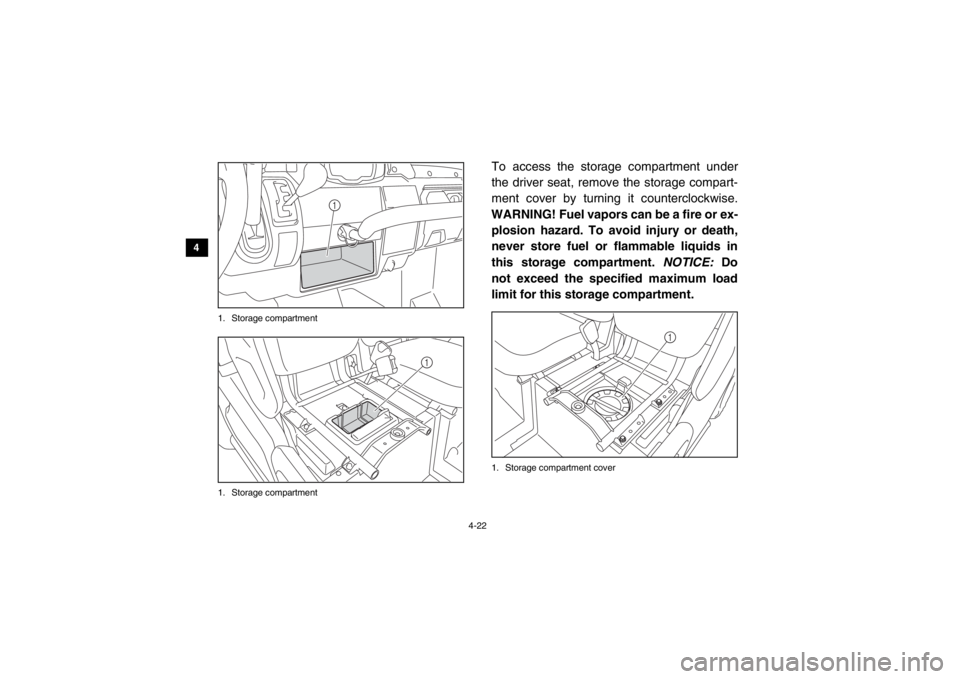
1. Storage compartment
1. Storage compartment
To access the storage compartment under
the driver seat, remove the storage compart-
ment cover by turning it counterclockwise.
WARNING! Fuel vapors can be a fire or ex- plosion hazard. To avoid injury or death,
never store fuel or flammable liquids in
this storage compartment. NOTICE: Do
not exceed the specified maximum load
limit for this storage compartment.1. Storage compartment cover
1
1
1
1XP7B_EE.book Page 22 Tuesday, February 4, 2014 3:40 PM
Page 58 of 180
4-26
4
5
6
7
8
9
10
11
12
13
14
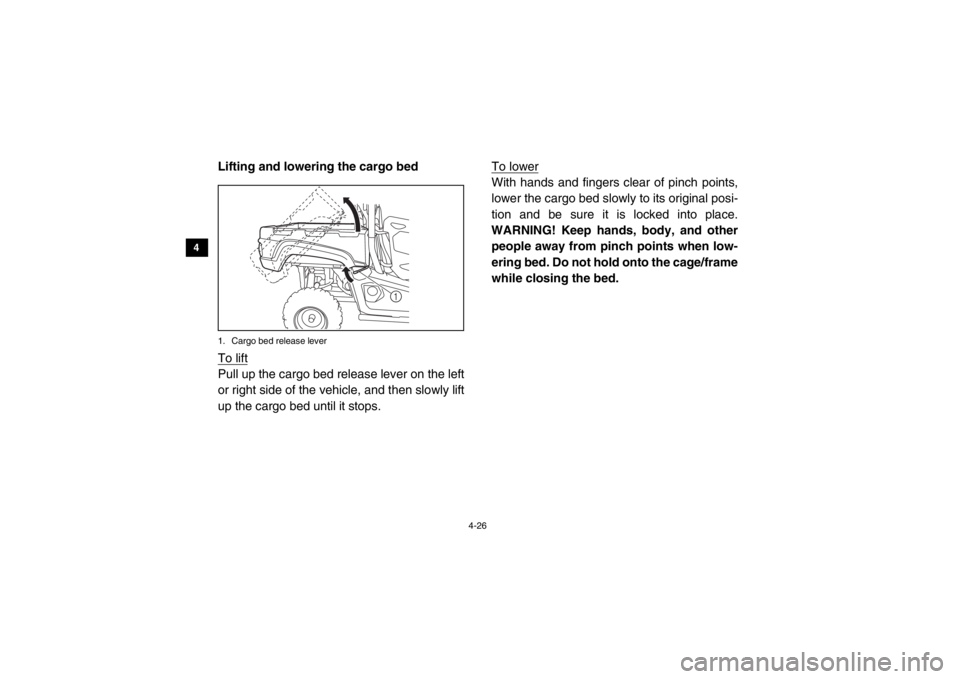
Lifting and lowering the cargo bed1. Cargo bed release leverTo liftPull up the cargo bed release lever on the left
or right side of the vehicle, and then slowly lift
up the cargo bed until it stops. To lower
With hands and fingers clear of pinch points,
lower the cargo bed slowly to its original posi-
tion and be sure it is locked into place.
WARNING! Keep hands, body, and other people away from pinch points when low-
ering bed. Do not hold onto the cage/frame
while closing the bed.
1
1XP7B_EE.book Page 26 Tuesday, February 4, 2014 3:40 PM
Page 69 of 180
5-7
1
2
3
45
6
7
8
9
10
11
12
13
14
EVU00430Final gear oilMake sure the final gear oil is at the specified
level. Add oil as necessary. (See page 8-15
for details.)
If desired, an SAE 80W-90 hypoid gear oil
may be used for all conditions.TIPGL-4 is a quality and additive rating; GL-5 or
GL-6 rated hypoid gear oils may also be used.EVU00440Differential gear oilMake sure the differential gear oil is at the
specified level. Add oil as necessary. (See
page 8-17 for details.)
EVU00450Accelerator pedalCheck to see that the accelerator pedal oper-
ates correctly. It must operate smoothly and
spring back to the idle position fully when re-
leased. Have a Yamaha dealer repair as nec-
essary for proper operation.EVU00460Seat beltsMake sure that the seat belts are not frayed,
torn, stretched, or damaged. The seat belts
must move smoothly when pulled out and re-
tract on its own when released. The seat belts
must also lock up when quickly pulled out.
The latch plate should click securely into the
buckle and release when the release button is
pushed firmly. Wash off any dirt or mud that
could affect operation. Have a Yamaha dealer
repair as necessary for proper operation.
Recommended oil:
SAE 80 API GL-4 Hypoid gear oil
Recommended oil: SAE 80 API GL-4 Hypoid gear oil
1XP7B_EE.book Page 7 Tuesday, February 4, 2014 3:40 PM
Page 70 of 180

5-8
5
6
7
8
9
10
11
12
13
14
A crash can damage the restraint systems in
your vehicle. A damaged restraint system
may not properly protect the person using it,
resulting in serious injury or death in a crash.
To help make sure your restraint systems are
working properly after a crash, have them in-
spected and any necessary replacements
made as soon as possible.Passenger handholdCheck that the handhold bar and its supports
are in good condition. Confirm that the locking
pins are securely fastened, and then push
and pull on the handhold to make sure that it
is not loose.EVU01230SteeringPark on level ground. Turn the steering wheel
right and left. Check for excessive free play,
abnormal noises, or a rough feeling. Have a
Yamaha dealer repair as necessary for proper operation.
EVU00470Fittings and fastenersAlways check the tightness of chassis fittings
and fasteners before a ride. Take the vehicle
to a Yamaha dealer or refer to the Service
Manual for correct tightening torque.Instruments, lights and switchesCheck that all instruments, lights and switches
are working properly. Correct if necessary.Control cablesWhen riding in cold weather, always make
sure all control cables work smoothly before
you begin riding. WARNING! Control cables
can freeze in cold weather and you could
be unable to control the vehicle.EVU00500TiresCheck tire pressure regularly to make sure it
is at the recommended specifications. Also
check for wear and damage.
1XP7B_EE.book Page 8 Tuesday, February 4, 2014 3:40 PM
Page 79 of 180
6-6
1
2
3
4
56
7
8
9
10
11
12
13
14
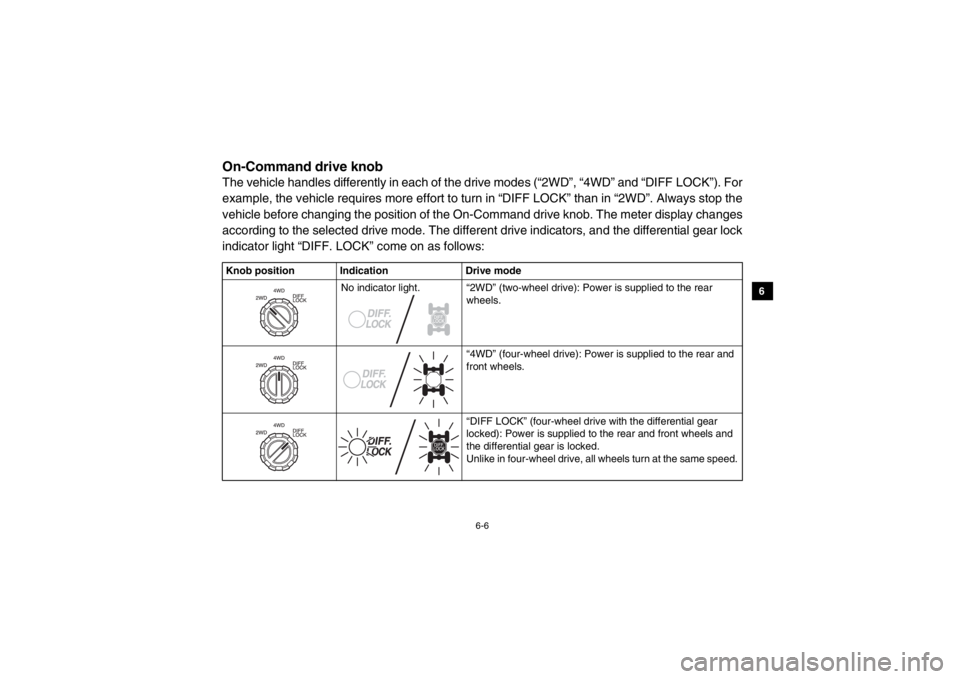
5B410009On-Command drive knobThe vehicle handles differently in each of the drive modes (“2WD”, “4WD” and “DIFF LOCK”). For
example, the vehicle requires more effort to turn in “DIFF LOCK” than in “2WD”. Always stop the
vehicle before changing the position of the On-Command drive knob. The meter display changes
according to the selected drive mode. The different drive indicators, and the differential gear lock
indicator light “DIFF. LOCK” come on as follows:Knob position Indication Drive mode
No indicator light. “2WD” (two-wheel drive): Power is supplied to the rear wheels.
“4WD” (four-wheel drive): Power is supplied to the rear and
front wheels.
“DIFF LOCK” (four-wheel drive with the differential gear
locked): Power is supplied to the rear and front wheels and
the differential gear is locked.
Unlike in four-wheel drive, all wheels turn at the same speed.
1XP7B_EE.book Page 6 Tuesday, February 4, 2014 3:40 PM
Page 80 of 180

6-7
6
7
8
9
10
11
12
13
14
TIP●
When the knob is set to “DIFF LOCK” or “4WD”, the differential gear lock indicator and indi-
cator light will flash until the differential gear is completely locked or unlocked.
●
When the indicator and indicator light are flashing, turning the steering wheel back and forth
will help the differential gear lock to engage or disengage.
●
Riding before the differential gear is properly engaged or disengaged (e.g., when the indica-
tor and indicator light are flashing) will cause the vehicle speed to be limited until the differ-
ential gear is completely engaged or disengaged.
1XP7B_EE.book Page 7 Tuesday, February 4, 2014 3:40 PM
Page 94 of 180
7-10
7
8
9
10
11
12
13
14
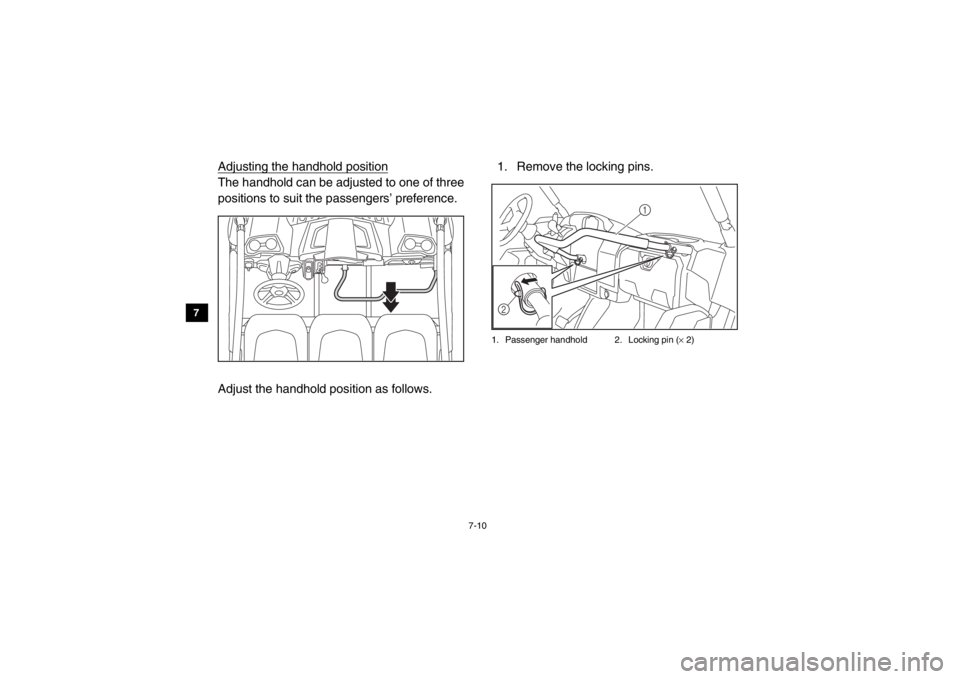
Adjusting the handhold positionThe handhold can be adjusted to one of three
positions to suit the passengers’ preference.
Adjust the handhold position as follows. 1. Remove the locking pins.
1. Passenger handhold 2. Locking pin (
× 2)
1
2
1XP7B_EE.book Page 10 Tuesday, February 4, 2014 3:40 PM
Page 99 of 180
7-15
1
2
3
4
5
67
8
9
10
11
12
13
14
Wear eye protection when operating or riding
the vehicle to reduce the risk of a serious ac-
cident or injury. Eye protection, such as a face
shield or goggles, may reduce the risk of for-
eign material getting in your eyes and help
prevent loss of vision.
Practice for new Yamaha Viking users
You should become familiar with the perfor-
mance characteristics of the vehicle in a large,
flat area that is free of obstacles and other ve-
hicles. Practice controlling the accelerator
pedal, brakes, steering, and drive select lever.
Drive at slow speeds with gradual accelera-
tion and turning. Practice smooth throttle ap-
plication. Practice slowing down before
turning. Practice maintaining a steady throttle
through the turn. Avoid higher speeds until
you are thoroughly familiar with the operation
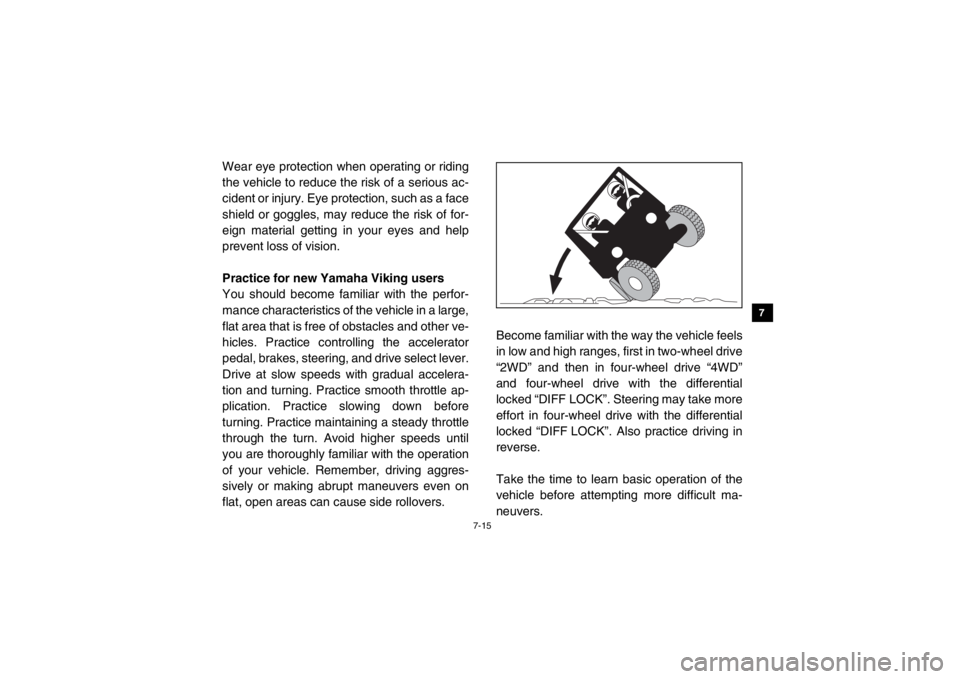
of your vehicle. Remember, driving aggres-
sively or making abrupt maneuvers even on
flat, open areas can cause side rollovers.Become familiar with the way the vehicle feels
in low and high ranges, first in two-wheel drive
“2WD” and then in four-wheel drive “4WD”
and four-wheel drive with the differential
locked “DIFF LOCK”. Steering may take more
effort in four-wheel drive with the differential
locked “DIFF LOCK”. Also practice driving in
reverse.
Take the time to learn basic operation of the
vehicle before attempting more difficult ma-
neuvers.1XP7B_EE.book Page 15 Tuesday, February 4, 2014 3:40 PM
Page 103 of 180

7-19
1
2
3
4
5
67
8
9
10
11
12
13
14
Leaving the vehicle
Do not get out of the vehicle while the engine
is running and the drive select lever is in any
gear. There is a risk of injury because:●
Children or others may accidentally press
the accelerator pedal.
●
Objects tossed into the vehicle may strike
the accelerator pedal.
●
The parking brake may not keep the vehi-
cle from accelerating.
Unwanted vehicle movement can cause seri-
ous injury or death, and it may be dangerous
to try to stop the vehicle. Parking on a flat area
When parking on a flat area, stop the engine
and shift the drive select lever into the neutral
position. Apply the parking brake to help pre-
vent the vehicle from rolling.
Parking on a slope
The parking brake acts only on the rear
wheels when in “2WD”. For the parking brake
to take effect on all four wheels, shift to
“DIFF LOCK” before stopping the engine.
If you park on a hill that is too steep the vehi-
cle may roll out of control. Never park on hills
that are so steep you cannot walk up them
easily. If you must park on an incline follow
these instructions:
1. Bring the vehicle to a stop by applying the
brake pedal.
2. Put the vehicle in “DIFF LOCK”.
3. Turn the key to “ ” (off).
1XP7B_EE.book Page 19 Tuesday, February 4, 2014 3:40 PM
Page 104 of 180

7-20
7
8
9
10
11
12
13
14
4. With the brake pedal applied, set the parking brake.
5. Block the front and rear wheels with
rocks or other objects.
Loading
The total weight of operator, passengers, ac-
cessories, cargo, trailer tongue weight, and
the vehicle itself must not exceed 1080 kg
(2381 lb). Vehicle loading can affect handling.
See “Loading” on page 6-8.
Operation on differe nt surfaces and
terrainsGo slowly and proceed with caution when op-
erating on an unfamiliar surface or terrain.
This vehicle may handle differently in certain
types of terrains or on certain surfaces. You
may come upon hidden rocks, bumps, or
holes without enough time to react. To avoid
loss of control or rollover, always be alert to
changing surfaces or terrain when operating
the vehicle.
Your Yamaha Viking has higher ground clear-
ance and other features to handle rugged ter-
rain, and as a result, can overturn in situations
where some vehicles may not. Abrupt maneu-
vers or aggressive driving can cause loss of
control, including rollovers – even on flat,
open areas. These rollovers can result in
crushed limbs and other serious injuries or
death to drivers or passengers.
1XP7B_EE.book Page 20 Tuesday, February 4, 2014 3:40 PM