light YAMAHA YFM400F 2001 User Guide
[x] Cancel search | Manufacturer: YAMAHA, Model Year: 2001, Model line: YFM400F, Model: YAMAHA YFM400F 2001Pages: 426, PDF Size: 21.5 MB
Page 78 of 426
4-17
Yuki_Data:Yuki_data:Yuki:Yuki_1:ATV:HM00B061_YFM400FWA-61:YFM600-4.frame
EL
EBU00607
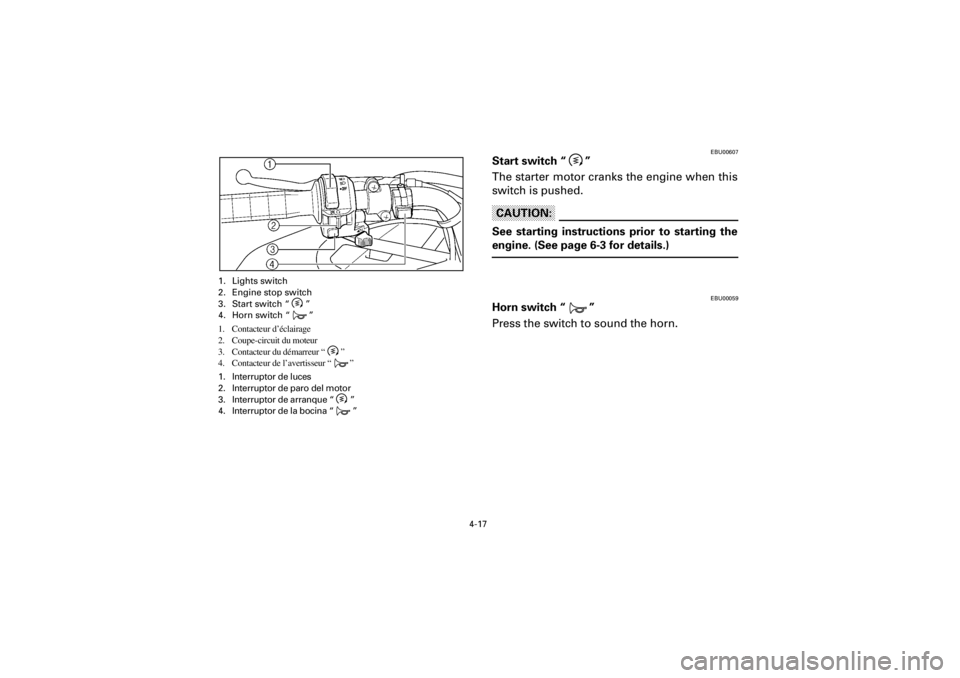
Start switch “ ”
The starter motor cranks the engine when this
switch is pushed.
CAUTION:
See starting instructions prior to starting the
engine. (See page 6-3 for details.)
EBU00059
Horn switch “ ”
Press the switch to sound the horn.
1. Lights switch
2. Engine stop switch
3. Start switch “ ”
4. Horn switch “ ”
1. Contacteur d’éclairage
2. Coupe-circuit du moteur
3. Contacteur du démarreur “ ”
4. Contacteur de l’avertisseur “ ”
1. Interruptor de luces
2. Interruptor de paro del motor
3. Interruptor de arranque “ ”
4. Interruptor de la bocina “ ”
Page 90 of 426
4-29
Yuki_Data:Yuki_data:Yuki:Yuki_1:ATV:HM00B061_YFM400FWA-61:YFM600-4.frame
EL
EBU00608
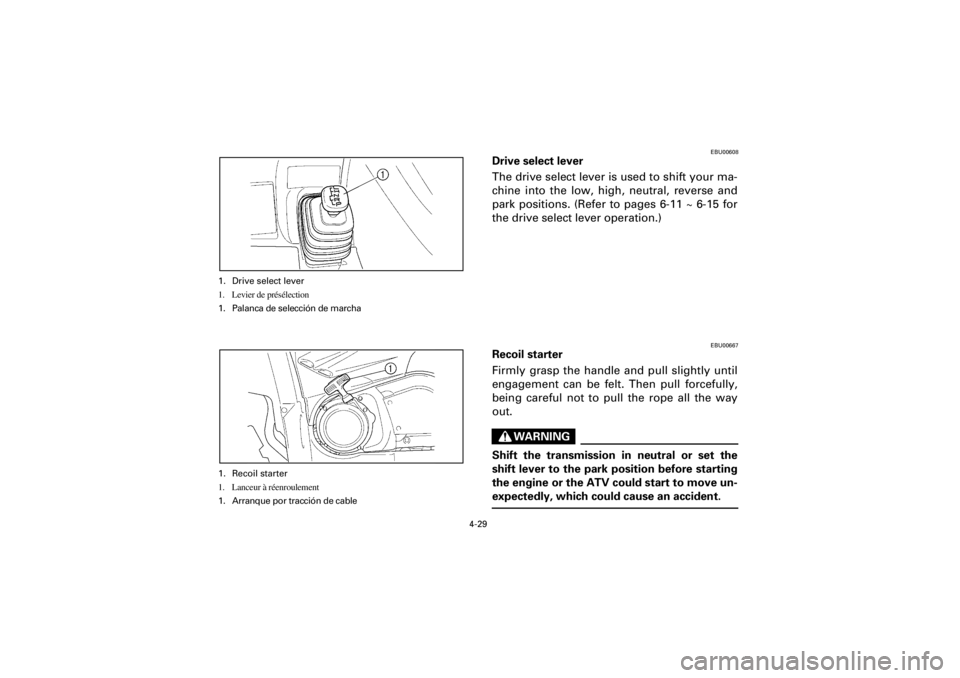
Drive select lever
The drive select lever is used to shift your ma-
chine into the low, high, neutral, reverse and
park positions. (Refer to pages 6-11 ~ 6-15 for
the drive select lever operation.)
EBU00667
Recoil starter
Firmly grasp the handle and pull slightly until
engagement can be felt. Then pull forcefully,
being careful not to pull the rope all the way
out.
WARNING
Shift the transmission in neutral or set the
shift lever to the park position before starting
the engine or the ATV could start to move un-expectedly, which could cause an accident.
1. Drive select lever
1. Levier de présélection
1. Palanca de selección de marcha1. Recoil starter
1. Lanceur à réenroulement
1. Arranque por tracción de cable
Page 110 of 426
4-49
Yuki_Data:Yuki_data:Yuki:Yuki_1:ATV:HM00B061_YFM400FWA-61:YFM600-4.frame
EL
EBU00748
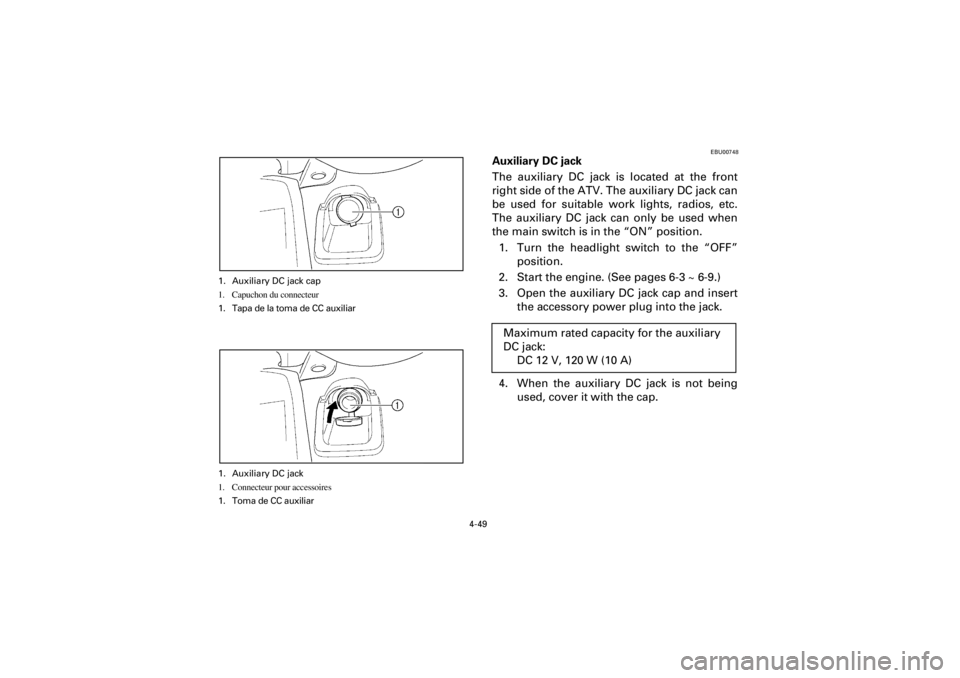
Auxiliary DC jack
The auxiliary DC jack is located at the front
right side of the ATV. The auxiliary DC jack can
be used for suitable work lights, radios, etc.
The auxiliary DC jack can only be used when
the main switch is in the “ON” position.
1. Turn the headlight switch to the “OFF”
position.
2. Start the engine. (See pages 6-3 ~ 6-9.)
3. Open the auxiliary DC jack cap and insert
the accessory power plug into the jack.
4. When the auxiliary DC jack is not being
used, cover it with the cap. Maximum rated capacity for the auxiliary
DC jack:
DC 12 V, 120 W (10 A)
1. Auxiliary DC jack cap
1. Capuchon du connecteur
1. Tapa de la toma de CC auxiliar1. Auxiliary DC jack
1. Connecteur pour accessoires
1. Toma de CC auxiliar
Page 112 of 426
4-51
Yuki_Data:Yuki_data:Yuki:Yuki_1:ATV:HM00B061_YFM400FWA-61:YFM600-4.frame
EL
CAUTION:l
Do not use accessories requiring more
than the above maximum capacity. This
may overload the circuit and cause the
fuse to blow.
l
If accessories are used without the engine
running or with the headlight turned on,
the battery will lose its charge and engine
starting may become difficult.
l
Do not use an automotive cigarette light-
er or other accessories with a plug that
gets hot because the jack can be dam-aged.
Page 114 of 426

5-1
Yuki_Data:Yuki_data:Yuki:Yuki_1:ATV:HM00B061_YFM400FWA-61:YFM600-5.frame
EL
EBU00113
PRE-OPERATION CHECKS
Before using this machine, check the following points:
ITEM ROUTINE PAGE
Brakes
• Check operation, free play, fluid level and fluid leakage.
• Fill with DOT 4 brake fluid if necessary.5-7 ~ 5-9,
8-91 ~ 8-95
Fuel
• Check fuel level.
• Fill with fuel if necessary.5-11 ~ 5-13
Engine oil
• Check oil level.
• Fill with oil if necessary.5-15 ~ 5-17,
8-31 ~ 8-41
Coolant reservoir
• Check coolant level.
• Fill with coolant if necessary.8-53 ~ 8-63
Final gear oil/
Differential gear oil
• Check for leakage. 5-19, 8-41 ~ 8-51
Throttle
• Check for proper throttle cable operation. 5-21, 8-87
Wheels and tires
• Check tire pressure, wear and damage.5-25 ~ 5-31,
8-107 ~ 8-109
Fittings and Fasteners
• Check all fittings and fasteners. 5-21
Lights
• Check for proper operation. 5-23, 8-121 ~ 8-127
Front axle boots
• Check for damage. 8-63
Page 136 of 426

5-23
Yuki_Data:Yuki_data:Yuki:Yuki_1:ATV:HM00B061_YFM400FWA-61:YFM600-5.frame
EL
EBU00153
Lights
Check the headlight and taillight to make sure
they are in working condition. Repair as neces-
sary for proper operation.
EBU00155
Switches
Check the operation of the headlight switch,
engine stop switch and any other switches. Re-
pair as necessary for proper operation.
Page 150 of 426
6-5
Yuki_Data:Yuki_data:Yuki:Yuki_1:ATV:HM00B061_YFM400FWA-61:YFM600-6.frame
EL
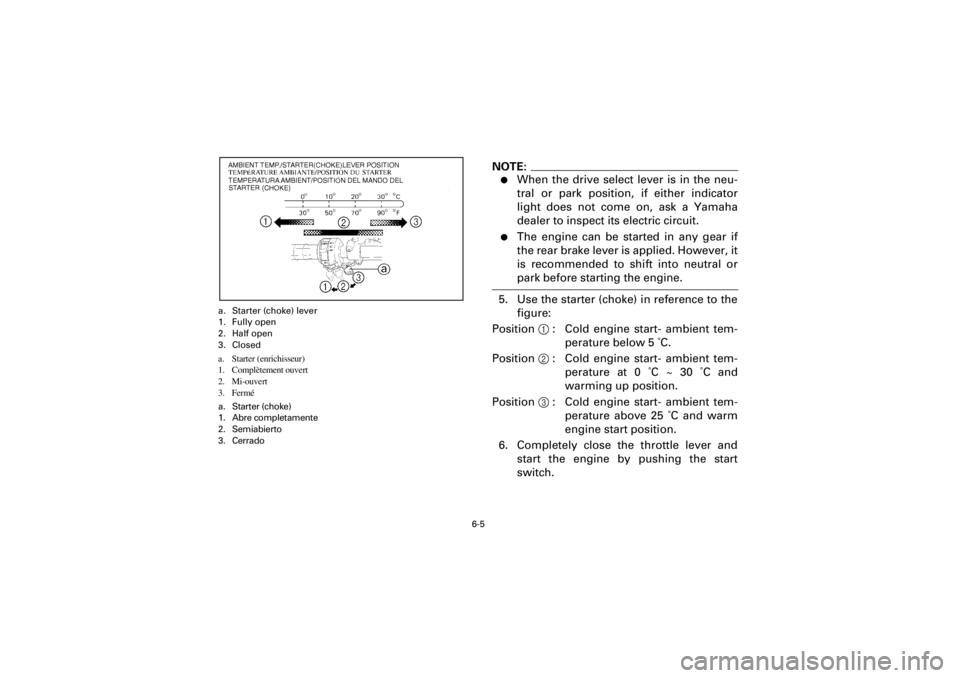
a. Starter (choke) lever
1. Fully open
2. Half open
3. Closed
a. Starter (enrichisseur)
1. Complètement ouvert
2. Mi-ouvert
3. Fermé
a. Starter (choke)
1. Abre completamente
2. Semiabierto
3. Cerrado
NOTE:
l
When the drive select lever is in the neu-
tral or park position, if either indicator
light does not come on, ask a Yamaha
dealer to inspect its electric circuit.
l
The engine can be started in any gear if
the rear brake lever is applied. However, it
is recommended to shift into neutral or
park before starting the engine.
5. Use the starter (choke) in reference to the
figure:
Position
1
: Cold engine start- ambient tem-
perature below 5 ˚C.
Position
2
: Cold engine start- ambient tem-
perature at 0 ˚C ~ 30 ˚C and
warming up position.
Position
3
: Cold engine start- ambient tem-
perature above 25 ˚C and warm
engine start position.
6. Completely close the throttle lever and
start the engine by pushing the start
switch.
Page 154 of 426

6-9
Yuki_Data:Yuki_data:Yuki:Yuki_1:ATV:HM00B061_YFM400FWA-61:YFM600-6.frame
EL
EBU00180
Starting a warm engine
To start a warm engine, refer to the “Starting a
cold engine” section. The starter (choke)
should not be used. The throttle should be
opened slightly.
EBU00182
Warming up
To get maximum engine life, always warm up
the engine before starting off. Never accelerate
hard with a cold engine! To see whether or not
the engine is warm, check if it responds to the
throttle normally with the starter (choke)
turned off.
Page 158 of 426
6-13
Yuki_Data:Yuki_data:Yuki:Yuki_1:ATV:HM00B061_YFM400FWA-61:YFM600-6.frame
EL
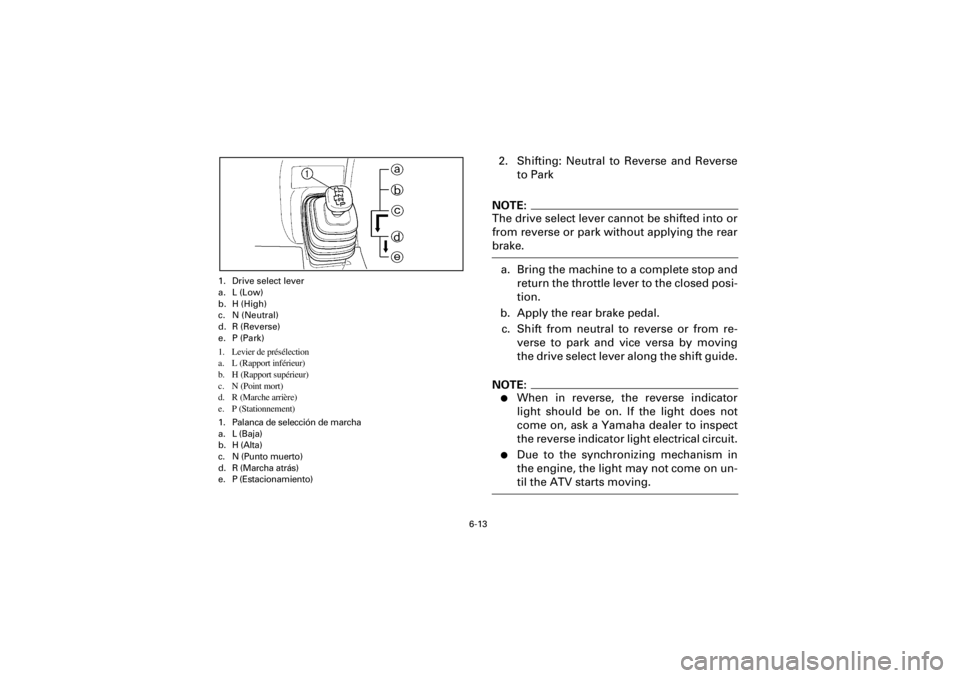
1. Drive select lever
a. L (Low)
b. H (High)
c. N (Neutral)
d. R (Reverse)
e. P (Park)
1. Levier de présélection
a. L (Rapport inférieur)
b. H (Rapport supérieur)
c. N (Point mort)
d. R (Marche arrière)
e. P (Stationnement)
1. Palanca de selección de marcha
a. L (Baja)
b. H (Alta)
c. N (Punto muerto)
d. R (Marcha atrás)
e. P (Estacionamiento)
2. Shifting: Neutral to Reverse and Reverse
to Park
NOTE:
The drive select lever cannot be shifted into or
from reverse or park without applying the rear
brake.
a. Bring the machine to a complete stop and
return the throttle lever to the closed posi-
tion.
b. Apply the rear brake pedal.
c. Shift from neutral to reverse or from re-
verse to park and vice versa by moving
the drive select lever along the shift guide.
NOTE:
l
When in reverse, the reverse indicator
light should be on. If the light does not
come on, ask a Yamaha dealer to inspect
the reverse indicator light electrical circuit.
l
Due to the synchronizing mechanism in
the engine, the light may not come on un-
til the ATV starts moving.
Page 218 of 426
7-41
Yuki_Data:Yuki_data:Yuki:Yuki_1:ATV:HM00B061_YFM400FWA-61:YFM600-7.frame
EL
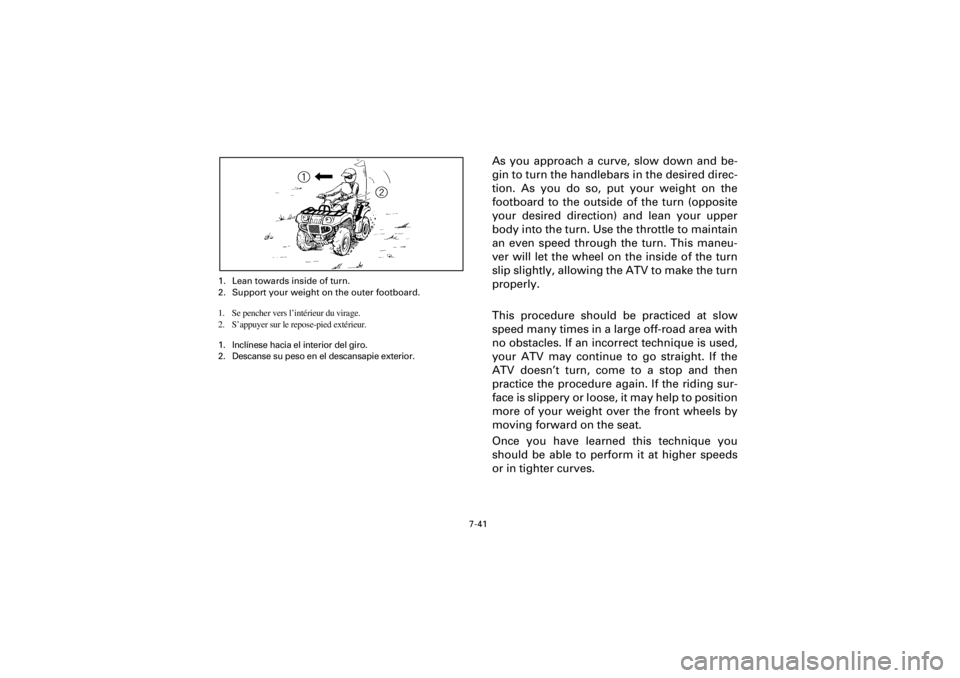
1. Lean towards inside of turn.
2. Support your weight on the outer footboard.
1. Se pencher vers l’intérieur du virage.
2. S’appuyer sur le repose-pied extérieur.
1. Inclínese hacia el interior del giro.
2. Descanse su peso en el descansapie exterior.
As you approach a curve, slow down and be-
gin to turn the handlebars in the desired direc-
tion. As you do so, put your weight on the
footboard to the outside of the turn (opposite
your desired direction) and lean your upper
body into the turn. Use the throttle to maintain
an even speed through the turn. This maneu-
ver will let the wheel on the inside of the turn
slip slightly, allowing the ATV to make the turn
properly.
This procedure should be practiced at slow
speed many times in a large off-road area with
no obstacles. If an incorrect technique is used,
your ATV may continue to go straight. If the
ATV doesn’t turn, come to a stop and then
practice the procedure again. If the riding sur-
face is slippery or loose, it may help to position
more of your weight over the front wheels by
moving forward on the seat.
Once you have learned this technique you
should be able to perform it at higher speeds
or in tighter curves.