engine YAMAHA YZ125LC 2001 Owner's Manual
[x] Cancel search | Manufacturer: YAMAHA, Model Year: 2001, Model line: YZ125LC, Model: YAMAHA YZ125LC 2001Pages: 558, PDF Size: 13.11 MB
Page 60 of 558
1-16
GEN
INFO
TORQUE-CHECK POINTS
EC1A0012
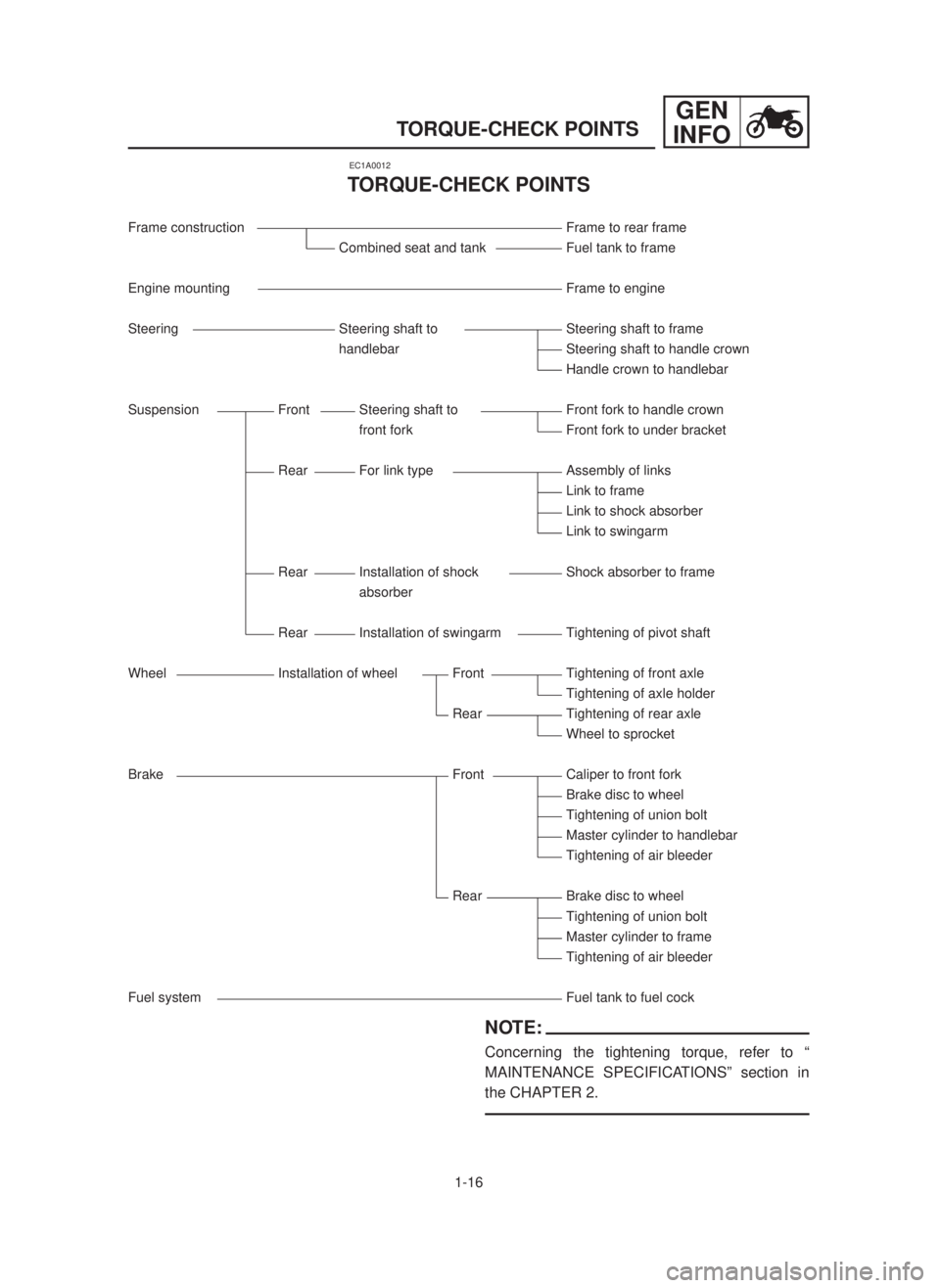
TORQUE-CHECK POINTS
Frame construction Frame to rear frame
Combined seat and tank Fuel tank to frame
Engine mounting Frame to engine
Steering Steering shaft to Steering shaft to frame
handlebar Steering shaft to handle crown
Handle crown to handlebar
Suspension Front Steering shaft to Front fork to handle crown
front fork Front fork to under bracket
Rear For link type Assembly of links
Link to frame
Link to shock absorber
Link to swingarm
Rear Installation of shock Shock absorber to frame
absorber
Rear Installation of swingarm Tightening of pivot shaft
Wheel Installation of wheel Front Tightening of front axle
Tightening of axle holder
Rear Tightening of rear axle
Wheel to sprocket
Brake Front Caliper to front fork
Brake disc to wheel
Tightening of union bolt
Master cylinder to handlebar
Tightening of air bleeder
Rear Brake disc to wheel
Tightening of union bolt
Master cylinder to frame
Tightening of air bleeder
Fuel system Fuel tank to fuel cock
NOTE:
Concerning the tightening torque, refer to “
MAINTENANCE SPECIFICATIONS” section in
the CHAPTER 2.
5MV-9-30-1B 6/20/0 5:12 PM Page 10
Page 64 of 558
1-17
GEN
INFO
CLEANING AND STORAGE
EC1B0000
CLEANING AND STORAGE
EC1B1000
CLEANING
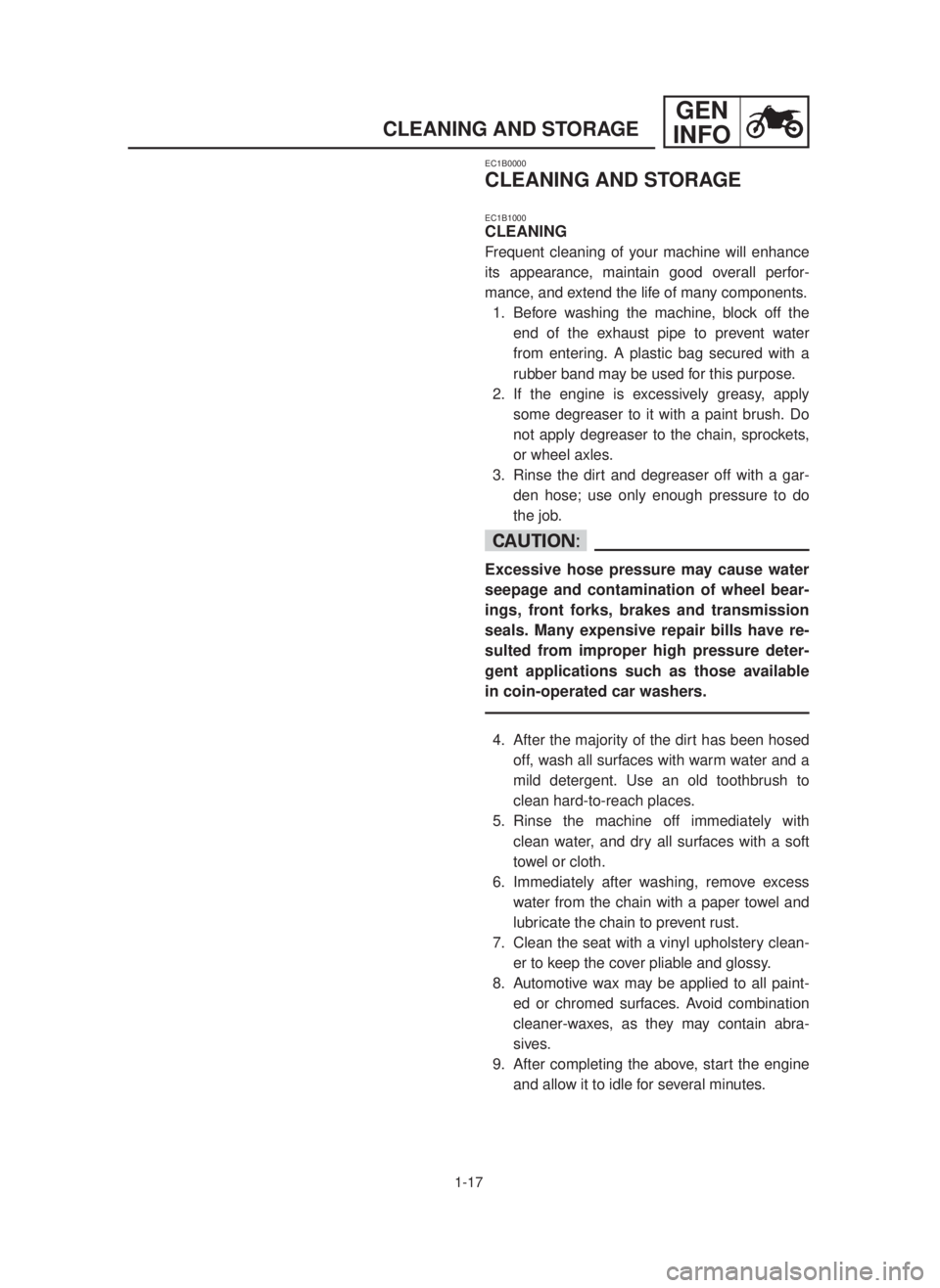
Frequent cleaning of your machine will enhance
its appearance, maintain good overall perfor-
mance, and extend the life of many components.
1. Before washing the machine, block off the
end of the exhaust pipe to prevent water
from entering. A plastic bag secured with a
rubber band may be used for this purpose.
2. If the engine is excessively greasy, apply
some degreaser to it with a paint brush. Do
not apply degreaser to the chain, sprockets,
or wheel axles.
3. Rinse the dirt and degreaser off with a gar-
den hose; use only enough pressure to do
the job.
cC
Excessive hose pressure may cause water
seepage and contamination of wheel bear-
ings, front forks, brakes and transmission
seals. Many expensive repair bills have re-
sulted from improper high pressure deter-
gent applications such as those available
in coin-operated car washers.
4. After the majority of the dirt has been hosed
off, wash all surfaces with warm water and a
mild detergent. Use an old toothbrush to
clean hard-to-reach places.
5. Rinse the machine off immediately with
clean water, and dry all surfaces with a soft
towel or cloth.
6. Immediately after washing, remove excess
water from the chain with a paper towel and
lubricate the chain to prevent rust.
7. Clean the seat with a vinyl upholstery clean-
er to keep the cover pliable and glossy.
8. Automotive wax may be applied to all paint-
ed or chromed surfaces. Avoid combination
cleaner-waxes, as they may contain abra-
sives.
9. After completing the above, start the engine
and allow it to idle for several minutes.
5MV-9-30-1B 6/20/0 5:12 PM Page 14
Page 66 of 558
1-18
GEN
INFO
CLEANING AND STORAGE
EC1B2001
STORAGE
If your machine is to be stored for 60 days or
more, some preventive measures must be taken
to avoid deterioration. After cleaning the ma-
chine thoroughly, prepare it for storage as fol-
lows:
1. Drain the fuel tank, fuel lines, and the carbu-
retor float bowl.
2. Remove the spark plug, pour a tablespoon
of SAE 10W-30 motor oil in the spark plug
hole, and reinstall the plug. With the engine
stop switch pushed in, kick the engine over
several times to coat the cylinder walls with
oil.
3. Remove the drive chain, clean it thoroughly
with solvent, and lubricate it. Reinstall the
chain or store it in a plastic bag tied to the
frame.
4. Lubricate all control cables.
5. Block the frame up to raise the wheels off
the ground.
6. Tie a plastic bag over the exhaust pipe out-
let to prevent moisture from entering.
7. If the machine is to be stored in a humid or
salt-air environment, coat all exposed metal
surfaces with a film of light oil. Do not apply
oil to rubber parts or the seat cover.
NOTE:
Make any necessary repairs before the machine
is stored.
5MV-9-30-1B 6/20/0 5:12 PM Page 16
Page 68 of 558
2-1
SPECGENERAL SPECIFICATIONS
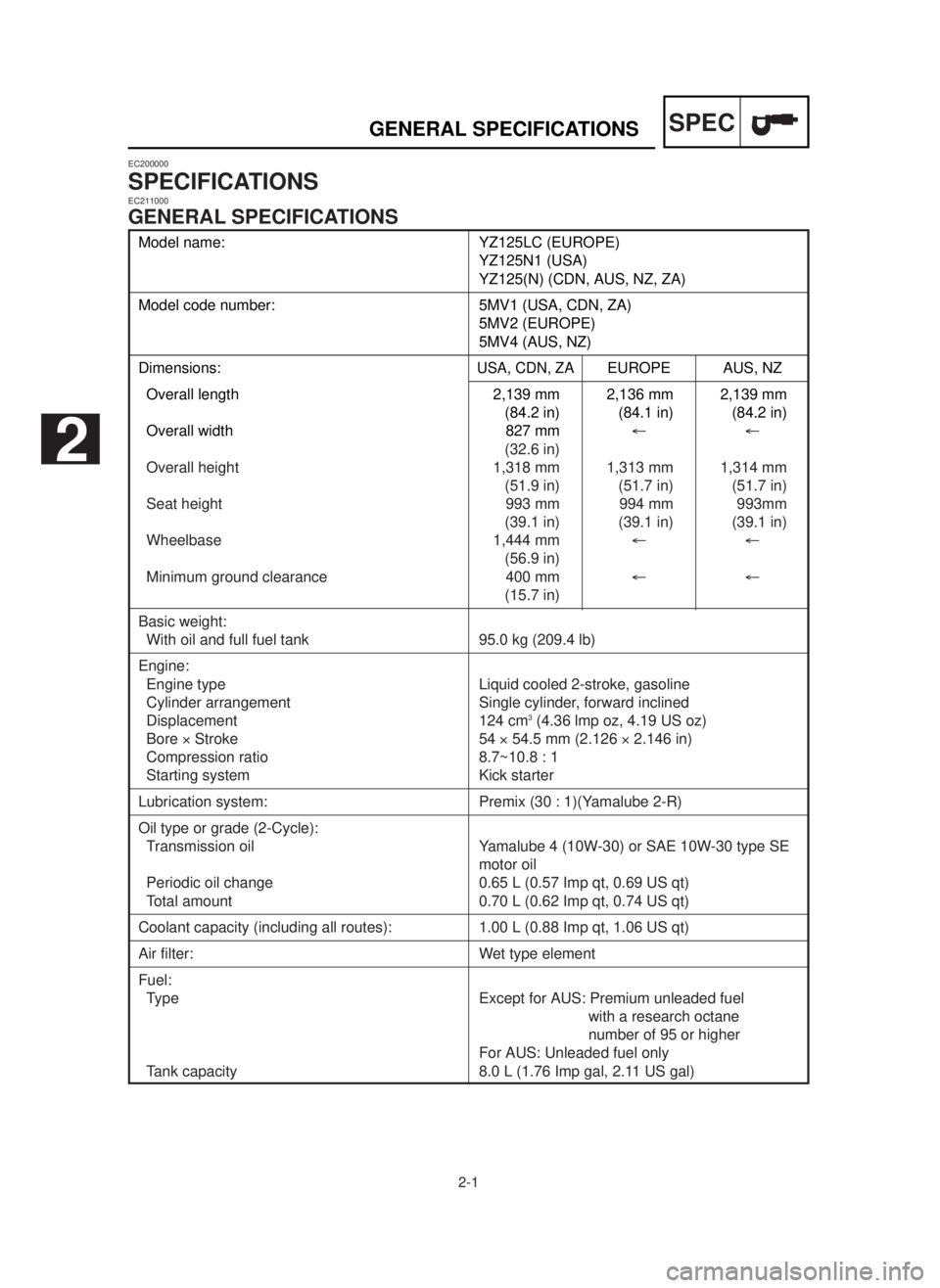
Model name: YZ125LC (EUROPE)
YZ125N1 (USA)
YZ125(N) (CDN, AUS, NZ, ZA)
Model code number: 5MV1 (USA, CDN, ZA)
5MV2 (EUROPE)
5MV4 (AUS, NZ)
Dimensions:USA, CDN, ZAEUROPE AUS, NZ
Overall length 2,139 mm 2,136 mm 2,139 mm
(84.2 in) (84.1 in) (84.2 in)
Overall width 827 mm¬¬
(32.6 in)
Overall height 1,318 mm 1,313 mm 1,314 mm
(51.9 in) (51.7 in) (51.7 in)
Seat height 993 mm 994 mm 993mm
(39.1 in) (39.1 in) (39.1 in)
Wheelbase 1,444 mm¬¬
(56.9 in)
Minimum ground clearance 400 mm¬¬
(15.7 in)
Basic weight:
With oil and full fuel tank 95.0 kg (209.4 lb)
Engine:
Engine type Liquid cooled 2-stroke, gasoline
Cylinder arrangement Single cylinder, forward inclined
Displacement 124 cm
3(4.36 lmp oz, 4.19 US oz)
Bore ´Stroke 54 ´54.5 mm (2.126 ´2.146 in)
Compression ratio 8.7~10.8 : 1
Starting system Kick starter
Lubrication system: Premix (30 : 1)(Yamalube 2-R)
Oil type or grade (2-Cycle):
Transmission oil Yamalube 4 (10W-30) or SAE 10W-30 type SE
motor oil
Periodic oil change 0.65 L (0.57 Imp qt, 0.69 US qt)
Total amount 0.70 L (0.62 Imp qt, 0.74 US qt)
Coolant capacity (including all routes): 1.00 L (0.88 Imp qt, 1.06 US qt)
Air filter: Wet type element
Fuel:
Type Except for AUS: Premium unleaded fuel
with a research octane
number of 95 or higher
For AUS: Unleaded fuel only
Tank capacity 8.0 L (1.76 Imp gal, 2.11 US gal)
EC200000
SPECIFICATIONSEC211000
GENERAL SPECIFICATIONS
2
5MV-9-30-2A 6/19/00 1:15 PM Page 2
Page 70 of 558

2-3
SPECMAINTENANCE SPECIFICATIONS
Item Standard Limit
Cylinder head:
Combustion chamber capacity 10.2 cm
3…
(0.359 Imp oz, 0.345 US oz)
Warp limit…
0.03 mm (0.0012 in)
Cylinder:
Bore size 54.000~54.014 mm 54.1 mm (2.130 in)
(2.1260~2.1265 in)
Taper limit…
0.05 mm (0.0020 in)
Out of round limit…
0.01 mm (0.0004 in)
Piston:
Piston size/ 53.957~53.972 mm…
(2.1243~2.1249 in)
Measuring point* 17.5 mm (0.69 in)…
Piston clearance 0.040~0.045 mm 0.1 mm (0.004 in)
(0.0016~0.0018 in)
Piston offset 1.0 mm (0.039 in)/EX-side…
Piston pin:
Piston pin outside diameter 14.995~15.000 mm 14.975 mm
(0.5904~0.5906 in) (0.5896 in)
Piston ring:
Sectional sketch Plain…
B=1.0 mm (0.039 in)…
T=2.15 mm (0.085 in)…
End gap (installed) 0.5~0.7 mm (0.020~0.028 in) 1.2 mm (0.047 in)
Side clearance (installed) 0.035~0.080 mm 0.1 mm (0.004 in)
(0.0014~0.0031 in)
Crankshaft:
Crank width “A” 55.90~55.95 mm …
(2.201~2.203 in)
Runout limit “C” 0.03 mm (0.0012 in) 0.05 mm (0.0020 in)
Connecting rod big end
side clearance “D” 0.20~0.70 mm (0.008~0.028 in)…
Small end free play “F” 0.8~1.0 mm (0.031~0.039 in) 2.0 mm (0.08 in)
Clutch:
Friction plate thickness 2.9~3.1 mm (0.114~0.122 in) 2.8 mm (0.110 in)
Quantity 8 …
Clutch plate thickness 1.5~1.7 mm (0.059~0.067 in) …
Quantity 7 …
Warp limit … 0.2 mm (0.008 in)
Clutch spring free length 40.1 mm (1.579 in) 38.1 mm (1.500 in)
Quantity 5 …
Clutch housing thrust clearance 0.20~0.25 mm (0.008~0.010 in) …
Clutch housing radial clearance 0.015~0.049 mm …
(0.0006~0.0019 in)
Clutch release method Outer pull, rack and pinion pull …
EC212000
MAINTENANCE SPECIFICATIONSEC212100
ENGINE
5MV-9-30-2A 6/19/00 1:15 PM Page 4
Page 71 of 558

2-4
SPECMAINTENANCE SPECIFICATIONS
Item Standard Limit
Transmission:
Main axle deflection limit…
0.01 mm (0.0004 in)
Drive axle deflection limit…
0.01 mm (0.0004 in)
Shifter:
Shifting type Cam drum and guide bar…
Guide bar bending limit…
0.05 mm (0.0020 in)
Kick starter type: Kick and mesh type…
Kick clip friction force P=0.8~1.2 kg (1.8~2.6 lb)…
Air filter oil grade (oiled filter):Foam-air-filter oil or engine mixing oil…
Carburetor: USA, CDN, ZA
EUROPE
AUS, NZ
Type/Manufacturer TMXø
38SS¬
/MIKUNI
I.D. mark 5MV1 00 5MV2 10…
Main jet (M.J.) #460 #450…
Jet needle-clip position (J.N.) 6BGK9-75-3 6BHY1-75-3…
Cutaway (C.A.) 5.75¬…
Pilot jet (P.J.) #25 #30…
Pilot air screw (P.A.S.) 1-1/4 1-1/2…
Valve seat size (V.S.)
ø3.8 mm (0.15 in)¬…
Starter jet (G.S.) #80¬…
Fuel level (F.L.) 13.5~14.5 mm ¬
(0.53~0.57 in)
Reed valve:
Thickness* 0.42 mm (0.017 in)…
Valve stopper height 8.2~8.6 mm (0.323~0.339 in)…
Valve bending limit…
0.2 mm (0.008 in)
Cooling:
Radiator core size:
Width 110 mm (4.33 in)…
Height (left) 240 mm (9.45 in)…
(right) 220 mm (8.66 in)…
Thickness 32 mm (1.26 in)…
Radiator cap opening pressure 95~125 kPa…
(0.95~1.25 kg/cm
2, 13.5~17.8 psi)
Radiator capacity (total) 0.63 L (0.55 Imp qt, 0.67 US qt)…
Water pump:
Type Single-suction centrifugal pump…
5MV-9-30-2A 6/19/00 1:15 PM Page 5
Page 77 of 558

2-10
SPECMAINTENANCE SPECIFICATIONS
Part to be tightened Thread size Q'tyT ightening torqueNm m•kg ft•lb
Rear brake master cylinder and frame M 6 ´1.0 2 10 1.0 7.2
Rear brake reservoir tank and frame M 6 ´1.0 1 7 0.7 5.1
Rear brake hose union bolt (caliper) M10 ´1.25 1 30 3.0 22
Rear brake hose union bolt (master cylinder) M10 ´1.25 1 30 3.0 22
Rear wheel axle and nut M20 ´1.5 1 125 12.5 90
Nipple (spoke) – 72 3 0.3 2.2
Driven sprocket and wheel hub M 8 ´1.25 6 42 4.2 30
Disc cover and rear brake caliper M 6 ´1.0 2 7 0.7 5.1
Protector and rear brake caliper M 6 ´1.0 2 7 0.7 5.1
Engine mounting:
Engine and frame (front) M10 ´1.25 1 69 6.9 50
Engine and frame (lower) M10 ´1.25 1 69 6.9 50
Engine bracket and frame M 8 ´1.25 2 34 3.4 24
Engine bracket and engine M 8 ´1.25 1 34 3.4 24
Pivot shaft and nut M16 ´1.5 1 85 8.5 61
Relay arm and swingarm M14 ´1.5 1 80 8.0 58
Relay arm and connecting rod M14 ´1.5 1 80 8.0 58
Connecting rod and frame M14 ´1.5 1 80 8.0 58
Rear shock absorber and frame M10 ´1.25 1 56 5.6 40
Rear shock absorber and relay arm M10 ´1.25 1 53 5.3 38
Rear frame and frame M 8 ´1.25 3 29 2.9 21
Swingarm and brake hose holder M 5 ´–4 4 0.4 2.9
Chain tensioner mounting M 8 ´1.25 2 19 1.9 13
Chain support and swingarm M 6 ´1.0 3 7 0.7 5.1
Seal guard and swingarm M 5 ´0.8 4 5 0.5 3.6
Fuel tank mounting M 6 ´1.0 2 10 1.0 7.2
Fuel tank and fuel cock M 6 ´1.0 2 7 0.7 5.1
Fuel tank and seat set bracket M 6 ´1.0 1 7 0.7 5.1
Fuel tank and hooking screw (fitting band) M 6 ´1.0 1 7 0.7 5.1
Fuel tank and fuel tank bracket M 6 ´1.0 4 7 0.7 5.1
Air scoop mounting M 6 ´1.0 8 3 0.3 2.2
Front fender mounting M 6 ´1.0 4 7 0.7 5.1
Rear fender mounting M 6 ´1.0 4 7 0.7 5.1
Side cover mounting M 6 ´1.0 4 7 0.7 5.1
Seat mounting M 6 ´1.0 2 7 0.7 5.1
Number plate M 6 ´1.0 1 7 0.7 5.1
NOTE:
s
s- marked portion shall be checked for torque tightening after break-in or before each race.
s
s
s s
s s
s s
s s
s s
s s
s s
s s
s s
s s
s s
s s
s s
s s
s s
s s
s s
s s
5MV-9-30-2A 6/19/00 1:15 PM Page 11
Page 79 of 558

2-12
SPEC
GENERAL TORQUE SPECIFICATIONS/
DEFINITION OF UNITS
This chart specifies torque for standard faste-
ners with standard I.S.O. pitch threads. Torque
specifications for special components or assem-
blies are included in the applicable sections of
this book. To avoid warpage, tighten multi-faste-
ner assemblies in a crisscross fashion, in pro-
gressive stages, until full torque is reached.
Unless otherwise specified, torque specifications
call for clean, dry threads. Components should
be at room temperature.
A: Distance across flats
B: Outside thread diameter
EC230000
DEFINITION OF UNITS
EC220001
GENERAL TORQUE SPECIFICATIONS
A B TORQUE SPECIFICATION
(Nut) (Bolt)
Nm m•kg ft•lb
10 mm 6 mm 6 0.6 4.3
12 mm 8 mm 15 1.5 11
14 mm 10 mm 30 3.0 22
17 mm 12 mm 55 5.5 40
19 mm 14 mm 85 8.5 61
22 mm 16 mm 130 13 94
Unit Read Definition Measure
mm milimeter 10-
3meter Length
cm centimeter 10-2meter Length
kg kilogram 103gram Weight
N Newton 1 kg ´m/sec2Force
Nm Newton meter N ´m Torque
m•kg Meter kilogrma m ´kg Torque
Pa Pascal N/m2Pressure
N/mm Newton per millimeter N/mm Spring rate
L Liter — Volume or capacity
cm3Cubic centimeter — Volume or capacity
r/min Revolution per minute — Engine speed
5MV-9-30-2A 6/19/00 1:15 PM Page 13
Page 116 of 558
2-13
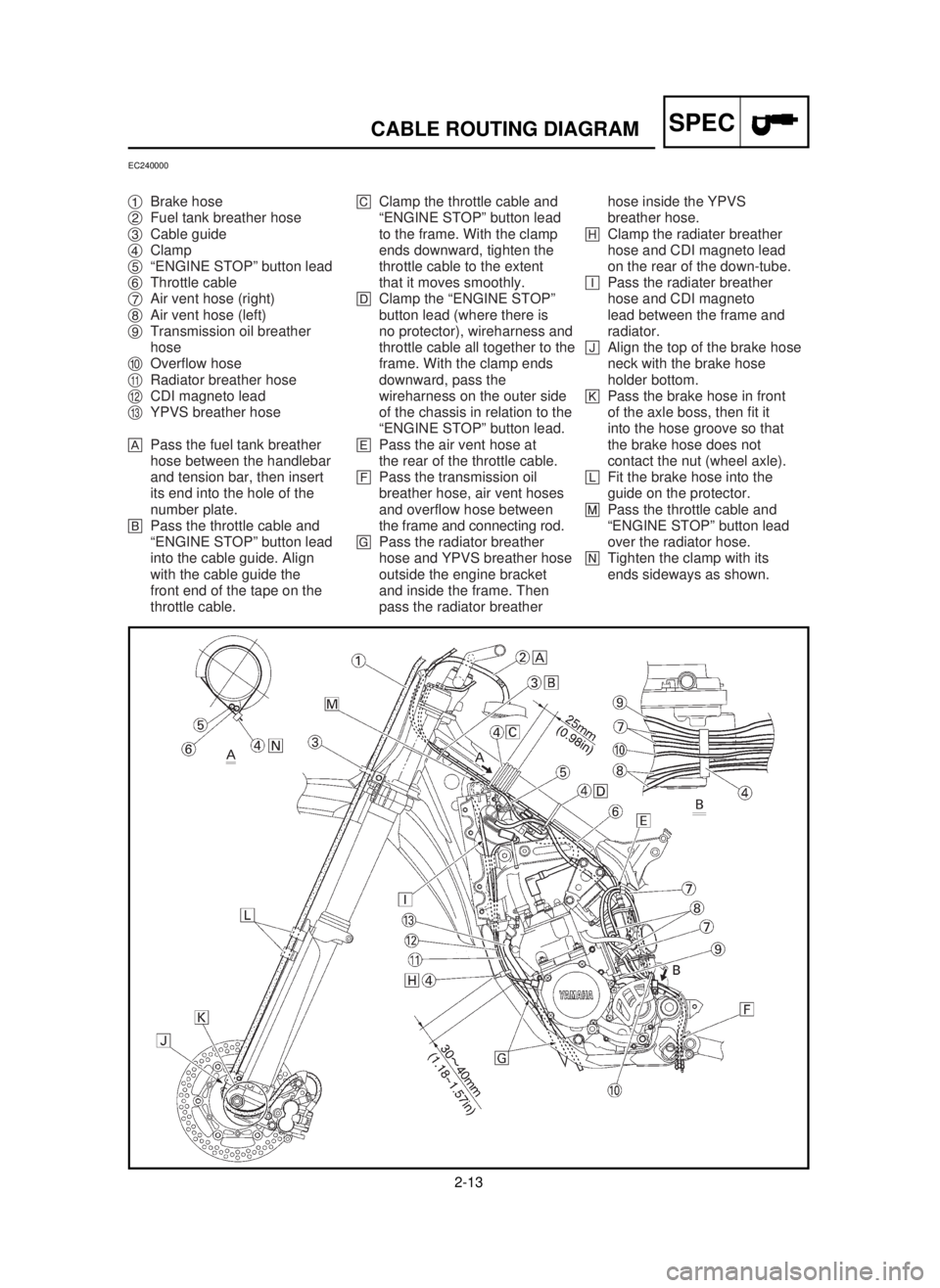
SPECCABLE ROUTING DIAGRAM
EC240000
1Brake hose
2Fuel tank breather hose
3Cable guide
4Clamp
5“ENGINE STOP” button lead
6Throttle cable
7Air vent hose (right)
8Air vent hose (left)
9Transmission oil breather
hose
0Overflow hose
qRadiator breather hose
wCDI magneto lead
eYPVS breather hose
APass the fuel tank breather
hose between the handlebar
and tension bar, then insert
its end into the hole of the
number plate.
BPass the throttle cable and
“ENGINE STOP” button lead
into the cable guide. Align
with the cable guide the
front end of the tape on the
throttle cable.CClamp the throttle cable and
“ENGINE STOP” button lead
to the frame. With the clamp
ends downward, tighten the
throttle cable to the extent
that it moves smoothly.
DClamp the “ENGINE STOP”
button lead (where there is
no protector), wireharness and
throttle cable all together to the
frame. With the clamp ends
downward, pass the
wireharness on the outer side
of the chassis in relation to the
“ENGINE STOP” button lead.
EPass the air vent hose at
the rear of the throttle cable.
FPass the transmission oil
breather hose, air vent hoses
and overflow hose between
the frame and connecting rod.
GPass the radiator breather
hose and YPVS breather hose
outside the engine bracket
and inside the frame. Then
pass the radiator breather hose inside the YPVS
breather hose.
HClamp the radiater breather
hose and CDI magneto lead
on the rear of the down-tube.
IPass the radiater breather
hose and CDI magneto
lead between the frame and
radiator.
JAlign the top of the brake hose
neck with the brake hose
holder bottom.
KPass the brake hose in front
of the axle boss, then fit it
into the hose groove so that
the brake hose does not
contact the nut (wheel axle).
LFit the brake hose into the
guide on the protector.
MPass the throttle cable and
“ENGINE STOP” button lead
over the radiator hose.
NTighten the clamp with its
ends sideways as shown.
5MV-9-30-2B 6/19/00 1:14 PM Page 26
Page 117 of 558
2-13
SPEC
SCHEMA DE CHEMINEMENT DES CABLES
KABELFÜHRUNGSÜBERSICHTPLAN
DIAGRAMMA DEL PASSAGGIO DEI CAVI
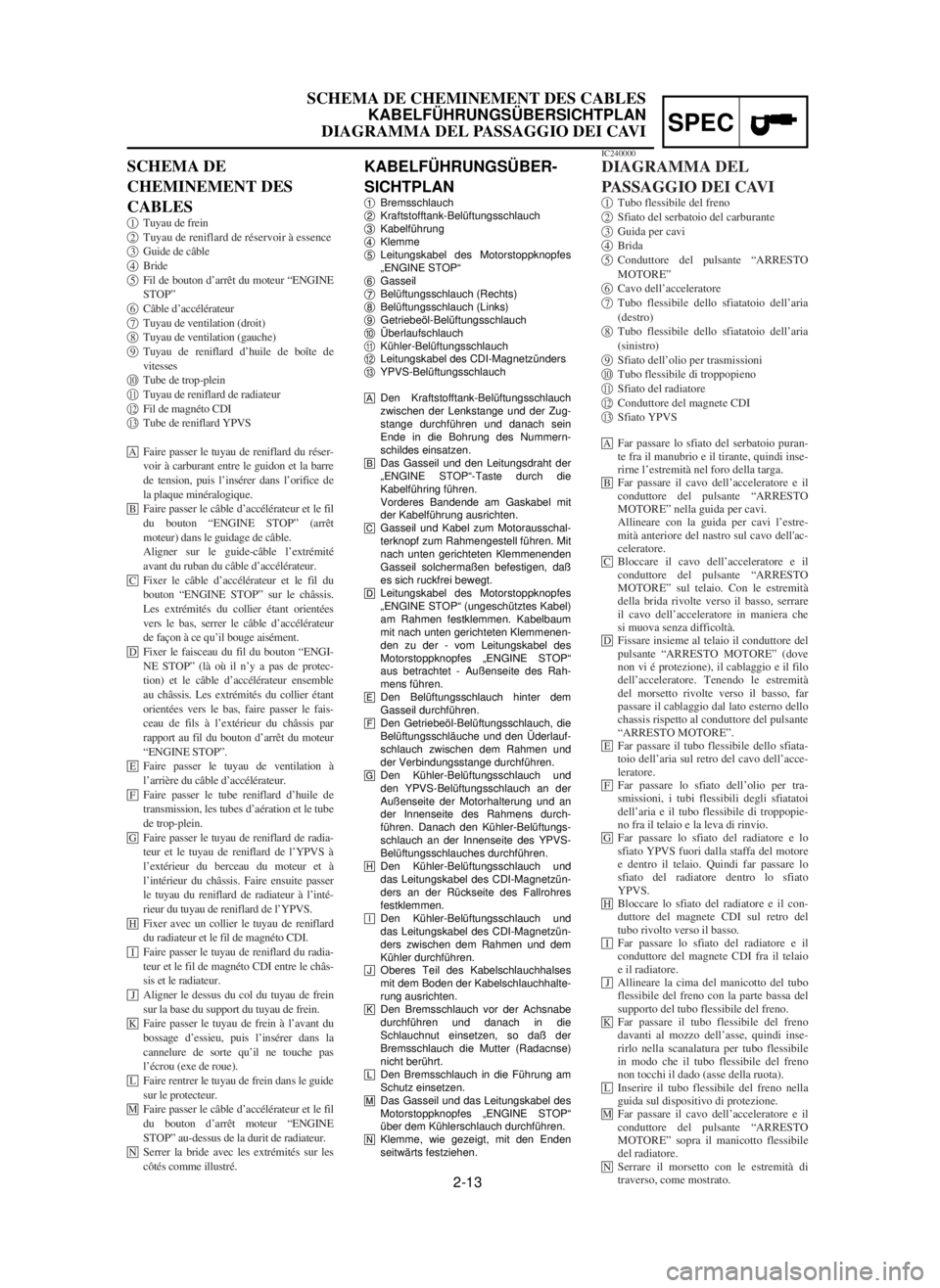
KABELFÜHRUNGSÜBER-
SICHTPLAN
1Bremsschlauch
2Kraftstofftank-Belüftungsschlauch
3Kabelführung
4Klemme
5Leitungskabel des Motorstoppknopfes
„ENGINE STOP“
6Gasseil
7Belüftungsschlauch (Rechts)
8Belüftungsschlauch (Links)
9Getriebeöl-Belüftungsschlauch
0Überlaufschlauch
qKühler-Belüftungsschlauch
wLeitungskabel des CDI-Magnetzünders
eYPVS-Belüftungsschlauch
ADen Kraftstofftank-Belüftungsschlauch
zwischen der Lenkstange und der Zug-
stange durchführen und danach sein
Ende in die Bohrung des Nummern-
schildes einsatzen.
BDas Gasseil und den Leitungsdraht der
„ENGINE STOP“-Taste durch die
Kabelführing führen.
Vorderes Bandende am Gaskabel mit
der Kabelführung ausrichten.
CGasseil und Kabel zum Motorausschal-
terknopf zum Rahmengestell führen. Mit
nach unten gerichteten Klemmenenden
Gasseil solchermaßen befestigen, daß
es sich ruckfrei bewegt.
DLeitungskabel des Motorstoppknopfes
„ENGINE STOP“ (ungeschütztes Kabel)
am Rahmen festklemmen. Kabelbaum
mit nach unten gerichteten Klemmenen-
den zu der - vom Leitungskabel des
Motorstoppknopfes „ENGINE STOP“
aus betrachtet - Außenseite des Rah-
mens führen.
EDen Belüftungsschlauch hinter dem
Gasseil durchführen.
FDen Getriebeöl-Belüftungsschlauch, die
Belüftungsschläuche und den Üderlauf-
schlauch zwischen dem Rahmen und
der Verbindungsstange durchführen.
GDen Kühler-Belüftungsschlauch und
den YPVS-Belüftungsschlauch an der
Außenseite der Motorhalterung und an
der Innenseite des Rahmens durch-
führen. Danach den Kühler-Belüftungs-
schlauch an der Innenseite des YPVS-
Belüftungsschlauches durchführen.
HDen Kühler-Belüftungsschlauch und
das Leitungskabel des CDI-Magnetzün-
ders an der Rückseite des Fallrohres
festklemmen.
IDen Kühler-Belüftungsschlauch und
das Leitungskabel des CDI-Magnetzün-
ders zwischen dem Rahmen und dem
Kühler durchführen.
JOberes Teil des Kabelschlauchhalses
mit dem Boden der Kabelschlauchhalte-
rung ausrichten.
KDen Bremsschlauch vor der Achsnabe
durchführen und danach in die
Schlauchnut einsetzen, so daß der
Bremsschlauch die Mutter (Radacnse)
nicht berührt.
LDen Bremsschlauch in die Führung am
Schutz einsetzen.
MDas Gasseil und das Leitungskabel des
Motorstoppknopfes „ENGINE STOP“
über dem Kühlerschlauch durchführen.
NKlemme, wie gezeigt, mit den Enden
seitwärts festziehen.
SCHEMA DE
CHEMINEMENT DES
CABLES
1Tuyau de frein
2Tuyau de reniflard de réservoir à essence
3Guide de câble
4Bride
5Fil de bouton d’arrêt du moteur “ENGINE
STOP”
6Câble d’accélérateur
7Tuyau de ventilation (droit)
8Tuyau de ventilation (gauche)
9Tuyau de reniflard d’huile de boîte de
vitesses
0Tube de trop-plein
qTuyau de reniflard de radiateur
wFil de magnéto CDI
eTube de reniflard YPVS
ŒFaire passer le tuyau de reniflard du réser-
voir à carburant entre le guidon et la barre
de tension, puis l’insérer dans l’orifice de
la plaque minéralogique.
ºFaire passer le câble d’accélérateur et le fil
du bouton “ENGINE STOP” (arrêt
moteur) dans le guidage de câble.
Aligner sur le guide-câble l’extrémité
avant du ruban du câble d’accélérateur.
Fixer le câble d’accélérateur et le fil du
bouton “ENGINE STOP” sur le châssis.
Les extrémités du collier étant orientées
vers le bas, serrer le câble d’accélérateur
de façon à ce qu’il bouge aisément.
¶Fixer le faisceau du fil du bouton “ENGI-
NE STOP” (là où il n’y a pas de protec-
tion) et le câble d’accélérateur ensemble
au châssis. Les extrémités du collier étant
orientées vers le bas, faire passer le fais-
ceau de fils à l’extérieur du châssis par
rapport au fil du bouton d’arrêt du moteur
“ENGINE STOP”.
«Faire passer le tuyau de ventilation à
l’arrière du câble d’accélérateur.
ÄFaire passer le tube reniflard d’huile de
transmission, les tubes d’aération et le tube
de trop-plein.
©Faire passer le tuyau de reniflard de radia-
teur et le tuyau de reniflard de l’YPVS à
l’extérieur du berceau du moteur et à
l’intérieur du châssis. Faire ensuite passer
le tuyau du reniflard de radiateur à l’inté-
rieur du tuyau de reniflard de l’YPVS.
úFixer avec un collier le tuyau de reniflard
du radiateur et le fil de magnéto CDI.
öFaire passer le tuyau de reniflard du radia-
teur et le fil de magnéto CDI entre le châs-
sis et le radiateur.
ÆAligner le dessus du col du tuyau de frein
sur la base du support du tuyau de frein.
ûFaire passer le tuyau de frein à l’avant du
bossage d’essieu, puis l’insérer dans la
cannelure de sorte qu’il ne touche pas
l’écrou (exe de roue).
ÂFaire rentrer le tuyau de frein dans le guide
sur le protecteur.
µFaire passer le câble d’accélérateur et le fil
du bouton d’arrêt moteur “ENGINE
STOP” au-dessus de la durit de radiateur.
÷Serrer la bride avec les extrémités sur les
côtés comme illustré.
IC240000
DIAGRAMMA DEL
PASSAGGIO DEI CAVI
1Tubo flessibile del freno
2Sfiato del serbatoio del carburante
3Guida per cavi
4Brida
5Conduttore del pulsante “ARRESTO
MOTORE”
6Cavo dell’acceleratore
7Tubo flessibile dello sfiatatoio dell’aria
(destro)
8Tubo flessibile dello sfiatatoio dell’aria
(sinistro)
9Sfiato dell’olio per trasmissioni
0Tubo flessibile di troppopieno
qSfiato del radiatore
wConduttore del magnete CDI
eSfiato YPVS
ŒFar passare lo sfiato del serbatoio puran-
te fra il manubrio e il tirante, quindi inse-
rirne l’estremità nel foro della targa.
ºFar passare il cavo dell’acceleratore e il
conduttore del pulsante “ARRESTO
MOTORE” nella guida per cavi.
Allineare con la guida per cavi l’estre-
mità anteriore del nastro sul cavo dell'ac-
celeratore.
Bloccare il cavo dell’acceleratore e il
conduttore del pulsante “ARRESTO
MOTORE” sul telaio. Con le estremità
della brida rivolte verso il basso, serrare
il cavo dell’acceleratore in maniera che
si muova senza difficoltà.
¶Fissare insieme al telaio il conduttore del
pulsante “ARRESTO MOTORE” (dove
non vi é protezione), il cablaggio e il filo
dell’acceleratore. Tenendo le estremità
del morsetto rivolte verso il basso, far
passare il cablaggio dal lato esterno dello
chassis rispetto al conduttore del pulsante
“ARRESTO MOTORE”.
«Far passare il tubo flessibile dello sfiata-
toio dell’aria sul retro del cavo dell’acce-
leratore.
ÄFar passare lo sfiato dell’olio per tra-
smissioni, i tubi flessibili degli sfiatatoi
dell’aria e il tubo flessibile di troppopie-
no fra il telaio e la leva di rinvio.
©Far passare lo sfiato del radiatore e lo
sfiato YPVS fuori dalla staffa del motore
e dentro il telaio. Quindi far passare lo
sfiato del radiatore dentro lo sfiato
YPVS.
úBloccare lo sfiato del radiatore e il con-
duttore del magnete CDI sul retro del
tubo rivolto verso il basso.
öFar passare lo sfiato del radiatore e il
conduttore del magnete CDI fra il telaio
e il radiatore.
ÆAllineare la cima del manicotto del tubo
flessibile del freno con la parte bassa del
supporto del tubo flessibile del freno.
ûFar passare il tubo flessibile del freno
davanti al mozzo dell’asse, quindi inse-
rirlo nella scanalatura per tubo flessibile
in modo che il tubo flessibile del freno
non tocchi il dado (asse della ruota).
ÂInserire il tubo flessibile del freno nella
guida sul dispositivo di protezione.
µFar passare il cavo dell’acceleratore e il
conduttore del pulsante “ARRESTO
MOTORE” sopra il manicotto flessibile
del radiatore.
÷Serrare il morsetto con le estremità di
traverso, come mostrato.
5MV-9-30-2B 6/19/00 1:14 PM Page 27