battery Abarth 124 Spider 2018 Owner handbook (in English)
[x] Cancel search | Manufacturer: ABARTH, Model Year: 2018, Model line: 124 Spider, Model: Abarth 124 Spider 2018Pages: 220, PDF Size: 2.91 MB
Page 81 of 220

82)Do not operate a vehicle with a
damaged seat belt. Using a damaged seat
belt is dangerous. An accident could
damage the belt webbing of the seat belt in
use. A damaged seat belt cannot provide
adequate protection in a collision. Contact
an Abarth Dealership to inspect all seat belt
systems in use during an accident before
they are used again.
83)Have your seat belts changed
immediately if the pretensioner or load
limiter has been expended. Always have an
expert repairer, we recommend an Abarth
Dealership immediately inspect the seat
belt pretensioners and air bags after any
collision. Like the air bags, the seat belt
pretensioners and load limiters will only
function once and must be replaced after
any collision that caused them to deploy. If
the seat belt pretensioners and load
limiters are not replaced, the risk of injury in
a collision will increase.
84)Positioning the shoulder portion of the
seat belt. Improper positioning of the
shoulder portion of the seat belt is
dangerous. Always make sure the shoulder
portion of the seat belt is positioned across
your shoulder and near your neck, but
never under your arm, on your neck, or on
your upper arm.
85)Positioning the lap portion of the seat
belt. The lap portion of the seat belt worn
too high is dangerous. In a collision, this
would concentrate the impact force directly
on the abdominal area, causing serious
injury. Wear the lap portion of the belt
snugly and as low as possible.86)Instructions for use of seat belt
assemblies. Seat belts are designed to
bear upon the bony structure of the body,
and should be worn low across the front of
the pelvis or the pelvis, chest and
shoulders, as applicable; wearing the lap
section of the belt across the abdominal
area must be avoided. Seat belts should
be adjusted as firmly as possible,
consistent with comfort, to provide the
protection for which they have been
designed. A slack belt will greatly reduce
the protection afforded to the wearer. Care
should be taken to avoid contamination of
the webbing with polishes, oils and
chemicals, and particularly battery acid.
Cleaning may safely be carried out using
mild soap and water. The belt should be
replaced if webbing becomes frayed,
contaminated or damaged. It is essential to
replace the entire assembly after it has
been worn in a severe impact even if
damage to the assembly is not obvious.
Belts should not be worn with straps
twisted. Each belt assembly must only be
used by one occupant; it is dangerous to
put a belt around a child being carried on
the occupant's lap.
87)No modifications or additions should
be made by the user which will either
prevent the seat belt adjusting devices
from operating to remove slack, or prevent
the seat belt assembly from being adjusted
to remove slack.SBA SYSTEM
(Seat Belt Alert)
SEAT BELT WARNING
LIGHT
The LED on dashboard trim turns on if
the driver or passenger's seat is
occupied and the seat belt is not
fastened with the ignition switched ON.
If the driver or passenger's seat belt is
unfastened (only when the passenger
seat is occupied) and the vehicle is
driven at a speed faster than about
20 km/h, the
LED flashes. After a
short time, the LED stops flashing, but
remains illuminated.
If a seat belt remains unfastened, the
LED flashes again for a given period of
time. In this case, fasten the seat belt.
If the driver or passenger's seat belt is
unfastened after the LED turns on, and
the vehicle speed exceeds 20 km/h, the
LED flashes again.
79
Page 127 of 220
REFUELLING THE
VEHICLE
153) 154) 155) 156) 157) 158)
Always stop the engine before
refuelling.
FUEL REQUIREMENTS
Only use premium unleaded fuel
(conforming to EN 228 specification
within E10) with a number of octanes
not lower than 95.
IMPORTANT USE ONLY UNLEADED
FUEL. Leaded fuel is harmful to the
catalytic converter and oxygen sensors
and will lead to deterioration of the
emission control system and or failures.
IMPORTANT The use of E10 fuel with
10% ethanol in Europe is safe for your
vehicle. Damage to your vehicle may
occur when ethanol exceeds this
recommendation.
IMPORTANT Never add fuel system
additives, otherwise the emission
control system could be damaged.
Contact an Abarth Dealership for
details.
REFUELLING
PROCEDURE
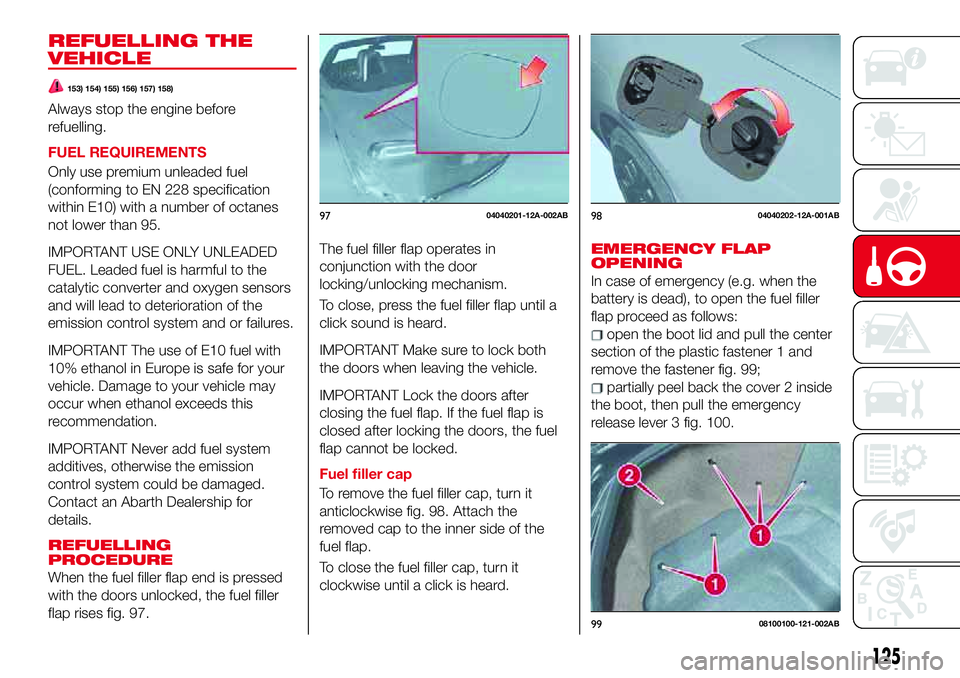
When the fuel filler flap end is pressed
with the doors unlocked, the fuel filler
flap rises fig. 97.The fuel filler flap operates in
conjunction with the door
locking/unlocking mechanism.
To close, press the fuel filler flap until a
click sound is heard.
IMPORTANT Make sure to lock both
the doors when leaving the vehicle.
IMPORTANT Lock the doors after
closing the fuel flap. If the fuel flap is
closed after locking the doors, the fuel
flap cannot be locked.
Fuel filler cap
To remove the fuel filler cap, turn it
anticlockwise fig. 98. Attach the
removed cap to the inner side of the
fuel flap.
To close the fuel filler cap, turn it
clockwise until a click is heard.
EMERGENCY FLAP
OPENING
In case of emergency (e.g. when the
battery is dead), to open the fuel filler
flap proceed as follows:
open the boot lid and pull the center
section of the plastic fastener 1 and
remove the fastener fig. 99;
partially peel back the cover 2 inside
the boot, then pull the emergency
release lever 3 fig. 100.
9704040201-12A-002AB9804040202-12A-001AB
9908100100-121-002AB
125
Page 155 of 220

IMPORTANT
3)Dispose of the bottle and the sealant
liquid properly. Have them disposed of in
compliance with national and local
regulations.
JUMP STARTING
PREPARATIONS FOR
JUMP STARTING
177) 178) 179) 180) 181) 182) 183) 184) 185) 186)
34)
Jump-starting is dangerous if done
incorrectly. So follow the procedure
carefully fig. 142. If you feel unsure
about jump-starting, we strongly
recommend that you have a competent
service technician do the work.
IMPORTANT When using booster
battery is used, comply with the
utilisation and precaution instructions
specified by the producer.
IMPORTANT Do not use the booster
battery or any other source of external
supply with a voltage above 12 V: the
battery, the starter, the alternator and
the electrical system of the vehicle
could be damaged. You can damage a
12 V starter, ignition system, and other
electrical parts beyond repair with a
24 V power supply (two 12 V batteries
in series or a 24 V motor generator set).
14208030100-121-001-1AB
153
Page 156 of 220
IMPORTANT Do not attempt jump
starting if the battery is wet. The battery
could break and explode!
JUMP-STARTING
PROCEDURE
IMPORTANT If the procedure below is
carried out incorrectly can cause severe
injuries to people or damage the
recharging system of one or both
vehicles. Carefully follow the
instructions given below.
Proceed as follows to carry out a jump
starting:
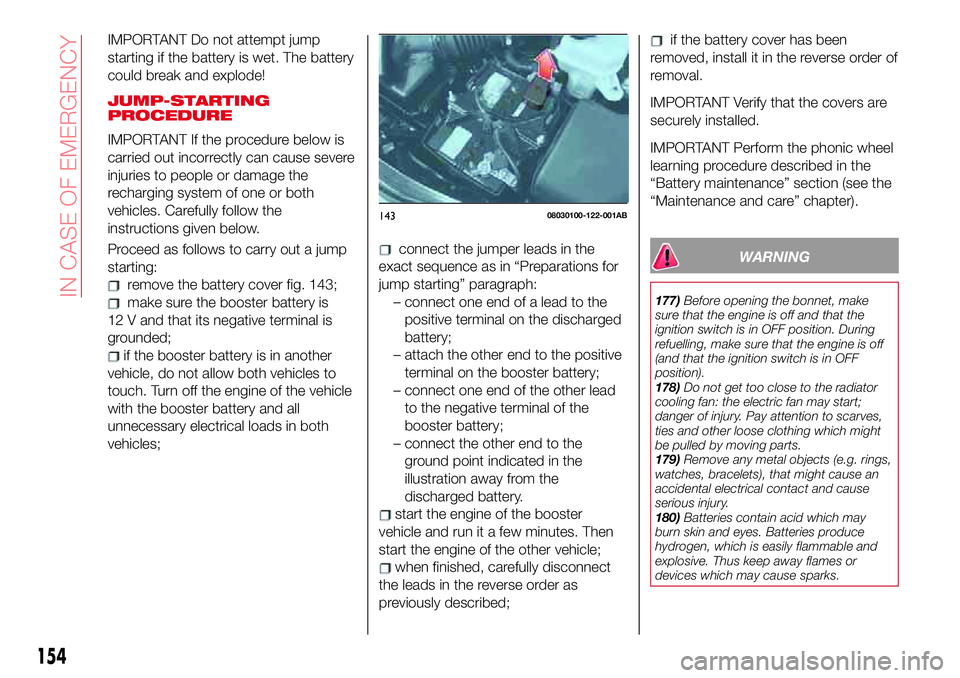
remove the battery cover fig. 143;
make sure the booster battery is
12 V and that its negative terminal is
grounded;
if the booster battery is in another
vehicle, do not allow both vehicles to
touch. Turn off the engine of the vehicle
with the booster battery and all
unnecessary electrical loads in both
vehicles;
connect the jumper leads in the
exact sequence as in “Preparations for
jump starting” paragraph:
–connectoneendofaleadtothe
positive terminal on the discharged
battery;
– attach the other end to the positive
terminal on the booster battery;
– connect one end of the other lead
to the negative terminal of the
booster battery;
– connect the other end to the
ground point indicated in the
illustration away from the
discharged battery.
start the engine of the booster
vehicle and run it a few minutes. Then
start the engine of the other vehicle;
when finished, carefully disconnect
the leads in the reverse order as
previously described;
if the battery cover has been
removed, install it in the reverse order of
removal.
IMPORTANT Verify that the covers are
securely installed.
IMPORTANT Perform the phonic wheel
learning procedure described in the
“Battery maintenance” section (see the
“Maintenance and care” chapter).
WARNING
177)Before opening the bonnet, make
sure that the engine is off and that the
ignition switch is in OFF position. During
refuelling, make sure that the engine is off
(and that the ignition switch is in OFF
position).
178)Do not get too close to the radiator
cooling fan: the electric fan may start;
danger of injury. Pay attention to scarves,
ties and other loose clothing which might
be pulled by moving parts.
179)Remove any metal objects (e.g. rings,
watches, bracelets), that might cause an
accidental electrical contact and cause
serious injury.
180)Batteries contain acid which may
burn skin and eyes. Batteries produce
hydrogen, which is easily flammable and
explosive. Thus keep away flames or
devices which may cause sparks.
14308030100-122-001AB
154
IN CASE OF EMERGENCY
Page 157 of 220

181)Do not allow the positive (+) terminal
to contact any other metal object that
could cause sparks. Flames and sparks
near open battery cells are dangerous.
Hydrogen gas, produced during normal
battery operation, could ignite and cause
the battery to explode. An exploding
battery can cause serious burns and
injuries. When working near a battery, do
not allow metal tools to contact the positive
(+) or negative (–) terminal of the battery.
182)Keep all flames, including cigarettes,
and sparks away from open battery cells.
Flames and sparks near open battery cells
are dangerous. Hydrogen gas, produced
during normal battery operation, could
ignite and cause the battery to explode. An
exploding battery can cause serious burns
and injuries.
183)Do not jump-start a frozen battery or
one with a low fluid level. Jump-starting a
frozen battery or one with a low fluid level is
dangerous. It may rupture or explode,
causing serious injury.
184)Route the jumper leads away from
parts that will be moving. Connecting a
jumper lead near or to moving parts
(cooling fans, belts) is dangerous. The lead
could get caught when the engine starts
and cause serious injury.
185)Never tow a vehicle to start it. Towing
a vehicle to start it is dangerous. The
vehicle being towed could surge forward
when its engine starts, causing the two
vehicles to collide. The occupants could be
injured.186)Connect the negative lead to a good
ground point (see figure) away from the
battery. Connecting the end of the second
jumper lead to the negative (–) terminal of
the discharged battery is dangerous. A
spark could cause the gas around the
battery to explode and injure someone.
IMPORTANT
34)Do not connect the cable to the
negative terminal (–) of the flat battery. The
following spark could lead to battery
explosion and cause serious harm. Only
use the specific earth point; do not use any
other exposed metallic part.
TOWING THE
VEHICLE
ATTACHING THE TOW
HOOKS
35) 36) 37)
Proceed as follows:
remove the towing eyelet and the
wheel brace from the luggage
compartment;
wrap a flathead screwdriver or similar
tool with a soft cloth to prevent damage
to a painted bumper, and open the cap
located on the front 1 fig. 144 or rear
bumper 2 fig. 145.
14408060203-121-001AB
155
Page 160 of 220

MAINTENANCE AND CARE
Correct maintenance permits the
performance of the vehicle to be
maintained over time, as well as limited
running costs and safeguarding the
efficiency of the safety systems.INTRODUCTION.............159
ENGINE COMPARTMENT......165
BATTERY RECHARGING.......169
WHEELS AND TIRES..........170
BODYWORK...............172
INTERIORS................174
158
MAINTENANCE AND CARE
Page 161 of 220
SERVICING
Be extremely careful and prevent injury
to yourself and others or damage to
your vehicle when using this manual for
inspection and maintenance.
If you are unsure about any procedure it
describes, we strongly urge you to have
a reliable and qualified service shop
perform the work, preferably at Abarth
Dealership.
Factory-trained FCA technicians and
genuine FCA parts are best for your
vehicle. Without this expertise and the
parts that have been designed and
made especially for your vehicle,
inadequate, incomplete, and insufficient
servicing may result in problems. This
could lead to vehicle damage or an
accident and injuries.
For expert advice and quality service,
contact an Abarth Dealership.
The owner should retain evidence that
proper maintenance has been
performed as prescribed.
A claim against a warranty will not
qualify if it results from lack of
maintenance and not from defective
material or authorised workmanship.
Claims against the warranty resulting
from lack of maintenance, as opposed
to defective materials or authorized FCA
workmanship, will not be honored.Scheduled maintenance
NOTE After the prescribed period,
continue to follow the described
maintenance at the recommended
intervals.
Emission control and related
systems
The ignition and fuel systems are highly
important to the emission control
system and to efficient engine
operation. Do not tamper with them.
All inspections and adjustments must
be made by Abarth Dealership.
OWNER MAINTENANCE
PRECAUTIONS
187) 188) 189)
38)
Routine service
We highly recommend that these items
be inspected daily, or at least every
week:
Engine oil level
Engine coolant level
Brake and clutch fluid Level
Washer fluid level
Battery maintenance
Tire inflation pressure
Improper or incomplete service may
result in problems. This section gives
instructions only for items that are easy
to perform.As explained in the “Introduction”
paragraph, several procedures can be
done only by a qualified service
technician with special tools.
Improper do-it yourself maintenance
during the warranty period may affect
warranty coverage. For details, read the
separate Warranty statement provided
with the vehicle. If you are unsure about
any servicing or maintenance
procedure, have it done by Abarth
Dealership.
There are strict environmental laws
regarding the disposal of waste oil and
fluids. Please dispose of your waste
properly and with due regard to the
environment.
We recommend that you entrust the oil
and fluid changes of your vehicle to an
Abarth Dealership.
159
INTRODUCTION
SCHEDULED
Page 162 of 220
PERIODIC CHECKS
Every1,000 kmor before long trips
check and, if necessary, top up:
engine coolant level;
brake fluid level;
windscreen washer fluid level;
tire inflation pressure and condition;
operation of lighting system
(headlights, direction indicators, hazard
warning lights, etc.);
operation of windscreen
washer/wiper system and
positioning/wear of windscreen window
wiper blades.
Every 3,000 km, check and top up if
required: engine oil level.
HEAVY-DUTY USE OF THE
VEHICLE
If the vehicle is used under one of the
following conditions:
dusty roads;
short, repeated journeys (less than
7-8 km) at sub-zero outside
temperatures;
engine often idling or driving long
distances at low speeds or long periods
of inactivity;
the following checks must be carried
out more often than indicated in the
Scheduled Servicing Plan:
check front disc brake pad condition
and wear;
check cleanliness of bonnet and
luggage compartment locks,
cleanliness and lubrication of linkage;
visually inspect conditions of: engine,
gearbox, transmission, pipes and hoses
(exhaust/fuel system/brakes) and
rubber elements (gaiters/sleeves/
bushes, etc.);
check battery charge and battery
fluid level (electrolyte);
visually inspect conditions of the
accessory drive belts;
check and, if necessary, change
engine oil and replace oil filter;
check and, if necessary, replace
pollen filter;
check and, if necessary, replace air
cleaner.
160
MAINTENANCE AND CARE
Page 167 of 220
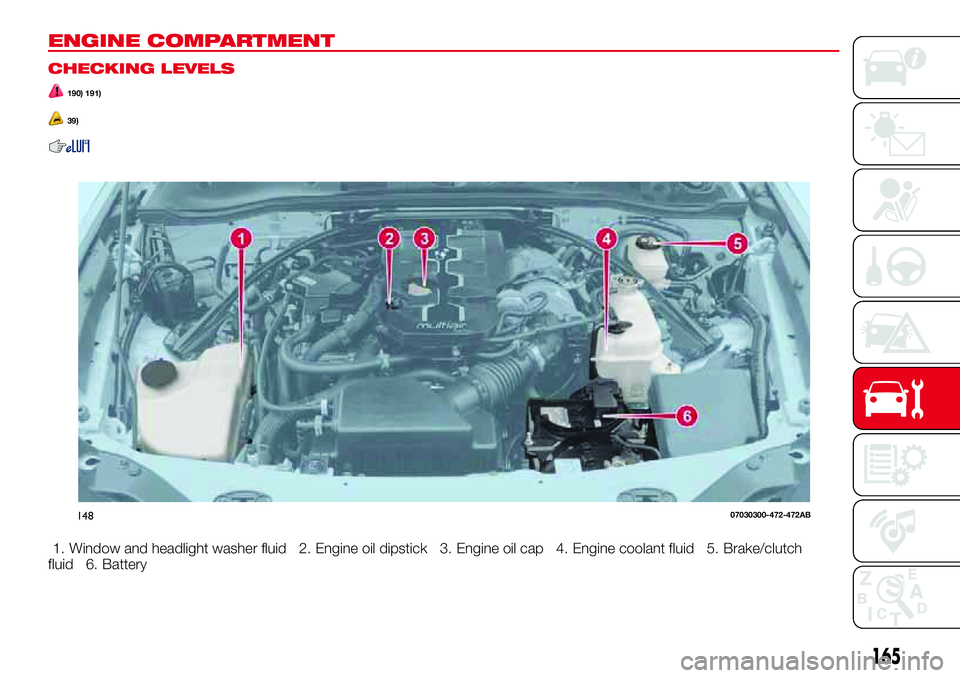
ENGINE COMPARTMENT
CHECKING LEVELS
190) 191)
39)
1. Window and headlight washer fluid 2. Engine oil dipstick 3. Engine oil cap 4. Engine coolant fluid 5. Brake/clutch
fluid 6. Battery
14807030300-472-472AB
165
Page 169 of 220

BRAKE / CLUTCH FLUID
198) 203)
46)
It should be kept between the MAX and
MIN lines fig. 151.
The level normally drops with
accumulated distance, a condition
associated with wear of brake and
clutch linings. If it is excessively low,
have the brake/clutch system contact
an Abarth Dealership.
NOTE On right-hand drive versions the
reservoir is located on the left side of
the engine compartment.
WINDOW AND
HEADLIGHT WASHER
FLUID
196) 197) 204)
Inspect fluid level in the washer fluid
reservoir fig. 152; open the cap and
add fluid if necessary.
AUTOMATIC
TRANSMISSION
CONTROL UNIT
5)
The transmission control oil level should
only be checked at Abarth Dealership.
BATTERY MAINTENANCE
199) 200) 201) 202)
47)
6)
To get the best service from a battery:
keep it securely mounted;
keep the top clean and dry;
keep terminals and connections
clean, tight, and coated with petroleum
jelly or terminal grease;
rinse off spilled electrolyte
immediately with a solution of water
and baking soda;
if the vehicle will not be used for an
extended time, disconnect the battery
leads and charge the battery every six
weeks.
NOTE
Every time the battery is reconnected
after being disconnected, it is
necessary to perform the following
procedure:
warm up the engine;
with the vehicle stationary, the engine
running and the transmission in the
neutral or N/P (for automatic
transmission) position, press the
accelerator down fully to bring the
engine speed to over 6000 rpm;
release the accelerator pedal and
wait for the engine to return naturally to
idling speed.
If this procedure is not performed, the
warning light could turn on: in this
case, contact Abarth Dealership.
IMPORTANT If, after the first press of
the accelerator pedal to bring the
engine to over 6000 rpm, another
follows immediately after without the
15107030601-121-002AB
15207030901-121-001AB
167