brake light Abarth 124 Spider 2020 Owner handbook (in English)
[x] Cancel search | Manufacturer: ABARTH, Model Year: 2020, Model line: 124 Spider, Model: Abarth 124 Spider 2020Pages: 224, PDF Size: 3.9 MB
Page 157 of 224

TIRE SERVICE USAGE
PRECAUTIONS
NoteThe tire sealant cannot be reused.
Purchase new tire sealant at an Abarth
Dealership.
The tire service kit cannot be used in
the following cases. Consult an Abarth
Dealership:
– the period of effective use for the
tire sealant has expired (the period
of effectiveness is indicated on the
bottle label);
– the tear or puncture exceeds about
4 mm;
– the damage has occurred to an
area of the tire other than the tread;
– the vehicle has been driven with
nearly no air remaining in the tire;
– the tire has come off the wheel rim;
– damage to the wheel rim has
occurred;
– the tire has two or more punctures.
SEALING A TIRE WITH
TIRE SERVICE
Proceed as follows:
move the vehicle off the right-of-way
to a safe place on a level and hard
surface where the vehicle does not
obstruct traffic;
shift the shift lever to the 1 or
Reverse (R) position (manual
transmission), and shift the selector
lever to the P position (automatic
transmission);
apply the parking brake with the
brake pedal depressed and turn off the
engine;
if necessary, flash the hazard warning
lights and set up the roadside
emergency triangle;
unload passengers and cargo and
remove the tire service kit;
shake the tire sealant well.
IMPORTANT If the bottle is shaken after
the injection hose is screwed on, tire
sealant could spray out from the
injection hose. Tire sealant contacting
clothing or other objects may be
impossible to remove. Shake the bottle
before screwing on the injection hose.
IMPORTANT The sealant hardens easily
and injecting it will be difficult under
cold weather conditions (0°C or below).
Warm the sealant inside the vehicle to
facilitate injection.
remove the cap 1 from the bottle 2
fig. 135. Screw on the injection hose
3 with the bottle's inner cap left on to
break the inner cap;
remove the valve cap 4 fig. 136 from
the flat tire. Press the back of a valve
core tool 6 to the core of the tire valve
5 and bleed all the remaining air;
13508020202-03A-003AB
155
Page 168 of 224
fluids. Please dispose of your waste
properly and with due regard to the
environment.
We recommend that you entrust the oil
and fluid changes of your vehicle to an
Abarth Dealership.
PERIODIC CHECKS
Every1,000 kmor before long trips
check and, if necessary, top up:
engine coolant level;
brake fluid level;
windscreen washer fluid level;
tire inflation pressure and condition;
operation of lighting system
(headlights, direction indicators, hazard
warning lights, etc.);
operation of windscreen
washer/wiper system and
positioning/wear of windscreen window
wiper blades.
Every 3,000 km, check and top up if
required: engine oil level.
HEAVY-DUTY USE OF THE
VEHICLE
If the vehicle is used under one of the
following conditions:
dusty roads;
short, repeated journeys (less than
7-8 km) at sub-zero outside
temperatures;
engine often idling or driving long
distances at low speeds or long periods
of inactivity;
the following checks must be carried
out more often than indicated in the
Scheduled Servicing Plan:
check front disc brake pad condition
and wear;
check cleanliness of bonnet and
luggage compartment locks,
cleanliness and lubrication of linkage;
visually inspect conditions of: engine,
gearbox, transmission, pipes and hoses
(exhaust/fuel system/brakes) and
rubber elements (gaiters/sleeves/
bushes, etc.);
check battery charge and battery
fluid level (electrolyte);
visually inspect conditions of the
accessory drive belts;
check and, if necessary, change
engine oil and replace oil filter;
check and, if necessary, replace
pollen filter;
check and, if necessary, replace air
cleaner.
166
MAINTENANCE AND CARE
Page 169 of 224
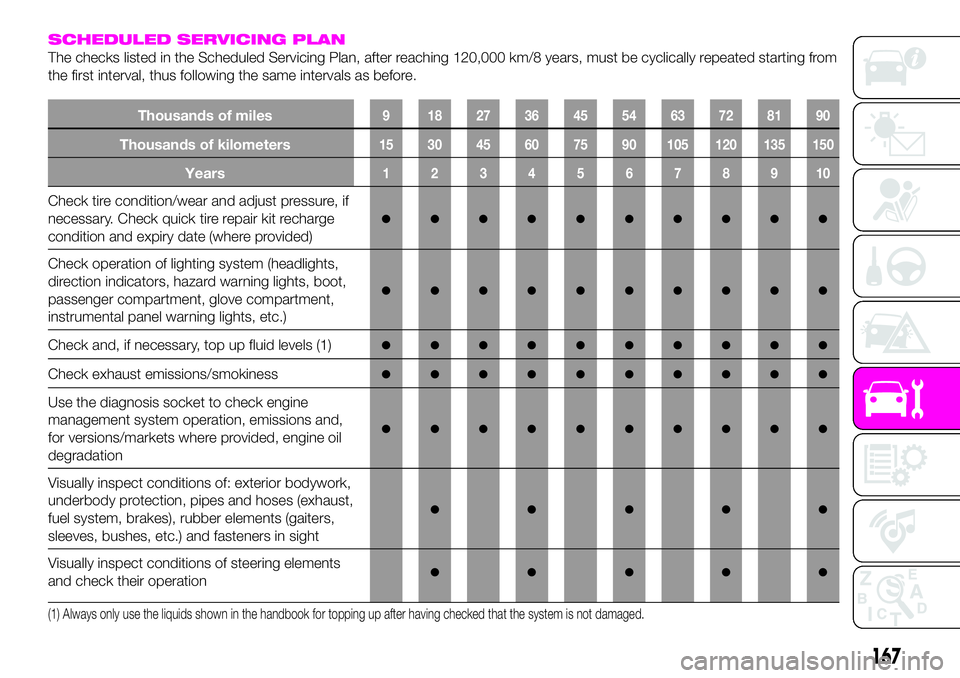
SCHEDULED SERVICING PLAN
The checks listed in the Scheduled Servicing Plan, after reaching 120,000 km/8 years, must be cyclically repeated starting from
the first interval, thus following the same intervals as before.
Thousands of miles9 182736455463728190
Thousands of kilometers15 30 45 60 75 90 105 120 135 150
Years12345678910
Check tire condition/wear and adjust pressure, if
necessary. Check quick tire repair kit recharge
condition and expiry date (where provided)
●●●●●●●●●●
Check operation of lighting system (headlights,
direction indicators, hazard warning lights, boot,
passenger compartment, glove compartment,
instrumental panel warning lights, etc.)
●●●●●●●●●●
Check and, if necessary, top up fluid levels (1)●●●●●●●●●●
Check exhaust emissions/smokiness●●●●●●●●●●
Use the diagnosis socket to check engine
management system operation, emissions and,
for versions/markets where provided, engine oil
degradation
●●●●●●●●●●
Visually inspect conditions of: exterior bodywork,
underbody protection, pipes and hoses (exhaust,
fuel system, brakes), rubber elements (gaiters,
sleeves, bushes, etc.) and fasteners in sight
●●●●●
Visually inspect conditions of steering elements
and check their operation●●●●●
(1) Always only use the liquids shown in the handbook for topping up after having checked that the system is not damaged.
167
Page 173 of 224
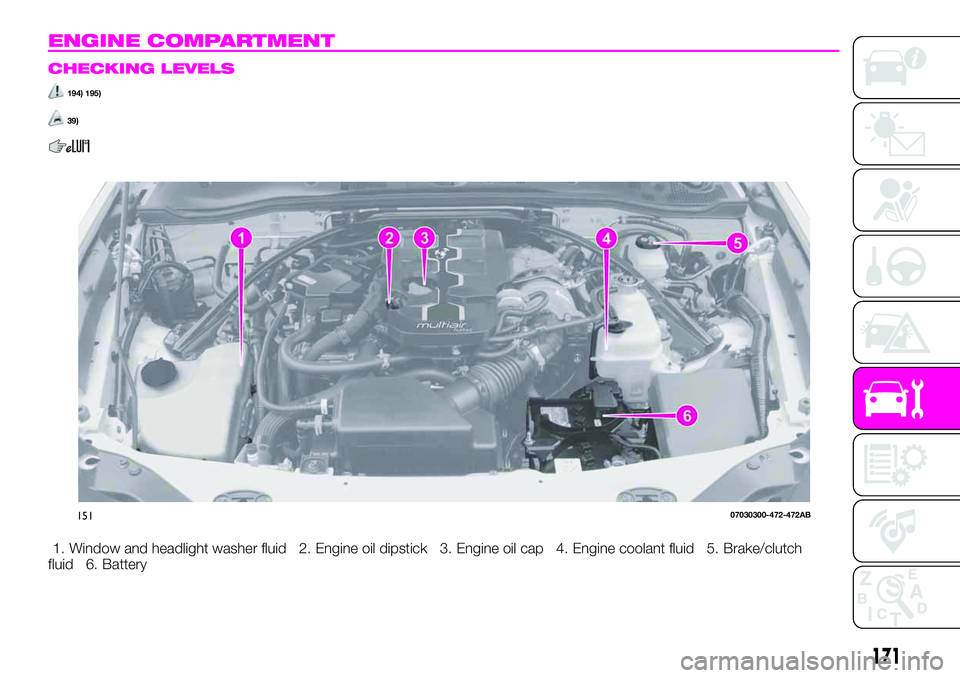
ENGINE COMPARTMENT
CHECKING LEVELS
194) 195)
39)
1. Window and headlight washer fluid 2. Engine oil dipstick 3. Engine oil cap 4. Engine coolant fluid 5. Brake/clutch
fluid 6. Battery
15107030300-472-472AB
171
Page 175 of 224
IMPORTANT Use only soft
(demineralised) water in the coolant
mixture. Water that contains minerals
will cut down on the coolant's
effectiveness.
IMPORTANT Do not add only water.
Always add a proper coolant mixture.
IMPORTANT The engine has aluminium
parts and must be protected by an
ethylene-glycol-based coolant to
prevent corrosion and freezing.
IMPORTANT DO NOT USE coolants
Containing Alcohol, methanol, Borate
or Silicate. These coolants could
damage the cooling system.
IMPORTANT DO NOT MIX alcohol or
methanol with the coolant. This could
damage the cooling system.
IMPORTANT Do not use a solution that
contains more than 60% antifreeze.
This would reduce effectiveness.
IMPORTANT If the “FL22” mark is
shown on or near the cooling system
cap, use of FL-22 is recommended
when replacing engine coolant. Using
engine coolant other than FL-22 may
cause serious damage to the engine
and cooling system.BRAKE / CLUTCH FLUID
202) 207)
41)
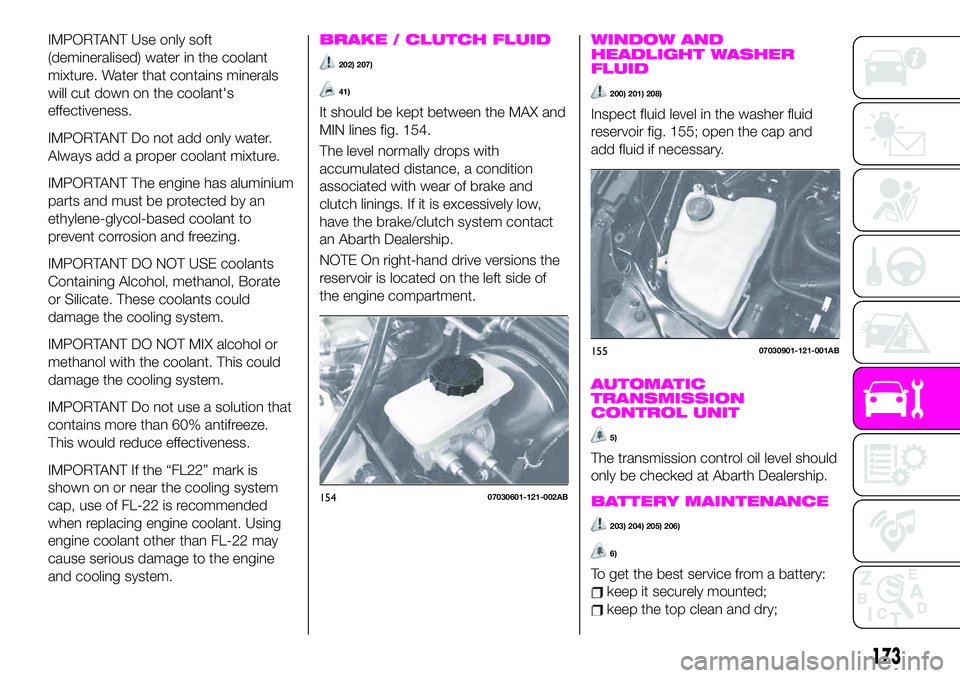
It should be kept between the MAX and
MIN lines fig. 154.
The level normally drops with
accumulated distance, a condition
associated with wear of brake and
clutch linings. If it is excessively low,
have the brake/clutch system contact
an Abarth Dealership.
NOTE On right-hand drive versions the
reservoir is located on the left side of
the engine compartment.
WINDOW AND
HEADLIGHT WASHER
FLUID
200) 201) 208)
Inspect fluid level in the washer fluid
reservoir fig. 155; open the cap and
add fluid if necessary.
AUTOMATIC
TRANSMISSION
CONTROL UNIT
5)
The transmission control oil level should
only be checked at Abarth Dealership.
BATTERY MAINTENANCE
203) 204) 205) 206)
6)
To get the best service from a battery:
keep it securely mounted;
keep the top clean and dry;
15407030601-121-002AB
15507030901-121-001AB
173
Page 182 of 224
IMPORTANT Do not use steel wool,
abrasive cleaners, or strong detergents
containing highly alkaline or caustic
agents on chromeplated or anodised
aluminium parts. This may damage the
protective coating; also, cleaners and
detergents may discolour or deteriorate
the paint.
Thoroughly rinse off all soap with
lukewarm or cold water. Do not allow
soap to dry on the finish.
218)
WARNING
218)Dry off brakes that have become wet
by driving slowly, releasing the accelerator
pedal and lightly applying the brakes
several times until the brake performance
returns to normal. Driving with wet brakes
is dangerous. Increased stopping distance
or the vehicle pulling to one side when
braking could result in a serious accident.
Light braking will indicate whether the
brakes have been affected.
IMPORTANT
45)In order to preserve the appearance of
the paint abrasive products and/or polishes
should not be used for cleaning the vehicle.46)Avoid washing with rollers and/or
brushes in washing stations. Wash the
vehicle only by hand using neutral pH
detergents; dry it with a wet chamois
leather. Abrasive products and/or polishes
should not be used for cleaning the car.
Bird droppings must be washed off
immediately and thoroughly as the acid
they contain is particularly aggressive.
Avoid (if at all possible) parking the vehicle
under trees; remove vegetable resins
immediately as, when dried, it may only be
possible to remove them with abrasive
products and/or polishes, which is highly
inadvisable as they could alter the typical
opaqueness of the paint. Do not use pure
windscreen washer fluid for cleaning the
front windscreen and rear window; dilute it
min. 50% with water. Only use pure screen
washer fluid when strictly necessary due to
outside temperature conditions.
IMPORTANT
7)Detergents cause water pollution. Only
wash your vehicle in areas equipped to
collect and treat wastewater from this type
of activity.
INTERIORS
INTERIOR CARE
222) 223) 224)
If the vehicle interior becomes soiled by
any of the following, wipe it off
immediately using a soft cloth.
Leaving it uncleaned could cause
discolouration, stains, cracks, or
peeling of the coating, and it will make it
hard to wipe off later.
Beverage or fragrance
Grease or oil
Soiling
NOTE Do not wipe the interior using
alcohol, chlorine bleach, or organic
solvents such as thinner, benzene, and
petrol. Otherwise, it may cause
discolouration or stains.
NOTE Rubbing hard with a stiff brush or
cloth may cause damage.
180
MAINTENANCE AND CARE
Page 219 of 224
INDEX
ABS system................73
Accessory socket.............38
Active bonnet................74
Active safety systems...........73
Advanced Keyless Entry System....14
AFS (Adaptive Front Lighting
System)..................27
Attaching the tow hooks........161
Auto-wiper control............29
Automatic climate control system.......................34
Automatic lighting.............25
Automatic transmission.........119
Auxiliary driving systems.........77
Battery (maintenance).........173
Battery charging procedure......176
Battery recharging............176
Bodywork (care and
maintenance).............178
Bonnet....................41
Boot lid...................38
Boot lid (opening).............38
Brake Assist................117
Brake/clutch fluid (level check). . . .173
Checking levels.............171
Child seat installation position.....90
Child-restraint precautions.......86
Child-restraint system suitability
for various seat position.......91Child-restraint system types......89
Climate control system..........31
Coming Home light system.......25
Constant monitoring..........114
Control panel and instruments.....48
Convertible Top (lowering)........42
Convertible Top (Soft Top)........42
Cruise Control..............123
Dashboard..................8
Dead lock device.............16
Dimensions................188
Doors.....................16
Drive selection..............123
Driver Air Bag...............102
DRL (Daytime Running Lights).....24
DSC system................73
Emergency flap opening.......131
Emergency stop signal system. . . .138
Emergency towing............163
Engine...................184
Engine compartment..........171
Engine coolant (level check)......172
Engine oil (level check).........172
Essential information............3
Exterior lights................24
Flash to pass...............25
Fluid capacities..............189
Fluids and lubricants..........190Front fog lights...............25
Fuel consumption and
CO2 emissions............193
Fuel filler cap...............131
Fuse block (engine compartment)......................149
Fuse block (left side of the vehicle)......................152
Fuses (under the bonnet)........148
Fuses (vehicle's left side)........147
Gear lever positions..........119
Gear Shift Indicator............52
Hazard warning lights.........138
Hazard warning lights (control). . . .138
Head restraints...............21
Headlight washer.............30
Headlights..................24
Heated seats................19
Heavy-dute use of the vehicle
(scheduled servicing)........166
High beams.................25
HLA function................80
How the SRS Air bags work......102
How to use this manual..........3
Identification data............183
Ignition switch...............11
Immobilizer system............14
INFO switch.................51
Installing child-restraint systems....95
Interior care................180
Interiors..................180
Page 220 of 224
Internal equipment............38
Jump starting..............159
Jump starting (procedure).......160
Key battery replacement........10
Keyless Entry System...........9
Keys......................9
Lane change signals...........27
Leaving Home Light system.......27
Load limiter (pretensioner)........85
Maintaining the finish.........179
Maintenance monitor...........53
Manual climate control system.....32
Manual transmission..........118
Mechanical Limited Slip
Differential................79
Message indicated on display.....71
Mirrors....................22
Multimedia.................195
Navigation................208
Occupant protection systems.....81
Odometer/Trip meter...........50
Outside mirrors...............22
Owner maintenance precautions . . .165
Paintwork (preserving).........178
Parking...................116
Parking brake...............117
Parking Sensor System.........129
Passenger Air Bag............102Passenger occupant classification
system.................107
Passive Entry................17
Performance...............192
Periodic checks (scheduled
servicing)................166
Power mirrors...............23
Power window lock switch.......37
Power windows..............36
Prescriptions for handling the
vehicle at the end of its life.....194
Pretensioners................85
Push button start positions.......11
Radio 3”.................197
Radio 7”..................202
Read this carefully..............2
Rear camera (ParkView rear
backup camera)...........133
Rear fog lights...............26
Refuelling procedure..........131
Refuelling the vehicle..........131
Replacing a bulb.............139
Replacing a tire..............177
Replacing exterior light bulbs.....142
Replacing fuses.............147
Rims and tires..............185
Rims and tires provided........186
SBA system (Seat Belt Alert)......84
Scheduled servicing plan.......167Seat belt precautions...........82
Seat belt pretensioner and load
limiting systems.............85
Seat Belt pretensioners.........102
Seat belts..................82
Seat belts (fastening/unfastening)}.......................82
Seats.....................19
Seats (manual adjustment).......19
Seats and fabric parts (cleaning) . . .181
Shift-lock override (automatic
gearbox)................120
Shift-lock system (automatic
gearbox)................120
Side Air Bags...............103
Snow chains...............177
Speed limiter...............126
SPORT mode...............123
Starting the engine.........11,116
Steering wheel...............21
Supplementary restraint system
(SRS) - Air bag............100
Symbols....................3
TCS (Traction Control System).....73
Theft deterrent system..........15
Tips, controls and general
information...............196
Tire service kit..............154
Tires rotation (recommendations) . .177
Tool storage................154
Towing the vehicle............161
INDEX