gearbox Abarth 500 2018 Owner handbook (in English)
[x] Cancel search | Manufacturer: ABARTH, Model Year: 2018, Model line: 500, Model: Abarth 500 2018Pages: 192, PDF Size: 5.86 MB
Page 88 of 192
release the brake pedal and press
the accelerator pedal (quickly pressing
the pedal fully down and turning off
the ASR, if provided, results in a “lively”
departure).
Engaging reverse gear (R)
To engage reverse gear, press the R
button on the gearbox panel instead of
the 1 button.
Engaging neutral (N)
Press the (N) button to engage neutral.
Neutral (N) can only be engaged with
accelerator pedal released, regardless
of the brake pedal’s status (pressed
or not). In any case, pressing the brake
pedal is recommended.
ACOUSTIC SIGNAL
For safety reasons, there is a buzzer
warning when parking the car with the
gearbox in neutral (N) (the warning is
heard when the ignition key is turned to
the STOP position).
With the car stationary, the engine
running and (1
st), (2nd) or (R) engaged,
the system activates the buzzer and
automatically puts the transmission in
neutral (N) when:
the accelerator and/or brake pedal
are not operated for at least 3 minutes;
the brake pedal is pressed for longer
than 10 minutes;
the driver's door is opened and the
accelerator pedal or the brake pedal
are not operated for at least 1.5
seconds;
a fault has been detected in the
transmission.
PARKING THE CAR
To park safely, you must engage 1
stor
reverse (R) gear, with your foot on
the brake pedal and, if there is a
gradient, operate the handbrake. Wait
until the indication of the gear engaged
disappears on the display before
releasing the brake pedal.
IMPORTANT NEVER leave the car with
the transmission in neutral (N).
IMPORTANT NOTES
With car stationary and gear
engaged, always keep the brake pedal
pressed until you decide to set off,
then release the brake and accelerate
gradually.
During prolonged stops with the
engine running, it is advisable to keep
the transmission in neutral (N).
In order to safeguard the efficiency
of the clutch, do not use the
accelerator to keep the car stationary
(e.g. when stopped on an incline); if the
clutch overheats it could be damaged.
Use the brake pedal or the handbrake
instead and use the accelerator pedal
only when you decide to set off.
Only use 2ndgear when you need
greater control for setting off on
surfaces with poor grip.
If you have to engage 1stgear with
reverse gear (R) engaged, or vice versa,
only do so when the car is completely
stationary and with the brake pedal
pressed.
Although it is strongly inadvisable, if
you are driving downhill and, for
unexpected reasons, you let the car
move forward with the transmission in
neutral (N), when there is a request
to engage a gear, depending on the
actual speed of the car, the system will
automatically engage the best gear
for the correct transmission of drive
torque to the wheels.
86
STARTING AND DRIVING
Page 105 of 192

DEVICE PROTECTEDFUSE AMPERE
Robotised sequential gearbox control unit power supply (+ ignition) F16 7.5
Heated rear windowF20 30
Fog lightsF30 15
Robotised sequential gearbox control unit F84 10
Front power socket (with or without cigar lighter) F85 20
WARNING
118)If the fuse blows again, contact an Abarth Dealership.
119)Never replace a fuse with metal wires or anything else.
120)Never replace a fuse with another with a higher amp rating; DANGER OF FIRE.
121)If a general protection fuse (MEGA-FUSE, MIDI-FUSE, MAXI-FUSE) blows, contact an Abarth Dealership.
122)Before replacing a fuse, make sure that the ignition key has been removed and that all the other services are switched off and/or
disengaged.
123)If a general protection fuse for the safety systems (airbag system, braking system), power unit systems (engine system, gearbox system)
or driving system blows, contact an Abarth Dealership.
WARNING
25)If you need to wash the engine compartment, take care not to directly hit the engine compartment fuse box with the water jet.
103
Page 108 of 192
WARNING
124)The information required by the
applicable regulation is indicated on the
Fix&Go kit package label. Carefully read
the label on the cartridge before use, avoid
improper use. The kit should be used by
adults and cannot be used by children.
125)IMPORTANT: Do not exceed 80 km/h.
Avoid sudden acceleration or braking.
The kit provides a temporary repair,
therefore the tyre must be examined and
repaired by a specialist as soon as
possible. Before using the kit, ensure that
the tyre is not excessively damaged and
that the rim is in good condition, otherwise
do not use it and call roadside assistance.
Do not remove foreign bodies from the
tyre. Do not let the compressor turned on
for more than 20 consecutive minutes -
overheating hazard.
WARNING
26)The sealant fluid is effective with
external temperatures between -40°C and
+55°C. The sealant fluid has an expiry
date. It is possible to repair tyres which
have been damaged on tread up to a
diameter of 6 mm. Show the cartridge and
the label to the personnel charged with
handling the tyre treated with the tyre
repair kit.
JUMP STARTING
If thesymbol on the display turns
on constantly, contact an Abarth
Dealership immediately.
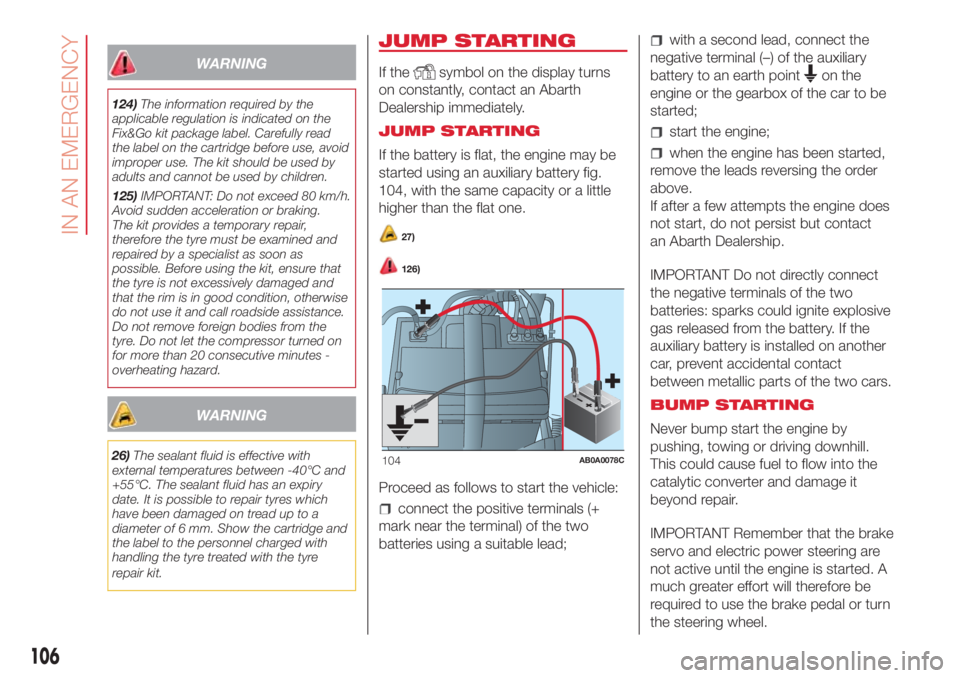
JUMP STARTING
If the battery is flat, the engine may be
started using an auxiliary battery fig.
104, with the same capacity or a little
higher than the flat one.
27)
126)
Proceed as follows to start the vehicle:
connect the positive terminals (+
mark near the terminal) of the two
batteries using a suitable lead;
with a second lead, connect the
negative terminal (–) of the auxiliary
battery to an earth point
on the
engine or the gearbox of the car to be
started;
start the engine;
when the engine has been started,
remove the leads reversing the order
above.
If after a few attempts the engine does
not start, do not persist but contact
an Abarth Dealership.
IMPORTANT Do not directly connect
the negative terminals of the two
batteries: sparks could ignite explosive
gas released from the battery. If the
auxiliary battery is installed on another
car, prevent accidental contact
between metallic parts of the two cars.
BUMP STARTING
Never bump start the engine by
pushing, towing or driving downhill.
This could cause fuel to flow into the
catalytic converter and damage it
beyond repair.
IMPORTANT Remember that the brake
servo and electric power steering are
not active until the engine is started. A
much greater effort will therefore be
required to use the brake pedal or turn
the steering wheel.
104AB0A0078C
106
IN AN EMERGENCY
Page 110 of 192
TOWING THE
VEHICLE
The tow hook, which is supplied with
the vehicle, is housed in the tool box,
under the carpet in the luggage
compartment.
128) 129) 130) 131) 132)
ATTACHING THE TOW
RING
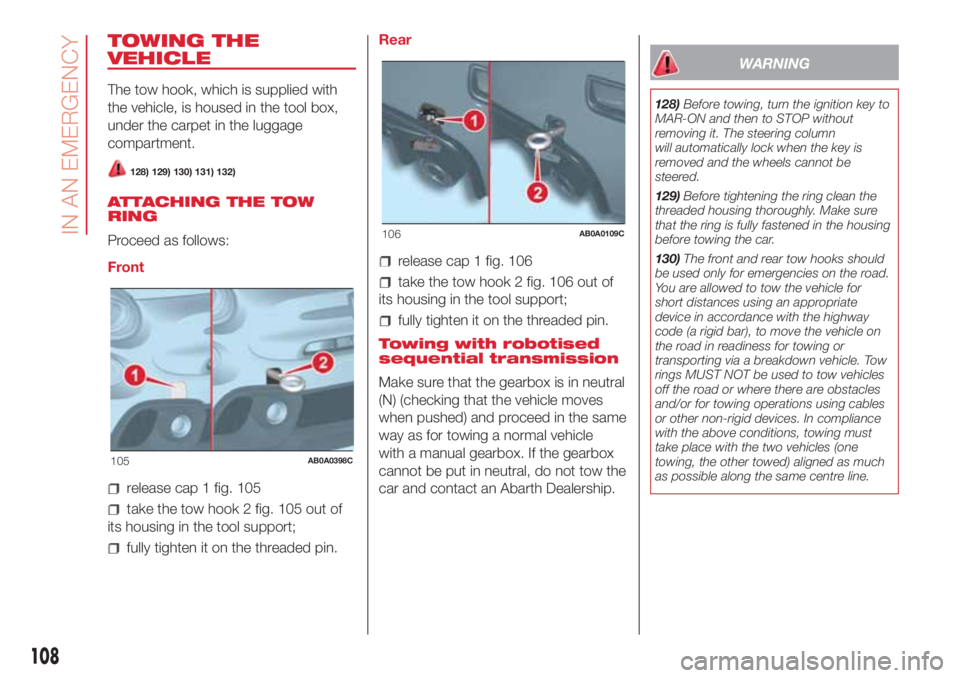
Proceed as follows:
Front
release cap 1 fig. 105
take the tow hook 2 fig. 105 out of
its housing in the tool support;
fully tighten it on the threaded pin.Rear
release cap 1 fig. 106
take the tow hook 2 fig. 106 out of
its housing in the tool support;
fully tighten it on the threaded pin.
Towing with robotised
sequential transmission
Make sure that the gearbox is in neutral
(N) (checking that the vehicle moves
when pushed) and proceed in the same
way as for towing a normal vehicle
with a manual gearbox. If the gearbox
cannot be put in neutral, do not tow the
car and contact an Abarth Dealership.
WARNING
128)Before towing, turn the ignition key to
MAR-ON and then to STOP without
removing it. The steering column
will automatically lock when the key is
removed and the wheels cannot be
steered.
129)Before tightening the ring clean the
threaded housing thoroughly. Make sure
that the ring is fully fastened in the housing
before towing the car.
130)The front and rear tow hooks should
be used only for emergencies on the road.
You are allowed to tow the vehicle for
short distances using an appropriate
device in accordance with the highway
code (a rigid bar), to move the vehicle on
the road in readiness for towing or
transporting via a breakdown vehicle. Tow
rings MUST NOT be used to tow vehicles
off the road or where there are obstacles
and/or for towing operations using cables
or other non-rigid devices. In compliance
with the above conditions, towing must
take place with the two vehicles (one
towing, the other towed) aligned as much
as possible along the same centre line.
105AB0A0398C
106AB0A0109C
108
IN AN EMERGENCY
Page 116 of 192

Thousands of miles 9 18 27 36 45 54 63 72 81 90
Thousands of kilometres 15 30 45 60 75 90 105 120 135 150
Years 1 2 3 4 5 6 7 8 9 10
Visually inspect conditions of toothed timing drive belt
Check the oil level in the robotised sequential gearbox
activation system (2)
Check and, if necessary, restore the self-locking differential
pre-loading (where present) (3)
Change the oil of the transmission equipped with limited
slip differential (where present)(3) (4)
Change engine oil and replace oil filter
Spark plug replacement (5)
(2) Only for cars on the road in countries with particularly severe climates (cold countries).
(3) It is recommended to carry out this operation immediately after each time the car has undergone demanding use
(4) The first transmission oil change must be done on reaching the first 10,000 km, independently of the time passed
(5) The following are essential to ensure correct operation and prevent serious damage to the engine: only use spark plugs of the same make and type specially
certified for 1.4 Turbo petrol Abarth engines (see the information in the "Engine" paragraph); strictly comply with the spark plug replacement interval given in the
Scheduled Servicing Plan; for spark plug replacement it is advisable to contact an Abarth Dealership.
114
SERVICING AND CARE
Page 118 of 192
PERIODIC CHECKS
Every 1,000 km or before long
journeys, check and, if necessary, top
up the following:
engine coolant level;
brake fluid level;
windscreen washer fluid level;
tyre inflation pressure and condition;
operation of lighting system
(headlights, direction indicators, hazard
warning lights, etc.);
operation of screen washer/wiper
system and positioning/wear of
windscreen/rear window wiper blades.
Every 3,000 km check and top up if
required: engine oil level.
You are advised to use PETRONAS
LUBRICANTS products, which have
been designed and produced
specifically for Abarth cars (see table
"Capacities" in the "Technical
specifications" chapter).
DEMANDING USE OF
THE CAR
If the car is used mainly under one of
the following conditions:
if the car is used under demanding
conditions, e.g. on track;
dusty roads;
short, repeated journeys (less than
7-8 Km) at sub-zero outdoor
temperatures;
engine often idling or driving long
distances at low speeds or long periods
of inactivity;
the following checks must be carried
out more often than indicated in the
Scheduled Servicing Plan:
check front disc brake pad condition
and wear;
check cleanliness of bonnet and
luggage compartment locks,
cleanliness and lubrication of linkage;
visually inspect conditions of:
engine, gearbox, transmission, pipes
and hoses (exhaust/fuel system/brakes)
and rubber elements (gaiters/sleeves/
bushes, etc.);
check battery charge and battery
fluid level (electrolyte);
visually inspect conditions of the
accessory drive belts;
check and, if necessary, change
engine oil and replace oil filter;
check and, if necessary, replace
pollen filter;
check and, if necessary, replace air
cleaner.
116
SERVICING AND CARE
Page 142 of 192
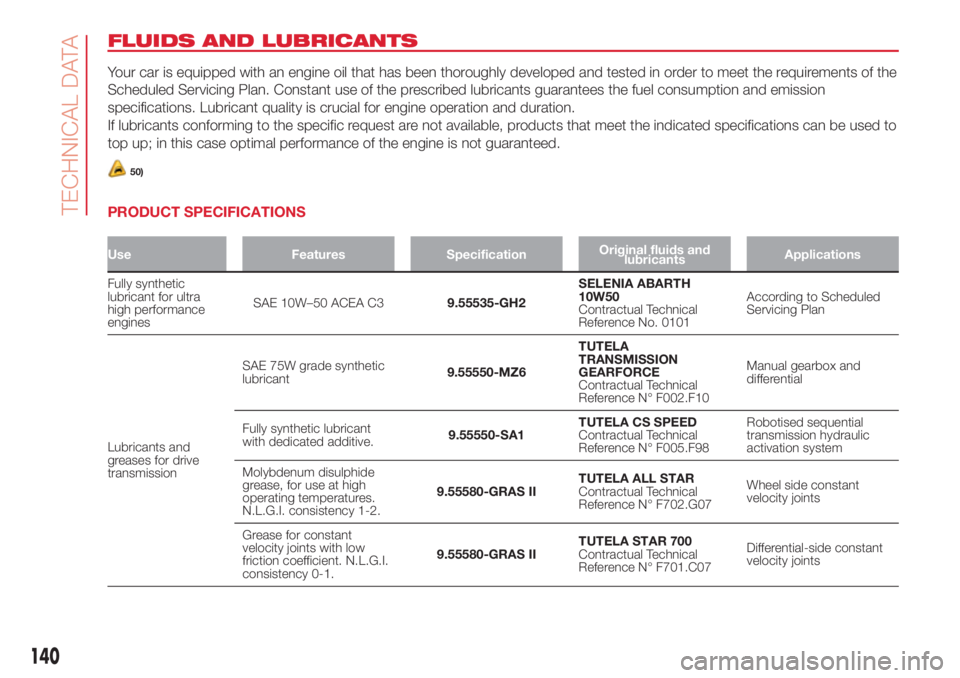
FLUIDS AND LUBRICANTS
Your car is equipped with an engine oil that has been thoroughly developed and tested in order to meet the requirements of the
Scheduled Servicing Plan. Constant use of the prescribed lubricants guarantees the fuel consumption and emission
specifications. Lubricant quality is crucial for engine operation and duration.
If lubricants conforming to the specific request are not available, products that meet the indicated specifications can be used to
top up; in this case optimal performance of the engine is not guaranteed.
50)
PRODUCT SPECIFICATIONS
Use Features SpecificationOriginal fluids and
lubricantsApplications
Fully synthetic
lubricant for ultra
high performance
enginesSAE 10W–50 ACEA C39.55535-GH2SELENIA ABARTH
10W50
Contractual Technical
Reference No. 0101According to Scheduled
Servicing Plan
Lubricants and
greases for drive
transmissionSAE 75W grade synthetic
lubricant9.55550-MZ6TUTELA
TRANSMISSION
GEARFORCE
Contractual Technical
Reference N° F002.F10Manual gearbox and
differential
Fully synthetic lubricant
with dedicated additive.9.55550-SA1TUTELA CS SPEED
Contractual Technical
Reference N° F005.F98Robotised sequential
transmission hydraulic
activation system
Molybdenum disulphide
grease, for use at high
operating temperatures.
N.L.G.I. consistency 1-2.9.55580-GRAS IITUTELA ALL STAR
Contractual Technical
Reference N° F702.G07Wheel side constant
velocity joints
Grease for constant
velocity joints with low
friction coefficient. N.L.G.I.
consistency 0-1.9.55580-GRAS IITUTELA STAR 700
Contractual Technical
Reference N° F701.C07Differential-side constant
velocity joints
140
TECHNICAL DATA
Page 145 of 192
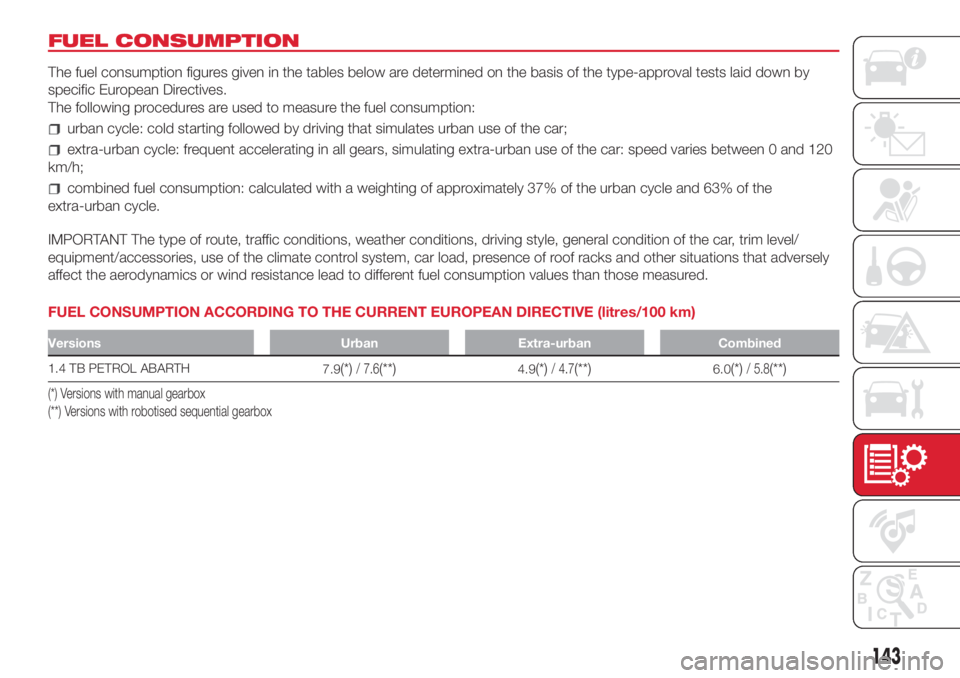
FUEL CONSUMPTION
The fuel consumption figures given in the tables below are determined on the basis of the type-approval tests laid down by
specific European Directives.
The following procedures are used to measure the fuel consumption:
urban cycle: cold starting followed by driving that simulates urban use of the car;
extra-urban cycle: frequent accelerating in all gears, simulating extra-urban use of the car: speed varies between 0 and 120
km/h;
combined fuel consumption: calculated with a weighting of approximately 37% of the urban cycle and 63% of the
extra-urban cycle.
IMPORTANT The type of route, traffic conditions, weather conditions, driving style, general condition of the car, trim level/
equipment/accessories, use of the climate control system, car load, presence of roof racks and other situations that adversely
affect the aerodynamics or wind resistance lead to different fuel consumption values than those measured.
FUEL CONSUMPTION ACCORDING TO THE CURRENT EUROPEAN DIRECTIVE (litres/100 km)
Versions Urban Extra-urban Combined
1.4 TB PETROL ABARTH
7.9(*)/ 7.6(**)4.9(*)/ 4.7(**)6.0(*)/ 5.8(**)
(*) Versions with manual gearbox
(**) Versions with robotised sequential gearbox
143
Page 146 of 192
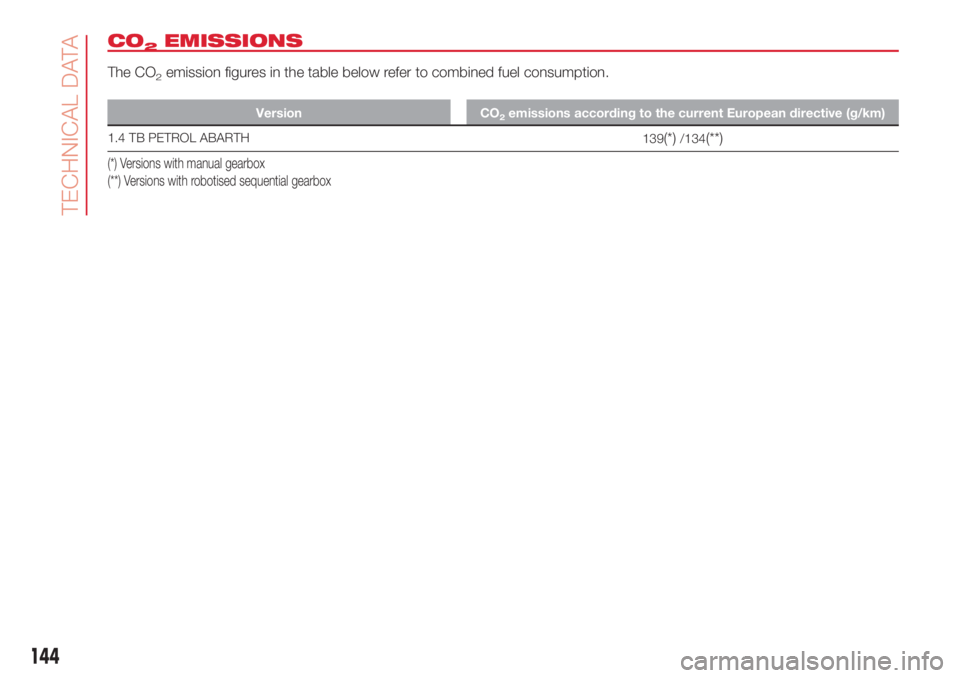
CO2EMISSIONS
The CO2emission figures in the table below refer to combined fuel consumption.
Version CO2emissions according to the current European directive (g/km)
1.4 TB PETROL ABARTH
139(*)/134(**)
(*) Versions with manual gearbox
(**) Versions with robotised sequential gearbox
144
TECHNICAL DATA
Page 189 of 192
snow tyres.....................134
tyres fitted.....................134
Tyres - maintenance................124
Uconnect™ 5”
APPS mode...................156
Bluetooth® source.............153
controls on front panel..........149
controls on the steering
wheel..........................151
eco:Drive™....................157
Media mode...................153
my:Car........................158
navigation......................158
phone mode...................154
Settings.......................158
switching the system on/off.....153
Uconnect™ LIVE services......156
voice commands...............161
Uconnect™ 5”/7” HD
Tips, controls and
information.....................147
Uconnect™ 7” HD
Android Auto...................173
Apple CarPlay..................173
AUX source....................169
Bluetooth® source.............168
controls on front panel..........162
controls on the steering
wheel..........................165Media mode...................167
navigation......................175
phone mode...................169
Settings.......................174
switching the system on/off.....167
trip computer..................169
Uconnect™ LIVE services......171
USB source....................169
voice commands...............176
Use of the Owner Handbook..........6
Using the manual gearbox...........84
Using the robotised sequential
transmission......................84
Vehicle changes/alterations...........4
Warning lights and messages
.......45
Washing and cleaning the soft
top .............................127
Weights...........................136
Wheels and tyres...................124
tyre inflation pressure...........134
Window bags (side airbags for
head protection)..................78
Window washing....................23
Windows (cleaning)................126
Windscreen washer (jets)...........123
Windscreen/rear window washer
fluid.............................119
Windscreen/rear window wiper
(blades).........................123