fuel Abarth 500 2018 Owner handbook (in English)
[x] Cancel search | Manufacturer: ABARTH, Model Year: 2018, Model line: 500, Model: Abarth 500 2018Pages: 192, PDF Size: 5.86 MB
Page 108 of 192
WARNING
124)The information required by the
applicable regulation is indicated on the
Fix&Go kit package label. Carefully read
the label on the cartridge before use, avoid
improper use. The kit should be used by
adults and cannot be used by children.
125)IMPORTANT: Do not exceed 80 km/h.
Avoid sudden acceleration or braking.
The kit provides a temporary repair,
therefore the tyre must be examined and
repaired by a specialist as soon as
possible. Before using the kit, ensure that
the tyre is not excessively damaged and
that the rim is in good condition, otherwise
do not use it and call roadside assistance.
Do not remove foreign bodies from the
tyre. Do not let the compressor turned on
for more than 20 consecutive minutes -
overheating hazard.
WARNING
26)The sealant fluid is effective with
external temperatures between -40°C and
+55°C. The sealant fluid has an expiry
date. It is possible to repair tyres which
have been damaged on tread up to a
diameter of 6 mm. Show the cartridge and
the label to the personnel charged with
handling the tyre treated with the tyre
repair kit.
JUMP STARTING
If thesymbol on the display turns
on constantly, contact an Abarth
Dealership immediately.
JUMP STARTING
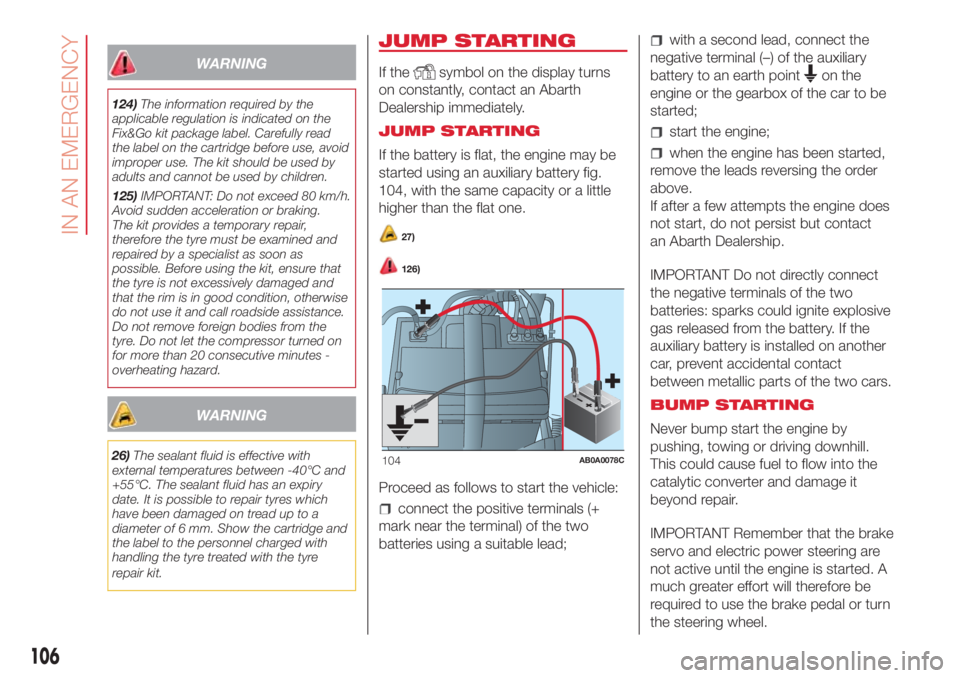
If the battery is flat, the engine may be
started using an auxiliary battery fig.
104, with the same capacity or a little
higher than the flat one.
27)
126)
Proceed as follows to start the vehicle:
connect the positive terminals (+
mark near the terminal) of the two
batteries using a suitable lead;
with a second lead, connect the
negative terminal (–) of the auxiliary
battery to an earth point
on the
engine or the gearbox of the car to be
started;
start the engine;
when the engine has been started,
remove the leads reversing the order
above.
If after a few attempts the engine does
not start, do not persist but contact
an Abarth Dealership.
IMPORTANT Do not directly connect
the negative terminals of the two
batteries: sparks could ignite explosive
gas released from the battery. If the
auxiliary battery is installed on another
car, prevent accidental contact
between metallic parts of the two cars.
BUMP STARTING
Never bump start the engine by
pushing, towing or driving downhill.
This could cause fuel to flow into the
catalytic converter and damage it
beyond repair.
IMPORTANT Remember that the brake
servo and electric power steering are
not active until the engine is started. A
much greater effort will therefore be
required to use the brake pedal or turn
the steering wheel.
104AB0A0078C
106
IN AN EMERGENCY
Page 109 of 192

WARNING
27)Never use a fast battery-charger to
start the engine as this could damage the
electronic systems of your vehicle,
particularly the ignition and engine fuel
supply control units.
WARNING
126)This starting procedure must be
performed by expert personnel because
incorrect actions could cause electrical
discharge of considerable intensity.
Furthermore, battery fluid is poisonous and
corrosive: avoid contact with skin and
eyes. Keep naked flames and lighted
cigarettes away from the battery and do
not cause sparks.
FUEL CUT-OFF
SYSTEM
This intervenes in the case of an impact
causing:
the interruption of the fuel supply
with the engine consequently cutting
out
the automatic unlocking of the doors
turning on the lights inside the car.
The intervention of the system is
indicated by a message shown on the
display.
IMPORTANT Carefully check the car for
fuel leaks, for instance in the engine
compartment, under the car or near the
tank area.
127)
After a crash, turn the ignition key to
STOP position to prevent the battery
from running down.
To restore the correct operation of the
car, proceed as follows:
turn the ignition key to the MAR
position
activate the right direction indicator
deactivate the right direction
indicator
activate the left direction indicator
deactivate the left direction indicator
activate the right direction indicator
deactivate the right direction
indicator
activate the left direction indicator
deactivate the left direction indicator
turn the ignition key to the STOP
position
turn the ignition key to the MAR-ON
position.
WARNING
127)If, after an impact, you smell fuel or
notice leaks from the fuel system, do
not reactivate the system to avoid the risk
of fire.
107
Page 115 of 192
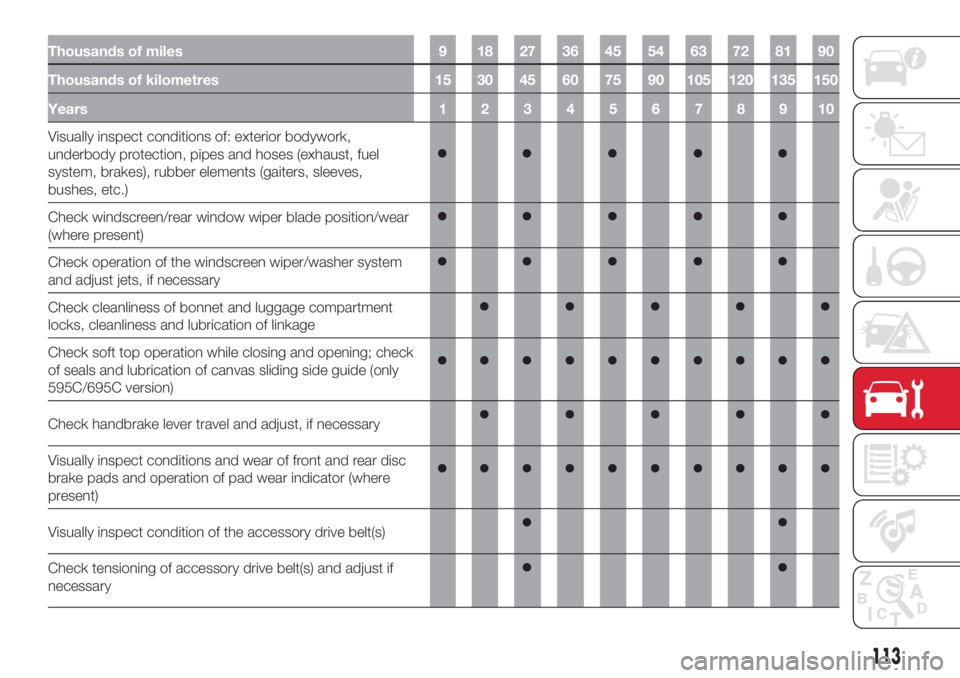
Thousands of miles 9 18 27 36 45 54 63 72 81 90
Thousands of kilometres 15 30 45 60 75 90 105 120 135 150
Years 1 2 3 4 5 6 7 8 9 10
Visually inspect conditions of: exterior bodywork,
underbody protection, pipes and hoses (exhaust, fuel
system, brakes), rubber elements (gaiters, sleeves,
bushes, etc.)
Check windscreen/rear window wiper blade position/wear
(where present)
Check operation of the windscreen wiper/washer system
and adjust jets, if necessary
Check cleanliness of bonnet and luggage compartment
locks, cleanliness and lubrication of linkage
Check soft top operation while closing and opening; check
of seals and lubrication of canvas sliding side guide (only
595C/695C version)
Check handbrake lever travel and adjust, if necessary
Visually inspect conditions and wear of front and rear disc
brake pads and operation of pad wear indicator (where
present)
Visually inspect condition of the accessory drive belt(s)
Check tensioning of accessory drive belt(s) and adjust if
necessary
113
Page 118 of 192
PERIODIC CHECKS
Every 1,000 km or before long
journeys, check and, if necessary, top
up the following:
engine coolant level;
brake fluid level;
windscreen washer fluid level;
tyre inflation pressure and condition;
operation of lighting system
(headlights, direction indicators, hazard
warning lights, etc.);
operation of screen washer/wiper
system and positioning/wear of
windscreen/rear window wiper blades.
Every 3,000 km check and top up if
required: engine oil level.
You are advised to use PETRONAS
LUBRICANTS products, which have
been designed and produced
specifically for Abarth cars (see table
"Capacities" in the "Technical
specifications" chapter).
DEMANDING USE OF
THE CAR
If the car is used mainly under one of
the following conditions:
if the car is used under demanding
conditions, e.g. on track;
dusty roads;
short, repeated journeys (less than
7-8 Km) at sub-zero outdoor
temperatures;
engine often idling or driving long
distances at low speeds or long periods
of inactivity;
the following checks must be carried
out more often than indicated in the
Scheduled Servicing Plan:
check front disc brake pad condition
and wear;
check cleanliness of bonnet and
luggage compartment locks,
cleanliness and lubrication of linkage;
visually inspect conditions of:
engine, gearbox, transmission, pipes
and hoses (exhaust/fuel system/brakes)
and rubber elements (gaiters/sleeves/
bushes, etc.);
check battery charge and battery
fluid level (electrolyte);
visually inspect conditions of the
accessory drive belts;
check and, if necessary, change
engine oil and replace oil filter;
check and, if necessary, replace
pollen filter;
check and, if necessary, replace air
cleaner.
116
SERVICING AND CARE
Page 132 of 192
TECHNICAL DATA
Everything you may find useful for
understanding how your vehicle
is made and works is contained in this
chapter and illustrated with data, tables
and graphics. For the enthusiasts and
the technician, but also just for those
who want to know every detail of their
vehicle.IDENTIFICATION DATA....................131
ENGINE ..........................................132
WHEELS .........................................134
DIMENSIONS ..................................135
WEIGHTS........................................136
REFUELLING ..................................139
FLUIDS AND LUBRICANTS ............140
PERFORMANCE .............................142
FUEL CONSUMPTION ....................143
CO
2EMISSIONS ...........................144
PRESCRIPTIONS FOR HANDLING
THE VEHICLE AT THE END OF ITS
LIFE ................................................145
130
TECHNICAL DATA
Page 134 of 192

ENGINE
(For markets where provided)
GENERAL INFORMATION1.4 TB PETROL ABARTH
135 HP1.4 TB PETROL ABARTH
145 HP1.4 TB PETROL ABARTH
160 HP(*)
Engine code 312A1000 312B4000 312B4000
Cycle Otto Otto Otto
Number and position of cylinders 4 in line 4 in line 4 in line
Piston bore and stroke (mm) 72 × 84 72 × 84 72 × 84
Total displacement (cm
3) 1368 1368 1368
Compression ratio 9.8 : 1 9.8 : 1 9.8 : 1
Maximum power (EEC) (kW) 99 107 118
Maximum power (EEC) (HP) 135 145 160
corresponding engine speed
(rpm)5500 5500 5500
Maximum torque (EEC) (Nm)
180
(**)/ 206(***)180(**)/ 210(***)210(**)/ 230(***)
corresponding engine speed
(rpm)2000
2000(**)/ 3000(***)2000(**)/ 3000(***)
Spark plugs NGK IKR9F8 NGK IKR9F8 NGK IKR9F8
FuelUnleaded petrol 95 RON (EN 228
specification)Unleaded petrol 95 RON or 98
RON (Specification EN 228)Unleaded petrol 95 RON or 98
RON (Specification EN 228)
(*) Kit
(**) NORMAL
(***) SPORT
132
TECHNICAL DATA
Page 135 of 192

GENERAL
INFORMATION1.4 TB PETROL
ABARTH 163 HP1.4 TB PETROL
ABARTH 165 HP1.4 TB PETROL
ABARTH 180 HP(*)1.4 TB PETROL
ABARTH 180 HP
Engine code 312B6000 312B3000 312B3000 312A3000
Cycle Otto Otto Otto Otto
Number and position of
cylinders4 in line 4 in line 4 in line 4 in line
Piston bore and stroke
(mm)72×84 72×84 72×84 72×84
Total displacement (cm
3) 1368 1368 1368 1368
Compression ratio 9.0 : 1 9.0 : 1 9.0 : 1 9.0 : 1
Maximum power (EEC)
(kW)120
(****)121(****)132(****)132(****)
Maximum power (EEC)
(HP)163(****)165(****)180(****)180(****)
corresponding engine
speed (rpm)5500 5500 5500 5500
Maximum torque (EEC)
(Nm)210
(**)/ 230(***)210(**)/ 230(***)230(**)/ 250(***)230(**)/ 250(***)
corresponding engine
speed (rpm)2000(**)/ 3000(***)2000(**)/ 3000(***)2000(**)/ 3000(***)2000(**)/ 3000(***)
Spark plugs NGK IKR9F8 NGK IKR9F8 NGK IKR9F8 NGK IKR9F8
FuelUnleaded petrol 95 RON
or 98 RON (Specification
EN 228)Unleaded petrol 95 RON
or 98 RON (Specification
EN 228)Unleaded petrol 95 RON
or 98 RON (Specification
EN 228)Unleaded petrol 95 RON
or 98 RON (Specification
EN 228)
(*) Kit
(****) Result obtained using 98 RON unleaded petrol
(**) NORMAL
(***) SPORT
133
Page 138 of 192
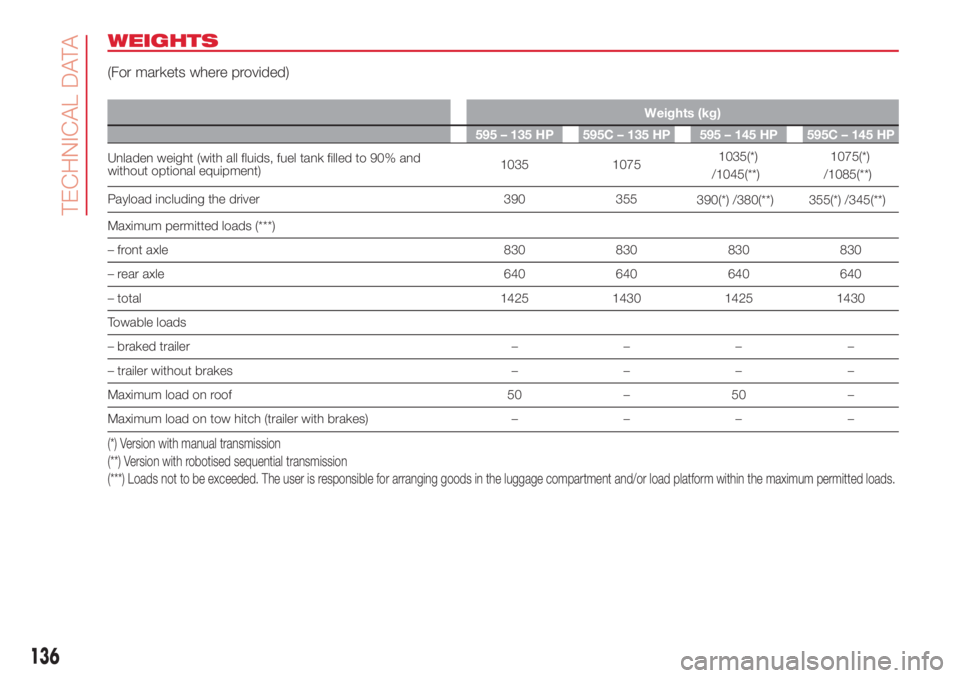
WEIGHTS
(For markets where provided)
Weights (kg)
595 – 135 HP 595C – 135 HP 595 – 145 HP 595C – 145 HP
Unladen weight (with all fluids, fuel tank filled to 90% and
without optional equipment)1035 10751035(*)
/1045(**)1075(*)
/1085(**)
Payload including the driver 390 355
390(*) /380(**)355(*) /345(**)
Maximum permitted loads(***)
– front axle 830 830 830 830
– rear axle 640 640 640 640
– total 1425 1430 1425 1430
Towable loads
– braked trailer––––
– trailer without brakes––––
Maximum load on roof 50 – 50 –
Maximum load on tow hitch (trailer with brakes)––––
(*) Version with manual transmission
(**) Version with robotised sequential transmission
(***) Loads not to be exceeded. The user is responsible for arranging goods in the luggage compartment and/or load platform within the maximum permitted loads.
136
TECHNICAL DATA
Page 139 of 192
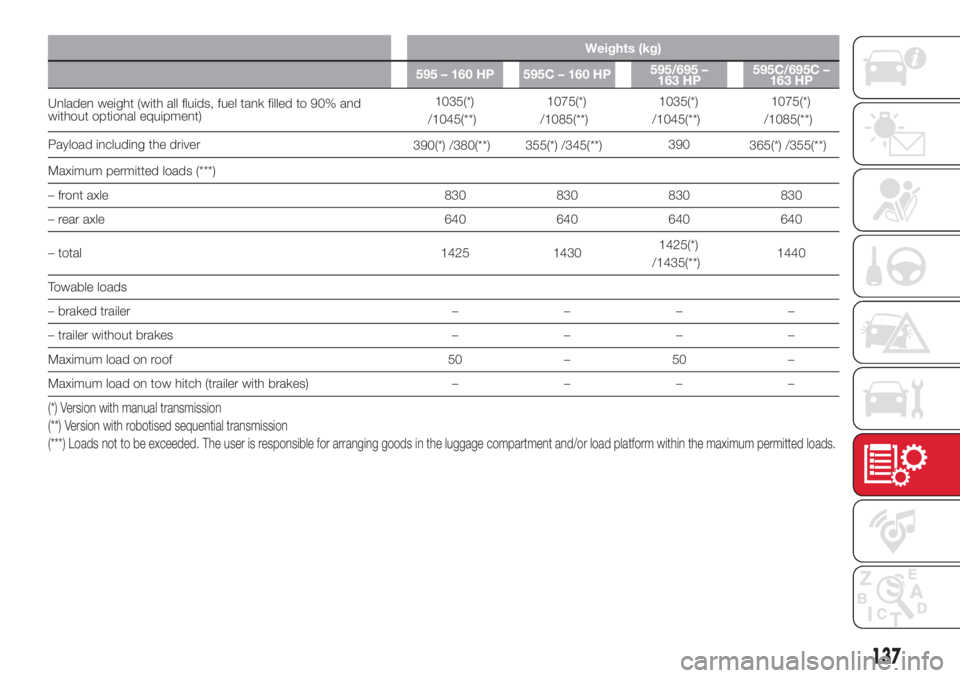
Weights (kg)
595 – 160 HP 595C – 160 HP595/695 –
163 HP595C/695C –
163 HP
Unladen weight (with all fluids, fuel tank filled to 90% and
without optional equipment)1035(*)
/1045(**)1075(*)
/1085(**)1035(*)
/1045(**)1075(*)
/1085(**)
Payload including the driver
390(*) /380(**)355(*) /345(**)390
365(*) /355(**)
Maximum permitted loads(***)
– front axle 830 830 830 830
– rear axle 640 640 640 640
– total 1425 14301425
(*)
/1435(**)1440
Towable loads
– braked trailer––––
– trailer without brakes––––
Maximum load on roof 50 – 50 –
Maximum load on tow hitch (trailer with brakes)––––
(*) Version with manual transmission
(**) Version with robotised sequential transmission
(***) Loads not to be exceeded. The user is responsible for arranging goods in the luggage compartment and/or load platform within the maximum permitted loads.
137
Page 140 of 192
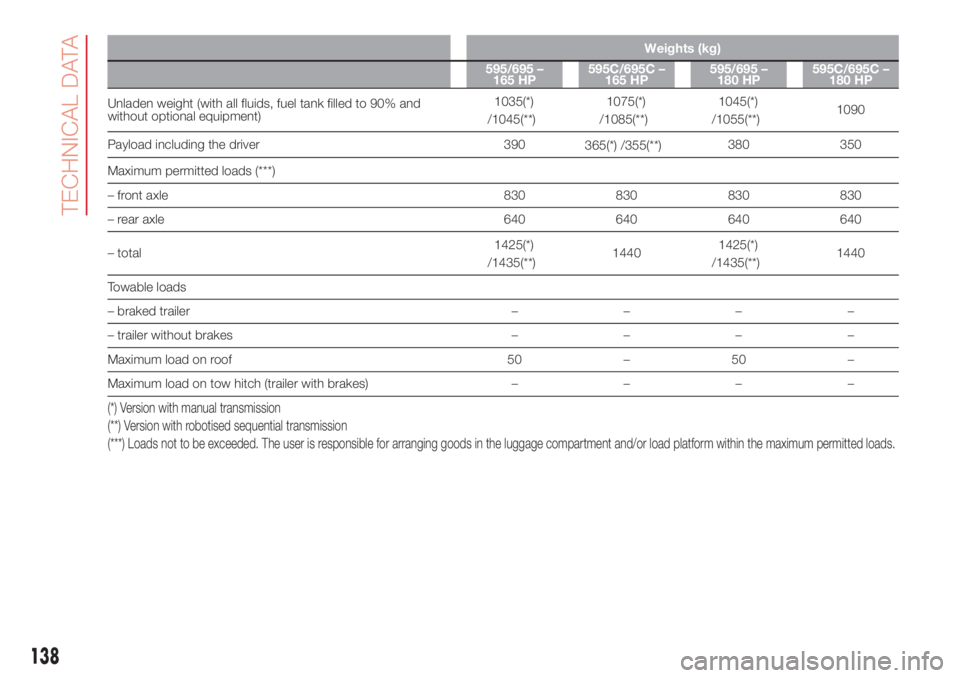
Weights (kg)
595/695 –
165 HP595C/695C –
165 HP595/695 –
180 HP595C/695C –
180 HP
Unladen weight (with all fluids, fuel tank filled to 90% and
without optional equipment)1035(*)
/1045(**)1075(*)
/1085(**)1045(*)
/1055(**)1090
Payload including the driver 390
365
(*) /355(**)380 350
Maximum permitted loads
(***)
– front axle 830 830 830 830
– rear axle 640 640 640 640
– total1425
(*)
/1435(**)14401425(*)
/1435(**)1440
Towable loads
– braked trailer––––
– trailer without brakes––––
Maximum load on roof 50 – 50 –
Maximum load on tow hitch (trailer with brakes)––––
(*) Version with manual transmission
(**) Version with robotised sequential transmission
(***) Loads not to be exceeded. The user is responsible for arranging goods in the luggage compartment and/or load platform within the maximum permitted loads.
138
TECHNICAL DATA