fuel cap Abarth 500 2018 Owner handbook (in English)
[x] Cancel search | Manufacturer: ABARTH, Model Year: 2018, Model line: 500, Model: Abarth 500 2018Pages: 192, PDF Size: 5.86 MB
Page 13 of 192
KEYS
1)
1)
MECHANICAL KEY
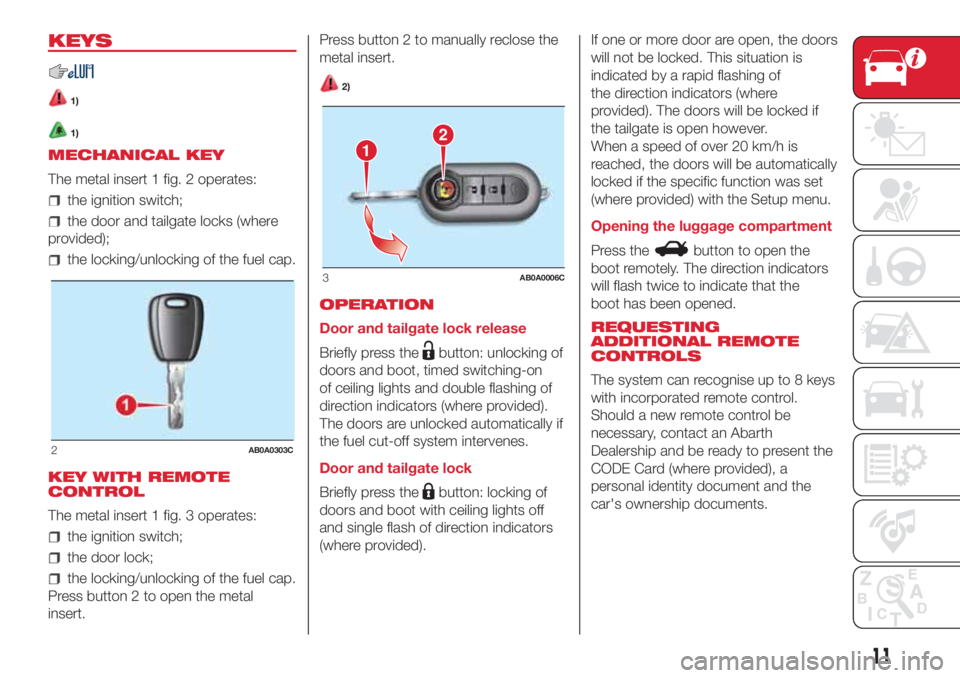
The metal insert 1 fig. 2 operates:
the ignition switch;
the door and tailgate locks (where
provided);
the locking/unlocking of the fuel cap.
KEY WITH REMOTE
CONTROL
The metal insert 1 fig. 3 operates:
the ignition switch;
the door lock;
the locking/unlocking of the fuel cap.
Press button 2 to open the metal
insert.Press button 2 to manually reclose the
metal insert.
2)
OPERATION
Door and tailgate lock release
Briefly press the
button: unlocking of
doors and boot, timed switching-on
of ceiling lights and double flashing of
direction indicators (where provided).
The doors are unlocked automatically if
the fuel cut-off system intervenes.
Door and tailgate lock
Briefly press the
button: locking of
doors and boot with ceiling lights off
and single flash of direction indicators
(where provided).If one or more door are open, the doors
will not be locked. This situation is
indicated by a rapid flashing of
the direction indicators (where
provided). The doors will be locked if
the tailgate is open however.
When a speed of over 20 km/h is
reached, the doors will be automatically
locked if the specific function was set
(where provided) with the Setup menu.
Opening the luggage compartment
Press the
button to open the
boot remotely. The direction indicators
will flash twice to indicate that the
boot has been opened.
REQUESTING
ADDITIONAL REMOTE
CONTROLS
The system can recognise up to 8 keys
with incorporated remote control.
Should a new remote control be
necessary, contact an Abarth
Dealership and be ready to present the
CODE Card (where provided), a
personal identity document and the
car's ownership documents.
2AB0A0303C
12
3AB0A0006C
11
Page 65 of 192
In the case of abnormal signals, it is
recommended to perform the RESET
procedure. If the warnings reappear
once the RESET procedure has started,
check that the same type of tyre is
used on all four wheels and that the
tyres are not damaged; if the
space-saver spare wheel is being used,
refit a wheel with a tyre of normal
dimensions in place of the space-saver
wheel as soon as possible; if possible
remove the snow chains; make sure
that the load is distributed correctly and
repeat the RESET procedure, driving
on a clean and surfaced road. If the
warning persist, contact an Abarth
Dealership.
WARNING
66)If the system signals a pressure drop
on one or more tyres, it is recommended
to always check the pressure on all tyres.
67)The iTPMS does not relieve the driver
from the obligation to check the tyre
pressure every month; it is not to
be considered a system to replace
maintenance or a safety system.
68)Tyre pressure must be checked with
tyres cold. Should it become necessary for
whatever reason to check pressure with
warm tyres, do not reduce pressure even
though it is higher than the prescribed
value, but repeat the check when tyres are
cold.69)The iTPMS cannot indicate sudden
tyre pressure drops (for example when
a tyre bursts). In this case, stop the vehicle,
braking with caution and avoiding abrupt
steering.
70)The system only warns that the tyre
pressure is low: it is not able to inflate
them.
71)Insufficient tyre inflation increases fuel
consumption, reduces the tread duration
and may affect the capacity to drive safely.
OCCUPANT
PROTECTION
SYSTEMS
Some of the most important safety
equipment of the car comprise the
following protection systems:
seat belts;
SBR (Seat Belt Reminder) system;
head restraints;
child restraint systems;
Front airbags and side bags (where
present).
Read the information given the
following pages with the utmost care. It
is of fundamental importance that the
protection systems are used in the
correct way to guarantee the maximum
possible safety level for the driver and
the passengers.
For the description of the head restraint
adjustment see the "Head restraints"
paragraph in the "Knowing your car"
chapter.
63
Page 91 of 192

WARNING
21)For correct operation of the system,
sensors must always be clean from mud,
dirt, snow or ice. Be careful not to scratch
or damage the sensors while cleaning
them. Avoid using dry, rough or hard
cloths. The sensors must be washed using
clean water, with the addition of vehicle
shampoo if necessary. When using special
washing equipment such as high pressure
jets or steam cleaning, clean the sensors
very quickly keeping the jet more than
10 cm away.
22)Have interventions on the bumper in
the area of the sensors carried out only by
an Abarth Dealership. Interventions on
the bumper that are not carried out
properly may compromise the operation of
the parking sensors.
WARNING
113)Parking and other dangerous
manoeuvres are, however, always the
driver’s responsibility. While carrying out
these manoeuvres, always make sure that
no people (especially children) or animals
are in the area concerned. The parking
sensors are an aid for the driver, but the
driver must never allow their attention
to lapse during potentially dangerous
manoeuvres, even those executed at low
speeds.
REFUELLING THE
VEHICLE
Stop the engine before refuelling.
IMPORTANT Never introduce leaded
petrol to the tank, even in small
amounts in an emergency, as this
would damage the catalytic converter
beyond repair.
REFUELLING CAPACITY
To ensure that you fill the tank
completely, top up twice after the first
click of the fuel supply gun. Further
top-ups could cause faults in the fuel
supply system.
FUEL TANK CAP
Plug 2 fig. 80 is fitted with a cable that
secures it to flap 1 so that it cannot
be lost.Unscrew cap 2 using the ignition key.
The sealing may cause a slight pressure
increase in the tank. A little breathing
off, while slackening the cap is
absolutely normal. When refuelling,
fasten the plug to the device inside the
flap as shown in fig. 80.
114)
Fuels - identification of
vehicle compatibility.
Graphic symbol for
consumer information in
accordance with
EN16942
The symbols shown below facilitated
recognising the correct fuel type to
be used on your car.
Before proceeding with refuelling,
check the symbols inside the fuel filler
flap (where provided) and compare
them with the symbols shown on the
fuel pump (where provided).
Symbols for petrol powered cars
1
2
80AB0A0058C
89
Page 108 of 192
WARNING
124)The information required by the
applicable regulation is indicated on the
Fix&Go kit package label. Carefully read
the label on the cartridge before use, avoid
improper use. The kit should be used by
adults and cannot be used by children.
125)IMPORTANT: Do not exceed 80 km/h.
Avoid sudden acceleration or braking.
The kit provides a temporary repair,
therefore the tyre must be examined and
repaired by a specialist as soon as
possible. Before using the kit, ensure that
the tyre is not excessively damaged and
that the rim is in good condition, otherwise
do not use it and call roadside assistance.
Do not remove foreign bodies from the
tyre. Do not let the compressor turned on
for more than 20 consecutive minutes -
overheating hazard.
WARNING
26)The sealant fluid is effective with
external temperatures between -40°C and
+55°C. The sealant fluid has an expiry
date. It is possible to repair tyres which
have been damaged on tread up to a
diameter of 6 mm. Show the cartridge and
the label to the personnel charged with
handling the tyre treated with the tyre
repair kit.
JUMP STARTING
If thesymbol on the display turns
on constantly, contact an Abarth
Dealership immediately.
JUMP STARTING
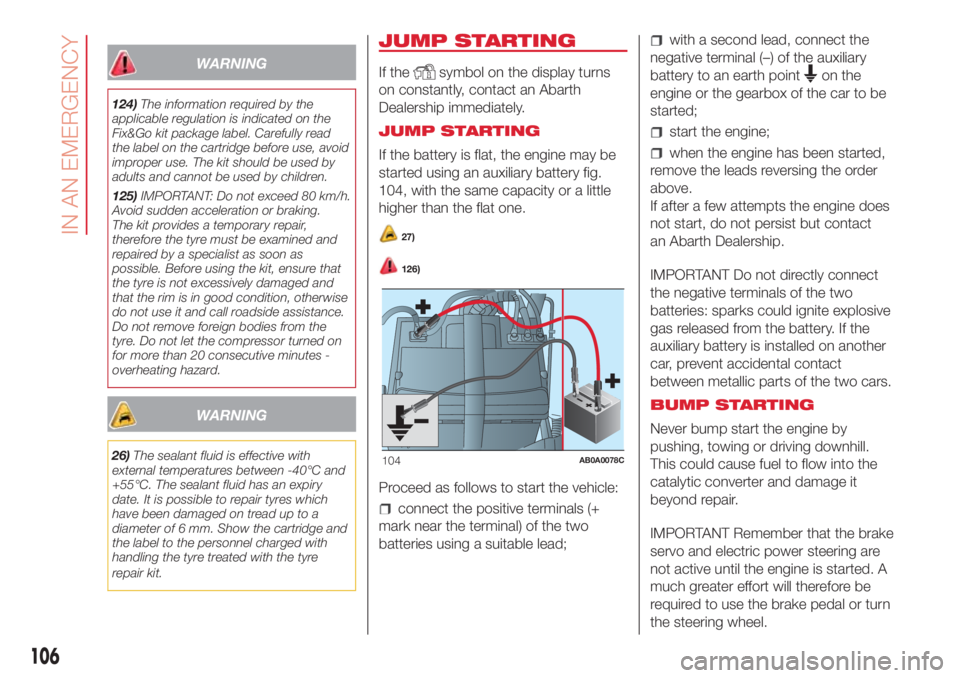
If the battery is flat, the engine may be
started using an auxiliary battery fig.
104, with the same capacity or a little
higher than the flat one.
27)
126)
Proceed as follows to start the vehicle:
connect the positive terminals (+
mark near the terminal) of the two
batteries using a suitable lead;
with a second lead, connect the
negative terminal (–) of the auxiliary
battery to an earth point
on the
engine or the gearbox of the car to be
started;
start the engine;
when the engine has been started,
remove the leads reversing the order
above.
If after a few attempts the engine does
not start, do not persist but contact
an Abarth Dealership.
IMPORTANT Do not directly connect
the negative terminals of the two
batteries: sparks could ignite explosive
gas released from the battery. If the
auxiliary battery is installed on another
car, prevent accidental contact
between metallic parts of the two cars.
BUMP STARTING
Never bump start the engine by
pushing, towing or driving downhill.
This could cause fuel to flow into the
catalytic converter and damage it
beyond repair.
IMPORTANT Remember that the brake
servo and electric power steering are
not active until the engine is started. A
much greater effort will therefore be
required to use the brake pedal or turn
the steering wheel.
104AB0A0078C
106
IN AN EMERGENCY
Page 118 of 192
PERIODIC CHECKS
Every 1,000 km or before long
journeys, check and, if necessary, top
up the following:
engine coolant level;
brake fluid level;
windscreen washer fluid level;
tyre inflation pressure and condition;
operation of lighting system
(headlights, direction indicators, hazard
warning lights, etc.);
operation of screen washer/wiper
system and positioning/wear of
windscreen/rear window wiper blades.
Every 3,000 km check and top up if
required: engine oil level.
You are advised to use PETRONAS
LUBRICANTS products, which have
been designed and produced
specifically for Abarth cars (see table
"Capacities" in the "Technical
specifications" chapter).
DEMANDING USE OF
THE CAR
If the car is used mainly under one of
the following conditions:
if the car is used under demanding
conditions, e.g. on track;
dusty roads;
short, repeated journeys (less than
7-8 Km) at sub-zero outdoor
temperatures;
engine often idling or driving long
distances at low speeds or long periods
of inactivity;
the following checks must be carried
out more often than indicated in the
Scheduled Servicing Plan:
check front disc brake pad condition
and wear;
check cleanliness of bonnet and
luggage compartment locks,
cleanliness and lubrication of linkage;
visually inspect conditions of:
engine, gearbox, transmission, pipes
and hoses (exhaust/fuel system/brakes)
and rubber elements (gaiters/sleeves/
bushes, etc.);
check battery charge and battery
fluid level (electrolyte);
visually inspect conditions of the
accessory drive belts;
check and, if necessary, change
engine oil and replace oil filter;
check and, if necessary, replace
pollen filter;
check and, if necessary, replace air
cleaner.
116
SERVICING AND CARE
Page 187 of 192
INDEX
A
ccessories purchased by the
owner
.............................4
Analogue pressure gauge............41
Automatic climate control
system...........................27
Battery
...........................121
advice for extending its life......121
inspecting the charge...........121
recharging.....................122
replacement...................121
Bodywork (cleaning and
maintenance)....................125
Brake fluid.........................119
Checking levels
...................117
Child protection systems.............67
Cleaning and maintenance
car interior.....................128
leather parts...................128
plastic parts....................128
seats..........................128
CO
2emissions....................144
Control panel and on-board
instruments.......................39
Courtesy lights......................22
Daytime running lights (DRL)
........20
Dimensions........................135
Dipped headlights (bulb
replacement).....................97
Dipped headlights/side lights.........20Direction indicators..................21
Direction indicators (bulb
replacement).....................96
Doors...............................14
Door central
locking/unlocking................14
door locking/unlocking...........14
opening/closing with the key . . . . . .14
Driver side knee bag.................76
Electric windows...................29
Engine.............................132
marking........................131
Engine bonnet......................35
Engine compartment (washing).....126
Engine coolant fluid................119
Engine oil (consumption)............119
Engine oil (level check)..............119
Exterior lights.......................20
Fiat CODE system..................13
Fitting a child restraint system
with seat belts....................68
Fix&Go kit.........................104
Flashing............................20
Fluids and lubricants...............140
Fog lights (bulb replacement).........97
Fog lights/rear fog light..............21
Follow Me Home (device)............21
Front airbag driver's side.............75
Front airbags........................74Front ceiling light....................22
Front light clusters (bulb
replacement).....................96
Fuel consumption..................143
Fuel cut-off system.................107
Fuel tank cap.......................89
Fuse boxes (location)................99
Fuses (replacement).................99
Gear Shift Indicator (system)........41
Handbrake.........................83
Hazard warning lights................92
Head restraints......................18
rear head restraints..............18
Headlamp alignment corrector.......22
Headlights (washing)...............126
Heated rear window (activation)......26
Identification data
bodywork paint plate...........131
chassis marking................131
engine marking.................131
identification data plate.........131
Ignition device.......................12
Installing an “ISOFIX” child
restraint system...................71
Installing electrical/electronic
devices............................4
Instrument panel....................10
Interiors (cleaning)..................128
iTPMS..............................61